Introduction
With links established between exposures during key developmental periods and later health and disease, especially the burgeoning incidence of non-communicable diseases (NCDs),Reference Daar, Singer and Persad 1 , 2 the challenge now is how to engage the at-risk population in evidence-based intervention strategies. In deciding who needs to be engaged, deciding when is also relevant in order for the new knowledge and any altered health behaviors promoted to have time to be beneficial. Youth become an obvious target population because the ‘window of opportunity’ in relation to the developmental origins of health and disease (DOHaD) requires that behaviors before conception are influenced, so as to optimize fetal micronutrient provision. Also, for reasons that include infant care and nutrition after birth being as relevant as patterns of growth throughout pregnancy, there is an implicit requirement that youth of both genders are engaged.
Traditionally youth are not a sub-set of the population who prioritize or even seriously consider their future health or that of their potential partners, let alone their offspring. But as their health behaviors correspond strongly from adolescence to adult life, knowledge and behaviors learned during this period are important because of their sustained influence.Reference Viner, Ozer and Denny 3 Hence, engaging young people in the context of DOHaD is a particularly important investment, and innovative education has the potential to sow the seeds of learned behaviors that can positively impact the health of the next generation of parents and their offspring. Education initiatives which incorporate health promotion include the WHO Health Promoting School (HPS) model. HPS programs have proven success in engaging youth and improving health in a variety of contexts by disseminating key knowledge effectively and promoting health practices that positively impact future behaviors.Reference St Leger and Young 4 – Reference Tang, Nutbeam and Aldinger 7
Schools adopting the WHO HPS model provide opportunities within the formal curriculum to improve knowledge and conduct a range of activities related to healthy practices.Reference St Leger and Young 4 , Reference Macnab 6 , 8 Many schools in Africa now do this.Reference Macnab, Stewart and Gagnon 9 HPS programs have been shown to be particularly effective in low resource settings.Reference Tang, Nutbeam and Aldinger 7 Each school is engaged in the context of the local community, as this allows integration of the knowledge, experience, skills and resources of a broad array of people and promotes community participation.Reference St Leger and Young 4 , Reference Stokols, Grzywacz, McMahan and Phillips 10 , Reference Laverack and Mohammadi 11 Government agencies often contribute to the most effective HPS programs;Reference Macnab, Stewart and Gagnon 9 such agencies have an important role in the future to advocate for DOHaD-related education.
The Cape Town manifesto calls for DOHaD to be presented as a new and exciting way to achieve a healthier life. 2 Achieving a reduction in the incidence of NCDs is a considerable challenge;Reference Daar, Singer and Persad 1 but the goal must be to make men, women and children in low, middle and high income countries alike the beneficiaries. Health promotion relies on many elements, but education is of central importance as a means whereby society can promote health and avoid future harm.Reference Tang, Nutbeam and Aldinger 7 , 8 , Reference Stokols, Grzywacz, McMahan and Phillips 10 , Reference Cutler and Lleras-Muney 12 But, the content of any educational message, how it is delivered and who delivers it are integral to whether the intended learner sees any immediate relevance and/or what is learned has any long-term effect; this is particularly apparent when working to engage youth.
Because WHO HPS programs have had success teaching health knowledge and behaviors in ways that young people find relevant, and which impact their long-term lifestyle choices, we told pupils in our Ugandan HPS program about DOHaD, and asked them to discuss the priorities and challenges they saw for introducing DOHaD-related learning into their schools
Methods
This was an observational study that involved pupils in their final year at primary schools in Uganda were we have established WHO HPS programs running. The concept of DOHaD was shared during one of the regular discussion groups used to promote health education dialog in these HPS programs by each school’s own peer ‘youth champions’ and teachers.Reference Macnab 6 Participants were informed that DOHaD was an area where their help was needed to identify how the health promotion message could best be presented to youth. And, that the results of their discussion would be collected and their recommendations shared through publication. No student was identified by name or number; so all contributions were anonymous. All the pupils gave their verbal assent to participate. Discussion groups were conducted in the local language. Written materials were read out and displayed on flip charts in the local language to ensure comprehension.
First, participants were read the following paragraph explaining DOHaD.
‘Nutrition and care in early life are important, as a good start means your child is much less likely to have bad health problems later in life. These problems include becoming seriously fat, heart disease, blood pressure, diabetes, some forms of cancer and mental illness. You may already know that the foods a woman eats when pregnant and while she breastfeeds have a direct effect on her child’s future health. But what a woman eats before she gets pregnant is just as important, and how healthy the man is that makes the baby and the kind of support and care he gives also contribute to his child’s future health. So boys and girls need to learn together what they each can do to give the babies they will have in the future a good start and why it matters. Everyone should know that we have the power to choose what we do, and that good choices as mothers and fathers give our children the best chance to grow up healthy, happy and successful.’
Discussion then followed with students asked to identify points in the paragraph of importance to them, to ensure the group understood what DOHaD means and implies.
Next, lists of five groups of three elements from DOHaD-related writing were displayed on flip charts and read out to the class; these addressed:
-
∙ Health
-
∙ Nutrition
-
∙ Responsive Caregiving
-
∙ Early Learning, and
-
∙ Economics
The children were then asked to rank the three elements in each group from 1 to 3 to show which they found most interesting and relevant, knowing what they now did about DOHaD. Then each member of the group indicated their choices by a show of hands with the score for each item recorded on the flip chart to allow the class to see how many had ranked each element as their first, second or third choice. Peer led dialog followed, with participants asked to suggest how the DOHaD elements ranked highest could best be presented to youth. Suggestions asked for were:
-
∙ How do you think you and the young people you know would like to hear about DOHaD? (Messages)
-
∙ Who do you think would make learning about DOHaD messages interesting and believable? (Messengers), and
-
∙ What teaching or learning approaches/styles would work best? (Methods)
All the suggestions the group liked were recorded on flip charts; overlapping responses were identified and repetitions deleted and those remaining ranked in order of importance. Later, the results from the three HPS school groups were translated into English, content coded and blended to provide the top ranked elements, response rate (%) and top ranked suggestions. Statistical analysis was not feasible.
Results
Three schools in existing HPS programs in geographically separate rural areas in Western Uganda participated; 151 primary school pupils in their final year took part; 70 males and 81 females (mean age 12.7 range 11–13 years).
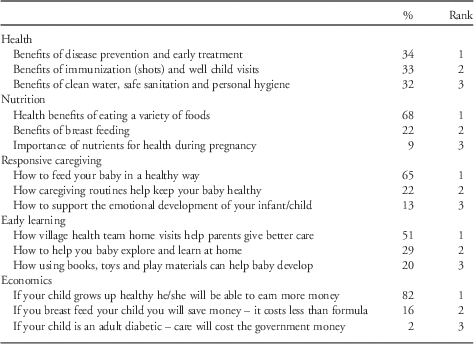
Table 1 shows how pupils ranked three DOHaD-related elements in each of five topic areas.
Evaluation of perceived relevance and interest of DOHaD-related statements: % and rank of pooled responses from 151 respondents

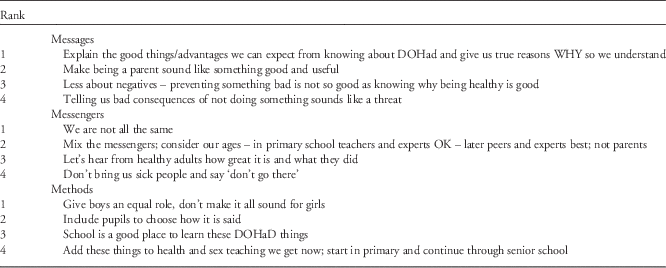
Table 2 shows the top four suggestions from pupils in rank order for optimal messaging, messengers and methods of delivery for DOHaD-related health promotion collated from the groups in the three schools.
Ranked suggestions collated from the three school groups (n=151)

Supplementary comments made in relation to the suggestions offered were:
‘Messages’: Give them to us starting young with reminders as we get older. Must be positive – tell us what will make us and our children healthy not what diseases we will get. ‘Money talks.’ Keep it simple. Say what works not just what is bad.
‘Messengers’: Peer to peer best. Use social media with us doing texts. Experts acceptable on some things BUT don’t preach! Our parents, ‘NO’ except for young pupils. We would listen to celebs, especially if they came to our school!
‘Methods’: School is a good place for this. Ask us to help. We want to know WHY. Be positive; Tell us specific actions/Give us tools we can use; Pay us to be healthy; Tell boys and girls together; No morals.
Discussion
The idea that early life would impact future health was unfamiliar to children in our WHO health promoting schools in rural Uganda, but they quickly came to understand the concept when the subject of DOHaD was introduced as the topic for an in-class health discussion. Such discussion sessions are a regular component of HPS used to engage pupils in health related topics, promote discussion and identify avenues for constructive behavioral change.Reference Macnab 6 , Reference Macnab, Stewart and Gagnon 9 But in this DOHaD-driven session, feedback shared by the children was documented to capture the elements they found most relevant to them and the suggestions they gave on how to engage youth with the DOHaD message.
In ranking DOHaD-related statements, the ‘Economics’ outcome that a healthy child has the potential to earn more was clearly identified to be of most interest. The concept that there could be an economic benefit from good health resonated with a high proportion of children; indeed, the phrase ‘money talks’ or an equivalent was articulated strongly by every group. In discussion children were made aware that some at-risk youth are paid to comply with preventive or care initiatives; learning that incentives are given to promote health was of obvious interest. Medical, social and biological science supports incentive-based approaches.Reference Ranganathan and Lagarde 13 – Reference Richards, Plate and Ernst 15 Studies in brain development show the potential for youth to benefit in particular, as incentives activate the limbic-based systems underpinning reinforcement and motivated behavior in teenagers which have a maturational imbalance relative to prefrontal cortical areas involved in self-regulatory processes.Reference Richards, Plate and Ernst 15
Two items from the ‘Nutrition’ and ‘Responsive Care’ statements ranked next in importance: the benefits of eating a variety of foods and knowing how to feed a baby in a healthy way. But another ‘Nutrition’ statement received the lowest ranking of all; this low ranking for the importance of additional nutrients for health during pregnancy obviously reflects lack of awareness among the children, and so identifies an important learning opportunity for DOHaD-related health promotion among youth.
Not surprisingly in a rural environment where village health teams (VHT) are the conduit for much of the new knowledge on health and behavior,Reference Turinawe, Rwemisisi and Musinguzi 16 children identified VHT home visits to help parents provide better care as the most relevant statement related to ‘Early Learning.’ Children expressed no preference among the three ‘Health’ benefit options; no clear reason emerged in discussion, but teachers in two groups commented that in their experience pupils tend to see themselves as either sick or healthy and that prevention is a concept they are only familiar with for specific health topics that they have learned about through HPS initiatives in their school, such as malaria, and measures to improve oral health and hygiene through tooth brushing and hand washing.Reference Tang, Nutbeam and Aldinger 7 , Reference Macnab, Mukisa, Mutabazi and Steed 17 , Reference Macnab 18 Hence there are grounds to believe that, if introduced as part of education, programs delivered using the WHO model, health behaviors relevant to DOHaD could be promoted.
The suggestions for messages, messengers and methods showed close similarities across the three schools. Children all wanted to know how good health is beneficial, what works and why, and to be given clear tools to use to achieve it. Many expressed that information framed in a positive context was better than being told something would lead to later harm; some identified emphasis on bad consequences as a threat. Ideas on who should provide the information varied; as in other studies, the age of the recipient was seen to be a major factor influencing who children would be most likely to listen to, believe and learn from.Reference Macnab, Deevska, Gagnon, Cannon and Andrew 19 In the main, teachers were thought best for younger children, with peers and experts for those older. Few saw a role for parents. One group felt strongly that having celebrities promote an issue would make them want to pay attention; some in two groups asked how social media could be used. Children in all three groups indicated that they did not want to hear from people with the diseases they were being taught to avoid, but said hearing from healthy adults how good it feels was OK (one group volunteered this as the way they learned best about sex). All groups said schools like their own were the right place to learn about DOHaD; every group prioritized in some way that pupils should be involved in what, when and/or how DOHaD health promotion was provided. Boys and girls spoke about the need and benefits of including issues meaningful to boys, and making the health of future children a role shared by both genders.
This feedback emphasizes the challenge for the DOHaD agenda of the current emphasis on maternal health, pregnancy and infant nutrition and even the first 1000 days, as this risks lack of engagement of males. However, we would argue that our children’s interest and ideas indicate that if girls and boys are involved jointly in exploring creative approaches, inclusive health promotion strategies can be developed that will engage both genders. Clearly both genders need to learn the DOHaD-related links between causation of illness and the contribution of diet and lifestyle in early life to NCDs. And, the call by children for boys and girls to be engaged and for the usefulness of parenting to be emphasized is interesting, as it suggests some awareness of potential benefits from both quality maternal care and the positive influence of fathers’ engagement; two elements central to DOHaD and strongly supported by the literature.Reference Koblinsky, Moyer and Calvert 20 – Reference Zvara, Schoppe‐Sullivan and Dush 22
This is in keeping with the call by the WHO commission on social determinants of health for the introduction of frameworks that promote participation of girls and boys in decisions about their education. 23 The commission also endorsed increased attention to life-skills-based education as a way of supporting health behaviors and empowering young people to take control of their lives. And the DOHaD-related education approaches identified by pupils in our study as being of interest are examples of the innovative, content specific, school-based interventions to tackle health challenges faced by young people that the WHO commission called for.
We recognize limitations in what we report; this was a small cohort, validated tools were not used, data were pooled to evaluate the principal responses, and statistics were not applied. However, the data come from three geographically separate schools (90 km apart) yet did have strong similarities, and key findings point to what are probably substantive preferences, several of which are in keeping with prior literature reporting learning preferences and health choice priorities between boys and girls.Reference Macnab, Deevska, Gagnon, Cannon and Andrew 19 , Reference Pérez-Rodrigo and Aranceta 24 We also believe our findings are relevant, as this is the first discussion of the potential for the WHO HPS model to be used in the context of DOHaD, and the first data from youth discussion groups charged with addressing how to engage them effectively in the DOHaD agenda.
The responses of the children suggest they saw the relevance of DOHaD when the rationale was explained and are amenable to learning about strategies relevant to future health. WHO health promoting schools have had proven success engaging youth in the context of improving health, particularly in low resource settings. Schools also provide the most effective and efficient way to reach a large segment of the population.Reference Pérez-Rodrigo and Aranceta 24 The combination of school-based dissemination of key knowledge and promotion of health practices can positively impact future behaviors. Hence, we suggest the HPS model is an important avenue to consider for DOHaD-driven health promotion. Further studies are needed to investigate what strategies will work in this context, but the WHO model represents ‘fertile ground’ for further exploratory dialog with youth and to begin pilot programs aimed to engage youth in the context of the DOHaD agenda.
Acknowledgments
The health promotion programs at our schools are funded by the Hillman Medical Education Fund (HMEF), Canada. The DOHaD-focused discussions were not funded separately and took place as part of regular curriculum activities. We gratefully acknowledge the children who participated, and the teachers and ‘youth champions’ who led the discussions and documented the responses. The authors thank the Stellenbosch Institute for Advanced Study for the invitation to work at the Wallenberg Research Centre in Stellenbosch where this project was conceived.