Introduction
Fascioliasis is a worldwide zoonosis (World Health Organization, 2006; Lewin, Reference Lewin2007) caused by the liver flukes Fasciola hepatica and Fasciola gigantica. Incidence of fascioliasis in the cattle population is very common in the eastern region of the state of Uttar Pradesh in India (Shukla et al., Reference Shukla, Singh and Singh2006). The freshwater snail Lymnaea acuminata is the intermediate host of F. gigantica (Singh & Agarwal, Reference Singh and Agarwal1981). In humans the disease is characterized by hypereosinophilia, abdominal pain and exceptionally acute pancreatitis (Saba et al., Reference Saba, Korkmaz, Inan, Mamikoglu, Turhan, Gunseren, Cevikol and Kabaalioglu2004; Echenique-Elizondo et al., Reference Echenique-Elizondo, Amondarain and Lironde Robles2005). An effective method to reduce the incidence of fascioliasis is to control the population of vector snails and, thereby, break the life cycle of these flukes (Singh et al., Reference Singh, Singh and Singh2005; Kumar & Singh, Reference Kumar and Singh2006; Shukla et al., Reference Shukla, Singh and Singh2006). Earlier studies have shown that cypermethrin has a powerful molluscicidal action on the snail L. acuminata (Singh & Agarwal, Reference Singh and Agarwal1986). It has also been conclusively shown that acetylcholinesterase (AChE), acid and alkaline phosphatases (ACP and ALP) in the nervous tissue of L. acuminata are very sensitive parameters influenced by molluscicides (Singh & Singh, Reference Singh and Singh2000; Rao et al., Reference Rao, Singh, Singh and Singh2003; Tripathi et al., Reference Tripathi, Singh, Singh and Singh2004; Kumar et al., Reference Kumar, Singh and Singh2008).
The objective of this study was to explore the possibility that seasonal changes in abiotic factors, namely temperature, pH, dissolved oxygen and carbon dioxide and electrical conductivity, of the test water can influence the levels of AChE, ACP and ALP assayed in each month of the year (2006–2007) in L. acuminata, following exposure to sublethal concentrations (40 and 80%) of 24 h LC50 of cypermethrin.
Materials and methods
Test material
Cypermethrin 10% [(RS)-alpha-cyano-3-phenoxybenzyl (1RS)-cis-, trans-3-(2,2-dichlorovinyl)-2,2-dimethylcyclopropane carboxylate] was obtained from Bharti Minerals Ltd, Secunderabad, India. Temperature, pH and electrical conductivity of water were measured by thermometer and digital pH and conductivity meters, respectively. Dissolved O2 and CO2 were estimated according to methods described by APHA (2005).
Bioassays for LC50
Adult L. acuminata (length 2.25 ± 0.2 cm) were collected from Ramgarh Lake, located almost adjacent to Gorakhpur University campus. Snails were acclimatized in dechlorinated tap water for 72 h. A stock solution of cypermethrin (10% EC) prepared in distilled water, was serially diluted; requisite quantities were pipetted into aquarium water. The snails were exposed to different concentrations of cypermethrin in glass aquaria, each containing 3 litres of dechlorinated water. Ten experimental animals were kept in each aquarium. Control animals were kept in equal volumes of dechlorinated tap water under similar conditions. Mortality of snails was observed after 24, 48, 72, 96 h. No response to a needle probe was taken as evidence of death. Dissolved O2, CO2 and conductivity, temperature and pH of treated and control water were measured simultaneously with toxicity tests, every 24 h for 96 h. Bioassays for the determination of LC50 value were performed in each month of the year. Lethal concentration (LC50) values, lower and upper confidence limits (LCL and UCL) and slope values were calculated by the method of Russell et al. (Reference Russell, Robertson and Savin1977) using the POLO computer program. The product moment correlation coefficient, according to the method of Sokal & Rohlf (Reference Sokal and Rohlf1973), was determined between LC50 and temperature/pH/conductivity/dissolved O2/dissolved CO2 of water in each of the 12 months, in order to observe any significant correlation.
Enzyme assays
Twenty snails, kept in glass aquaria containing 3 litres of dechlorinated water, were exposed to sublethal concentrations (40 and 80% of 24 h LC50) of cypermethrin in each month. Six aquaria were set up for each concentration. At sublethal exposure the snails will be stressed by the cypermethrin treatment. Measurement of AChE, ALP and ACP activity at these concentrations will provide evidence of the in vivo action of cypermethrin on these enzymes (Singh & Singh, Reference Singh and Singh2000; Rao et al., Reference Rao, Singh, Singh and Singh2003; Kumar et al., Reference Kumar, Singh and Singh2008). Control animals were left untreated. After 24 h treatment, the snails were washed with water and the nervous tissue was dissected out from the buccal mass for the measurement of AChE, ACP and ALP activity.
Acetylcholinesterase
Acetylcholinesterase (AChE) activity was measured according to the method of Ellman et al. (Reference Ellman, Courtney, Andres and Featherstone1961) as modified by Singh et al. (Reference Singh, Singh and Agarwal1982): 50 mg of nervous tissue was homogenized in 1.0 ml of 0.1 m phosphate buffer, pH 8.0, for 5 min in an ice bath and centrifuged at 1000 g for 30 min at 4°C. The supernatant was used as an enzyme source. The change in optical density at 412 nm was recorded for 3 min after every 30 s interval. Enzyme activity was expressed as μmoles ‘SH’ hydrolysed per min per mg protein.
Alkaline and acid phosphatases
Alkaline (ALP) and acid (ACP) phosphatase activity were measured by the method of Bergmeyer (Reference Bergmeyer1967) as modified by Singh & Agarwal (Reference Singh and Agarwal1989); p-nitrophenyl phosphate was used as substrate. Tissue homogenate (2% w/v) was prepared in ice-cold 0.9% NaCl and centrifuged (5000 g) at 4°C. The supernatant was used as an enzyme source. The yellow colour developed due to the formation of p-nitrophenol was determined colorimetrically at 420 nm. The acid and alkaline phosphatase activity was expressed as μmoles substrate hydrolysed per 30 min per mg protein.
Protein estimation
Proteins in the enzyme sources were estimated by the method of Lowry et al. (Reference Lowry, Rosebrough, Farr and Randall1951).
Statistical analysis
Results were expressed as mean ± SE of six replicates. Rank correlations were applied between control and corresponding changes in the enzyme activity in different months of the year.
Results
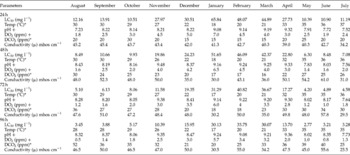
There was a significant (P < 0.05) time-dependent variation in the toxicity of cypermethrin against L. acuminata in different months of the year (table 1); highest toxicity was observed in months of May, June and July (24 h LC50 10.39–11.19 mg l− 1) and lowest (24 h LC50 65.84–48.07 mg l− 1) during January and February. A significant positive correlation (r = 0.89; P = 0.001) between LC50 and dissolved O2 was noted for each month and at each interval of 24 h exposure (table 1). A similar finding between LC50 and water pH (r = 0.79; P = 0.01) was found. In contrast, a significant negative correlation between LC50 and dissolved CO2 (r = 0.72; P = 0.01) and with water temperature (r = 0.87; P = 0.01) was noted. No marked correlation was observed between the LC50 and conductivity of water at 72 h or 96 h of exposure. High temperature (35–37°C) and low pH (7.23–7.91) and dissolved oxygen (1.8–2.5 ppm) increased the toxicity of cypermethrin against L. acuminata. The slope values were steep and separate estimations of LC50, based on each of the six replicates, were found within the 95% confidence limits of LC50. The t-ratio was greater than 1.96 and the heterogeneity factor was less than 1.0. The g value was less than 0.5 at all probability levels.
Toxicity (LC50) of cypermethrin against L. acuminata in different months of the year (2006–2007).

Each experiment was replicated six times. Temperature, pH, dissolved oxygen and dissolved carbon dioxide, and conductivity were measured after intervals of 24 h up to 96 h.
Product moment correlation coefficients between the LC50 and different parameters indicate significant (P < 0.05) (+) positive/(*) negative correlations.
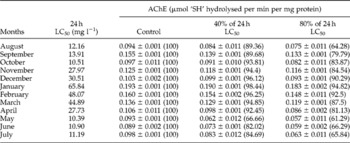
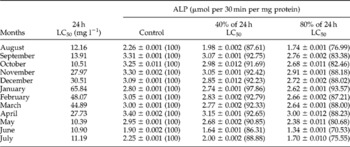
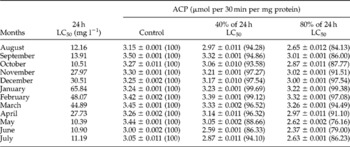
There was a significant positive rank correlation (40% of 24 h LC50: τ = 0.818; P = 0.01; 80% of 24 h LC50: τ = 0.727; P = 0.01) between LC50 in different months and corresponding AChE activity in the nervous tissue of the snail. Maximum inhibition in AChE activity (61.29% of control) was observed in snails exposed to 80% of 24 h LC50 in the month of May (table 2). A significant positive rank correlation was noticed between the ALP (40% of 24 h LC50: τ = 0.515; P = 0.05; 80% of 24 h LC50: τ = 0.515; P = 0.05) and ACP (40% of 24 h LC50: τ = 0.879; P = 0.01; 80% of 24 LC50: τ = 0.757; P = 0.01) activity in treated groups of snails and sublethal treatments in different months. Maximum inhibition in ALP activity (70.53% of control) and that of ACP activity (76.16% of control) was observed in snails exposed to 80% of 24 h LC50 in months of June and May (tables 3 and 4, respectively).
Effect of 24 h exposure to 40% and 80% of 24 h LC50 of cypermethrin in different months of the year (2006–2007) on acetylcholinesterase (AChE) activity in the nervous tissue of L. acuminata.
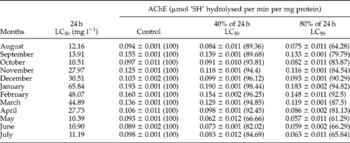
Values are mean ± SE of six replicates. Values in parentheses indicate % enzyme activity, with the untreated control taken as 100%.
Rank correlation coefficient between LC50 and AChE activity in treated groups indicates a significant positive (P < 0.05) correlation.
Effect of 24 h exposure to 40% and 80% of 24 h LC50 of cypermethrin in different months of the year (2006–2007) on alkaline phosphatase (ALP) activity in the nervous tissue of L. acuminata.

Values are mean ± SE of six replicates. Values in parentheses indicate % enzyme activity, with the untreated control taken as 100%.
Rank correlation coefficient between LC50 and ALP activity in treated groups indicates a significant positive (P < 0.05) correlation.
Effect of 24 h exposure to 40% and 80% of 24 h LC50 of cypermethrin in different months of the year (2006–2007) on acid phosphatase activity in the nervous tissue of L. acuminata.

Values are mean ± SE of six replicates. Values in parentheses indicate % enzyme activity with untreated control taken as 100%.
Rank correlation coefficient between LC50 and ACP activity in treated groups indicates a significant positive (P < 0.05) correlation.
Discussion
Cypermethrin is a non-polar, class 2 synthetic pyrethroid (ETN, 1996). The toxicity of cypermethrin varies with changes in abiotic factors in the water. The temperature of the water is a significant factor which alters the toxicity of cypermethrin during each month of the year. When the water temperature is higher in the summer season (May–July), the toxicity of cypermethrin is maximal. On the other hand, in the winter season the temperature of water is low and the toxicity of cypermethrin is less, as evident by a higher LC50 value. Possibly cypermethrin becomes more soluble at high temperature, causing more mortality of snails. Dissolved oxygen is also a factor that alters the toxicity of cypermethrin. In winter, water holds more oxygen (Waterwatch Australia, 2002) and, as a result, less mortality of snails occurs during this period. At higher temperature the dissolved oxygen concentration decreases, which is reflected by higher mortality of the snails. Dissolved oxygen is one of the major components required by snails during metabolic activity (Ishak & Mohamed, Reference Ishak and Mohamed1975; Watten, Reference Watten2004). At higher temperature, the increasing rate of snail metabolism may release more CO2, which affects the pH of water (Toews et al., Reference Toews, Shroll, Wai and Smart1995; Berge et al., Reference Berge, Bjerkeng, Pettersen, Schaanning and Oxnevad2006). This was evident from the elevated concentration of CO2 which causes decreases in the pH of water during the summer season. Cypermethrin is more stable at the low pH (Camilleri, Reference Camilleri1984) of water in the summer season from May to July and, as a result, causes higher mortality in the snail L. acuminata.
Cypermethrin is a nerve toxin, and sodium channels of the nerve membrane are its major target site (Velisek et al., Reference Velisek, Wlasow, Gomulka, Svobodova, Dobsikova, Novotny and Dudzik2006). A sodium channel exposed to cypermethrin can remain open much longer, even up to several seconds (Singh et al., Reference Singh, Singh and Agarwal1993; He, Reference He1994). The amplitude of prolonged sodium current after cypermethrin treatment is too small to induce repetitive activity in nerve fibres, but it is sufficient enough to cause a long-lasting repetitive firing in the lateral-line sense organ (Vijverberg et al., Reference Vijverberg, Van der Zalm, Van Kleef and Van den Bercken1983). It has already been reported that sublethal treatment (80% of 24 h LC50) of cypermethrin caused significant inhibition of AChE activity (86% of control) in the nervous tissue of L. acuminata (Singh & Agarwal, Reference Singh and Agarwal1991). The high anti-AChE activity was observed in the months of May to August. Anti-AChE activity of cypermethrin may cause more toxicity at high temperature/dissolved carbon dioxide and at low pH/ dissolved oxygen of water. The enzyme ALP, which plays a critical role in protein synthesis (Pilo et al., Reference Pilo, Asnani and Shah1972) and secretory activity (Ibrahim et al., Reference Ibrahim, Migazi and Dexian1974), is comparatively less inhibited than AChE. Acid phosphatase (ACP), a lysosomal enzyme (Aruna et al., Reference Aruna, Chetty, Naidu and Swami1979) that plays an important role in autolysis and phagocytosis, pathological necrosis and overall catabolism (Abou-Donia, Reference Abou-Donia1978; Tripathi et al., Reference Tripathi, Singh, Singh and Singh2004), was reduced significantly. Earlier studies have shown that increased concentration of ACP causes breakdown of existing protein in L. acuminata (Singh & Agarwal, Reference Singh and Agarwal1989), but inhibition of ACP activity in this study indicates that it is not used in breakdown of cellular protein. The rank correlation coefficient applied between the LC50 values of different months and the corresponding inhibition of enzyme activity indicates a positive correlation between the LC50 and the inhibition of AChE, ALP and ACP. Besides its anticholinergic effect, cypermethrin also inhibits both ALP and ACP activity.
This study shows conclusively that variant abiotic factors (temperature, pH, dissolved oxygen and carbon dioxide and electrical conductivity) in the surrounding water can significantly alter the toxicity of cypermethrin in L. acuminata. It is also obvious that the most suitable period for the control of L. acuminata in India is during the months of May to July. As a corollary, it is suggested that the treatment of a water body with cypermethrin for the control of L. acuminata, and ultimately fascioliasis, is more potent and cost-effective during these 3 months than using a higher concentration of this molluscicide during the remaining 9 months of the year.
Acknowledgements
The authors are grateful to Professor Anil K Srivastav, former head, Department of Zoology, DDU Gorakhpur University, Gorakhpur for valuable suggestions in the preparation of the manuscript.