Introduction
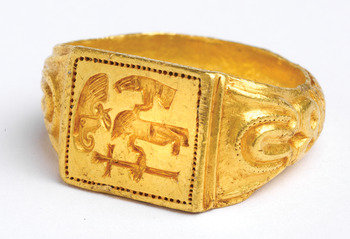
A unique early Anglo-Saxon gold finger ring (Fig. 1) was discovered by metal-detecting in Uttlesford District, northwest Essex (precise location undisclosed in order to protect the site), in 2011 (PAS ID ESS-E396B1: see McLean Reference McLean2011; T ref 2011 T855 [Rec. no. 7732]: see Geake Reference Geake2012; Traherne et al. Reference Traherne, Richardson and Lewis2013). Dated stylistically to around ad 580–650, the ‘northwest Essex ring’Footnote 1 is a high-status object without parallel in England. The object is highly decorated with Style II art, ‘an international aristocratic signature’ (Fern et al. Reference Fern, Dickinson and Webster2019a, 93), and displays a distinctive juxtaposition of ‘pagan’ and ‘Christian’ imagery. The decorative elements on the bezel comprise a belted anthropomorphic figure which holds a long cross in the right hand, a bird of prey in the left. Two zoomorphic heads appear on the shoulder and upon the hoop there are four raptors and interlace ornament. In the discussion offered in this article, I explore the possibility that the northwest Essex ring lends further support to the argument that falconry was practised in early Anglo-Saxon England (Wallis Reference Wallis2017). In order to consider the potential of the ring as evidence for this hunting practice, I begin by analysing the finger ring itself and the imagery upon it, situating this within an Anglo-Saxon and broader Continental context. I next introduce the archaeology of falconry and summarize the evidence for falconry in early Anglo-Saxon England. This evidence is contextualized through a discussion of the social context of the ring and its imagery, focusing on the ‘ideology of predation’ (Pluskowski Reference Pluskowski, Carver, Sanmark and Semple2010) within which falconry, as a high-status hunting pursuit, may have been performed. Finally, evaluating the hybrid ‘pagan’ and ‘Christian’ elements of the imagery upon the bezel, I suggest that the new, fashionable hunting practice of falconry, perhaps recently imported from ‘pagan’ south Scandinavia, and the ring itself as a high-status and possibly ‘royal’ object with both Scandinavian and Continental ‘Frankish’ associations, may have played important roles in the dynamics of (what Schjødt Reference Schjødt, Słupecki and Morawiec2009 theorizes as) pagan-Christian ‘discursive space’.
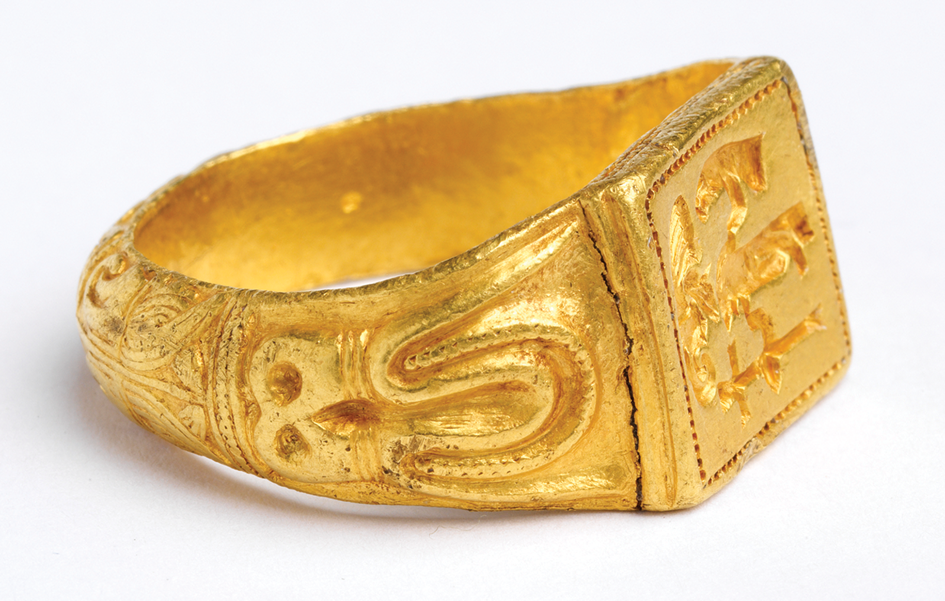
The northwest Essex Anglo-Saxon ring. (Courtesy of Saffron Walden Museum.)

The northwest Essex ring
The northwest Essex ring was discovered by metal-detectorist Tony Carter in November 2011. Acquired through the Treasure Act (1996), it has been on permanent display in the archaeology gallery at the Saffron Walden Museum since 2014 (accession no. 2014.1).Footnote 2 Found in plough-soil at a site lacking any indication of other Anglo-Saxon activity, the ring ‘appears to have been a solitary loss, and not from a burial or settlement’ (Wingfield Reference Wingfield2015, 1). Despite the lack of direct archaeological context, a scattering of metal-dectectorist finds in recent years, such as the small copper-alloy cast pendant or mount with two confronted Style II birds of prey (PAS CAM-5BC2F1, on loan to Saffron Walden Museum), also from Uttlesford District, attest to early Anglo-Saxon activity in the Cambridge region. Furthermore, the cemetery at Great Chesterford, establishment of a substantial manor at Wicken Bonhunt and rise of the East Saxon kingdom and its neighbours (e.g. Challis Reference Challis1992) coincide with the approximate date of the ring (Wingfield Reference Wingfield2015).
The ring weighs 20.10 g and non-destructive X-ray fluorescence analysis of the surface (by the British Museum) shows a metal composition of 92–94 per cent gold, 5–6 per cent silver and the remainder copper (Geake Reference Geake2012). Gold alloy fineness has been seen to correlate with an early date of manufacture (see e.g. Hilgner Reference Hilgner2016), but recent analysis of the early Anglo-Saxon Staffordshire Hoard does not show this correlation (Fern et al. Reference Fern, Dickinson and Webster2019a). The ring was manufactured by casting and engraving/punching and objects cast in gold are rare in early Anglo-Saxon England. Most gold objects were constructed using gold sheet, perhaps because it used less of the precious metal. The high gold content and cast manufacture of the northwest Essex ring support the possibility that it was a royal object (C. Fern pers. comm., 2019), but are not direct indicators of an early date within the period.
Finger rings are not identified as a ‘leading’ artefact type in the revised chronology for furnished burials set out by Hines and Bayliss (Reference Hines and Bayliss2013) according to their Bayesian statistical modelling of radiocarbon dates and correspondence analysis for the seriation of grave assemblages. The principle indicator of the date for the ring, then, is the Salin Style II decoration (Salin Reference Salin1904), which was used by the Anglo-Saxon elite for a relatively short period (Høilund Nielsen Reference Høilund Nielsen, Dickinson and Griffiths1999; Reference Høilund Nielsen and Geaken.d.), around 580–650 (Mclean Reference McLean2011), a period coinciding archaeologically with the phenomenon of ‘princely’ burial (e.g. Sutton Hoo, Suffolk; Taplow, Buckinghamshire; Broomfield and Prittlewell, Essex) and subsequent decline of furnished burial in the 670s to 680s (Hines & Bayliss Reference Hines and Bayliss2013) and historically with the growth of kingship and development of regional kingdoms (e.g. Yorke Reference Yorke1990, 9), as well as major religious change with the ‘Conversion’ to Christianity (Geake Reference Geake1997; Reference Geake, Lucy and Reynolds2002; Hines Reference Hines, Hines and Bayliss2013, 550).
Høilund Nielsen (Reference Høilund Nielsen, Dickinson and Griffiths1999) divides Style II into regionally distinct ‘Anglian’ and ‘Kentish’ styles. Motifs characterizing the earlier ‘Anglian’ repertoire include Scandinavian-derived raptors (in phases A1 and A2) lacking in the later (MS) phase, which includes interlace and interfaces with manuscripts. ‘Kentish’ Style II material, by contrast, contains interlace earlier in the sequence, which loses its animal character over time. So the raptor imagery upon the ring indicates a regional link to East Anglia and ultimately Scandinavia, while the interlace lacking animal elements looks to Kent and the Continent. From studying the Staffordshire Hoard, however, Fern (pers. comm., 2019) has proposed a new understanding of Style II in England. Rather than regionally distinct styles, he identifies an early and a late form in use, ‘Anglo-Saxon early Style II’ and ‘Anglo-Saxon late Style II’. Birds with angled head surrounds like those on the ring were in use in both phases, demonstrating that ‘earlier’ motifs persisted for longer than previously thought.
It is not possible to fix the date of the ring within the period 580–650 with any confidence based on gold alloy fineness, technique of manufacture or style, although the historical context of the conversion may indicate that it post-dates 600. As a stray find lacking archaeological context the date of deposition is unknown, but the use of Style II means the ring cannot have been deposited earlier than the third quarter of the sixth century. While the crack in the bezel is probably post-deposition damage, possible use-wear shown by the smoothing over of the pair of crouching bird of prey motifs on the loop above this crack suggests that by the time of its deposition it may have been in use for some time, perhaps more than one generation. But as Style II continued to be used and developed into the middle of the seventh century, it is unlikely to have been deposited long after this date.
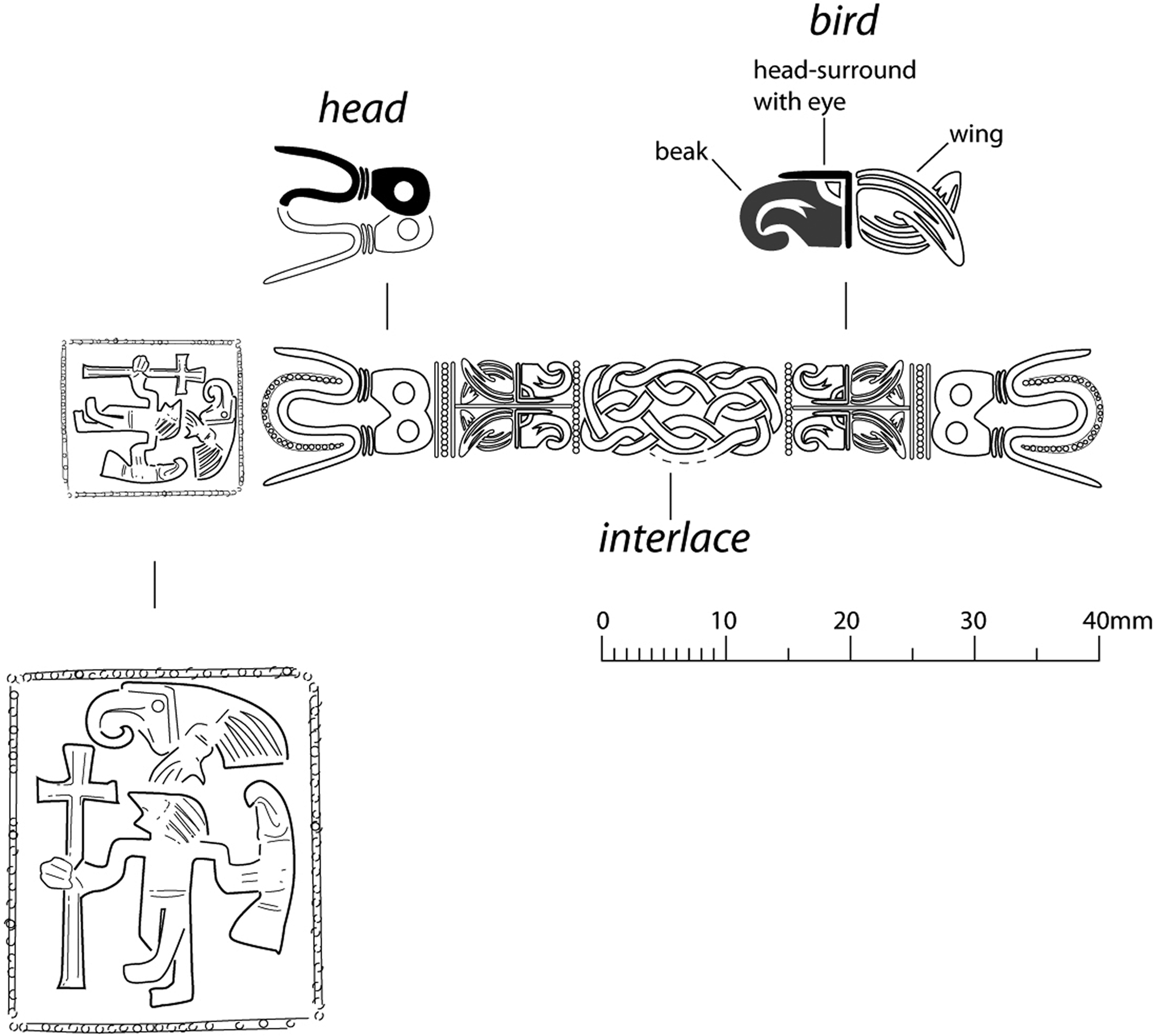
The decoration is highly stylized, elegantly composed and profuse on every available surface. The figurative motifs on the bezel consist of an anthropomorphic figure which holds a long cross or cross-staff in one hand and a raptor in the other, with a larger bird set above, contained within a rectangular grooved border punctuated with rows of deeper dots (Figs 1 & 2). The standing anthropomorphic figure is particularly intriguing, not only for the ambiguous human-animal elements, but also because the posture of the body is awkward and it is difficult to know which features are deliberate and meaningful, rather than the clumsy consequences of engraving at this scale. There is no indication of clothing on the figure aside from a line across the waist, which probably indicates a belt. The torso and waist are presented en face but the head is in profile.
Line drawing of the decoration on the northwest Essex ring. (Courtesy of Chris Fern.)

The region below the waist can be interpreted in three ways: 1) the legs, like the head, are in profile in a ‘natural’ mode, with the left leg being nearer the viewer and the feet pointing forwards, in which case the bulge at the figure's right hip might represent genitalia, although their alignment with the en face torso and waist and with the legs makes this identification questionable; 2) the bulge at the right hip is in profile but represents the whole right thigh with the knee bent backwards and/or sideways behind the left leg, with any intelligibly anatomical connection with the two forward-facing legs/feet lacking; 3) the bulge is the right hip and like the torso and waist en face, whilst the two extended legs face to their right, thus ambiguously being both en face and in profile. In any one of these possibilities, the depiction of the legs is suggestive of movement in some way. The flat bezel of a signet ring is impressed into heated wax in order to seal documents, but considering the decoration as a positive image (patrix), rather than solely as a negative image (matrix) would probably not make any difference to the perception of the imagery, except in terms of the direction the figures face.
The cross is held by the figure like a staff and the figure appears to be moving, the arrangement suggesting that this person has a priestly office and that the cross-staff may have been wielded in a ceremonial procession of some sort. Ceremonial crosses were probably in use at this early period, but the ‘great gold cross’ (see Fern et al. Reference Fern, Dickinson and Webster2019b, Catalogue 539) from the Staffordshire Hoard is the only extant contemporary Anglo-Saxon example (Fern et al. Reference Fern, Dickinson and Webster2019a; Webster Reference Webster2012a, 125). A comparable cross-staff with flared terminals is shown between two figures on the Merovingian tremissis looped for use as a pendant, dating to the late sixth to early seventh century, from King's Field, Faversham (Blackmore et al. Reference Blackmore, Blair, Hirst and Scull2019, 337; Gannon Reference Gannon2003, 101–2, fig. 3.25). Unlike crosses on pendants and other decorated objects, such as the inscribed arm of a cross (see Fern et al. Reference Fern, Dickinson and Webster2019b, Catalogue 540) that probably ornamented a reliquary shrine and a pendant cross (see Fern et al. Reference Fern, Dickinson and Webster2019b, Catalogue 588) that a high ecclesiastic might have worn, from the Staffordshire Hoard (Fern et al. Reference Fern, Dickinson and Webster2019a), finds of long crosses are unusual in England at this date. The two small foil gold crosses with flared terminals from Prittlewell, Essex (Blackmore et al. Reference Blackmore, Blair, Hirst and Scull2019) are unique in England but do appear on the aforementioned Frankish coins and in the late sixth-century Gospels of St Augustine (Hirst & Scull Reference Hirst and Scull2019, 93; MoLAS 2004, 28; Webster Reference Webster and Panhuysen2011).
Of the two birds upon the bezel, the larger bird is the more complex, with a distinctly curved beak, small dot for an eye, an angular head surround, a fanned tail with feathers indicated by three grooved lines and detail beneath the body which suggests a foot and talons. These features are typical of the early Anglo-Saxon Style II ‘crouching bird of prey’ motif, found for instance on the shield from Mound I at Sutton Hoo and the gilt-bronze and silver shield mount from the nearby Tranmer House (Bromeswell) burial ground (Fern Reference Fern2015, 115–16), its hooked beak reaching to the feet ‘at the moment of the catch’ (Marzinzik Reference Marzinzik2013, 100–101). The second raptor on the bezel is smaller and more schematic than the first, the main elements of head, body and tail each separated by a simple band. The goldsmith has positioned the bird, ingeniously if unnaturally, at a 90° angle to the first, conceivably in order to juxtapose the bird with the left hand of the anthropomorphic figure at the same time as accommodating the entire arrangement within the confines of the bezel. Intriguingly, the legs and/or feet of this second raptor are fused with the hand/lower arm of the anthropomorph, suggesting a close association between them.
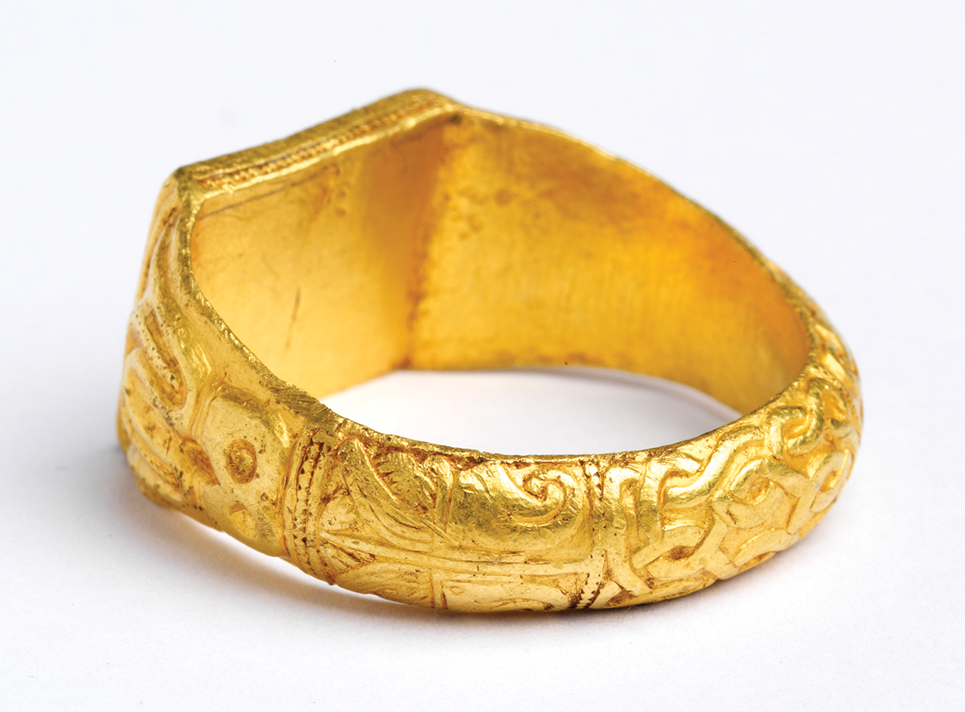
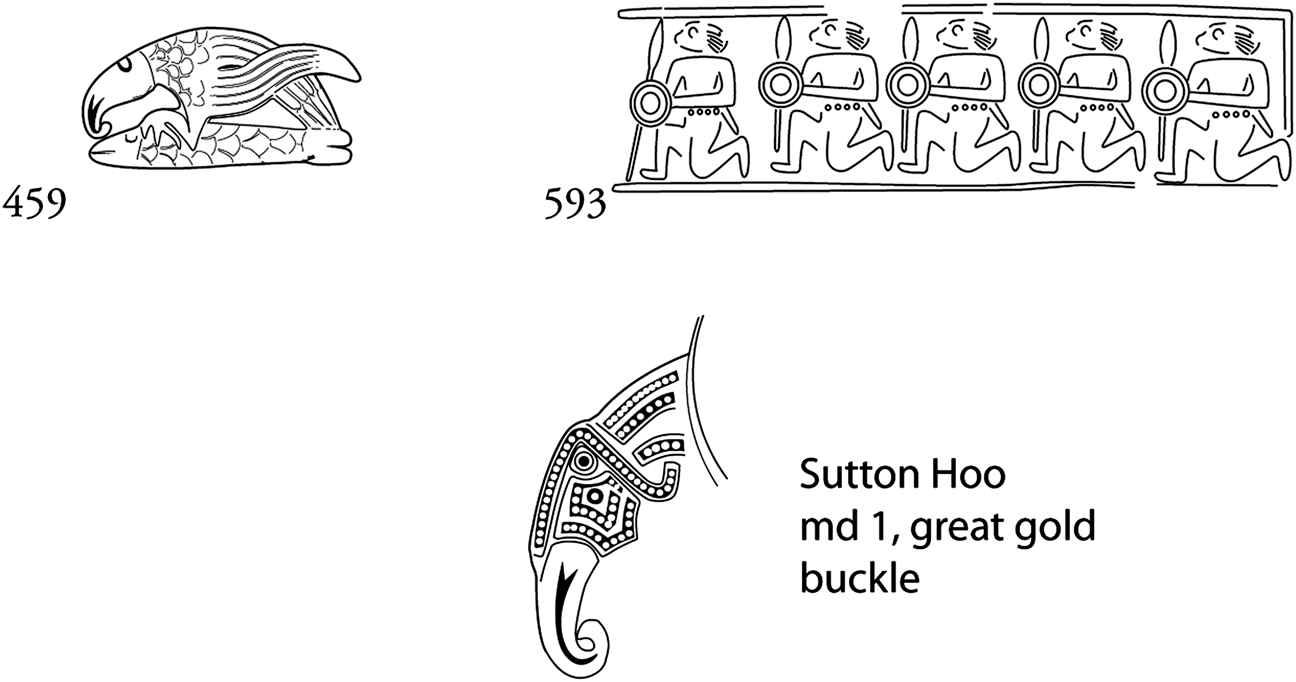
In addition to the two raptors upon the bezel, four further Style II raptors adorn the hoop (Figs 2–4), a pair positioned symmetrically on either side of it. The head of each bird is presented in profile, the curved beak supported by a robust head with a single piercing eye. As with the larger raptor on the bezel, an angular band separates the head from the body, but here the body consists solely of a pair of folded wings viewed from above or behind, bold grooves indicating the primary feathers. Each bird in the pair is separated by a vertical band and they look outwards from the ring rather than at one another, and down the hoop away from the bezel. These birds, too, compare with other ‘crouching bird of prey’ motifs, but they lack the fanned tail and large feet with curved talons seen elsewhere (e.g. the facing pair upon the aforementioned small copper-alloy pendant or mount from Uttlesford). It is possible that these details were sacrificed by the designer in order to accommodate the two pairs of raptors symmetrically within the confined space between the animal heads on the shoulder and the interlace at the bottom of the hoop. The closest parallel for the wing form is on a gold mount (see Fern et al. Reference Fern, Dickinson and Webster2019b, Catalogue 459) from the Staffordshire Hoard (Fig. 5), which is in the form of a bird holding a fish. Other similar examples of wings are illustrated by Speake (Reference Speake1980, fig. 17d–f), including the raptors-with-prey on the Sutton Hoo mound 1 purse lid. Interestingly, the groove dividing the mandibles of the beak terminates in a Y-form, a signature trait of the Sutton Hoo regalia (Fig. 5) and other metalwork from the wider East Anglian region, so ‘an origin for the North West Essex ring in a royal East Anglian workshop should be considered a distinct possibility’ (C. Fern pers. comm., 2019).
The pair of Style II raptors located on the hoop (below the bezel) of the northwest Essex ring. (Courtesy of Saffron Walden Museum.)

The pair of Style II raptors located on the hoop (above the bezel) of the northwest Essex ring. (Courtesy of Saffron Walden Museum.)

Line drawing of decoration in the form of a bird holding a fish on a gold mount (object 459) and warriors on an embossed helmet foil (object 593) from the Staffordshire Hoard, and a raptor head from the great gold buckle (md 1) from Sutton Hoo Mound 1. (Courtesy of Chris Fern.)

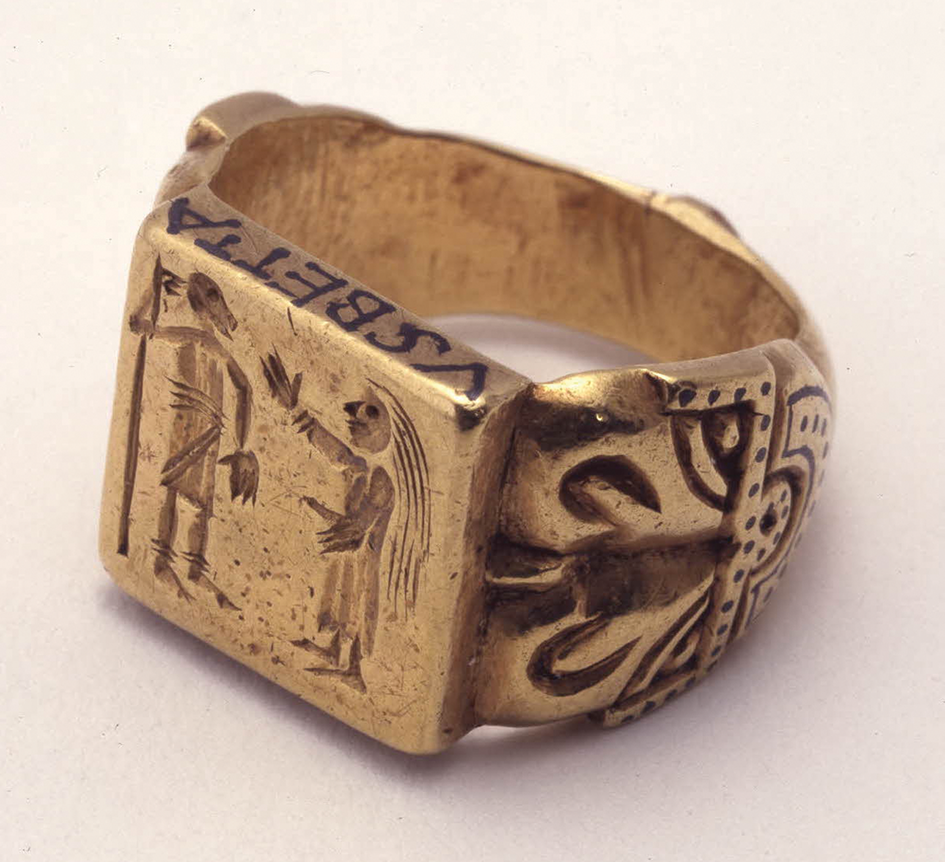
Animal-style imagery is also situated upon either side of the shoulder of the ring (Figs 2 & 6), where two ‘conjoined heads’, each with ‘a large circular … eye’, share beak-like, ‘widely splayed jaws’ and a ‘tongue’ (McLean Reference McLean2011). The repetition of the motif on both shoulders of the ring compares with the aforementioned gold signet ring from Mulsanne, France (British Museum accession no. 1937,1118.1) which has ‘a conjoined pair of profiled birds’ heads’ (British Museum n.d.) at each shoulder (Fig. 7), although in this case the heads are conjoined only at their characteristically Style II head surround—a typical bi-face (mirrored profile) presentation of what is actually a single animal. The extended upper mandible on the northwest Essex ring might suggest they are water birds, but given the prevalence of raptors on the ring and in Style II art more broadly, it is plausible that the depiction is of a pair of conjoined raptor heads, reduced stylistically to the simplest element of a head bearing a curved beak and glaring eye. Speake (Reference Speake1980, 81) points out that ‘[i]n Anglo-Saxon ornament of the fifth, sixth and seventh centuries, exceptions to the predatory bird are rare’. While it is tempting to identify the creatures on the shoulder as predatory birds, the Staffordshire Hoard displays a variety of Style II predatory head-forms, including on quadrupeds and legless serpents, others with symmetrical, long-/open-jawed heads without a head surround, some with a centrally placed eye (Fern et al. Reference Fern, Dickinson and Webster2019a; also Geake Reference Geaken.d.; Leahy & Bland Reference Leahy and Bland2009). Furthermore, each pair of creatures on the shoulder can also be read as a facemask. The ambiguity may be intentional and it is notable that the overall aesthetic effect of the motif is typical of the visual puzzles used in Style II animal art, the heads concealed within the decoration, their identity ambiguous, requiring the viewer actively to ‘read’ the riddle. For Fern and Speake (Reference Fern and Speake2014, 8), such ‘deliberate concealment was possibly intended to restrict knowledge of the sacred meaning of the art’.
Conjoined animal heads/facemask on the shoulder of the northwest Essex ring (above the bezel). (Courtesy of Chris Fern.)
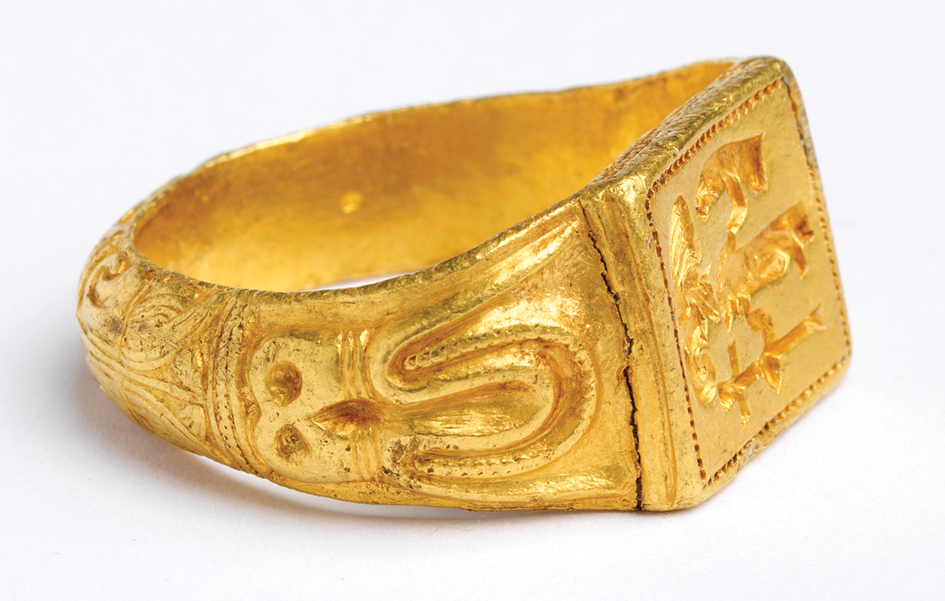
Gold signet ring from Mulsanne, France. (Courtesy of the Trustees of the British Museum.)

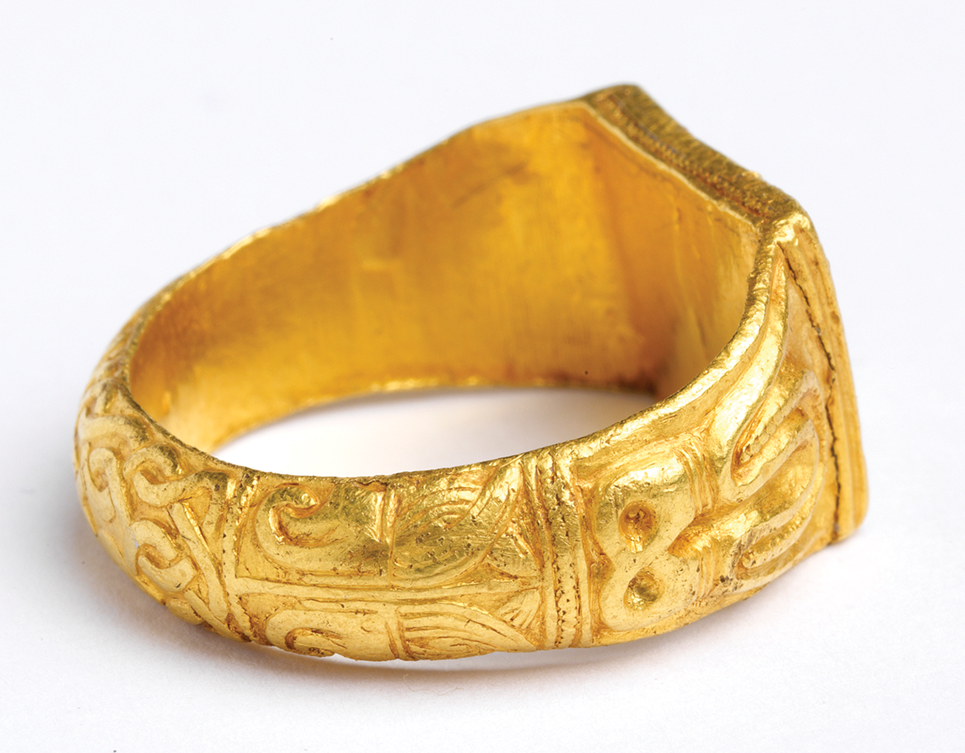
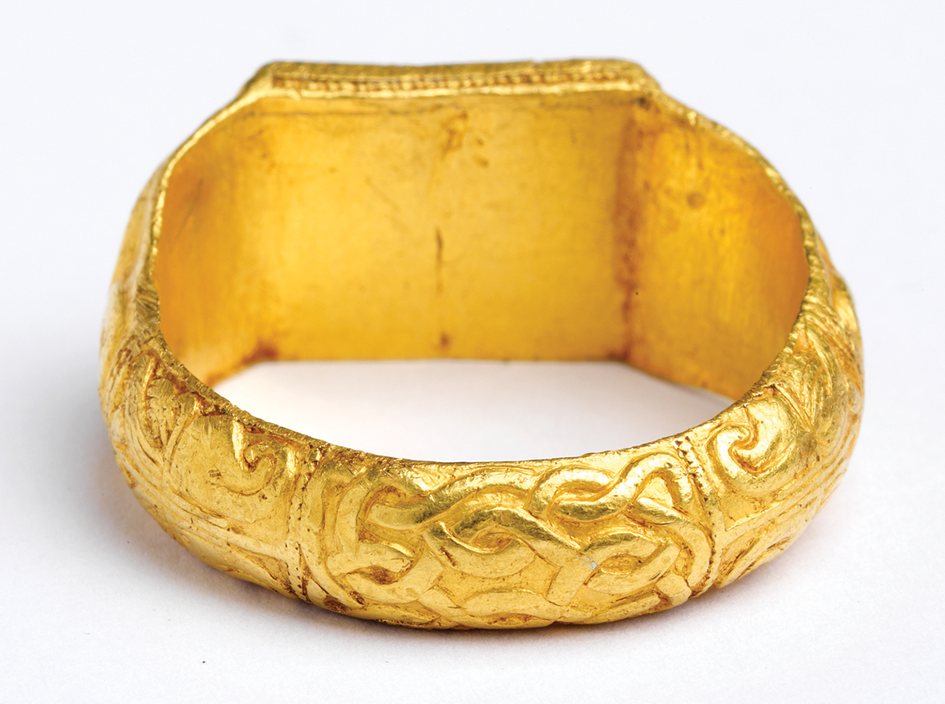
The final decorative element on the ring is the interlace on the hoop (Figs 2 & 8), which occupies a central field and is separated from the four Style II raptors on either side by a beaded rib. The motif is abstract, not zoomorphic, with ‘a larger looser loop in the centre and smaller loops and tighter interlace at either end of the panel’ (McLean Reference McLean2011). McLean (Reference McLean2011) proposes that the ‘ends of the ribbon do not meet, but both stop at the edge of the hoop on the same side as the cross on the bezel’, but while part of the composition extends beyond the edge of the original casting it is based on a single unbroken strand, which might, Fern (pers. comm., 2019) proposes, have been considered its power as a motif.
Interlace on the hoop of the northwest Essex ring. (Courtesy of Saffron Walden Museum.)

Having examined the formal properties of the decoration, it is worth making some further comparative remarks on the anthropomorphic figure and the raptors. The anthropomorphic figure is enigmatic but not without comparison. A belted nude also appears on the buckle from Finglesham, Kent (Chadwick Hawkes et al. Reference Chadwick Hawkes, Davidson and Hawkes1965) and the human figurine from Carlton Colville, Suffolk (Webster Reference Webster, Bland and Voden-Decker2002; see also Brundle Reference Brundle2013). The pointed, beak-like nose and scraped-back hair echo the figures on gold foil objects (guldgubber) from Scandinavia (see Helmbrecht Reference Helmbrecht, Hårdh and Larsson2013), and more locally the embossed helmet foil (Fig. 5; see Fern et al. Reference Fern, Dickinson and Webster2019b, Catalogue 593) from the Staffordshire Hoard (Høilund Nielsen Reference Høilund Nielsen and Geaken.d.). Høilund Nielsen (Reference Høilund Nielsen and Geaken.d.) notes that the upward glance of the embossed figures on the helmet has ‘no direct parallels’ and that ‘one might expect to find something or someone standing above them’; on the ring, the upward glance of the anthropomorph is to the raptor above and to the top of the cross, highlighting the relationship between these three elements. The hybrid human and animal-like features on the head may be intentionally ambiguous, as seen in other Style II art, such as the anthropomorphic figure on the aforementioned gold signet ring from Mulsanne, France.
Other figures from the period with male genitalia include the ‘man-between-spears’ on the Finglesham buckle and the human figurine from Carlton Colville. The legs of the figure are comparable with the bent knees of the figure on the Finglesham buckle and the gold foil figures. Brundle (Reference Brundle2013, 213) notes that the gestures of figures with bent knees and the palms of their hands showing may indicate dance and life or incapacity and death, and that bodily gesture is ‘associated with authority, control and symbolic bodily behaviour’ (2013, 215). The overall body posture of the figure on the ring conveys the importance of what is held in each hand while at the same time suggesting that the figure is moving in some way, perhaps walking or dancing.
A formal comparison can also be made with the standing anthropomorphic figure holding a cross in the right hand, a bird in the left, on a number of silver sceatta (see e.g. Gannon Reference Gannon2003, 51, fig 2.40), as well as the winged Victory on the reverse of Merovingian pseudo-Imperial regnal solidi (Geake Reference Geake2012). Gannon (Reference Gannon2003, 87–8) suggests the figure between two long crosses, such as on Roman coins depicting a winged Victory with a long cross, like the man-between-spears on the Finglesham buckle, is ‘possibly Christianizing a well-known motif’ and as such ‘expresses the talismanic protection obtained through entrenchment between sacred symbols’ (Gannon Reference Gannon2003, 87). If this idea can be extended to the ring, then the bird, like the cross, as well as the anthropomorph, may have ‘sacred’ connotations. As such, the ring can be situated within a broader corpus of objects with anthropomorphic imagery from the period across northern and central Europe, associated with high status and the communication of ideas pertaining to the social, political and sacred (e.g. Helmbrecht Reference Helmbrecht, Hårdh and Larsson2013).
There is a preponderance of raptor motifs on the ring, indicating the significance of these predatory creatures to the wearer(s) of it and, by extension, those in society privileged to see it. Dickinson (Reference Dickinson2005, 158) states that within the category of raptor imagery ‘the range of possible iconographic meanings is wide’. Eagles are associated with Ó∂inn in later textual sources, so the raptors on the ring perhaps brought the wearer ‘talismanic protection’ (Gannon Reference Gannon2003, 87). But the long cross makes identification of the anthropomorphic figure as Woden accompanied by his two ravens or eagles problematic, and a critical approach is necessary when examining early Anglo-Saxon material culture in terms of later Norse mythology (e.g. Hedeager Reference Hedeager2011; Price Reference Price, Carver, Sanmark and Semple2010). Given the prominence of the cross on the ring it is possible that the raptors have a Christian association, for example the eagle of St John the Evangelist (as depicted upon, for example, the early eleventh-century Grimbald Gospels). But according to McLean (Reference McLean2011), the Style II character of these particular birds on the bezel have ‘North European pagan connotations’.
The ring dates to a period when socio-religious identities across the region were in flux. The choice to use Style II animal ornament might ‘be seen as a political statement, as versions of it in Kent may have reflected Frankish connections, whereas in East Anglia its characteristics are different, closer to Scandinavian representations’ (Hinton Reference Hinton2005, 62; also Høilund Nielsen Reference Høilund Nielsen, Dickinson and Griffiths1999; but see Wamers Reference Wamers, Graham-Campbell and Ryan2009). But the Staffordshire Hoard with its raptor imagery adds significantly to this picture of Style II politics, suggesting not only that there was ‘continuous contact’ between parts of Anglo-Saxon England and Scandinavia during the seventh century (Høilund Nielsen Reference Høilund Nielsen and Geaken.d.), but also that Style II was masterfully integrated into the ornamentation of Christian artefacts by the mid seventh century (Fern et al. Reference Fern, Dickinson and Webster2019a). Incorporating both Scandinavian and Frankish elements, the ring reflects Mirrington's point that in Essex ‘the iconography of status was bound up in engagement with long-distance social networks’ (Mirrington Reference Mirrington2013, 393). The combination of high-status object of fine manufacture with multi-cultural imagery, then, suggests the ring played an important role in international relations.
Anglo-Saxon finger rings
Having analysed the formal properties of the northwest Essex ring, comparable imagery and dating, I next set the object within the broader archaeological context of comparable Insular and Continental early medieval gold signet rings and their decoration. Such rings are rare (e.g. Filmer-Sankey Reference Filmer-Sankey1990; Mirrington Reference Mirrington2013, 106): a search for ‘Early Medieval finger rings’ in the Portable Antiquities Scheme database lists 25 objects, of which seven are made from gold, and none of them approaches the early date of the northwest Essex ring (the earliest is ‘finger ring LVPL-8C0D79’, possibly from the first half of the eighth century). Hinton (Reference Hinton2005, 78, fig. 3.2) notes that ‘[e]laborate finger-rings become more frequent in the late sixth and seventh centuries, although they were never common, there being few in base metals’. The known early Anglo-Saxon gold signet rings, discussed below, broadly coincide with princely burial from the 570s through to the 620s, and with the end of furnished burials in the 670s–680s.
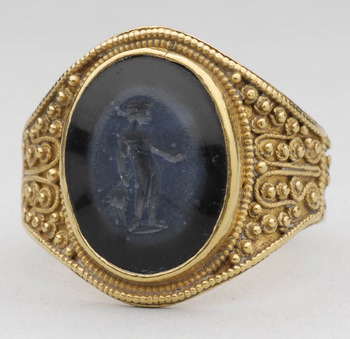
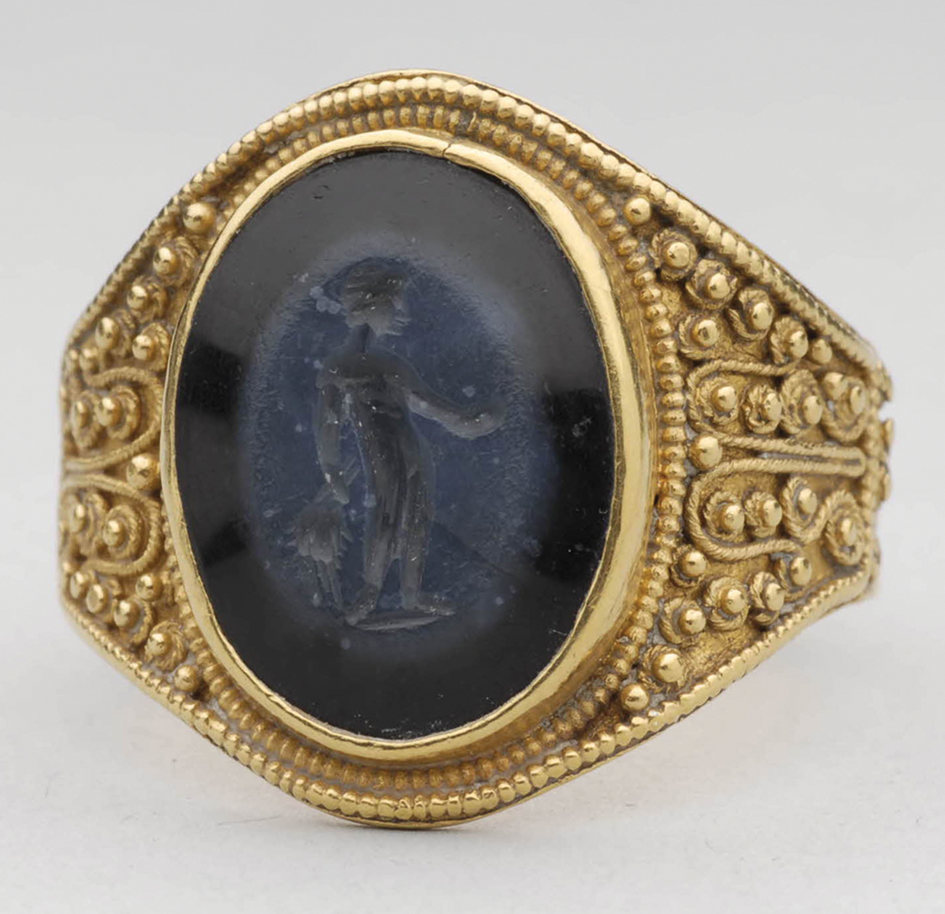
The gold ring from Snape, Suffolk (Fig. 9) has beaded gold wire decoration and a Roman nicolo onyx intaglio depicting a male figure with the letters BONVS EVENTVS [a happy outcome] in the place of a bezel (Bruce-Mitford Reference Bruce-Mitford1952; Filmer-Sankey & Pestell Reference Filmer-Sankey and Pestell2001). This object, citing the form of Roman signet rings and with its intaglio bearing an iconic Latin reference, demonstrates how the early Anglo-Saxon elite creatively appropriated from Roman tradition and envisioned themselves as its inheritors (e.g. Webster Reference Webster2012a, 44). It is therefore possible that the imagery on the northwest Essex ring was influenced by Roman coins depicting a winged Victory with a long cross (McLean Reference McLean2011), and the standing nude figure also resembles those on B-bracteates (McLean Reference McLean2011), which themselves incorporate Roman motifs (e.g. Pesch Reference Pesch and Bech2012). Aside from a sixth-century date and East Anglian find location, the materials, form and decoration of the Snape ring are markedly different from the northwest Essex ring.
The signet ring from the Snape ship burial, Suffolk. (Courtesy of the Trustees of the British Museum.)
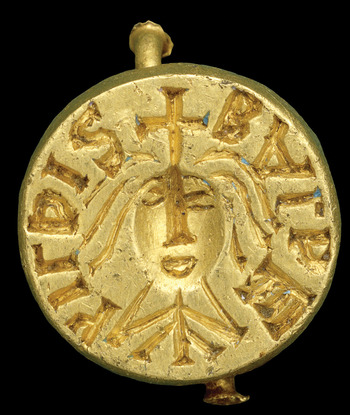
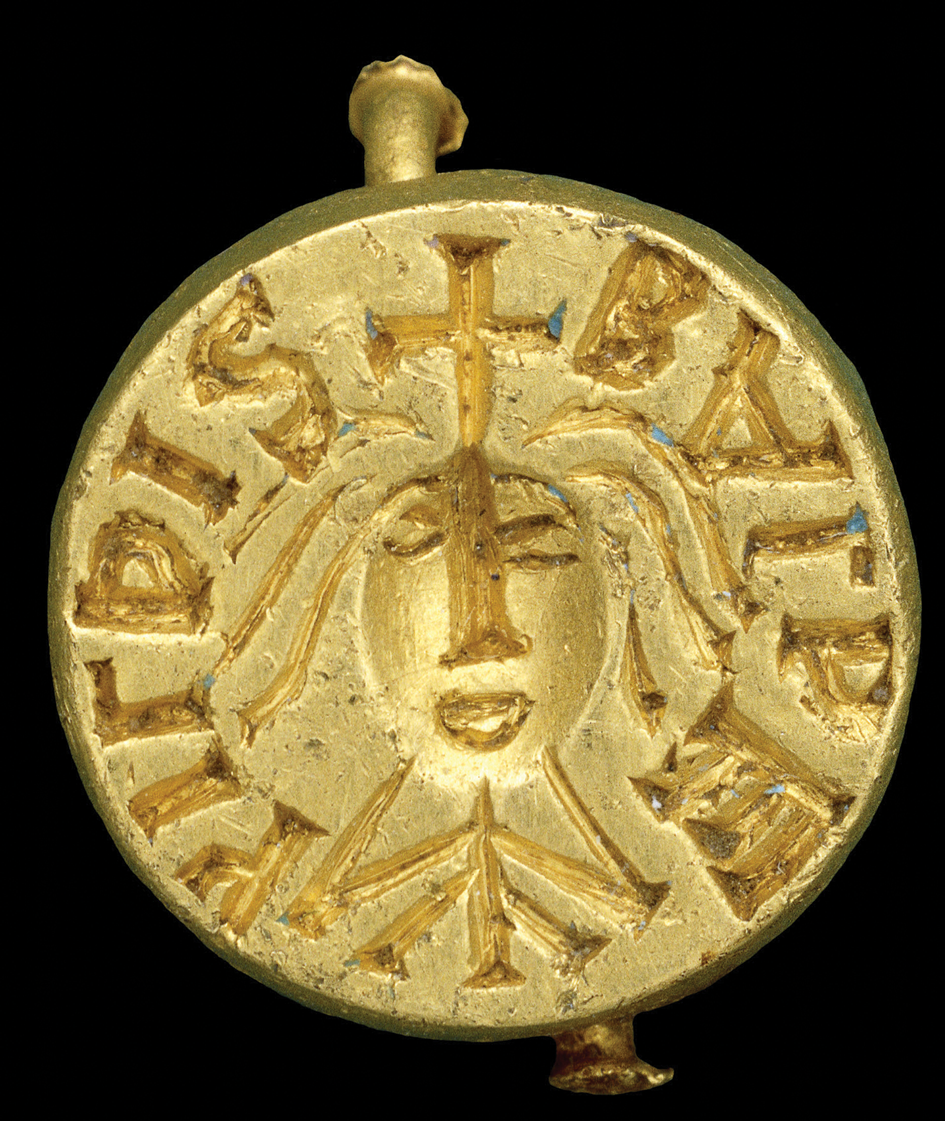
The double-sided seal ring from Postwick, Norfolk (PAS-8709C3), known as the Baldehildis ring (Fig. 10), is on display at Norwich Castle Museum. Dating to the seventh century and so broadly contemporary with the northwest Essex ring, the bezel (the only surviving piece of the ring) shows a head with long hair en face and the inscription ‘+BALDEHILDIS’ (Karkov Reference Karkov2011, 123). Its bezel pivots and the reverse shows a couple in profile, one figure with a beard, the other with long hair, the pair surmounted by a cross. They might be ‘a married couple, as such devices are known on the Continent’ (Hinton Reference Hinton2005, col. pl. B.5), so the object may have been a betrothal ring. It might be the one given to Balthild (c. 635–680), the East Anglian wife of the Frankish King Clovis II (639–658), but the name on the ring ‘is not quite hers’ (Hinton Reference Hinton2005, col. pl. B.5) and it is also plausible that the ring was ‘sent as a token during diplomatic business between the kingdoms’ of East Anglia and Frankia. Pestell (Reference Pestell, Wamers and Périn2012) argues the couple are engaged in a sexual act, this ‘pagan’ amuletic imagery contrasting with the Christian symbolism on the other side. The Baldehildis ring may display both Christian and pagan imagery, is probably of Frankish manufacture (Karkov Reference Karkov2011, 123) or was made by Frankish goldsmiths working in England, and is indicative of elite status, thus showing similarities to the northwest Essex ring. But with prominent Style II raptor imagery, the northwest Essex ring is quite distinctive.
Double-sided seal ring from Postwick, Norfolk, known as the Baldehildis ring. (Courtesy of the Trustees of the British Museum.)
Among a variety of early medieval gold rings from the Continent, the closest equivalent to the northwest Essex ring in style and date is the gold signet ring dated to the late sixth to seventh century from Mulsanne, France, with a deeply inscribed rectangular bezel depicting a woman on the right who gestures towards an anthropomorph holding a staff or spear on the left (Fig. 7). The edge has the inscription DROMACI/USBETTA and the shoulders of the hoop show the aforementioned ‘conjoined pair of profiled birds’ heads’ (British Museum n.d.). This too may have been a betrothal ring, but it is unlikely that the northwest Essex ring functioned as such because, inter alia, it lacks a couple, a contextual Latin inscription and any other connotations of marriage. The combination of ‘pagan’ raptor imagery with a motif of Christianity suggests it was involved in mediating relationships of another order. In the following discussion, the raptor imagery, and particularly the anthropomorph conjoined with a bird of prey, are examined as possible evidence for the high-status hunting pursuit of falconry in early Anglo-Saxon England (see Wallis Reference Wallis2017).
Falconry in early England
Falconry (or hawking) is a practice ‘in which humans and birds of prey develop a hunting companionship through which they learn to hunt in cooperation’ (Schroer Reference Schroer2015, ii). The archaeological evidence for falconry comprises seven elements:
1. equipment specific to falconry (bewits, jesses, swivel or varvel, leash, bell, hood, glove, creance, lure), either singly or preferably in combination;
2. the remains of a raptor buried alone or with human remains;
3. bones of raptors among other faunal remains from a site;
4. a preponderance of female raptors (usually favoured over males because they are larger and more powerful);
5. remains of quarry species;
6. depictions of hawking scenes in art;
7. elements of secondary evidence, such as a preponderance of raptors in the visual culture (for further discussion, see Wallis Reference Wallis2014; also Jennbert Reference Jennbert, Hårdh, Jennbert and Olausson2007; Reference Jennbert2011; Prummel Reference Prummel1997; Wallace Reference Wallace, Gersmann and Grimm2018).
The earliest convincing evidence for falconry to date is from Anatolia, dating to the early third millennium bc (Canby Reference Canby2002; Wallis Reference Wallis2014). The possible use of later prehistoric stone wrist-guards in Britain as an element of falconry equipment to protect the arm from a raptor's talons (Sheppard Reference Sheppard and Sheppard1930; Woodward & Hunter Reference Woodward and Hunter2011) has added to the debate over falconry's genesis, but I have demonstrated from a falconer's perspective that these objects would be impractical as falconry equipment (Wallis Reference Wallis2014). Most scholars agree that falconry was not introduced to Europe until the fifth to sixth centuries (the ‘Migration Period’) (Epstein Reference Epstein1943, 504). ‘Falconry graves’ (Adams Reference Adams, Bintley and Williams2015; Åkerström-Hougen Reference Åkerström-Hougen and Zeitler1981) and legal codes treating crimes against falconry birds and hunting dogs on the Continent (e.g. Dobiat Reference Dobiat, Grimm and Schmölcke2013, 353; Giese Reference Giese, Grimm and Schmölcke2013; Hicks Reference Hicks1986, 162; Prummel Reference Prummel1997, 335) show that falconry was well established in Scandinavia and central Europe by at least the early sixth century.
In Britain, falconry is thought to date to no earlier than the middle Anglo-Saxon period (e.g. Cherryson Reference Cherryson2002; Dobney & Jaques Reference Dobney and Jaques2002; Grieve Reference Grieve2012, 115; Holmes Reference Holmes2014; Oggins Reference Oggins1984; Reference Oggins2004; Prummel Reference Prummel1997), but a re-examination of the earliest evidence for falconry in England, comprising the faunal remains of raptors and their quarry, Style II animal art which shows a preponderance of predatory birds including hawk-with-prey motifs, and small copper-alloy bells which may have functioned as falconry equipment (such as neck bells, fitted to falconry birds in order to aid locating them when lost from sight), suggests that the practice emerged at least a century earlier than previously thought, in the late sixth or early seventh century (Wallis Reference Wallis2017). Certain finds from Mound I at the ‘royal’ cemetery of Sutton Hoo are particularly notable, including two striking raptor-with-prey motifs on the purse lid, which Hicks (Reference Hicks1986) thinks relate directly to falconry, a small copper-alloy bell attached to a short chain, which may have functioned as a neck loop, and an iron ‘standard’, which may have been used as a perch for tethering and displaying falconry birds. This evidence, alongside a concentration of the faunal remains of raptors in the region of East Anglia and the material and social connections between Sutton Hoo and central Sweden with its falconry graves, indicates that falconry was introduced from Scandinavia to the British Isles via the emerging kingdom of East Anglia in the late sixth or early seventh century (Wallis Reference Wallis2017).
The ‘Scandinavian connection’ at Sutton Hoo might suggest the ruling class of the East Angles was aligned socially, politically and ancestrally with a pagan-falconer elite in central Sweden. But East Anglia was not isolated from the Continent and wider world, as demonstrated by such finds from Mound 1 as the Byzantine silver bowls (Adams Reference Adams, Bintley and Williams2015, 46; Hicks Reference Hicks1986, 161), nor from Christian influence, as shown by the two English-made scabbard-bosses with round-armed cross motifs (Hinton Reference Hinton2005, 61). I have proposed that falconry and falconry birds may have played an important social and religious role in the emerging kingdom of the East Angles, brokering its identity in relation to a pagan-falconer elite in Scandinavia and the newly established Christian alliances in southeast England and on the Continent (Wallis Reference Wallis2017). The exciting chance find of the northwest Essex ring, with its possible ‘falconer’ depicted on the bezel and unique juxtaposition of ‘pagan’ and ‘Christian’ motifs, enables further examination of these themes and brings the kingdom of the East Saxons to bear upon the equation.
A falconry interpretation
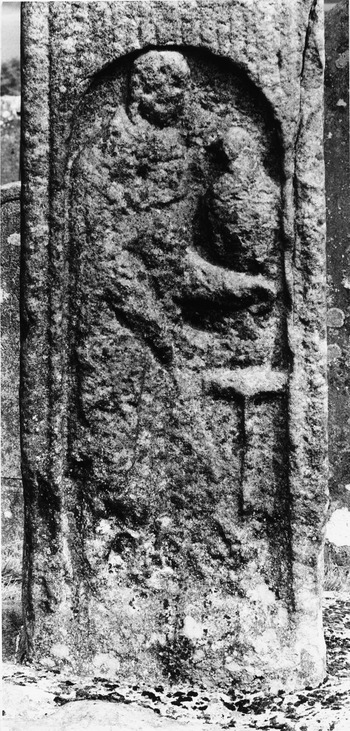
One of the most striking motifs upon the bezel is the composition of an anthropomorphic figure holding a cross-staff in the right hand and one of the raptors in the left. Comparable imagery of broadly contemporary date is found upon a small number of early Anglo-Saxon coins (e.g. North Reference North1980; Sutherland Reference Sutherland1948) and upon the Bewcastle Cross (Cumbria) (Fig. 11). The coins include a silver Secondary sceat of Series K, type 20/18, which has a standing anthropomorphic figure with cross in the right hand, bird in the left, with the addition of a t-perch or Tau cross beneath the bird (Gannon Reference Gannon2003, 96, fig. 3.20b), while a Series L, type 13 has a seated figure holding the bird in the right hand, the cross in the left (Gannon Reference Gannon2003, 98, fig 3.22b). Struck no earlier than the second half of the seventh century with minting continuing well into the eighth century, the coins probably post-date the production of the ring but may have been contemporary with its later biography. Gannon notes a formal similarity with Arab-Byzantine issues from the last quarter of the seventh century, in which the ‘robed Byzantine emperor was replaced by the standing caliph, often shown wearing “native” clothes, and the orb cruciger by a falcon on a stand’ (Gannon Reference Gannon2003, 95). Falconry was well known in the Byzantine world, as shown by a number of mosaics including those from the ‘Villa of the Falconer’ in Argos which show hawking scenes. Hicks (Reference Hicks1986) goes so far as to propose that this mosaic inspired the raptor-with-prey motif on the Sutton Hoo purse lid. Given these relations of relevance, it is possible that the anthropomorphic figure with a raptor upon the fist depicted on the ring is also associated with falconry.
The ‘falconer’ on the Bewcastle Cross, Cumbria. (© Corpus of Anglo-Saxon Stone Sculpture. Photograph: T. Middlemass.)
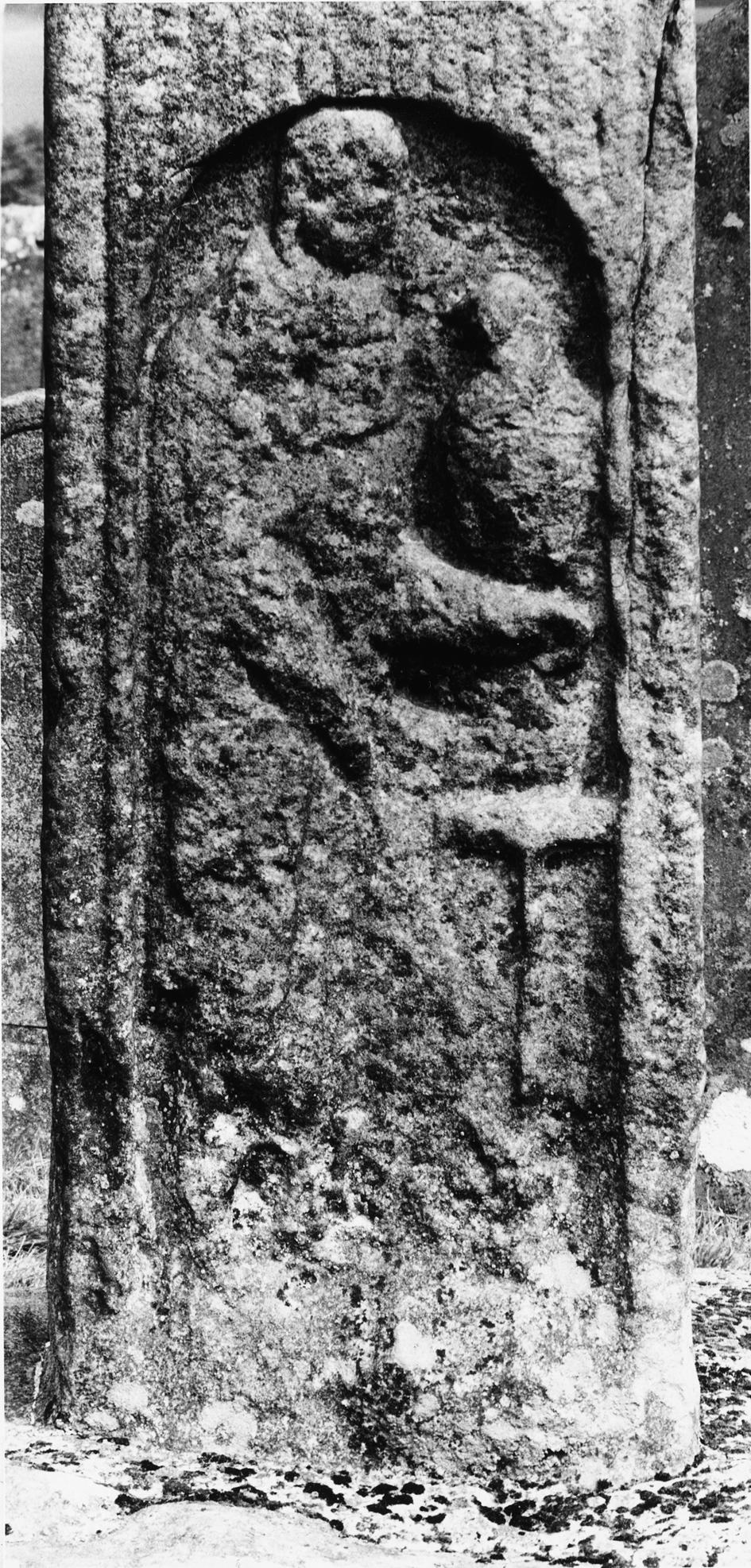
The so-called ‘falconer’ (Baldwin Brown Reference Baldwin Brown1921, 132–4; Blair Reference Blair1962, 159; Karkov Reference Karkov2011, 70; Mellor Reference Mellor1949, 1; Oggins Reference Oggins1984, 177) on the Bewcastle cross is depicted wearing a ‘heavy gauntlet’ (Blair Reference Blair1962, 159) with a raptor on the fist and ‘a crutch perch’ (Mellor Reference Mellor1949, 1) or ‘T-shaped perch’ (Oggins Reference Oggins1984, 177) below the bird. This monument is dated to around the second half of the seventh century or first half of the eighth century (e.g. Ó Carragáin Reference Ó Carragáin2006), so post-dates the manufacture of the ring but may have been contemporary with its use prior to deposition. One of the earliest examples of a falconry interpretation of the imagery on the cross is by Baldwin Brown (Reference Baldwin Brown1921, 132–4):
At the foot of the shaft below the inscription, in a niche with rounded head like that of the Christ, is carved in fairly bold relief the figure of a falconer. He is standing, not full face like the two figures above him, but turned a little towards his left in an easy pose of some freedom and grace. The left hand and wrist are enclosed in a stout gauntlet and upon this is perched a bird of the falcon kind …There is some doubt whether the head of the bird is seen or whether it was represented covered with the hood which cloaks the head and eyes of a hawk … Below the bird is seen its perch, a T-shaped stand, very like that shown in old illustrated works on falconry, such as George Turberville's Booke of Falconrie, of 1575, or Simon Latham's The Falcon's Lure, of 1633, and in the right hand of the figure is held the stick which falconers use to beat the cover where the quarry might have sought refuge.
The aristocratic rather than ecclesiastical dress, active posture and possible association with the layman mentioned in the inscription (Bailey & Cramp Reference Bailey and Cramp1988, 61–72; Gannon Reference Gannon2003, 96) support Baldwin Brown's identification of a ‘falconer’, but the figure has also been interpreted as representing St John with his eagle (e.g. Bailey & Cramp Reference Bailey and Cramp1988, 61–72), and Gannon (Reference Gannon2003, 96–7) makes the important point that multiplicity and ambiguities in the symbolism of both the aforementioned coins and this sculpture would have invited complex exegesis. As supporting evidence for the idea that the anthropomorphic figure on the ring is a falconer, it is notable that the lower left arm and/or hand of the figure seems to fuse with the legs and/or feet of the bird, marking a physical association between them and one which can be explained by the intimate link between falconer and falconry bird. This intimacy manifests, for instance, in the many hours falconers spend carrying their birds on the fist during ‘manning’ (accustoming the bird to a wide variety of social settings) and when hunting for quarry. It is also key to the success of the hunting partnership that falconer and trained raptor trust one another.
The t-perch accompanying the human-with-hawk on the coins and the monumental cross is absent from the ring, but the long cross or cross-staff is prominent, and I would like to suggest that this too functioned as a perch, and one which facilitated the public display of birds of prey. A possible ‘falconry perch’ contemporary with the ring and from the neighbouring region of East Anglia is the enigmatic iron ‘standard’ from Sutton Hoo: suitably cushioned for the birds’ feet, this object may have been used to display birds of prey in public performances incorporating the rich regalia from Mound I (Wallis Reference Wallis2017). The Sutton Hoo standard and processional cross-staffs like the one upon the ring could have carried and displayed a number of raptors at once, much like the ‘cadge’ (a cushioned frame suspended from shoulder straps) used by falconers historically and today. These displays might have been important accents to royal and religious pageantry. It is tempting to suggest that the bird above the cross on the ring is flying to the perch and that a bird drawn to a cross would be both a metaphorical and didactic tool for preaching. The cross on the ring, then, may reference Christian thought, a priestly office and a ceremonial and processional staff, but possibly also a perch for tethering and displaying falconry birds.
Supporting evidence for a falconry interpretation of the human-with-raptor on the ring might also be indicated by a feature at the foot of the larger, more detailed bird on the bezel above the ‘falconer’. The foot comprises an engraved line pointing forwards which terminates in three parallel lines to suggest the front toes and talons plus a single line projecting backwards. The latter feature may suggest the large rear talon of a raptor, the hallux, but if so it is unusual that it is not curved naturalistically as on other ‘crouching bird of prey’ motifs. This single trailing line might instead indicate an element of falconry equipment. A falconry bird is ‘dressed’ with a leather ‘jess’ which is fastened around each leg and these are held by the falconer in order to restrain the bird when being carried on the fist. The jesses trail behind the bird when flying in pursuit of quarry, so it is possible that the single line projecting backwards from the foot of the larger bird on the bezel is a simple visual indication of a pair of jesses viewed when the bird is in flight. The limited detail in the engraving does not permit a more definitive statement, but if the human with raptor on the bezel depicts a falconer with a falconry bird on the fist, then it is possible that the larger raptor is also a falconry bird and that it is depicted wearing jesses and ‘waiting-on’ in flight. There is no depiction of quarry, hunting dogs, beaters or other elements of a hawking trip and it would be problematic to read the heavily stylized rather than naturalistic composition on the bezel as a hawking ‘scene’, but these coded elements may have made obvious sense to viewers as references to falconry.
A further reference to falconry may be hinted at in the interlace decoration (Figs 2 & 8), in an oblique reference to a perennial concern for all falconers, the safe tethering of a bird (to the glove or its perch/block) so that it cannot escape or injure itself. The ‘falconer's knot’ is a unique device enabling falconers to tether and reclaim their birds using one hand while the other is occupied with holding the bird. While it is uncertain whether this specific knot was in use in the Anglo-Saxon period, given that all falconry birds must be tethered when not being flown it seems fitting that the falconry-related imagery on the northwest Essex ring is completed by interlace. Thinking along similar lines and reflecting on the falconry graves in east Sweden, Jennbert (Reference Jennbert2018) has suggested that the bird brooches found in women's graves in south Sweden may refer to falconry, with the interlace motif upon them citing the strappage and cordage used in falconry equipment (that is, bewits, jesses, leash, creance, lure). This interpretation is also in tune with the broader context of weaving and binding metaphors in Anglo-Saxon art and literature (e.g. Brundle Reference Brundle2019, 130–31). The interlace on the northwest Essex ring, then, may allude to the importance of knots in falconry. Commenting on the interlace on the Bewcastle Cross, Karkov (Reference Karkov2011, 78) states that ‘[t]he purpose of the knot is to fasten together, and the monument too is thus a knot’. In a similar way, the interlace on the ring may bind together the other raptor-focused imagery in a falconry-rich ‘composition’.
The falconry interpretation of the northwest Essex ring I have set out in this article can be summarized thus:
1. the unique depiction on the bezel of a ‘human’ figure holding a bird of prey in one hand is highly suggestive of a falconry bird perched upon the fist of a falconer;
2. the fusion of the human's arm with the bird's legs indicates a close relationship and one of the closest bonds a human can develop with a raptor is through falconry;
3. the ring displays a preponderance of raptors overall, possibly 10 in total, emphasizing the significance of birds of prey to the ring-bearer(s);
4. the goldsmith has depicted the raptors from a variety of perspectives (perched upon the fist, from above/behind, in flight and possibly beak-head only), the care taken to execute these diverse representations reiterating their importance;
5. the single line projecting backwards from the foot of the larger raptor on the bezel might highlight an element of falconry equipment, specifically the leather jesses fastened to the legs of falconry birds in order to restrain them safely and which trail behind them during flight;
6. the cross-staff held in the right hand of the anthropomorph is suggestive of a processional cross, which may also have functioned as a perch for tethering and displaying falconry birds;
7. the interlace may allude to the importance of strappage, cordage and knots in falconry and might be read as binding together the other raptor-focused imagery in a falconry-rich ‘composition’.
Considering these seven elements of evidence together, a persuasive case can be made that the northwest Essex ring has a falconry association. This finding complements and adds to the existing archaeological evidence for falconry in early Anglo-Saxon England, which extends the date of its introduction by at least a century, to around the late sixth or early seventh century (Wallis Reference Wallis2017). Furthermore, the northwest Essex find location for the ring, bordering East Anglia, and possibility that the ring was made in a royal East Anglian workshop, not only align with the argument that falconry was introduced at this early period to the emerging kingdom of the East Angles (Wallis Reference Wallis2017), but also suggest that the East Saxons were familiar with falconry, if not falconers themselves.
Høilund Nielsen (Reference Høilund Nielsen, Dickinson and Griffiths1999) has demonstrated that Style II is indicative of high status and Fern (Reference Fern, Dickinson and Webster2019a, 313) argues that ‘[t]he cross-regional consistency of motifs and symbols [in Style II art] strongly suggests that an ideological meaning underpinned their use’. Treating how the Anglo-Saxon elite thought about birds of prey, I have proposed (Wallis Reference Wallis2017) that the high-status pursuit of falconry, public displays of falconry birds and representations of raptors in art offered strategies by which competing early Anglo-Saxon warrior-leaders enhanced their martial prowess. Exploring the social and political context of the northwest Essex ring as a falconry-associated object, I next discuss the role of early Anglo-Saxon falconry and falconry birds within what Pluskowski (Reference Pluskowski, Carver, Sanmark and Semple2010) identifies as an ‘ideology of predation’.
Early Anglo-Saxon falconry within an ideology of predation
Early Anglo-Saxon kings, Yorke (Reference Yorke1990, 16) proposes, ‘owed their positions to their abilities as warleaders, as did the other Germanic leaders who created kingdoms for themselves out of the former Roman provinces of Europe’. Various forms of martial behaviour were probably exploited in the performance and reproduction of this warrior-leader status. Pluskowski (Reference Pluskowski, Carver, Sanmark and Semple2010, 117) argues that in aligning themselves with predatory creatures (e.g. wolves, boars, raptors) and behaviour (fighting, hunting, hawking) in their art, material culture and other aspects of their daily lives, they were thereby acting as the ‘instigators of violence and the top consumers in their group’ (see also Geake Reference Geake, Ashley and Marsden2014 on the predatory pike in early Anglo-Saxon art). Juxtaposing themselves with these creatures, whether visually in art or by hunting, they defined themselves socially, politically and cosmologically as predators, empowered with the qualities of these animals. As a recent and perhaps fashionable hunting pursuit imported from Scandinavia, the practice of falconry and public display of trained hunting birds on the fist may have asserted predatory prowess in a particularly conspicuous way. Raptors were arguably active social agents (see Poole Reference Poole2015), not only in hunting pursuits but also in ceremonial displays which enhanced the predatory, martial and noble qualities required of these early Anglo-Saxon warrior-leaders.
The relationship formed between falconer and bird of prey can be singled out over other human–wild animal relations as particularly significant, ‘at the conceptual “cutting edge” of mutability’ (Pluskowski Reference Pluskowski, Carver, Sanmark and Semple2010, 117). Unlike other wild, predatory animals (e.g. wolf, bear, boar, pike) which usually remained outside the ‘domestic’ sphere unless brought back as dead quarry from hunting trips, ‘wild’ (trained, but never ‘tame’ or domesticated) falconry birds actually lived within the community. Accustoming the bird to falconer(s) and ‘helpers’ (dogs, horses, beaters) requires extended periods of ‘manning’ in various domestic and other social settings. Alongside such other working/companion animals as dogs and horses, falconry birds would have been party to some of the most intimate of social spaces—but unlike these domestic animals, the trained falconry bird on the fist would have been a constant and fierce reminder of the hunter's martial qualities, the falconry bird an extension of the leader-warrior as apex predator (see also Wallis Reference Wallis2017).
The violence constituted within this ideology of predation was not unbridled, however, and the practice of falconry enables an insight into how it may have been managed if not contained. It is worth reiterating Schroer's (Reference Schroer2015, ii) point that in falconry ‘humans and birds of prey develop a hunting companionship through which they learn to hunt in cooperation’. A falconry bird cannot be forced into submission through starvation or rough handling. It is encouraged into tolerating humans and performing its natural hunting behaviour through an extended training process involving careful manning and the delivery of food rewards at key moments which reinforce the hunting partnership. The relationship between falconer and falconry bird is thus ‘a process of relational becoming or mutual making’ in which the falconer must ‘adjust sensitively to the bird … avoiding bad experiences, which might impede the further development of a hunting companionship’ (Schroer Reference Schroer2015, 272). Practising successful falconry therefore requires patience and restraint, respect and humility, fortitude and fine judgement, qualities which alongside military prowess may have been required of early Anglo-Saxon leaders and valued by their followers within a broader context of martial cognition.
The desirable predatory qualities of birds of prey took striking visual form in the Style II imagery of raptors and other dangerous creatures on high-status objects. Most famously at Sutton Hoo, birds of prey adorn the front and rear of the shield, the great gold buckle (md 1: see Fig. 5) and the lyre (Carver [1998] Reference Carver2007, 32; Webster Reference Webster2012a, 66), and of course the purse lid with its raptor-with-prey images. The northwest Essex ring, too, shows a preponderance of raptors, indicating that the wearer(s) of it made a direct association between these birds of prey and their own martial and predatory qualities. Perhaps the pointed, beak-like nose of the anthropomorphic figure, as well as the scraped-back hair which compares with the tail feathers of the raptor above it, further accent this relationship. Fluidity between human and bird also appears on the Brandon Plaque (British Museum accession no. 1978,1101.1: Marzinzik Reference Marzinzik2013, 140–41) and the Franks Casket (British Museum accession no. 1867,0120.1: Webster Reference Webster2012b). And if the right thigh is, rather, a discernible penis, then perhaps this male attribute also contributes to the wearer's martial, predatory qualities. Either way, the graphic assertion of an intimate human–raptor relationship on the bezel suggests that the person(s) who wore the ring identified with the ‘falconer’ depicted and may therefore have been involved in falconry. It is possible that the role of falconer was a specialist one within the royal household (C. Wingfield pers. comm., 2017) and that the ring was a marker of this status, perhaps given as a gift. If not a defined role, then falconry was arguably a key attribute which defined the high-status individual who wore the ring.
In sum, I propose that the imagery on the northwest Essex ring relates to falconry, a practice which can be contextualized within an ideology of predation. Falconry arguably enabled early Anglo-Saxon warrior-leaders to display their martial abilities in a highly active and visible way and taught them such other qualities as fortitude and fine judgement. Having examined the imagery upon the ring in terms of falconry and within a social ideology of predation, I next evaluate the interpersonal and relational qualities of the object by exploring the importance of reciprocity and obligation in Anglo-Saxon society.
Reciprocity, obligation and oath-rings
The northwest Essex ring is a flashy piece of jewellery which must have looked striking when being worn, especially when displayed alongside other dress fittings such as those made in gold, silver, garnet and cloisonné, as befitting a high-ranking early Anglo-Saxon warrior-leader. Caught in sunlight or the flickering flames of a hearth, the showy gold object, rare as this precious metal was, would have impressed people even at some distance. But only those in close proximity to the affluent bearer(s) of the ring, comprising kin and loyal associates—perhaps high-ranking warriors, religious counsellors and falconers among them—would have been able to see the imagery upon it with sufficient definition to ‘read’ it. At arm's length and at a glance only the imagery on the bezel would be visible, the rich decoration on the hoop obscured or partially hidden if the ring was being worn on a finger. The full impact of the decoration would only be appreciated when in intimate contact with the ring's wearer and particularly when either handling or wearing the object. As such, the ring held particular social power when individuals were at close quarters, that is, in intimate settings where the ring-wearer, and presumably on some occasions the ring itself, were the focus of attention. The object was therefore agentive in the structured, legitimate transgressing of elite social space. Whether worn on the finger or not, it was arguably meant to be part of performative display. Based on this analysis, I would next like to propose that gift giving on the part of leaders and in turn the swearing of oaths of loyalty by their retainers (e.g. Nicolay Reference Nicolay2014) pertain to the relational context of the northwest Essex ring.
In order to succeed, early Anglo-Saxon leaders relied heavily on the loyalty of their warriors. Yorke (Reference Yorke1990, 17) stresses that ‘the relationship of the king with his military followers was of vital importance’ because of the ‘reciprocal nature of the relationship of king and comitatus [warband]’. Gift giving was a crucial means by which loyalty could be obtained and maintained (see e.g. Curta Reference Curta2006; Hardt Reference Hardt, Hardt and Heinrich-Tamaska2013; Nicolay Reference Nicolay2014; Scull Reference Scull and Hamerow2011), just as the fluctuating, unequal relationships of obligation and reciprocity forged by ‘the gift’ are an important technology of social reproduction in many other societies (Mauss [1925] Reference Mauss and Guyer2016). In the epic poem Beowulf ‘[t]he followers fought loyally for their lord, but the loyalty had been purchased beforehand by the upkeep the king provided for his warriors and by the giving of gifts’ (Yorke Reference Yorke1990, 17). The Anglo-Saxon rune poem states that ‘Generosity is a grace in men of position and deserving of praise, a prop to their honour’ (Halsall Reference Halsall1981, 87). The dating of these poems and their relevance to approaching early Anglo-Saxon thought is moot, but they do suggest that gift giving, generosity and by return obligation were perennial Anglo-Saxon concerns. In addition, the gift was more than a fiscal agent: ‘obtaining gifts from a chieftain was for many of his retainers a way to partake in that chieftain's luck and success’ (Curta Reference Curta2006, 672).
A variety of objects (among them gold rings and weapons mounted with gold fittings) were valued as gifts and Beowulf insists that ‘anything made or decorated with gold was especially desired’ (Yorke Reference Yorke1990, 17). Aethelberht's law code (early seventh century) refers to a ‘lord-ring’ payment (Hinton Reference Hinton2005, 51) and the term bēag-gyfan, ring-giver, is often used to describe the king in Beowulf (e.g. l. 1102; Yorke Reference Yorke1990, 17). In return for the receiving of gifts went the swearing of loyalty to the ring-giver: ‘Time and again, when the goblets passed and seasoned fighters got flushed with beer they would pledge themselves to protect Heorot’ (Heaney Reference Heaney2000, ll. 480–82). Regarding the role of rings in the making of oaths, the oft-cited but least reliable Anglo-Saxon example is that of the Viking leader Guthrum, who in 876 swore to Alfred ‘with oaths upon the holy bracelet’ (Anglo-Saxon Chronicle: see Avalon Project n.d.). As broader context, the heathen Icelandic law code set out in Landnámabók during the time of settlement (ninth–tenth centuries) required that every public temple kept a silver arm ring weighing two ounces. This was worn by the goði at assemblies, reddened in the blood of a sacrificial animal, and oaths were sworn over the ring while calling on the gods. These late textual sources cannot directly inform the interpretation of early Anglo-Saxon archaeology, but they do provide indirect evidence for the importance of oath-making and oath rings among the Anglo-Saxons and their neighbours later in the period (see Laing Reference Laing2014). These sources are thought to reference arm rings and neck rings in particular, but a finger ring is another form of ring to which they might refer.
The emphasis on reciprocity and obligation in Anglo-Saxon society, then, specifically the allegiance of retainers to their lord, sealed through the giving of highly prized objects and the making of oaths, may be relevant to understanding the social role of the northwest Essex ring. At various points in its biography the ring may have been agentive not only as a ‘lord-ring’ in gift exchange, but also as an oath-ring over which loyalty was sworn. The use-wear upon the object suggests that it may have been passed on as a treasured badge of office and perhaps as an heirloom. Taking account of the ring's early date which intersects with the ‘Conversion Period’ (Geake Reference Geake1997; Reference Geake, Lucy and Reynolds2002), and the clear reference to Christianity in the long cross on the bezel, I next explore a specific instance in which such an oath-ring may have been particularly important; in negotiating pagan–Christian discursive space.
Negotiating pagan–Christian discursive space
Far from a straightforward conversion from an established and coherent ‘paganism’ to an imported and unfamiliar Christianity, early Anglo-Saxon England was a ‘time of ideological experiment and inventive thinking’ (Carver Reference Carver, Carver, Sanmark and Semple2010, 17) as emerging kingdoms negotiated political coherency, economic control and religious change. Hines (Reference Hines, Hines and Bayliss2013, 550) suggests that ‘the six decades from the late 590s to the 650s, and particularly the period from around 620 to 655, saw a substantial and major change in the professed religion of much of England’. This coincides with the approximate date of the north-west Essex ring which, with its hybrid ‘pagan’ and ‘Christian’ visual elements, may offer further insights into the Conversion Period. Two contemporary objects from the Staffordshire Hoard which also evidence a meeting of traditional thinking and Christianity are the sword pommel (object 52: see Fern et al. Reference Fern, Dickinson and Webster2019b) decorated with embattled stallions and Greek-style crosses (c. 620–650) (Fern & Speake Reference Fern and Speake2014, 30–31), and the great gold cross (object 539: see Fern et al. Reference Fern, Dickinson and Webster2019b) with its Style II animal interlace (c. 625–667) (Fern & Speake Reference Fern and Speake2014, 38–9; Fern et al. Reference Fern, Dickinson and Webster2019a). Rather than read this imagery and that upon the ring as syncretic or evidencing a ‘transition’ from a pagan past to a Christian future, these objects arguably occupied a complex ‘discursive space’ (Schjødt Reference Schjødt, Słupecki and Morawiec2009) of creative religious adaptation and were active in the construction of new identities. The combination of distinctive imagery plus elite and possibly royal status suggests that the ring played a role in brokering between elements of pagan traditions and the (re)introduced Christian faith, and the function of the object as a signet ring may be relevant to this interpretation.
It is possible that the northwest Essex ring was used to seal and authenticate some of the first vellum documents in England, in which case these must have been the most important of religious and official texts. At such an early phase in the use of manuscripts, however, it is unlikely that the ring functioned in this way. Discussing ‘prestige finger rings’, Filmer-Sankey (Reference Filmer-Sankey1990, 245) notes that ‘[i]t must be assumed that, before the Conversion, certainly in the Anglo-Saxon areas of Britain, there were no documents to seal. Even after the Conversion, the spread of literacy and the growth of the need for written contracts must have been slow’. Yorke (Reference Yorke1990, 20) agrees that ‘[a]lthough written records began to be kept in the seventh century, the amount of material actually dating from this century is small’. More likely, as with other signet rings from the early Anglo-Saxon period, the northwest Essex ring lent authority and prestige to the person(s) who wore it, by virtue (in part) of imitating Roman signet rings. Referring to the Snape ring, Hinton (Reference Hinton2005, 51) suggests that ‘[b]ecause the gem could have been used as a seal, it might have been valued for that association by someone who had no real need for it, but who knew and respected what it was’. Filmer-Sankey (Reference Filmer-Sankey1990, 245) adds:
[T]he fewer the documents in need of sealing, the greater the status implied. As the functional use of an object is restricted, so the rank that it symbolises is increased. The status imparted to the Anglo-Saxon wearers of [such] rings must thus have been augmented by the fact that they may never have been used.
If it was worn at all, that is: it is plausible that such rings were used as authenticators, carried by a messenger as a guarantee that the message was genuine. The value of the gold, manufacture by casting, quality of the craftsmanship and unique imagery upon the northwest Essex ring indicate that it must have augmented the status of the person owning it to a significant degree and that this person played a key role social role.
I have suggested that early Anglo-Saxon warrior-leaders maintained their status by associating themselves visually and materially with predatory creatures and by exhibiting their martial prowess by fighting, hunting and hawking. The ring-bearer(s) also lived during a period of ideological flux and social change, negotiating between the worlds of traditional, localized thinking and new, foreign influence. If, as I have proposed, falconry was an increasingly fashionable, high-status hunting pursuit befitting leaders who were concerned to perform their predatory qualities at a time when Christian thinking was increasingly influential, then one reason why the bearer of the ring would want to be associated with a falconer holding a raptor and a cross is because this imagery fuses traditional and new identities. This possibility is in keeping historically with Pope Gregory's guidance that elements of paganism should not be challenged, but rather assimilated into Christian thinking (Hirst & Scull Reference Hirst and Scull2019, 96). As leaders converted for political advantage, returned to paganism at whim and, in the case of Rædwald (according to Bede: McClure & Collins Reference McClure and Collins2008), kept altars to both traditions, so this visual hybridity might reflect innovative thinking on the part of the ring-wearer who offered a way forward in turbulent times.
It is tempting, if problematic, to bring the historical records of Bede to bear upon the identity of the East Saxon ‘royal’ owner of the ring (Wingfield Reference Wingfield2015). An early date for the ring would coincide with the reign of King Sledd (r. c. 587–c. 600) or his son Sæberht (r. c. 600–616), the first Christian king, and with the approximate date of the Prittlewell ‘Prince’ (c. 575–605 or c. 580–600) (Blackmore et al. Reference Blackmore, Blair, Hirst and Scull2019, 290). Following a return to paganism after Sæberht, Christianity was firmly re-established with the reign of Sigeberht II (‘Sanctus’) (r. c. 653–660), towards the end of the probable date for the ring's manufacture. But it is impossible to reconcile the archaeology with the history with any confidence. It is perhaps more plausible to imagine a high-status individual wearing this highly charged, flashy piece of jewellery on the finger of one hand, while holding a raptor on the fist of the other. It is possible that falconry was a fashionable pursuit held in common by high-status leaders across northwest Europe. Thus the wearer of the ring displayed the diplomatic cachet required to negotiate the pagan–Christian milieu within which these early Anglo-Saxon leaders were embedded. The ring may, furthermore, have been agentive in metaphorically ‘sealing’ these negotiations during gift exchanges and the swearing of oaths.
Conclusion
The interpretation of the northwest Essex ring in terms of falconry set out in this article lends further weight to my argument that falconry was practised in early Anglo-Saxon England; and the early date for the ring based on its Style II imagery, combined with the find location of northwest Essex, supports my proposal that falconry was introduced first to East Anglia in the late sixth to early seventh century (Wallis Reference Wallis2017). The depiction of a plausible ‘falconer’ with a raptor on the fist, along with a second raptor possibly wearing jesses which trail behind as it waits on in flight, are particularly suggestive of a falconry association. The bezel also shows a plausible cross-perch for displaying falconry birds, and in addition to the preponderance of raptors on the ring the interlace, too, can be read as more than non-figurative decoration, alluding to the importance of knots for tethering falconry birds, as well as binding together the other raptor-focused imagery upon it in an elegant visual riddle pertaining to falconry.
The raptor imagery on the ring can be situated within a broader interest in birds of prey in Style II art and within a social ideology of predation wherein elite leaders aligned themselves with dangerous creatures in order to define themselves socially, politically and cosmologically as predators. The wearers of the ring, the possible use-wear indicating there may have been more than one, made a direct association between themselves and the predatory qualities of the birds of prey depicted upon it. Perhaps the original owner of the ring, who may have commissioned the design, identified with the ‘falconer’ on the bezel and was a practitioner of falconry. The ring-bearer(s) may even have had a designated role of falconer in the royal household. The graphic representation of a falconer with a falconry bird, one of the most intimate relationships a human can establish with a bird of prey, is also suggestive of such qualities as patience and restraint, respect and humility, fortitude and fine judgement, which alongside martial prowess would arguably have been required of early Anglo-Saxon leaders and valued highly by their followers.
The remarkable juxtaposition of pagan and Christian elements upon the ring and find location bordering East Anglia lends further support to my argument (Wallis Reference Wallis2017) that falconry and falconry birds played an important social and religious role in the emerging kingdom of the East Angles, negotiating its identity in relation to a pagan-falconer elite in Scandinavia and the newly established Christian alliances in southeast England and on the Continent. The accidental loss of the ring in East Saxon territory might suggest that falconry was popular with East Saxons of high status or that a visitor to the kingdom on a diplomatic mission was a practising falconer. It is possible that the object was used to seal some of the first vellum documents in England, but it is more likely that the reference to Roman signet rings lent authority and prestige to the person(s) who wore it. Within an early Anglo-Saxon social code of reciprocity and obligation, gift-giving and oath-swearing, the ring arguably played an important role in social reproduction, and particularly in maintaining the standing of the high-status and perhaps royal leaders who bore it. Drawing on the authority of the Roman past, Scandinavian ancestors, local ‘pagan’ traditions and (re)imported Christian thinking, the ring and its wearer(s) were perhaps crucial in the brokering of pagan-Christian discursive space, the use-wear upon it suggesting that it may have been agentive over more than a single generation of the Conversion Period.
‘The evidence of one single finger-ring, no matter how splendid, should not be’, as Filmer-Sankey cautions, ‘stretched too far’. But I trust that readers will find the falconry interpretation of the northwest Essex ring that I have offered in this article of interest. If the Snape ring demonstrates that Sutton Hoo was no royal ‘flash in the pan’ but evidence of ‘a well-lit path of power and cosmopolitan culture in the kingdom of East Anglia’ (Filmer-Sankey Reference Filmer-Sankey1990, 249), then the discovery of the northwest Essex ring complicates this view. The find location might reinforce the idea of East Anglia as a major power centre, since the northwest corner of Essex, especially the Cam valley, naturally ‘faces’ towards East Anglia, not the Thames valley. Added to this, it is possibly that the ring was made in a royal East Anglian workshop. But the find location may also point to the emerging kingdom of Essex as a significant player in the socio-politics of early Anglo-Saxon England. The case of the ‘princely’ burial at Prittlewell demonstrates that in the late sixth and seventh centuries the East Saxon kingdom was ‘an important power whose rulers were at the forefront of social, political and cultural changes that shaped early England’ (Hirst & Scull Reference Hirst and Scull2019, 105). Parker Pearson et al. (Reference Parker Pearson, Van de Noort and Woolf1993) go so far as to suggest that Mound I at Sutton Hoo commemorated an Essex king, not an East Anglian one. At the very least, the boundary between the two kingdoms must be recognized as marginal or contested. The fate of the last owner of the ring, who surely lamented its loss, and the circumstances of the ring's final deposition—lost while hawking, perhaps (over rough ground on a gentle slope down to a stream: C. Wingfield pers. comm., 2019)—in a location without any indication of other Anglo-Saxon archaeological activity, must, however, remain unknown.
Acknowledgements
I am grateful to Carolyn Wingfield, who kindly facilitated access to the Northwest Essex Ring and Saffron Walden Museum's archive on the object. Chris Fern, Helen Geake, David Hinton, Aleks Pluskowski, Howard Williams and two anonymous reviewers offered generous and constructive feedback on previous drafts of the paper, and I am especially thankful to Chris Fern for permission to use his line drawings. The project was awarded grants from the International Visual Arts and Cultures (IVAC) Research Centre and Birgan Oscan Iseri Fund at Richmond University.