


Introduction
Panic disorder with or without agoraphobia (PD) is common in medical settings, especially in emergency departments (ED). Individuals with PD often consult for symptoms they fear the most, such as chest pain (Katerndahl, Reference Katerndahl1990, Reference Katerndahl2003), which is the second most frequent complaint among patients presenting to the emergency department (Eslick, Reference Eslick2004; Ly and McCaig, Reference Ly and McCaig2002). In 50–90% of cases, patients presenting to the emergency department with a chief complaint of chest pain are diagnosed with non-cardiac chest pain (NCCP), or chest pain with minimal risk of heart disease (Bahr, Reference Bahr2000; Karlson, Herlitz, Pettersson, Ekvall and Hjalmarson, Reference Karlson, Herlitz, Pettersson, Ekvall and Hjalmarson1991; Kroenke and Mangelsdorff, Reference Kroenke and Mangelsdorff1989; Wulsin and Yingling, Reference Wulsin and Yingling1991). Non-cardiac chest pain may have multiple causes, one of which may be PD, which is found in 24–70% of non-cardiac chest pain patients (Beitman, Mukerji, Russell and Grafting, Reference Beitman, Mukerji, Russell and Grafting1993; Carter et al., Reference Carter, Maddock, Zoglio, Lutrin, Jella and Amsterdam1994; Dammen, Arnesen, Ekeberg and Friis, Reference Dammen, Arnesen, Ekeberg and Friis2004; Dammen, Ekeberg, Arnesen and Friis, Reference Dammen, Ekeberg, Arnesen and Friis1999; Fleet et al., Reference Fleet, Dupuis, Marchand, Burelle, Arsenault and Beitman1996; Goldberg et al., Reference Goldberg, Morris, Christian, Badger, Chabot and Edlund1990; Hocaoglu, Gulec and Durmus, Reference Hocaoglu, Gulec and Durmus2008; Yingling, Wulsin, Arnold and Rouan, Reference Yingling, Wulsin, Arnold and Rouan1993). Moreover, PD is 4 to 13 times more frequent in emergency department patients with non-cardiac chest pain (17–63%; Fleet et al., Reference Fleet, Dupuis, Marchand, Burelle, Arsenault and Beitman1996; Foldes-Busque et al., in press; Kuijpers, Dennollet, Wellens, Crijns and Honig, Reference Kuijpers, Dennollet, Wellens, Crijns and Honig2007; Worthington et al., Reference Worthington, Pollack, Otto, Gould, Sabatino and Goldman1997; Wulsin and Yingling, Reference Wulsin and Yingling1991; Yingling et al., Reference Yingling, Wulsin, Arnold and Rouan1993) relative to rates observed in the general population (4.7%; Kessler et al., Reference Kessler, Chiu, Jin, Ruscio, Shear and Walters2006). The high prevalence of PD among non-cardiac chest pain patients is thought to be linked to similarities between certain cardiovascular symptoms and the tendency of individuals with PD to focus on physical symptoms they interpret as dangerous. This preoccupation makes them more inclined to seek help via the emergency department or other medical services (Clark, Reference Clark1986; Pauli et al., Reference Pauli, Marquardt, Hartl, Nutzinger, Holzl and Strian1991; White and Barlow, Reference White, Barlow and Barlow2004). Nevertheless, in most cases (> 92%), PD is not diagnosed following medical evaluation in the emergency department (Fleet et al., Reference Fleet, Dupuis, Marchand, Burelle, Arsenault and Beitman1996; Foldes-Busque et al., in press; Weissman, Reference Weissman1990; Wulsin, Arnold, and Hillard, Reference Wulsin, Arnold and Hillard1991) and even when PD is detected, treatment is rarely initiated within the realms of these services (Dammen, Bringager, Arnesen, Ekeberg and Friis, Reference Dammen, Bringager, Arnesen, Ekeberg and Friis2006; Fifer et al., Reference Fifer, Mathias, Patrick, Mazonson, Lubeck and Buesching1994; Mathias et al., Reference Mathias, Fifer, Mazonson, Lubeck, Buesching and Patrick1994; Montgomery, Bullock and Fineberg, Reference Montgomery, Bullock and Fineberg1991; Wulsin et al., Reference Wulsin, Liu, Storrow, Evans, Dewan and Hamilton2002; Yelin et al., Reference Yelin, Mathias, Buesching, Rowland, Calucin and Fifer1996). Unfortunately, without timely treatment, PD tends to have a chronic course (Fleet et al., Reference Fleet, Lavoie, Martel, Dupuis, Marchand and Beitman2003; Kessler et al., Reference Kessler, Chiu, Jin, Ruscio, Shear and Walters2006; Roy-Byrne et al., Reference Roy-Byrne, Stein, Russo, Mercier, Thomas and McQuaid1999), leads to repeated utilization of health care resources (Marchand and Boivin, Reference Marchand, Boivin, Ladouceur, Marchand and Boisvert1999; Simpson, Kazmierczak, Power and Sharp, Reference Simpson, Kazmierczak, Power and Sharp1994), especially emergency department resources (Zane, McAfee, Sherburne, Billeter and Barsky, Reference Zane, McAfee, Sherburne, Billeter and Barsky2003), and contributes to the development of other psychiatric disorders (Beitman et al., Reference Beitman, Kushner, Basha, Lamberti, Mukerji and Bartels1991; Brown and Barlow, Reference Brown and Barlow1992; Kessler et al., Reference Kessler, McGonagle, Zhao, Nelson, Hughes and Eshleman1994; Reich et al., Reference Reich, Warshaw, Peterson, White, Keller and Lavori1993; Roberge et al., Reference Roberge, Marchand, Cloutier, Mainguy, Miller and Bégin2005; Roy-Byrne et al., Reference Roy-Byrne, Stein, Russo, Mercier, Thomas and McQuaid1999; Schmidt, Reference Schmidt1999), all of which come at high functional, occupational, and social costs. This highlights the importance of intervening rapidly to limit the chronicity and socioeconomic repercussions of this disorder.
To this day, only one controlled and randomized study has examined the efficacy of an empirically-validated treatment (i.e. the selective serotonin reuptake inhibitor [SSRI] paroxetine) for PD patients presenting to the emergency department with non-cardiac chest pain (Wulsin et al., Reference Wulsin, Liu, Storrow, Evans, Dewan and Hamilton2002). In contrast, two studies have assessed the efficacy of brief psychological interventions (individual and group) for individuals presenting to the emergency department for panic attacks (Dyckman, Rosenbaum, Hartmeyer and Walter, Reference Dyckman, Rosenbaum, Hartmeyer and Walter1999; Swinson, Soulios, Cox and Kuch, Reference Swinson, Soulios, Cox and Kuch1992). Finally, seven studies have assessed the efficacy of CBT-based interventions for individuals presenting to a medical setting with non-cardiac chest pain (without identifying the underlying psychological disorders) (Cott, McCully, Goldberg, Tanser and Parkinson, Reference Cott, McCully, Goldberg, Tanser and Parkinson1992; Esler et al., Reference Esler, Barlow, Woolard, Nicholson, Nash and Erogul2003; Klimes, Mayou, Pearce, Coles and Fagg, Reference Klimes, Mayou, Pearce, Coles and Fagg1990; Mayou et al., Reference Mayou, Bryant, Sanders, Bass, Klimes and Forfar1997; Peski-Oosterbaan et al., Reference Peski-Oosterbaan, Spinhoven, Rood, Does, Bruschke and Rooijmans1999; Potts, Lewin, Fox and Johnstone, Reference Potts, Lewin, Fox and Johnstone1999; Sanders et al., Reference Sanders, Bass, Mayou, Goodwin, Bryant and Tyndel1997). On the whole, the results of these trials have demonstrated the efficacy of these approaches over usual care, evaluation only, or a wait-list control condition. Significant post-treatment effects have been observed for symptom reduction (i.e. chest pain, anxiety and depression), improved functional limitations, reduced health care service and medication use, and improved quality of life. However, in spite of these promising results, no study has yet measured the efficacy of psychological treatments in individuals suffering from PD presenting to the emergency department with non-cardiac chest pain.
The present study sought to assess the efficacy of two brief CBT interventions (a 1-session panic management intervention [PMI] and a 7-session biweekly CBT intervention for PD) for the treatment of PD in patients presenting to the emergency department with non-cardiac chest pain, with the following rationale: (a) CBT is regarded as a first-line treatment for PD according to key practice guidelines published by the American Psychiatric Association (2009) and the Canadian Psychiatric Association (Swinson et al., Reference Swinson, Antony, Bleau, Chokka, Craven and Fallu2006); (b) brief CBT formats or self-help approaches are increasingly considered as effective alternatives to the standard, longer (12–18 sessions) CBT formats; (c) CBT interventions have demonstrated effectiveness for non-cardiac chest pain patients in medical settings; (d) PD tends to become chronic if not treated; and (e) the fact that PD patients have the highest rate of emergency department utilization compared to other mental disorders. We hypothesized first that both brief intervention conditions would be more efficacious than a usual-care control condition on all outcome measures. Second, on an exploratory basis, we hypothesized that the 7-session CBT would outperform the 1-session PMI in terms of efficacy on all outcome measures.
Method
Participants
Fifty-eight adults presenting to the emergency department of three Quebec hospitals who were discharged with a diagnosis of non-cardiac chest pain and who suffered from PD with (39.7%) or without (60.3%) agoraphobia were recruited. Patients were included if they: (1) presented to the emergency department with a chief complaint of chest pain that was determined to be non-cardiac (non-cardiac chest pain); (2) had a primary diagnosis of PD (with or without agoraphobia) with a clinical severity score of at least 4 on the Anxiety Disorder Interview Schedule for DSM-IV (ADIS-IV; Di Nardo, Brown and Barlow, Reference Di Nardo, Brown and Barlow1994) for more than a month; (3) were ≥ 18 years of age; and (4) were French speaking. Participants were excluded if they: (1) had another Axis 1 disorder that conferred greater psychiatric morbidity than PD; (2) had any medical condition that could entail panic-like symptoms or interfere with PD treatment; and (3) had undergone CBT or any other psychological treatment or group support in the 6 months prior to the study, or planned to undertake one during the course of the study. Patients on antidepressants (i.e. SSRIs) or anxiolytics were included only if they agreed to maintain their doses at stable prescribed levels for the duration of the study.
Setting
Recruitment of participants took place between June 2006 and December 2009 in the emergency department of three Quebec hospitals, one specializing in cardiac care (Montreal Heart Institute), and two general university-affiliated hospitals (Montreal's Sacré-Coeur Hospital and Hôtel-Dieu of Lévis in Quebec). Ethics committees of all participating institutions approved the research protocol and written consent was obtained from all the participants.
Research design
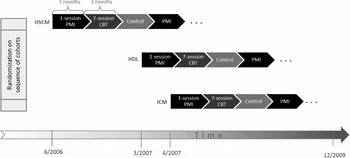
This was a quasi-experimental study that included three conditions (cohorts) with pre-test and post-test assessments. Intervention condition cohorts (rather than individual patients) were randomized according to a randomly determined fixed sequence that was in a sealed envelope and randomly selected by one of the investigators (AM), where each intervention condition cohort was recruited over a 3-month period for every year of recruitment. The start and end times of the recruitment periods were asynchronous across the hospitals, thereby minimizing possible seasonal effects (see Figure 1). In order to minimize negative expectancy biases, patients in the control condition cohort were not informed about the existence of the psychological interventions. The consent form specific to the two intervention conditions described both interventions. All participants accepted the intervention conditions they were assigned to, regardless of the type. The independent variables of this study were the two intervention conditions (1-session PMI, 7-session CBT) and the usual-care control condition, as well as time (pre-test, post-test, 3- and 6-month follow-ups). The primary outcome was the severity of PD according to the ADIS-IV. Secondary outcomes were fear of physical sensations, agoraphobic cognitions, frequency of panic attacks and agoraphobia, anxiety sensitivity, as well as cardiac anxiety.
Randomization on sequence of cohorts

Procedure
Participants were recruited directly in the emergency department, after being informed of the procedure and having signed an informed consent. First, patients were asked a series of socio-demographic, medical history questions and whether or not they are taking psychotropic medication. PD was then assessed during a structured interview (ADIS-IV) by trained clinical research assistants who were supervised by licensed clinical psychologists. All interviews were audio recorded, and a random sample of 30% was rated independently to determine the reliability of diagnoses of PD, which was 92%.
Eligible patients were then asked to complete a set of self-report questionnaires, after which they were assigned to one of three conditions: (1) a 1-session PMI lasting 2 hours (n = 23); (2) a 7-session biweekly CBT lasting a total of 7 hours (n = 14); or (3) a usual-care control condition (n = 13). Patients were assessed in person at baseline (prior to beginning the intervention) and 14-weeks post-intervention, and at 3- and 6-months follow-up by telephone. All patients were re-administered the same clinical interview (ADIS-IV) and were sent the same set of questionnaires that were answered at baseline.
Intervention protocols
Panic management intervention (PMI). The 1-session PMI lasted 2 hours and was initiated within 2 weeks of the emergency department visit. It was conducted individually by a psychologist within the emergency department and consisted of the following therapeutic strategies: information and education on chest pain, panic attacks, PD and agoraphobia as well as on the factors explaining the development and the maintenance of PD; demystification of panic symptoms, cognitive restructuring and strategies to cope with panic. At the end of the session, participants were given a self-management manual called Les douleurs thoraciques non-cardiaques et l'anxiété [Non-Cardiac Chest Pain and Anxiety] (Marchand, Lessard and Pelland, Reference Marchand, Lessard and Pelland2005). This manual was adapted from the book La peur d'avoir peur [Fear of Fear] (Marchand and Letarte, Reference Marchand and Letarte2004). It is based on cognitive-behavioural theories of PD, with special attention to cardiac anxiety. Participants in the PMI condition were told to use this manual as a reference guide when needed after the intervention.
7-session CBT intervention. The 7-session CBT intervention was initiated within 2 weeks of the emergency department visit. It consisted of 7 one-hour bi-weekly individual sessions conducted by a psychologist within the emergency department. Therapeutic strategies were the same as those used in the 1-session PMI but also included exposure to physical sensations related to panic symptoms, as well as in vivo exposure when applicable. Participants were given the same self-management manual described above. They were also asked to read specific sections after each session, and to perform exercises between sessions. Therapists monitored participants’ progress and were active in ensuring that participants understood the information offered and were engaged in the therapy.
Usual-care control condition: Usual care in emergency departments generally involves being informed by the physician that the patient's chest pain was non-cardiac in origin and the possibility to be referred for further treatment. However, in this study, no patients were referred for subsequent treatment.
Intervention integrity
All interventions took place in the hospital where participants were recruited. Four clinical psychologists trained and supervised in CBT conducted the interventions. A structured treatment protocol adapted from Marchand and colleagues was used to ensure treatment integrity (Marchand and Letarte, Reference Marchand and Letarte2004). In addition, all intervention sessions were audio-recorded and 30% were randomly selected for analysis by two independent, qualified raters using a therapeutic integrity instrument developed by our team (Marchand et al., Reference Marchand, Roberge, Dupuis, Contrandriopoulus, Mainguy and Savard2000). Results indicated that psychologists’ adherence rates to the intervention protocol were 99%.
Flow of participants through the study
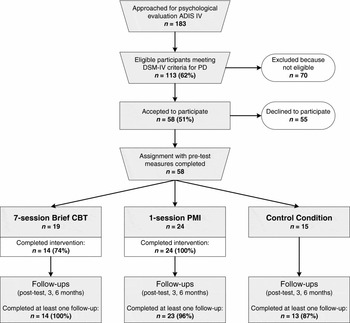
Details of the flow of participants can be found in Figure 2. In total, 183 patients presenting to the emergency department with chest pain were approached to undergo the initial psychiatric interview. After verifying eligibility, we recruited a total of 58 consenting individuals into the study who agreed to be assigned to one of the three conditions: a 1-session PMI (n = 24), a 7-session CBT intervention (n = 19), or a usual-care control condition (n = 15). Participant dropouts were found in the 1-session PMI (n = 1, at post-test), the 7-session CBT (n = 5, during the intervention) and in the usual-care control condition (n = 2, at post-test), but the differences were not statistically significant. In total, 58 participants completed the pre-test evaluation and 50 (86%) completed at least one follow-up evaluation.
Flow of participants’ recruitment

Measures
Diagnostic interview: Anxiety Disorder Interview Schedule for DSM-IV (ADIS-IV). We used an adapted French-Canadian translation (Boivin and Marchand, Reference Boivin and Marchand1996) of the ADIS-IV structured interview (Di Nardo et al., Reference Di Nardo, Brown and Barlow1994) as our primary measure of PD and PD severity, as well as to assess comorbid DSM-IV-TR disorders (Association Américaine de Psychiatrie, 2003). PD severity was assessed according to an 8-point scale (range 0–8), with higher scores denoting higher PD severity and interference with daily functioning (Brown, Di Nardo and Barlow, Reference Brown, Di Nardo and Barlow1994). Only participants with a score of 4 or more (suggesting at least moderate PD) were considered eligible.
Self-report questionnaires. The French-Canadian version (Stephenson, Marchand and Lavallee, Reference Stephenson, Marchand and Lavallée1998) of the Body Sensations Questionnaire (BSQ; Chambless, Caputo, Bright and Gallagher, Reference Chambless, Caputo, Bright and Gallagher1984) was used to measure the frequency and degree of fear of 17 physical sensations (e.g. chest pain) usually experienced during panic attacks or when anxious. Items are rated on a 5-point Likert scale (range 1–5), with higher scores indicating greater fear of physical sensations.
The French-Canadian version (Stephenson, Marchand and Lavallée, Reference Stephenson, Marchand and Lavallée1999) of the Agoraphobic Cognitions Questionnaire (ACQ; Chambless et al., Reference Chambless, Caputo, Bright and Gallagher1984) was used to measure the frequency of 14 catastrophic thoughts related to the negative consequences of experiencing panic attack symptoms. Items are rated on a 5-point Likert scale (range 1–5), with higher item scores indicating greater agoraphobic cognitions.
The French-Canadian version (Roberge and Marchand, Reference Roberge and Marchand1997) of the Panic and Agoraphobia Scale (PAS; Bandelow, Reference Bandelow1995) was used to measures the frequency of panic attacks and the occurrence of agoraphobia in the last 7 days, using two sub-scales of this 13-item questionnaire.
The French-Canadian version (Stephenson, Marchand and Brillon, Reference Stephenson, Marchand and Brillon1994; Stephenson, Marchand, Lavallée and Brillon, Reference Stephenson, Marchand, Lavallée and Brillon1996) of the Anxiety Sensitivity Index (ASI; Reiss, Peterson, Gursky and McNally, Reference Reiss, Peterson, Gursky and McNally1986) was used to measure patient's sensitivity and negative reactions to their physical and cognitive symptoms of anxiety. It contains 16 items that are rated on a 5-point Likert-type scale (range 0–4), with higher scores indicating higher anxiety sensitivity.
A French translation of the Cardiac Anxiety Questionnaire (CAQ; Eifert et al., Reference Eifert, Thompson, Zvolensky, Edwards, Frazer and Haddad2000) was used to measure heart-focused anxiety, i.e. the fear of cardiac-related stimuli and sensations because of their perceived negative consequences. It consists of 18 items rated on a 5-point Likert-type scale (range 0–4) and has three subscales: heart-related fear, avoidance and attention, with higher scores indicating worse cardiac anxiety.
Statistical analyses
Baseline differences between the three intervention conditions, patients treated at the three intervention sites, and completers vs. non-completers were examined using analyses of variance (ANOVA) and chi-square tests for continuous and categorical variables respectively. Treatment effects were evaluated using both intent-to-treat (ITT) and completer analyses. Group mean substitution was generally employed for missing data in secondary outcome measures and was replaced with the individual's preceding scores only if more than 15% of data cases for a specific variable were missing (Allison, Gorman and Primavera, Reference Allison, Gorman and Primavera1993).
In this mixed design study, repeated measures factorial ANOVAs (3 conditions x 4 assessment periods) were conducted on each continuous dependant outcome variable in order to evaluate group changes over time. The three conditions represent the between-subjects factors and the assessment periods represent the within-subjects effects. For the variables, PD severity (according to the ADIS-IV severity score) and the PAS sub-scales for panic attacks and avoidance, repeated measures ANOVAs were conducted on difference scores since the raw data presented a significant floor effect and parametric tests could therefore not be performed. Difference scores as outcome measures were calculated by computing the difference in the outcome variable between baseline and post-test scores, between post-test and 3-month follow-up scores, as well as between 3-month and 6-month follow-up scores. In addition, logarithmic and square root transformations were used for repeated measures ANOVAs on the ACQ variable, as the distribution was not normal. In cases of significant time and treatment interactions on repeated measures ANOVAs, post-hoc analyses using the same analysis methodology were carried out on each condition separately, in order to analyze the time effect for each condition. Significance was set at 0.05 and the effect size was assessed using η2. All analyses were carried out using version 17 of the SPSS statistical package (SPSS, Chicago, III).
Results
Sample characteristics
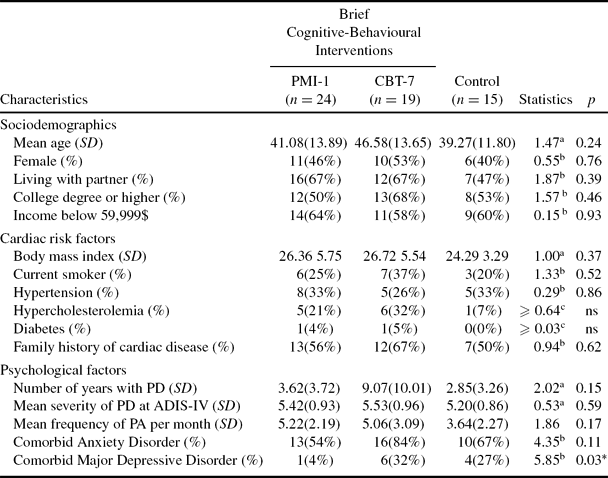
Participants were 47% female (n = 27) and had a mean age of 42.41 years (SD = 13.42; range 21–81). The mean duration of PD was 5.05 years (SD = 6.65) and the mean frequency of panic attacks per month was 4.76 (SD = 2.57). PD was found to interfere moderately to severely with daily functioning, with a mean severity score on the ADIS-IV of 5.40 (SD = 0.92). Comorbid anxiety disorders were diagnosed in 67% of the participants, the most frequent being generalized anxiety disorder (26%), specific phobia (17%) and social phobia (14%). Comorbid major depressive disorder was diagnosed in 19% of cases. A summary of socio-demographic and clinical characteristics can be found in Table 1.
Baseline characteristics of PD patients presenting with non-cardiac chest pain to the emergency department by conditions (n = 58)
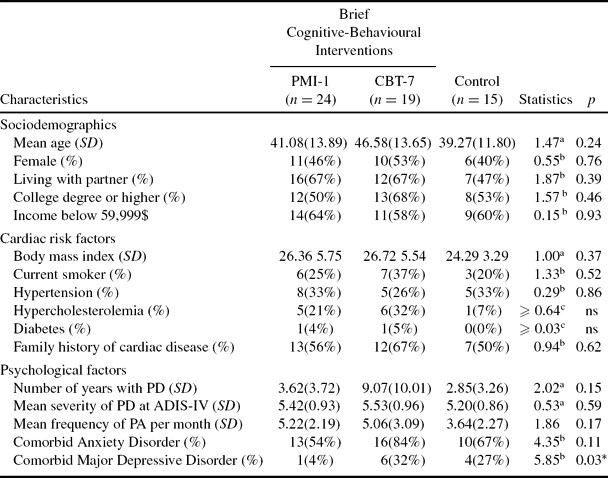
Notes: These analyses were conducted on the intend-to-treat participants. PMI-1 = 1-session Panic Management Intervention; CBT-7 = 7-session Cognitive Behavioural Therapy; Control = Usual-care control condition; PA = panic attack. * There is a significant difference between the 1-session PMI and the 7-session CBT at p < 0.05 as indicated by the Fisher's Exact Test. aANOVA bPearson Chi-square. cThere is no significant difference between the conditions at p < 0.05 as indicated by the Fisher's Exact Test
Baseline comparisons
As presented in Table 1, with the exception of a higher prevalence of major depressive disorder at baseline in patients in the 1-session PMI relative to the 7-session CBT (p = .03), there were no other significant differences between the three conditions regarding socio-demographic, cardiac risk factor, and psychological characteristics (including on all outcome variables, data not shown). Additional analyses revealed that with the exception of dropouts (who had higher levels of avoidance than completers, F(1, 52) = 5.836, p = .019), there were no other significant differences in socio-demographic or clinical characteristics between completers and dropouts or between patients treated at the three recruitment centres (data not shown).
Treatment outcome
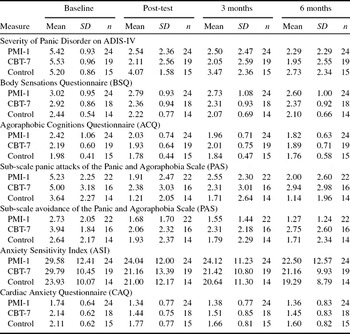
Table 2 lists the means and standard deviations of all three conditions for all outcome measures over time, according to ITT analyses. Chi squared tests showed that a greater number of participants in the two brief psychotherapy interventions no longer met criteria for PD after treatment, compared to those in the usual-care control condition χ2 (2, n = 58) = 5.95, p = .05 (54.2% in 1-session PMI, 68.4% in 7-session CBT, vs. 26.7% in usual-care condition).
Means and standard deviations (SD) of the 1-session PMI, the 7-session CBT and the usual-care control condition on all outcome measures over time (ITT analysis)

Note: PMI-1 = 1-session Panic Management Intervention; CBT-7 = 7-session Cognitive Behavioural Therapy; Control = Usual-care control condition; ADIS-IV = Anxiety Disorder Interview Schedule for DSM-IV; PAS = Panic and Agoraphobia Scale; ITT = Intend-To-Treat
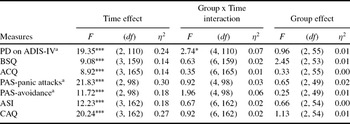
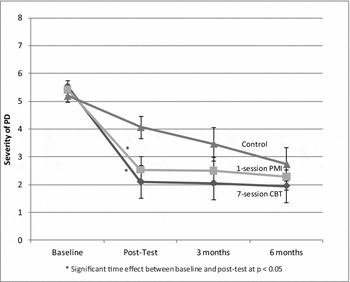
Table 3 contains results of treatment efficacy for all three conditions. Since ITT and completer analyses yielded the same results, only ITT analyses are presented. Results revealed a significant (p < .001) time effect on all outcome measures at post-test, as well as at 3- and 6-month follow-ups, on the following outcomes: severity of PD; fear of physical sensations; agoraphobic cognitions; panic attacks; avoidance; anxiety sensitivity; and cardiac anxiety. Trend analyses on all outcome measures show significant improvement in symptoms from baseline to post-test, and a floor effect indicative of little change in symptoms from post-test to 3- and 6-month follow-ups (see Figure 3).
Analysis of Variance (ANOVA) results for PD patients consulting for DTNC in the emergency department

Notes: These analyses were conducted on the intend-to-treat participants. The Greenhouse-Geisser correction was used when necessary. *p < .05; **p < .01; ***p < .001 aANOVAs on these variables were done on the difference scores
Severity of PD (ADIS-IV) over time

For all but one variable, no statistically significant Group by Time interaction was observed, demonstrating that despite a marked overall reduction of symptoms, no significant difference over time was observed for any particular condition on most outcome variables (see Table 3). However, for the primary outcome measure, the severity of PD according to the ADIS-IV, there was a significant Group x Time interaction (F (4, 110) = 2.74, p = .03, η2 = 0.07), in addition to an overall reduction in symptoms, with post-hoc analyses indicating that severity of PD (ADIS-IV) decreased significantly in both intervention conditions relative to the usual-care condition over time. Also, no significant differences between the efficacy of the 7-session CBT and the 1-session PMI were found at any given time. No other significant group effects were found. As can be seen in Table 3, the effect sizes associated with time are consistently higher than those associated with group or their interaction.
Discussion
Overall, the results of this study demonstrated a noteworthy improvement on all outcome measures, indicating that, as hypothesized, among patients presenting to the emergency department with non-cardiac chest pain, the severity of PD (with or without agoraphobia), frequency of panic attacks and agoraphobia, cardiac anxiety, and anxiety sensitivity, were all lower at post-intervention and at 3- and 6-month follow-up in patients in the two brief CBT intervention conditions relative to the usual-care condition. The first hypothesis is supported by the results for the severity of PD, indicating that receiving either one of the intervention conditions is more beneficial in short and medium term than receiving solely the information by the physician without further treatment.
The findings of this study only partially confirmed our second exploratory hypothesis: while preliminary non-parametric analyses done on the severity of PD (ADIS-IV) did show a significant difference between the two brief CBT interventions favouring the 7-session intervention, these differences disappeared when doing parametric analyses using the difference score. This suggests that a greater number of subjects would most likely show the same superiority in the statistical analysis. While several outcome measures yielded no significant statistical differences between the two brief intervention conditions and the usual-care control condition as well as between the one-session PMI and the 7-sessions CBT, a sample size of at least 165 participants (55 per condition) would be necessary to show such significant differences between the three conditions (power of 0.80, significance threshold of 0.05).
Results demonstrating the efficacy of both psychotherapies (1-session PMI and 7-session CBT) on PD severity are consistent with previous studies, which show that brief CBT formats are both an effective and efficient form of intervention for PD in psychological settings (Côté, Gauthier, Laberge, Cormier and Plamondon, Reference Côté, Gauthier, Laberge, Cormier and Plamondon1994; Deacon and Abramowitz, Reference Deacon and Abramowitz2006; Ghosh and Marks, Reference Ghosh and Marks1987; Gould and Clum, Reference Gould and Clum1993; Gould, Clum and Shapiro, Reference Gould, Clum and Shapiro1993; Hecker, Losee, Fritzler and Fink, Reference Hecker, Losee, Fritzler and Fink1996; Lidren et al., Reference Lidren, Watkins, Gould, Clum, Asterino and Tulloch1994). To our knowledge, this is the first study to examine the efficacy of two brief CBT-based interventions for PD patients with non-cardiac chest pain presenting to the emergency department using multiple CBT strategies. Our results also appear consistent with those of previous studies with non-cardiac chest pain patients (knowing that this population includes patients with PD) who consulted different medical services and received individual or group CBT treatment varying between 8 and 38 hours (Cott et al., Reference Cott, McCully, Goldberg, Tanser and Parkinson1992; Klimes et al., Reference Klimes, Mayou, Pearce, Coles and Fagg1990; Mayou et al., Reference Mayou, Bryant, Sanders, Bass, Klimes and Forfar1997; Peski-Oosterbaan et al., Reference Peski-Oosterbaan, Spinhoven, Rood, Does, Bruschke and Rooijmans1999; Potts et al., Reference Potts, Lewin, Fox and Johnstone1999).
With the exception of PD severity, there were no other significant differences in secondary panic self-report outcome measures between the conditions over time, which was contrary to our first hypothesis. Moreover, our results revealed no superiority of the 7-session over the 1-session CBT intervention on any outcomes, which was also contrary to our second hypothesis. The reasons for these unexpected findings are not clear. However, we could speculate on why we may have observed this pattern of results. First, the time effect observed in the usual-care control condition suggests that receiving information from the emergency department physician of the absence of organic or cardiac disease may be seen as reassuring and, consequently, may have had a therapeutic effect on most outcome measures, which is generally inconsistent with the previous literature (McDonald, Daly, Jelinek, Panetta and Gutman, Reference McDonald, Daly, Jelinek, Panetta and Gutman1996). Indeed, previous research shows that negative cardiac test results in patients with chest pain do not reduce anxiety or worry about having a cardiac event (Goodacre, Mason, Arnold and Angelini, Reference Goodacre, Mason, Arnold and Angelini2001; Norell et al., Reference Norell, Lythall, Coghlan, Cheng, Kushwaha and Swan1992). Similarly, the frequent evaluation contacts by a research assistant among patients in the usual-care group may have also been seen as reassuring and could have contributed to the symptom reduction observed. Nevertheless, both intervention conditions also might have benefited from these possible therapeutic effects. Future studies assessing the impact of receiving a non-cardiac diagnosis by the emergency department physician or frequent contacts (attention) by research personnel is therefore warranted.
Study limitations and strengths
The results of this study should be interpreted in light of some methodological limitations. First, this was not a traditional randomized controlled trial in that individual participants were not randomly assigned to the conditions. Rather, the order of the three intervention condition cohorts was randomly pre-determined, a design chosen for logistical and ethical reasons. However, the lack of baseline differences on the vast majority of measures between the three intervention groups increases our confidence that participants were similar across the three groups. Second, most of our outcome measures were self-reported by patients using questionnaires, some of which may not have been sensitive enough to detect changes in our population. Previous studies comparing PD patients in psychiatric and emergency department settings indicate that in the latter, panic symptoms, agoraphobic cognitions and sensitivity to anxiety are generally lower (Beitman, Kushner, Lamberti and Mukerji, Reference Beitman, Kushner, Lamberti and Mukerji1990; Belleville, Foldes-Busque and Marchand, Reference Belleville, Foldes-Busque and Marchand2010; Fleet, Martel, Lavoie, Dupuis and Beitman, Reference Fleet, Martel, Lavoie, Dupuis and Beitman2000). It is also possible that these measures may have been more sensitive for the detection of longer-term changes. Indeed, a 12-month follow-up is currently under way for this project and results will be presented later.
Despite the above limitations, this study also has a number of important strengths. First, we used an adapted version of a validated, structured treatment protocol that was administered by qualified clinical psychologists with expertise in CBT strategies. Second, the interventions also involved the utilization of a self-management manual and the use of reliable and valid diagnostic and evaluation instruments, which increases the validity of the results obtained. Third, our assessment of PD diagnosis reliability (92%) and treatment integrity on the part of interventionists (99%) further highlights the scientific rigour of the present study. Fourth, the presence of a usual-care control condition, of limited negative expectancy biases due to the use of separate consent forms for both intervention conditions and for the control condition, and of controlling a possible seasonal effect by using non-synchronized recruitment periods between the recruitment centres, also adds to the quality of the study. The use of multiple recruitment centres also ensured a more representative sample and enhances generalizability. Moreover, the sample was made up of individuals who had PD that interfered moderately to severely with daily functioning, accompanied in many cases by anxiety or mood comorbid disorders. It is interesting to note that the two brief CBT interventions proved to be effective for reducing PD severity despite the presence of comorbidities, which may increase the external validity of the findings.
Clinical implications and future research
The results obtained by this study are very promising because they provide support for the efficacy of offering brief psychological interventions to individuals who consult first line care services for their non-cardiac chest pain related to PD symptoms. To our knowledge, this study is the first to assess the efficacy of two brief interventions using multiple conventional CBT strategies for PD patients presenting to the emergency department with non-cardiac chest pain that are initiated soon after their emergency department visit. Results of this study suggest that the strategies used in the brief CBT interventions were indeed effective for reducing PD severity. It would therefore be interesting to see if certain strategies are more efficient than others. Overall, this study highlights the importance of integrating specialized psychological interventions, adapted to PD patients who present to first line of care, into the usual-care services offered by primary care health providers. Such interventions can help these individuals to improve their well-being, overall functioning and psychosocial adaptation, as well as facilitate the accessibility of best treatments by the appropriate services, and reduce the strain on the emergency department.
Acknowledgements
This study was supported by a grant from the Canadian Institute of Health Research (CIHR, no. 157824) awarded to André Marchand, Kim Lavoie, Richard Fleet, Julien Poitras, Alain Vadeboncoeur, Jean-Marc Chauny, André Arsenault, Simon Bacon and Gilles Dupuis. In addition, post-graduate scholarships were given to the first author, Marie-Josée Lessard, from the Groupe interuniversitaire de recherche sur les urgences (GIRU) and from the Fonds de recherche sur la société et la culture (FQRSC) to carry out this research project. Salary support was also provided by a Research Scholar award from the Fonds de la recherche en santé du Quebec (FRSQ) (KLL). We would also like to thank the department of Psychology at the University of Quebec at Montreal, the Montreal Heart Institute, the Sacré-Coeur Hospital Research Centre, and the Hôtel Dieu de Lévis hospital for their ongoing support throughout the project. The authors also wish to thank all the participants who took part in the project as well as the research assistants and the psychologists, without whom this study could not have been realised.



Comments
No Comments have been published for this article.