Background
Physicians’ provision of prescription medications at lethal doses intentionally to cause death — which is referred to by terms such as physician assisted suicide, physician assisted dying, lawful physician hastened death, medical aid in dying (MAiD), or other phrases — remains highly controversial in the United States and around the world.1 Although legally permitted in many countries (e.g., the Netherlands, Belgium, Switzerland, Canada, two states in Australia) as well as in several US states, the medical profession remains divided about the fundamental ethics and legality of MAiD. Although few national-level medical societies support MAiD outright, some (such as the American Medical Association,2 American Academy of Neurology,Reference Russell, Epstein and Bonnie3 British Medical Association,4 and German Medical AssociationReference Bowen5) appear to have adopted positions of neutrality,Reference Barsness, Regnier, Hook and Mueller6 and others (such as the World Medical Association7 and American College of PhysiciansReference Snyder and Mueller8) remain steadfastly opposed.
At the individual physician level, surveys conducted globally over the past three decades have generally focused on assessing physician support or lack thereof for MAiD in general.Reference Emanuel, Onwuteaka-Philipsen, Urwin and Cohen9 In the United States, where MAiD is governed by state law, surveys have similarly focused on whether MAiD should be legally or ethically permissible,Reference Doukas, Waterhouse, Gorenflo and Seid10 although some have addressed physicians’ views of adequacy of safeguards for MAiD (such as accurate prognosis and screening for depression).Reference Hetzler, Nie, Zhou and Dugdale11 MAiD safeguards — such as requiring terminal illness, full decision-making capacity, and the ability to ingest the medications, among others — are meant to prevent abuses of MAiD and are believed to protect patient autonomy while avoiding harms.
These prior surveys, while shedding important light on MAiD, often fail to tell the whole story of MAiD, particularly around the experiences of physicians who participate in various MAiD activities, such as discussions of MAiD with patients, MAiD referrals, consulting on MAiD cases, or serving as a MAiD attending (i.e., prescribing drugs for MAiD). In particular, little is known about physicians’ disclosure of their own views on MAiD, physician presence during ingestion of MAiD drugs, expanding MAiD indications, and perceived utility of ethics consultation. Thus, it is important to collect updated, scientifically rigorous data around the MAiD experienceReference Ganzini, Nelson, Schmidt, Kraemer, Delorit and Lee12 as social and professional attitudes evolve.
Specific ethical issues at the forefront of MAiD activities deserve empirical investigation, such as physician communication about MAiD and expansion of MAiD eligibility. A survey of Dutch physicians found greater support for MAiD in so-called physical illnesses, such as cancer, when compared to psychiatric illness or dementia.Reference Bolt, Snijdewind, Willems, van der Heide and Onwuteaka-Philipsen13 A small study in Canada explored attitudes toward MAiD in dementia, recognizing the challenge of mental capacity determination and prognostication in this condition.Reference Nakanishi, Cuthbertson and Chase14
Prior studies suggest that physicians’ attitudes toward MAiD are affected by direct clinical experience. Thus, we sampled physicians in the US state of Colorado who were likely to have engaged in the full spectrum of MAiD activities and sought to assess their attitudes and beliefs toward ethical issues in MAiD. Colorado legally authorized “Access to Medical Aid in Dying” in 2016.
Prior studies suggest that physicians’ attitudes toward MAiD are affected by direct clinical experience.Reference Kaldjian, Jekel, Bernene, Rosenthal, Vaughan-Sarrazin and Duffy15 Thus, we sampled physicians in the US state of Colorado who were likely to have engaged in the full spectrum of MAiD activities and sought to assess their attitudes and beliefs toward ethical issues in MAiD. Colorado legally authorized “Access to Medical Aid in Dying” in 2016.16
Methods
Our survey methodology has been described comprehensively elsewhere.Reference Campbell, Kini and Ressalam17 Here we describe only the most essential methodological features. In this article, we present findings related to physicians’ disclosure of their own views on MAiD, physician presence during ingestion of MAiD drugs, expanding MAiD indications, and perceived utility of ethics consultation.
Sample
We developed a sample of 583 physicians in the state of Colorado whom we hypothesized would be more likely to engage in MAiD-related discussions and activities. First, we used the Colorado All-Payer Claims Database (a repository of billing claims from nearly all insured patients who received healthcare in the state) to identify a cohort of patients similar to actual patients who received MAiD prescriptions in the state.18 Accordingly, we identified 2,960 patients who had received hospice services for diagnoses including malignant neoplasms, progressive neurodegenerative diseases, and chronic heart or lung disease. Second, we identified the 6,369 physicians who had provided outpatient services to these patients. Third, we developed an a priori ranking system — taking into account specialty (e.g., oncology, palliative care), number of patients seen in the 2,960 patient cohort, and individual (rather than group) provider status — to increase the likelihood of surveying physicians most likely to engage in MAiD-related activities. See Figure 1.
Sampling strategy for the physician survey

Survey Instrument
We created a survey based on current literature and key informant interviews with physicians with experience in MAiD. Following four cognitive interviews and iterative refinement, the final paper survey was four pages long and included 40 items plus demographic questions (see Appendix). Given the sensitive nature of MAiD and to encourage participation via absolute anonymity, paper surveys had no identifiers and a very limited set of demographic questions.
Data Collection
The survey was conducted by mail by the Center for Survey Research (CSR) in three waves exactly 3 months apart from July 2020 to January 2021. Each sampled physician received only 1 mailed survey. The first wave occurred in July 2020 with 12 weeks between each wave. Surveys included $50 cash reimbursement and a postage paid return envelope. Since the survey was anonymous, the research team could not know who completed the survey and who did not; therefore, there were no follow-up mailings or phone calls to non-respondents.
Data Processes and Analysis
Responses from paper surveys were double entered by the CSR. Discrepancies such as typos were handled by the person verifying the data, or in some cases, the manager of data processing.
For analysis, some variables were combined. For analyses and reporting responses to whether physicians disclosed their own views about MAiD (i.e., “every time,” “sometimes,” or “never”), responses were dichotomized into “every time/sometimes” and “never.” Responses to whether physicians were willing to be present were dichotomized into the categories “definitely not/probably not” and “probably yes/definitely yes.” We also grouped respondents who had attended and/or consulted on MAiD into a single category reflecting MAiD participation compared to those who had done neither. Data were analyzed using R version 4.0.5. Differences in proportions were tested using Pearson Chi-squared tests and Fischer Exact Tests for bivariate comparisons with small n’s.
Ethics Approval
The study was reviewed and declared exempt by the Colorado Multiple Institutional Review Board.
Funding
This study was funded via a Making a Difference grant from the Greenwall Foundation. The foundation had no role in the study design, acquisition or interpretation of the data, or the decision to submit the results.
Results
From the sample of 583 unique physicians we received 300 completed surveys, for an adjusted response rate of 55%.19 Demographic characteristics are shown in Table 1. Respondents were predominantly male, reflective of the demographics of physicians in Colorado,20 white, non-Hispanic, with a diversity of experience in terms of self-reported years practicing medicine. Just over half of respondents reported practicing in primary care (general internal medicine and family medicine), with a small proportion (2.8%) in hospice and palliative medicine.
Characteristics of Respondents

* n’s vary slightly due to missing data by item.
** Some physicians reported serving as both. A total of 49 physicians had served as either attending or consulting.
In terms of MAiD activities, 16.3% (n=49 unique physicians) reported serving as either a MAiD consulting or MAiD attending. Of these physicians, 49% only served as a MAiD consultant, 22.4% served only as a MAiD attending, and 28.4% served as both a MAiD attending and also a MAiD consultant (for unique patients).
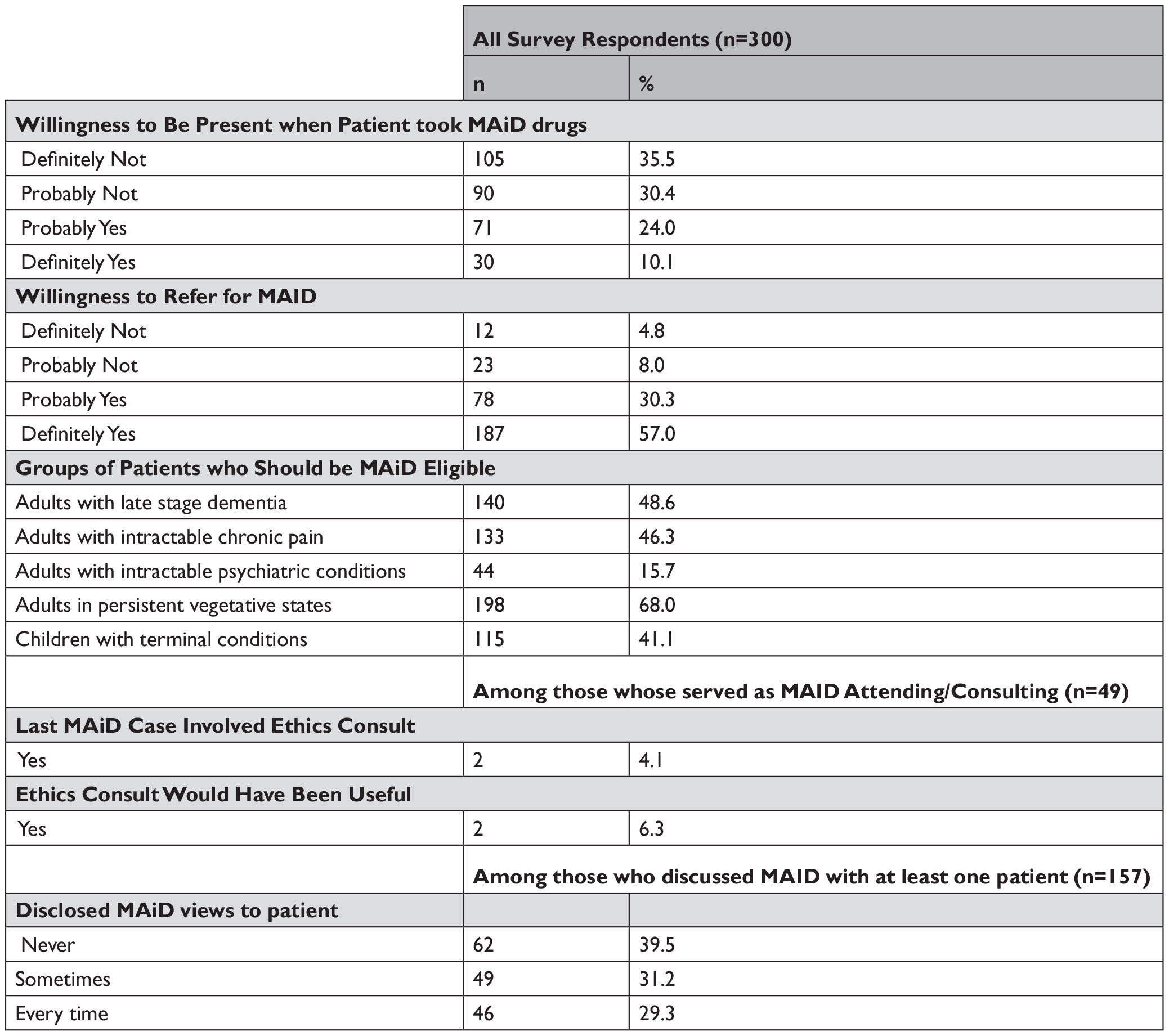
Here, we report physicians’ responses to questions related to four key ethical issues of interest: physician self-disclosure of their personal views about MAiD to patients considering MAiD; physician willingness to be present when a patient ingests MAiD drugs; the expansion of MAiD to new non-terminal conditions that are not currently permitted under Colorado law; and the use of ethics consultation. These results are in Table 2.
Attitudes toward ethically-relevant aspects of Medical Aid-in-Dying

Physician Self-Disclosure
Of physicians who reported having discussed MAiD with at least one patient since 2017, we asked how often during those discussions they disclosed their own views on MAiD to patients (every time, sometimes, never). Of the 157 physicians who had discussed MAiD with a patient, 62 (39.5%) reported that they had never disclosed their own views of MAiD to a patient, and 46 (29.3%) reported that they disclosed their own view of MAiD to a patient “every time.” We found that physicians who identified as women were more likely to report having never disclosed their own views when compared to physicians who identified as men (p=0.001). We found no statistically significant differences in self-disclosure based on race, years in practice, specialty, or having served as a MAiD consultant/attending.
Physician Presence When MAiD Drugs are Taken
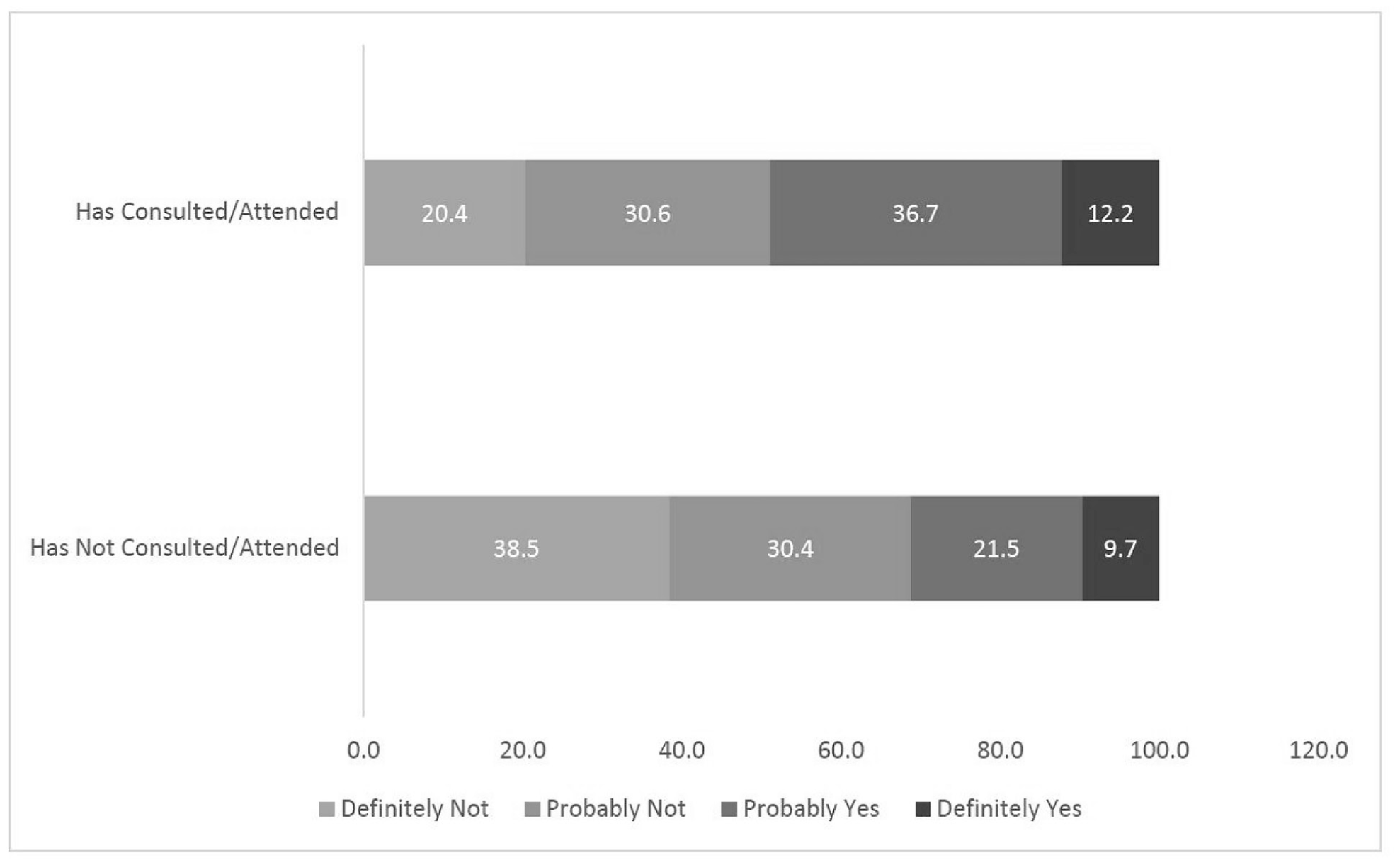
We asked all respondents, “If you were asked today, would you be willing to be present when the patient took the MAiD drugs?” A total of 30 (10.1%) respondents said definitely yes, while 105 (35.5%) said definitely not. As shown in Figure 2, physicians who had attended or consulted on MAiD were significantly more likely to be willing to be present (p=0.046).
Physician willingness to be present during MAiD drug ingestion comparing physicians who have consulted/attended versus those who have not ( findings statistically significant between groups, p = 0.046 )

Expansion of MAiD
We asked all respondents a “yes/no” question regarding the expansion of MAiD to groups of patients not currently eligible for MAiD under Colorado law. Of the respondents, 68% felt patients in a persistent vegetative state should be eligible for MAiD followed by 48.1% for patients with late-stage dementia, 46.3% for those intractable chronic pain, 41.1% for children with terminal conditions, and 15.7% for patients with intractable psychiatric conditions.
Involvement of Ethics Consultation Services
For those 49 physicians who had served as either the attending or consulting physician on a recent MAiD case, we asked if ethics consultation had been involved (yes or no) and if not, whether such consultation would have been helpful (yes, no, or unsure). Of MAiD consultants and attending physicians, only two respondents reported an ethics consultation service was involved in their most recent case. Of the 47 whose most recent case did not involve ethics consultation only 2 reported having an ethics consultation service in their most recent case would have been helpful.
Discussion
Using a novel survey methodology, we were able to identify and successfully survey 36 physicians in the state of Colorado who have ever written at least one MAiD prescription; for reference, 70 physicians in the state of Colorado wrote MAiD prescriptions in calendar year 2020. We were also able to elicit the beliefs and attitudes of those physicians most likely to engage in discussions around MAiD.21 Although motivated by the hypothesis that direct clinical experience with MAiD would affect participants’ views, we did not find clear evidence that physicians who had served as a consulting/attending were more willing to expand MAiD eligibility, and we found few associations between physician age, gender, specialty, or other characteristics and attitudes toward specific ethical issues. Nevertheless, our study yielded four principal findings that expand the ethical discourse around MAiD by focusing not only on whether it should be permitted legally but also on the real-world experiences of physicians related to MAiD.
First, regarding physician disclosure, we found that a sizable proportion of physicians (40%) reported having never disclosed their personal views during discussions with patients about MAiD, and physicians identifying as women were less likely to report doing so (a finding that runs counter to prior studies suggesting women tend to self-disclose more than men).Reference Roter, Hall and Aoki22 Disclosure is distinct from the issue of whether physicians are obliged to inform patients about the availability of MAiD.Reference Chandhoke, Pond, Levine and Oczkowski23 Studies have suggested that patients prefer physicians to be open about their views,Reference Back, Starks, Hsu, Gordon, Bharucha and Pearlman24 and some have argued that physicians are obligated, for the sake of transparency, to share their own viewsReference Lo25 when discussing MAiD.
Nevertheless, concerns exist that physicians’ disclosure could be construed as either tacit endorsement or condemnation of MAiD that can improperly influence patients’ decisions or disrupt the patient-physician relationship.Reference Brassfield and Buchbinder26 Our findings reinforce the ongoing need to improve how physicians communicate about end-of-life decisions.Reference Sutherland27 Future research is needed to explore in more depth why physicians sometimes do not disclose their views and how patients interpret such disclosures in the unique setting of MAiD.
Second, we found that just over one-third of physicians were willing to be present when patients took MAiD drugs. Of course, physician presence is assumed in jurisdictions such as Canada, Belgium, the Netherlands, and others, where a clinician administers the lethal medication. However, despite the fact that physician presence is not legally prohibited in Colorado, the presence of physicians during self-administration of lethal drugs may be legally and ethically wrought. Physicians who are committed to patient-physician relationships may desire to be present during MAiD, or experience a sense of relationship fracture if they are not (as data from hospice care suggest).Reference Freeman, Banner and Ward28 However, if the MAiD drugs do not work as expected, physicians who are present may experience dilemmas, such as whether to pursue resuscitation; they may also feel compelled to provide additional MAiD support or call emergency services. Calls for additional organizational-level guidance, policy, and procedures should include clear guidance for what to do in this unlikely event.Reference Ho, Joolaee, Jameson and Ng29
Being present when a patient self-administers MAiD drugs can relate to the concept of complicity (i.e., a perception of having participated in a wrongdoing). For some physicians who oppose MAiD, being present — or even discussing or referring eligible patients to others for MAiD — is perceived as complicity with a moral wrong.Reference Vogel30 Feelings of complicity are likely to vary based on the nature of the action under consideration (i.e., physicians may feel more complicit with referral as compared to discussion), but few data exist on this precise question. Nearly 90% of our physician sample were probably or definitely willing to refer an eligible patient for MAiD. This suggests that the vast majority of physicians may not feel complicity regarding these actions; however, we cannot state with certainty the precise reason or reasons why a significant minority would not refer.
Third, our findings add insights to the debate over appropriate indications for MAiD which are often considered non-terminal except in the most advanced stages. Our respondents were generally split in supporting expansion of MAiD for patients with Alzheimer’s disease and related dementias, for those with chronic pain, and for pediatric patients. At present, several countries, including Canada, Belgium, and the Netherlands, permit MAiD for mature minors, though this issue remains contested in the US and no US state allows it.Reference Brouwer, Kaczor, Battin, Maeckelberghe, Lantos and Verhagen31 However, we observed substantial opposition for adults with intractable psychiatric conditions and far greater support for expansion to adults in the persistent vegetative state (PVS). Qualifying conditions for MAiD vary internationally; in some countries (such as the Netherlands, for example), the definition of “unbearable suffering” is open to interpretation and has increasingly allowed for written advance euthanasia directives in dementia.Reference Mangino, Nicolini, De Vries and Kim32 Recent controversy in Colorado has centered around whether certain eating disorders, such as anorexia nervosa, should qualify.
Under all US state laws, the presence of a terminal illness and the ability to consent are considered critical safeguards for MAiD and thus are required for participation in MAiD. However, some states, such as Oregon, have considered bills that would eliminate the terminal illness requirement (allowing, for example, for patients with dementia to request MAiD in advance of deteriorating capacity); Canada eliminated the terminal illness requirement in 2001. Nevertheless, the absence of support for (non-terminal) psychiatric conditions is not surprising, given red flags that have been raised about bias, stigma, and gender disparities in psychiatric illness and MAiD.Reference Appelbaum33 Data from other studies suggest our findings might have been more supportive had psychiatrists been a focus of the study.Reference Evenblij, Pasman, Pronk and Onwuteaka-Philipsen34 The support for patients in the PVS — who cannot consent and who are not expected to die within 6 months — was surprising, however, and could reflect implicit judgments about quality of life. Some evidence suggests that judgments about the permissibility of MAiD correlate to respondents’ assessment of the quality of life of particular illnesses, and this may partly explain our findings.35 Interestingly, we saw no differences in opinions about expansion based upon whether physicians had or had not participated as a MAiD attending, though our sample size prevents definitive conclusions. It is possible that longstanding, deeply entrenched beliefs about MAiD exist that are not affected by actual MAiD participation.
Fourth, we found virtually no utilization of ethics consultation in MAiD cases and a low perceived value of ethics consultation. A burgeoning literature describes the value added by ethics consultation, but this literature has not explored MAiD.Reference Wocial, Molnar and Ott36 No state laws requires ethics consultation; some institutions nationally require it as a matter of policy. For MAiD specifically, a prior survey noted support for mandatory palliative care consultation,Reference Rosenberg, Butler and Caprio37 but the value added by an ethics consultation is expected to be different. Movements toward creating practice guidelines and best practices for MAiD ought to consider highlighting formal ethics consultation as one way to help navigate the complicated ethical and professional experiences of patients, families, and physicians in MAiD. Greater involvement of palliative care specialists could also provide additional support.
We close with a few comments on the role of the data presented above in policy debates. On the one hand, the beliefs of those physicians most likely affected by MAiD law and practice deserve careful consideration, as they are most affected by MAiD.Reference Landry, Ely and Thomas38 On the other hand, we are careful not to conclude from the data from our survey (e.g., our responding physicians’ attitudes toward expansion of MAiD) to the value judgment that such expansion should or should not occur. To do so would ignore the uniqueness of our sample (which is not generalizable to all physicians in Colorado or the profession as a whole) as well as the obvious truth that matters of ethics are not solved by majority or consensus opinion alone.
Like all studies, ours has limitations. MAiD activities are relatively rare, our sample size was small, and the desire to preserve anonymity prevented the collection of detailed demographic data; this limits our ability to conduct discrete analysis on a number of demographic variables that may be of interest. Additionally, our findings are not generalizable to other states or jurisdictions. Finally, our novel sampling strategy means that our findings do not generalize to the entire population of physicians, but instead, are thought to reflect that narrower subset of physicians most likely to engage in MAiD activities.
Conclusion
Our study has described physicians’ attitudes toward some of the more contentious ethical issues in MAiD among those physicians most likely to care for patients who might seek MAiD. Our findings suggest that additional efforts may be needed to understand physician discussion and self-disclosure regarding MAiD and to characterize beliefs about expansion of MAiD indications when MAiD itself remains highly contentious. Future research is needed to better characterize the beliefs and attitudes of physicians in other locales and in other specialty settings.
Note
A grant was made to the University of Colorado to support this research. Hillary Lum reports grants to the University of Colorado from National Institute on Aging, Alzheimer’s Association, Colorado Department of Public Health and Environment, and Patient Centered Outcomes Research Institute to support other research. Lum also reports a contract made with American Academy of Family Physicians to the University of Colorado to support other work. Lum also reports consulting fees from Indiana University and Penn State University for research conducted with those institutions and an honoraria from the University of South Florida for grant review was paid to me as an individual.