Introduction
The daylily gall midge, Contarinia quinquenotata Loew (Diptera: Cecidomyiidae), as reviewed by Rosetta (Reference Rosetta2018), is a small slender-bodied fly that uses daylilies, Hemerocallis Linnaeus spp. (Asphodelaceae), as a host plant. The adult midge lays its eggs in the developing flower buds. Larval feeding within the bud causes conspicuous deformities in the developing flower, often resulting in partially necrotic flowers that fail to open. Larvae make their way into the soil and overwinter as pupae, then emerge as adults the following year. Although this pest does not cause severe damage to or kill the plant, because daylilies are prized for their ornamental flowers, the daylily gall midge can be a significant horticultural pest (American Daylily Society 2018).
The daylily gall midge originates in eastern Asia, in the areas of the native range of its plant hosts (Hulme Reference Hulme2009). Through global trade of plant material, the daylily gall midge has become widely established in other parts of the world, including Europe, Australia, and western North America (Gagné and Jaschhof Reference Gagné and Jaschhof2014). Although the daylily gall midge is not confirmed to occur within eastern North America, gardeners in the Canadian province of Nova Scotia began reporting symptoms resembling gall midge damage beginning in 2018.
In the spring of 2019, the Nova Scotia Daylily Society (Hammonds Plains, Nova Scotia, Canada), a member club of the American Hemerocallis Society, approached us to explore whether the daylily gall midge occurs within the region. In consultation with members, we developed a three-part project with three interrelated objectives.
Our first objective was to estimate if and where the daylily gall midge occurs in the region. For this objective, we used community science (often referred to as citizen science or civic science): an approach that engages members of the public in scientific inquiry (Cohn Reference Cohn2008). Community science has been used effectively to better understand the spatial distribution of invasive species, such as the brown marmorated stinkbug, Halyomorpha halys Stål (Hemiptera: Pentatomidae) (Maistrello et al. Reference Maistrello, Dioli, Dutto, Volani, Pasquali and Gilioli2018), or the leopard slug, Limax maximus Linnaeus (Gastropoda: Limacidae) (Morii et al. Reference Morii, Ohkubo and Watanabe2018).
Our second objective was to determine through the use of DNA barcoding whether the symptom of deformed daylily buds was caused by the daylily gall midge or by a different agent. Such barcodes are short, standardised sequences of DNA used for species-level identification of unknown specimens (Hebert et al. Reference Hebert, Cywinska, Ball and deWaard2003). A portion of the mitochondrial gene cytochrome c oxidase 1 (CO1) has been used as a barcode to identify insects (Hebert et al. Reference Hebert, Cywinska, Ball and deWaard2003; Hajibabaei et al. Reference Hajibabaei, Janzen, Burns, Hallwachs and Hebert2006).
The DNA barcoding technique can be especially useful when traditional morphological identification is neither available nor feasible. This is often the case for cecidomyid gall midges, a taxonomic family that has been estimated to contain more than a million distinct species (Hebert et al. Reference Hebert, Ratnasingham, Zakharov, Telfer, Levesque-Beaudin and Milton2016).
Our third and final objective was to quantify the importance of daylily traits that influence the susceptibility of a cultivar to daylily gall midge attack. During the project, a daylily society member provided a high-resolution data set of 517 registered daylily varieties grown at a single site. Attributes of the data set included a number of their traits (ploidy level, plant height, flower width), an estimate of their phenology (first day in flower), and whether or not the plant showed symptoms of the daylily gall midge.
Materials and methods
Estimating range through community science records
Preliminary conversations and review of photographs gave us relatively high confidence that the daylily gall midge was established within Canada’s Maritimes region. We began our research efforts by distributing an electronic survey to gardeners across the Canadian provinces of New Brunswick, Nova Scotia, and Prince Edward Island (hereafter referred to as “the Maritimes”).
Our survey was created using Survey123, a web-based application developed by Environmental Systems Research Institute (Redlands, California, United States of America). The survey asked questions to determine when and where symptoms of the daylily gall midge occurred. The survey was shared through gardening pages on social media, large regional nurseries, garden club newsletters, and word of mouth. Based on the size of the regional social media groups dedicated to gardening, which include more than 15 000 members cumulatively, attendance at public talks (>150 people), and the ubiquity of daylilies as a garden plant, we estimate our survey reached at least 1000 eligible individuals.
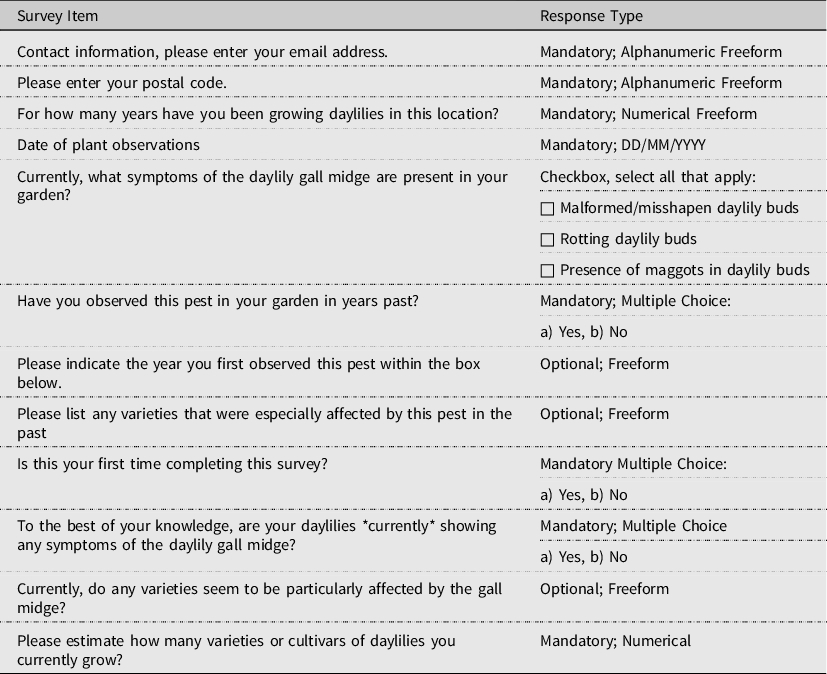
The survey was designed to determine whether and where the gall midge occurred and with what certainty (Table 1). Estimates of certainty were based on pest symptoms. The options ranged from low certainty (malformed or necrotic flower buds) to higher certainty (malformed buds or necrotic flower buds containing numerous larvae). Each observation was georeferenced using a postal code. Observers were encouraged to submit additional reports if gall midge symptoms appeared after first completing the survey.
The survey questions and types of responses requested and distributed to community members. The survey included photos of daylily gall midge symptoms for comparison purposes. Survey was designed and administered using the Survey123 application developed by Environmental Systems Research Institute (Redlands, California, United States of America).

DNA barcoding study
Sample collection
In an effort to confirm the presence of the pest within the region, we used a community science approach to collect larvae of the daylily gall midge. Through connections with gardening clubs and the Nova Scotia Daylily Society, we distributed postage paid and pre-addressed envelopes (N = 100) that contained a short datasheet, a sterile collection container, and an information package to gardeners across Nova Scotia. This was not a geographically distributed sample of individuals but rather an effort to maximise the likelihood of collecting a gall midge sample. The information package included photos of healthy and infested daylily buds. Community scientists were instructed to search their plants for infested buds, seeking buds that appeared wrinkled, bumpy, or warped. Community scientists were also asked to split apart buds that appeared infested to ensure buds contained larvae. All infested buds containing larvae were shipped live and were stored, upon receipt, at –20 °C until laboratory work began.
In addition to efforts to collect larvae from buds, we collected soil samples from fieldsites with the intent to rear an adult daylily gall midge. Using a garden trowel, we took 12 soil samples of approximately 500 cm3 from a single location near Brookfield, Nova Scotia (45° 25' 49.8" N, 63° 27' 95.1" W) on 14 June 2019. This was at the site of the common garden experiment, where hundreds of daylily varieties were grown. Soil samples were collected from specific locations based on 12 daylily plants where gall midge symptoms were reported in 2018. Samples were taken to a depth of approximately 10 cm. Each soil sample was then placed into a simple emergence trap (one sample per trap) that was constructed from a square opaque plastic container (width: 9 cm; height: 12 cm) covered with opaque black polyethylene film. A 3-cm length of rubber tubing (diameter = 1 cm) led from each soil sample into a specimen cup partially filled with 90% ethanol. Insects emerging from the soil entered the specimen cup via the tube. We anticipated that adult gall midges would be included among the emergent insects. Traps were active for six weeks, and all insects collected via this method were stored in 90% ethanol.
Barcoding process
Sterile scalpels and forceps were used to dissect the daylily buds. When larvae were present, we removed all larvae, to a maximum mass of 25 mg, and transferred samples into 2-mL tubes prefilled with sterilised 2.8-mm ceramic beads (Omni International; Kennesaw, Georgia, United States of America). The contents of each tube were homogenised in ATL lysis buffer (Qiagen, Toronto, Ontario, Canada) for 60 seconds on the Bead Ruptor 4 Homogenizer (Omni International), setting 3. A total of eight distinct fly morphospecies were destructively sampled using the same homogenisation procedure. All adult flies were photographed using a ZEISS Stemi 508 Stereomicroscope (Carl Zeiss Canada Ltd., Toronto, Ontario, Canada) before homogenisation.
Total DNA was extracted from individual samples for both larvae and adults using the Qiagen DNeasy Blood and Tissue kit (Qiagen) according to the manufacturer’s instructions as outlined in the DNeasy Blood & Tissue Handbook (Qiagen 2020), using the spin-column protocol for purification of total DNA from animal tissues. Deviations from this protocol included a sample incubation with 0.1 mg of RNase A (ThermoScientific, Burlington, Ontario, Canada) for 20–25 minutes and only one elution of AE buffer (60 μL). To determine the quality and quantity of DNA extracts, aliquots were run on 1% agarose gels and NanoDrop 1000 spectrophotometry (ThermoScientific) was performed.
The DNA extracts were amplified using primers designed to target the CO1 gene for Lepidoptera, LepF1 – 5′-ATTCAACCAATCATAAAGATAT-3′ and LepR1 – 5′-TAAACTTCTGGATGTCCAAAAA-3′ (Hebert et al. Reference Hebert, Penton, Burns, Janzen and Hallwachs2004). Samples that failed to amplify with this primer pair were re-amplified using MlepF1 – 5′-GCTTTCCCACGAATAAATAATA-3′ (Hajibabaei et al. Reference Hajibabaei, Janzen, Burns, Hallwachs and Hebert2006) as a forward primer with LepR1. Reaction conditions used were 1× Phusion HF Buffer with 1.5 mM MgCl2 (ThermoScientific), 200 µM dNTPs (Promega Ultra Pure Deoxynucleotide Triphosphates, PCR Nucleotide Mix, ThermoScientific), 0.4 µM of each primer (Integrated DNA Technologies, Coralville, Iowa, United States of America), and 0.5 U Taq DNA polymerase (ThermoScientific). Reactions were done in a BioRad T100 Thermal Cycler (BioRad Laboratories, Hercules, California, United States of America) using the following thermal cycling protocol: initial denaturation occurred at 98 °C for 2 minutes, followed by 10 cycles of 98 °C for 10 seconds, annealling at 52 °C, increasing by 0.5 °C per cycle for 10 seconds, and an extension at 72 °C for 20 seconds, followed by 25 cycles of 98 °C for 10 seconds, 57 °C for 10 seconds, and 72 °C for 20 seconds, with a final extension at 72 °C for 10 minutes. To verify amplification, aliquots of the polymerase chain reaction products were electrophoresed on a 1.2% agarose gel.
Polymerase chain reaction products were sequenced at the McGill University and Génome Québec Innovation Centre (Montréal, Québec, Canada), using an Applied Biosystem’s 3730×l DNA Analyzer (ThermoScientific). The sequences obtained were compared against records from the Barcode of Life Database (BOLD; Guelph, Ontario, Canada).
Common garden study
A common garden approach is typically used to separate the effects of environmental and genetic variation on phenotype (de Villemereuil et al. Reference de Villemereuil, Gaggiotti, Mouterde and Till-Bottraud2016). Under this experimental design, genetically distinct strains, families, or populations are compared under uniform environmental conditions. In the present study, plant trait data were collected from a single location near Brookfield, Nova Scotia (45° 25' 49.8" N, 63° 27' 95.1" W), where symptoms indicative of daylily gall midge were observed in the summer of 2018. The garden was arranged into 10 beds across a 0.3-ha (0.75-acre) property. The number of daylily varieties within each bed ranged from 9 to 139. Symptoms had previously been observed in all areas of the garden. The gardener kept records of phenology (date of first bloom) and numerous plant traits (ploidy level, plant height, flower width, and flower colour) for 517 registered daylily varieties grown on site. The garden was inspected daily for gall midge symptoms, and infested buds were destroyed. Each plant was classified as being either ‘affected’ or ‘unaffected’ by the daylily gall midge.
To determine how phenology affected the likelihood of pest attack, we used logistic regression. Our estimate of flowering phenology was based on a single observation of phenology data – the date when a variety first flowered in 2019.
We also used logistic regression to determine whether any plant traits influenced gall midge attack. Because the pest does not occur across the entirety of the daylily flowering period (Halstead Reference Halstead2012), we explored a subset of the daylily varieties for which the first bloom occurred within the same period as when the gall midge was active (18 July – 12 August 2019). This reduced the sample size from N = 517 to N = 476.
The status of the plant (galled versus nongalled) was modelled as a function of bloom width (continuous), plant height (continuous), ploidy level (diploid versus tetraploid), the location of the plant within the garden (categorical with 10 levels), and whether the predominant bloom colour was yellow (yellow versus nonyellow).
Results
Survey response
We reached 232 individual households using the digital survey. Individuals had been growing daylilies at their sites for a median of 10 years (range: 0–50 years). Households grew a median number of six daylily varieties, with a range between 1 and 1850. Approximately 29% of respondents (N = 67) indicated that they had observed probable symptoms of daylily gall midge in the past. Fourteen individuals (21%) reported they had first noticed gall midge symptoms in 2012–2015, whereas 52 individuals (78%) reported first noticing symptoms in 2016–2018. The remaining participant did not indicate when the pest symptoms were first observed.
Geographical spread of daylily gall midge symptoms
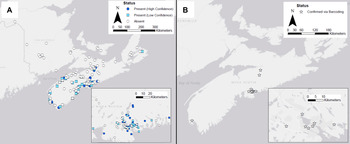
We determined that symptoms of the daylily gall midge occurred in the province of Nova Scotia, but no symptoms were recorded outside of Nova Scotia (Fig. 1A). Of 232 total respondents who provided data, 50.8% (118 respondents) reported no evidence of daylily gall midge. Of the 49.2% of respondents who reported symptoms, 40.4% of these reports (N = 46) were low certainty, where deformed flower buds were observed but maggots were not. The remaining 59.6% of positive reports (N = 68) were high-certainty cases, where the dissection of malformed or misshapen flower buds revealed numerous maggots.
Map demonstrating the geographical representation of the daylily gall midge symptoms spread within Maritime Canada: A, responses from the survey, where observations submitted by community scientists were classified as pest absent (no symptoms detected), pest present (low confidence) – where deformed daylily flower buds were detected but maggots were not observed – or pest present (high confidence) – where misshappen or malformed daylily flower buds revealed numerous maggots; B, confirmed occurrences of the daylily gall midge based on DNA barcoding of samples.

DNA barcoding
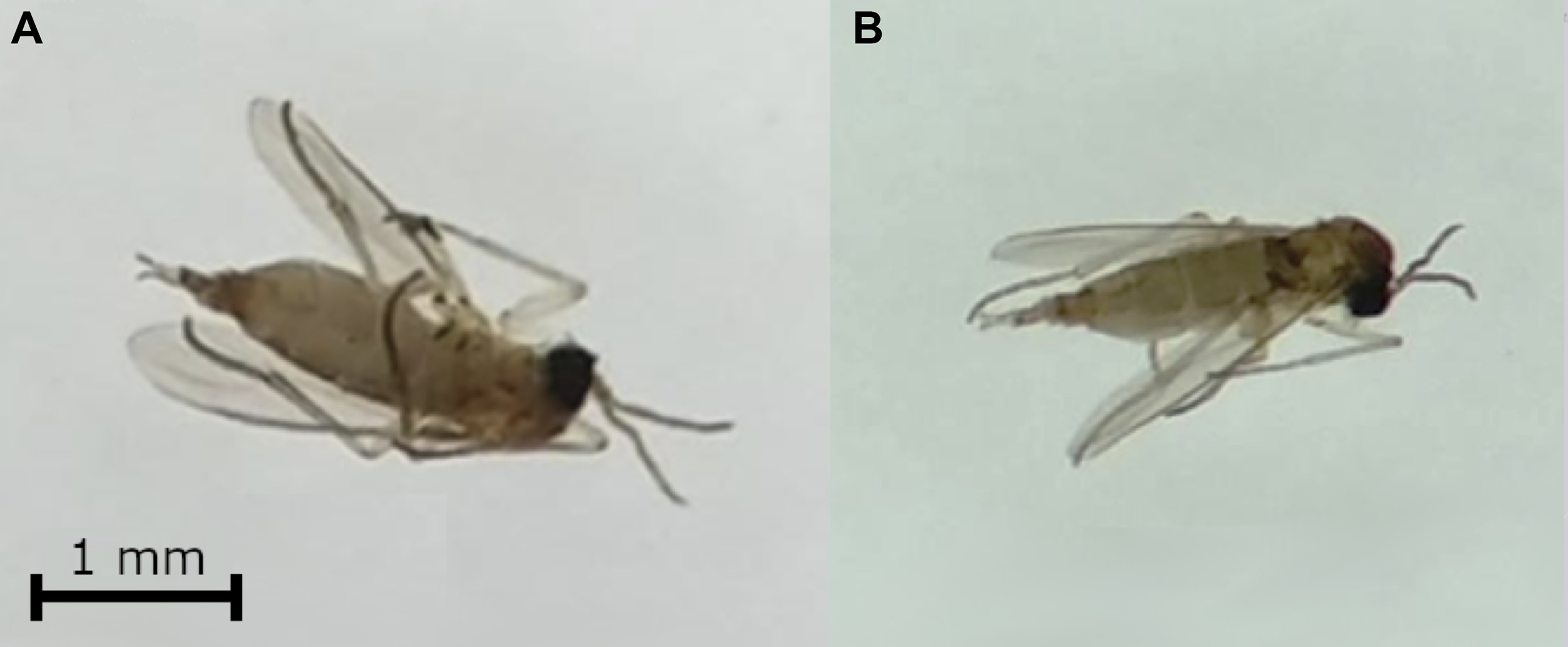
We received 13 samples of daylily buds infested with larvae. Twelve samples were successfully sequenced and queried on BOLD. Ten samples matched the daylily gall midge barcode sequences (BOLD: ADT3168), whereas two other samples matched Megaselia arcticae Disney (Diptera: Phoridae) sequences (BOLD: ADA3072). One of the adult flies reared from soil underlying infested daylily plants (Fig. 2) matched to the daylily gall midge. All sequenced samples matched with BOLD records at more than 99.2% probability of placement.
An adult specimen of the daylily gall midge (Contarinia quinquenotata) reared from a soil sample from a garden in Brookfield, Nova Scotia. Barcoding of DNA confirmed the sequence was 100% identical to the daylily gall midge record in the Barcode of Life Database (BOLD: ADT3168). Photograph taken from compound microscope (ZEISS Stemi 508 Stereomicroscope; Carl Zeiss Canada Ltd., Toronto, Ontario, Canada) showing A, a ventral view and B, a dorsal view. Scale bar is approximate.

Samples that matched with the daylily gall midge through DNA barcoding represented a smaller geographic range than did the records submitted by community scientists (Fig. 1B). Samples were clustered in the Halifax Regional Municipality, with other samples occurring in Yarmouth County (1) and Colchester County (2). Nucleotide sequences for Contarinia quinquenotata and Megaselia arcticae are available on GenBank (accession numbers MZ188753 and MZ188754, respectively).
Trait susceptibility
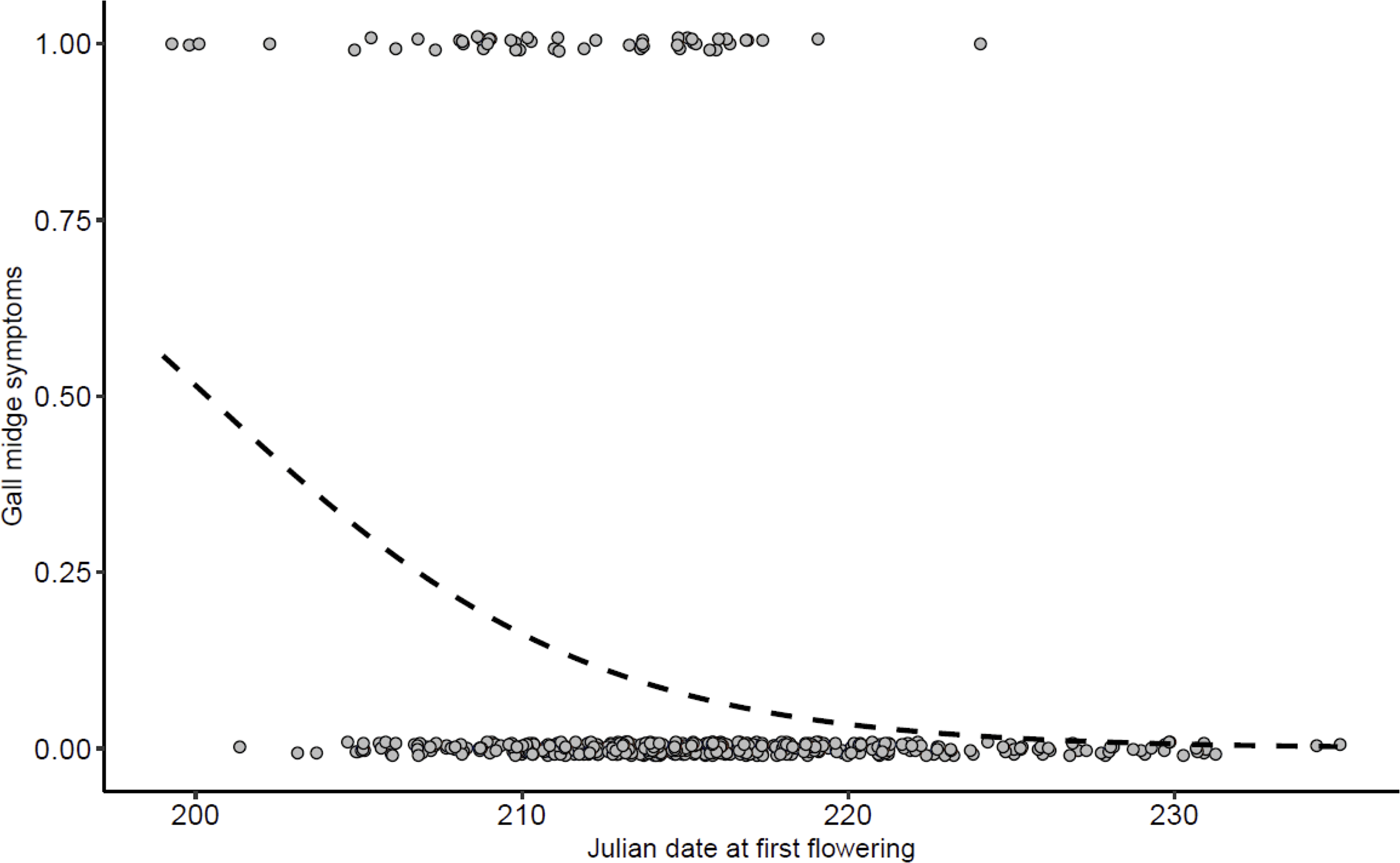
Using a logistic model, plant phenology significantly affected the likelihood of being infected by the gall midge (Wald’s X 2 = 26.99, P < 0.001). We found that early-blooming varieties are more likely to be affected by gall midge than later-blooming varieties (Fig. 3). The logistic model revealed that the odds of a daylily variety being attacked by the gall midge decreased 16% with each day that the date of first bloom was delayed (OR 0.84; 95% confidence interval: 0.79, 0.90).
Logistic model of daylily (Hemerocallis spp.) flower phenology, as estimated by date of first bloom in the common garden in summer 2019. Each point represents a registered daylily variety. The likelihood of a daylily variety showing symptoms of the gall midge decreased 16% per day, demonstrating that earlier-blooming varieties are more susceptible to the daylily gall midge than later-flowering varieties.

Using a multiple logistic model, we determined that neither plant height (Wald’s X 2 = 0.006, P = 0.93), flower width (X 2 = 0.03, P = 0.85), ploidy level (X 2 = 0.76, P = 0.38), nor location within the garden (X 2 = 15.0, P = 0.09) significantly affected the likelihood of a plant displaying symptoms of gall midge. The likelihood of a plant showing symptoms of the gall midge was significantly affected by flower colour (Wald’s X 2 = 4.81, P = 0.028). Plants with predominately yellow flowers were nearly twice as likely to be affected by the gall midge than nonyellow flowers were (OR 2.00; 95% confidence interval: 1.08, 3.72).
Discussion
Through community science, we confirmed that the daylily gall midge occurred within the Canadian province of Nova Scotia. Despite our efforts to target all three Maritime provinces, we had minimal participation from the provinces of New Brunswick (15 records) and Prince Edward Island (three records). Although these survey efforts detected no evidence of daylily gall midge, our sample was too small to make any meaningful conclusions. Because daylilies are widely planted and traded, it is likely that this pest may be more widely established in the region than our data suggest. Without sufficient sampling effort, species may evade detection even when they are common and relatively abundant (Harvey et al. Reference Harvey, Qureshi and MacIsaac2009). Many factors can bias community science–based studies (Bird et al. Reference Bird, Bates, Lefcheck, Hill, Thomson and Edgar2014), such as a higher likelihood of reporting positive detections of a pest relative to reporting absence of a pest.
Although community science has become a widely used tool for monitoring pests such as the brown marmorated stinkbug, Halyomorpha halys (Maistrello et al. Reference Maistrello, Dioli, Bariselli, Mazzoli and Giacalone-Forini2016), ensuring that contributed data are of high scientific quality is a major challenge (Kosmala et al. Reference Kosmala, Wiggins, Swanson and Simmons2016). Our approach of assigning different levels of confidence (i.e., survey reports with and without maggots present in infested buds) can help better contextualise what the findings mean. An approach that has been widely used to validate observations is through voucher specimens, which can later be confirmed by expert verification (Delaney et al. Reference Delaney, Sperling, Adams and Leung2008), or by diagnostic tests such as DNA barcoding (Dörler et al. Reference Dörler, Kropf, Laaha and Zaller2018). Soliciting, collecting, and sequencing a larger number of samples from across the region would be a useful next step to better understand the extent to which this pest occurs.
Through the use of DNA barcoding, we detected a second dipteran species, Megaselia arcticae Disney, within daylily flower buds. Megaselia is the most diverse genus within the Phoridae and includes at least 1500 species. Flies within this genus have numerous different life histories and may act as detritivores, parasitoids, herbivores, or predators (Disney Reference Disney1994). Megaselia arcticae was described from samples collected in Zackenberg in Arctic Greenland (Disney Reference Disney2004), but nothing has been published about its life history. Although we determined using DNA barcoding that the larvae of this insect occur in damaged Hemerocallis flower buds, this method cannot infer any details about the ecological role or habits of this species.
Although our study of phenology was limited to a single location, in agreement with findings by the Royal Horticultural Society (2020), we determined that earlier-flowering varieties are more vulnerable than later-flowering varieties to daylily gall midge. This is likely because the gall midge is an early season pest. Additionally, we found that yellow daylily varieties were more likely to be affected, which is again in agreement with available evidence (Royal Horticultural Society 2020). To avoid major pest problems of the daylily gall midge, choosing later-flowering varieties can provide significant benefits to individual gardeners. Because there are more than 90 000 registered daylily cultivars, for most gardeners, the impacts of this pest can be avoided by planting varieties that are less susceptible to gall midge attack. Degree-day modelling of the emergence of this pest alongside the bloom time of widely grown cultivars could also help to confirm this hypothesis.
A report by Halstead (Reference Halstead2012) trialling the efficacy of three systemic insecticides demonstrated that the use of thiacloprid reduced gall midge–infested flower buds 4.9-fold relative to a distilled-water control, but the author cautioned that treating plants may pose risk to pollinating insects. Because the level of infestation in controls in Halstead’s (Reference Halstead2012) study reached only 14.7% of all flowering buds in the susceptible cultivar “Cynthia Mary”, tolerating moderate losses of daylily flowers could provide a useful perspective. Unlike other invasive garden insect pests, such as the emerald ash borer, Agrilus planipennis Fairmaire (Coleoptera: Buprestidae), or the spotted lanternfly, Lycorma delicatula White (Hemiptera: Fulgoridae), that kill plants, daylily gall midge is considered and treated by most jurisdictions as a minor pest.
Our study reveals that this pest occurs in some parts of Nova Scotia; therefore, gardeners should take precautions when purchasing plants to prevent the spread of the pest. Small-scale trade of ornamental plants is generally not subjected to the same regulatory oversight as the trade of agricultural plants. As with many other pests, the long-distance movement (e.g., more than 10 km) of gall midges typically occurs via the movement of infested material rather than via natural dispersal. The midge’s poor dispersal ability is indicated in Halstead’s (Reference Halstead2012) insecticide study, which failed in its first year because no gall midge colonisation occurred despite a heavily infested patch of plants located less than 50 m from the trial. Although dispersal distances for this species are not available, other Cecidomyiid midges typically exhibit limited active dispersal ability. For example, Briggs and Latto’s (Reference Briggs and Latto2000) study of the coyote brush bud gall midge, Rhopalomyia californica Felt (Diptera: Cecidomyiidae), revealed that the species’ adult females moved on average 1.7 m during their short adult lifespan. However, when a host plant is abundant within a landscape, gravid females undertaking passive dispersal (i.e., travelling on wind) can be successful: Kolesik (Reference Kolesik1993) found that the lentil gall midge, Contarinia lentis Aczel, could disperse up to 300 m on wind currents.
Preventing this pest from establishing within gardens is more easily achieved than its eradication or management. Gardeners can reduce the risk of introducing the pest to their gardens and limit its continued spread when buying, trading, and selling daylily plant material. The use of bare-root material eliminates spread of the pest overwintering in the soil, whereas selling plants without flowering buds (i.e., dormant material) can further reduce the risk of accidental pest movement. Plant hygiene, as always, is important to practise in preventing further spread of horticultural pests. If the gall midge has become established, removal and destruction of infested buds are crucial to reducing the severity of symptoms in the subsequent year (American Daylily Society 2018). Through conversations with gardeners throughout the region, numerous destruction methods were trialled, including soaking buds in hot soapy water and burning. Freezing may also be a suitable option; although many of the samples we received by mail were alive when they reached our laboratory, none survived prolonged freezing at –20 °C.
In the Canadian Maritimes region, the daylily gall midge was first detected by gardeners. Gardeners and other members of the public are regularly credited with the first detection of invasive pests. A study by Looney et al. (Reference Looney, Murray, LaGasa, Hellman and Passoa2016) reported that more than one-third of invasive insect pest detections in the state of Washington, United States of America in 1990–2014 were made by members of the public. Through collaboration and outreach, we show that it is possible to build on such detections to confirm the presence of an introduced pest, to better understand the spatial extent of the problem, and to use diligent record keeping to answer research questions. Working alongside gardeners through community science is a useful strategy to better understand the significance and ecology of horticultural pests.
Acknowledgements
The authors are grateful to all community scientists for their participation, without whose enthusiastic involvement this study would not have been possible.
Author contributions
All authors collaboratively conceived and designed the study. PM and AC developed and distributed surveys. KR and AC completed laboratory work. HJC collected data for the common garden experiment. PM, KR, and AC analysed and interpreted data. PM, KR, and AC jointly wrote the manuscript. All authors proofread and approved the final manuscript.
Funding
This project was supported by the Nova Scotia Daylily Society, the Department of Plant Food and Environmental Sciences (Dalhousie University, Faculty of Agriculture), the Natural Sciences and Engineering Research Council of Canada (KR and PM), and the Killam Trust (PM).
Conflict of interest statement
The authors declare no conflict of interest.
Data availability
Data and accompanying code are available at https://doi.org/10.5683/SP2/MBI03E.