Introduction
Injuries are the third most important cause of overall deaths globally, and are the main cause of death among one- to 40-year-olds. Road traffic crashes are responsible for 25% of the injuries. Ninety percent of road traffic deaths occur in low- and medium-income countries (LMICs)Reference Peden, Scurfield and Sleet 1 , Reference Murray and Lopez 2 with the majority occurring before arrival in the hospital.Reference Mock, Jurkovich, Nii-Amon-Kotei, Arreola-Risa and Maier 3 It has also been shown that death was potentially preventable in a large proportion of those who died from road crashes before reaching hospital.Reference Hussain and Redmond 4 In Nigeria, road traffic injury (RTI) rate is estimated to be 41 per 1,000 population while the mortality is 1.6 per 1,000 population.Reference Labinjo, Juillard, Kobusingye and Hyder 5 It represents two-thirds of emergency surgical admissions and approximately 70% of trauma-related deaths in the emergency room.Reference Solagberu, Adekanye, Ofoegbu, Udoffa, Abdur-Rahman and Taiwo 6
Care of the injured from road traffic crashes starts before arrival in the hospital and it is believed that prompt and efficient prehospital care reduces morbidity and mortality from RTI.Reference Peden, Scurfield and Sleet 1 Prehospital trauma care systems have evolved over the years and essential elements include prompt communication and activation of the system, timely response, correct assessment, efficient treatment, and prompt transport of the injured to a formal health care facility when needed.Reference Mohan, Tiwari, Khayesi and Nafukho 7 In many countries, the Emergency Medical Service (EMS) is responsible for provision of prehospital trauma care employing Basic Life Support (BLS) and Advanced Life Support (ALS) focusing on fast and safe transport to trauma center. This service is well-established in many high-income countries, while many LMICs lack the basic infrastructure needed for effective EMS.Reference Peden, Scurfield and Sleet 1 Evacuation and transportation of the injured to hospital in these countries are often carried out by bystanders, relatives, or other volunteers in commercial or private vehicles.Reference Nantulya and Reich 8 , Reference Nielsen, Mock, Joshipura, Rubiano, Zakariah and Rivara 9
Nigeria does not have a national emergency health policy which could facilitate a national prehospital trauma care system. However, in some states, there are organized ambulance services located on some major highways to offer first-aid treatment and facilitate quick transport of accident victims to the hospital. A study conducted among road traffic injured patients presenting to four tertiary-level hospitals in South Western Nigeria showed that 91.4% did not receive any form of prehospital care and only 8.0% were transported in ambulances manned by untrained health workers.Reference Oluwadiya, Olakulehin and Olatoke 10 Lagos State Ambulance Service (LASAMBUS) was established in 2001 to provide prehospital care for trauma victims. Ambulances manned by health workers trained in BLS are stationed at strategic points along the highways to carry out effective triage, provide immediate first-aid treatment, and evacuate the injured to designated trauma centers in Lagos. A review of activities of LASAMBUS from 2001 to 2006 showed that an average of 5,000 patients were attended to annually, 90% sustaining trauma. Among those injured, 60% were treated at the site of emergency while the rest were transported to designated hospitals.Reference Adewole, Fadeyibi and Kayode 11
With a population of over 21 million, 12 Lagos State, arguably, is the most densely populated city in Africa and has the highest concentration of motorized vehicles in Nigeria. It is, therefore, desirable to highlight the burden of RTI in the city and assess the level and effectiveness of prehospital care, especially the role of LASAMBUS in provision of initial care and transportation of the injured to the hospital. This may assist in formulation of state policies towards improving trauma care and reducing morbidity and mortality from road traffic crashes. The aim of this study was to evaluate the magnitude of RTI and level of prehospital care of the injured patients seen at the Lagos State University Teaching Hospital(LASUTH) in Ikeja, the busiest tertiary care center in Lagos State.
Methods
A retrospective study of all road traffic injured patients seen at the Surgical Emergency Room (SER) of LASUTH from January 1, 2012 to December 31, 2014 was conducted. Approval for the study was granted by the Health Research and Ethics Committee of LASUTH.
Setting
The study was conducted at LASUTH, located in Ikeja, Lagos State. The state is the most densely populated in Nigeria, occupying a land mass of 3,577 km2 with Lagos metropolis constituting 85% of the populated area. The total annual Gross Domestic Product is approximately 91 billion United States Dollars (USD) and has a per capita income of USD 4,333, the highest in the country. It has a male population of 52%; 83% are less than 40 years old, and the literacy rate is 75%. 12 The hospital, which was upgraded from a General Hospital to a University Teaching Hospital in 2003 following the establishment of Lagos State University College of Medicine, has 750 beds. It has the busiest SER in Nigeria, receiving a monthly average of over 1,100 trauma and non-trauma emergencies. This is due to large population of the state, central location, and State Governmental policy of relatively free health care. Other public tertiary institutions where injured patients are treated are Lagos University Teaching Hospital, National Orthopedic Hospital, and Federal Medical Centre, Ebute Metta. These institutions are owned by the Federal Government of Nigeria and their emergency surgical patient load combined is less than the over 1,000 per month seen at LASUTH. Data for all patients presenting to the emergency room of LASUTH with injuries are captured in the Institution Trauma Registry.
Patients and Data Collection
All patients presenting to the emergency room with trauma from road traffic crashes during the study period were included in the study. These were those who sustained injuries from crashes involving motorized vehicles, pedal cycle, and train. Those presenting with injuries from other sources were excluded. Relevant data were extracted from the Trauma Registry database using pre-determined guidelines into a standardized electronic abstract form. Parameters extracted include: age; gender; date and time of injury; date and time of arrival in SER; host status; whether driver, passenger, or pedestrian; type of vehicle involved; and region injured. Information on how patients were brought to the hospital, whether by LASAMBUS, the Police, Federal Road Safety Corps (FRSC) personnel, relatives, bystanders, or brought themselves, also was recorded. Other parameters included whether patient was referred from another hospital or not, the diagnosis, and outcome in SER.
Statistical Analysis
Results were analyzed using Statistical Package for Social Sciences (SPSS; IBM Corporation; Armonk, New York USA) version 16 and are presented in tables and figures. Statistical comparison of categorical data was done using chi-square or Fisher’s exact tests and level of significance was set at <.05.
Results
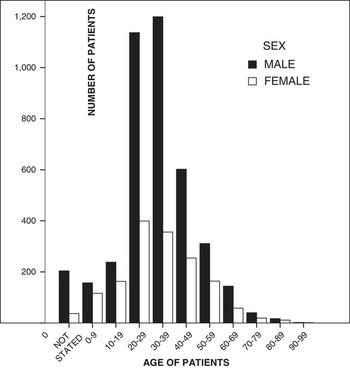
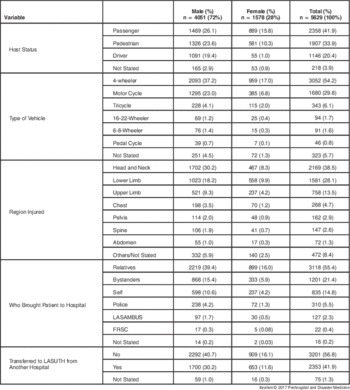
A total of 23,537 patients were seen at the SER during the study period. Among them, 16,024 (68.1%) sustained trauma, and road traffic crashes were responsible for the injuries in 5,629 (35.0%) of trauma cases. Age range of patients involved in RTI was from six months to 92 years with a mean age of 33.5 years (SD=14.60). Males among them were 4,051 (72.0%), while the remaining 1,578 (28.0%) were females, giving a M:F ratio of 2.6:1. Peak age incidence was in the third and fourth decades of life representing 55.0%. Figure 1 shows age and sex distribution of the patients. Characteristics of patients involved in RTI are as shown in Table 1. Apart from passengers who constituted 42.0% of the injured, pedestrians were the second most vulnerable population injured (34.0%). Four wheelers were the most frequent vehicle type involved in road crashes (54.0%), followed by motor cycles in nearly one-third. Head and neck, lower limb, and upper limb were the most injured regions of the body representing 40.0%, 29.0%, and 14.0%, respectively. Less than one-quarter (24.0%) presented to the emergency room within an hour following injury, while one-third arrived to the emergency room between one and six hours; three-quarters among them had not visited any hospital before coming to LASUTH.
Age and Sex Distribution of RTI Patients in LASUTH. Abbreviations: LASUTH, Lagos State University Teaching Hospital; RTI, road traffic injury.

Characteristics of Road Traffic Injured Patients in LASUTH

Abbreviations: FRSC, Federal Road Safety Corps; LASAMBUS, Lagos State Ambulance Service; LASUTH, Lagos State University Teaching Hospital.
Majority (55.4%) were brought to the hospital by relatives, followed by bystanders (21.4%). The Police and FRSC personnel statutorily responsible for bringing injured patients to the hospital brought 5.5% and 0.4% of the injured, respectively, while LASAMBUS, which is equipped with trained personnel to provide BLS, brought only 127 patients (2.3%; Table 1).
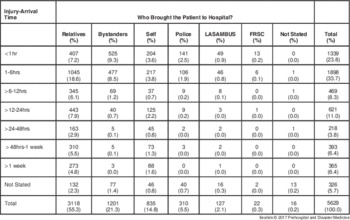
Table 2 shows injury-arrival time of the patients studied. One-quarter presented within one hour while another one-third presented between one and six hours following injury. Largest proportion of patients brought by FRSC (59.0%), Police (45.0%), bystanders (44.0%), and LASAMBUS (39.0%) arrived within one hour, while the greatest proportion of those brought by relatives (34.0%) and those who brought themselves (26.0%) arrived within one to six hours.
Injury – Arrival Time of Injured Patients Presenting to LASUTH

Abbreviations: FRSC, Federal Road Safety Corps; LASAMBUS, Lagos State Ambulance Service; LASUTH, Lagos State University Teaching Hospital.
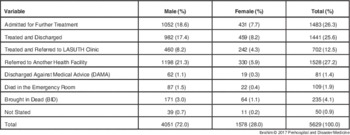
Early outcomes of the patients in the emergency room are as shown in Table 3. A total of 3,861 patients (68.0%) were attended to, while 1,528 (27.0%) could not be attended to due to lack of admission bed space and were transferred to other tertiary health facilities. Among those attended to, 1,441 (38.0%) were treated and discharged home; 702 (18.0%) were treated and referred to the relevant LASUTH clinic for follow-up; while 1,483 (39.0%) were admitted for further treatment. One hundred and nine patients (1.9%) died in the emergency room while 235 bodies were brought in dead.
Outcomes of the Injured Patients Presenting to LASUTH Emergency Room

Abbreviation: LASUTH, Lagos State University Teaching Hospital.
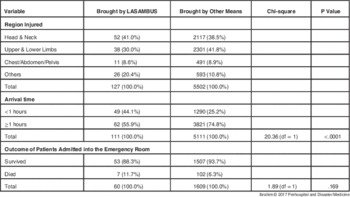
Effects of transportation of the patients by LASAMBUS to the hospital are as shown in Table 4. Majority of those brought by LASAMBUS had head and neck injuries, as against limb injuries which predominate among those who came by other means. Arrival time of those brought by LASAMBUS was significantly shorter than that for those who came by other means (chi square=20.36; P=.0001). There was no significant difference in deaths between those brought by LASAMBUS and others (chi square=1.89; P=.169).
Profile and Outcome of Patients Brought by LASAMBUS to the Hospital

Abbreviation: LASAMBUS, Lagos State Ambulance Service.
Discussion
The most vulnerable to RTI in this study are those between 20 and 40 years of age with males predominating. This finding is similar to reports from other parts of Nigeria and many developing countries.Reference Solagberu, Adekanye, Ofoegbu, Udoffa, Abdur-Rahman and Taiwo 6 , Reference Nantulya and Reich 8 , Reference Oluwadiya, Olakulehin and Olatoke 10 , Reference Paravar, Hosseinpour and Salehi 13 , Reference Macharia, Njeru, Muli-Musiime and Nantulya 14 Fatalities and disabilities from RTI also occur mostly in this active and productive age group with negative effect on the economy of the victim’s household and the country. Majority of the injured were passengers. They are the most injured in Africa, while in Asia and Latin America, pedestrians were found to be at higher risk.Reference Peden, Scurfield and Sleet 1 However, in developed nations, most deaths and disabilities from road crashes occur in drivers.Reference Nantulya and Reich 8 More than one-half of the crashes involved four-wheeler vehicles (ie, private cars, taxis, mini-buses, and light trucks) while one-third was caused by motorcycles. This is similar to a recent report from Ilorin, a city in central Nigeria.Reference Adeoye, Kadri and Bello 15 However, findings in a population-based study in NigeriaReference Labinjo, Juillard, Kobusingye and Hyder 5 and report from Abakaliki in Eastern NigeriaReference Madubueze, Chukwu, Omoke, Oyakhilome and Ozo 16 showed that motorcycles were the most frequent cause of road crashes. Similar findings were reported from studies conducted in other cities in developing countries.Reference Paravar, Hosseinpour and Salehi 13 , Reference Chalya, Mabula and Dass 17 In 2012, Lagos State Government enacted a new Road Traffic Law banning motorcycle and tricycle riders from plying the highways in the state. This may have contributed to the reduction in number of crashes from these motorized vehicles in Lagos.
Majority among the victims were brought to the hospital by relatives, bystanders, the police, and personnel of the FRSC and did not have any formal prehospital care. Studies in developing countries have shown that most of the road crash patients are brought to the hospital by relatives and bystanders, mainly in private or commercial vehicles.Reference Macharia, Njeru, Muli-Musiime and Nantulya 14 , Reference Chalya, Mabula and Dass 17 , Reference Solagberu, Ofoegbu, Abdur-Rahman, Adekanye, Udoffa and Taiwo 18 Only 2.3% brought by LASAMBUS were offered prehospital care by medical personnel trained in BLS. Access to prehospital care is grossly inadequate in many LMICs. A survey conducted in some countries by Nielson et alReference Nielsen, Mock, Joshipura, Rubiano, Zakariah and Rivara 9 showed that ALS facilities during transport were available to a significant number of persons in South Africa and Panama, while BLS capabilities were available to more than one-half of people only in South Africa and Gujarat State in India. In Kenya, only four percent of people injured reported having received first aid from trained personnel at the crash site,Reference Macharia, Njeru, Muli-Musiime and Nantulya 14 while in Tanzania, none of the patients received any prehospital care.Reference Chalya, Mabula and Dass 17 However, a report from Iran revealed that approximately 14% of the injured were transported by ambulance and 10% were rescued by trained personnel.Reference Khorasani-Zavareh, Haglund, Mohammadi, Naghavi and Laflamme 19 In contrast, nearly all the injured patients in advanced nations have access to formal prehospital care provided by the EMS.Reference Yeguiayan, Garrigue and Binquet 20
A study conducted by Hauswald et alReference Hauswald and Yeoh 21 showed that establishing EMS in low-income countries similar to those in the developed nations may not be cost-effective, mainly because of poor resources and communication facilities. In these countries, most injured people are transported to the hospital by commercial vehicles;Reference Nantulya and Reich 8 , Reference Nielsen, Mock, Joshipura, Rubiano, Zakariah and Rivara 9 , Reference Macharia, Njeru, Muli-Musiime and Nantulya 14 , Reference Chalya, Mabula and Dass 17 therefore, building on the existing informal mode of prehospital transport by giving drivers of these vehicles training in first-aid has improved access to first-aid at the site of a crash.Reference Mock, Tiska, Adu-Ampofo and Boakye 22 In this study, 75% of the injured were transported to the hospital by either relatives or bystanders who acted as first responders. Training different groups like school teachers, community volunteers, and uniformed personnel like the police, fire fighters, and road safety corps members in basic first-aid has the potential of improving prehospital care in low-income countries.Reference Nielsen, Mock, Joshipura, Rubiano, Zakariah and Rivara 9 In areas of Cambodia and Iraq infested with landmines, a program of widespread first-aid training and provision of basic supplies to a network of thousands of village volunteers was instituted. This initiative resulted in a sustained reduction in mortality among victims of landmine and other types of injuries from 40% to eight percent.Reference Husum, Gilbert, Wisborg, Heng and Murad 23
In developing countries, there are different levels of organization for EMS systems. In Vietnam and Colombia, there are national policies on EMS, while in others like Ghana, South Africa, and Pakistan, ambulance services are organized at national, regional, and local levels. Facilities for communication between the emergency care provider and the receiving hospital also vary among the countries.Reference Nielsen, Mock, Joshipura, Rubiano, Zakariah and Rivara 9 Lagos State Government pioneered the establishment of ambulance service to provide prehospital care for injured patients in Nigeria. It has an efficient radio-communication network linking the public, LASAMBUS, emergency rooms in LASUTH, and other designated General Hospitals and the Ministry of Health, with a dedicated emergency toll-free phone hotline. Findings in this study showed that only 2.3% among the RTI patients were brought to the facility by LASAMBUS. Although, 15% among the victims brought themselves to the hospital and are unlikely to have life-threatening injuries, it is obvious that the current 20 ambulance points spread across the state is inadequate and unable to cope with the large number of vehicle crash victims in Lagos.
One-quarter of the injured in this study arrived to hospital within one hour. This proportion is lower than that reported from Kenya where one-half of the victims arrived to hospital within 30 minutes, while 72% arrived within an hour.Reference Macharia, Njeru, Muli-Musiime and Nantulya 14 Although arrival time of victims brought by LASAMBUS was significantly shorter than that for others, the proportion of those arriving within one hour among them is low compared to a report from Iran where 99.5% of EMS conveyed victims of RTI in the city of Urmia got to the hospital within 20 minutes.Reference Bigdeli, Khorasani-Zavareh and Mohammadi 24 Lagos city is noted for traffic congestion with consequent slowing of vehicular movements. This factor may have contributed to the arrival time in this study. A similar observation was made in Tehran, capital city of Iran, where arrival time of victims to the hospital was longer than that in other smaller cities.Reference Modaghegh, Roudsari and Sajadehchi 25 A possible solution to this is the use of air ambulance. However, the cost of establishing Helicopter Emergency Medical Service is beyond what many developing countries can afford. Presently, Lagos State Government has constructed a helipad in front of the SER in LASUTH to facilitate air ambulance services. There are plans to acquire air ambulances to cater specifically for victims during disasters with mass casualty. Majority of the patients brought by LASAMBUS had head and neck injuries. These injuries are often fatal. There is a need to strengthen the functions of this ambulance service, especially in the provision of prehospital care to these critically injured patients to improve their outcomes.
Limitations
Although efforts were made to have accurate and complete data entry into the trauma register by employing trained and experienced research personnel for data handling, there were patients with missing data which could cause selection bias in the study. However, the proportion of these patients was small considering the relatively large study population. Cases with missing data were excluded from statistical analysis. Another source of concern was invalid data entry. To minimize this, data variables were well-defined for ease of interpretation. The research personnel were trained and also monitored to ensure accurate data entry.
Conclusion
Among the victims, less than three percent had formal prehospital care offered by medical personnel trained in BLS and were brought to the hospital by LASMBUS. Overwhelming majority who did not have access to formal prehospital care were either brought to the hospital by relatives, bystanders, the police and personnel of the FRSC, or brought themselves. Increasing the number of ambulance points on the highways and other major roads in Lagos requires resources that may not be readily available. Training selected groups in the community and uniformed personnel who are likely to be first-responders in basic first-aid may be a more feasible and cost-effective measure to improve prehospital care in this setting. The target group could be commercial vehicle drivers, teachers, the police, fire fighters, and road safety personnel. Enhancing the functions of the present ambulance service by improving the infrastructure and manpower to cater for a larger proportion of the critically injured is desirable to reduce mortality and morbidity from road crashes in Lagos. In addition, establishing a national emergency health policy which could facilitate national prehospital trauma care system requires attention.