INTRODUCTION
A major challenge statesmen have confronted in their initial attempts to promote modernization has been how to impose rules that will transform peoples living at society's fringes from potential threats into legible, taxable subjects. In East Asia and Southeast Asia, these peoples included hill minorities, nomads, sea gypsies, mobile floating villagers, forest dwellers, and various outcasts who tended to be beyond the state's reach (Scott Reference Scott2009).Footnote 1 Siam's conscription law of 1905, for instance, refers to the “people of the forest and mountains (khon pa khon doi)” who were exempt, which signified the state's inability to extend control to those fringe societies (Koizumi Reference Koizumi1999). So long as these peoples remained subservient and politically marginalized, the state was free to leave them alone or engage them on an ad hoc basis through sporadic trade. However, as natural resources in the peripheries became more important, these groups became impossible to ignore, since they often either stood in the way of the state expropriating the resources or became indispensable as laborers needed to exploit them.
What interests us here is the diverse approaches that different states developed to their relations with peripheral societies in the resource economy. One fundamental variable was the degree to which states adopted inclusive or exclusive approaches to them—while some attempted to solicit their skills and labor to help manage resources in their territories, others denied indigenous communities any constructive role. Toward one end of the inclusive-exclusive spectrum was the Japanese state, which offered people at the fringes material incentives in exchange for conserving state forests, and acknowledged their existing customs regarding resource use and extraction. Toward the other end was Siam (since 1939, Thailand), where the state was consistently more exclusionary and even oppressed indigenous societies. This article takes these two societies as representative of the contrasting approaches, and explains why they diverged in the ways they did.
The contrast is puzzling given the way in which each country is typically characterized. In most literature, Japan is generally portrayed as a successful state that carried out institutional reform in pursuit of strong developmental goals, while Thailand has been portrayed as “weak” or at most moderate (Siriprachai Reference Siriprachai2012). Larsson, for example, compares the modernization experiences of the two countries and concludes that Siam's “general institutional development remained surprisingly weak” (Reference Larsson2008: 2). Doner, Ritchie, and Slater argue, “Thailand's ruling elites faced less systemic vulnerability than elites in Japan,” and that their “fortuitous position as a buffer between the French and the British allowed Thai monarchs to preserve national sovereignty through negotiations rather than war” (Reference Doner, Ritchie and Slater2005: 349).
If heightened external threats facilitated Japan's development of a strong state, then why did that state turn out to be so willing to negotiate with people with regard to resources use, while Siam's maintained top-down policies that recognized no customary rights to resources? In my comparison of the two countries, I will highlight the ethnic-labor, bureaucratic, and agro-ecological conditions that, I assert, together explain their different orientations. In particular, I argue that in Japan the labor force in the resource sectors was more embedded, and this made it necessary for the government to engage with people on the periphery. In Siam, by contrast, the valued natural resources were enclaved, and this allowed elites to establish a distinctively exclusive system.
My general argument is this: humans and nature both become resources as exploitation penetrates peripheries that were once beyond the state's control. As the state comes to dominate inhabitants through the mobilization of labor and resources, the relation between people and resources is inverted. Local populations that were formerly served by the resources, particularly in peripheral regions, are now mobilized to serve up resources to the centralized state. People can come to serve the state in different ways, however, for reasons that I will examine here.
I selected Japan and Siam as my case studies for three reasons. First, both states began their modernization processes around the same time in the late nineteenth century, and they continued until decentralized political structures and agriculture-based economies with rigid class systems prevailed. Second, neither state was colonized, which implies that a reasonable part of the relatively autonomous interactions between the states and the societies remained in place. Third, both states faced severe pressure from Western powers to open their borders to free trade, and both selectively recruited Western advisors and technicians in order to absorb Western technology and promote rapid modernization.Footnote 2 Many others have compared these two countries,Footnote 3 but most studies have been preoccupied with the pace of modernization, and for this reason their analyses are based on the state as a whole; many aspects of centralization within each state have been left unexamined. In what follows, I will tease out the contextual factors that led these states to adopt their particular approaches to resource policy, which have in turn had lasting effects on each society and its relationship with the state.
The late nineteenth-century modernization period saw the emergence of unified, economically robust states pursuing coherent internal and external political agendas. Not surprisingly, societal groups in many country contexts resisted these trends. The resulting dynamic of state-society interaction came to shape the evolution of political institutions in important ways. Instead of treating “the state” as a single entity, therefore, I follow the analytical tradition of state-in-society, in which the process of state engagement with other social forces “highlights the mutual transformation of the state and other social groups, as well as the limitations of the state” (Migdal Reference Migdal, Lichbach and Zuckerman1997: 222).Footnote 4 This state-society framework is appropriate for examining our two cases.
After World War II, the trajectories of Siam and Japan diverged more, and the effectiveness of comparing them begins to break down. At that time Japan embarked on a developmental path that introduced a quite radical reform in land tenure, and from the 1960s onward Japan's resource use was increasingly externalized, and this, too, transformed state-society relations (Sato Reference Sato, Toyoda, Sato and Nishikawa2011). That the forest cover of Japan remains at 70 percent today, while that of Thailand declined from 60 percent in the 1950s to 20 percent in the 2000s, is due not to rigid forest protection in Japan, but rather to the under-use of resources there, while in Thailand forest clearance continues to generate economic rents. Their different demands on these resources have had a considerable influence on the structure of state-society relations.Footnote 5
A wealth of historical material has accumulated about Japan's and Thailand's struggles over the utilization and protection of natural resources across the past hundred years. Although the central agendas of both states carried different emphases regarding various aspects of resource utilization, the basic tensions between the state and society over resource control remained, and common political circumstances surrounded them. That both Japan and Siam avoided direct colonization is one indicator of their success in handling their transitions externally. Internally, though, in each country the centralization of control over resources had dissimilar effects on how resource-mediated relations between the state and society developed.
The role of natural resources in processes of modern state-building remains surprisingly understudied. Despite recent environmental concerns, such as CO2 emissions, biodiversity, and climate change, and worries over the uneven distribution of benefits accruing from natural resources and its political ramifications—civil wars, corruption, rent seeking, and the like—few scholars have analyzed links between natural resources and the formation of particular types of state-society relations in the context of Asia.Footnote 6
Theoretically, this article engages the literature on state formation, especially that on the theme of strong and weak states (Migdal Reference Migdal1988; Tilly Reference Tilly1990; Wade Reference Wade1990; Bates Reference Bates2001). Mainstream scholarship has tended to emphasize the capacity of a state to extract resources in the form of taxes as a measure of its strength, but we must recognize that different methods of extraction can have distinct social and political ramifications.Footnote 7 The article is also a partial critique of the literature on notions of a “resource curse” (Ross Reference Ross1999; Dunning Reference Dunning2008), which is most attentive to the use of the revenue created from resources while ignoring the labor processes connected to the materiality of the resources in question.Footnote 8 Kurtz, referring to the experience of Latin American countries, does claim that the absence of a labor-repressive relationship to production is critical to the long-run development of effective governmental institutions (Reference Kurtz2009: 485). He is particularly attentive to the mechanisms by which labor is recruited and employed in production. Yet while his focus on labor is a promising approach, the picture derived from evidence from Asia looks far more complex than that which Kurtz has drawn from his Latin American case studies. The question is not simply one of whether coercion is present or absent. There is usually a gradient ranging from exclusionary policies to a compromised handover of resources to the people, which can vary over time. The more important question is what exactly repressive policies bring about. Unlike studies that take resource wealth (or poverty) as a given, and then explain the economic and political outcome, here I will explore the process of state struggles to institutionalize natural resources.
Although the need to focus on land-based resources seems to have faded in states that have experienced successful industrial and economic growth, the topic's continuing relevance is clear in recent debates in both Thailand and Japan over decentralization, community rights, and environmental rights (including community forestry and water governance). Around the world, resource questions have always been significant as the flipside of economic and political inequalities between urban and rural regions (Ribot and Larson Reference Ribot and Larson2005). Natural resources continue to generate intense state-society negotiations and relations, and understanding the historical roots of such relations offers a new window into why widespread inaction prevails in present-day policies of state devolution in regards the environment (Sato Reference Sato and Sato2013).
Here I focus on forests and mines since these two resource bases have attracted continued attention from the states in question and have also had significant effects on fringe societies. Furthermore, since utilization of these resources tends to be labor-intensive, they should have broad impacts on society throughout the production process. Capital-intensive resources such as oil and gas are quite different in this respect, and it is important to emphasize here that focusing solely on economic incentives provides an unsatisfactory understanding of why states decide to control natural resources. In the two cases considered here, early administrative efforts prioritized mining and forestry despite their marginal contribution to state revenues. In Japan these accounted for less than 1 percent of the total state tax revenue throughout the Meiji period,Footnote 9 while commercial services and royalties from tin mining and forestry in Siam brought in only about 5 percent (Ingram Reference Ingram1971: 177). Nevertheless, the early establishment of resource departments within the Ministry of the Interior and Home Ministry suggests that these resources were seen to be of critical significance.Footnote 10 If states are revenue-maximizing agents (Levi Reference Levi1988), these paradoxical incidences point to previously overlooked aspects of statecraft.
STATE CENTRALIZATION OF NATURAL RESOURCES IN JAPAN
Resource Centralization in the Early Meiji Period
With Japan's high ratio of population to land, resource management was always of interest to the feudal lords who controlled each domain (han) until the Edo period (1603–1867). Rules shaped access to forests, water, minerals, and other resources available in each territory of the han. Farmers, as the main providers of taxes and labor, were tied to their land in each locality without freedom to relocate. Political revolution in 1867 ended the three hundred-year rule of the Tokugawa Shogunate, and once power was transferred to the emperor centralization rapidly followed.
Among the new policies the Meiji government introduced in 1868, none was as enduring as the land tax reform (chiso kaisei). First promulgated on 28 July 1873, this policy was a sweeping attempt to transform Japan's governance from a highly decentralized, semi-autonomous structure based on local and provincial rules into a social system built upon contracts between the state and individuals—that is, a single owner of a single piece of land.Footnote 11 Also radical was its replacement of the in-kind tax, which had been paid mostly in rice, with a monetary tax of 3 percent of the average net profit expected from the land, reckoned according to individual property assessments. Newly issued land certificates indicated not only the land's location and owner, but also its monetary value, which allowed it to be sold. This represented the new government's attempt to tax the population “equally,” that is, to establish a tax system that included not only farmers but also city residents and forest owners, two groups that fell outside the previous tax scheme.
Although farmland was the main focus of the new land tax reform, the government also targeted key mines as bases for promoting rapid industrialization. All major industrial facilities, along with weapons and shipbuilding factories previously controlled by individual han, were confiscated and placed under the authority of the newly established Ministry of Public Works (kōbushō). Gold, silver, and copper were given priority since they formed the foundation of the new government's finances and nation-wide currency system (Ministry of Trade and Industry 1966: 5). Export was another key area of industrialization; most equipment and machinery had to be imported from the West, which meant exports had to be increased. Here copper and coal were crucial, and between 1884 and 1898 over 81 percent of the copper produced in Japan was sent abroad (Asahi Shinbunsha Reference Shinbusha1999: 1221).
State Intervention in Forests
A little-recognized aspect of the land-tax reform is how it affected forestlands. As I have said, forests today cover close to 70 percent of Japan's land area, and the reform, despite its marginal contribution to taxes, affected the livelihoods of farmers in two important ways. First, because forests were important as a source of fertilizers and for animal grazing, the reform affected the farming communities at large. Second, the reform enforced a new demarcation of property in which the primary objective was to differentiate state-owned assets from those privately owned. This top-down reform left a large amount of land undefined, which later became a source of conflict. This division significantly impinged on the behavior of farmers, who had relied on local customs to manage forest areas communally. The intricate link between the farmers and forests ultimately made the state's intervention in forests a decidedly political issue.
Because markets for forest products had been limited under the seclusion policy (sakoku) and long-term investments were impossible, general awareness of the concept of “property” was weak, and this enabled the state to intervene into and exploit commonly held forests without facing much resistance (Fukushima Reference Fukushima1970). In view of this lack of awareness, it is easy to understand why the Japanese government, after initially declaring all forests without state-issued certificates of ownership to be “state forests,” decided to auction off a large portion of the state-owned forests to private parties (Resource Council 1960). This decision was triggered, in part, by the realization that the state was incapable of properly managing large portions of the state forests.
Due to the great diversity of local customs regarding the forests, of their geological characteristics, and of available products, it was difficult to establish a one-to-one system of individual property ownership for forests. This was unlike the situation for agricultural fields, where it was relatively easy to identify boundaries and owners. The public auction of unproductive wastelands was intended to procure quick revenue for the state from direct sales, and, since the government expected landowners to make the land productive, to secure a future tax-base. Yet the outcome was disastrous in terms of both the inequality and the conflicts generated, and also the damage to resources caused by over-exploitation. This massive handover of land to individuals also dealt a major setback to farmers who had relied on communal lands for which property rights were uncertain. Some 1.8 million of Japan's people lost access to communal lands in 1888, compared to 99,000 in 1879. Some of these people subsequently became involved in arson and illegal tree cutting (Resource Council Reference Scott1960: 79).
An increase in riots and uprisings forced the government to renounce its privatization policy on 20 July 1874. It was this abrupt shift in policy and the subsequent damage to the resource base that prompted the government to establish a centralized agency specifically responsible for governing the forests. The government introduced the enigmatic “public domain” system (kō yu chi), which gave municipalities the authority to accommodate local needs in state-owned lands. Although forests formed an uncertain tax base, they gained political importance, particularly since they supplied materials needed to develop Japan's navy, which was critical for combating Western powers.
In 1879, the Japanese government established the Forestry Bureau (sanrin kyoku) within the Home Ministry, responsible for promoting industrialization, a key policy goal of the new Meiji government. A pivotal figure in establishing this bureau was Toshimichi Ohkubo, who emphasized domestic stabilization over pursuing international interests. In addition to strengthening the police force for maintaining order, he promoted forestry as an important means of industrialization.Footnote 12 In his proposal for the establishment of the Forestry Bureau, Ohkubo emphasized that the “protection of forests is a central task of the administration of a national economy” (Nishio Reference Nishio1988: 38). He was explicitly referring to the European experience, particularly that of Prussia, where he had studied the forest administration system. Ohkubo pointed out that forests serve multiple environmental functions, such as protecting watersheds and acting as buffers against wind damage.
The centralization policy had ramifications far beyond the control of forests. Procurement of building materials for schools, hospitals, bridges, railroad beds, and ships now required state permission, because most of these materials were supplied from state rather than private forests (ibid.: 52). With the introduction of forestry science from Germany, forestry operations changed. The indigenous knowledge that had previously been relied upon was now seen to be largely irrelevant. The state's acquisition of private property destroyed many of the long-standing communal forest management systems (Niwa Reference Niwa1989).
Because local communities already used forest resources intensively, particularly for fertilizer, it was difficult for the government to dismantle these management systems.Footnote 13 In areas where forestlands came into the hands of the centralized state or large-scale landlords, farmers rioted to demand their rights, particularly to communal lands (iriai). While there had previously been uprisings against farmland taxation, these protestors were farmers fighting for the right to access land (Fukushima Reference Fukushima1970). Resistance often took the form of illegal, forceful encroachment on state property, which sometimes escalated to the indiscriminate felling of trees or arson, which had devastating consequences. Although there were occasional conflicts between mine workers and employers, confrontations over forests were a daily occurrence across much of Japan. This, and the elaborate penalty system established in most communal forests, both point to the general scarcity of Japan's forest resources, more severe than shortages in Siam during this period.
Faced with protracted resistance to state confiscation, unequal privatization of communal forests, and heightened demands for labor to manage the state forests, the initial centralization efforts gradually evolved into more inclusive policies that accommodated local needs (Ogino Reference Ogino1990). Triggered by the promulgation of the National Forest Law, around 1900 the government initiated a mechanism to co-opt farmers through “local facilities” (jimoto shisetsu), and this was gradually expanded. By 1926, 310 sites covering more than 40,000 hectares of state forests were commissioned to local people (Kikuma Reference Kikuma1980). In some prefectures, such as Akita, by 1937 local facilities were present in 70 percent of state forests (Kikuma Reference Kikuma1980: 492). This policy was initiated largely in response to the failure of earlier policies that had required forest users to have contracts in order to purchase non-timber forest products (Matsunami Reference Matsunami1920: 278). Local facilities handled the demarcation of forestlands for the specific purpose of transferring management responsibilities to locals in exchange for their having access to resources such as wood for fuel and grass for grazing. What we find, then, is a shift from a suppressive policy to an inclusive one based on a modern concept of forest management (Ogino Reference Ogino1990: 274).
Improving the livelihood of farmers was not the primary purpose of this policy, which was to secure control of national forests by eliminating timber theft and monitoring forest fires through local labor. Nevertheless, it did create space for a state-society dialogue. State promotion of “forest unions” was among the inclusive policies that became prominent after the amended Forest Law of 1908. These were formed throughout the country under guidelines of the Ministry of Agriculture and Commerce for the purpose of promoting protection of private forests (Matsunami Reference Matsunami1920: 189). With low-interest loans the government supported the activities of these unions in forest maintenance through thinning and branch trimming, reforestation, and public works to conserve the soil. There was a gradual transition from a policing type of administration to one that encouraged local initiatives in resources conservation and development (Resource Council 1960: 684).
State Intervention in Minerals
Japan has a long tradition of gold, silver, and copper mining dating back to the ninth century. But the major demands for these metals in the modern period came from international rather than domestic markets. Prior to the Meiji Restoration, mining activities had been controlled by feudal lords in each han, but after it all mines were placed under state control, and those wanting to extract ores had to obtain government permission. In 1873, the Japan Mining Law (nihon kōhō) further strengthened this policy by restricting landowners' entitlements to underground resources except for water (Morita Reference Morita2012). The centralization of mining activities was hastened by the state's need to secure metals for minting coins as part of establishing a unified currency system. The Meiji government also sought to obtain foreign currency through coal and copper exports.
Prior to the establishment of the Department of Mines (kōzan kyoku) in March of 1887, the administrative system of mines underwent a series of complex organizational changes. It started with the central government's take-over in Osaka of the administrative office for copper, the main export item, and then proceeded to an attempt to centrally regulate the circulation of copper through the issuing of licenses. Because of the sizable investments involved, mining administration was originally under the jurisdiction of the accounting office, but over the next several years it was transferred to various ministries, including Finance (ōkurashō), Civil Affairs (minbushō), Public Works (kōbushō), and finally, in 1886, the Ministry of Agriculture and Commerce (nōshōmushō). But inefficient production and the high costs of employing foreign technicians led the government to privatize key mines in 1889.
Labor disputes in the mining sector intensified around 1904 due to an economic downturn and the increasingly harsh working conditions. Thousands of miners in major copper mines at Ashio, Beshi, and other locations rioted and brought operations to a halt, and the government tried to suppress them with the police force (Ministry of Trade and Industry 1966: 396). From 1869 to 1898, twenty-eight of Japan's seventy-one labor strikes took place in the mines (Sasaki Reference Sasaki1971: 252). At that time, the majority of miners were farmers willing to work only in the fallow seasons, but as the mining frontier extended to deeper and more distant locations, worsening work conditions made mining unpopular among them.Footnote 14 Consequently, major mines, such as that in Miike, began to employ prisoners and Korean forced laborers, abundantly available even during the peak agricultural periods. The keen interest in industrialization, supported by state investments, created an insurmountable demand for skilled labor in mining operations, and the governance of mines soon became mired in the problem of securing a steady flow of quality labor.
Japan's long tradition of mining meant that easily accessible minerals near the surface had been exhausted by the early Meiji period. Any major exploitation had to be conducted at deeper levels, and this had ramifications for the types of labor that could be mobilized. When prisoners were first employed in mining during the Edo period, their role was limited to water drainage and transportation because they lacked skills needed for tasks such as refining and pitting. But the rapid introduction of Western techniques and mechanization eliminated the need for manual water drainage, and prisoners were increasingly sought for jobs such as digging and transportation in the deep pits, where mechanization lagged. The extreme, inhumane work conditions in the mines were first publicized in 1889 by Matsuoka Koichi, who conducted a “field inspection” of the Takashima coalmine in Hizen (Saga and parts of Nagasaki today). His report criticizing the dehumanizing conditions there sparked a government investigation. The state acknowledged the poor conditions and an important result was the introduction of the Mining Regulation (kōgyō jōrei) in 1890, which established guidelines for protecting mine workers' health and basic rights.Footnote 15
Another important element in the efforts to modernize the mining industry was the influence of foreign advisors (French, British, German, and American). Their activities targeted not only the technical aspects of mining but also reformation of management systems to eliminate the decentralized approach. The problem was that the highly decentralized decision-making system gave discretionary powers to local associations of craftsman (yamashi) that often lacked long-term plans and capital (Yoshiki Reference Yoshiki1979: 3). Foreign advisors recommended assigning the mine owners responsibility for management and converting the unstable contract-based workers into wage laborers (ibid.: 14).Footnote 16 While Japanese policymakers were careful in choosing which advice to take, the modernization reform did gradually transfer control of the mines to their owners, which eventually reduced the role of locally influential figures.
In sum, Japan experienced a series of abrupt shifts in centralization and partial decentralization within a brief period after the Meiji Restoration. Brought about partly by the frequent riots by farmers, these shifts revealed how hard it was to establish centralized control of resources in peripheral areas where government security forces remained inadequate. The relative weakness of the state in Japan's peripheral regions gave local people leverage in negotiations with authorities. Centralization of control over mining and mineral resources, therefore, was important because it not only established control over key economic resources but also ushered in state regulations for people who otherwise would have fallen outside the government's reach. Reflecting on a major riot in Ashio Copper Mine, the owner observed that one consequence was that “after the riot, the number of stationed policemen had increased by fifty to maintain order among the miners” (Nimura Reference Nimura1988: 339). State officials now controlled the welfare of mine workers, including prisoners and outcasts, and mine owners had to submit regular reports on labor and production. Over time, the state's provisioning of security and health services created a population that relied upon it.
STATE CENTRALIZATION OF NATURAL RESOURCES IN SIAM
A Gradual Centralization
As in Japan, Siam was a decentralized polity and some of its geographical regions were governed by locally influential feudal lords called Chao Muang until Prince Damrong Rajanubhab instituted changes to provincial administration in 1892. Yet Siam was far more decentralized than Japan in that the government in Bangkok had almost no control over the remoter provinces. The ruling elites perceived this lack of territorial integrity to be a problem only when France and Great Britain threatened Thai independence in the latter half of the nineteenth century (Bunnag Reference Bunnag1977: 14).Footnote 17 Similarly, the reaches of the provincial governments were limited to the immediate vicinities of central towns, and their main job was to “settle minor disputes and to judge minor cases” (ibid.: 24). H.G.Q. Wales, who served as an advisor to the Siamese government, noted, “Beyond the confines of the kingdom proper were the tributary states governed by their own sovereigns according to their own customs and religions” (Reference Wales1934: 107). In the process of centralization the central government had no choice but to appoint local strong men as governors, who then appointed their own staff to administer district, commune, and village affairs (Bunnag Reference Bunnag1977: 23).
People in the northern states received protection, and acknowledgement of their usufruct rights, in return for providing corvée labor and paying taxes and tribute to the Chao (Sethakul Reference Sethakul1989). Local control was particularly strong in the north, where teak was abundant, and in the south, which had rich tin deposits. Imposing central control of such resources, by definition, meant controlling the local lords within the new system under the unified command of Bangkok. This task became even more complex when the Siamese government was confronted with the threat of colonization. But through measures such as land taxes, poll taxes, and state-paid salaries for officials dispatched from Bangkok to take over the rule of the Chao, the government transformed the feudal system based on local territorial power into one based on a nation-wide bureaucratic power.
Hoping to promote free trade, the British signed the so-called Bowring Treaty of 1855 with the Siamese government. It gave one-sided privileges to the British including free trade at fixed low rates of import and export duties, a guarantee of full extraterritorial powers, and the right to own land in Siam. The government thought the treaty unfair because it gave it no room to negotiate, but growing intimidation by the West forced it to overhaul the system of local resources controlled by feudal lords.
Unlike Japan, Siam suffered a shortage of labor due to its high infant mortality rate, and this made preservation of the nation's manpower a government priority. According to Wales (Reference Wales1934: 10), the labor scarcity hindered the government's ability to develop Siamese resources to their full potential.Footnote 18 As a result, slave raids were carried out among ethnic minorities, and professional Chinese slave hunters were periodically brought in. Slaves accounted for a fourth to a third of the total labor population (Thompson Reference Thompson1947: 214). The government had to elaborate a system of rights over human property since laborers required a more complex management system than did land (Feeny Reference Feeny1989). Conscripted people avoided state-mandated corvée labor through various means, including registration falsification, which occasionally weakened the king's authority (Koizumi Reference Koizumi1995).
One of the key administrative reforms initiated by King Chulalongkorn (Rama V, 1868–1910) was to transform the labor-based economy into a tax-based one. This allowed the monarch to “undercut the nobility's control over manpower and capture a greater share of the effective tax burden” (Feeny Reference Feeny1989: 291). As in Japan following the dismantling of the in-kind tax system, the Siamese government also worked to create a monetary-based economy.Footnote 19 The Land Title Deed Issuance Act of 1908 led to land tenure registration, and most tenure rights were concentrated in the central plains where rent-accruing rice fields were located (Ingram Reference Ingram1971: 66).
Even before land tenures were recognized as legal, natural resources and particularly forests played an important role in the nationhood of ancient Siam by delineating effective, if imprecise borders between sovereign states (Thongchai Reference Thongchai1994). As Thongchai shows in his analysis of boundary markings in early Siam, ambiguous demarcations were intolerable where tin mining and timber were located and so Siam and Britain had to establish formal agreements (ibid.: 54, 73).Footnote 20
Despite the great interest in controlling these resources, the monopoly over tin accounted for less than 0.2 percent of the annual revenue during the Rama II era, and during the Rama IV era the combined revenues from tin, iron, and teak contributed only 0.7 percent of the annual revenue (Wales Reference Wales1934: 231–32). Although the accuracy of these numbers is uncertain, we can safely assume that non-agricultural resources were relatively unimportant in terms of Siam's overall economy. Therefore, we must look elsewhere for explanations of why the government was so intent on centralizing control over them.
Percentage of Total Exports Accounted for by Four Commodities

Source: Ingram Reference Ingram1971: 94.
The state's interest in natural resources began to grow as more and more foreigners scrambled for concessions on teak in the north and tin in the south. The tin business, which primarily involved Chinese and British enterprises, caused no significant territorial disputes, but the teak trade was strongly beset by territorial issues, as described by Macaulay: “The growing importance of the timber trade was no doubt one of the reasons which determined the Siamese government to take more control of affairs in the north. Their idea no doubt was to get control of the Laos States of Northern Siam, but they proceeded gradually, not wishing at first to upset the reigning chiefs, though eventually they expropriated them and took the administration of Upper Siam entirely into their own hands” (Reference Macaulay1934: 59). In other words, the government was prompted to seek control of teak and tin not as commodities, but rather due to their geopolitical positions.
Formation of the Royal Departments of Mines and Forests
Tin was the only mineral that had been extracted on a large scale. A large part of Siam's tin output was controlled by a handful of powerful Chinese families connected to provincial governors (Falcus Reference Falcus, Devenport-Hines and Jones1989). There had been a long history of metal production in Siam, but capital-intensive development only began around the mid-nineteenth century with Chinese enterprises. People living in tin-producing areas in the south had long paid their taxes with tin (Wales Reference Wales1934: 200), and the first royal export monopoly established to supplement the Siamese economy was that on tin. However, most mineral resources that were known to exist in the late nineteenth century were not exploited until the British arrived. Although the government in Bangkok opposed the spread of British influence, it looked favorably on the Chinese. But unlike the Japanese government after the Meiji Restoration, Bangkok authorities had insufficient control of the leases, most of which were in the hands of local governors. A letter from Minister of the Interior Damrong Rajanubhab addressed to King Rama V clearly states, “Because there was no specific law for mine-related issues, all disputes that had occurred in the area had been judged arbitrarily by the court, which had no technical knowledge” (Rajanubhab Reference Rajanubhab1901).
The Royal Mines and Geology Department (later renamed the Department of Mines) was established in 1891 to give Bangkok authorities control over lease allocations. A German and a British advisor, who later became departmental chiefs, drafted a 1901 Mining Act that clarified the regulation of the industry. Herbert Warrington Smyth, a British geologist appointed as one of the Mining Department's first directors, wrote in his memoir Five Years in Siam: “There were a dozen or so big mining concessions in existence, covering in some cases a hundred square miles, a weariness of the spirit of their owners, on which, for the most part, no rents had been paid and no work had been done. They had been mostly granted to men of the concession-hunting type, whose sole objective was to sell their concessions as soon as possible for the highest price to some gullible company” (Reference Smyth1898: 33).
Against this background, King Chulalongkorn undertook to organize the license system, which he expected would ease the conflict between mining companies, provincial governors, and Bangkok (Krom Sapayakorn Tarani Reference Tarani1992). Among the new Mining Department's first tasks were to conduct geological surveys and draft a code of mining regulations to help the government secure tax revenue. The political effects of resource centralization should not be overlooked here; as Loos keenly observed in her introduction to Smyth's book, “Scientific knowledge, in the form of cadastral and mineral surveys of the areas, was a necessary step in the broader centralization and commercialization processes” (Reference Loos1994: xvi).
Chinese immigrants were the primary laborers in the mining sector (Ingram Reference Ingram1971: 210).Footnote 21 Conditions were harsh, and this forced companies to keep their wages high in order to attract workers (Skinner Reference Skinner1957: 110). Small-time Chinese mining companies needed a lease, and they paid a royalty of 10–16 percent to the government (Ingram Reference Ingram1971: 108). They had excellent knowledge of the country's mineral resources, and these were kept “secret, in hopes, no doubt, to gain advantages from it some years hence” (Malloch Reference Malloch1852: 22). The government did not initiate systematic efforts to replace Chinese laborers with Siamese nationals, or to train mining specialists in Siam (Krom Sapayakorn Tarani Reference Tarani1992: 183–92), until after the 1930s, when a strong nationalist mood prevailed in the country. So during the modernization period, mining in the south remained more or less an economic enclave free from government interventions except for indirect control through leasing.
What about forests? The Royal Forest Department was established in 1896, and the English forester H. Slade served as the first conservator of forests (Chao Krom Pamai) until 1901. The centralized control of forests was stimulated by the near exhaustion of teak forests in Burma despite a tightening of conservation measures, and by an expanding British demand for the wood. Prince Damrong Rajanubhab, who was instrumental in overseeing the Forestry Department under his Ministry of the Interior, recalled that contract disputes between Burmese timber merchants supported by the British counselor and local lords of the northern region as providers of the wood put great political pressure on the Thai side, and the government was compelled to take charge of the forests in order to “take forestry out from politics” (Ministry of the Interior 1952: 43). The king also targeted forestry as the avenue for centralizing the state control over the peripheral regions (Barton and Bennett Reference Barton and Bennett2010).
The main responsibilities of the department in its early years were survey work and inspection in collaboration with the Royal Survey Department. Its duties included monitoring the operations of dominant timber firms such as the Bombay Burmah Trading Corporation. The core policy aim was to preserve this revenue source by preventing activities that would damage the forests, and among the new Royal Forest Department's key tasks were marking trees selected for cutting, fixing lease boundaries, and settling disputes (Slade Reference Slade1901). Slade suspended the issuance of leases for at least six years in order to conserve the forests (Slade Reference Slade1897). Two resource agencies were set up within the jurisdiction of the Ministry of the Interior, attesting to the political significance of natural resources during this period.
The Bangkok government used the heightened level of forest resource exploitation driven by these new European firms to legitimize state management of teak resources. Macaulay wrote, “After a short time a regular Forest Department was established, and the Siamese Government justified the step to the chiefs by implying that with this measure the Europeans would be kept in line…” (Reference Wales1934: 60). The government skillfully exploited British and French intimidation as an opportunity to push centralization to an extent that otherwise would have been difficult.
In this period we find the architecture of resource governance being built upon the foundational assumption that local people were a hindrance to sustainable exploitation. Slade laid out the initial, key tasks of the department: “As soon as sufficient staff, both controlling & executive can be established, it is most important that attention be paid to the following: taking up reserves, fire-protection, planting, creeper-cutting, clearing of teak samplings, girdling, preparation of working plans and regulation of hill-clearing” (1901: 7). He characterized the agricultural practices of hill people as “wasteful,” and emphasized that regulation of hill-clearing was “most important and until some definite policy has been determined on, it will be impossible to estimate the teak areas at the disposal of the government” (ibid.). No recognition was given to traditional shifting cultivation practices, and the Forest Department under Slade made it clear that any unoccupied and unclaimed land in the north belonged to the king and the Forest Department (Mekvichai Reference Mekvichai1988). Such prejudices later became enshrined in the Forestry Law of 1941. No room was made for “native rights” in the evolving system of state resource control, and the long-term consequence was that an exclusionary resource policy was locked into place (Peluso and Vandergeest Reference Peluso and Vandergeest2001: 778).Footnote 22
Perhaps more importantly, governance was extended to include resource transportation (e.g., how best to transport logs to market), communication (how to secure effective translators in remote areas), and the political jurisdiction of the central government—the Ministry of the Interior, to which the Forestry Department was affiliated—and the Forestry Department headquarters, initially located in Chiang Mai.Footnote 23 Macaulay discerned that, in this way, forest administration became an important instrument through which the political center in Bangkok extended its influence to the northern frontier, gradually reducing the economic basis of the feudal lords:
For generations these chiefs (in Chiengmai, Lakon, and Nan) had been allowed to govern the country within their respective states without any control from Bangkok, though in theory their power was circumscribed. Therefore, it was not an easy matter to upset the old regime suddenly, with the reigning chiefs still alive. It also happened that all the chiefs were old men at the time the Siamese Government started its scheme of assuming control of the Laos States. This was around 1896 and coincided with the advent of H. Slade to start a Forest Department. Thus, it may be truly said, that it was through the Forest Department that the Siamese Government inaugurated the system, and this ended with their securing absolute control of the Laos States (1934: 65).
Not until 1938 did the state demarcate its conservation zones, to which local access was limited (Kitahara Reference Kitahara, Ken and Kitahara2010). These state-owned forest reserves subsequently became sites of conflict with farmers resisting the restrictions the state's conception of conservation imposed on their customary rights. The original style of resource governance emphasized “dos and don'ts,” such as termination of timber leases, and prohibition of cutting young trees, but it slowly developed into the demarcation of a range of permissible activities. For example, forest reserves could be used during certain periods, and forest products in protected areas could be harvested only for subsistence needs.
In Siam, then, resource management gradually evolved out of regional divisions that reflected both the geographical concentration of key resources (teak in the north, tin in the south) and the difficulty of imposing top-down centralization. As communications and transportation improved, functional divisions were imposed based on ministerial mandates, and regional offices became representative branches of central control, which was increasingly concentrated in the capital.
A COMPARATIVE EXPLANATION OF THE DIFFERENT SOCIETAL RESPONSES
Similar Beginnings, Different Outcomes
Both Japan and Siam began their modernization processes from largely decentralized political structures with class-based hierarchies embodying significant inequality among citizens. The governments of both states, where de facto autonomous feudal lords had traditionally governed individual territories, were worried about the expanding Western powers, and both believed rapid centralization and modernization were the only way to cope with this threat. Most importantly, both were hamstrung by inequitable treaties that restricted their options for autonomous development (Larsson Reference Larsson2012). A consequence of the 1855 Bowring Treaty was that by the 1930s 70 percent of Siam's trade and 95 percent of its modern economic sector was owned by foreign, mainly British capital (Somboon Reference Somboon, Sugihara, Phongpaichit and Baker2012: 11). In this context, centralized control of natural resources and a streamlining of property regimes were considered imperatives for rapid modernization.
Although forests and mines were only marginal sources of revenue, these resources were granted administrative importance for three reasons. First, from a bureaucratic perspective, they were seen as a latent source of domestic and international conflict that could severely harm the modernization process. Therefore, the state established itself as the legitimate mediator between private business interests, local people, and foreign groups. With the rising international interest in commodities, the state, particularly in Siam, took the Western threat as an opportunity to assume the role of central mediator of boundary disputes and gradually assumed the role previously played by the feudal lords in each locale. This shift accelerated centralized control over Siam's territorial space.
Second, government officials grew aware of an ecological scarcity that extended beyond the shortage of particular commodities. King Rama V's court became progressively more concerned about the scramble for concessions and the rapid depletion of the northern forests (Barton and Bennett Reference Barton and Bennett2010: 75). However, Siam's general abundance of land and forests made the local leaders less interested in protecting these as ecological units. Japan's concern for its resource base was more pressing. This is why, in the proposal recommending the establishment of the Forestry Department, Ōkubo Toshimichi made the case for involving local people in protection activities. Concern over forest destruction became even more salient in Japan around 1900, and the government, realizing that forest degradation was serious enough to mobilize local residents, began to encourage the formation of forest unions. In Japan, natural resources were seen not only as commodities, in terms of their immediate utility; they also provided a channel through which the state could penetrate local societies. This perspective was less evident in Siam.
A third reason natural resources were granted administrative importance was that their exploitation forced a confrontation between traditional institutions and those of the advanced West, and the state concentrated its efforts on replacing the former with the latter. While in Japan traditional forestry and mining techniques and the legal and institutional arrangements for resource governance selectively adapted to the Western style, in Siam European departmental heads ran the forest and mining departments during their formative years. In both cases, state officials considered natural resource development, which included technologies such as mapping, to be an advanced field where new knowledge could be applied. Technical orientation shifted resources from being a political issue to a scientific one, as demonstrated by the transfer, in both countries, of administrative jurisdictions from ministries of the interior to ministries of agriculture.
While Siam's and Japan's modernization efforts shared similarities, several key differences illuminate previously neglected dimensions of modern state-building. First, the Japanese government was quick to reverse its centralization policy and auction off key resources to the private sector, concentrating state resources in key industrial locations as pilot initiatives for modernization. In Siam, centralization was focused instead on building the government structure in Bangkok without handing over any land rights to private investors in the region. There were concessions of mines and forests, but unlike in Japan, where zaibatsu—industrial and financial business conglomerates—flourished via their involvement in resources development, in Siam no domestic actors dominated exploitation of the most important national resources.
A second key difference was that the Japanese government, enthusiastic about importing Western techniques in resource exploitation, was more proactive in installing legal instruments to protect laborers and provide services and incentive mechanisms to encourage locals to participate in state projects. In the forestry sector, to promote interest in state conservation projects, surrounding villages were given free access to gather grass and branches, while in the mining sector proactive labor protection policies were instituted. In Thailand, by contrast, the central government continued to dominate the control and allocation of resource access, and the question of whether to grant communal rights to forests was not even debated until the 1980s (Sato Reference Sato and Sato2013).
During the modernization of Japan, labor organizations among miners were strengthened rather than marginalized. Due to the widespread presence of middlemen and sub-contacting labor bosses, commands of the centralized state reached workers indirectly. This generated labor movements that sought legislative support from the state to bypass labor bosses and industrialists, which in turn facilitated the development of self-help organizations. One noteworthy local institution, called tomoko, developed among the Japanese mine workers that not only provided insurance for those injured and unable to work, but also served as a guild-like informal network for transferring skills. Mines tended to be abandoned after a few years of operation, depending on the ore's accessibility, which forced miners to move frequently. Some chose to relocate in order to learn new skills (Murakushi Reference Murakushi1998).Footnote 24 Tomoko represented a locally based, indigenous system that supported the relocation of skilled laborers and sought to guarantee that they would be treated respectfully at their next workplace. The widespread existence of this system speaks to the shortage of skilled labor in Japan at that time.
The growing ability of people to organize themselves led Japanese authorities to more strictly enforce political order, and this bred larger disputes in the 1930s as communist ideas spread among the lower classes. They were able to combat the authorities more effectively because they had a greater stake in the conflicts due to their property rights and protections of their community traditions, and they could marshal their stronger group consciousness to organize and mobilize.
The apparent state-society synergy seen in Japan was far from what some have romantically called “social capital” (Evans Reference Evans1997).Footnote 25 Literature on social capital “emphasizes the role of the civil society at the expense of the state” (Fine Reference Fine and Clark2007: 561) and tends to characterize social capital as a positive sum gain from the cooperation. But these self-help organizations in Japan were not aimed at helping each other maximize production but rather at minimizing risk and defending workers' basic livelihoods in one of the harshest professions of the time.
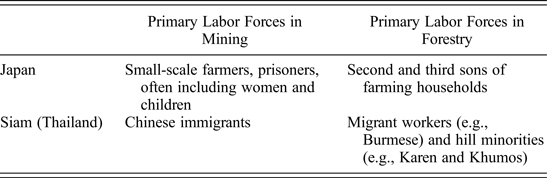
In Siam, on the other hand, Chinese laborers formed self-help, self-defense societies in defiance of the authorities, and these took on the character of secret societies (Cushman Reference Cushman1991; Baker and Pasuk Reference Baker and Pasuk2005: 48). While occasional revolts at times stalled the administrative reforms put forth by the king during the early years of modernization, they were rare in regions where local lords had been effectively co-opted by the Bangkok government via financial inducements (Ramsay Reference Ramsay1979). In the south, disputes and their settlement were primarily in the hands of the influential Khaw family, which the Bangkok government employed as a useful buffer against British influence in the border areas with Malaya (Cushman Reference Cushman1991: 43). Laborers were not only denied their communal rights to forests, but they had no legal backup from the government until 1956, when a labor law was first enacted and workers associations were given the right to organize and bargain collectively with employers (Mabry Reference Mabry1979).Footnote 26Table 2 summarizes the types of labor employed in the resource sectors in Siam and Japan.
Types of Labor Forces Employed in Mining and Forestry

Source: author
Possible Explanations
Three factors explain the differences between the two countries with respect to state-society relations in the natural resource sectors. First, in both cases ethnicity and labor conditions created a certain detachment between the state and society. The enclave-type mining and forestry operations in nineteenth-century Siam employed a predominantly segregated labor force that was semi-independent of state control. Mine and forest workers were primarily non-Siamese, such as Karen and Khumos from Indochina, and the central government was uninterested in improving their working conditions, particularly in the 1920s and 1930s when the nationalist mood was high (Thompson Reference Thompson1947: 230). Enclaves were also made possible by the lack of effective central authority. In Japan, by contrast, forest products were indispensable for peasant agriculture. Recognition that forests were intimately linked with agriculture necessitated a wider and much closer state-society interaction in the early stages of Japan's modernization process. The prolonged battle between the state and the people for control of communal forests (called iriai) was enough to convince leading governmental figures that a pursuit of top-down resource centralization was futile. Furthermore, worker shortages forced the state to take the initiative in improving labor conditions, or at least to respect customary labor organization among miners. Such state-society negotiations, evolving out of a combination of premodern customs and newer incentives provided by the Japanese state, were not carried out in Siam during this same period.
The second factor distinguishing the two states was a difference in bureaucratic mindsets regarding Western approaches to resource exploitation. While Japan's reform-minded bureaucrats were keen to promote modernization, they were also aware of its side effects due to their experiences in the West. Particularly so in the Home Ministry, where “social bureaucrats” played a leading role in legislating protective measures for factory workers (Garon Reference Garon1987: 230).Footnote 27 These bureaucrats cautiously selected elements from the spreading Western techniques of resource management. In Siam, though, high-ranking officials in resource departments were mostly Europeans who brought with them the mindset that resources should be exploited as efficiently as possible with little respect for local communities or their customs.Footnote 28
The third factor was a difference in the two states' agro-ecological conditions that affected land-based means of subsistence. In Japan, the longer history of resource exploitation, a general shortage of resources, and the wider variety of goods exploited all made forest products an indispensable part of agricultural life. In Siam, conversely, commercially valuable timber such as teak was the sole target of early forest management. There, mining focused on tin production and state involvement was limited, unlike Japan where mining was much more varied, including copper, gold, silver, coal, and iron. The diversity of resources exploited in Japan generated diverse traditions of management among the resource communities, while in Siam the top-down exploitation of certain resources, directed primarily by British interests, created one-way management with no respect for local customs. The perception of forests as a source of commodities, established during the modernization era, lasted until 1989 when Thailand was forced to abolish commercial forestry operations due to excessive logging.
We must ask whether the differences between Japan's and Siam's resource governance were in any way indicative of the state's capacity to “penetrate deep in the society,” which, as Levi (Reference Levi1988: 47) postulated, is a precondition of its extractive capacity. I would answer in the affirmative, but for a different reason than Levi gives. The state's capacity to penetrate is a function of state-society relations. In Japan, control of the mines depended on private enterprises and traditional workers' associations. The government's modernization process, heavily informed by Western knowledge of resource management, often conflicted with these traditional institutions, especially in the forestry sector. Thus, the demarcation of Japanese forests into state- and privately-owned had the effect of securing a space for the latter, in which foreign ideas (mainly German) could be accommodated. Siam's ability to penetrate society was initially influenced by the colonial approach to natural resources that considered them as tradable commodities, and political negotiation with feudal lords was an attempt to stabilize their flow. In this sense, the Thai state was more extractive but more limited in scope due to the enclaved nature of the labor force involved in the resources industries.
CONCLUSION: GOVERNANCE THROUGH RESOURCES
Are inclusive policies better than exclusive ones? The answer depends on one's perspective. If one views modernization as the ideal opportunity for the state to improve the standard of living of people, inclusive policies may be welcome, although it must be noted that policies in the Meiji period were inclusive only to the extent of allowing people to participate in state conservation projects. In Japan, mobilization of people through various inclusive techniques was necessary to protect state interests. In contrast, exclusionary policies of the type pursued in Siam may simply result in less state interference and more freedom for those engaged in resource exploitation. Also, we must remember that resource extraction based on market demands generated working conditions that were as harsh as those under compulsory state projects.
We should focus instead on the effects those policies had: governance of the environment goes hand in hand with the governance of people. In both Japan and Siam, natural resources played a vital role in state-society formation, yet the way in which each state engaged with people through resources produced very different sorts of state-society relations. In both countries the division of land into private and state sectors, with most of the underutilized forests falling into the latter, left a lasting legacy of conflict between the state and the people. While the Japanese state quickly learned, partly from resistance by local people, to accommodate people at its fringes by recognizing and accepting existing resource management customs, and even facilitated the creation of forest unions, Siam's state was consistently and throughout its history more exclusionary and even oppressive of indigenous societies.
Again, this is a matter neither of state intentions nor whether one government was more benevolent toward its people. It is simply an illustration of the divergent paths facilitated by state institutions that responded differently to the need to govern different agro-ecological demands. The paths each country chose were not predetermined, but the ranges of opportunities open to them were sufficiently different to induce distinctive reactions from both the state and the society. Both Japan and Siam faced a pressing need to centralize resource control. However, the Meiji government, pushed to its ecological limits much earlier than was Siam's, was forced to make use of existing institutions because its only option was to rely on its people for modernization. The land and the labor needed to carry out modernization were in shorter supply in Japan, and so the state had to make better use of society's traditional organizations to provide workers with buffers against negative consequences for their health and living conditions. The more embedded nature of the labor force in this process made it necessary for the government to interact and negotiate with marginal groups, whereas in Siam the enclaved nature of the resource economy allowed elites to establish a distinctively exclusive system.Footnote 29 The Japanese state's institutionalization of communal space in the process of state-society negotiations implanted a mechanism that has had enduring effects, while Siam's process of exclusion lacked such a protective mechanism. In contrast to the rapid decline of resource dependence in Japan, in rural Thailand the continued reliance on and competition over natural resources remains clear in the many resource-related conflicts there, and manifest in long-lasting debates over enactment of the Community Forestry Act (Sato Reference Sato2003).
Natural resources were seen by these centralizing states not only as something to be exploited but also as both potential assets for and risks to the nation-building project. In both, most resources were located in remote areas, and state attempts to control them necessarily involved interacting with local peoples, particularly the laborers expected to fulfill the state's objectives. Therefore, resource interventions targeted at the fringes of territory and society produced lasting effects on state-society relations far beyond their original purpose of procuring resources. As exploitation moved into peripheries beyond state control, and as states dominated these areas by mobilizing labor and resources, people whom the resources had formerly served came to serve up the resources under state management. Between these two states, perhaps the most divergent outcome was that only the Japanese government, through its intense negotiations with local communities, recognized the limitations to state penetration and full control. Yet across these two cases, prisoners, poor immigrants, and hill tribes were brought into the state system via the development of resources in marginal areas.
With the rise in global environmental problems today, states have influence far beyond traditional areas of governance. People who previously fell outside their direct control have now been brought under their full purview in the name of “environmental protection.” This occurs through ever more subtle interventions related to biodiversity, climate, watersheds, mangrove forests, and various disaster-related fields.Footnote 30 While these expanding state interventions tend to be assessed in binary terms of policy actions and policy impacts, it must always be kept in mind that their socio-political effects are likely to extend well beyond the immediate target of intervention. Our need to understand diverging state and societal responses to environmental needs and problems will only grow in tandem with our ever-increasing attempts to control nature.