




No CrossRef data available.
Article contents
Parents dying of cancer and their children
Published online by Cambridge University Press: 19 July 2005
Abstract
Objective: We reviewed our experience with 28 consecutive children referred for assessment and intervention. These were the children of patients with terminal cancer referred to the Palliative Care and Symptom Control Service. In all cases the dying parent was a biological parent.
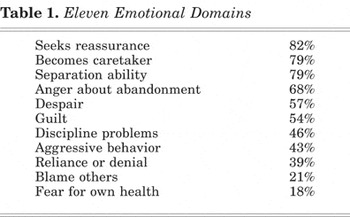
Methods: Eleven parameters were assessed in each of 29 children and their incidence was calculated. The children and their parents were seen in a semistructured interview, together as well as separately. The parameters were: seeking reassurance (82), becoming a caretaker (79), inability to separate from parent (79), anger about feeling abandoned (68), despair (57), guilt (54), discipline problems, aggressive behavior (46), denial (39), blame of others (21), and fear for the child's own health (18).
Results: Our results suggest that children with dying parents manifest significant distress as well as a greater understanding of their parent's illness than is usually suspected.
Significance of results: Timely intervention by a child psychiatrist or other mental health professional with proven competence in working with children can help children to better cope with the death and dying of their parent and ameliorate the process of bereavement following the parent's death.
Because of our small sample, we cannot generalize about all of the findings. Further research is required to characterize the level of distress in the children and the long-term impact in their overall adjustment to life.
Keywords
Information
- Type
- Research Article
- Information
- Copyright
- © 2004 Cambridge University Press
INTRODUCTION
Last year two million children and adolescents younger than 18 years experienced the loss of a parent (Christ et al., 2002). This group of bereaved children represents a hidden high-risk group whose needs are often minimized or overlooked by overwhelmed parents and are unknown to most of the medical staff. The reasons for the neglect of this population vary. Children may not express their reactions in words or when they do, they appear to recover quickly after the death of their parent occurs. In both cases, the bereavement of the child may go unattended. There is a common belief among parents and caretakers that children are generally adaptive, and that they will make peace with their circumstances on their own. Also, parents and caretakers sometimes voice the belief that children, particularly younger ones, don't really understand what is going on (Kastenbaum, 1967; Spinetta et al., 1974; Stambrook & Parker, 1987; Chesterfield, 1992; Pettle & Britten, 1995) and therefore, it is best not to discuss the situation with them. In all these cases, the children who are about to lose a parent to cancer often do not receive the information and attention they need at this critical time. Communicating the bad news of a cancer diagnosis is difficult enough for doctors (Buckman, 1984; Fallowfield & Jenkins, 1999; Maguire, 1999; Butow et al., 2002) so it is not surprising that parents dying of cancer, who are coming to terms with the existential issues surrounding dying, are often at a loss as to when, how, and what to tell their children about cancer and death.
From studies conducted with children dying from fatal illnesses (Spinetta, 1974; Nitschke et al., 1982; Bluebond-Langner, 1989; Claflin & Barbarin, 1991; Ellis & Leventhal, 1993) and children experiencing the death of a parent (Elizur & Kaffman, 1983; Kroll et al., 1998; Christ et al., 2002), common themes emerge that are relevant to both the short- and long-term care of such children. Contrary to common belief, discussions of a child's fears do not heighten anxiety but reduce alienation (Sourkes, 1992, 1996) and assuage the belief that the illness is too terrible to discuss. There should be no curtain of silence drawn around the child's worst fears (Sourkes, 1987, 1996). Often, there is a discrepancy between the child's ideas, fantasies, and thoughts about the parent's condition and what the parents assume the child knows. Children's reactions to a life-threatening illness become more disruptive when there is a family history of trauma or abuse, or a family that struggles with cohesiveness and integration.
Because of their affective need for parenting, children who lose one parent often become anxious about the survival of the other, and may protect the well parent from becoming aware of their distress. That, and the difficulty of sustaining mood states in childhood, may lead the well parent, teacher, or other closely involved adult to believe the child has recovered from, or has not been affected by, bereavement. Children who are forewarned of the imminence and inevitability of death have lower levels of anxiety than those who are not, even children within the same family. The practitioner needs to be aware that some children may need specialized help in recovering from depressive and other symptoms that are associated with bereavement. An editorial by Kroll et al. (1998) cites several studies specifically related to parents dying of cancer. These studies reiterate the importance of communication between parents and children and provide support for the claim that parents underestimate the impact of a terminal illness on their children. How the surviving parent models his or her expression of grief and responds to affective displays by the child are key mediators of the child's grief response. So too, developmental factors alter a child's response to loss (Piaget, 1929). By 4 years of age, most children have some understanding of the difference between a temporary separation and death, a level of conceptualization that expands with increasing age.
The objective of this study is to report the experience of 28 children of parents with terminal cancer and child bereavement following the loss of a parent. The information gathered in this study points to some of the issues the clinician should be aware of when approaching parents and children in this predicament.
METHODS
In this article, we report on 28 children who experienced the impact of a parent or sibling with terminal cancer.
The children ranged in age from 3 to 18 years, and each had a natural parent who had been diagnosed with advanced cancer (locally recurrent or metastatic) and was likely to die of progressive disease. A child psychiatrist, Estela Beale, or a nurse specialist, Debra Sivesind, interviewed each child. The children were asked a series of questions and their answers were assessed by the interviewers based on their responses surrounding the 11 emotional domains listed in Table 1.
Eleven Emotional Domains

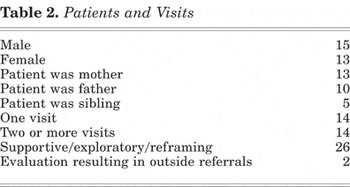
Fourteen of the children were seen only once and the rest were seen numerous times, as indicated in Table 2.
Patients and Visits

The reasons children were only seen one time by the therapist and nurse specialist varied, including the family having left town shortly after the initial meeting or the death of the parent. In situations when we were asked to consult with a child shortly before his or her parent's death, the child was very sad, tense, and preoccupied and did not seem to connect with the interviewers. When children were seen early in the course of the parent's terminal illness at the time the parent entered the Palliative Care and Symptom Control Service, the therapeutic connection was stronger and usually they were motivated to return. The interviews typically began by talking with the parents or other caretaker and in all cases were concluded by speaking with the child alone. Latency age and adolescent children were seen in interactive interviews, following the standard principles of crisis intervention. Younger children, ages 3 to 8, were seen in a playroom where they were free to choose a play activity. This structured but nondirectional approach is based on the understanding that if a child feels safe and free, he or she will spontaneously express thoughts and feelings in a metaphoric or displaced manner. Commonly, children do not understand their own internal emotional struggles or may be incapable or unwilling to express them in words. Although this approach does not exclude other ages, the older children and adolescents who were seen only once preferred sit-down meetings. In all cases, both clinicians conducted a review of the charts and consensus was reached about the findings. Data are reported using descriptive statistics.
RESULTS
The results of the pilot study showed that 82% of the children interviewed sought reassurance, and 79% of them considered themselves to be caregivers of their dying parent. The children also displayed high levels of aggressive behavior and separation anxiety. These data show that the children increased their participation in activities related to patient care, and if physically unable to do so, they wished to protect and help their dying parent. Faced with the parent's obvious deterioration and fear of the parent's death, a strong wish to do everything possible to keep the parent alive is triggered. Interestingly, it also appears that while the child is lost in frenetic activity he or she is not faced with as much anxiety and grief as might otherwise occur or as might be expected.
All the children interviewed had some understanding of the parent's condition and were frightened about the outcome. Regardless of the level of information provided, children speculated wildly about issues related to their parent's health. Despite the particulars of parental religious beliefs none of the children made any reference to religion, unless the parent was present and introduced the subject. In contrast to the standard account (Matthews, 1989) of developmental stages, small children demonstrated a remarkable awareness of the parent's medical condition and its implications.
The following examples illustrate some of the issues addressed above.
Case 1
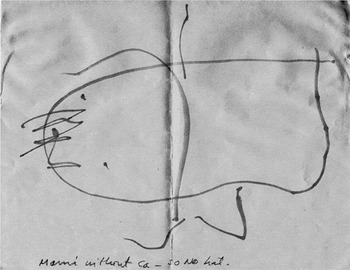
Grace, 3 years old, became almost unmanageable when her mother's condition took a turn for the worse. She became very vigilant, protested violently whenever the parents attempted physical separation, had violent temper tantrums, became finicky, and had sleeping difficulties. The family limited the discussion about the illness assuming that at her age she couldn't understand. Grace, a very poised and bright child, connected quickly with the interviewer and proceeded to select drawing materials, which she quickly filled with drawings of the mother with a hat, without a hat, with hair and without it, freely discussing her ideas about the effect of chemotherapy on her mother, and wishing her mother to be rid of cancer and be back to normal (Fig. 1). Discussing her thoughts, wishes, and fears, clarifying the information, and planning alternative solutions to some of the dilemmas allowed her to bring her concerns surrounding these issues more directly to her parents, engage in dialogue, get reassurance from the parents, and diminish her tendency to resort to angry behavior.

1.
Case 2
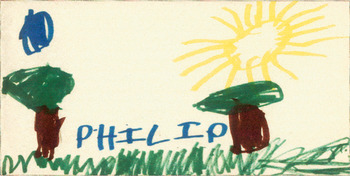
Philip, a 5-year-old, is a bright, verbal, outgoing boy who was tactfully informed by his father of his mother's dire circumstances. At age 35, she was unexpectedly diagnosed with advanced metastatic breast cancer. The husband was in shock so that even though he was physically present during the interview, his own reaction made him emotionally unavailable to Philip. Philip got busy in the sessions, painting, drawing, discussing events in the household, and engaging in an endless game in which pirates fought the good guys. This dramatization went on in a very intense manner, with fierce battles, but neither side was allowed to win. It became clear that this was a metaphor for the dilemma facing his mother. Can she battle cancer and win? Philip did not have an answer but the expression of his anger, impotence, and rage was helpful, and he found additional relief in being able to discuss with his father ways to stabilize the household and to make plans for the future. As the father became more able to deal with his wife's condition, he was also able to assist his children in containing their reactions to the family's circumstances.
In spite of Philip's outgoing, friendly nature, he had a worried expression that manifested itself in a drawing in which a dark cloud hangs over one of the two trees (Fig. 2).

2.
Case 3
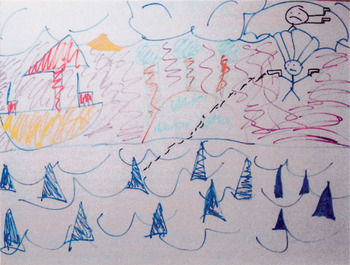
Arthur is a 10-year-old boy whose mother had been sick since he was 5. Until recently she was able to participate in her children's lives with energy and devotion, except when she was hospitalized. We met Arthur when his mother was obviously dying. Her parents had arrived from the Middle East and were not told the truth about her condition. After meeting with this therapist, the mother tried to discuss her illness with Arthur and told him that when she died she would go to heaven and prepare the road for when his turn came. These comments were not discussed further. The mother requested that I see Arthur and help them discuss their situation. I found Arthur to be a very energetic, smart, outgoing youngster. He immediately chose a game, but deferred playing in favor of drawing on a blackboard. His first drawing was a gory portrayal of a humanoid figure spitting “poop,” saliva, and other secretions from all parts of the body. He described his second picture (Fig. 3) as a parachuter, jumping off a plane that was on fire, and faced with nowhere to land. There are sharks in the water, alligators on the island, and a hidden explosive in the boat. Arthur was apparently filled with frightening images, which were probably a perception of his mother's gradual, relentless deterioration, while he was left alone with his intimidating feelings.

3.
DISCUSSION
The literature on the specific coping mechanisms of children of parents with cancer is limited. Most of the studies address concerns about children's reactions to the parent's illness, the effect on their development, premorbid factors, and the impact of communication on their ability to cope. The major limitation of the present study was that it enrolled a consecutive group of children who were referred by clinicians at the parent's request and, therefore, were more likely to have problems.
A study by Waechter (1971) provides support for the belief that giving a child opportunities to discuss his fears does not heighten anxiety and, as reflected in our case studies, that providing the child with understanding and with acceptance of his feelings and conveyance of permission to discuss any aspect of the parent's illness can decrease feelings of isolation and alienation and dispel the sense that the illness is too terrible to discuss. Waechter points out the striking dichotomy between the child's degree of awareness of the prognosis, as inferred from his imaginative stories, and the parent's belief about the child's degree of awareness of the parent's prognosis (Waechter, 1971). This dichotomy suggests that knowledge is communicated to the child by the changes that he encounters in his total environment after the diagnosis is made and by his perceptiveness of various nonverbal clues. This disparity presages a deepening isolation that is exacerbated when the child becomes aware of the evasiveness that meets expressions of his concern.
As we found in our study, interventions before the death of a parent can also ease the ensuing period of bereavement. In a longitudinal study of 25 preadolescent children living on a kibbutz who had lost their fathers in the Arab Israeli War of 1973, Elizur and Kaffman (1983) found that pretraumatic family and environmental factors were significant determinants of the duration and severity of bereavement. The data from this study were drawn exclusively from semistructured interviews held separately with the widowed mothers and the children's teachers: There were no child self-reports. The results suggested that emotional restraint in the surviving parent made it difficult for the child to express feelings, which led to a sense of intensified loneliness and increased anxiety and confusion. Their findings demonstrated that childhood bereavement symptoms tend to become exacerbated when the stress of the loss is compounded by pertinent child, family, and situational factors. In most cases, the combination of several factors determined the intensity of the bereavement response rather than the exclusive influence of any single factor. The results suggested that the child's emotional response during the early months of bereavement is largely determined by pretraumatic antecedent variables, whereas posttraumatic factors became more influential during the years following bereavement. Our study supports these conclusions and the importance of the availability of a supportive, stable family environment as well as the accessibility of professional intervention.
Kranzler et al. (1990) found that the ability of bereaved children to report grieving emotions correlated significantly with improved functioning, which supports our study's conclusions. Their study reported on the acute bereavement reactions of a cohort of preschool-aged children who experienced the death of either their mother or father. The aims of the study were to describe the children's acute state, to examine developmental influences that might impact on their vulnerability, and to identify important outcome mediators. The study supported both the importance of preexisting relationships in the family and the effects of ongoing adversity, especially depression in the surviving parent. It also provided acute bereavement data that support the retrospectively determined findings of Harris et al. (1986) and Breier et al. (1988), who concluded that although the death of a parent creates a vulnerability, ongoing provoking agents, particularly inadequacy of parenting after the loss, mediate the child's risk. The surviving parent's ability to cope with his or her own grief and capacity to respond to the emotional and other needs of their young children is critical. The young child's sensitivity to deficits in parental caretaking may create a particular vulnerability to parental loss.
The conclusion of Bowlby (1980) and Furman (1974) that grieving is possible even in early childhood is supported. The authors conclude that additional study of the interaction between the grieving parent and child is needed.
Hilden et al. (2000) found that when given the opportunity to communicate, children can conquer their fears as well as express their love in the terminal phase of a parent's illness and that honesty is indeed the best policy with children of all ages. In this way, the reality of the situation, no matter how awful it is, can be shared in an open manner. Our case studies support this viewpoint. Trying to protect children from knowledge about what is really happening often confuses the child even more than circumstances alone and escalates concerns about events that are beyond their control. A study conducted by Pfeffer et al. (2000) reported that the children in their sample were likely either denying or reluctant to acknowledge problems in the emotional domains assessed, for reasons that were directly or indirectly related to the loss of their parent. For example, they may have been reluctant to acknowledge their own feelings of depression for fear that doing so would upset other family members. However, reports of bereaved parents regarding their children's psychological distress and symptoms of depression reported lower levels than found in the children's reports of their own distress and psychiatric symptomatology. Bereaved parents may be so overwhelmed by their own grief and mourning that they are not fully aware of the level of distress of their children, or they may not be able to cope with their children's psychologically distressed states.
Finally, the death of a parent can interrupt the process of internalization and the development of feelings of safety. The roots of separation anxiety and fear of loss are grounded in the Attachment Theory first espoused by Bowlby (1980) who, in groundbreaking research, demonstrated that when primates are separated from the mother early in life their reaction escalates from a state of protest to marasmus and death. Since then other researchers have confirmed the instinctual roots of attachment, which assures the safety of infants who use intuitive behaviors to engage their caretakers and to guarantee their caretaker's presence and attentiveness. Internalization of primary caretakers is a process that becomes established by the time the child is 2 or 3 years of age. Once this process of internalization is accomplished, the child can sustain prolonged separations yet retain the memory of the parent. For the child to be able to obtain optimal emotional, social, and psychosexual maturity, a predicable, caring environment is required. Separation from the primary caretaker produces anxiety, which is manifested differentially depending on the child's developmental stage and is exacerbated by a terminal illness, as in the children we studied.
In conclusion, several themes emerge from these studies that are relevant both to the short- and long-term care of children who experience the death of a parent from cancer: (1) Previous family history affects the child's bereavement process, (2) a child's increased anxiety is directly correlated with a lack of information about his parent's cancer diagnosis, (3) anxiety increases when information is available but there is no opportunity for discussion with the child, (4) children of parents with cancer are at a higher risk of psychological disturbance (Harris et al., 1986), (5) a large percentage of bereaved children experience a major depressive disorder in adulthood (Harris et al., 1986), and (6) meeting with a mental health professional provides an avenue for supportive discussions, which in turn model for the family how discussions can be conducted to clarify issues, dispel fears, bring people together, or plan for the future.
It is important to remember that making recommendations to families in such a situation is difficult. There is no clear-cut solution for dealing with a family's reaction to terminal cancer. When a parent is dying of cancer, discussions among parents, children, and all other adult caretakers is important. However, these discussions are part of a process that should begin when the patient is first aware of his or her terminal condition. This may coincide with his or her referral to a palliative care team. The mental health professional should contact the family at this entry point and establish a connection. An assessment of the parent's adaptation to the illness and of the family and other support systems is very important. The children should be assessed independently to determine developmental age, level of information, adaptation to the critical situation, understanding of facts, and wishes and fantasies about the future. Finally, the interventions have to take place before despair or resignation set in so there is enough motivation to accomplish a higher level of communication, and possibly resolution of conflicts, before death is imminent.
ACKNOWLEDGMENT
We appreciate Mrs. Joann Aaron, Scientific Editor, for her valuable assistance.
References
REFERENCES
Bluebond-Langner, M.
(1989).
Worlds of dying children and their well siblings.
Death Studies,
1–16.Google Scholar
Bowlby, J.
(1980).
Attachment and Loss: Sadness and Depression,
Vol. 3.
London:
Hogarth Press.
Breier, A.,
Kelsoe, J.R., Jr.,
Kirwin, P.D.,
et al.
(1988).
Early parental loss and development of adult psychopathology.
Archives of General Psychiatry,
45,
987–993.Google Scholar
Buckman, R.
(1984).
Breaking bad news: Why is it still so difficult?
British Medical Journal (Clinical Research Edition),
288,
1597–1599.Google Scholar
Butow, P.N.,
Brown, R.F.,
Cogar, S.,
et al.
(2002).
Oncologists' reactions to cancer patients' verbal
cues.
Psycho-Oncology,
11,
47–58.Google Scholar
Claflin, C.J. &
Barbarin, O.A.
(1991).
Does “telling” less protect more? Relationships among
age, information disclosure, and what children with cancer see and
feel.
Journal of Pediatric Psychology,
16,
169–191.Google Scholar
Chesterfield, P.
(1992).
Communicating with dying children.
Nursing Standard,
6,
30–32.Google Scholar
Christ, G.H.,
Siegel, K., &
Christ, A.E.
(2002).
Adolescent grief: “It never really hit me … until it
actually happened.”
Journal of the American Medical Association,
288,
1269–1278.Google Scholar
Elizur, E. &
Kaffman, M.
(1983).
Factors influencing the severity of childhood bereavement
reactions.
American Journal of Orthopsychiatry,
53,
688–676.Google Scholar
Ellis, R. &
Leventhal, B.
(1993).
Information needs and decision-making preferences of children with
cancer.
Psycho-Oncology,
Vol. 2,
277–284.Google Scholar
Fallowfield, L. &
Jenkins, V.
(1999).
Effective communication skills are the key to good cancer
care.
European Journal of Cancer,
35,
1592–1597.Google Scholar
Furman, E.
(1974).
A Child's Parent Dies.
New Haven, CT:
Yale University Press.
Harris, T.,
Brown, G.W., &
Bifulco, A.
(1986).
Loss of parent in childhood and adult psychiatric disorder: The role
of lack of adequate parental care.
Psychology Medicine,
16,
641–659.Google Scholar
Hilden, J.M.,
Watterson, J., &
Chrastek, J.
(2000).
Tell the children.
Journal of Clinical Oncology,
18,
3193–3195.Google Scholar
Kastenbaum, R.
(1967).
The child's understanding of death: How does it
develop? In Explaining Death to Children.
E. Grollman (ed.), pp.
89–108.
Boston:
Beacon Press.
Kranzler, E.M.,
Shaffer, D.,
Wasserman, G.,
et al.
(1990).
Early childhood bereavement.
Journal of the American Academy of Child and Adolescent
Psychiatry,
29,
513–520.Google Scholar
Kroll, L.,
Barnes, J.,
Jones, A.L.,
et al.
(1998).
Cancer in parents: Telling children.
British Medical Journal,
316,
880.Google Scholar
Maguire, P.
(1999).
Improving communication with cancer patients.
European Journal of Cancer,
35,
2058–2065.Google Scholar
Matthews, G.B.
(1989).
Children's conceptions of illness and death. In
Children and Health Care: Moral and Social Issues,
L.M. Kopelman, J.C. Moskop (eds.), pp.
133–146.
Boston:
Kluwer Academic Publishers.
Nitschke, R.,
Humphrey, G.B.,
Sexauer, C.L.,
et al.
(1982).
Therapeutic choices made by patients with end-stage cancer.
Journal of Pediatrics,
101,
471–476.Google Scholar
Pettle, S.A. &
Britten, C.M.
(1995).
Talking with children about death and dying.
Child: care, health and development,
21,
395–404.Google Scholar
Pfeffer, C.R.,
Karus, D.,
Siegel, K.,
et al.
(2000).
Child survivors of parental death from cancer or suicide: Depressive
and behavioral outcomes.
Psycho-Oncology,
9,
1–10.Google Scholar
Piaget, J.
(1929).
The Child's Conception of the World.
London:
Routledge & Kegan Paul.
Sourkes, B.
(1987).
Views of the deepening shade: psychological aspects of
life-threatening illness.
American Journal of Hospice Care,
4,
22–29.Google Scholar
Sourkes, B.M.
(1992).
The child with a life-threatening illness. In
Countertransference in Psychotherapy with Children and
Adolescents,
J. Brandell, (ed.), pp.
267–284.
New York:
Jason Aronson.
Sourkes, B.M.
(1996).
The broken heart: anticipatory grief in the child facing
death.
Journal of Palliative Care,
12,
56–59.Google Scholar
Spinetta, J.J.
(1974).
The dying child's awareness of death: A review.
Psychological Bulletin,
81,
256–260.Google Scholar
Spinetta, J.J.,
Rigler, D., &
Karon, M.
(1974).
Personal space as a measure of a dying child's sense of
isolation.
Journal of Consulting and Clinical Psychology,
42,
751–756.Google Scholar
Stambrook, M. &
Parker, K.C.H.
(1987).
The development of the concept of death in childhood Vol. 33: A
review of the literature.
Merrill-Palmer Quarterly,
133–157.Google Scholar
Waechter, E.H.
(1971).
Children's awareness of fatal illness.
American Journal of Nursing,
7,
1168–1172.Google Scholar
Eleven Emotional Domains
Patients and Visits
1.
2.
3.
 You have
Access
- 44
- Cited by