Substance use disorders (SUDs) are a major public health problem affecting millions of alcohol and drug users and over a billion smokers worldwide, contributing to a number of health, criminal justice, interpersonal, and psychiatric problems (World Health Organization, 2008, 2011). SUDs are complex disorders with multiple biological and environmental risk factors that result in a diversity of clinical expressions. Most research on SUDs utilizes measures that assess the severity of the disease state or “postmorbid” condition. However, SUDs are developmental disorders with a relatively late onset, that is, there is a typical age course to initiation, problem use, and dependence (Zucker, Reference Zucker, Cicchetti and Cohen2006). In addition, SUDs cannot occur prior to the discrete event of the initiation of substance use. As such, SUDs provide a relatively clean model by which to study the progression from underlying or “premorbid” risk to chronic problematic use. Research focused on premorbid risk could yield important insights into etiology by identifying the early manifestations of vulnerability that can then be tracked to delineate casual mechanisms in the development of SUDs (Conway et al., Reference Conway, Levy, Vanyukov, Chandler, Rutter and Swan2010).
We detail our efforts to identify the behaviors, traits, and attitudes present prior to the initiation of substance use that best predicted later SUDs and related outcomes. Our rationale was that by focusing on the signs and symptoms most relevant to eventual SUDs, we would identify the most salient psychological characteristics that tap underlying risk. This is in contrast to relying on existing diagnostic measures associated with SUDs, such as disruptive behavior disorders, whose association with SUDs may be indirect and attributable to broad psychological processes associated with many disorders. Instead, we took a novel, empirically guided approach with the hope of making new discoveries regarding the development of SUDs.
Risk Factors for SUDs and Person–Environment Interplay
There are several excellent reviews of the risk factors for SUDs (Hawkins, Catalano, & Miller, Reference Hawkins, Catalano and Miller1992; Zucker, Reference Zucker, Cicchetti and Cohen2006; Zucker, Donovan, Masten, Mattson, & Moss, Reference Zucker, Donovan, Masten, Mattson and Moss2008); therefore, we provide only a cursory review. The strongest and most consistent risk factor is an early and persistent pattern of antisocial behavior as reported in multiple, longitudinal studies of both epidemiological and high-risk samples (Armstrong & Costello, Reference Armstrong and Costello2002; Zucker, Reference Zucker, Cicchetti and Cohen2006). Closely related risk factors are personality traits, referred to as “difficult” or “undercontrolled” temperament in young children (Caspi, Moffitt, Newman, & Silva, Reference Caspi, Moffitt, Newman and Silva1996; Eron, Huesmann, Dubow, Romanoff, & Yarmel, Reference Eron, Huesmann, Dubow, Romanoff, Yarmel, Crowell, Evans and O'Donnell1987; Masse & Trembaly, Reference Masse and Tremblay1997; Tarter, Alterman, & Edwards, Reference Tarter, Alterman and Edwards1985), and traits such as impulsivity, rebelliousness and defiance, and aggressiveness in older children and adolescents (Cloninger, Sigvardsson, & Bohman, Reference Cloninger, Sigvardsson and Bohman1988; Krueger, Markon, Patrick, Benning, & Kramer, Reference Krueger, Markon, Patrick, Benning and Kramer2007; Shedler & Block, Reference Shedler and Block1990). Antisocial behavior and disinhibited personality traits are collectively referred to as “externalizing” behaviors, which reflect a behavioral disinhibition liability defined as an inability to constrain socially restricted behavior (Iacono, Carlson, Taylor, Elkins, & McGue, Reference Iacono, Carlson, Taylor, Elkins and McGue1999; Iacono, Malone, & McGue, Reference Iacono, Malone and McGue2008; Zucker, Reference Zucker, Cicchetti and Cohen2006). Behavioral disinhibition is associated with a higher familial loading, an earlier age of initiation, adolescent onset of SUDs, and a more severe and persistent course of SUDs in adulthood (Hicks, Iacono, & McGue, Reference Hicks, Iacono and McGue2010; Iacono et al., Reference Iacono, Carlson, Taylor, Elkins and McGue1999; Iacono et al., Reference Iacono, Malone and McGue2008).
Although the associations are weaker and less consistent, there is also evidence of an internalizing or inhibition pathway to SUDs (Hussong, Jones, Stein, Baucom, & Boeding, Reference Hussong, Jones, Stein, Baucom and Boeding2011; Zucker, Reference Zucker, Cicchetti and Cohen2006). In young children, this liability is expressed as a cluster of traits that includes lack of approach and exploratory behavior, passivity, discomfort with novelty, shyness/social fearfulness, and anxiety when separated from caregivers (Caspi et al., Reference Caspi, Moffitt, Newman and Silva1996; Fox, Henderson, Marshall, Nichols, & Ghera, Reference Fox, Henderson, Marshall, Nichols and Ghera2005; Kagan, Reference Kagan1994). Inhibition predicts depression, anxiety disorders, and negative emotionality in childhood and adolescence (Caspi et al., Reference Caspi, Moffitt, Newman and Silva1996; Caspi & Silva, Reference Caspi and Silva1995), which are correlates of SUDs. The prospective associations between inhibition and SUDs are modest, however, especially after controlling for externalizing, and seem stronger for depression than for anxiety symptoms (Chassin, Pitts, DeLucia, & Todd, Reference Chassin, Pitts, DeLucia and Todd1999; Costello, Erkanli, Federman, & Angold, Reference Costello, Erkanli, Federman and Angold1999; Kaplow, Curran, Angold, & Costello, Reference Kaplow, Curran, Angold and Costello2001; King, Iacono, & McGue, Reference King, Iacono and McGue2004). It is interesting that some investigators reported that inhibition/internalizing was associated with less substance use and SUDs in adolescence and adulthood (Cloninger et al., Reference Cloninger, Sigvardsson and Bohman1988; Kaplow et al., Reference Kaplow, Curran, Angold and Costello2001; Masse & Tremblay, Reference Masse and Tremblay1997; Shedler & Block, Reference Shedler and Block1990). In addition, the link between extraversion, or positive emotionality, and SUDs is unclear, with some evidence that high positive emotionality is associated with early substance use but that chronic and severe SUDs are associated with lower positive emotionality (Sher, Grekin, & Williams, Reference Sher, Grekin and Williams2005). This suggests that facets of inhibition/internalizing and extraversion/positive emotionality may have differential associations with SUDs.
SUDs are also associated with several risk factors related to family, school, and peer environments as well as stressful life events (Hawkins et al., Reference Hawkins, Catalano and Miller1992; Zucker et al., Reference Zucker, Donovan, Masten, Mattson and Moss2008). A family history of SUDs, especially when accompanied by antisocial behavior, is a proxy that indexes increased risk via various mechanisms, including inherited risk and organization of the family environment (Puttler, Zucker, Fitzgerald, & Bingham, Reference Puttler, Zucker, Fitzgerald and Bingham1998). Adolescents who initiate substance use early and go on to develop SUDs tend to grow up in rearing environments characterized by less parental monitoring, harsh and inconsistent discipline, less positive parent–child relationships, and greater parental substance use that provides models for use and greater access to substances (Hawkins et al., Reference Hawkins, Catalano and Miller1992; Zucker et al., Reference Zucker, Donovan, Masten, Mattson and Moss2008). Early SUDs are also associated with academic failure and disengagement and rejection by prosocial peers, experiences that weaken the bonds to important socializing influences (Hawkins et al., Reference Hawkins, Graham, Maguin, Abbott, Hill and Catalano1997). These children also tend to affiliate with deviant peers, relationships that further weaken attachment to socializing influences and increase involvement in various norm violating behaviors, such as precocious substance use, sexual behavior, and delinquency (Jessor & Jessor, Reference Jessor and Jessor1977). Such children are also more likely to experience disruptive life events, such as parental discord and divorce; family, money, legal, or mental health problems; residential instability and living in neighborhoods characterized by economic disadvantage and high crime rates (Buu et al., Reference Buu, DiPiazza, Wang, Puttler, Fitzgerald and Zucker2009; Hawkins et al., Reference Hawkins, Catalano and Miller1992; Leventhal & Brooks-Gunn, Reference Leventhal and Brooks-Gunn2000). Moreover, these environmental risk factors are not independent; exposure to one risk factor is associated with exposure to several risk factors (Appleyard, Egeland, van Dulmen, & Sroufe, Reference Appleyard, Egeland, van Dulmen and Sroufe2005; Deater-Deckard, Dodge, Bates, & Pettit, Reference Deater-Deckard, Dodge, Bates and Pettit1998; Hicks, South, DiRago, Iacono, & McGue, Reference Hicks, South, DiRago, Iacono and McGue2009).
It is important to note that exposure to environmental risk is not independent of personal characteristics. For example, children who exhibit early externalizing and internalizing problems experience greater environmental stressors throughout childhood and adolescence (Appleyard et al., Reference Appleyard, Egeland, van Dulmen and Sroufe2005; Sameroff, Bartko, Baldwin, Baldwin, & Seifer, Reference Sameroff, Bartko, Baldwin, Baldwin, Seifer, Lewis and Feiring1998). This greater exposure is a function of various person–situation transactions that are, to some extent, heritable. The phenomenon of genetic risk influencing both psychiatric symptoms and exposure to environmental risk that contribute to those symptoms is called gene–environment correlation (Scarr & McCartney, Reference Scarr and McCartney1983). For example, heritable traits of parents that contribute to the organization of the rearing environment (e.g., antisocial behavior) also overlap with heritable risk for their children's externalizing problems. In addition, children with undercontrolled temperament traits often elicit negative reactions from others (harsh discipline, peer rejection) or actively seek environments associated with greater exposure to risk (deviant peers). These person–situation transactions often initiate a cascade of events whereby children with the greatest genetic risk are also exposed to the most environmental stress, compounding their risk for poor adult outcomes (Granic & Patterson, Reference Granic and Patterson2006; Hicks et al., Reference Hicks, South, DiRago, Iacono and McGue2009).
Conceptual and Analytic Approach to Scale Construction
Given the intertwined nature of person-level and environmental risk factors, our strategy was to first identify the person-level characteristics present prior to substance use initiation that were most predictive of later SUDs. These traits should be present at a relatively early age, heritable, stable across time, and have clear connections to adult behavior and personality. Once a measure of these traits was available, it would serve as a benchmark of individual-level risk that can be used to parse the person–situation transactions across childhood and adolescence that lead to SUDs.
Investigators of the Center for Education on Drug Abuse Research (CEDAR) have initiated such a program of research using a similar approach (Vanyukov, Kirisci, et al., Reference Vanyukov, Kirisci, Tarter, Simkevitz, Kirillova, Maher and Clark2003; Vanyukov, Tarter, et al., Reference Vanyukov, Tarter, Kirisci, Kirillova, Maher and Clark2003). This work posited that premorbid risk for SUDs is best conceptualized as a continuous liability dimension that is largely nonspecific and highly influenced by genetic factors that are common across SUDs (Kendler, Jacobson, Prescott, & Neale, Reference Kendler, Jacobson, Prescott and Neale2003; Vanyukov, Kirisci, et al., Reference Vanyukov, Kirisci, Tarter, Simkevitz, Kirillova, Maher and Clark2003; Vanyukov, Tarter, et al., Reference Vanyukov, Tarter, Kirisci, Kirillova, Maher and Clark2003). Utilizing a large, longitudinal family study of drug use disorders, investigators developed the transmissible liability index (TLI) to assess underlying risk for SUDs, by comparing the offspring (age 10–12) of drug dependent and nondrug dependent parents on a variety of measures that constitute the extensive CEDAR assessment. Employing several factor analytic and item response theory methods, a 45-item scale was eventually distilled that investigators posited indexed the transmissible risk to SUDs, that is, risk passed from parents to offspring and not confounded with active substance abuse. Subsequent reports support the validity of the TLI; for example, scores predict the onset and escalation of use and the onset of SUDs and are highly heritable (Hicks, Iacono, & McGue, Reference Hicks, Iacono and McGue2012; Kirisci et al., Reference Kirisci, Tarter, Mezzich, Ridenour, Reynolds and Vanyukov2009; Vanyukov et al., Reference Vanyukov, Kirisci, Moss, Tarter, Reynolds and Maher2009).
We sought to derive a similar index of premorbid risk, but our approach differed in that our criteria for selecting items were the prospective SUD outcomes of our preadolescent participants rather than distinguishing among individuals based on a family history of SUDs. Although family history is a consistent risk factor, it reflects only the liability that can be linked to parent–offspring similarity and is thus an indirect criterion for identifying premorbid risk relative an individual's realized SUD outcomes. We also employed a distinct psychometric approach to item selection (described below) that allowed multiple trait dispositions to emerge rather than emphasize a unidimensional continuous model of liability. Finally, as items were identified, we provided psychological interpretations as to the underlying trait constructs that could account for item covariance.
Our approach to scale development was strongly influenced by that of Tellegen et al. (Reference Tellegen, Ben-Porath, McNulty, Arbisi, Graham and Kaemmer2003) to parsing general and specific psychopathology constructs when restructuring the clinical scales of the Minnesota Multiphasic Personality Inventory, Second Edition (MMPI-2). Noting the substantial item overlap and high correlations among the original clinical scales, a key goal of the restructuring effort was to improve the scales' discriminant validity. To do so, the first step was to create a new scale that assessed the nonspecific emotional distress variance present in all the clinical scales. The resulting scale was called “demoralization” and was theoretically linked to the pleasantness–unpleasantness dimension of structural models of affect, specifically the low positive affect and high negative affect quadrant (Watson & Tellegen, Reference Waston and Tellegen1985). Next, Tellegen and colleagues (Reference Tellegen, Ben-Porath, McNulty, Arbisi, Graham and Kaemmer2003) identified the “core,” or unique component, of each clinical scale by conducting a series of principal component analyses that included the items from an original clinical scale along with the demoralization items. The first component was always a demoralization component followed by a component whose content was psychologically meaningful and distinct from all the other core components. Using the demoralization scale and “seed” scales of the new specific clinical scale constructs as benchmarks, the full MMPI-2 item pool was then used to refine a final set of restructured clinical scales that maximized convergent and discriminant validity.
Similar to the nonspecific emotional distress that pervaded the MMPI-2 clinical scales, any approach to designing a measure to assess premorbid risk for SUDs must include a strategy to assess the nonspecific externalizing liability; externalizing encompasses a broad content domain that includes hyperactivity, inattention, conduct problems, various forms of aggression and impulsivity, sensation seeking, oppositionality, defiance, and rebelliousness. All of these behaviors and traits are correlated, and each predicts SUDs. Therefore, our strategy was to first identify a more specific traitlike construct within the externalizing domain that accounted for the association between SUDs and all other externalizing content. Following that, we then identified unique variance that indexed meaningful trait constructs and added to the prediction of SUDs over and above nonspecific externalizing risk. After identifying the target constructs, refinements were made to the item set to maximize convergent and discriminant validity. Therefore, although our approach was empirically driven, it was guided by a clear theoretical rationale to derive scales that would have both predictive utility and psychological meaning to inform a parsimonious model of underlying risk for SUDs.
Our criterion variables for item selection were composite measures of substance abuse (heavy use and symptoms of alcohol, nicotine, and illicit drug abuse/dependence) and behavioral disinhibition (antisocial behavior and disinhibited personality traits) assessed in late adolescence. This approach was taken for several reasons. First, adolescent substance abuse is most predictive of a severe and persistent course of SUDs in adulthood (Clark, Kirisci, & Tarter, Reference Clark, Kirisci and Tarter1998; Hicks et al., Reference Hicks, Iacono and McGue2010). There is a large increase in the prevalence of SUDs in the early 20s, with many people exhibiting “developmentally limited” substance abuse that remits relatively quickly with few serious consequences (Zucker, Fitzgerald, & Moses, Reference Zucker, Fitzgerald, Moses, Cicchetti and Cohen1995). This creates substantial heterogeneity in terms of conceptualizing SUDs as a serious psychopathological condition, another reason why we focused on the more severe, early-onset substance abuse in adolescence. Second, there are high rates of comorbidity among SUDs and antisocial behavior in adolescence, most of which is attributable to common genetic risk (Krueger et al., Reference Krueger, Hicks, Patrick, Carlson, McGue and Iacono2002). However, the rates of comorbidity and the influence of this nonspecific genetic risk on specific SUDs declines with age as people begin to specialize in their substance abuse (Vrieze, Hicks, Iacono, & McGue, Reference Vrieze, Hicks, Iacono and McGue2012). Because key risk factors present in childhood were likely to be broad temperament and behavioral dispositions, it seemed likely that such broad trait dimensions would be most predictive of this nonspecific, mostly heritable risk in adolescence. Third, we used dimensional measures, because they are more sensitive to individual differences in risk relative to diagnoses. This is especially important because most people have yet to exhibit their highest levels of substance use and abuse by late adolescence. The behavioral disinhibition composite was included for a similar rationale: It provides a more sensitive measure of underlying risk for people who have yet to exhibit problematic substance use and is associated with more severe and chronic SUDs.
For the sake of theoretical clarity, we restricted the item pool to person-level characteristics. We did examine the associations between our resulting measures and various environmental measures for the purpose of validation, and we used the twin data to examine gene–environment interplay. We also examined associations between the traits we identified and several diagnostic and personality measures. Finally, we made several tests of the resulting scales' prospective and incremental predictive power relative to existing diagnostic measures, parental externalizing disorders, and environmental risk. This was especially important, as there is little need for new measures if they do not provide improved prediction and theoretical guidance relative to known risk factors and existing measures.
Method
Development sample
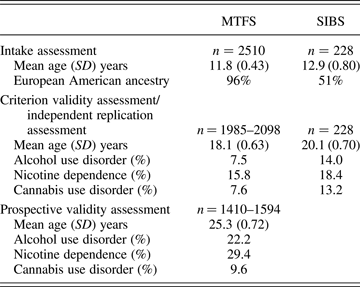
Demographic characteristics and the prevalence rates for SUDs for both the development and replication samples at intake and follow-up assessments are provided in Table 1. For the development sample, participants were the 2,510 male and female twins that constitute the younger cohort of the Minnesota Twin Family Study (MTFS; Iacono et al., Reference Iacono, Carlson, Taylor, Elkins and McGue1999; Keyes et al., Reference Keyes, Malone, Elkins, Legrand, McGue and Iacono2009), a community-based, longitudinal study investigating the development of SUDs. Families were recruited into the study the year the twins turned 11 years old. Over 90% of eligible families were successfully located for each target birth year with over 80% of eligible families agreeing to participate. Participating families were representative of the Minnesota population for the target birth years in terms of parental occupational status, educational attainment, and history of mental health treatment. Consistent with the demographics of Minnesota during the years the twins were born, 96% of the participants were of European American ancestry. Families were recruited to participate in follow-up assessments every 3 to 4 years. The total sample included 784 monozygotic (MZ; 50.3% male) and 471 dizygotic (DZ; 46.9% male) twin pairs. All twin pairs were same sex. Zygosity was determined by the agreement of three estimates: parental responses to a standard zygosity questionnaire, MTFS staff evaluation of physical similarity, and comparison of ponderal and cephalic indexes and fingerprint ridge counts.
Demographic characteristics and prevalence of substance use disorders in the Minnesota Twin Family Study (MTFS) development and Sibling Interaction and Behavior Study (SIBS) replication samples

Note: For SIBS, 42% reported East Asian ancestry. The sample sizes for the follow-up assessment refer to the number of participants with the outcome data for the behavioral disinhibition and substance abuse composites. The follow-up assessments for the MTFS are ongoing; however, retention rates (i.e., the percentage of eligible individuals who have participated thus far) have been over 90% for the criterion validity (target age 17) and prospective validity (target ages 20 and 24) assessments. Each substance use disorder was defined as three or more symptoms of abuse or dependence. Prevalence rates for the criterion validity assessment and independent replication assessment are lifetime. Prevalence rates for the prospective validity assessment refer to disorders present between ages 18 and 25 (assessed at target ages of 20 and 24).
Replication sample
We replicated results from the MTFS in a subsample of the Sibling Interaction and Behavior Study (SIBS; McGue et al., Reference McGue, Keyes, Sharma, Elkins, Legrand and Johnson2007), a longitudinal study of 617 families, each with two adolescent siblings. Two-thirds of SIBS families included two adopted (unrelated) siblings; the remaining one-third of families included two biological siblings. Adoptive families were ascertained through the three largest private adoption agencies in Minnesota. Families with biological siblings were ascertained using publicly available birth records and selected to include a sibling pair comparable in age and gender to the adoptive sibling pairs. Participation rates were about 60%; the only significant difference between participating and nonparticipating families was greater educational attainment for mothers of the nonadoptive families. A large proportion (42%) of the SIBS sample reported East Asian ancestry. Participants were invited to complete follow-up assessments every 3 to 4 years. For the present analyses, we focused on the 228 participants that were younger than 14 years old at the intake assessment, and had outcome data for the second follow-up assessment.
Age 11 item pool
Our initial pool included items and symptoms from ratings, interviews, and self-report measures completed by teachers, mothers, and twins. The following measures provided an initial pool of 362 candidate items and are briefly described below.
Teacher rating form
All twins were asked to nominate three teachers who knew them well to complete a 128-item rating form covering personality traits, behaviors, academic functioning, and peer affiliation. Most items were adapted from the Conners Teacher Rating Scale (Conners, Reference Conners1969; Pelham, Milich, & Murphy, Reference Pelham, Milich, Murphy and Murphy1989) and the Rutter Child Scale B (Rutter, Reference Rutter1967), with additional items to assess diagnostic and personality constructs. For behavioral items, teachers rated how characteristic a behavior was of the student (4-point scale from not at all to very much). For personality traits, teachers were instructed to compare the twin to his or her classmates (lowest 5%, lower 30%, middle 30%, higher 30%, or highest 5% of students in class). Scales derived from the teacher-rated items exhibited good internal consistency and interrater agreement (e.g., inattention, Cronbach α = 0.96 and intraclass correlation = 0.74). When more than one teacher rating was available, the mean of the teacher ratings was used for analysis (75% of participants had at least two teacher ratings). State of Minnesota policy led to members of a twin pair being placed in separate classrooms whenever possible, minimizing bias due to twin contrast or comparison on teacher ratings.
Child and mother reports of childhood disorders, academic engagement, personality, and delinquency
Mothers and each twin were independently interviewed to assess symptoms of attention-deficit/hyperactivity disorder (ADHD), conduct disorder (CD), oppositional–defiant disorder (ODD), major depressive disorder (MDD), and separation anxiety disorder (SAD) using the Diagnostic Interview for Children and Adolescents—Revised (Welner, Reich, Herjanic, Jung, & Amad, Reference Welner, Reich, Herjanic, Jung and Amado1987). DSM-III-R criteria were used, as this was the diagnostic system that was current when the study began. Symptoms were rated as absent (0), present at subthreshold level (0.5), or present at full threshold (1). Interviewers held a bachelor-level degree in psychology or related field and received extensive training in conducting structured interviews. All interviews were reviewed in a clinical case conference of at least two advanced clinical psychology graduate students (referring to audiotapes when necessary) who were required to reach consensus prior to assigning symptoms. A reliability study of 600 cases of this consensus process found an average κ reliability of 0.79 for mother reports and 0.84 for child reports.
Mothers and each twin also completed a 12-item rating scale (α = 0.83) regarding attitudes and behaviors toward academic engagement, such as enjoyment of school and completing assignments. Mothers also completed ratings of each child's personality using descriptions of 34 trait constructs developed to measure Tellegen's model of personality that includes 11 primary scales and three higher order factors of positive emotionality, negative emotionality, and behavioral constraint (Tellegen & Waller, Reference Tellegen, Waller, Boyle, Matthews and Saklofske2008). Items were rated on a 4-point scale (definitely low to definitely high). Twins and mothers also completed the Delinquent Behavior Inventory (DBI), a 36-item (α = 0.95) self-report measure inquiring about the twin's commission of various antisocial acts (truancy, lying, aggression, stealing, etc.; Taylor, McGue, Iacono, & Lykken, Reference Taylor, McGue, Iacono and Lykken2000).
Age 17 outcomes of substance abuse and behavioral disinhibition
Composites of substance abuse and behavioral disinhibition were calculated using measures from the age 17 assessment that served as the criterion variables by which age 11 items were selected. Roughly 80% of the total sample had data available at age 17. This represents a 91.6% retention rate for those who had reached the target age (assessments are ongoing). The mean number of years between the age 11 and 17 assessments was 6.3 years (SD = 0.55 years). At the baseline assessment, 9.1% of participants reported ever using tobacco, 4.3% ever drinking alcohol without their parents' permission, and 0.002% ever using marijuana. Only a handful of participants reported any sort of regular substance use. The results were unchanged if participants who initiated substance use prior to the baseline assessment were excluded.
Measures that constituted the age 17 substance abuse composite were assessed using an expanded version of the Substance Abuse Module of the Composite International Diagnostic Interview (Robins, Babor, & Cottler, Reference Robins, Babor and Cottler1987). For nicotine, these included frequency of nicotine use (average number of days per month), average number of cigarettes smoked per day, and symptoms of nicotine dependence. For alcohol, the measures were frequency of alcohol use (10 point scale), maximum number of drinks consumed in 24 hr, and symptoms of alcohol abuse and dependence. For illicit drugs, the measures were number of drug classes ever tried (alcohol, nicotine, marijuana, amphetamines, cocaine, barbiturates, tranquilizers, heroin, opiates, PCP, inhalants, and gas), number of lifetime marijuana uses, and symptoms of abuse and dependence for the illicit substance the participant used most. A log(1 + x) transformation was applied to all variables, and the mean z score across the measures (mean r = .61) was used as the substance abuse composite score at age 17 (SA17). To ensure scale scores predicted SUDs and not just substance use, while also differentiating among active substance users and not just between those who had and had not initiated use, we also replicated the criterion validity analyses using a composite that included only symptoms of abuse and dependence for alcohol, nicotine, and illicit drugs among only those participants who had initiated substance use by their age 17 assessment.
The behavioral disinhibition composite was composed of measures of antisocial behavior and disinhibited personality traits, including adult antisocial behavior (the adult criteria for antisocial personality disorder); dissocial behavior (0–3 scale) not necessarily captured by diagnostic criteria, specifically, ever being suspended or expelled from school, ever being arrested, and early age of sexual intercourse assessed using a life events interview; total score on the DBI assessing antisocial behavior in adolescence; total score on a 12-item behavioral disinhibition scale derived from the socialization scale of the California Psychological Inventory (Taylor et al., Reference Taylor, McGue, Iacono and Lykken2000); total score on aggressive undercontrol, a scale derived using 20 items (α = 0.84) from the aggression and constraint scales of the Multidimensional Personality Questionnaire (MPQ; Tellegen & Waller, Reference Tellegen, Waller, Boyle, Matthews and Saklofske2008). Adult antisocial behavior was assessed using an adaptation of the Structured Clinical Interview for DSM-III-R Axis II. Variables were log(1 + x) transformed when appropriate (mean r = .53 across measures), and the mean z score across measures was used to calculate the behavioral disinhibition composite score at age 17 (BD17; r = .73, p < .001 with SA17).
For the replication analyses in the SIBS sample, 81.1% of participants had data for both intake trait scores and the outcome measures (the second follow-up assessment is ongoing). The mean age at the young adult follow-up assessment (mean age = 20.1 years) with a mean of 7.2 years (SD = 0.35 years) between the intake and follow-up assessments. Parallel to the MTFS, the same measures were used to calculate the substance abuse composite. However, several behavioral disinhibition measures were not available in SIBS; therefore, symptoms of adult antisocial behavior served as the outcome measure of behavioral disinhibition. (For the sake of comparison, the same analyses are also reported for the MTFS.)
External measures to assess concurrent, prospective, and incremental validity
Various measures were used to examine the external correlates of scores on the resulting scales, the validity and reliability of which have been reported elsewhere. At age 11, teacher, mother, and child reports were combined (mean z score) to calculate composite measures of ADHD, CD, and ODD symptoms (Bornovalova, Hicks, Iacono, & McGue, Reference Bornovalova, Hicks, Iacono and McGue2010). Mother and child reports of symptoms of MDD and SAD and a teacher rating of internalizing distress were similarly combined to calculate an internalizing composite (Huibregtse et al., Reference Huibregtse, Bornovalova, Hicks, Malone, McGue and Iacono2011). Mother and father psychopathology was measured using a composite of externalizing disorders that was the mean z score for symptoms of CD, adult antisocial behavior, and alcohol, nicotine, and illicit-drug dependence (Hicks, Schalet, Malone, Iacono, & McGue, Reference Hicks, Schalet, Malone, Iacono and McGue2011). Intelligence was assessed using four scales from the Wechsler Intelligence Scales for Children, Revised, to provide estimates of verbal (vocabulary and information), performance (block design and picture arrangement), and full scale IQ. A family socioeconomic status variable was calculated using the mean z score of parents' educational attainment, income, and occupational status. Several measures were also used to construct composites of environmental risk factors (described in Hicks et al., Reference Hicks, South, DiRago, Iacono and McGue2009) and included academic achievement and engagement (mother and child reports of grade point average, expectation of educational attainment, and child attitudes about school), antisocial and prosocial peer affiliation (child and teacher ratings of the child's friends), quality of the mother–child and father–child relationship (child, mother, and father ratings), and family-level stressful life events (parental discord or divorce and family money, legal, and mental health problems). An environmental risk composite was also calculated by taking the mean z score among the six measures (mean r = .28) to provide an index of overall risk.
We also examined prospective validity with measures of personality, psychopathology, and environmental risk at age 17. Personality was assessed using the 198-item version of the MPQ (Tellegen & Waller, Reference Tellegen, Waller, Boyle, Matthews and Saklofske2008; α = 0.78–0.90 for the 11 primary scales). An internalizing disorder composite was calculated using the mean z score for symptoms of MDD, social phobia, simple phobia (assessed using the Structured Clinical Interview for DSM-III-R), and a teacher rating of internalizing distress (Hicks et al., Reference Hicks, South, DiRago, Iacono and McGue2009). An externalizing composite was calculated taking the mean z score of symptoms of adult antisocial behavior, and alcohol, nicotine, and illicit drug dependence (Hicks et al., Reference Hicks, South, DiRago, Iacono and McGue2009). We also examined associations with the same six environmental risk measures assessed at age 17 (Hicks et al., Reference Hicks, South, DiRago, Iacono and McGue2009).
Finally, we examined the predictive and incremental validity of the resulting scale scores for substance abuse and behavioral disinhibition in young adulthood (ages 18 to 25) using data collected from two later assessments (target ages 20 and 24). The young adult BD composite included symptoms of adult antisocial behavior, history of arrest, and MPQ aggressive undercontrol scores at age 24. The young adult SA composite included the same nine variables used to calculate the SA17 composite.
Item selection
We ranked the 362 items in terms of their bivariate associations with BD17 and SA17. A small number of the items with the highest correlations and similar content were then used to construct a seed scale. The BD17 and SA17 composites were then regressed on this seed scale and the residuals saved. The remaining items were correlated with the residual BD17 and SA17 scores. Items with a correlation ≥|0.10| with the residuals of either BD17 or SA17 were retained in the item pool, then grouped into subsets after considering results of exploratory factor analysis (EFA), and the effects of item content, instrument, and informant. Hierarchical regression analyses were then used to select the best items among these subsets in terms of predicting the BD17 and SA17 outcome measures. Item selection was terminated when additional items failed to provide significant improvement in the prediction of BD17 and SA17.
Following item selection, we examined the concurrent, incremental, and prospective validity of the resulting scales, examining associations with the various external criterion variables using correlational and regression analyses. All analyses were conducted in Mplus 5 (Muthén & Muthén, Reference Muthén and Muthén2007) using the maximum likelihood robust estimator with the cluster option that adjusts the standard errors for the correlated family observations and allows for missing data. Finally, biometric analyses were also conducted to estimate the heritability of the resulting scales as well as the genetic and environmental sources of overlap with BD17, SA17, and environmental risk at age 11. These models decompose the phenotypic variance into additive genetic, shared environmental, and nonshared environmental components. Additive genetic variance refers to genetic influences summed across loci and are inferred if the r mz > r dz. Shared environmental variance is attributable to environmental influences that contribute to similarity among family members and is inferred if r dz > .5 r mz. Nonshared environmental variance is due to environmental influences that contribute to differences among siblings (including measurement error) and is inferred if r mz < 1.0. For the multivariate case, a Cholesky decomposition was used to parse the genetic and environmental variance that is shared versus unique between two measures. These models also provide genetic and environmental correlations that index the extent of overlap between measures for their respective variance component. All biometric models were fit in Mx (Neale, Boker, Xie, & Maes, Reference Neale, Boker, Xie and Maes2004) using full information maximum likelihood that accommodates missing data.
Results
Item selection
Socialization
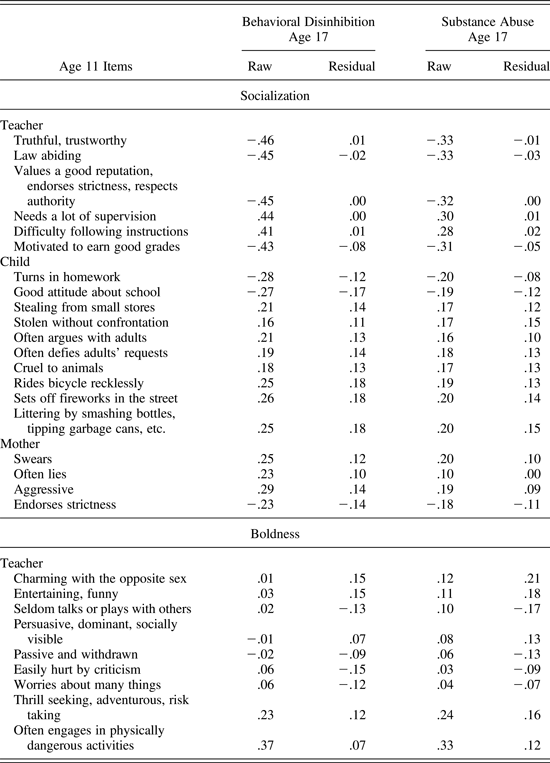
Correlations between the items at age 11 and the age 17 outcome variables were as high as |0.46| for BD17 and |0.33| for SA17. Teacher items were by far the most predictive; the 48 most highly correlated items were all teacher ratings. Therefore, we began scale development by assembling a seed scale using the five teacher items of a similar content with the largest correlations with BD17 and SA17 (truthful, trustworthy; law abiding; values a good reputation, endorses strictness, respects authority; needs a lot of supervision [reversed]; difficulty following instructions [reversed]). Each item described a child who conforms to rules, accepts adult supervision, and endorses conventional moral and ethical values. The mean interitem correlation was 0.67, with Cronbach α = 0.91. The scale scores were highly predictive of BD17 (R = .51, p < .001; p < .05 for each item when entered in a stepwise regression model) and SA17 (R = .36, p < .001; p < .05 for four of five items when entered in a stepwise regression model). Follow-up analyses revealed that the scale scores accounted for much of the predictive power among all the age 11 items, not only for teacher items but also for the child and mother items. In addition, the content of the next most highly correlated items changed, emphasizing attention problems (difficulty concentrating, inattentive, easily distracted). Therefore, we named this scale socialization (SOC; mean z score among the items), and additional items were incorporated if they provided incremental prediction of BD17 and SA17 over and above the SOC scale.
To identify additional items, we regressed BD17 and SA17 on SOC and saved the residual scores. We then ranked the remaining items by their correlations with these residual scores. We restricted the item pool to those items with a correlation ≥|0.10| with the residual scores of BD17 or SA17, yielding a pool of 59 candidate items. There were strong effects for informant and content (i.e., informant factors were as evident as content-based factors in EFA), with especially diverse content for the remaining teacher items. As such, we first examined the remaining teacher items before examining the child and mother items.
Boldness
Eighteen teacher items had a correlation ≥|0.10| with the residual scores of BD17 or SA17. In contrast to SOC, these items represented a diverse content (EFA suggested three factors) that included sociability and social dominance (persuasive, dominant, socially visible), resilience to stressors and lack of anxiety (easily hurt by criticism [reversed], worries about many things [reversed]), and thrill seeking (thrill seeking, adventurous, risk taking). Items were grouped on the basis of these content clusters and entered into regression models with SOC predicting BD17 and SA17. Items that remained significant (p < .01) for either BD17 or SA17 after controlling for SOC and the other items in the content cluster were retained for further analyses. This resulted in a nine-item scale: five sociability/social dominance items, two low stress reaction items, and two thrill-seeking items. Although seemingly heterogeneous, this content overlaps with low inhibition/internalizing, and was similar to the temperament construct called low behavioral inhibition or “boldness,” characterized by lack of shyness, willingness to risk shame and rejection in social situations, high social assurance, lack of worry, and lack of fear in novel and unpredictable situations (Fox et al., Reference Fox, Henderson, Marshall, Nichols and Ghera2005; Kagan, Reference Kagan1994; Patrick, Fowles, & Krueger, Reference Patrick, Fowles and Krueger2009). As these items were clearly distinct from SOC, they were used to form a separate boldness scale (BOLD; mean z score across items).
Child and mother items
Next, BD17 and SA17 were regressed on both the SOC and BOLD scales to identify any additional items from the original item pool. Six additional items had a correlation ≥|0.10| with the residual BD17 and SA17 scores, yielding a pool of 47 candidate items (1 teacher, 28 child, 18 mother). This item set represented a diverse content, and EFA revealed that item covariance was strongly affected by both informant and method of measurement, in addition to thematic content. That is, some EFAs yielded mother, child, and teacher factors rather than substantive trait factors. Because the informant often had as strong an influence as item content in EFAs, we conceptualized items from different informants as providing valid, unique information that should be retained rather than partialed out (e.g., by modeling informant effects). Method factors were also evident; for example, an EFA that included symptoms of CD and items of the DBI yielded interview and questionnaire factors rather than content-based facets of antisocial behavior.
Given these complexities, items were rationally grouped into clusters, giving consideration to item content, informant, method of measurement, and EFA results.Footnote 1 Items from each cluster were then entered into a regression model with SOC and BOLD. Items that remained significant (p < .01) after controlling for BOLD, SOC, and the other items in the cluster were retained for further analyses. We then examined the effect of adding these items to the SOC or BOLD scales. Items that improved prediction of BD17 and SA17 were incorporated into the final scales.
Criterion validity and replication analysis
The final item set for the SOC and BOLD scales and the item correlations with BD17 and SA17 are listed in Table 2. The SOC scale included 20 items (6 teacher, 10 child, 4 mother): the 5 teacher items of the seed scale, 3 academic engagement items, 2 stealing items, 3 oppositional–defiant items, 5 items of specific antisocial behaviors, and 2 mother-rated personality traits. No additional items were added to the 9-item BOLD scale. SOC and BOLD were uncorrelated (r = –.01, ns).
Correlations between age 11 items of socialization and boldness and the behavioral disinhibition and substance abuse outcomes at age 17
Note: “Residual” refers to residual scores of behavioral disinhibition and substance abuse after being regressed on the mean z score of the first five teacher items of socialization, that is, the seed scale for scale development.
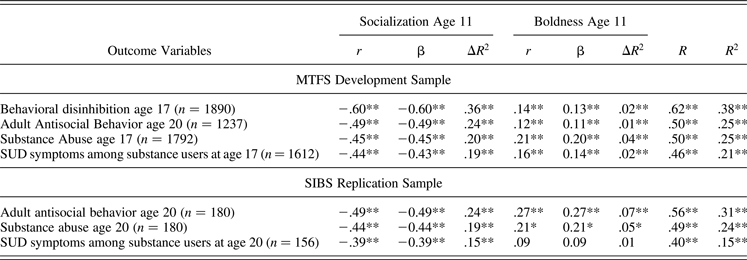
Criterion validity analysis for the SOC and BOLD scales are reported in Table 3. SOC had a large effect for BD17 and SA17. BOLD had a small and medium effect for BD17 and SA17, respectively. Because SOC and BOLD were uncorrelated, each provided significant incremental prediction over the other for BD17 and SA17. There was only a modest decline in effect sizes when predicting the SUD symptoms composite among the subsample of substance users.
Prediction of the behavioral disinhibition and substance abuse outcomes in late adolescence and young adulthood using socialization and boldness scores assessed in preadolescence in the MTFS and SIBS samples
Note: The substance abuse outcome combines measures of substance use and symptoms of SUDs. All ns refer to the listwise deletion sample size, but analyses were conducted using the MLR estimator that adjusts standard errors and parameter estimates for the correlated observations and missing data. MTFS, Minnesota Twin Family Study; SIBS, Sibling Interaction and Behavior Study; SUD, substance use disorder.
*p < .01. **p < .001.
The results of the replication analyses in the SIBS sample were highly consistent with the developmental analyses in the MTFS sample (r = .00 between BOLD and SOC). Compared to the MTFS sample, effects in the SIBS sample were nearly identical for SOC and stronger for BOLD when predicting adult antisocial behavior at age 20. The results were also similar when predicting the substance abuse composite at age 20, with virtually identical effect sizes for both SOC and BOLD (p values are higher because of the much smaller sample size of SIBS relative to the MTFS). For the analysis predicting the SUD symptoms composite among substance users, SOC remained a highly significant predictor with only a modest decline in effect size, whereas BOLD exhibited a greater decline in effect size such that it was no longer a significant predictor. Overall, the replication analyses demonstrated that the predictive power of the SOC and BOLD scores is not sample specific, as the scores predicted substance abuse and behavioral disinhibition outcomes in an independent sample with little decline in effect sizes.
Concurrent and prospective validity
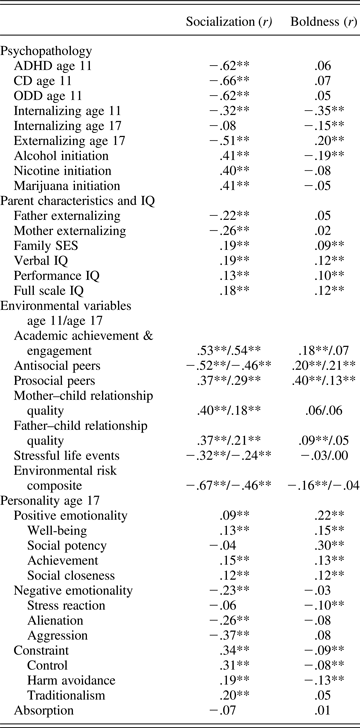
The correlations between SOC and BOLD at age 11 and various external validation measures at age 11 and 17 are reported in Table 4. Low SOC scores exhibited large associations with disruptive behavior disorders and medium associations with internalizing distress and parental externalizing disorders. BOLD was unrelated to disruptive behavior disorders and parental externalizing disorders and had a medium negative association with internalizing distress. SOC and BOLD had small positive associations with family socioeconomic status and each IQ measure. For the environmental variables, SOC had large or medium associations with academic achievement and engagement, prosocial peers, mother–child and father–child relationship quality, and negative associations with antisocial peers and stressful life events. BOLD had small to medium associations with academic achievement and engagement, antisocial and prosocial peers, and null or small associations with parent–child relationship quality and stressful life events. Low SOC had a large association with the environmental risk composite whereas BOLD had a small negative association.
Correlations between socialization and boldness and criterion variables at ages 11 and 17
Note: Correlations between socialization and attention-deficit/hyperactivity disorder (ADHD), conduct disorder (CD), oppositional defiant disorder (ODD), and academic achievement and engagement were adjusted for overlapping items by excluding the overlapping items from the socialization score. The correlation between boldness and internalizing was also adjusted by removing the overlapping items from the boldness score.
**p < .001.
Low SOC had medium associations with a younger age of initiation of alcohol, nicotine, and marijuana use and a large association with externalizing disorders at age 17. BOLD had medium associations with a younger age of initiation of alcohol use and externalizing disorders at age 17, and a small negative association with internalizing disorders at age 17. For environmental variables at age 17, SOC had small to large positive associations with academic achievement and engagement, prosocial peers and parent–child relationship quality and medium to large negative associations with antisocial peers and stressful life events. BOLD had small associations with antisocial and prosocial peers at age 17. Low SOC had a large association whereas BOLD was unrelated to the environmental risk composite at age 17. For self-reported personality at age 17, SOC had medium associations with negative emotionality (−) and constraint (+), in particular, the aggression (–), control (+), and alienation (–) scales. SOC had small associations with each positive emotionality scale except social potency. BOLD had a medium association with positive emotionality, primarily because of its association with social potency. BOLD also had small negative associations with stress reaction and harm avoidance.
Incremental validity
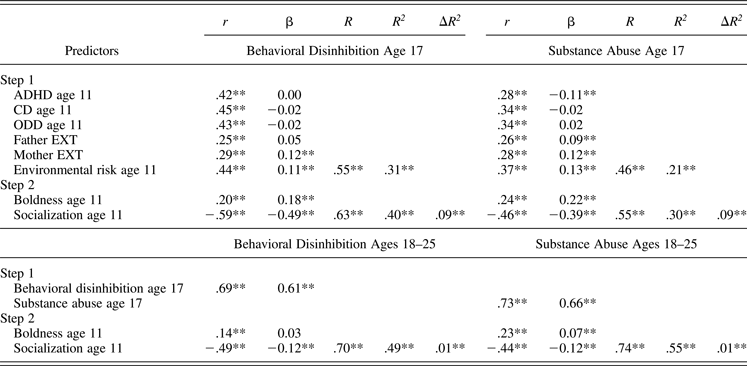
Next, we examined whether SOC and BOLD scores exhibited incremental predictive power over known risk factors for BD17 and SA17, namely, disruptive behavior disorders, parental externalizing disorders, and environmental risk. The results of hierarchical regression models are reported in Table 5 with the known risk factors entered in Step 1, and SOC and BOLD entered in Step 2 (results were unchanged if variables in Step 1 were entered singly rather than as a block). Each risk factor had a medium to large association with BD17 and SA17. In the full model, the environmental risk composite and mother externalizing continued to have significant, but small, predictive effects. Father externalizing also had a small effect for SA17. The effects of SOC and BOLD were relatively unaffected after controlling for the other risk factors, and added substantial incremental prediction for both BD17 and SA17 (ΔR 2 = .09, p < .001 for both). In contrast, when SOC and BOLD were entered in Step 1, the combination of disruptive behavior disorders, parental externalizing, and environmental risk added at Step 2 provided a ΔR 2 of only .03 and .05 (ps < .001) for BD17 and SA17, respectively.
Incremental predictive power of socialization and boldness for behavioral disinhibition and substance abuse at age 17 and ages 18–25
Note: All analyses were conducted using the MLR estimator that adjusts the standard errors and parameter estimates for the correlated observations and missing data. Listwise n = 1657 and 1287 for behavioral disinhibition at age 17 and ages 18–25, respectively; listwise n = 1586 and 1371 for the substance abuse composite at age 17 and ages 18–25, respectively. For models predicting age 17 outcomes, the results were unchanged if the predictors in Step 1 were entered singly rather than as a block. ADHD, attention-deficit/hyperactivity disorder; CD, conduct disorder; ODD, oppositional defiant disorder; EXT, externalizing.
**p < .001.
We also examined whether SOC and BOLD predicted substance abuse and antisocial behavior from ages 18 to 25. For the young adult BD composite, SOC and BOLD continued to exhibit large and small effects, respectively, though these effects were weaker than those for BD17 (R = .62 age 17 vs. .50 ages 18–25). However, the modest decline in effect sizes could be attributable to the slightly different composition of the young adult BD variable (in particular, the exclusion of the DBI in the young adult composite). For the young adult SA composite, SOC and BOLD exhibited large and medium effects, respectively, which were nearly the same as the effects for SA17 (R = .50 age 17 vs. .48 ages 18–25). Despite large stability coefficients between adolescent and young adult BD and SA (r = .69 and .73, respectively), the combination of SOC and BOLD also exhibited small incremental prediction for young adult BD and SA after controlling for BD17 and SA17 (both ΔR 2 = .01, p < .001), respectively.
Genetic and environmental influences
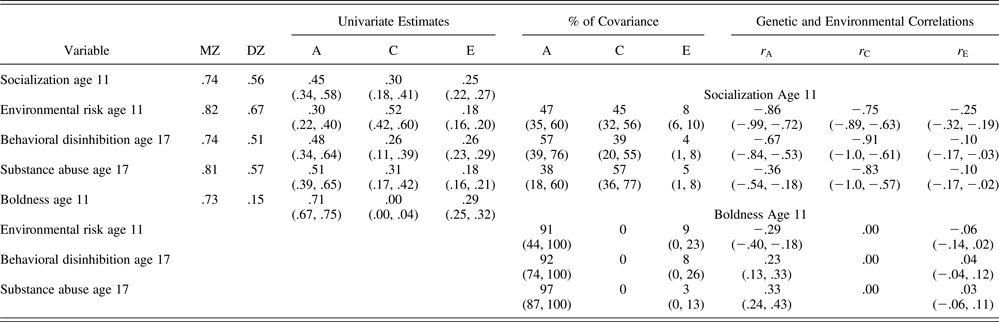
The twin correlations and genetic, shared environmental, and nonshared environmental variance components for SOC and BOLD scores, as well as the environmental risk composite at age 11 and the BD17 and SA17 outcome measures, are reported in the upper left of Table 6. Each measure had a high MZ correlation (.73 to .82) and each had a high DZ correlation (.51 to .67) except BOLD (.15). As such, BOLD had high heritability and no shared environmental variance, whereas the other variables exhibited moderate heritability and moderate shared environmental variance. Each variable exhibited modest to moderate nonshared environmental variance (.18 to .29).
Twin correlations, estimates of ACE variance components (95% confidence intervals), and measures of overlap between socialization and boldness and environmental risk, behavioral disinhibition, and substance abuse
Note: Because boldness had no shared environmental variance, the shared environmental contributions to the overlap between boldness and the other variables was fixed to zero. MZ, monozygotic; DZ, dizygotic; A, additive genetic; C, shared environment; E, nonshared environment; r A, genetic correlation; r C, shared environmental correlation; r E, nonshared environmental correlation.
We also fit multivariate biometric models to determine the genetic and environmental contributions to the overlap between SOC and BOLD and the environmental risk composite at age 11, BD17, and SA17. For BOLD, nearly all of its associations with the environmental risk composite, BD17, and SA17 were due to common genetic influences (lower right of Table 6). For SOC, additive genetic and shared environmental factors each accounted for between 38% and 57% of its associations with the environmental risk composite, BD17, and SA17 (upper right of Table 6). SOC had a large and BOLD a medium genetic correlation with the environmental risk composite at age 11; together they accounted for 82.4% of the heritable variance of the environmental risk composite at age 11, indicating a large gene–environment correlation. SOC also had a large and BOLD a medium genetic correlation with BD17; together, they accounted for 47.9% of the heritable variance of BD17. SOC and BOLD each had medium genetic correlations with SA17; together, they accounted for 22.0% of the heritable variance of SA17. SOC also had large shared environmental correlations with the environmental risk composite at age 11, BD17, and SA17, and accounted for 56.3%, 85.0%, and 73.8% of their shared environmental variance, respectively.
Discussion
We found that the majority of premorbid risk for SUDs was accounted for by two child personality traits: socialization and boldness. Children high in socialization were characterized by a willingness to conform to rules and adult supervision and to endorse conventional moral and ethical values. Socialization measures the low end, or adaptive pole, of the behavioral disinhibition liability that underlies externalizing disorders, as evidenced by strong associations between low socialization and disruptive behavior disorders, parental externalizing disorders, and personality traits related to aggression and impulsivity, as well as exposure to various environmental risk factors. Though moderately heritable, socialization also exhibited moderate shared environmental influences and accounted for much of the heritable variance in a composite of environmental risk, indicative of gene–environment correlation processes.
After identifying socialization, we focused on identifying traits that provided incremental prediction of SUD outcomes, efforts that resulted in the boldness scale. Bold children were sociable, socially fearless and dominant, resilient to stress, lacking anxiety, and thrill seeking. Because of our approach to scale construction, boldness was uncorrelated with socialization, and exhibited a distinct pattern of correlates including null associations with disruptive behavior disorders, parental externalizing disorders, and most environmental risk factors, with the exception of a modest association with antisocial peers. As a consequence of this independence, boldness provided incremental prediction of substance abuse. Boldness was also highly heritable with no shared environmental influences, suggesting a highly person-driven risk factor for substance abuse. Boldness was also associated with less internalizing distress and greater prosocial peer affiliation, indicative of positive adjustment in certain domains.
Conceptual advances
These findings build upon previous work attempting to measure premorbid risk for SUDs in a number of ways. For one, the effect sizes are larger than in previous work (Caspi et al., Reference Caspi, Moffitt, Newman and Silva1996; Cloninger et al., Reference Cloninger, Sigvardsson and Bohman1988; Masse & Tremblay, Reference Masse and Tremblay1997; Shedler & Block, Reference Shedler and Block1990), even relative to the TLI developed by CEDAR investigators that utilized sophisticated psychometric techniques and a longitudinal high-risk sample (Hicks et al., Reference Hicks, Iacono and McGue2012; Vanyukov et al., Reference Vanyukov, Kirisci, Moss, Tarter, Reynolds and Maher2009). This is probably the result of using the prospective SUD outcomes of the preadolescent participants as the criterion to select items rather than family history of SUDs, a more indirect measure of overall risk. The focus on identifying the trait constructs of socialization and boldness also provides a number of conceptual advantages to build a theoretical model of underlying risk for SUDs. One is that they are specifically geared toward accounting for risk for SUDs, rather than broad trait constructs from general models of personality. In addition, although there is substantial overlap in content between the CEDAR TLI and socialization, our focus on a trait approach required greater psychological interpretation as to the potential latent trait underlying the item covariance. The greater emphasis on the psychological meaning of the scales can then be used to more easily link the constructs to the broader personality and psychopathology literature. Finally, our emphasis on incremental prediction beyond a general externalizing risk factor allowed us to identify boldness items, content that is quite distinct from the disinhibition content that dominates the CEDAR TLI.
Another conceptual advantage of socialization and boldness is that they may tap independent pathways to substance abuse, thus providing a parsimonious model of person-level risk. Relative to externalizing, socialization provides a more focused, refined, and homogeneous construct, while also accounting for the link between child externalizing and later SUDs. That is, externalizing encompasses a broad content (inattention, hyperactivity, impulsivity, conduct problems, aggression, oppositionality); as such, externalizing variance is present in many measures, some of which likely have only an indirect link with SUDs. Shifting attention to socialization helps to focus future research on the interplay between premorbid person-level and environmental risk factors in the development of SUDs. In addition, socialization is keyed to the positive pole of externalizing, a conceptualization often lacking in symptom measures and models of risk with the potential to inform understanding of both adaptive and maladaptive outcomes. It is interesting that the most predictive items were teacher ratings of global descriptions of normative behaviors and attitudes rather than the more severe and specific symptoms of diagnostic measures. This suggests that the socialization scale taps a broad temperament dimension relevant to several important life outcomes, as opposed to a collection of heterogeneous items that provide predictive utility but little theoretical guidance.
Boldness offers another conceptual advance by providing a more efficient organization and clarifying the association between premorbid inhibition/internalizing and extraversion/positive emotionality and risk for substance abuse. Boldness entails the combination of multiple facet-level traits, specifically, sociability and social dominance, stress resilience, and thrill seeking. This particular configuration of facet-level traits from different content domains might account for the inconsistent links between substance abuse and the broad inhibition/internalizing and extraversion/positive emotionality constructs. Our results are consistent with findings that facets of extraversion/positive emotionality increase risk for an earlier age of initiation of alcohol use and substance use in adolescence and young adulthood (Sher et al., Reference Sher, Grekin and Williams2005) but cast doubt on the extent to which child inhibition/internalizing increases risk for substance use and abuse. Rather than a developmental pathway that begins in childhood, we suspect that the association between inhibition/internalizing and substance abuse is attributable to either comorbid externalizing, a consequence of persistent substance abuse, or to processes that emerge in adulthood.
In terms of links to other trait constructs, the content, independence, and distinctive pattern of correlates of socialization and boldness bear a strong resemblance to Factor 1 (interpersonal and affective features) and Factor 2 (impulsivity, antisocial behavior) psychopathy measures (Hare, Reference Hare2003; Lilienfeld & Widows, Reference Lilienfeld and Widows2005). Patrick et al. (Reference Patrick, Fowles and Krueger2009) recently proposed a triarchic model of psychopathy that included the trait constructs of disinhibition, boldness, and meanness. Disinhibition is synonymous with externalizing, and so has a clear link with socialization. Psychopathic boldness was characterized by high self-confidence and social efficacy, resiliency to stress, comfort with novelty, and capacity to remain calm and composed under conditions of threat or pressure. (Meanness is a constellation of traits primarily associated with callous aggression.) Measures of psychopathic boldness often exhibit correlates suggestive of psychological adjustment, such as negative associations with internalizing disorders and negative emotionality (Blonigen et al., Reference Blonigen, Patrick, Douglas, Poythress, Skeem and Lilienfeld2010; Hicks & Patrick, Reference Hicks and Patrick2006), and are positively associated with narcissism and thrill and adventure seeking (Benning, Patrick, Blonigen, Hicks, & Iacono, Reference Benning, Patrick, Blonigen, Hicks and Iacono2005; Benning, Patrick, Hicks, Blonigen, & Krueger, Reference Benning, Patrick, Hicks, Blonigen and Krueger2003). This suggests that psychopathy research may help to inform understanding of socialization and boldness. For example, the similarity between boldness and Factor 1 suggests that both may be linked to a genotypic weakness in fear reactivity (Patrick et al., Reference Patrick, Fowles and Krueger2009), a hypothesis that can be tested by examining whether boldness is associated with reduced defensive startle reactivity (Vaidyanathan, Hall, Patrick, & Bernat, Reference Vaidyanathan, Hall, Patrick and Bernat2011). In contrast, socialization is likely to exhibit associations with biological correlates of externalizing and Factor 2, such as reduced P3 amplitude (Gilmore, Malone, Bernat, & Iacono, Reference Gilmore, Malone, Bernat and Iacono2010) and error related negativity (Hall, Bernat, & Patrick, Reference Hall, Bernat and Patrick2007).
Methodological strengths
The study had several methodological strengths that engender confidence in the robustness of the findings. The first is our approach to scale construction. Informed by Tellegen and colleague's (Reference Tellegen, Ben-Porath, McNulty, Arbisi, Graham and Kaemmer2003) approach to parsing general and specific psychopathology constructs, we extended this approach by incorporating the use of criterion variables and the requirement of incremental prediction to guide item selection. Using this approach, we first identified the core piece of the nonspecific externalizing liability (socialization) and then identified additional, independent traits that conferred risk for substance abuse (boldness). We also tied the resulting scales to existing trait constructs such that our findings can both inform and be informed by other literatures. The elegance of this approach is that it provides a method that can be used by other investigators using either existing or new data sets to derive similar measures and replicate our findings. That is, the importance of this work is the trait constructs we identified and the method used to identify them, not a specific collection of items. This approach is not limited to premorbid risk measures of substance abuse. For example, we recently used similar procedures to derive a scale of borderline personality disorder (Bornovalova, Hicks, Patrick, Iacono, & McGue, Reference Bornovalova, Hicks, Patrick, Iacono and McGue2011).
Of course, we could have taken a different approach to identify key premorbid risk variables. For example, we could have used factor analysis to examine the covariance structure of the initial item pool, determined which of the resulting constructs best predicted substance abuse, and refined scales to assess these constructs. However, this approach would merely identify the constructs already embedded in the initial measures (the multiple informants and assessment methods would also complicate this approach), and their relative predictive power for substance abuse would simply mirror findings in the existing literature. Our approach was novel and identified slightly different target constructs and so has the potential to improve understanding of underlying risk for SUDs.
Another important strength of our approach was that we replicated our results in an independent sample with a high degree of consistency. Although some advocate splitting a sample into random halves in the process of development and validation, this approach reduces power and provides no actual test of independent replication. It should be noted that in SIBS, boldness failed to predict a composite of SUD symptoms among current substance users. This could signal that boldness is more relevant to initiation and adolescent substance use than for symptoms of abuse and dependence. However, the smaller effect may simply be a function of random variation, especially given the much smaller sample size. For example, the opposite pattern was observed for boldness predicting adult antisocial behavior, wherein the effect size was notably larger in SIBS relative to the MTFS. Future work is necessary to determine the more likely explanation.
An additional strength was the extensive MTFS assessment that allowed us to demonstrate a theoretically coherent pattern of convergent and discriminant associations between socialization and boldness and established risk factors for SUDs. Our most stringent test was the demonstration that socialization and boldness provided incremental prediction of substance abuse and behavioral disinhibition beyond disruptive behavior disorders, parental externalizing disorders, and environmental adversity. Incremental prediction is an essential, but often absent, aspect of validating new measures, and the socialization and boldness scales represent clear improvements over several existing measures taping risk for substance abuse.
A final strength of the study was the examination of the genetic and environmental influences on socialization and boldness. The greater heritability of boldness and the greater shared environmental influences on socialization indicates distinct etiological mechanisms, a pattern that was also evident in their associations with the environmental risk, behavioral disinhibition, and substance abuse composites. Associations with boldness were solely attributable to genetic influences, whereas the associations with socialization were due to a combination of genetic and shared environmental influences. In addition, socialization accounted for most of the heritable variance of the environmental risk composite. Putatively environmental measures often exhibit heritable variance because of their overlap with behavioral traits, a phenomenon called gene–environment correlation (Scarr & McCartney, Reference Scarr and McCartney1983). An active gene–environment correlation may be a key mechanism by which genetic influences on socialization increase risk for substance abuse. That is, children low on socialization may select into high-risk environments, which then increases risk for SUDs. The results from a separate analysis were consistent with this hypothesis (Hicks et al., in press). That is, low socialization at age 11 predicted exposure to environmental risk at age 14 even after controlling for the stability of environmental risk from age 11 to 14 (selection effect). Environmental risk at age 14 then mediated the influence of genetic risk factors on socialization that contributed to substance abuse at age 17. That is, genetic influences on socialization increased risk for substance abuse indirectly by increasing the likelihood of exposure to high-risk environments.
There was also substantial overlap between the shared environmental influences on socialization and the environmental risk, behavioral disinhibition, and substance abuse composites. The notable shared environmental influences on behavioral disinhibition and substance abuse are likely due to using dimensional measures that included initiation of substance use and child/adolescent antisocial behavior, both of which exhibit greater shared environmental influences relative to symptoms of SUDs and adult antisocial behavior (Hicks et al., Reference Hicks, Schalet, Malone, Iacono and McGue2011; Lyons et al., Reference Lyons, True, Eisen, Goldberg, Meyer and Faraone1995; Rhee et al., Reference Rhee, Hewitt, Young, Corley, Crowley and Stallings2003). The finding of overlap among the shared environmental influences on various externalizing phenotypes in late childhood and adolescence is consistent with previous MTFS studies (Burt, Krueger, McGue, & Iacono, Reference Burt, Krueger, McGue and Iacono2001; McGue, Iacono, & Krueger, Reference McGue, Iacono and Krueger2006). An important avenue of future research will be to better characterize this shared environmental risk factor and gene–environment correlations that contribute to substance abuse.
Limitations and future directions
Some limitations should be noted. One is that although the MTFS sample is representative of the Minnesota population from which it was drawn, it lacks ethnic and racial diversity. Another limitation is that not all of the candidate items were available for each informant, making it difficult to distinguish between the importance of content and informant.Footnote 2 An important aim of future research will be to administer the same set of items to each informant to provide a more direct comparison of informant effects. In addition, we were constrained by the items present in the MTFS data set. The advantages of the large and genetically informative MTFS sample and its extensive longitudinal assessments cannot be overstated, especially given the necessity of prospective outcomes to validate any measure of premorbid risk. However, with the target constructs identified, a goal of future research will be to refine the socialization and boldness scales, ideally using an iterative approach that entails multiple rounds of testing new items to refine both the measurement and conceptualization of the constructs (Tellegen & Waller, Reference Tellegen, Waller, Boyle, Matthews and Saklofske2008). Such an approach will likely reveal more distinct facet-level constructs underlying socialization and boldness that may have differential associations with the development of SUDs.
Our primary reason for identifying the key constructs underlying premorbid risk for SUDs was to improve research delineating the interplay between genetic and environmental risk for SUDs, especially during adolescence when substance use begins and SUDs first emerge. As such, the socialization and boldness scales provide measures of person-level risk present prior to the initiation of substance use that will help to delineate selection and causation processes between personal and environmental risk factors for SUDs. In addition, the distinctiveness of the socialization and boldness constructs provide a clear theoretical framework by which to examine differential risk mechanisms. An important next step will be to link socialization and boldness to different biological mechanisms (e.g., deficits in effortful control vs. defensive fear processes). Finally, pending refinements and validation across informants, measures of socialization and boldness may have clinical utility as a brief screen to identify children at high risk for substance abuse and antisocial behavior prior to the emergence of severe SUDs and criminal behavior.
In summary, we identified two trait constructs that accounted for the majority of premorbid risk for SUDs and improved upon existing measures in terms of prediction and theory. Although other studies have detected associations between child characteristics at earlier ages and/or over a greater period of time, the effects reported in these studies were relatively modest (Caspi et al., Reference Caspi, Moffitt, Newman and Silva1996; Cloninger et al., Reference Cloninger, Sigvardsson and Bohman1988; Shedler & Block, Reference Shedler and Block1990). The effect sizes we obtained were larger than in any previous study, and the degree of incremental validity over family history and environmental risk suggests that the socialization and boldness scales may be useful as both a research and a clinical tool. In addition, no other study has articulated a similar method to scale construction, provided independent replication, demonstrated a coherent pattern of convergent and discriminant associations with concurrent and prospective outcomes, as well as incremental validity relative to known risk factors for SUDs, and estimated genetic and environmental influences on premorbid risk factors and their associations with substance abuse and related outcomes, including environmental risk.
Future research that incorporates socialization and boldness will provide clinical utility via both improved risk assessment and insight into mechanisms of risk that can then be translated into prevention and intervention efforts. For example, interventions could be tailored to the personality style of children. Conrod and colleagues (Conrod, Castellanos, & Mackie, Reference Conrod, Castellanos and Mackie2008; Conrod, Castellanos-Ryan, & Strang, Reference Conrod, Castellanos-Ryan and Strang2010) have developed school-based prevention and intervention protocols tailored to different personality characteristics that have shown some efficacy for reducing adolescent drinking. Some of the target personality traits have notable overlap with socialization and boldness. These two lines of research could build upon each other to gain greater insights into both etiology and effective intervention and prevention. For example, knowledge of the different environmental correlates socialization and boldness could be used to refine the interventions to include environmental contexts that increase risk for substance abuse and may serve as key points at which to intervene.