Introduction
Central nervous system (CNS) tumors constitute an important cause of morbidity and mortality and are the leading cause of death in patients with pediatric cancer. More than 30% of pediatric patients with CNS tumors will succumb to their disease (Gatta et al., Reference Gatta, Botta and Rossi2014). The clinical course of these patients, especially in the end-of-life care (EoLC) period, is accompanied by different holistic problems, including suffering due to symptoms or prolonged hospital stays (Wolfe et al., Reference Wolfe, Grier and Klar2000; Goldman et al., Reference Goldman, Hewitt and Collins2006; Vallero et al., Reference Vallero, Lijoi and Bertin2014; Jagt-van Kampen et al., Reference Jagt-van Kampen, van de Wetering and Schouten-van Meeteren2015; Wolfe et al., Reference Wolfe, Orellana and Ullrich2015). Many international societies and institutions, advocate for the implementation of pediatric palliative care (PPC) programs to attend to their needs (American Society of Pediatric Hematology/Oncology (ASPHO), n.d.; Palliative Care Working Group. International Society of Paediatric Oncology, n.d.; WHO, n.d.).
PPC should begin when the disease is diagnosed, regardless of the probability of healing. It should be provided in all healthcare locations, including patients’ homes. Along with improving the Quality of Life of patients, PPC has demonstrated several benefits: (1) improving communication with patients and families; (2) better symptom assessment, and management; (3) incorporating new models of care encompassing inpatient–outpatient circuits; (4) establishing home-based care as a standard model of care; and (5) providing a holistic approach for patients’ and their families’ needs (Zhukovsky et al., Reference Zhukovsky, Herzog and Kaur2009; Foster et al., Reference Foster, Lafond and Reggio2010; Friedrichsdorf et al., Reference Friedrichsdorf, Postier and Dreyfus2015; Weaver et al., Reference Weaver, Heinze and Bell2016; Snaman et al., Reference Snaman, Kaye and Baker2018). These benefits have been described also at the early stages of the disease (Gans et al., Reference Gans, Kominski and Roby2012; Groh et al., Reference Groh, Borasio and Nickolay2013; Schmidt et al., Reference Schmidt, Otto and Hechler2013; Friedrichsdorf et al., Reference Friedrichsdorf, Postier and Dreyfus2015; Kaye et al., Reference Kaye, Friebert and Baker2016). However, barriers to the early provision of PPC continue to exist, restricting its provision to EoLC (Haines et al., Reference Haines, Frost and Kane2018; Cheng et al., Reference Cheng, Rost and De Clercq2019; Snaman et al., Reference Snaman, McCarthy and Wiener2020). A better understanding of the needs of specific groups of patients, and the benefits of PPC can favor early integration (Hinds et al., Reference Hinds, Pritchard and Harper2004; Snaman et al., Reference Snaman, McCarthy and Wiener2020). Previous studies have focused on the general aspects and symptoms present in EoLC (Wolfe et al., Reference Wolfe, Grier and Klar2000; Goldman et al., Reference Goldman, Hewitt and Collins2006; Hechler et al., Reference Hechler, Blankenburg and Friedrichsdorf2008; Pritchard et al., Reference Pritchard, Burghen and Srivastava2008; Vallero et al., Reference Vallero, Lijoi and Bertin2014; Jagt-van Kampen et al., Reference Jagt-van Kampen, van de Wetering and Schouten-van Meeteren2015; Kuhlen et al., Reference Kuhlen, Hoell and Balzer2016; Zernikow et al., Reference Zernikow, Szybalski and Hübner-Möhler2019). Particular aspects of care in concrete groups, such as patients with CNS cancer or studies with a comparative approach are still scarce (Hechler et al., Reference Hechler, Blankenburg and Friedrichsdorf2008; Jagt-van Kampen et al., Reference Jagt-van Kampen, van de Wetering and Schouten-van Meeteren2015; Kuhlen et al., Reference Kuhlen, Hoell and Balzer2016).
In this study, we aimed to describe the characteristics of deceased patients with CNS cancer attended by the Regional Pediatric Palliative Care Unit of Madrid (PPCUM), as well as the healthcare, social, and psychological interventions provided by the PPCUM. Additionally, we compared the characteristics and EoLC of deceased patients who attended the hospital where the PPCUM was located, based on if they were attended by the PPCUM or not.
Methods
This retrospective study was based on the medical records of deceased patients diagnosed with CNS cancer between January 2010 and December 2019 at the Niño Jesús Children's University Hospital (HIUNJ). HIUNJ functions as the setting for the PPCUM, the regional resource for the provision of PPC in Madrid, counting also with a Department of Pediatric Oncology. The PPC provides specialized PPC with a hospitalization and home-based care programs with an interdisciplinary team including pediatricians, nurses, psychologists, and social workers.
This study was composed of two parts: a descriptive study and a cohort comparative study. Patients were classified into (1) patients assisted by the PPCUM and (2) patients not assisted by the PPCUM. Patients in Group 1 were subclassified considering if they were referred from HIUNJ or other institutions. This subclassification was performed to enable the comparison of patients from Group 1 who primarily attended HIUNJ with patients from Group 2 (patients in HIUNJ who were not provided PPC).
We collected the epidemiological characteristics of Group 1, including sex, age at diagnosis, type of CNS cancer, age at death, time from diagnosis to death, and referring hospital. Regarding cancer history prior to referral, we registered the presence of disseminated disease, the presence of progression or relapse, and previous treatments (surgery, radiotherapy, chemotherapy, or clinical trials). Regarding interventions by the PPCUM, we registered the reason for referral, the location of the first contact, follow-up time, inclusion in the home hospitalization program, number and reason of hospital admissions, location of death, medical devices used, nursing interventions, psychological evaluation, social interventions, symptom prevalence, use of opioids, benzodiazepines, corticoids, and palliative sedation. Psychological and social variables were extracted from the medical reports using a Likert scale. Data were abstracted using a standardized questionnaire by a single researcher.
To compare patients who were attended by the PPCUM in HIUNJ with those who were not, we analyzed the number of therapies, the presence of disseminated disease at diagnosis or during outcome, the presence of progression or relapse events, administration of chemotherapy, radiotherapy, red blood cells and platelet transfusions, invasive support measures (life support measures that needed to be administered in the ICU), and palliative sedation during the final month of life; the number of days of hospital admission and ICU admission; and location of death (patient's home vs. hospital).
Statistical analyses were performed using Stata/IC® v16.1. We used median and interquartile ranges (IQ) for quantitative measures and proportions for categorical variables for description. Classic parametric and non-parametric for bivariate comparison were used depending on the variables analyzed. The Mantel–Haenszel log-rank test was used to compare the time from diagnosis to death. Statistical significance was set at p = 0.05.
This study was performed following the ethical guidelines and regulations of HIUNJ, obtaining approval as part of a larger research project from the Research Ethics Committee of the institution (internal code R-0086/20). The data obtained were anonymized and used only for research purposes. No human subject was directly exposed to research interventions.
Results
A total of 71 deceased patients with CNS cancer were examined, of whom 59 received assistance from the PPCUM. Of the 71 patients, 48 (67.6%) were primarily treated at the oncology department of HIUNJ of whom 36 (75%) were also attended by the PPCUM.
Characteristics of the patients attended by the PPCUM
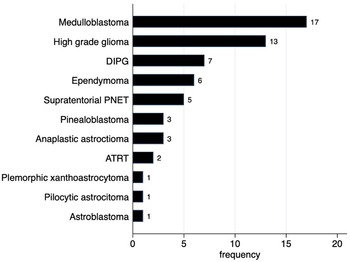
Of the 59 patients attended by the PPCUM, 69.5% were boys, with a median age at diagnosis of 6.1 years (IQ: 3.5–10.4) and at death of 9.2 years (IQ: 6.0–12.4). The most common diagnosis was medulloblastoma (28.8%) and high-grade glioma (22.0%) (Figure 1). As previously mentioned, 61% of the patients were referred from HIUNJ, 32.2% from other public hospitals in Madrid, and 6.8% from private institutions.
Frequency of cancer types.

Cancer treatment and outcomes before referral
At diagnosis, 12 patients (20.3%) presented with leptomeningeal dissemination, and one patient (1.7%) had bone metastasis. Through the course of their treatment, 49.2% of the patients developed leptomeningeal disease, with three also developing bone metastasis. Prior to the referral, 89.8% of the patients had experienced progression or relapse. Of these patients, 39.0% had received one line of treatment, 42.3% two, 10.2% three, and 8.5% four. Regarding oncological treatments, 98.3% of the patients had received chemotherapy, 88.1% received radiotherapy, 79.7% received surgery, 10.2% received high-dose chemotherapy followed by autologous bone marrow transplantation, and 33.9% received other experimental treatments, including oncolytic virus (9.9%), immunotherapy (8.5%), anti-angiogenic antibodies (4.2%), experimental chemotherapy regimens (4.2%), and targeted therapy (BRAF inhibitors) (1.4%).
Referral to the PPCUM and assistance provided
The main reason for referral was the recognition of different “trigger points” by the pediatric oncologist (93.2%), being the most frequent among them lack of therapeutic options (67.8%), or clinical progression (23.7%). Two patients (3.4%) were referred for pain control, one because the family expressed their desire for the patient to receive PPC and one when the EoLC situation was recognized. In 30.5% of the cases, the family expressed the wish for the patient to be attended by a home hospitalization resource. The median time from diagnosis to referral was 13.2 months (IQ: 7.1–35.0).
The median follow-up time by the PPCUM was 1.6 months (IQ: 0.6–5.2). Most patients (84.8%) were included in the home hospitalization program; 54.2% did not undergo further admissions; and 32.2% required only one hospitalization. A total of 37 hospitalizations were recorded, with symptom control (37.8%) and EoLC (35.1%) as the main causes. Regarding the place of death, 64.4% of the patients died at home, 18.6% and 15.3% while being hospitalized in the PPC and oncology wards, respectively, and one (1.7%) in the intensive care unit.
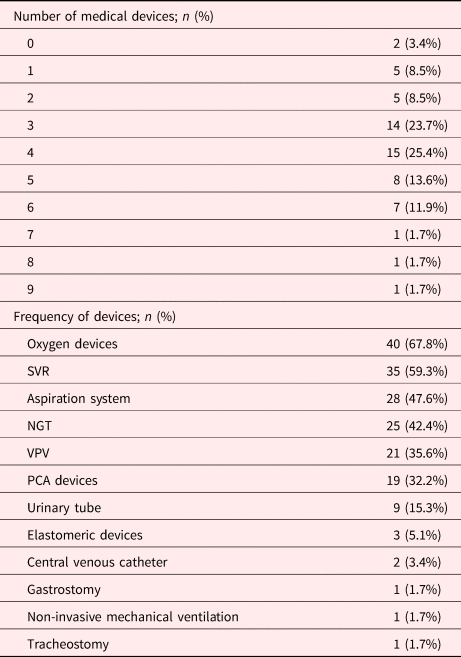
The need for medical devices is shown in Table 1; 79.7% of the patients needed three or more devices, with oxygen devices (67.8%) and subcutaneous venous reservoirs (59.3%) being the most frequently used. During the follow-up, 20 patients (33.9%) received chemotherapy — 18 for palliative purposes and 2 for curative — 5 patients (8.4%) received palliative radiation, 1 received curative radiation (1.7%), 2 patients (3.4%) were surgically treated with palliative goals, and 10 (17.0%) received experimental treatments.
Medical devices employed

SVR, subcutaneous venous reservoir; NGT, nasogastric tube; VPV, ventricular-peritoneal valve; PCA, patient control analgesia.
Nursing interventions, psychological evaluations, and social interventions
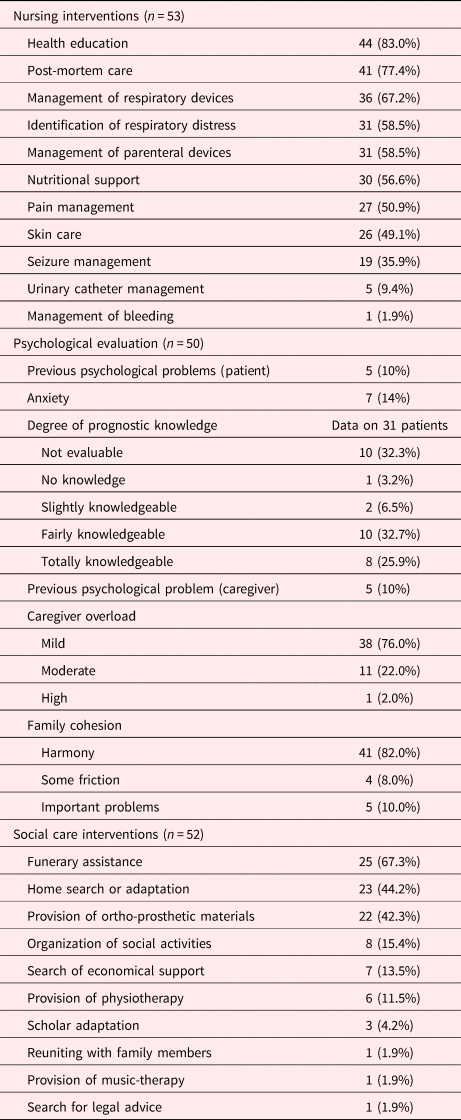
Nursing interventions were registered in 89.8% of the patients (Table 2); the most frequent interventions were provision of health education to the patients’ caregivers, post-mortem care, and management of respiratory support devices. Regarding psychological assessments, data were available for 84.7% of the patients. Of the patients evaluated, 10% had previous psychological conditions and 14% developed anxiety while being attended by the PPCUM. Of the patients for whom data was accessible and degree of knowledge evaluable, 85.7% were fairly or totally knowledgeable of their prognosis.
Nursing interventions, psychological evaluation, and social intervention

Among the parents, 10% had previous psychological problems and 24% developed moderate or high overload, while 18% of the families experienced friction to some degree. Social interventions were registered in 88.1% of the patients; the most frequent were support for funerary procedures (67.3%), adaptation or search for an adequate home (44.2%), and provision of ortho-prosthetic materials (42.3%).
Symptom prevalence, use of opioids, and palliative sedation
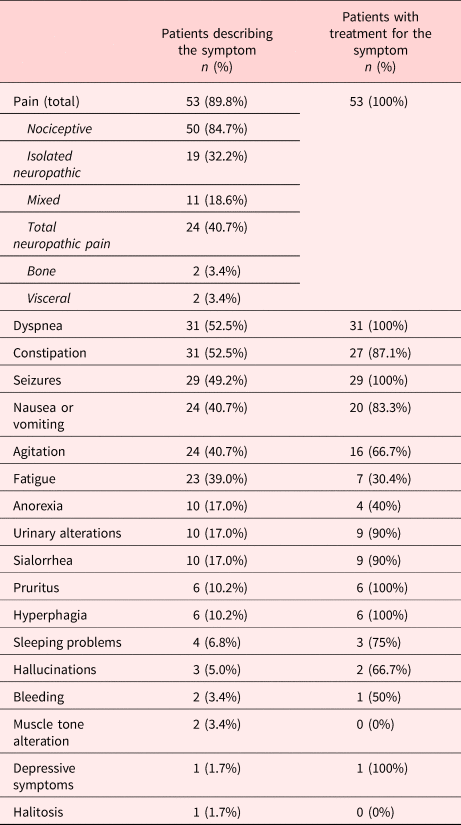
The number of symptoms per patient ranged from 0 to 10, with a median of 4 (IQ: 4–6) (Table 3). The most frequent symptom was pain, present in 89.8% of the patients. After being subclassified, the most common patterns were nociceptive (84.7%) and neuropathic pain (40.7%), either as an isolated or mixed pattern. Other frequent symptoms included dyspnea, constipation, or seizures. Opioids were administered to 83.1% of the patients, with 64.4% receiving them parenterally. Of the patients, 59.3% were administered benzodiazepines, in all administered parenterally at some point. Corticosteroids were administered to 48.5% of the patients.
Frequency of symptoms and of treated patients with each symptom

Palliative sedation was used in three patients (5.1%); it was indicated in two patients for dyspnea and one for pain and agitation. It was administered at the hospital with a median duration of one day before death. The medication used was midazolam for two patients and propofol for one.
Comparison among patients from HIUNJ based on PPC provision
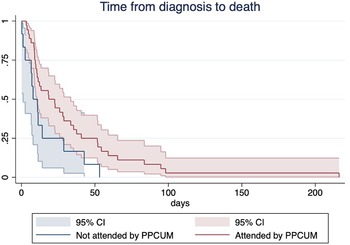
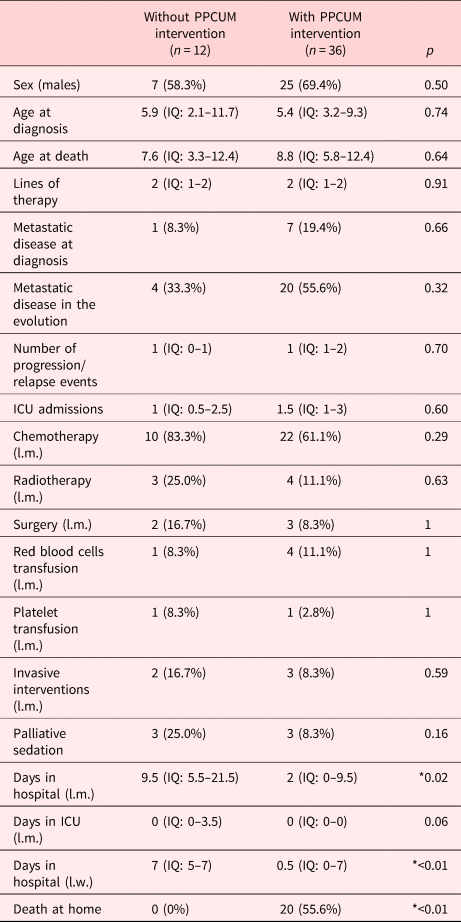
A total of 48 patients died of CNS tumors at HIUNJ during the period of study; 36 (75%) were attended by the PPCUM (Table 4). No significant differences were found in sex, age at diagnosis, or at death. The time from diagnosis to death (Figure 2), differed significantly (p < 0.01), with patients attended by the PPCUM having a higher survival rate.
Time from diagnoses to death.

Comparison of the characteristics of patients with and without PPCUM intervention

l.m., last month; l.w., last week.
* means statiscally significant.
No differences were found in the number of lines of treatment, disseminated disease at diagnosis, number of relapse or recurrence events, or number of ICU admissions. Regarding the last month of life, there were no differences in the proportion of patients who received chemotherapy, radiotherapy, surgery, red blood cells, or platelet transfusions.
While 50% of the patients attended by the PPCUM died at home, all in the non-PPCUM group died at the hospital (nine in the oncology ward and three in the ICU). The palliative-attended patients spent significantly fewer days at the hospital in the last month (median of 2 days vs. 9.5; p < 0.01) and in the last week (median of 0.5 vs 7; p < 0.01) of life with no difference regarding invasive interventions or palliative sedation in the last month of life between both groups.
Discussion
In this study, we described the global care provided by the PPCUM for patients deceased from a CNS tumor. The care provided by the PPCUM was primarily home-based programs, with heterogeneous needs and a higher probability of staying at home in the last month of life, and of dying at home than patients who were not attended by the PPCUM.
The overall clinical and epidemiological characteristics of our cohort were similar to those described in the literature, making our data comparable to those of other populations (Vallero et al., Reference Vallero, Lijoi and Bertin2014; Jagt-van Kampen et al., Reference Jagt-van Kampen, van de Wetering and Schouten-van Meeteren2015; Kuhlen et al., Reference Kuhlen, Hoell and Balzer2016). Regarding the referring hospital, in our study, most patients received cancer treatment before their referral at HIUNJ. The lack of local PPC resources in other hospitals may suppose a barrier toward their coverage (Haines et al., Reference Haines, Frost and Kane2018; de Noriega et al., Reference de Noriega, Pérez Martin and Martino Alba2020). While PPC is a growing discipline in Spain, existing barriers in the country have not been studied extensively (Arias-Casais et al., Reference Arias-Casais, Garralda and Pons2020). A literature review proposed four barrier levels: (1) Policy/payments; (2) Health systems; (3) Organizations; and (4) Individual barriers (Haines et al., Reference Haines, Frost and Kane2018). Considering that PPC in the region of Madrid is solely covered by the PPCUM, the only barrier attributable at the first two levels is the lack of local integration of PPC services in hospitals other than HIUNJ (Lindley and Edwards, Reference Lindley and Edwards2015). To avoid possible bias in the comparative section, we excluded patients not originally attended at HIUNJ. Different models of PPC involve different barriers; in our case, coordinating care among different settings of an integrated hospital and home program encompasses some degree of complexity (Baker et al., Reference Baker, Hinds and Spunt2008; Foster et al., Reference Foster, Lafond and Reggio2010). At the individual level, misconceptions about the objectives of PPC, its compatibility with curative treatments or fear of talking about death could play an important role both among healthcare professionals and patients and their families (Zhukovsky et al., Reference Zhukovsky, Herzog and Kaur2009; Dalberg et al., Reference Dalberg, Jacob-Files and Carney2013; Haines et al., Reference Haines, Frost and Kane2018). To address these issues, future research should include both quantitative and qualitative studies to explore the local reach of these factors.
Regarding the disease trajectory prior to referral, a high proportion of patients had characteristics that acknowledgeable as “trigger points” for specific PPC referral (Kaye et al., Reference Kaye, Rubenstein and Levine2015; Levine et al., Reference Levine, Baker and Wolfe2017): 49.2% of the patients developed disseminated disease, 61% received two or more lines of treatment, 89.8% experienced at least one relapse or progression event, and 30% received experimental treatments. These data, together with the short follow-up time compared to the time from diagnosis to referral, suggest that even patients provided with specific PPC received it late in their trajectory. PPC could have been provided by the oncology team at early stages (Craig et al., Reference Craig, Abu-Saad Huijer and Benini2008; WHO, n.d.). However, several studies have shown the feasibility and benefits of establishing fluid levels of PPC specialists' involvement (Baker et al., Reference Baker, Hinds and Spunt2008; Gans et al., Reference Gans, Kominski and Roby2012; Groh et al., Reference Groh, Borasio and Nickolay2013; Kaye et al., Reference Kaye, Friebert and Baker2016; Snaman et al., Reference Snaman, Kaye and Baker2018). Future initiatives should aim to incorporate PPC interventions in oncological care and improve interdisciplinary coordination and communication.
The assistance was provided mainly at patients’ homes; only 35.4% of the patients attended by the PPCUM died at the hospital and most required only one or no hospitalizations. This was possible even with a high burden of needs. The most frequent nursing intervention was health education for caregivers, followed by respiratory-focused interventions, which may be explained by the neuromuscular deterioration of these patients (Vallero et al., Reference Vallero, Lijoi and Bertin2014; Jagt-van Kampen et al., Reference Jagt-van Kampen, van de Wetering and Schouten-van Meeteren2015; Kuhlen et al., Reference Kuhlen, Hoell and Balzer2016).
Several findings regarding psychosocial aspects of care should be highlighted. A large proportion of patients were informed of their condition, excluding patients with cognitive impairment or younger than 5 years — research has described this as the age at which most children acquire the concept of death (Longbottom and Slaughter, Reference Longbottom and Slaughter2018). The importance of adequate communication with patients is considered a core point for their well-being and decision-making capabilities (Weaver et al., Reference Weaver, Heinze and Bell2016). Consistently with the literature, a relatively high proportion of families experienced difficulties in their dynamic even when we did not evaluate the bereavement period, when these problems generally increase (Hechler et al., Reference Hechler, Blankenburg and Friedrichsdorf2008; Snaman et al., Reference Snaman, McCarthy and Wiener2020). The social care provided was focused on domestic and mobility adaptations, relevant aspects considering the degree of motor impairment among these patients, and on funerary procedures (Jagt-van Kampen et al., Reference Jagt-van Kampen, van de Wetering and Schouten-van Meeteren2015; Kuhlen et al., Reference Kuhlen, Hoell and Balzer2016). All these interventions were carried out a short period of time preceding the patient's death.
The prevalence of the described symptoms is similar to previous studies (Wolfe et al., Reference Wolfe, Grier and Klar2000; Goldman et al., Reference Goldman, Hewitt and Collins2006; Hechler et al., Reference Hechler, Blankenburg and Friedrichsdorf2008; Friedrichsdorf and Nugent, Reference Friedrichsdorf and Nugent2013; Jagt-van Kampen et al., Reference Jagt-van Kampen, van de Wetering and Schouten-van Meeteren2015; Kuhlen et al., Reference Kuhlen, Hoell and Balzer2016). For nearly all symptoms, treatment measures were registered for most patients, except fatigue and agitation. We can explain this partially, as both may be secondary to other symptoms and treated indirectly by tackling the primary symptom or, in the case of fatigue, by the final stage of the disease (Ullrich et al., Reference Ullrich, Dussel and Orellana2018). This supports previous findings and recommendations pointing to symptom management as one of the core components of PPC (Snaman et al., Reference Snaman, Kaye and Baker2018; WHO, n.d.). The lack of clear evidence-based recommendations obstructs further comparisons. More studies are needed to understand the benefits and implications of pharmacological and non-pharmacological treatments (Hinds et al., Reference Hinds, Pritchard and Harper2004).
The correct indication and delivery of palliative sedation in pediatric patients is controversial (Postovsky et al., Reference Postovsky, Moaed and Krivoy2007; Henderson et al., Reference Henderson, FitzGerald and Hoehn2017). Its frequency in our study was lower than that reported in previous pediatric studies. In our experience, the presence of a progressive neurological disease due to a CNS tumor can lead to a natural decrease in the level of consciousness — a situation in which suffering is not present, or at least difficult to assess. However, to analyze the adequate indication, a case-by-case discussion is mandatory.
Finally, regarding the comparison among patients from HIUNJ, two main aspects were significantly different. First, the survival time from diagnosis to death was longer in patients attended by the PPCUM. Causality cannot be inferred, as no modulation for possible confounding factors was made. Several explanations are plausible. Patients who faced an unexpected death might not have been assessed by the PPCUM. This supports the existing recommendation of early integration of PPC interventions independent of the possibility of curation (Craig et al., Reference Craig, Abu-Saad Huijer and Benini2008). We cannot exclude the possibility that the intervention of the PPCUM may affect the survival rate of these patients, as shown by a study of adult lung cancer patients (Temel et al., Reference Temel, Greer and Muzikansky2010). To adequately understand this, the duration from the presentation of different trigger points to the patient's death should be studied.
Second, patients who were attended by the PPCUM spent more days at home during their last month of life and a higher number died at home. This is easily explained, as the PPCUM is the only available resource for providing home-based palliative care. The difference in the number of days spent in hospital between both groups is notable. PPC should be provided where the patient needs it, recognizing home as the preferred place of care (Foster et al., Reference Foster, Lafond and Reggio2010). It was not possible to study if patients died in their desired place of death, a more relevant measure.
Our study had several limitations. Its retrospective nature and the fact that it was based on clinical records may have inaccurately represented many of our findings. Regarding the prevalence of symptoms, patient-reported outcomes are recognized as a more adequate method to interpret patient needs (Wolfe et al., Reference Wolfe, Orellana and Ullrich2015). The sample size may be inadequate to compare differences among some of the variables. Although not significant, some variables present important and explainable differences, such as in the presence of disseminated disease or the higher proportion of palliative sedation in patients without PPC intervention.
Despite these limitations, we believe that our study makes many strong points. Few studies have focused on EoLC of pediatric patients with CNS cancer, and to our knowledge, none of them have proposed a comparative approach or incorporated integrated psychosocial aspects of care (Jagt-van Kampen et al., Reference Jagt-van Kampen, van de Wetering and Schouten-van Meeteren2015; Kuhlen et al., Reference Kuhlen, Hoell and Balzer2016).
Overall, our study adds to the literature about the complex needs of pediatric patients with CNS cancer during the EoLC period. We also describe interventions that could be common in their care and add data supporting the possible benefits of home-based care programs. Prospective multicenter studies would help to understand the ways in which PPC can enhance the quality of life through the trajectory of the disease.
Funding
This research received no specific grant from any funding agency, commercial, or not-for-profit sectors.
Conflict of interest
There are no conflicts of interest.