A fire broke out on April 17, 2013, at the West Fertilizer Company plant in West, Texas, about 70 miles south of Dallas. As a result, the fire suddenly led to a massive explosion resulting in 15 fatalities and 252 injured individuals.
1
The explosion was of great magnitude and inflicted severe damage to the community. The plant held 270 tons of ammonium nitrate reserves. The West Fertilizer Company plant was located in close proximity to residential areas, a nursing home, 2 schools, and an apartment complex in a rural community of approximately 2800 residents.
EVENT
The West Fertilizer Company explosion happened in the city of West, Texas, which had a population of approximately 2500. On April 17, 2013, a fire call at the plant was recorded at 7:29 PM CT; the explosion happened at 7:53 PM CT. The fatalities included 12 first responders on the scene.
IMPACT
The explosion was felt more than 30 miles away and left a crater approximately 100 feet across and 10 feet deep where the storage building was located. It registered as a 2.1 magnitude earthquake on the Richter scale and completely obliterated the West Fertilizer Company buildings. Flaming debris caused fires up to a half mile from the blast site. The furthest piece of debris was found 2.5 miles away. The explosion affected about half the homes in the town. Of the approximately 700 residences in West, half were damaged, including 142 completely destroyed and 51 with major damage. The explosion also destroyed the West Middle School and the West Rest Haven nursing home located 200 yards from the plant. Fifteen people died from the explosion and another 252 had nonfatal injuries.
1
RESPONSE EFFORTS
Emergency teams responded to the initial fire call. The immediate response included evacuation and relocation of nearby residents by emergency medical services as well as cooling of the plant’s ammonia nitrate storage by firefighters. West Rest Haven nursing home had 128 residents evacuated to local and regional care facilities. A football field and community center were used to relocate residents 0.25 mile and 1 mile from the blast site, respectively. Both ambulatory and nonambulatory nursing home residents were taken to the 2 triage sites. There were challenges identifying many of the nursing home residents and acquiring their medical histories and current medications. All radio and phone communications were down in the minutes following the explosion. Seven nearby health care facilities received injured residents from the explosion; there were no official notifications to hospitals. “First responders to the West Rest Haven Nursing home removed 133 residents, many in wheelchairs, from the rubble.”Reference Jervis and Stanglin
2
AFTER-ACTION RESPONSE
On April 18 the US Bureau of Alcohol, Tobacco, Firearms and Explosives announced that it would send a national response team including investigators and explosive experts to investigate the site.
3
The US Chemical Safety Hazard Investigation Board dispatched an investigation team to help determine the cause of the disaster.
4
Governor Perry Declared McLennan County a disaster area; President Obama issued an Emergency Declaration on April 22, 2013.
5
An epidemiological study was initiated to characterize the types of injuries observed and health care resources used following the explosion.
RESULTS AND FINDINGS
The nursing home had a census of 130 residents, of whom 55% were injured. It is important to realize that in this disaster over one-quarter (N=72; 28%) of the injured patients were residents of the West Rest Haven nursing home. In addition to drastically affecting the tight-knit community of the city of West, local and state resources were widely used to respond to this emergency.
According to the US Census Bureau, as of July 1, 2013, 44.7 million people in the United States are 65 years old and older with projections reaching 98.2 million by 2060.Reference Harris-Kojetin, Sengupta and Park-Lee
6
In this case as in many other disasters, the elderly are at far greater risk of harm than are younger populations. Long-term care services defined by the US Department of Health and Human Resources “include a broad range of health, personal care, and supportive services that meet the needs of frail older people and other adults whose capacity for self-care is limited because of a chronic illness; injury; physical, cognitive, or mental disability; or other health-related conditions.”
7
Long-term care adds a multilayered problem in the case of an evacuation. Residents are not only highly dependent on others for self-care but also may present with cognitive or mental impairments as well as many serious medical comorbidities. They may also depend on timely therapy and medication.
Training has shown to be effective and to facilitate responders in disaster situations. Post-disaster Geriatric Emergency Preparedness and Response continuing education programs have been shown to increase the knowledge of new responders while better preparing trained veterans.Reference Roush and Tyson
8
Planning exercises and periodic drills offer a more real-life scenario and improve the preparedness of respondents but remain very costly by comparison. After-action reports can be helpful to identify mistakes and serve to improve performance of disaster response. However, in addition to established methods, we need to start thinking of other ways to track, protect, and effectively evacuate fragile populations.
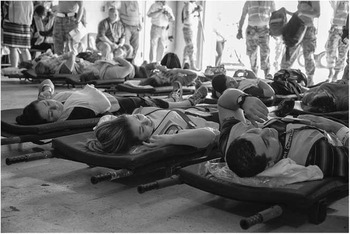
One innovative and cost-effective way is the of use pink evacuation vests for residents of long-term care facilities. This is similar to other visual identification initiatives to better identify and refer vulnerable populations during evacuations. For example, the Texas Emergency End-Stage Renal Disease (ESRD) Coalition offers purple wrist bands to ESRD patients. The bands include patient identification and key health information. The pink vests make residents stand out in a crowd and thus medical personnel are better able to attend to their medical needs in a timely fashion (Figure 1). Amid the chaos and confusion of a rescue operation, much of the attention will be given to what can be visually evaluated. Priority will be given to visible injuries; however, residents of a nursing home, if only for their timely medication, will be endangered just by being removed from their home. As a matter of fact, one first responder’s evaluation of the nursing home residents needs was this:
9
Many of those evacuated from the home could be seen sitting in wheelchairs near the end of the high school’s football field with cuts on their heads from flying glass after the explosion. About 15 to 20 ambulances were parked on the football field at about 9:45 p.m. Cody Harris, a Ross volunteer firefighter who helped evacuate the nursing home, said he saw many injured people, but none of the injuries appeared life-threatening.
Figure 1
Use of Pink Vests in a Cameron County, Texas, 2016 Air Evacuation Exercise.
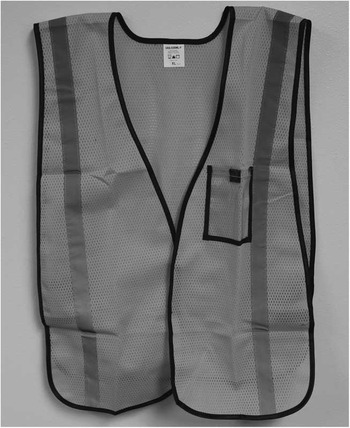
A successful pink vest project originating in the Houston area was expanded statewide by the Texas Department of State Health Services based upon lessons learned from the West Explosion. Pink vests were purchased for every licensed nursing home and assisted-living facility bed in the state. The vests have a pocket in the front for a basic information sheet, or other documents, including but not be limited to name, date of birth, next of kin, medications, and diagnosis (Figure 2). In high-risk coastal areas, the vests have been distributed to facilities and adopted as part of their evacuation procedures. In regions further from the coast, a limited number of jurisdictions declined the pink vests. However, most long-term care and assisted-living facilities across the state have incorporated the vests into their emergency planning process. They are deployed in different ways depending on the scenario. A hurricane evacuation allows time to pass out the vests and place current, complete contact and medical information in the front pockets. Other scenarios requiring a rapid evacuation may entail placing the vests on the residents as they go out the door with a card in the pocket displaying the most basic information to meet short-term tracking and personal safety needs.
Figure 2
Pink Vest Purchased for All Licensed Long-Term Care Facility Beds in Texas.
With an aging general population, the number of residents in long-term care and assisted-living facilities will steadily increase. Industrial accidents and natural disasters are not uncommon. Preparing these vulnerable populations for emergencies and disasters is a moral imperative. The lessons learned from recent disasters, including the nursing home evacuation during the West Fertilizer Company plant explosion, must be addressed by using novel approaches. It is not acceptable to experience preventable high morbidity and mortality among these vulnerable populations when it can be avoided with better simple and sometimes novel preparedness measures.





 You have
Access
A fire broke out on April 17, 2013, at the West Fertilizer Company plant in West, Texas, about 70 miles south of Dallas. As a result, the fire suddenly led to a massive explosion resulting in 15 fatalities and 252 injured individuals. 1 The explosion was of great magnitude and inflicted severe damage to the community. The plant held 270 tons of ammonium nitrate reserves. The West Fertilizer Company plant was located in close proximity to residential areas, a nursing home, 2 schools, and an apartment complex in a rural community of approximately 2800 residents.
EVENT
The West Fertilizer Company explosion happened in the city of West, Texas, which had a population of approximately 2500. On April 17, 2013, a fire call at the plant was recorded at 7:29 PM CT; the explosion happened at 7:53 PM CT. The fatalities included 12 first responders on the scene.
IMPACT
The explosion was felt more than 30 miles away and left a crater approximately 100 feet across and 10 feet deep where the storage building was located. It registered as a 2.1 magnitude earthquake on the Richter scale and completely obliterated the West Fertilizer Company buildings. Flaming debris caused fires up to a half mile from the blast site. The furthest piece of debris was found 2.5 miles away. The explosion affected about half the homes in the town. Of the approximately 700 residences in West, half were damaged, including 142 completely destroyed and 51 with major damage. The explosion also destroyed the West Middle School and the West Rest Haven nursing home located 200 yards from the plant. Fifteen people died from the explosion and another 252 had nonfatal injuries. 1
RESPONSE EFFORTS
Emergency teams responded to the initial fire call. The immediate response included evacuation and relocation of nearby residents by emergency medical services as well as cooling of the plant’s ammonia nitrate storage by firefighters. West Rest Haven nursing home had 128 residents evacuated to local and regional care facilities. A football field and community center were used to relocate residents 0.25 mile and 1 mile from the blast site, respectively. Both ambulatory and nonambulatory nursing home residents were taken to the 2 triage sites. There were challenges identifying many of the nursing home residents and acquiring their medical histories and current medications. All radio and phone communications were down in the minutes following the explosion. Seven nearby health care facilities received injured residents from the explosion; there were no official notifications to hospitals. “First responders to the West Rest Haven Nursing home removed 133 residents, many in wheelchairs, from the rubble.”Reference Jervis and Stanglin 2
AFTER-ACTION RESPONSE
On April 18 the US Bureau of Alcohol, Tobacco, Firearms and Explosives announced that it would send a national response team including investigators and explosive experts to investigate the site. 3 The US Chemical Safety Hazard Investigation Board dispatched an investigation team to help determine the cause of the disaster. 4 Governor Perry Declared McLennan County a disaster area; President Obama issued an Emergency Declaration on April 22, 2013. 5 An epidemiological study was initiated to characterize the types of injuries observed and health care resources used following the explosion.
RESULTS AND FINDINGS
The nursing home had a census of 130 residents, of whom 55% were injured. It is important to realize that in this disaster over one-quarter (N=72; 28%) of the injured patients were residents of the West Rest Haven nursing home. In addition to drastically affecting the tight-knit community of the city of West, local and state resources were widely used to respond to this emergency.
According to the US Census Bureau, as of July 1, 2013, 44.7 million people in the United States are 65 years old and older with projections reaching 98.2 million by 2060.Reference Harris-Kojetin, Sengupta and Park-Lee 6 In this case as in many other disasters, the elderly are at far greater risk of harm than are younger populations. Long-term care services defined by the US Department of Health and Human Resources “include a broad range of health, personal care, and supportive services that meet the needs of frail older people and other adults whose capacity for self-care is limited because of a chronic illness; injury; physical, cognitive, or mental disability; or other health-related conditions.” 7
Long-term care adds a multilayered problem in the case of an evacuation. Residents are not only highly dependent on others for self-care but also may present with cognitive or mental impairments as well as many serious medical comorbidities. They may also depend on timely therapy and medication.
Training has shown to be effective and to facilitate responders in disaster situations. Post-disaster Geriatric Emergency Preparedness and Response continuing education programs have been shown to increase the knowledge of new responders while better preparing trained veterans.Reference Roush and Tyson 8 Planning exercises and periodic drills offer a more real-life scenario and improve the preparedness of respondents but remain very costly by comparison. After-action reports can be helpful to identify mistakes and serve to improve performance of disaster response. However, in addition to established methods, we need to start thinking of other ways to track, protect, and effectively evacuate fragile populations.
One innovative and cost-effective way is the of use pink evacuation vests for residents of long-term care facilities. This is similar to other visual identification initiatives to better identify and refer vulnerable populations during evacuations. For example, the Texas Emergency End-Stage Renal Disease (ESRD) Coalition offers purple wrist bands to ESRD patients. The bands include patient identification and key health information. The pink vests make residents stand out in a crowd and thus medical personnel are better able to attend to their medical needs in a timely fashion (Figure 1). Amid the chaos and confusion of a rescue operation, much of the attention will be given to what can be visually evaluated. Priority will be given to visible injuries; however, residents of a nursing home, if only for their timely medication, will be endangered just by being removed from their home. As a matter of fact, one first responder’s evaluation of the nursing home residents needs was this: 9
Many of those evacuated from the home could be seen sitting in wheelchairs near the end of the high school’s football field with cuts on their heads from flying glass after the explosion. About 15 to 20 ambulances were parked on the football field at about 9:45 p.m. Cody Harris, a Ross volunteer firefighter who helped evacuate the nursing home, said he saw many injured people, but none of the injuries appeared life-threatening.
Use of Pink Vests in a Cameron County, Texas, 2016 Air Evacuation Exercise.
A successful pink vest project originating in the Houston area was expanded statewide by the Texas Department of State Health Services based upon lessons learned from the West Explosion. Pink vests were purchased for every licensed nursing home and assisted-living facility bed in the state. The vests have a pocket in the front for a basic information sheet, or other documents, including but not be limited to name, date of birth, next of kin, medications, and diagnosis (Figure 2). In high-risk coastal areas, the vests have been distributed to facilities and adopted as part of their evacuation procedures. In regions further from the coast, a limited number of jurisdictions declined the pink vests. However, most long-term care and assisted-living facilities across the state have incorporated the vests into their emergency planning process. They are deployed in different ways depending on the scenario. A hurricane evacuation allows time to pass out the vests and place current, complete contact and medical information in the front pockets. Other scenarios requiring a rapid evacuation may entail placing the vests on the residents as they go out the door with a card in the pocket displaying the most basic information to meet short-term tracking and personal safety needs.
Pink Vest Purchased for All Licensed Long-Term Care Facility Beds in Texas.
With an aging general population, the number of residents in long-term care and assisted-living facilities will steadily increase. Industrial accidents and natural disasters are not uncommon. Preparing these vulnerable populations for emergencies and disasters is a moral imperative. The lessons learned from recent disasters, including the nursing home evacuation during the West Fertilizer Company plant explosion, must be addressed by using novel approaches. It is not acceptable to experience preventable high morbidity and mortality among these vulnerable populations when it can be avoided with better simple and sometimes novel preparedness measures.
Acknowledgments
I would like to thank Bruce Clements from the Health Emergency Preparedness and Response Section, Texas Department of State Health Services, Division for Regional and Local Health Services, for his mentorship.