The overall birth prevalence of CHD is estimated to be about 9 in 1000, though variation exists amongst studies. Reference van der Linde, Konings and Slager1,Reference Hoffman and Kaplan2 Due to advances in care, many of these patients are surviving into adolescence and adulthood, requiring lifelong care from multiple healthcare providers. Though patients with complex CHD are surviving longer, associated morbidities may be significant and young adults with CHD may lack disease knowledge and have inaccurate perceptions about continued and accumulating risks. Reference van der Bom, Bouma, Meijboom, Zwinderman and Mulder3–Reference Reid, Webb, Barzel, McCrindle, Irvine and Siu5 Issues surrounding reproductive health – including contraceptive counselling, maternal health during pregnancy, and CHD recurrence risk in offspring – are important topics to discuss. Despite the importance of imparting correct, disease-specific reproductive knowledge to adolescents with CHD, little is known about how, or if, this communication occurs.
Physicians are important sources of information for preventative care, reproductive health issues and can promote medication adherence and improved chronic disease management. Reference DeMaria, Rivera and Ramos-Ortiz6–Reference Kessels10 However, for adolescents who are chronically ill, reproductive information from their healthcare provider may not occur, may be given directly to a parent (with or without the adolescent present), or may be deferred to the parent completely. Reference Whitfield, Jomeen, Hayter and Gardiner11–Reference East and Orchard15 Thus, both healthcare providers and parents are important sources from which adolescents with CHD begin to acquire the reproductive health knowledge that is essential for better health outcomes. This all suggests that examining conversations among providers, adolescents, and parents may be the first step in understanding how knowledge is imparted.
In this study, we analysed surveys distributed separately to female adolescent/mother dyads assessing self-reported conversations with healthcare providers and between each other regarding specific reproductive healthcare issues. Our goal is to understand adolescent/mother perceptions about these conversations (with providers and between themselves), as this may be a potential point of clinical intervention.
Methods
Study population
Adolescent females with CHD and their mothers/female guardians were recruited from two university-associated paediatric cardiology clinics (September 2015–August 2018). Eligible participants were between the ages 14 and 21 years. All mothers/female guardians were simultaneously recruited as participants at initial enrolment. We chose to enrol only mothers/female guardians (category termed “mothers”) because conversations surrounding puberty and sexuality occur more commonly amongst adolescent females and their mothers, rather than their fathers. Reference Meschke, Bartholomae and Zentall12,Reference Miller, Kotchick, Dorsey, Forehand and Ham16,Reference Ramchandani, Morrison, Gold and Akers17 If a male parent/guardian was present, we obtained consent for the adolescent to participate alone. Parents provided consent for adolescents and adolescents provided assent if age 17 years or younger. Those 18 years or older provided their own informed consent. All cardiology staff were informed of this study. For this study, only surveys completed by dyad pairs (i.e., adolescent and mother both completed survey) were assessed.
After informed consent/assent was obtained from all interested participants, a one-time, web-based questionnaire was completed assessing the adolescent’s and mother’s self-reported knowledge about their cardiac lesion, perceived conversations with a heath care provider about reproductive topics, and perceived conversations between the adolescent/mother dyad about reproductive topics. The study was approved by Indiana University’s Institutional Review Board.
Adolescent and parent survey
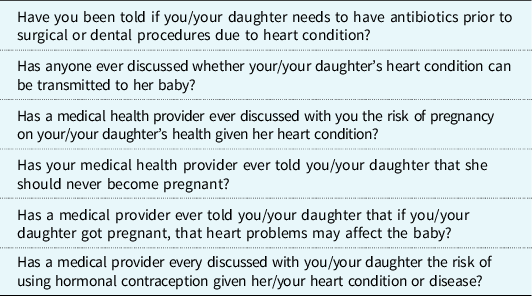
The study questionnaire assessed demographics and self-reports about the adolescent’s CHD lesion. Adolescents and mothers were asked to identify the adolescent’s CHD diagnosis from an extensive list of cardiac lesions provided in the survey. There was also an opportunity to write in their understanding of their diagnosis, if it was not listed. Adolescents and mothers were asked to recall five specific reproductive health conversations, and one related to subacute bacterial endocarditis prophylaxis, with a healthcare provider. These questions were adapted and modified from Hinze et al. Reference Hinze, Kutty, Sayles, Sandene, Meza and Kugler18 A range of 87–91 dyad responses were available for assessment, depending on whether a response was provided for a particular question due to skip patterns (Table 1).
Conversations assessed with healthcare providers.

Two specific questions assessed conversations within the adolescent/mother dyads: have you discussed with your daughter/parent the safety of using birth control with your heart disease and have you discussed with your daughter/parent the safety of getting pregnant with your heart disease? Respondents were able to select “never”, “1–2 times”, or “many times.” For the analysis, this variable was dichotomised to “never” versus “one or more times.” Dyads were then asked to respond to the question when do you think is the right time for a medical professional to have a discussion about birth control, getting pregnant, or carrying a pregnancy?
Clinician survey
The research cardiologist accessed the patient’s electronic medical record to report participant’s CHD diagnosis and to determine the risk of pregnancy (contraindicated, high risk, low or no risk), risk of recurrence in offspring, and contraindications to oestrogen-containing contraception. Those at high risk for morbidity or mortality with pregnancy included those with New York Heart Association class IV symptoms, pulmonary arterial hypertension, severe aortic enlargement, Eisenmenger syndrome, severe systemic ventricular dysfunction, and severe left-sided obstructive lesions. Reference Stout, Daniels and Aboulhosn19 Risk of recurrence in offspring and contraindications to oestrogen-containing contraception based on the cardiac lesion and medical history were reported based on current evidence and guidelines. 20–Reference Cowan and Ware25 Contraindications to oestrogen included adolescent women with functional class III and IV heart failure, cyanosis, mechanical valves, Eisenmenger syndrome, history of thromboembolism, and pulmonary hypertension. Reference Stout, Daniels and Aboulhosn19 Cardiac lesions were classified as simple, moderate, complex/transplant based on American College of Cardiology criteria. Reference Stout, Daniels and Aboulhosn19
Statistical procedure
Descriptive statistics including demographics and overall frequencies are reported as percentages for this sample of dyads. Dyad responses were assessed examining agreement between mother and daughter about conversations with healthcare providers and then examining agreement within dyads about conversations with each other regarding the two questions about safety of birth control and pregnancy. Bivariate analysis (chi-squared and t-tests) assessed the correlations between reported maternal and provider conversations. Data were analysed using Statistical Package for Social Sciences (SPSS version 26).
Results
A total sample of 91 adolescent/mother dyads were included in this study. Adolescents ranged in age from 14 to 21 years old (mean 16.8, SD = 2.1). In terms of level of education, 12.1% were in middle school, 63.7% were in high school, and 24.2% graduated high school or were in a specialised training programme. Most of this cohort were identified as white, non-Hispanic (86.8%). Similar to the cohort of adolescents, most mothers (87.9%) identified as white, non-Hispanic. The majority of mothers (56%) reported having a college degree, 42.9% graduated high school or had a GED, and 1.1% did not graduate high school. Most cardiac lesions (73.7%) were either moderate or great in complexity. Overall, 62.6% of adolescents and 89.0% of mothers could either completely or partially identify the CHD diagnosis correctly.
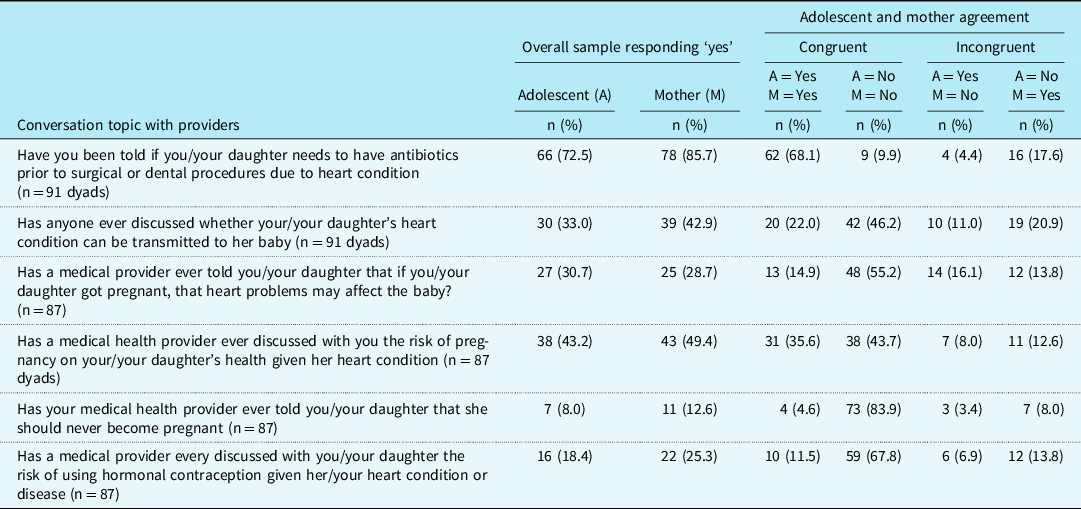
Adolescents were asked to recall whether they have had specific health-related conversations with their healthcare provider (Table 1). Before assessing reproductive health conversations, adolescents and mothers were asked if subacute bacterial endocarditis prophylaxis was discussed with a healthcare provider. The majority of adolescents (72.5%) and mothers (85.7%) reported that they had discussed this topic. It was rare that both mother and adolescent reported no conversation (9.9% of dyads) (Table 2).
Adolescent and mother frequencies of conversation topics with providers and by dyad agreement.

In contrast, when conversations about reproductive health-related items were assessed, the majority of adolescents and mothers reported never having had these conversations. Only a minority reported conversations with healthcare providers about the recurrence risk of CHD in offspring (33.0% and 42.9% for adolescents and mothers, respectively). In assessing congruency between adolescent and mother reports, the largest percentage (42 dyads, 46.2%) was congruent in reporting that they never had this conversation. When the dyads were incongruent, more of the mothers responded “yes” to having had the conversation (20.9%) than the adolescents (Table 2).
When the conversation, “has a medical provider told you/your daughter that if you/your daughter got pregnant, the heart problems may affect the baby?” was assessed, slightly less than one-third of the adolescents and mothers reported having had this conversation (30.7% and 28.7%, respectively). Again, the majority (55.2%) of the dyads both reported never having had this conversation with a provider (Table 2).
When asked about discussing the risk of pregnancy on the adolescent’s health, 43.2% of adolescents and 49.4% of mothers reported having had this conversation with a provider. Again, a large proportion of dyads were congruent in reporting never having this conversation (43.7%) and when incongruent, the mothers reported the conversations more frequently than the adolescents (Table 2).
While this question was likely not germane to the majority of adolescents, adolescent/mother dyads were asked if a healthcare provider ever told the adolescent that they should never become pregnant. Not surprisingly, only a minority of adolescents and mothers reported having had this conversation 8.0% and 12.6%, respectively (Table 2).
In regard to the risk of using hormonal contraception, only 18.4% of adolescents and 25.3% of mothers reported this conversation with a provider. Similar to the other conversations, the majority of adolescents and mothers were in agreement with 67.8% both reporting never having had this conversation with a provider (Table 2).
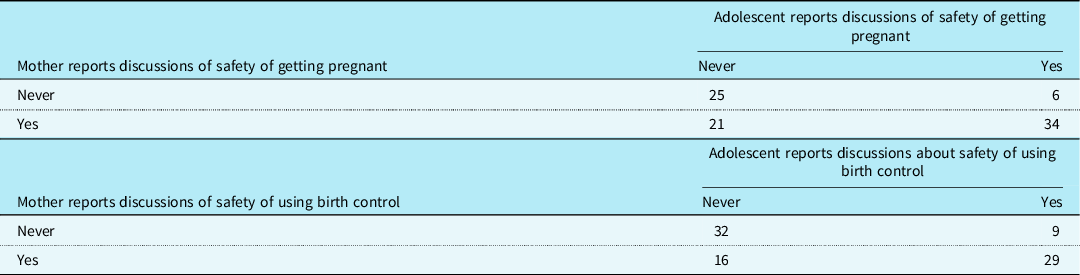
When examining conversations amongst adolescent/mother dyads, only 46.5% (n = 40) of adolescents and 64.0% (n = 55) of mothers reported they had discussed with each other the safety of becoming pregnant. While most pairs were congruent in their responses, mothers were more likely to have reported these conversations compared to adolescents. When asked about the discussion regarding safety of using birth control, only 44.2% (n = 38) of adolescents reported discussing this with their mother, and similarly, 52.3% (n = 45) of mothers reported having this conversation with their daughter (Table 3).
Mother and adolescent reports about conversations with each other about the safety of using birth control and safety of pregnancy (n = 86 dyads).

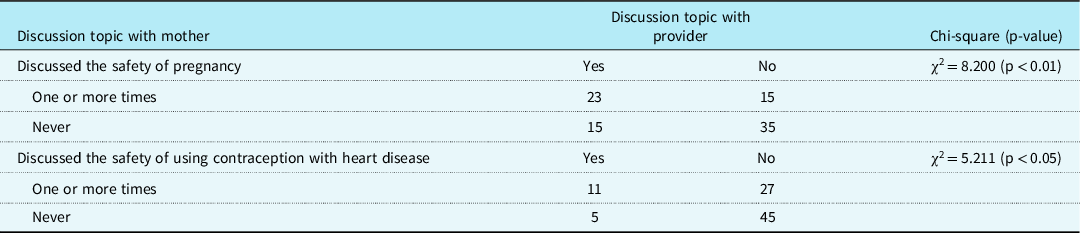
In comparing adolescent reported discussions with their mothers or with providers about the safety of pregnancy with heart disease, 40.0% (n = 35) of adolescents reported no conversation with their mother or healthcare provider (Table 4). But, when no conversation was reported with the provider, 17.0% (n = 15) of adolescents reported a conversation with their mother about safety of pregnancy (p < 0.01, X2 = 8.200). Similarly, just over half (51.1%, n = 45) of the adolescents reported that they did not discuss birth control in the context of their heart disease with either their mother or a healthcare provider. However, when the adolescent reported not having this conversation with the provider, 30.7% (n = 27) did report discussing contraception with their mother (p < 0.05, X2 = 5.211) (Table 4).
Adolescent/mother discussions about safety of using birth control and safety of pregnancy compared to adolescent/provider discussions (n = 88 dyads).

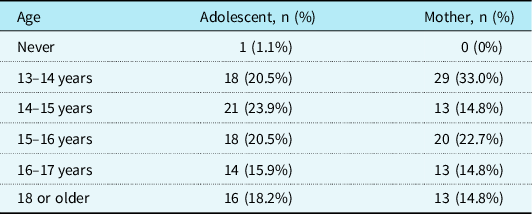
To obtain our cohort’s perspective on the appropriateness of reproductive health conversations, the dyads were asked when they believed the right time was for the provider to have a conversation about birth control and pregnancy. There was a fairly even distribution of responses wanting to have this conversation between 13 and 18 years of age. Parents generally favoured having this conversation earlier, with 33.0% reporting 13–14 years as the most appropriate age, while adolescent responses were fairly evenly distributed between the ages of 13 and 18 years of age (Table 5). Of note, the age ranges on the survey did include overlapping values, for example ages 13–14 and 14–15 as two separate groups.
Adolescents’ and mothers’ opinions on the right time to initiate discussions surrounding reproductive health (n = 88 dyads).

Discussion
Our results demonstrate that the majority of adolescents and mothers are reporting no conversations with their healthcare provider about reproductive health as it relates to the CHD diagnosis. The intentions of comparing dyad responses were several. Ideally, healthcare providers would provide education to both the mother and adolescent, to ensure accurate information delivery to both parties. This would support ongoing conversations at home and would allow the mother to provide guidance as the adolescent becomes more autonomous in their healthcare decision-making. Unfortunately, in many of the conversations assessed, neither the adolescent nor the mother reported discussions with a provider in regard to these specific reproductive health issues. In lieu of both the mother and adolescent having these conversations, the next best situation from an adolescent development perspective would be that the adolescent is having the conversation with the provider alone. This may imply that the conversation(s) are occurring in a confidential fashion and that correct information is being imparted directly to the adolescent. However, our results demonstrated that when adolescents and mothers were incongruent in reporting conversations with the healthcare provider, the mothers more frequently reported conversations with the provider than the adolescent. This may either suggest that conversations are being directed more towards the mother, or they are not occurring in a manner that promotes high recall amongst the adolescents.
A recent study of adult women with CHD demonstrated that the vast majority reported being sexually active, with the median age of first sexual encounter being 18 years old. Reference Deng, Gleason and Awh26 However, just around half reported having conversations with their provider about reproductive health and a high percentage in this study reported unplanned pregnancies. Reference Deng, Gleason and Awh26 Our results in an adolescent population echo the finding of limited conversations and also show that a high percentage of adolescents and mothers favour having conversations about reproductive health in the early teen years. This is supported by an American Heart Association statement suggesting initiating conversations about reproductive health in adolescents with CHD at 12 years of age, if developmentally appropriate. Reference Sable, Foster and Uzark27 Similarly, the ACC/American Heart Association recommends beginning the process of transitioning from a paediatric to adult cardiology provider at age 12 years, and during this time, the adolescents should be coached in assuming more responsibility for their health. Reference Warnes, Williams and Bashore28 Conversations surrounding reproductive health should certainly occur before the adolescent becomes sexually active to avoid unplanned pregnancies and improper use of oestrogen-related contraceptives.
In postulating why these conversations are occurring at low rates, it is interesting to compare our population to other populations of adolescents with chronic illness. In assessing perceptions of discussions surrounding reproductive health, Frederick et al found that paediatric oncologists agreed that these issues were important to discuss, but identified many barriers to having these conversations. Reference Frederick, Campbell, Kenney, Moss, Speckhart and Bober29 The perception that the family may not want to have these discussions and a hesitancy to ask the guardian leave the room in a subspecialty clinic setting was one barrier that was frequently mentioned. Other common barriers included lack of resources or referrals for patients, lack of knowledge or experience having the conversation, low priority given the number of other important topics to discuss, and time constraints in the clinical setting. Reference Frederick, Campbell, Kenney, Moss, Speckhart and Bober29 These may all apply to the outpatient paediatric cardiology setting – time in these appointments is spent explaining diagnostic testing results, future surgical planning, medication management, and planning for other procedures. With a limited clinic time, reproductive health conversations may be deferred or discussed superficially.
However, though the primary duty of the paediatric cardiologist is to manage their patient’s heart disease, it is important to recognise that those with chronic illness often identify their subspecialty provider as their primary medical provider, indicating the need for these providers to discuss preventative measures including those surrounding reproductive health. Reference Britto, Garrett, Dugliss, Johnson, Majure and Leigh30 A study examining the patient’s perspective in a cystic fibrosis clinic, another population with specific reproductive health issues, revealed that both adolescents and their parents desired information be shared with them regarding contraception, and later in life, pregnancy planning and fertility. Reference Kazmerski, Prushinskaya and Hill31 This again is consistent with our results that show many adolescents and mothers desire reproductive health conversations with providers in the early teen years, yet are reporting low levels of these conversations.
The conversation items that adolescents and mothers reported least frequently in this study were those related to the guidance to never become pregnant and the risk of using hormonal contraception. To help understand why these conversations were rarely reported, we used the clinician survey to assess the percentage of adolescents with contraindications to pregnancy or oestrogen-related birth control. 20–Reference Thorne, MacGregor and Nelson-Piercy22 We found that approximately 25% were at high risk if they were to become pregnant and another 10% carried contraindications to pregnancy. These numbers are disconcerting when comparing them to lack of pregnancy-related conversations. Likewise, 20.9% of adolescents had a contraindication to oestrogen-related birth control, which is similar to the number reporting having these conversations with a provider. However, these discussions were not more likely to occur in this cohort of adolescent women with contraindications to oestrogen (data not shown).
However, we did identify a small number of adolescents that were having reproductive-related conversations with their healthcare provider, when the mother was not discussing reproductive health with them. This is positive in that the conversations may be confidential and the adolescent feels comfortable enough with the provider to have these discussions. Conversely, another small subset of adolescents who were not having these conversations with their provider did have them with their mother. While this is encouraging, it is also a bit concerning in that it is not possible to know whether the mother is imparting correct information. It would be ideal in these scenarios for the provider to confer correct information to both parties.
In comparison to reproductive conversations, conversations regarding subacute bacterial endocarditis prophylaxis were reported very frequently. This serves to demonstrate that conversations may be more focused on topics directly or immediately related to the provider’s subspecialty. Reference Frederick, Campbell, Kenney, Moss, Speckhart and Bober29 This may also be the reason that a majority of adolescents and mothers were able to correctly identify the cardiac lesion. It has been previously shown that when conversations occur about reproductive health, they are often in the context of medication side effects or problems with the menstrual cycle, as opposed to sexual health in general or contraceptive adherence. Reference Parry, Sayner, Davis, Beznos, Carpenter and Sleath32
Limitations
An inherent limitation to this study is that it assesses adolescent and maternal perceptions of conversations with providers and amongst each other. As we did not survey the providers about these conversations, it is possible that they are in fact discussing reproductive health items with their patients and mothers. However, it is important to realise that they are not being discussed in a way that results in high recall. Sometimes, the volume of discussions that occur at an appointment is numerous and may lead to poor recall of issues that seem less germane at that time. A prior study has shown that adolescents would be receptive to receiving this information, suggesting they would remember the conversations if they happened in a meaningful way. Reference Hargrove, Penny and Sawyer33 It is possible that providers may be reluctant to discuss reproductive healthcare issues because they feel this is a topic that should be discussed with the mothers, and in turn, mothers may be avoiding the conversation until it is initiated by a healthcare provider. Reference East and Orchard15 Additionally, an overwhelming majority of our population identified as white, non-Hispanic. Thus, our results may not be completely generalisable to other ethnic or racial groups. It is also important to note that reproductive health conversations should also occur with males with CHD. Because this study only included females, the results may not be applicable to males.
Conclusions
Our results demonstrate that reproductive health conversations must be more of a priority, especially as related to the adolescent’s CHD diagnosis. More work is needed to address the barriers clinicians may face in having these conversations and understanding whether reported conversations are associated with correct knowledge. Mothers can be good allies in reinforcing this information, and it is important to empower both the mother and the adolescent with correct information to promote greater reproductive health and safety.
Adolescents with CHD both desire and need accurate information regarding their reproductive health. Important sources of this information are healthcare providers and mothers. We have demonstrated that adolescents and mothers report low rates of having these conversations with the healthcare provider, and in turn, mothers report low rates of having these conversations with their daughters. It is important that these topics be discussed at each appointment with the paediatric cardiologist (or liaison) and that the cardiologist encourages these conversations to happen at home between the mother and the adolescent. Recognising that time does not always permit such discussions, referral to a provider who understands inherit reproductive risk of this population and can assist in providing contraception to an adolescent would also be appropriate. By providing adolescents this information, they can be empowered to make decisions affecting their health and they can more effectively communicate their healthcare needs with other/new providers, particularly as they transition to adult-oriented services.
Financial support
This research received no specific grant from any funding agency, commercial or not-for-profit sectors.
Conflicts of interest
None.
Ethical standards
The authors assert that all procedures contributing to this work comply with the ethical standards of the relevant national guidelines on human experimentation and with the Helsinki Declaration of 1975, as revised in 2008, and has been approved by the Indiana University Institutional Review Board.