INTRODUCTION
Animals vary greatly in the way they allocate time to the different daily activities necessary for their growth, survival, and reproduction. Such variation in behaviour is also common among individuals of the same species and can have major influences on their fitness (Cuthill & Houston, Reference Cuthill, Houston, Krebs and Davies1997; Jones, Reference Jones2002; Bonaldo & Krajewski, Reference Bonaldo and Krajewski2007). Typical time budgets have been related to phylogenetic status (Brooks & McLennan, Reference Brooks and McLennan1991), stage of development (e.g. Jones Reference Jones2002; Bonaldo & Krajewski, Reference Bonaldo and Krajewski2007), sex (Mathisen et al., Reference Mathisen, Landa, Andersen and Fox2003; Stiver et al., Reference Stiver, Fitzpatrick, Desjardins and Balshine2006) and a range of environmental factors including habitat structure (e.g. Cartar & Real, Reference Cartar and Real1997; Dagosto & Yamashita, Reference Dagosto and Yamashita1998; Valdés-Muñoz & Mocheck, Reference Valdés-Muñoz, Mocheck, Claro, Lindeman and Parenti2001), presence of predators (e.g. Milinski & Heller, Reference Milinski and Heller1978; Forsgren & Magnhagen, Reference Forsgren and Magnhagen1993; Murphy & Pitcher, Reference Murphy and Pitcher1997), abundance and distribution of food resources (Massaro et al., Reference Massaro, Chardine, Jones and Robertson2000; Rastogi et al., Reference Rastogi, Zanette and Clinchy2006) and temperature (e.g. Russell, Reference Russell1971; Gass et al., Reference Gass, Romich and Suarez1999).
Tropical reef fish exhibit a wide range of activity patterns that vary among and within species at any one location (Collette & Talbot, Reference Collette, Talbot, Collette and Earle1972; Valdés-Muñoz & Mocheck, Reference Valdés-Muñoz, Mocheck, Claro, Lindeman and Parenti2001). Water movement is one of the major environmental factors structuring fish communities (Jones & Syms, Reference Jones and Syms1998), and especially the movement of planktivorous fish (Hobson, Reference Hobson1974; Bray et al., Reference Bray, Miller and Geesey1981; Hobson & Chess, Reference Hobson and Chess1986; Hamner et al., Reference Hamner, Jones, Charleton, Hauri and Williams1988; Hamner & Wolanski, Reference Hamner and Wolanski1988). Recently, field and laboratory studies investigated the specific effects of water flow on the behaviour and energetic processes of benthic coral reef fish (Bellwood & Wainwright, Reference Bellwood and Wainwright2001; Fulton et al., Reference Fulton, Bellwood and Wainwright2001; Fulton & Bellwood, Reference Fulton and Bellwood2002a; Johansen et al., Reference Johansen, Fulton and Bellwood2007a). Wave exposure was shown to be a major factor influencing the activity of some common wrasses and damselfish, and several generalizations were made about their behaviour. It was found that fish tend to avoid the water column, where flux is higher, and stay longer in refuges on the bottom when there is high water flow (Fulton et al. Reference Fulton, Bellwood and Wainwright2001; Fulton & Bellwood, Reference Fulton and Bellwood2002a; Johansen et al. Reference Johansen, Fulton and Bellwood2007a). It was also found that species with different swimming capabilities respond in different degrees to hydrodynamics (Fulton & Bellwood, Reference Fulton and Bellwood2005; Johansen et al., Reference Johansen, Fulton and Bellwood2007a).
Substratum composition is another environmental variable capable of influencing fish distribution and behaviour (Jones & Syms Reference Jones and Syms1998; Valdés-Muñoz & Mocheck, Reference Valdés-Muñoz, Mocheck, Claro, Lindeman and Parenti2001; Floeter et al. Reference Floeter, Krohling, Gasparini, Ferreira and Zalmon2007; Sabater & Tofaeono Reference Sabater and Tofaeono2007). The distinct structure and associated fauna of different bottom types may offer different resources (e.g. prey and shelter) to reef fish and, thus, substratum composition of reefs may influence fish activity. Nevertheless, there is no study, to our knowledge, that aimed to verify whether substratum composition could influence the activity budgets of different species of reef fish.
Despite the advances in the understanding of the relationships between reef fish behaviour and environmental variables, especially water movement, most research on this topic has been conducted in high diversity coral reefs. These habitats are structurally complex and offer a wide range of environmental conditions to their inhabitants (Levinton, Reference Levinton1995; Bellwood & Wainwright, Reference Bellwood, Wainwright and Sale2002). As a consequence, fish in high diversity systems may specialize in living/using habitats with particular features (e.g. Bouchon-Navarro & Bouchon, Reference Bouchon-Navarro and Bouchon1989; Jennings et al., Reference Jennings, Boullé and Polunin1996; Munday et al., Reference Munday, Jones and Caley1997; Gardiner & Jones, Reference Gardiner and Jones2005). Oceanic rocky reefs, on the other hand, are less structurally complex and less biologically diverse (Floeter et al., Reference Floeter, Rocha, Robertson, Joyeux, Smith-Vaniz, Edwards, Barreiros, Ferreira, Gasparini, Brito, Falcón, Bowen and Bernardi2008). In these habitats, species have usually less refuges from water movement and are exposed to varying hydrodynamics (currents and wave exposure) coming from open seas. In order to survive in oceanic reefs, fish must be able to cope with the different conditions present there either by resisting to the varying conditions or by quickly changing and adapting their behaviour. Therefore, understanding the effects of environmental variables on fish behaviour in tropical oceanic reefs is fundamental to evaluate how the activity budgets of reef fish in general are influenced by these variables and whether the current predictions about coral reef fish may also be applied to other reef systems.
In this paper we take a multi-species comparative approach to better understand the relationships between reef fish behaviour, wave exposure and benthic composition in the field. The activity budgets of nine abundant and widely distributed reef fish species were studied in a tropical Western Atlantic oceanic island and our main goals were to examine whether behavioural similarities among species were related to taxonomic or trophic status, whether fish activity varies spatially and whether it may be correlated to wave exposure and substratum composition. Our main hypotheses were that: (1) fish species would stay mostly closer to the bottom, avoid the water column and forage less in places with high wave exposure, in an attempt to avoid extra energetic expenditure in high wave exposure; (2) fish responses to wave exposure would be less significant for good swimmers; and (3) activity budgets may vary with substratum composition, especially for fish that forage mainly on the bottom.
MATERIALS AND METHODS
Study sites
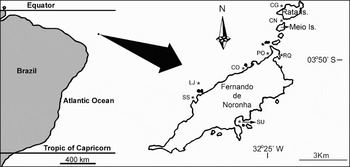
The study was conducted at the Fernando de Noronha Archipelago (03°50′S 32°25′W), an oceanic island 345 km off north-eastern Brazil, from 22 June to 17 July 2007. We studied eight volcanic rocky reefs: Cagarras, Canal, Porto, Buraco da Raquel, north shore of Praia da Conceição, Laje Dois Irmãos, south shore of Praia do Sancho and north shore of Baía do Sueste (Figure 1). Cagarras (CG) is a sheltered rocky reef down to 34 m depth. Canal (CN) is located between Rata and Meio islands, subject to high wave exposure, and up to 12 m deep. Porto (PO) is a shallow (< 5m deep) reef located in a sheltered sandy bay. Buraco da Raquel (RQ) is a reef lagoon with rocky and sandy bottom and a maximum depth of 3 m at low tide. Conceição (CO) is a reef adjacent to a sandy beach, up to 12 m deep. Laje Dois Irmãos (LJ) is a rocky reef lying about 15–26 m deep with a high per cent coral cover. Sancho (SS) is a steep reef adjacent to a sandy beach, up to 12 m deep. Sueste (SU) is a shallow sheltered bay with rocky and sandy bottom, but it is frequently exposed to high surge typical on the east coast on the archipelago. Visibility ranged from 3 to 30 m and water temperature varied from 27–28°C at all sites.
The study sites at the Fernando de Noronha Archipelago: (CG) Cagarras, (CN) Canal, (PO) Porto, (RQ) Buraco da Raquel, (CO) Praia da Conceição, (LJ) Laje Dois Irmãos, (SS) Praia do Sancho and (SU) Baía do Sueste.

Procedure
We studied the behaviour of nine reef fish species: the damselfish (Pomacentridae) Abudefduf saxatilis, the grouper (Serranidae) Cephalopholis fulva, the grunts (Haemulidae) Haemulon chrysargyreum and H. parra; the wrasses (Labridae) Halichoeres radiatus, H. dimidiatus and Thalassoma noronhanum; and the goatfish (Mullidae) Mulloidichthys martinicus and Pseudupeneus maculatus. These species were chosen because they are very abundant at Fernando de Noronha and widely distributed (Humann & Deloach, Reference Humann and Deloach2002; Floeter et al., Reference Floeter, Rocha, Robertson, Joyeux, Smith-Vaniz, Edwards, Barreiros, Ferreira, Gasparini, Brito, Falcón, Bowen and Bernardi2008). Thus, they are good targets to study the influence that varying environmental variables have in the behaviour of fish species able to cope with a wide range of conditions. The species above were also chosen because they represent major reef fish families (Bellwood & Wainwright, Reference Bellwood, Wainwright and Sale2002).
We made a general comparison of broad behavioural categories among the studied species. Also, for C. fulva, H. chrysargyreum, H. radiatus and T. noronhanum we compared their behaviour among sites and investigated the correlation of behavioural categories to wave exposure and substratum cover. Observations were conducted from 0900h to 1600h and care was taken to equally distribute samples during morning and afternoon and at high and low tides at each study site. This approach was chosen to minimize time of day effect on behaviour, which is beyond the scope of this paper. Only the sites SU and RQ were sampled just during high and low tides respectively, as these sites are accessible to divers only under these conditions.
To record fish behaviour and the relative abundance of substratum types, we randomly positioned belt transects of 20 × 2 m in each study site. Fish survey is feasible in this transect width even in the lowest visibility of some study sites and this transect length fits in reef areas with similar habitat characteristics (Floeter et al., Reference Floeter, Krohling, Gasparini, Ferreira and Zalmon2007). We conducted a total of 91 transects around the archipelago, which were allocated proportionally to the reef areas of each study site (13 in CG, 13 in CN, 18 in SS, 10 in LJ, 4 in PO, 16 in CO, 7 in SU and 10 in RQ). To standardize our observations, data about fish behaviour were all collected by the first author using the scanning methodology (Lehner, Reference Lehner1998). During this procedure the diver swam over transects at a constant speed, recording all the individuals of the study species and their behaviour at the time they were seen. To avoid possible effects of ontogenetic variation, only individuals showing adult coloration (Humann & Deloach, Reference Humann and Deloach2002) were investigated. The behaviour of each individual fish was classified into one of the following eight categories: (1) swimming continually within 30 cm of the bottom (SB); (2) immobile within 30 cm of the bottom (IB); (3) swimming continually in the water volumn, at least 30 cm above the substratum (SC); (4) immobile in the water column, at least 30 cm above the substratum (IC); (5) foraging (e.g. pursuing prey, probing or digging in to the substratum) or biting prey (FO); (6) being cleaned by cleaner fish (BC); (7) cleaning other fish (C); and (8) defending nest, guarding egg mass (DN). Only one record was taken for each fish individual, to minimize the risk of non-independent data.
The relative abundance of each substratum type in each transect was estimated by the photoquadrats method (Preskitt et al., Reference Preskitt, Vroom and Smith2004). In short, while the first diver collected data on fish behaviour, a second diver simultaneously swam behind him, keeping a distance of at least 5 m, and took five photographs of the bottom at haphazardly chosen points, each corresponding to an area of 40 × 60 cm. The substrata were classified into one of the seven following categories: (1) non-consolidated (NC), which includes sand and rubble; (2) epilithic algal matrix (EAM), turf algae with sediments; (3) green algae (GA), mostly Caulerpa verticillata; (4) brown algae (BA), mostly Dictyota spp., Dictyopteris spp., Padina spp. and Sargassum spp.; (5) sponge (S); (6) colonial cnidarians (CN), mainly stony corals, zoanthids and Millepora spp.; and (7) bare rock (BR). The relative coverage of each substratum was estimated by classifying 20 random points on each photograph according to the seven categories above. The photoquadrats were analysed in the coral point count with Excel Extension software (CPCe v3.4) (Kohler & Gill, Reference Kohler and Gill2006).
We also recorded the depth and estimated the wave exposure in each transect. Wave exposure was classified within an arbitrary scale from 0 to 8, where the score 8 is the highest exposure recorded among the sites. This classification was based on the previous dive experience of the first and second authors, who have been conducting research in the archipelago for ten consecutive years.
Analysis
We compared the behaviour of different species with a cluster analysis using the mean percentage of behaviours displayed at all sites for each species. In this analysis we also classified species in trophic groups, according to the literature (Randall, Reference Randall1967; Sierra et al., Reference Sierra, Claro, Popova, Claro, Lindeman and Parenti2001, Floeter et al., Reference Floeter, Krohling, Gasparini, Ferreira and Zalmon2007) and data on their diet in Fernando de Noronha (Krajewski, unpublished data). Also, for the most abundant species (C. fulva, H. chrysargyreum, H. radiatus and T. noronhanum) we compared their behaviour among the four sites (CN, SS, CO and RQ), where at least 19 individuals of each species were found.
For C. fulva, H. chrysargyreum, H. radiatus and T. noronhanum, we compared the behavioural categories to wave exposure in each transect using simple linear regressions with a randomization test. Significance levels were estimated with N = 10000 re-samplings (Manly, Reference Manly1997). For each species, only transects with 10 or more individuals recorded were considered for the analysis. Also, for each species we only considered for the analysis behaviours in which the mean frequencies among all sites were higher than 20%, otherwise the analysis would not be feasible.
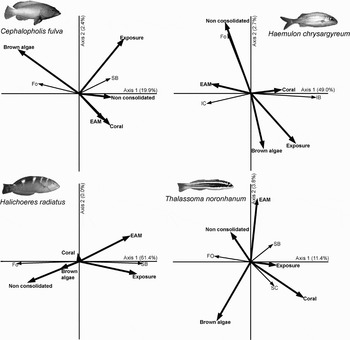
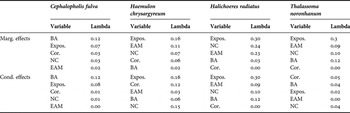
The general relationship among the environmental variables and most frequently displayed behaviours of the studied species was analysed in a redundancy analysis (RDA). We excluded from the analyses substrata with average relative abundance lower than 5%. We obtained the ordination diagram and both the marginal (independent effect of a variable) and conditional effects (the effect that the variable adds to the analysis with all variables together) of each variable in the general behavioural display of each species. These effects were expressed by their lambda value, which gives an estimate of the percentage of variation on species behaviour that could be explained by the independent factor (Leps & Smilauer, Reference Leps and Smilauer2007).
To allow statistical analyses, all data on percentage of display and substratum cover were arcsine transformed (Zar, Reference Zar1999; Leps & Smilauer, Reference Leps and Smilauer2007). Data considering behaviours were transformed using the formula:  , where x is the number of individuals in the given behavioural category in a given transect and n is the total number of individuals in the transect (Zar, Reference Zar1999).
RESULTS
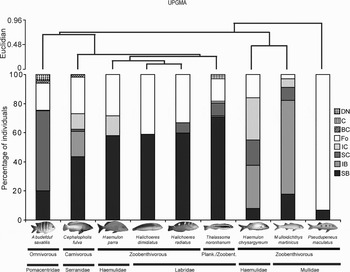
Cluster analysis identified a number of behavioural groupings (Figure 2). The three wrasse species studied (H. dimidiatus, H. radiatus and T. noronhanum), along with H. parra, were grouped mainly because of the high displays of swimming on the bottom and foraging. The behaviour of C. fulva was also similar to these four species, but presented a higher proportion of immobility at the bottom (IB) (Figure 2). Haemulon chrysargyreum and M. martinicus were more similar to each other than to the other species of their respective families. Pseudupeneus maculatus behaved differently than any other species, since it presented an extremely high percentage of foraging (FO). The behavioural groupings recorded are not necessarily related to the evolutionary history or trophic group of the fish (Figure 2).
The studied species grouped according to the percentage of individuals (average among all studied sites) displaying the eight behavioural categories considered in all study sites: SB, swimming on the bottom; IB, immobile on the bottom; SC, swimming on the water column; IC, immobile on the water column; FO, foraging; BC, being cleaned; C, cleaning; DN, defending nest.

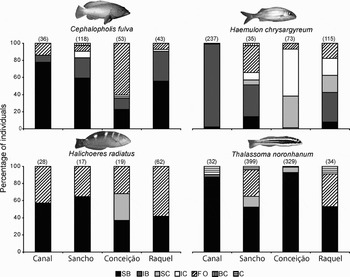
All studied species varied greatly in behaviour between different sites (Figure 3). Halichoeres radiatus showed the least variation between sites, but, even so, the display of FO varied from 31 to 58% and the frequency of SC from 0 to 31% among the studied sites.
Behavioural variation (% of individuals displaying each behavioural category) of four studied species in four different study sites. Behavioural categories: SB, swimming on the bottom; IB, immobile on the bottom; SC, swimming on the water column; IC, immobile in the water column; FO, foraging; BC, being cleaned; C, cleaning; DN, defending nest. Numbers of observed individuals are in parentheses.

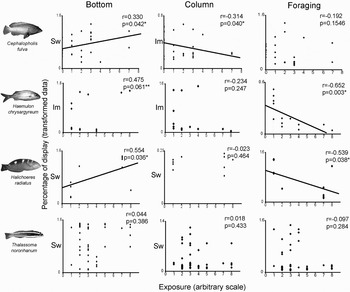
For C. fulva and H. radiatus there was a significant positive correlation between wave exposure and proximity to the bottom (swimming or immobile), but for H. chrysargyreum this relationship was marginally significant (P = 0.06). Also, a negative correlation between wave exposure and foraging was found for H. chrysargyreum and H. radiatus (Figure 4). For all species, except C. fulva, there was no relationship between water column use and exposure. For T. noronhanum no relationship between any behaviour and wave exposure was found (Figure 4).
Relationship between staying in the bottom or water column (swimming or immobile) and foraging with exposure for four studied species. Each point corresponds to a single transect. The displayed values are from arcsine transformed data. Legends are as follows: Sw, swimming; Im, immobile; *, significant values; **, marginally significant values.

In contrast to the relationship between fish behaviour and wave exposure, which are more similar among species, the behavioural response to substratum composition was generally weaker and species-specific (Figure 5; Table 1). For example, the behaviour of C. fulva was mostly influenced by brown algae, H. chrysargyreum by EAM and H. radiatus by non-consolidated substratum (Table 1). However, the behaviour of T. noronhanum was not greatly influenced by any of the environmental variables measured.
Redundancy analysis (RDA) diagram showing the relationship among exposure and substratum composition (bold) and the main behaviours displayed by four reef fish in the Fernando de Noronha Archipelago. Legends are as follows: SB, swimming on the bottom; IB, immobile on the bottom; SC, swimming on the water column; IC, immobile on the water column; FO, foraging.

Marginal (Marg.) and conditional (Cond.) effects of exposure and bottom composition on the behaviour of four reef fish species at the Fernando de Noronha Archipelago. Environmental variables: BA, brown algae; Cor., coral; EAM, epilithic algae matrix; Expos., exposure; NC, non-consolidated substratum.

DISCUSSION
Behavioural variation among and within species
In this study we found that similarities of the general behaviour of some species are not necessarily associated with their phylogenetic relationship or trophic group. This is clear for two species pairs studied, Haemulon species and the goatfish. Although each pair consists of species of the same trophic group, family, and even the same genus, they are very different in their behaviour. Haemulon chrysargyreum and M. martinicus, for example, are more similar to each other than to species of their own families, which is probably because they may also be nocturnal, and sometimes remain inactive in the water column during the day (Randall, Reference Randall1967; Krajewski et al., Reference Krajewski, Bonaldo, Sazima and Sazima2004, Reference Krajewski, Bonaldo, Sazima and Sazima2006). Thus, common evolutionary history and trophic ecology are not prerequisites nor necessarily imply that species behave similarly as neither have similar functional roles on the reefs (Sazima, Reference Sazima1986).
The behavioural variation within species or taxonomic groups is largely corroborated by studies on herbivorous fish. Formerly considered as a uniform group, herbivorous fish species were shown to be very different in their behaviour and functional roles on reefs (Bellwood & Choat, Reference Bellwood and Choat1990; Bellwood et al., Reference Bellwood, Hoey and Choat2003). These differences in ecology and functional role were shown to vary among species of the same family (Bellwood & Choat, Reference Bellwood and Choat1990) and, for single species, during development (Bonaldo et al., Reference Bonaldo, Krajewski, Sazima and Sazima2006; Bonaldo & Krajewski, Reference Bonaldo and Krajewski2007; Bonaldo & Bellwood, Reference Bonaldo and Bellwood2008). Studies on the patterns of behavioural variation within and among carnivorous reef fish are scarce. However, the variation in behaviour and resource use recorded here and elsewhere (Randall, Reference Randall1967; Valdés-Muñoz & Mocheck, Reference Valdés-Muñoz, Mocheck, Claro, Lindeman and Parenti2001) strongly suggests that carnivorous fish may also be highly variable in their general behaviour both within families and species. As the functional role of fish on reefs is directly dependent on fish behaviour, the variation in the activity of fish and its relationship with environmental variables should be further considered in any study aiming to understand or modelling fish impact on reefs.
We also found that single species may greatly vary their activities between nearby sites with different environmental characteristics. Future research that investigates the variation in behaviour and its effects on fish condition (energetic processes) will be fundamental to elucidate to what extent fish are truly versatile in their behaviour without affecting their fitness (Jones & McCormick, Reference Jones, McCormick and Sale2002).
Wave exposure and fish behaviour
Our results support most findings and predictions that experimental work and field data from coral reef fish has found for fish behavioural responses to water flow (Fulton et al., Reference Fulton, Bellwood and Wainwright2001; Fulton & Bellwood, Reference Fulton and Bellwood2005; Johansen et al., Reference Johansen, Fulton and Bellwood2007a, Reference Johansen, Bellwood and Fulton2008). Most studied species tended to stay close to the bottom in sites with high water movement. By behaving this way, such species may save energy avoiding swimming in the higher water layers, which have higher water flux (Johansen et al., Reference Johansen, Fulton and Bellwood2007b), in exposed sites.
Foraging was also negatively correlated to exposure for two species (H. chrysargyreum and H. radiatus) and this is probably a mechanism to avoid the high energetic costs of searching for prey in sites with high wave exposure. Benthic invertebrate foragers, and especially searcher invertebrate feeders such as most wrasses and grunts, usually need to move long distances in search for prey (Choat, Reference Choat1982). Under high wave exposure, swimming demands high energy expenditure and some invertebrate feeders seem to avoid extra energy expenditure by avoiding foraging under high wave exposure (Johansen et al., Reference Johansen, Fulton and Bellwood2007a). The non-significant relationship between exposure and foraging of C. fulva is more difficult to interpret. This result may have been caused by an underestimation of C. fulva foraging behaviour in the present study, as this species frequently acts as an ambush predator, remaining immobile close to the bottom (Nemtzov, Reference Nemtzov1993; Sazima et al., Reference Sazima, Krajewski, Bonaldo and Sazima2005). Thus, we may have classified some instances of C. fulva foraging into the category ‘immobile on the bottom’. However, as when ambushing this grouper does not face the dilemma of the high energetic cost of searching prey in long forays in exposed sites, as wrasses and grunts do, it is possible that high wave exposure does not inhibit its foraging.
The relationship between exposure and staying (swimming or immobile) in the water column is less clear. Only for C. fulva was there a significant negative correlation between staying immobile on the water column and wave exposure, which can be explained by the strong association of this species to the bottom. As with most grouper species, C. fulva is not a fast swimmer and stays mostly close to the bottom. Thus, it may venture in the water column only when there is low water movement and the costs of swimming and manoeuvring do not demand too much energy (Johansen et al., Reference Johansen, Fulton and Bellwood2007a).
As with several Haemulon spp., H. chrysargyreum gains protection against predators by gathering in large schools in mid-water during the day (Krajewski et al., Reference Krajewski, Bonaldo, Sazima and Sazima2004). Getting very close to the bottom could prevent such school formation and increase the chance of predation. Also, as H. chrysargyreum is primarily nocturnal and stays mostly inactive during the day (Krajewski et al., Reference Krajewski, Bonaldo, Sazima and Sazima2004), it does not face an energetic cost for staying in the water column as high as an active fish does. Thus, the absence of significant negative correlation between water column use and exposure for this species is probably due to the protective advantage of staying in schools in the water column and the fact that it does not face an excessive increase in the energetic costs to maintain this formation. For H. radiatus there was also no relationship between water column use and wave exposure but this can be explained by the fact that this species hardly ever swims in the water column.
The clearest exception among all studied species was T. noronhanum, since there was no relationship between any of its behaviour and wave exposure. The genus Thalassoma has one of the highest aspect–fin ratios among common reef fish families (e.g. Labridae, Pomacentridae and Acanthuridae) (Wainwright et al., Reference Wainwright, Bellwood and Westneat2002), suggesting that Thalassoma spp. have high swimming performances. It is therefore possible that T. noronhanum is capable of swimming in highly exposed sites without expending proportionally much more energy and thus, its activity is not significantly affected by water movement. The species is, indeed, recorded to be extremely abundant in well exposed oceanic sites (Rosa & Moura, Reference Rosa and Moura1997; Gasparini & Floeter, Reference Gasparini and Floeter2001; Floeter et al., Reference Floeter, Rocha, Robertson, Joyeux, Smith-Vaniz, Edwards, Barreiros, Ferreira, Gasparini, Brito, Falcón, Bowen and Bernardi2008; Krajewski & Floeter, in preparation).
Our results, along with recently published data considering reef fish behaviour and distribution on different water flow conditions (Bellwood & Wainwright, Reference Bellwood and Wainwright2001; Fulton et al., Reference Fulton, Bellwood and Wainwright2001, Reference Fulton, Bellwood and Wainwright2005; Fulton & Bellwood, Reference Fulton and Bellwood2002a, Reference Fulton and Bellwood2004, Reference Fulton and Bellwood2005; Johansen et al., Reference Johansen, Fulton and Bellwood2007a, Reference Johansen, Fulton and Bellwoodb, Reference Johansen, Bellwood and Fulton2008) corroborate the idea that wave exposure is one of the major physical factors influencing the distribution and activity budget of a range of tropical reef fish.
Substratum composition and fish behaviour
The first pattern that we noticed was that behavioural responses to substratum composition were not universal. This was expected as several traits of the fish biology, such as living or foraging substratum selection, which could mediate the relationship with bottom cover, are species specific and not a universal physical response, as seen for water flow.
Because reef fish spend a large amount of time foraging (Fulton & Bellwood, Reference Fulton and Bellwood2002b), we could expect that their foraging substratum preferences mediate behavioural responses to substratum composition. For example, there was a negative relationship between foraging and brown algae (BA) abundance for H. chrysargyreum. As this species forages mostly on BA (Krajewski et al., in preparation) it may have a higher feeding success in such a substratum and, thus, would spend less time searching for food in places with high BA cover. However, it seems that this response is mostly due to indirect effects of exposure, since BA occurs in places with moderate to high exposure, where H. chrysargyreum tends to forage less. The latter explanation is supported by the higher marginal and conditional effect of exposure than that of BA on the behaviour of H. chrysargyreum. Wave exposure could also explain why there was a positive relationship between foraging and non-consolidated substratum for H. chrysargyreum and H. radiatus, since such a substratum is more abundant in places with low exposure. In both cases it seems that exposure alone can account for the behavioural responses recorded.
For C. fulva there was a positive relationship of foraging with brown algae and this relationship is held even with BA occurring generally in places with generally high exposure, where due to the effect of exposure the fish would be supposed to forage less. Such a relationship strongly suggests that the abundance of BA is influencing the activity of C. fulva. However, there is no information about foraging substratum use for this species and it is difficult to understand what process is causing this behavioural response.
Benthic composition is a complex variable, which can occur in several different combinations and may influence fish in different ways and intensities. Species may not respond to the abundance of a single substratum, but rather to the different sets of combinations of substrata available on the reefs. This is probably why we did not find relationships between general behavioural responses and the relative abundances of some particular substrata. The effect of particular bottom types on the behaviour of species may be better assessed by experimental research, where it is possible to control environmental variables. Also, as species differ in their relationships with substrata, further knowledge on their natural history and substratum use is fundamental to develop specific hypotheses predicting their responses to varying benthic compositions.
CONCLUSION
We found that even species that cope with a wide range of environmental variables (i.e. are widely distributed) and live in oceanic habitats, where hydrodynamics are highly variable, display local variation in their activity budgets in response to wave exposure. For the most part, species tended to stay close to the bottom and forage less in sites with high wave exposure. This behavioural response to wave exposure was also recorded for coral reef fish species in previous studies and appears to be a strategy of fish in general to minimize energy expenditure in conditions where swimming may demand excessive energy (Bellwood & Wainwright, Reference Bellwood and Wainwright2001; Fulton et al., Reference Fulton, Bellwood and Wainwright2001; Johansen et al., Reference Johansen, Fulton and Bellwood2007a). The only exceptions to this pattern seem to be fish with good swimming performances, such as Thalassoma spp. (Wainwright et al., Reference Wainwright, Bellwood and Westneat2002; Fulton & Bellwood, Reference Fulton and Bellwood2004). The behavioural responses of reef fish to substratum composition seem weaker and more species-specific. Rather than unique responses to each factor, it is possible that environmental factors act in synergy and that fish behaviour is dynamically influenced by the local and temporal variation in environmental factors. The ability of fish to quickly respond to the environment, and adapt their behaviour, can directly influence their fitness and functional role on reefs and our findings highlight the importance of future studies on the variation in activity and behaviour of reef fish.
ACKNOWLEDGEMENTS
We thank Centro Golfinho Rotador and Águas Claras diving centre for logistical support at Fernando de Noronha Archipelago; the Ibama for logistical support and issuing research permits (#240/2006); R.M. Bonaldo, C.H.R. Goatley and J.L. Johansen for carefully reviewing the manuscript; and the CAPES and CNPq for financial support.