Due to a combination of nutritional factors and a more sedentary lifestyle, the incidence of type 2 diabetes mellitus is increasing worldwide. In 2010, the prevalence is expected to have increased by 46 percent compared to that in 2000 (Reference Bonow and Gheorghiade3;Reference Zimmet, Alberti and Shaw32). The disease is associated with high societal costs, the majority of which are attributable to complications of the disease, in particular macrovascular diseases such as myocardial infarction (MI) and stroke (1;Reference Chale, Swai, Mujinja and McLarty6;Reference Henriksson, Agardh and Berne15;Reference Jonsson18;Reference McKendry22;Reference Phillips and Salmeron26). With an increasing prevalence, costs are also bound to increase.
Recent studies have shown that intensive lifestyle intervention aimed at reducing weight and intake of fat, and increasing the intake of fiber and physical activity leads to lower risk of developing type 2 diabetes in people with impaired glucose intolerance, a precursor of type 2 diabetes (Reference Knowler, Barrett-Connor and Fowler19;Reference Pan, Li and Hu25;Reference Tuomilehto, Lindstrom and Eriksson30). The Finnish Diabetes Prevention Study (DPS) randomized 522 men and women either to participate in the intervention program or to be part of a control group. Patients were on average 55.7 years old, with a body mass index (BMI) of 31 and a waist circumference of 102 cm. They had a fasting glucose level of 109 mg/dl (6.0 mmol/L), a total cholesterol level of 215 mg/dl (5.6 mmol/L), and a blood pressure of 140/86 mm Hg. The program included visits to the physician, visits to the nutritionists, and participation in individually tailored exercise groups along with encouragement of individual exercise. The program has been described in detail elsewhere (Reference Eriksson, Lindstrom and Valle12). The implementation of such a program is associated with substantial costs. However, given the high costs and the reduction in quality of life associated with diabetes and its complications, there are also large potential benefits of such interventions. To estimate the full consequences of the intervention, an economic evaluation is necessary.
To be able to evaluate the cost-effectiveness of lifestyle intervention programs similar to that of DPS, simulation models could be applied on various population cohorts such as, for example, a Swedish cohort of 60-year-old men and women recently screened. Using such a cohort study, it is possible to perform an analysis taking local variations in the risk factor profile into consideration. The 60-year-old cohort consists of a population-based random sample of one third of the 60-year-olds in the County of Stockholm. Seventy-eight percent of a total of 5,460 people invited to participate took part in the study including physical examinations, blood sampling, and extensive questionnaires on their health and lifestyle. A total of 70 percent of the men and 60 percent of the women were overweight, while 19 and 20 percent, respectively, could be considered obese, with a BMI greater than 30. The metabolic syndrome was present in 30 percent of the men and 15 percent of the women. In addition, 20 percent of the men and 10 percent of the women had a serum fasting glucose ≥6.1 mmol/L. Many of the screened subjects were thus at risk of developing diabetes and cardiovascular disease (Reference Hellenius, Rosell, Sandgren and De14).
Given the increasing prevalence of diabetes mellitus in the population, and the high prevalence of associated risk factors, it may be worthwhile to implement a program similar to the DPS. The purpose of this study was to evaluate the cost-effectiveness of applying this intervention to a population at risk, making use of a representative population-based sample in Stockholm, Sweden.
METHODS
To estimate the cost-effectiveness of implementing a program for diabetes prevention similar to the one performed by Tuomilehto and colleagues (Reference Eriksson, Lindstrom and Valle12;Reference Tuomilehto, Lindstrom and Eriksson30) in a Swedish setting, a simulation model was developed. The model was a Markov state transition model with seven states using yearly cycles (Reference Sonnenberg and Beck28). Patients start in a state for impaired glucose tolerance (IGT) where they have a risk of either developing manifest diabetes mellitus, suffering an MI or a stroke, or dying from other causes. If none of these events occur during the year, patients remain in the IGT state, with new risks to move to other states the following year and so on. Patients who develop manifest diabetes may subsequently suffer from an MI or a stroke or die from other causes. Patients with MI or stroke either move to a second-year state for the respective disease or die. The model only takes into account the first MI or stroke event in each subject. Microvascular complications are not explicitly incorporated into the model. Instead, the costs associated with these complications are included as a function depending on the time since diagnosis of diabetes. The model was evaluated using Monte Carlo simulation, where the value for parameter in the model was drawn from its underlying distribution.
The risk of developing overt diabetes was taken from the placebo arm of the DPS (6 percent yearly) (Reference Tuomilehto, Lindstrom and Eriksson30). The risk of suffering an MI or stroke is based on risk equations from the UK Prospective Diabetes Study (UKPDS). The risk factors included in these equations were age at diagnosis, disease duration, sex, atrial fibrillation (not present in our sample), ethnicity (all subjects are assumed to be Caucasian in our study), smoking status, systolic blood pressure, HbA1c, and total and low density lipoprotein cholesterol (Reference Kothari, Stevens and Adler20;Reference Stevens, Kothari, Adler and Stratton29). Mortality following MI and stroke was estimated using Weibull regression based on Swedish inpatient statistics and cause of death statistics (4;5).
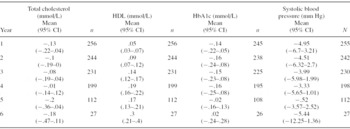
Intervention had two effects in the model: First, it affected the risk of developing diabetes. The trial showed a relative risk of .4 (95 percent confidence interval [CI], .3–.7). This reduction was applied to each year of intervention. Second, the intervention also affected risk factors for cardiovascular disease. This reduction (summarized in Table 1) was also applied in the model. No lasting effect of intervention was assumed once treatment was discontinued. Because a recent follow-up of the DPS patients has showed that a risk reduction of 38 percent of developing diabetes was observed in patients up to 2 years after the discontinuation of treatment, a scenario including this effect was also explored (Reference Lindstrom, Ilanne-Parikka and Aunola21). The drop-out rate in the trial was low: 2.8 percent on a yearly basis; therefore, it was not included in the model.
Change in Risk Factors (Compared to Baseline) Included in the UKPDS Risk Engine Observed in the Intervention Arm of the Finnish Diabetes Prevention Study

UKPDS, UK Prospective Diabetes Study; HDL, high density lipoprotein; CI, confidence interval.
Each health state in the model is associated with certain costs, expressed in 2003€ (1€=9.16 SEK, 0.94 USD). Direct and indirect costs (i.e., costs related to work absence) for the first year after an MI or stroke (direct cost of €5,695 and €10,256, indirect costs of €12,200 and €8,223) were taken from a study by Zethraeus and colleagues (Reference Zethraeus, Molin, Henriksson and Jönsson31). For the following years, we used assumptions of a direct cost of €819 for MI and €4,966 for a stroke from a model by Johannesson (Reference Johannesson17). The corresponding indirect costs were €6,439 and €7,724 for a MI and a stroke, respectively. In a sensitivity analysis, the first-year costs were varied by 20 percent. A scenario with no costs beyond the first year was also explored. To estimate the cost of treatment of diabetes and microvascular complications, we used data from the Swedish part of the CODE-2 study (Reference Henriksson, Agardh and Berne15). A yearly cost based on the duration since the diagnosis of diabetes was estimated using a linear regression on patients without a stroke or MI. The intervention consisted of yearly visits to the physician at a cost of €73 (Stockholm County Council, data on file), visits to the nutritionists (seven visits during the first year and visits every third month thereafter) at a cost of €39 (Stockholm County Council, data on file), and participation in circuit-type resistance training session estimated to a cost of €818 for a group of fifteen persons (personal communication, Korpen Stockholm). We assumed that costs associated with time and travel to physicians was equal to those for treatment of hypertension: €38 at a 2003 value (Reference Johannesson16). The participation rate in the circuit-type training was between 50 and 85 percent; we, therefore, assumed a mean participation rate of 67.5 percent. The average yearly cost of intervention was thus €730 during the first year and €498 during the following years. It has been shown that, in interventions that have an effect on survival, it is proper to also include the costs associated with longer life (in terms of the difference between production and consumption) (Reference Meltzer23). However, this strategy is not done in most studies and, to facilitate comparisons with other studies, we have not included it in the base case. In a sensitivity analysis, we included estimates of these costs calculated by Ekman (Reference Ekman11).
In addition to being associated with certain costs, each state in the model is also associated with quality of life weights called utilities. The utility is a weight between 0 and 1, where 1 represents perfect health and 0 corresponds to a health state equal to death. By using these weights, the number of quality-adjusted life-years (QALYs) gained by the intervention can be estimated. Utility weights for diabetics have been estimated from the UKPDS trial by Clarke and colleagues (Reference Clarke, Gray and Holman7). We assume that the reduction in quality if life due to stroke and myocardial infarction would be the same for diabetic and nondiabetic patients.
We extracted patients from the cohort of 60-year-old Swedes who would be eligible for the intervention, that is, patients with a BMI greater than 25, a fasting glucose >6.1 mmol/L (no oral glucose challenge was performed in the screening), and without a diagnosis of diabetes mellitus. A total of 397 patients in the cohort fulfilled the criteria: 32.1 percent were women, and 22 percent were current smokers. The mean total cholesterol was 6.1 mmol/L; mean high density lipoprotein concentration, 1.3 mmol/L; mean systolic blood pressure, 148.3 mm Hg; mean BMI, 30.3; waist circumference, 103.3 cm; and fasting glucose, 7.0 mmol/L. No HbA1c measurements were available in the sample. Because this factor was necessary in the risk functions, we predicted values using a linear regression on the DPS patients. When running the simulations, subjects were drawn at random from the eligible populations and the effect of treatment was assessed for each subject.
In the base case, we assumed that treatment would continue for 6 years, the longest follow-up time in the original DPS. All costs and effects were discounted by 3 percent in accordance with the guidelines form the Swedish Pharmaceutical Benefits Board. This figure was tested in a sensitivity analysis. The perspective of the analysis was that of the society, thus including both direct and indirect costs.
RESULTS
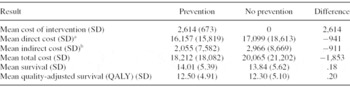
Table 2 shows the results regarding costs and survival from the base-case analysis. As indicated, the cost of intervention is quite high, but this cost is offset by savings. Indirect costs play a relatively small role, which is natural, given that the population is 60 years old and thus close to retirement. The predicted gain in survival is .18 years. Standard deviations are quite large, indicating a large variation in the underlying model parameters.
Mean per Patient Cost (2003€) and Survival (Years) Results from the Base-Case Analysis (3% Discounting Applied to Costs and Effects)

a Including cost of intervention.
b Indirect costs are costs due to lost production, for example, because of work absence.
SD, standard deviation; QALY, quality-adjusted life-years.
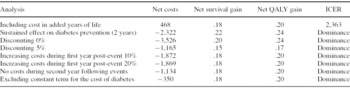
Table 3 shows the results from the sensitivity analyses. Including costs in added years of life leads to higher costs and thus a higher incremental cost-effectiveness ratio, which is natural because the intervention is predicted to have positive effects on survival. Assumptions about discounting had no major impact on the results, neither did increasing the cost following events, slightly indicating that the model is stable with regard to these parameters. Excluding costs in the years following the first after an event led to a reduction in the predicted savings, but the net results are still negative, indicating overall savings. Excluding the constant part of the predicted cost of microvascular complications leads to smaller savings, but the net cost is still negative, which indicates that the intervention would be cost-saving even at low cost for newly diagnosed patients.
Predicted Mean Cost per Patient (2003€), Mean Gain in Survival (Years), Mean Gain in Quality-Adjusted Survival (QALY), and Cost-Effectiveness (Cost per QALY Gained) in the Sensitivity Analyses

QALY, quality-adjusted life-years; ICER, incremental cost-effectiveness ratio (cost per QALY gained).
CONCLUSIONS
Our results indicate that a lifestyle intervention program focusing on diet and exercise to prevent type 2 diabetes in 60-year-old men and women at risk is costly but that the potential health gains are impressive, and the net costs are negative. The results were stable to assumptions about costs and discounting. The intervention has been shown to be effective (with a risk reduction of 56 percent) and also possible to implement in the primary care setting. Compliance rates were high in the trial with an annual drop-out rate of only 2.8 percent. Our study shows that it is also well worth the money spent.
There are some limitations to our study: the cost data used were collected in 1997. However, the results from the sensitivity analysis indicate that this is of little consequence. It could also be argued that, because the CODE-2 study included all costs in patients with diabetes regardless of whether these costs were caused by the diabetes, using these costs as the cost that is avoided when diabetes is delayed may be an overestimation. However, our sensitivity analysis showed that, when the fixed component of this cost was excluded and only the (quite small) yearly incremental cost was included, which would represent a very conservative alternative estimate, the net costs still indicated savings.
Another limitation of our study is the data on quality of life incorporated into the model. The model estimated by Clarke and colleagues includes more health states than are being used in our model, namely heart failure, amputations, blindness, and ischemic heart disease (other than MI) (Reference Clarke, Gray and Holman7). This finding means that the potential quality of life gains predicted by our model were an underestimation, as these health states are not explicitly modeled.
No studies have investigated the applicability of the UKPDS risk equations in the patients included in this study. It is difficult to assess if they over- or underestimate the risk of MI and stroke in Swedish patients. We believe that such a difference, if it exists, is likely to be small. Another issue with the risk equations is that they were developed to assess the risk of complication in diabetic patients. In our model, they are used to predict the risk among patients with IGT, assuming that such patients have the same risk as patients with newly diagnosed diabetes. This finding may represent an overestimation of their risk.
Patients with diabetes have higher mortality than those in the general population and also higher mortality than individuals with IGT (9). Some of this excess in mortality in diabetic patients is mediated through the higher risk of MI and stroke, which have high case fatalities. This finding, nevertheless, does not capture the entire increase in mortality and can lead to an underestimation of the benefits of intervention and thus might overestimate cost-effectiveness ratios.
When we modeled intervention, we assumed that patients no longer on treatment (either because they dropped out or because the intervention period was over) immediately moved back to their risk profile at baseline. We also assumed that they no longer had any reduced risk of developing diabetes. This is a very conservative assumption; indeed, a recent follow-up study has shown that some effect is maintained (Reference Lindstrom, Ilanne-Parikka and Aunola21). When including this assumption into the calculations, results become even more favorable.
The effects of the potential sources of bias are all working in the direction of overestimated cost-effectiveness ratios, with the possible exception of the applicability of the UKPDS equations to the Swedish sample. Our estimate is thus most likely a very conservative one. In addition, there are beneficial effects of diet and exercise not captured in this model. Recent studies have shown a possible relationship between the metabolic syndrome and prostate cancer, colorectal cancer, and breast cancer (Reference Barnard, Aronson, Tymchuk and Ngo2;Reference Colangelo, Gapstur, Gann, Dyer and Liu8;Reference Guastamacchia, Resta and Triggiani13;Reference Sinagra, Amato and Scarpilta27). Should this intervention be incorporated, results would be even more beneficial.
The economic aspects of lifestyle intervention in the prevention of diabetes have received little attention previously. Two studies have investigated the American Diabetes Prevention Program. The Diabetes Prevention Program Investigators conducted a within-trial analyses of the resource consumption recorded during the trial with QALYs as the measure of effectiveness. During the 3-year trial, the cost-effectiveness ratios (from the societal perspective) was 31,512 USD (€24,894) per QALY gained compared with placebo (10). Palmer and colleagues performed a modeling study in five countries, which (from a healthcare payer perspective) indicated cost-savings (Reference Palmer, Roze and Valentine24). Our study, which is the first study to both analyze costs from the societal perspective and analyze the economic consequences over the entire lifespan of the patient, shows that a longer intervention, such as the 6 years in DPS is favorable. Compared with previous studies, our study also has the advantage of using primary data for almost all the components included in the model.
Lifestyle intervention directed toward men and women at risk for diabetes mellitus is cost-saving for the healthcare payer and highly cost-effective for the society. In light of alarming reports from all over the world regarding a rapid increase in obesity, the metabolic syndrome, and diabetes type 2, there is an urgent need for implementation of such lifestyle intervention programs to reduce future burden of disease and costs for the society.
POLICY IMPLICATIONS
The implementation of intervention programs, similar to DPS, directed toward individuals at high risk of developing diabetes should be seriously considered as a way of both reducing overall illness and as a cost-reducing measure to the healthcare system.
CONTACT INFORMATION
Peter Lindgren, PhD (peter.lindgren@healtheconomics.se), Institute of Environmental Medicine, Division of Cardiovascular Epidemiology, Karolinska Institutet, P. O. Box 210, Nobels väg 13, SE-171 77 Stockholm, Sweden; Managing Director, European Health Economics, Vasagatan 38, SE-111 20 Stockholm, Sweden
Jaana Lindström, PhD (jaana.lindstrom@ktl.fi), Senior Researcher, Department of Health Promotion and Chronic Disease Prevention, National Public Health Institute, Mannerheimintie 166, 00300 Helsinki
Jaakko Tuomilehto, MD, PhD, MPH (jaakko.tuomilehto@ ktl.fi), Professor, Department of Public Health, University of Helsinki, P.O. Box 41, 00014 University of Helsinki, Sweden
Matti Uusitupa, MD, PhD (matti.uusitupa@uku.fi), Department of Clinical Nutrition, School of Public Health and Clinical Nutrition, P.O. Box 1627, University of Kuopio, 70211 Kuopio, Finland
Markku Peltonen, PhD (markku.peltonen@ktl.fi), Associate Professor, Head of Unit, Diabetes Unit, National Public Health Institute, Mannerheimintie 166, 00300 Helsinki, Finland
Bengt Jönsson, PhD (bengt.jonsson@hhs.se), Professor, Centre for Health Economics, Stockholm School of Economics, Box 6501, SE-113 83 Stockholm, Sweden
Ulf de Faire, MD, PhD (ulf.defaire@ki.se), Professor, Institute of Environmental Medicine, Division of Cardiovascular Epidemiology, Karolinska Institutet, P.O. Box 210, Nobels väg 13, SE-171 77 Stockholm, Sweden; Senior Consultant and Head, Cardiovascular Laboratory, Karolinska Hospital, SE-171 76 Stockholm, Sweden
Mai-Lis Hellénius, MD (mai-lis.hellenius@ki.se), Professor, Department of Neurobiology, Care Sciences and Society, Karolinska Institutet; Senior Consultant, Center for Family and Community Medicine, Stockholm County Council, Alfred Nobels Allé 12, 141 83 Huddinge, Sweden