











1. Introduction and main results
In this paper, we study the local behaviour near its singular set  $\Gamma$ of positive singular solutions
 $u$ to fractional semilinear elliptic equations
 \begin{align} (-\Delta)^{\alpha} u =f(u), ~~&x\in \Omega\backslash \Gamma. \end{align}
In the formula above,  $0<\alpha <1$,
 $\Omega = \mathbb {R}^{N}$ or
 $\Omega$ is a smooth bounded domain,
 $\Gamma$ is a singular subset with fractional capacity zero (see definition 1.1 below). We recall that the fractional Laplacian
 $(-\Delta )^{\alpha }$ is a pseudo-differential operator defined as
 \begin{align*} (-\Delta)^{\alpha}u(x)&=C_{N,\alpha} \text{P.V.} \int_{\mathbb{R}^{N}}\frac{u(x)-u(y)}{|x-y|^{n+2\alpha}}\,\textrm{d}y\nonumber\\ &= C_{N,\alpha}\lim_{\varepsilon\rightarrow 0}\int_{\mathbb{R}^{N}\backslash B_\varepsilon(x)}\frac{u(x)-u(y)}{|x-y|^{n+2\alpha}}\,\textrm{d}y, \end{align*}
where  $C_{N,\alpha }$ is a normalization constant defined as
 \begin{align*} C_{N,\alpha}=\frac{2^{2\alpha}\alpha\Gamma(({N+2\alpha})/({2}))} {\pi^{\frac{N}{2}}\Gamma(1-\alpha)}. \end{align*}
Throughout this paper, we assume that the nonlinear term  $f$ satisfies
 \begin{align} \begin{cases} f(t) \text{ is positive for all } t>0,\\ f(t) \text{ is locally bounded for all } t\geq 0,\\ \dfrac{f(t)}{t^{\tfrac{N+2\alpha}{N-2\alpha}}} \text{ is nonincreasing in } t \text{ for large and positive } t. \end{cases} \end{align}
Note that in this paper, we assume that
 \begin{align*} u\in C^{2}(\Omega\backslash \Gamma)~~ \text{and} ~~ \int_{\mathbb{R}^{N}}\frac{|u(x)|}{1+|x|^{1+2\alpha}}\,\textrm{d}x<\infty, \end{align*}
which will make  $(-\Delta )^{\alpha } u$ well-defined. Please see [Reference Caffarelli and Silvestre7, Reference Di Nezza, Palatucci and Valdinoci19] and the references therein for further details on the definition of fractional Laplacian.
Note that problem (1.1) with  $f(u)=u^{({N+2\alpha })/({N-2\alpha })}$ arises in conformal geometry when, for a given metric, we look for a conformal metric with constant fractional curvature and prescribed singularities. More precisely, given the Euclidean metric
 $|dx|^{2}$ on
 $\mathbb {R}^{N}$, we are looking for a conformal metric
 $g_\omega =\omega ^{({4})/({N-2\alpha })}|dx|^{2}$, with positive constant fractional curvature
 $Q_\alpha ^{g_\omega }=C_{N,\alpha }$, which is radially symmetric and has a prescribed singularity at the origin (see [Reference Chang and González9, Reference González, Mazzeo and Sire23, Reference Schoen40, Reference Schoen and Yau41] for more details).
One of the motivations for studying problem (1.1) arises from classical works of Caffarelli et al. [Reference Caffarelli, Gidas and Spruck5]. In this crucial paper, using a rather complicated version of Alexandrov reflection, they proved the asymptotic symmetry of positive solutions to
 \begin{align} -\Delta u =f(u),~~ &x\in B_1\backslash \{0\}, \end{align}
under the following assumptions on the nonlinear function  $f$:
(f 1)
 $f(t)$ is locally Lipschitz continuous,
(f 2)
$f(t)$ is nondecreasing in $t$ with $f(0)=0$,(f 3)
$\frac {f(t)}{t^{\frac {N+2}{N-2}}}$ is nonincreasing in $t$ for large $t$,(f 4)
$f(t)\geq c t^{p}$ for some $p\geq \frac {N}{N-2}$ and large $t$.


Li [Reference Li34] obtained the same result on the asymptotic radial symmetry of solutions to (1.3) under assumptions  $(f_1)$ and
 $(f_3)$ only, by exploiting the powerful method of moving planes. The moving planes method has numerous applications in studying nonlinear partial differential equations, which goes back to the seminal work of Alexandrov [Reference Alexandrov1] and further developed by Serrin [Reference Serrin44], Gidas et al. [Reference Gidas, Ni and Nirenberg22], Berestycki and Nirenberg[Reference Berestycki and Nirenberg3], Chen and Lin [Reference Chen and Lin13, Reference Chen and Lin14], Sciunzi [Reference Sciunzi42], Chen et al. [Reference Chen, Li and Li10].
Chen and Lin [Reference Chen and Lin12] proved a weaker version of the results of [Reference Caffarelli, Gidas and Spruck5] for the general case when the singular set  $\Gamma$ has Newtonian capacity zero with
 $f$ satisfying
 $(f_1)$-
 $(f_3)$ and
(f 5)
$\lim _{t\rightarrow \infty }\frac {f(t)}{t^{({N+2})/({N-2}})}=1$.

Assumption  $(f_5)$ was relaxed by Chen and Lin [Reference Chen and Lin15], who obtained a local estimate of positive solutions to problem (1.3) with a singular set of capacity zero, provided
 $f(t)/t^{({N+2})/({N-2})}$ is nonincreasing in
 $t$ for large
 $t$. More precisely, they show that any positive singular solutions to problem (1.3) satisfy that
 \begin{align} \frac{f(u(x))}{u(x)}\leq C d(x,\Gamma)^{{-}2} \end{align}
for all  $x\in B_1\backslash \Gamma$.
In this paper, we give a similar estimate to (1.4) in the framework of fractional Laplacian, please see (1.5) below for more details. Note that since we deal with the fractional elliptic problem (1.1), which is nonlocal due to the fractional operator  $(-\Delta )^{\alpha }$, unlike (1.3), we need to perform a careful analysis to overcome the nonlocality. Firstly, in order to prove (1.5) by moving spheres method, we establish a new narrow region principle for lower-semicontinuous function, see proposition 2.3 for more details. Secondly, the blow-up analysis plays an important role in the proof of (1.5), and requires the definition of an auxiliary function which is more complicated than the usual one, which also adds some difficulties in the proof. Some other related results can see [Reference Ao, DelaTorre, González and Wei2, Reference Chen, Liu and Zheng16, Reference DelaTorre and González17, Reference Esposito, Montoro and Sciunzi21, Reference Jin, Li and Xiong30, Reference Lin and Prajapat37, Reference Oliva, Sciunzi and Vaira39, Reference Xiong48, Reference Zhang52] and the references therein.
Recently, nonlocal problems and operators have been widely studied and have attracted the attention of many mathematicians from different research fields. Chang and González[Reference Chang and González9] studied the connection between the fractional Laplace operator and a class of conformally covariant operators in conformal geometry. González et al. [Reference González, Mazzeo and Sire23] investigated the singular sets of solutions and characterized the connection between the dimension of the singular sets and the order of the equations. Caffarelli et al. [Reference Caffarelli, Jin, Sire and Xiong6], by the extension formulations for fractional Laplacians[Reference Caffarelli and Silvestre7], obtained the local behaviour and asymptotically radial symmetry of nonnegative solutions to problem (1.1) with  $f(u)=u^{({N+2\alpha })/({N-2\alpha })}$ and
 $\Gamma =\{0\}$. Jin et al. [Reference Jin, Queiroz, Sire and Xiong31] generalized these results to singularity set with fractional capacity zero instead of a single point. For some other works involving the fractional Laplacian via the moving planes (spheres) method, please see [Reference Ao, DelaTorre, González and Wei2, Reference Chen, Li and Li10, Reference DelaTorre, Pino, González and Wei18, Reference Huang and Tian28, Reference Montoro, Punzo and Sciunzi38, Reference Wu and Chen47, Reference Yang and Zou49–Reference Zhang52] and the references therein.
In this paper, we continue to investigate the local behaviour of nonnegative solutions to problem (1.1) with general nonlinear term  $f$ satisfying (1.2). The nonlocality of the fractional Laplacian makes this problem difficult to deal with problem (1.1). To overcome this difficulty, we analyze (1.1) via the extension formulations for fractional Laplacian, which reduced this nonlocal problem into a local one in higher dimensions. On the other hand, because of the lack of regularity of
 $f$ and the fact that
 $f(t)/t^{({N+2\alpha })/({N-2\alpha })}$ is nonincreasing in
 $t$ for large
 $t$, we can not use strong maximum principle and Liouville theorem directly. Thus, we developed a new narrow region principle (see proposition 2.3 below) to obtain the positivity of the solution.
In order to describe our main results in a more precise way, let us first introduce some notations. We use capital letters, such as  $X=(x,\,t)\in \mathbb {R}^{N}\times \mathbb {R}_+$ to denote a point in
 $\mathbb {R}^{N+1}_+$. Denote
 $\mathcal {B}_R(X)$ as the ball in
 $\mathbb {R}^{N+1}$ with radius
 $R$ and centre at
 $X$,
 $\mathcal {B}_R^{+}=\mathcal {B}_R\cap \mathbb {R}^{N+1}_+$ as the upper half ball,
 $\partial '\mathcal {B}_R$ as the flat part of
 $\partial \mathcal {B}_R$ which is the ball
 $B_R$ in
 $\mathbb {R}^{N}$,
 $\partial ''\mathcal {B}_R$ as the curved boundary portion of
 $\partial \mathcal {B}_R$,
 $B_R(x)$ as the ball in
 $\mathbb {R}^{N}$ with radius
 $R$ and centre at
 $x$. For simplicity,
 $\mathcal {B}_R:=\mathcal {B}_R(0)$,
 $B_R:=B_R(0)$ and so on.
It is well-known that problem (1.1) is equivalent to the nonlinear boundary value problem
 \begin{align*} \begin{cases} -\text{div}(t^{1-2\alpha}\nabla U(X))=0, & X\in \Omega\times (0,+\infty),\\ \dfrac{\partial U}{\partial \nu^{\alpha}}(x,0)=f(u(x)), & x\in \Omega\backslash \Gamma, \end{cases} \end{align*}
where
 \begin{align*} \frac{\partial U}{\partial \nu^{\alpha}}(x,0)={-}\lim_{t\rightarrow 0+}t^{1-2\alpha}\partial_t U(x,t), \end{align*}
and  $u(x):=U(x,\,0)$.
We say that  $u(x)\in H_{loc}^{\alpha }(\mathbb {R}^{N}{\setminus} \Gamma )\cap L^{1}(\mathbb {R}^{N})$ is a weak solution to problem (1.1) if
 \begin{align*} \frac{C_{N,\alpha}}{2}\int_{\mathbb{R}^{N}}\int_{\mathbb{R}^{N}} \frac{(u(x)-u(y))(\varphi(x)-\varphi(y))}{|x-y|^{N+2\alpha}}\,\textrm{d}x\,\textrm{d}y=\int_{\mathbb{R}^{N}} f(u) \varphi(x)\,\textrm{d}x \end{align*}
for all  $\varphi \in C^{\infty }_{c}(\Omega \backslash \Gamma )$.
Now we introduce the fractional capacity, which is a modification of the classical Newtonian capacity.
Definition 1.1 For every compact subset  $\Gamma$ of
 $\mathbb {R}^{N}$ and
 $0 <\alpha < 1$, define
 \begin{align*} \text{Cap}_\alpha(\Gamma)=\inf\left\{\int_{\mathbb{R}^{N}} |\xi|^{2\alpha}| \hat{g}(\xi)|^{2}\,\textrm{d}\xi:g\in C_c^{\infty}(\mathbb{R}^{N}), g(x)\geq 1, ~~x\in \Gamma\right\}, \end{align*}
where  $\hat {g}(\xi )$ is the Fourier transform of
 $g$.
One of our main results is the following asymptotic blow-up rate estimate of solutions to problem (1.1) with a singular set  $\Gamma$. For simplicity, here we only consider
 $\Omega =B_1$.
Theorem 1.2 Assume that  $f$ satisfies (1.2),
 $\Omega =B_1$ and
 $\Gamma \subset B_{1/2}$ is a compact subset of
 $B_1$ with
 $\text {Cap}_\alpha (\Gamma )=0$. Let
 $u$ be a nonnegative weak solution to problem (1.1). Then there exists
 $C > 0$ such that
 \begin{align} \frac{f(u(x))}{u(x)}\leq C d(x,\Gamma)^{{-}2\alpha} \end{align}
for all  $x\in B_1\backslash \Gamma$.
Remark 1.3 We must emphasize that inequality (1.5) is new even for  $\Gamma \equiv \{0\}$.
Remark 1.4 When  $f(u)=u^{({N+2\alpha })/({N-2\alpha })}$, inequality (1.5) is reduced to
 \begin{align*} u(x)\leq C d(x,\Gamma)^{-({N-2\alpha})/({2})}, \end{align*}
which is the main result of theorem 1.3 in [Reference Jin, Queiroz, Sire and Xiong31].
When  $f(u)=u^{p}$ with
 $({N})/({N-2\alpha })< p<({N+2\alpha })/({N-2\alpha })$, inequality (1.5) is reduced to
 \begin{align*} u(x)\leq C d(x,\Gamma)^{-({2\alpha})/({p-1})}. \end{align*}
This estimate was obtained by Yang and Zou in [Reference Yang and Zou50] with  $\Gamma \equiv \{0\}$.
Therefore, the main results of this paper give a unified formula for the asymptotic behaviour of singular positive solutions to problem (1.1) with subcritical or critical exponent.
One consequence of inequality (1.5) is that every solution  $u$ to problem (1.1) satisfies the following spherical Harnack inequality when
 $\Gamma \equiv \{0\}$.
Theorem 1.5 Assume that  $f$ satisfies (1.2),
 $\Omega =B_1$ and
 $\Gamma \equiv \{0\}$. Let
 $u$ be a nonnegative weak solution to problem (1.1). Then there exists
 $C > 0$ such that, for any
 $0< r<1$,
 \begin{align} \max_{|x|=r}u(x)\leq C\min_{|x|=r}u(x). \end{align}
Let  $\Omega =\mathbb {R}^{N}$ and
 $\Gamma =\mathbb {R}^{k}$ with
 $1\leq k\leq N-2\alpha$. By theorem 2.2 in [Reference Jin, Queiroz, Sire and Xiong31], we know that
 $\text {Cap}_\alpha (\Gamma )=0$. The following result shows that the solutions to problem (1.1) are cylindrically symmetric provided
 $f(t)/ t^{({N+2\alpha })/({N-2\alpha })}$ is nonincreasing in
 $t$ for all
 $t>0$.
Theorem 1.6 Let  $1\leq k\leq N-2\alpha$. Assume that
 $U$ is a nonnegative solution to
 \begin{align} \begin{cases} -\text{div}(t^{1-2\alpha}\nabla U)=0, & X\in \mathbb{R}_+^{N+1},\\ \dfrac{\partial U}{\partial \nu^{\alpha}}(x,0)=f(u), & x\in \mathbb{R}^{N}\backslash \mathbb{R}^{k}, \end{cases} \end{align}
where  $f(t)$ is positive for all
 $t>0$ and
 $f(t)/ t^{({N+2\alpha })/({N-2\alpha })}$ is nonincreasing in
 $t$ for all
 $t>0$. Suppose that there exists
 $x_0\in \mathbb {R}^{k}$ such that
 \begin{align} \limsup_{X\rightarrow(x_0 ,0_{N-k},0)}U(X)=\infty, \end{align}
then
 \begin{align} U(x,y,t)= U(x,|y|,t), \end{align}
where  $(x,\,y,\,t)\in \mathbb {R}^{k}\times \mathbb {R}^{N-k} \times \mathbb {R}_+$ and
 $0_{N-k}$ is the origin of
 $\mathbb {R}^{N-k}$.
With the help of spherical Harnack inequality (1.6) and cylindrically symmetric (1.9), we are also able to show the following asymptotic symmetry results.
Let  $\Gamma \subset B_{1/2}$ be a smooth
 $k$-dimensional closed manifold with
 $k \leq N-2\alpha$, and
 $\Lambda$ be a tubular neighbourhood of
 $\Gamma$ such that any point of
 $\Lambda$ can be uniquely expressed as the sum of
 $x+v$, where
 $x\in \Gamma$ and
 $v \in (T_x \Gamma )^{+}$, the orthogonal complement of the tangent space of
 $\Gamma$ at
 $x$. Denote
 $\Pi$ the orthogonal projection of
 $\Lambda$ onto
 $\Gamma$. For small
 $r > 0$ and
 $z\in \Gamma$, let
 \begin{align*} \Pi^{{-}1}_r(z)=\{y\in\Lambda: \Pi(y)=z, |y-z|=r\}. \end{align*}
Theorem 1.7 Let  $\Gamma$ be a compact set of
 $\Omega =B_1$,
 $f$ satisfies (1.2) and
 $\lim _{t\to +\infty }t^{-({N})/({N-2\alpha })}f(t)=+\infty$. Then any nonnegative solution
 $u$ to problem (1.1) is asymptotically symmetric, that is, as
 $r\rightarrow 0^{+}$,
 \begin{align} u(x)=u(x')(1+o(1)),~~x,x'\in \Pi^{{-}1}_r(z), \end{align}
where  $o(1)$ is uniformly small for all
 $z\in \Gamma$.
Remark 1.8 Recently, Han et al. [Reference Han, Li and Li26] obtained arbitrary orders asymptotic behaviour of positive solutions to the Yamabe equation and  $\sigma _k$-Yamabe equation near isolated singular points, which extended the related results of Caffarelli et al. [Reference Caffarelli, Gidas and Spruck5], Korevaar et al. [Reference Korevaar, Mazzeo, Pacard and Schoen32], Han et al. [Reference Han, Li and Teixeira27] and Leung [Reference Leung33]. Guo et al. [Reference Guo, Li and Wan24, Reference Guo, Wan and Yang25] also established the sharp asymptotic behaviour of positive solutions to weighted elliptic equation. In a forthcoming paper, we will study a slightly stronger estimate of (1.10), that is
 \begin{align*} u(x)=u(x')(1+O(|x|^{\gamma})),~~x,x'\in \Pi^{{-}1}_r(z) \end{align*}
for some  $\gamma >0$.
The paper is organized as follows. Section 2 contains some notations and narrow region principles. Section 3 is concerned with the proof of theorem 1.2. In § 4, we study spherical Harnack inequality of solutions to problem (1.1). Then we devote § 5 and § 6 to the proof of theorems 1.6 and 1.7, respectively.
2. Preparations
2.1 Notation and preliminaries
In this paper, we use the method of moving spheres and blow-up analysis to prove theorem 1.2. The method of moving spheres is a variant useful method of moving planes, which has numerous applications in studying qualitative properties of partial differential equations. It is well known that, for the method of moving planes, we move parallel planes along a chosen direction to the limiting position to obtain symmetry of the solutions about the limiting plane. While for the method of moving spheres, we fix a centre and increase or decrease the radius of the spheres to show some kinds of monotonicity or symmetry of the solutions along the radial directions of the spheres by comparing the solution with its Kelvin transformation.
We first give the definition of Kelvin transformation.
Definition 2.1 Given  $\lambda > 0$ and
 $x_0\in \mathbb {R}^{N}$, define the Kelvin transformation of
 $u$ with respect to the sphere
 $S_\lambda (x_0):=\{x: |x-x_0|=\lambda \}$ as
 \begin{align*} u_{\lambda,x_0}(x)=\left(\frac{\lambda}{|x-x_0|} \right)^{N-2\alpha}u(x_\lambda), \end{align*}
where
 \begin{align*} x_\lambda=x_0+\frac{\lambda^{2}(x-x_0)}{|x-x_0|^{2}}, \end{align*}
which is the inversion point of  $x$ about the sphere
 $S_\lambda (x_0)$.
In the proof of theorem 1.2, we need the following a priori estimate, which holds also for the case that the fractional perimeter of  $\Omega$ is finite, here let
 $\Omega =B_1$ for simplicity.
Lemma 2.2 Let  $u$ be a positive solution to problem (1.1) with
 $\Omega =B_1$,
 $\Gamma$ and
 $f$ satisfy the hypotheses of theorem 1.2. Then
 $f(u)\in L^{1}(B_1)$.
Proof. Since  $\text {Cap}_\alpha (\Gamma )=0$, then there exists a nonnegative
 $\alpha$-harmonic function sequence
 $\{\eta _n\}$ such that
•
$\eta _n(x)=0,\, x\in \Gamma$,•
$\eta _n(x)\rightarrow 1$ uniformly in $C^{\alpha }_{loc}(\mathbb {R}^{N}{\setminus} \Gamma )$ as $n\rightarrow \infty$,•
$\parallel \eta _n \parallel _{H^{\alpha }}\rightarrow 0$ as $n\rightarrow \infty$.


For any  $k>0$, let
 $\varphi _k$ be a smooth nonincreasing function satisfying
 \begin{align*} \varphi_k(t)=\begin{cases} 1, & t< k,\\ 0, & t\geq 2k. \end{cases} \end{align*}
Taking  $\eta _n\varphi _k(u)$ as a test function in problem (1.1), using integration by parts formulas (see lemma 3.3 in [Reference Serena, Xavier and Enrico43]), we obtain that
 \begin{align} \frac{C_{N,\alpha}}{2} & \int_{\mathbb{R}^{2N}{\setminus} (B^{c}_1)^{2}}\frac{(u(x)-u(y))[\eta_n\varphi_k(u) (x)-\eta_n\varphi_k(u)(y)]}{|x-y|^{N+2\alpha}}\,\textrm{d}x\,\textrm{d}y\nonumber\\ & = \int_{B_1}\eta_n\varphi_k(u)f(u)\,\textrm{d}x +\int_{B^{c}_1}\eta_n\varphi_k(u) \mathcal {N}_\alpha u\,\textrm{d}x, \end{align}
where  $B^{c}_1=\mathbb {R}^{N}{\setminus} B_1$,
 $\mathcal {N}_\alpha$ is the nonlocal normal derivative introduced in [Reference Serena, Xavier and Enrico43], i.e.,
 \begin{align*} \mathcal {N}_\alpha u(x)=C_{N,\alpha} \int_{B_1} \frac{u(x)-u(y)}{|x-y|^{N+2\alpha}}\,\textrm{d}y, \quad x\in \mathbb{R}^{N}{\setminus} \overline{B}_1. \end{align*}
Note that
 \begin{align*} \eta_n\varphi_k(u) (x)-\eta_n\varphi_k(u)(y) =\eta_n(x)[\varphi_k(u)(x)-\varphi_k(u)(y)] +\varphi_k(u)(y)[\eta_n(x)-\eta_n(y)], \end{align*}
by the monotonicity of  $\varphi _k$, we get
 \begin{align*} [u(x)-u(y)][\varphi_k(u)(x)-\varphi_k(u)(y)]\leq 0. \end{align*}
Therefore,
 \begin{align*} & (u(x)-u(y)) [\eta_n\varphi_k(u)(x)-\eta_n\varphi_k(u)(y)] \\ & \quad = \eta_n(x)[u(x)-u(y)][\varphi_k(u)(x)-\varphi_k(u)(y)] \\ &\qquad +\varphi_k(u)(y)[u(x)-u(y)][\eta_n(x)-\eta_n(y)]\\ &\quad \leq \varphi_k(u)(y)[u(x)-u(y)][\eta_n(x)-\eta_n(y)].\end{align*}
Now let  $k>0$ be large enough such that
 $u(y)< k$ for any
 $y\in \mathbb {R}^{N}{\setminus} B_1$. Thus
 $\varphi _k(u)(y)=1$ for any
 $y\in \mathbb {R}^{N}{\setminus} B_1$. This fact, together with (2.1), shows that
 \begin{align} \int_{B_1}\eta_n\varphi_k(u)f(u)\textrm{d}x &\leq \frac{C_{N,\alpha}}{2}\int_{\mathbb{R}^{2N}{\setminus} (B^{c}_1)^{2}}\frac{\varphi_k(u)(y)[u(x)-u(y)][\eta_n(x)-\eta_n(y)]}{|x-y|^{N+2\alpha}}\,\textrm{d}x\,\textrm{d}y \notag\\ &\quad -\int_{B^{c}_1}\eta_n\varphi_k(u) \mathcal {N}_\alpha u\,\textrm{d}x\nonumber\\ & = \frac{C_{N,\alpha}}{2}\int_{\mathbb{R}^{2N}{\setminus} (B^{c}_1)^{2}}\frac{[u(x)-u(y)][\eta_n(x)-\eta_n(y)]}{|x-y|^{N+2\alpha}}\,\textrm{d}x\,\textrm{d}y \notag\\ &\quad -\int_{B^{c}_1}\eta_n \mathcal {N}_\alpha u\,\textrm{d}x\nonumber\\ & = \langle u,(-\Delta)^{\alpha} \eta_n\rangle- \int_{B^{c}_1}\eta_n \mathcal {N}_\alpha u\,\textrm{d}x. \end{align}
For fixed  $k$, let
 $n\rightarrow \infty$ in (2.2), by the properties of
 $\eta _n$, we find
 \begin{align*} \int_{B_1}\varphi_k(u)f(u)\,\textrm{d}x \leq \left|\int_{\mathbb{R}^{N}{\setminus} B_1} \mathcal {N}_\alpha u\,\textrm{d}x\right|. \end{align*}
Let  $k\rightarrow +\infty$, the above inequality leads to
 $f(u)\in L^{1}(B_1)$ since the fractional perimeter of
 $B_1$ is finite. For more details, please see remark 3.4 in [Reference Serena, Xavier and Enrico43].
2.2 Narrow region principle
We need the following narrow region principle of anti-symmetric functions, which is crucial of our proofs in the application of the moving spheres method in the forthcoming.
Let
 \begin{align*} \Phi(x)=\frac{C}{|x|^{N-2\alpha}},~~x\in \mathbb{R}^{N}{\setminus} \{0\}, \end{align*}
be the fundamental solution of  $(-\Delta )^{\alpha }$. Let
 $\Psi (x)$ be a
 $C^{1,1}$-function, coincides with
 $\Phi (x)$ when
 $x$ is outside
 $B_1$. For any
 $\tau >1$, denote
 \begin{align*} \Psi_\tau(x)=\frac{\Psi\left({x}/{\tau}\right)}{\tau^{N-2\alpha}},~~x\in \mathbb{R}^{N}, \end{align*}
and
 \begin{align} \gamma_\tau(x)=(-\Delta)^{\alpha}\Psi_\tau(x). \end{align}
For more properties of  $\gamma _\tau$ and
 $\Psi _\tau$, please see [Reference Dipierro, Montoro, Peral and Sciunzi20, Reference Silvestre45].
Without loss of generality, here we take  $x_0=0$ and denote
 $u_{\lambda }(x)=u_{\lambda ,0}(x)$ as the Kelvin transformation of
 $u(x)$ with respect to sphere
 $S_{\lambda }(0)$.
Proposition 2.3 Narrow region principle Let  $\Omega \subset B_\lambda (0)$ be an open set, and
 $u$ be a lower-semicontinuous function in
 $\bar {\Omega }$ such that for some nonnegative constant
 $\widetilde {C}$,
 \begin{align} \begin{cases} (-\Delta)^{\alpha} u(x)\geq{-}\widetilde{C}, & x\in\Omega\subset B_\lambda(0),\\ u(x)\geq 0, & x\in B_\lambda(0){\setminus} \Omega,\\ u(x)={-}u_{\lambda}(x), & x\in B_\lambda(0). \end{cases} \end{align}
Then there exists sufficiently small  $\delta >0$ such that,
 \begin{align} \inf_{x\in\Omega}u(x)\geq 0, \end{align}
provided
 \begin{align*} \Omega\subset A_{\lambda-\delta,\lambda}: \equiv\{x\in \mathbb{R}^{N}:\lambda-\delta<|x|<\lambda\}. \end{align*}
Furthermore, if  $u(x)=0$ for some
 $x\in \Omega$, then
 $u(x)\equiv 0$ for almost every
 $x\in \mathbb {R}^{N}$.
Remark 2.4 Note that the integral representation of  $u$ does not apply for nonsmooth functions. Therefore, the proof of [Reference Chen, Li and Zhang11] is not available in this case.
Proof. Since  $u$ is lower-semicontinuous, it attains its minimum point, say at
 $x_0\in \Omega$, that is
 \begin{align*} u(x_0)=\inf_{x\in\Omega}u(x). \end{align*}
Now suppose that  $u(x_0)<0$, otherwise there is nothing to prove.
Define  $\bar {u}(x)=u(x)-u(x_0)$. Obviously, by (2.4), we have
 $\bar {u}(x)$ satisfies
 \begin{align*} \begin{cases} (-\Delta)^{\alpha}\bar{u}(x)\geq{-}\widetilde{C}, & x\in\Omega\subset B_\lambda(0),\\ \bar{u}(x)\geq 0, & x\in B_\lambda(0),\\ \bar{u}(x_0)=0. \end{cases} \end{align*}
By virtue of corollary 2.16 in [Reference Silvestre45], we have that, for every  $\tau < \text {dist}(x_0,\,\partial \Omega )$,
 \begin{align} 0=\bar{u}(x_0)\geq\int_{\mathbb{R}^{N}}\bar{u}(x) \gamma_\tau(x-x_0)\,\textrm{d}x-\widetilde{C}\tau^{2\alpha}, \end{align}
where  $\gamma _\tau$ is defined by (2.3) and
 $\widetilde {C}$ appears in (2.4). By the anti-symmetry assumption
 $u(x)=-u_{\lambda }(x)$, we find
 \begin{align} \left(\frac{\lambda}{|x|}\right)^{N-2\alpha}\bar{u} (x_\lambda)&=\left(\frac{\lambda}{|x|} \right)^{N-2\alpha}[u(x_\lambda)-u(x_0)]\nonumber\\ &={-}\bar{u}(x)-\left[1+\left(\frac{\lambda}{|x|}\right)^{N-2\alpha}\right]u(x_0). \end{align}
By (2.7), a simple calculation yields,
 \begin{align} &\int_{\mathbb{R}^{N}}\bar{u}(x) \gamma_\tau(x-x_0)\,\textrm{d}x\nonumber\\ &\quad = \int_{\mathbb{R}^{N}{\setminus} B_\lambda(0)}\bar{u}(x) \gamma_\tau(x-x_0)\,\textrm{d}x+\int_{B_\lambda(0)}\bar{u}(x) \gamma_\tau(x-x_0)\,\textrm{d}x\nonumber\\ &\quad = -\int_{ \mathbb{R}^{N}{\setminus} B_\lambda(0)}\left(\frac{\lambda}{|x|}\right)^{N-2\alpha}\bar{u} (x_\lambda)\gamma_\tau(x-x_0)\,\textrm{d}x\nonumber\\ &\qquad -u(x_0)\int_{ \mathbb{R}^{N}{\setminus} B_\lambda(0)}\left[1+\left(\frac{\lambda}{|x|}\right)^{N-2\alpha} \right]\gamma_\tau(x-x_0)\,\textrm{d}x\notag\\ &\qquad +\int_{B_\lambda(0)}\bar{u}(x) \gamma_\tau(x-x_0)\,\textrm{d}x\nonumber\\ &\quad = -\int_{ B_\lambda(0)}\bar{u} (x)\gamma_\tau\left(\frac{\lambda^{2} x}{|x|^{2}}-x_0\right)\left(\frac{\lambda}{|x|}\right)^{N+2\alpha}\,\textrm{d}x\nonumber\\ &\quad -u(x_0)\int_{ \mathbb{R}^{N}{\setminus} B_\lambda(0)}\left[1+\left(\frac{\lambda}{|x|}\right)^{N-2\alpha} \right]\gamma_\tau(x-x_0)\,\textrm{d}x+\int_{B_\lambda(0)}\bar{u}(x) \gamma_\tau(x-x_0)\,\textrm{d}x\nonumber\\ &\quad = \int_{B_\lambda(0)}\bar{u}(x) \left[\gamma_\tau(x-x_0)-\gamma_\tau\left(\frac{\lambda^{2} x}{|x|^{2}}-x_0\right)\left(\frac{\lambda}{|x|}\right)^{N+2\alpha} \right]\,\textrm{d}x\nonumber\\ &\quad -u(x_0)\int_{ \mathbb{R}^{N}{\setminus} B_\lambda(0)}\left[1+\left(\frac{\lambda}{|x|}\right)^{N-2\alpha}\right] \gamma_\tau(x-x_0)\,\textrm{d}x. \end{align}
Now we show that, for any  $x\in B_\lambda (0)$ and
 $\tau < \text {dist}(x_0,\,\partial \Omega )$,
 \begin{align} \gamma_\tau(x-x_0)>\gamma_\tau\left(\frac{\lambda^{2} x}{|x|^{2}}-x_0\right)\left(\frac{\lambda}{|x|}\right)^{N+2\alpha}. \end{align}
Recalling that  $\tau < \text {dist}(x_0,\,\partial \Omega )$ and
 $\Omega \subset B_\lambda (0)$, we have that
 $B_\tau (x_0)\subset B_\lambda (0)$.
Case 1:  $x\in B_\lambda (0){\setminus} B_\tau (x_0)$. By the definition of
 $\gamma _\tau$, see (2.3), it follows that
 \begin{align} \gamma_\tau(x-x_0)&=\int_{ \mathbb{R}^{N}}\frac{\Psi_\tau(x-x_0)-\Psi_\tau(y)} {|x-x_0-y|^{N+2\alpha}}\,\textrm{d}y\nonumber\\ &=\int_{ \mathbb{R}^{N}}\frac{\Psi_\tau(x-x_0)-\Phi(y)} {|x-x_0-y|^{N+2\alpha}}\,\textrm{d}y+\int_{ \mathbb{R}^{N}}\frac{\Phi(y)-\Psi_\tau(y)} {|x-x_0-y|^{N+2\alpha}}\,\textrm{d}y. \end{align}
Thus, taking into account the fact
 \begin{align*} \begin{split} \Psi_\tau(x) & =\Phi(x),~~x\in \mathbb{R}^{N}{\setminus} B_\tau(0),\\ \Psi_\tau(x) & \leq\Phi(x),~~x\in B_\tau(0), \end{split} \end{align*}
where  $\Phi$ is the fundamental solution of
 $(-\Delta )^{\alpha }$, we obtain
 \begin{align} \int_{ \mathbb{R}^{N}}\frac{\Psi_\tau(x-x_0)-\Phi(y)} {|x-x_0-y|^{N+2\alpha}}\,\textrm{d}y=\int_{ \mathbb{R}^{N}}\frac{\Phi(x-x_0)-\Phi(y)} {|x-x_0-y|^{N+2\alpha}}\,\textrm{d}y=0. \end{align}
 \begin{align} \gamma_\tau(x-x_0) &=\int_{ \mathbb{R}^{N}}\frac{\Phi(y)-\Psi_\tau(y)} {|x-x_0-y|^{N+2\alpha}}\,\textrm{d}y\nonumber\\ &=\int_{ B_\tau(x_0)}\frac{\Phi(y-x_0)-\Psi_\tau(y-x_0)} {|x-y|^{N+2\alpha}}\,\textrm{d}y. \end{align}
Similar arguments show that
 \begin{align} \gamma_\tau\left(\frac{\lambda^{2} x}{|x|^{2}}-x_0\right) =\int_{ B_\tau(x_0)}\frac{\Phi(y-x_0)-\Psi_\tau(y-x_0)} {\left|\frac{\lambda^{2} x}{|x|^{2}}-y\right|^{N+2\alpha}}\,\textrm{d}y. \end{align}
Notice that,
 \begin{align} \frac{1} {\left|\frac{\lambda^{2} x}{|x|^{2}}-y\right|^{N+2\alpha}} \left(\frac{\lambda}{|x|}\right)^{N+2\alpha} =\frac{1} {\left|\frac{\lambda x}{|x|}-\frac{|x|y}{\lambda}\right|^{N+2\alpha}}. \end{align}
In view of  $x\in B_\lambda (0){\setminus} B_\tau (x_0)$ and
 $y\in B_\tau (x_0)$, we get
 \begin{align} \frac{1} {|x-y|^{N+2\alpha}}-\frac{1} {\left|\frac{\lambda x}{|x|}-\frac{|x|y}{\lambda}\right|^{N+2\alpha}}\geq 0. \end{align}
By (2.12), (2.13) and (2.15), we derive that
 \begin{align} \gamma_\tau(x-x_0)>\gamma_\tau\left(\frac{\lambda^{2} x}{|x|^{2}}-x_0\right)\left(\frac{\lambda}{|x|}\right)^{N+2\alpha},~~x\in B_\lambda(0){\setminus} B_\tau(x_0). \end{align}
Case 2:  $x\in B_\tau (x_0)$. Obviously,
 $\frac {\lambda ^{2} x}{|x|^{2}}\in \mathbb {R}^{N}{\setminus} B_\lambda (0)$, in this case, (2.13) holds too. Thus, by (2.14),
 \begin{align} \gamma_\tau\left(\frac{\lambda^{2} x}{|x|^{2}}-x_0\right)\left(\frac{\lambda}{|x|}\right)^{N+2\alpha} &=\int_{ B_\tau(x_0)}\frac{\Phi(y-x_0)-\Psi_\tau(y-x_0)} {\left|\frac{\lambda^{2} x}{|x|^{2}}-y\right|^{N+2\alpha}}\,{\rm d}y \left(\frac{\lambda}{|x|}\right)^{N+2\alpha}\nonumber\\ &\leq \frac{C} {\left|\frac{\lambda^{2} x}{|x|^{2}}-\frac{\tau x}{|x|}\right|^{N+2\alpha}}\left(\frac{\lambda}{|x|}\right)^{N+2\alpha}\nonumber\\ & = \frac{C} {\left|\frac{\lambda x}{|x|}-\frac{\tau x}{\lambda}\right|^{N+2\alpha}}\nonumber\\ &:= C_1, \end{align}
here we have used the fact that  $\Phi -\Psi _\tau$ is a
 $L^{1}$-function with compact support and
 \begin{align*} \frac{\lambda x}{|x|}\in \partial B_\lambda(0), \frac{\tau x}{\lambda}\in B_\tau(x_0). \end{align*}
On the other hand,
 \begin{align*} \gamma_\tau(x-x_0)=\frac{1}{\tau^{N}}\gamma_1\left(\frac{x-x_0}{\tau}\right), \end{align*}
and  $\gamma _1$ is strictly positive function. Thus, we can choose
 $\tau$ sufficiently small such that
 \begin{align} \gamma_\tau(x-x_0)=\frac{1}{\tau^{N}}\gamma_1\left(\frac{x-x_0}{\tau}\right)\geq C_1, \end{align}
where  $C_1$ appears in (2.17). (2.17) and (2.18) imply that, for small
 $\tau$,
 \begin{align} \gamma_\tau(x-x_0)>\gamma_\tau\left(\frac{\lambda^{2} x}{|x|^{2}}-x_0\right)\left(\frac{\lambda}{|x|}\right)^{2\alpha},~~x\in B_\tau(x_0). \end{align}
(2.16) and (2.19) imply that (2.9) holds.
Consequently, by virtue of (2.9), taking into account (2.8), we arrive at
 \begin{align} \int_{\mathbb{R}^{N}}\bar{u}(x) \gamma_\tau(x-x_0)\,\textrm{d}x \geq -u(x_0)\int_{ \mathbb{R}^{N}{\setminus} B_\lambda(0)}\left[1+\left(\frac{\lambda}{|x|}\right)^{N-2\alpha}\right] \gamma_\tau(x-x_0)\,\textrm{d}x. \end{align}
For the right-hand side of the above inequality, by proposition 2.12 of [Reference Silvestre45], we find
 \begin{align*} &\int_{ \mathbb{R}^{N}{\setminus} B_\lambda(0)}\left[1+\left(\frac{\lambda}{|x|}\right)^{N-2\alpha}\right] \gamma_\tau(x-x_0)\,\textrm{d}x\\ &\quad \geq \int_{ (\mathbb{R}^{N}{\setminus} B_\lambda(0))\cap (B_{2\delta}(x_0){\setminus} B_{\delta}(x_0))} \gamma_\tau(x-x_0)\,\textrm{d}x\\ &\quad \geq \int_{ B_{2\delta}(x_0){\setminus} B_{\delta}(x_0)} \gamma_\tau(x-x_0)\,\textrm{d}x\\ &\quad \geq \frac{C }{\delta^{2\alpha}}, \end{align*}
which contradicts to (2.6) when  $\delta > 0$ is sufficiently small. Note that in the above inequality, we have used the fact that
 $\tau \leq \delta$ and
 $\gamma _\tau (x-x_0)\approx C/|x-x_0|^{N+2\alpha }$ as
 $\tau \to 0$. Therefore, (2.5) must be true.
Suppose  $u(x)=0$ at some point in
 $\Omega$, say at
 $x_1$ and
 $u(x)>0$ for any
 $x\neq x_1$. Thus, for any
 $\tau < \text {dist}(x_1,\,\partial \Omega )$,
 \begin{align} 0=u(x_1)\geq\int_{\mathbb{R}^{N}}u(x) \gamma_\tau(x-x_1)\,\textrm{d}x-\widetilde{C}\tau^{2\alpha}. \end{align}
Similar arguments as above show that
 \begin{align*} &\int_{\mathbb{R}^{N}}u(x) \gamma_\tau(x-x_1)\,\textrm{d}x\nonumber \\ & \quad = \int_{B_\lambda(0)}\bar{u}(x) \left[\gamma_\tau(x-x_1)-\gamma_\tau\left(\frac{\lambda^{2} x}{|x|^{2}}-x_1\right)\left(\frac{\lambda}{|x|}\right)^{N+2\alpha} \right]\,\textrm{d}x\nonumber\\ &\quad \geq \int_{B_\lambda(0)}u(x) \gamma_\tau(x-x_1) \,\textrm{d}x\nonumber\\ &\quad \geq \int_{ B_{2\delta}(x_1){\setminus} B_{\delta}(x_1)}u(x) \gamma_\tau(x-x_1) \,\textrm{d}x\nonumber\\ &\quad \geq \frac{C }{\delta^{2\alpha}}, \end{align*}
which yields a contradiction to (2.21). Therefore,  $u(x)=0$ for almost every
 $x\in B_\lambda (0)$, anti-symmetry assumption implies that
 $u(x)=0$ for almost every
 $x\in \mathbb {R}^{N}$.
When  $\widetilde {C}=0$, we can obtain the simple maximum principle for anti-symmetric functions, which does not involve any assumptions about measure of domains.
Proposition 2.5 Simple maximum principle Let  $\Omega \subset B_\lambda (0)$ be an open set, and let
 $u$ be a lower-semicontinuous function in
 $\bar {\Omega }$ and suppose
 \begin{align*} \begin{cases} (-\Delta)^{\alpha} u(x)\geq 0, & x\in\Omega,\\ u(x)\geq 0, & x\in B_\lambda(0){\setminus} \Omega,\\ u(x)={-}u_{\lambda}(x), & x\in B_\lambda(0). \end{cases} \end{align*}
Then  $u(x)\geq 0$ for every
 $x\in \Omega$. Furthermore, if
 $u(x)=0$ for some
 $x\in \Omega$, then
 $u(x)\equiv 0$ for almost every
 $x\in \mathbb {R}^{N}$.
Proof. Similar arguments of the proof of proposition 2.3 can be applied to this case. Using the same notation as above, by proposition 2.15 in [Reference Silvestre45], we have that, for every  $\tau <\text {dist}(x_0,\,\partial \Omega )$,
 \begin{align} 0=\bar{u}(x_0)\geq\int_{\mathbb{R}^{N}}\bar{u}(x) \gamma_\tau(x-x_0)\,\textrm{d}x. \end{align}
Similarly, we can obtain (2.20) holds again, while the right-hand side of (2.20) is positive, which contradicts (2.22). This finishes the proof.
We also need the following lemma.
Lemma 2.6 (Proposition 2.5 of [Reference Jin, Queiroz, Sire and Xiong31])
Suppose that  $\Gamma \subset \mathbb {R}^{N}$ is compact and
 $\text {Cap}_\alpha (\Gamma )=0$,
 $U\in W_{loc}^{1,2}(t^{1-2\alpha },\,\mathcal {B}_1^{+}\backslash \Gamma ) \cap C(\mathcal {B}_1^{+}\backslash \Gamma )$ and
 \begin{align*} \liminf_{X\rightarrow (x,0)} U(X)>{-}\infty, x\in \Gamma, X\in\mathcal {B}_1^{+}. \end{align*}
Suppose that  $U$ solves
 \begin{align*} \begin{cases} -\text{div}(t^{1-2\alpha}\nabla U)\leq 0, & X\in\mathcal {B}_1^{+},\\ \dfrac{\partial U}{\partial \nu^{\alpha}}(x,0)\geq 0, & x\in\partial \mathcal' {B}_1^{+}\backslash \Gamma, \end{cases}\end{align*}
in the weak sense. Then
 \begin{align*} U(X)\geq \inf_{\partial''\mathcal {B}_1^{+}}U, X\in\bar{\mathcal {B}}_1^{+}\backslash \Gamma. \end{align*}
The following Harnack inequality will be used in our proof. For more details of the proof, please see [Reference Cabre and Sire4, Reference Jin, Li and Xiong29].
Lemma 2.7 Let  $0\leq U\in W_{loc}^{1,2}(t^{1-2\alpha },\,\mathcal {B}_R^{+})$ be a weak solution to
 \begin{align*} \begin{cases} -\text{div}(t^{1-2\alpha}\nabla U)= 0, & X\in\mathcal {B}_R^{+},\\ \dfrac{\partial U}{\partial \nu^{\alpha}}(x,0)=a(x)U(x,0), & x\in\partial' \mathcal {B}_R^{+}. \end{cases} \end{align*}
If  $a(x)\in L^{p}(B_R)$ for some
 $p>N/2\alpha$, then we have
 \begin{align} \sup_{\bar{\mathcal {B}}^{+}_{R/2}}U\leq C(R) \inf_{\bar{\mathcal {B}}^{+}_{R/2}}U, \end{align}
where  $C$ depends only on
 $N,\, \alpha ,\, R$ and
 $\|a\|_{L^{p}(B_R)}$.
3. Proof of theorem 1.2
The main tools of the proof of theorem 1.2 are blow-up analysis and method of moving spheres. For easier reading, we assume that  $\Gamma \equiv \{0\}$, in this case,
 $d(x,\,\Gamma )=|x|$. For the general case, a slight change will be needed in the proof, such as,
 $r_i=|x_i|$ should be replaced by
 $r_i=d(x_i,\,\Gamma )$.
 $\Omega _i$, the domain of
 $W_i(x,\,t)$ given by (3.9), should be defined as
 \begin{align*} \Omega_i:=\left\{(x,t)\in \mathbb{R}^{N+1}_+:\left(z_i+\widetilde{M}_i^{{-}1}x, \widetilde{M}_i^{{-}1}t\right)\in \mathcal {B}_1^{+}\backslash \Gamma\right\}, \end{align*}
but there is no essential change in the whole proof.
For simplicity, we may also assume that  $f(t)\in C^{1,\gamma }(\mathbb {R}^{N})$ with
 $\gamma >\max \{0,\,1-2\alpha \}$. For the general case, it is easy to make necessary modification of the following arguments.
Proof of theorem 1.2. According to (1.2), there exists  $t_0>0$ such that
 \begin{align} \frac{f(t)}{t^{\frac{N+2\alpha}{N-2\alpha}}} ~~\text{is nonincreasing for} ~~t\geq t_0. \end{align}
We prove (1.5) by contradiction.
Suppose that there exists a sequence  $\{x_i\}\subset B_1$ such that
 $x_i\rightarrow 0$ as
 $i\rightarrow \infty$,
 \begin{align} \frac{f(u(x_i))}{u(x_i)}=\sup_{|x|\geq |x_i|}\frac{f(u(x))}{u(x)}, \end{align}
and
 \begin{align} \lim_{i\rightarrow\infty}|x_i|^{2\alpha}\frac{ f(u(x_i))}{u(x_i)}={+}\infty. \end{align}
Define
 \begin{align} v_i(y)=\frac{u(x_i+\widetilde{\mathbb{M}}_i^{{-}1}y)}{\mathbb{M}_i}, \end{align}
where
 \begin{align*} \mathbb{M}_i=u(x_i), ~~ \widetilde{\mathbb{M}}_i =\left(\frac{f(u(x_i))}{u(x_i)}\right)^{({1}/{2\alpha})}. \end{align*}
In order to obtain a contradiction, we show that
Claim 1.  $v_i(y)$, defined by (3.4), converges to a nonconstant function
 $v(x)\in C^{2}_{loc}(\mathbb {R}^{N})$.
It is worth pointing out that, this claim can be proved by classification result of fractional Laplace equations [Reference Chen, Li and Zhang11], provided  $\lim _{t\to +\infty }f(t)/t^{({N+2\alpha })/({N-2\alpha })}=1$. Unfortunately, we can not use this classification result directly under the assumption (1.2). In order to show that
 $v(x)$ is a nonconstant function, following the ideas given in [Reference Chen and Lin15], we choose another sequence points
 $z_i^{*}$, such that
 $v_i(z_i^{*})$ converge to
 $v^{*}(x)$ while
 $v^{*}(x)>v(x)$. This fact shows that the limit function
 $v(x)$ is a nonconstant function. More details see subsection 3.1 below.
Claim 2.  $v_i(y)$ converges to a constant.
This claim will be proved by the method of moving spheres described in [Reference Chen and Lin13, Reference Chen and Lin14, Reference Lin and Prajapat36].
Obviously, these two claims contradict each other. Therefore, (3.2) and (3.3) are ruled out. The proof of theorem 1.2 is complete if these two claims hold. For the convenience of reading, we postpone the proof of these two claims in the following subsection.
3.1 Proof of claim 1
We use some ideas introduced in [Reference Chen and Lin15] to prove claim 1, a similar argument see [Reference Caffarelli, Jin, Sire and Xiong6, Reference Jin, Li and Xiong29].
Proof of claim 1. Set  $r_i=|x_i|$, here and subsequently, we require
 $i>i_0$ such that
 $u(x_i)>t_0$, where
 $t_0$ appears in (3.1). Therefore, (3.1) holds for all
 $i>i_0$. Define
 \begin{align*} S_i(z,x)=\left(\frac{f(u(z))}{u(z)}\right)^{\frac{1}{2\alpha}} \left(\frac{r_i}{4}-|z-x|\right), ~~|z-x|<\frac{r_i}{4}. \end{align*}
Let  $|\overline {x}_i|=r_i=|x_i|$ and
 $|z_i-\overline {x}_i|\leq \frac {r_i}{4}$ such that
 \begin{align} S_i(z_i,\overline{x}_i)=\sup\limits_{|z-x|\leq\frac{r_i}{4},r_i=|x|}S_i(z,x). \end{align}
Now we show that
 \begin{align} \frac{3}{4}r_i\leq|z_i|\leq r_i. \end{align}
Obviously, by choosing of  $z_i$, we have
 $\frac {3}{4}r_i\leq |z_i|$. For the right-hand side of (3.6), suppose on the contrary, that is
 $|z_i|>r_i$, then by (3.2),
 \begin{align*} \frac{f(u(z_i))}{u(z_i)}\leq \frac{f(u(x_i))}{u(x_i)}. \end{align*}
Thus,
 \begin{align*} S_i(z_i,\overline{x}_i)&=\left(\frac{f(u(z_i))}{u(z_i)}\right)^{\frac{1}{2\alpha}} \left(\frac{r_i}{4}-|z_i-\overline{x}_i|\right)\\ &\leq \left(\frac{f(u(x_i))}{u(x_i)}\right)^{\frac{1}{2\alpha}} \left(\frac{r_i}{4}-|z_i-\overline{x}_i|\right) < &\frac{r_i}{4} \left(\frac{f(u(x_i))}{u(x_i)}\right)^{\frac{1}{2\alpha}} = S_i(x_i,x_i), \end{align*}
which contradicts (3.5). Consequently, (3.6) holds.
We are now in a position to show
 \begin{align} \frac{f(u(z_i))} {u(z_i)} =\sup_{|x|\geq|z_i|}\frac{f(u(x))}{u(x)}. \end{align}
According to (3.6), we have  $|z_i|\leq r_i$. If there exists a point
 $\widehat {z}_i: |z_i|< |\widehat {z}_i|\leq r_i$ such that
 \begin{align*} \frac{f(u(\widehat{z}_i))}{u(\widehat{z}_i)}>\frac{f(u(z_i))}{u(z_i)}, \end{align*}
which together with
 \begin{align*} \frac{r_i}{4}-|\widehat{z}_i-\overline{x}_i|>\frac{r_i}{4}-|z_i-\overline{x}_i|, \end{align*}
leads to  $S_i(z_i,\,\overline {x}_i)\leq S_i(\widehat {z}_i,\,\overline {x}_i)$, this fact contradicts (3.5) again. Thus (3.7) holds.
By (3.3), we find that, as  $i\rightarrow +\infty$,
 \begin{align*} S_i(z_i,\overline{x}_i)\geq S_i(x_i,x_i)=\frac{r_i}{4}\left(\frac{f(u(x_i))}{u(x_i)} \right)^{\frac{1}{2\alpha}}\rightarrow+\infty. \end{align*}
Define
 \begin{align*} W_i(x,t)=\frac{U(z_i+\widetilde{M}_i^{{-}1}x, \widetilde{M}_i^{{-}1}t)}{M_i},~~ (x,t)\in \Omega_i, \end{align*}
where  $U(z,\,t)$ is the Caffarelli-Silvestre extension function of
 $u(z)$,
 \begin{align} M_i=u(z_i), ~~ \widetilde{M}_i=\left(\frac{f(u(z_i))}{u(z_i)}\right)^{\frac{1}{2\alpha}}, \end{align}
and
 \begin{align} \Omega_i:=\left\{(x,t)\in \mathbb{R}^{N+1}_+:\left(z_i+\widetilde{M}_i^{{-}1}x, \widetilde{M}_i^{{-}1}t\right)\in \mathcal {B}_1^{+}\backslash \{0\}\right\}. \end{align}
Obviously, by the Caffarelli-Silvestre extension formula and (3.8), we find  $W_i(x,\,t)$ satisfies
 \begin{align} \begin{cases} -\text{div}(t^{1-2\alpha}\nabla W_i(x,t))=0, & (x,t)\in\Omega_i,\\ \dfrac{\partial W_i}{\partial \nu^{\alpha}}(x,0)=h_i(w_i(x)), & x\in \partial'\Omega_i, \end{cases} \end{align}
where
 \begin{align} w_i(x)=\frac{u(z_i+\widetilde{M}_i^{{-}1}x)}{M_i} \end{align}
and
 \begin{align} h_i (t)=\frac{f(M_i t)}{f(M_i)}. \end{align}
Set
 \begin{align*} 2 \mu_i:=\frac{r_i}{4}-|z_i-\overline{x}_i|. \end{align*}
Obviously, for any  $|z-\overline {x}_i|\leq \mu _i$, we have
 \begin{align*} 0<2 \mu_i\leq \frac{r_i}{4},~~\frac{r_i}{4}-|z-\overline{x}_i|\geq \mu_i. \end{align*}
In view of (3.5), we get, for any  $|z-\overline {x}_i|\leq \mu _i$,
 \begin{align*} 2 \mu_i\left(\frac{f(u(z_i))}{u(z_i)}\right)^{\frac{1}{2\alpha}} =S_i(z_i,\overline{x}_i)\geq S_i(z,\overline{x}_i) \geq \mu_i\left(\frac{f(u(z))}{u(z)}\right)^{\frac{1}{2\alpha}}, \end{align*}
which, together with (3.11) and (3.12), leads to
 \begin{align} \frac{h_i(w_i(x))}{w_i(x)}=\frac{f(M_i w_i(x))}{w_i(x)f(M_i)} =\frac{u(z_i)}{f(u(z_i))}\frac{f(u(z))}{u(z)}\leq 4^{\alpha} \end{align}
with  $z=z_i+\widetilde {M}_i^{-1}x$ and
 $|z_i+\widetilde {M}_i^{-1}x-\overline {x}_i|\leq \mu _i$.
Now rewrite (3.10) as
 \begin{align*} \begin{cases} \text{div}(t^{1-2\alpha}\nabla W_i(x,t))=0, & (x,t)\in\Omega_i,\\ \dfrac{\partial W_i}{\partial \nu^{\alpha}}(x,0)=\dfrac{h_i(w_i(x))} {w_i(x)}w_i(x), & x\in \partial'\Omega_i. \end{cases} \end{align*}
By the Harnack inequality [Reference Cabre and Sire4, Reference Tan and Xiong46], we know that  $w_i$ is uniformly bounded in any compact set of
 $\mathbb {R}^{N}$. Therefore, according to lemma 4.4 in [Reference Cabre and Sire4], after passing to a subsequence,
 $w_i$ converges to
 $w$ in
 $C^{2}_{loc}(\mathbb {R}^{N})$.
Now we show that  $w$ is a nonconstant function, this follows by the same method as in [Reference Chen and Lin15].
Choose  $z_i^{*}\in \{t z_i: t> 1\}$, such that
 $u_i(z_i^{*})=(1-\sigma )u_i(z_i)$ for large
 $i$ and
 $\sigma \in (0,\,1/2)$. By (3.2), (3.3) and (3.7) , it is easy to check that
 \begin{align} |z_i^{*}-z_i|^{2\alpha}\frac{ f(u(z_i))}{u(z_i)}&=(t-1)^{2\alpha}|z_i|^{2\alpha}\frac{ f(u(z_i))}{u(z_i)}\rightarrow+\infty,\nonumber\\ \frac{ f(u(z_i^{*}))}{u(z_i^{*})}&\leq\frac{ f(u(z_i))}{u(z_i)}. \end{align}
Define  $w_i^{*}$,
 $h_i^{*}$,
 $W^{*}_i$ and
 $\Omega ^{*}_i$ in an obvious fashion as before. Then, by the Caffarelli-Silvestre extension formula, we get
 \begin{align*} \begin{cases} -\text{div}(t^{1-2\alpha}\nabla W^{*}_i)=0, & (x,t)\in\Omega^{*}_i,\\ \dfrac{\partial W^{*}_i}{\partial \nu^{\alpha}}(x,0)=h^{*}_i(w^{*}_i), & x\in \partial\Omega^{*}_i. \end{cases} \end{align*}
For any  $|y|\leq C$,
 $C$ is a positive constant, let
 $z=z_i^{*}+(\widetilde {M}^{*}_i)^{-1}y$. Note that
 $\widetilde {M}^{*}_i |z_i|\rightarrow +\infty$ as
 $i\rightarrow \infty$. Therefore, for large
 $i$,
 \begin{align*} |z|-|z_i|&\geq |z_i-z^{*}_i|-(\widetilde{M}^{*}_i)^{{-}1}|y|\\ &=(\widetilde{M}^{*}_i)^{{-}1}[\widetilde{M}^{*}_i|z_i-z^{*}_i|-|y|]\\ &=(\widetilde{M}^{*}_i)^{{-}1}[\widetilde{M}^{*}_i |z_i|(t-1)-|y|]\\ &\geq 0. \end{align*}
Therefore, (3.7) and (1.2) yield
 \begin{align*} \frac{f(u(z))}{u(z)} &\leq \frac{f(u(z_i))}{u(z_i)}\\ &\leq \frac{f(u(z^{*}_i))}{u(z^{*}_i)}\left(\frac{u(z_i)}{u(z^{*}_i)}\right)^{({4\alpha})/({N-2\alpha})}\\ &=\frac{f(u(z^{*}_i))}{u(z^{*}_i)}(1-\delta)^{-({4\alpha})/({N-2\alpha})}, \end{align*}
which implies that
 \begin{align*} \frac{h^{*}_i(w^{*}_i(x))}{w^{*}_i(x)} =\frac{u(z^{*}_i)}{f(u(z^{*}_i))}\frac{f(u(z))}{u(z)}\leq (1-\delta)^{-({4\alpha})/({N-2\alpha})}. \end{align*}
Similarly proof as above shows that  $w^{*}_i$ converges to
 $w^{*}$ in
 $C^{2}_{loc}(\mathbb {R}^{N})$.
Note that  $z=z_i^{*}+(\widetilde {M}^{*}_i)^{-1}y$ and
 $|y|\leq C$. Thus, for
 $i$ large enough, we have
 \begin{align*} u(z_i)\geq u(z)\geq (1-2\sigma)u(z_i). \end{align*}
Consequently, by (1.2) and (3.14), we get
 \begin{align*} h^{*}_i(w^{*}_i(x)) &=\frac{f(u(z))}{f(u(z^{*}_i))}\\ &\geq \frac{f(u(z_i))}{f(u(z^{*}_i))}\left(\frac{u(z)}{u(z_i)}\right)^{({N+2\alpha})/({N-2\alpha})}\\ &\geq \frac{u(z_i)}{u(z^{*}_i)}\left(\frac{u(z)}{u(z_i)}\right)^{({N+2\alpha})/({N-2\alpha})}\\ &\geq \frac{(1-2\sigma)^{\frac{N+2\alpha}{N-2\alpha}}}{1-\sigma}:=C>0. \end{align*}
This fact implies that
 \begin{align} \int_{B_1}(-\Delta)^{\alpha} w_i^{*} =\int_{B_1}h_i^{*}(w_i^{*})\geq C|B_1|. \end{align}
On the other hand, using integration by parts formulas of fractional Laplace operator (see lemma 3.2 in [Reference Serena, Xavier and Enrico43]), we derive that
 \begin{align} \int_{B_1}(-\Delta)^{\alpha} w_i^{*} =\int_{\mathbb{R}^{N}\backslash B_1}\mathcal {N}w_i^{*}, \end{align}
where  $\mathcal {N}$ is nonlocal normal derivative. Letting
 $i\rightarrow \infty$ in (3.16) and taking into account (3.15), we have
 $\mathcal {N}w^{*}\neq 0$, which leads to
 $w^{*}$ is not a constant.
The proof of claim 1 is now complete.
3.2 Proof of claim 2
In this subsection, we apply the method of moving spheres inspired by [Reference Caffarelli, Jin, Sire and Xiong6, Reference Cao and Li8, Reference Jin, Li and Xiong29, Reference Jin, Queiroz, Sire and Xiong31] to prove claim 2. In order to do this, we need to only show that, for any  $\lambda >0$ and
 $x\in \mathbb {R}^{N}$,
 \begin{align} w_{\lambda,x}(y)\leq w(y),~~|y-x|\geq \lambda, \end{align}
where  $w_{\lambda ,x}$ is the Kelvin transformation of
 $w$ with respect to sphere
 $S_{\lambda }(x)$. (3.17) combined with lemma 11.2 in [Reference Li and Zhang35] leads to that
 $w$ is a constant.
It is worthwhile to point out that, in the following, we only need to consider that  $y$ belongs to
 \begin{align*} \Omega_y=\left\{y\in\mathbb{R}^{N}:|y-x|\geq \lambda\widetilde{M}_i^{{-}1}, z_i+\widetilde{M}_i^{{-}1} \left(x+\frac{\lambda^{2}(y-x)}{|y-x|^{2}}\right)\neq 0\right\}, \end{align*}
where  $\widetilde {M}_i$ defined by (3.8). In fact, if
 $|y-x|\leq \lambda \widetilde {M}_i^{-1}$, by lemma 2.6, it can be easily seen that
 \begin{align} w_{\lambda,x}(y)\geq M_i^{{-}1}\widetilde{M}_i^{N-2\alpha}\inf_{\partial B_1}u=\left(\frac{f(M_i)}{M_i^{({N})/({N-2\alpha})}} \right)^{({N-2\alpha})/({2\alpha})}\inf_{\partial B_1}u, \end{align}
where  $M_i=u(z_i)$.
Let 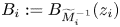 $B_i:=B_{\widetilde {M}_i^{-1}}(z_i)$, thus we have
 \begin{align} \int_{B_i}f(u(x))\,\textrm{d}x&=\left(\frac{M_i^{({N})/({N-2\alpha})}}{f(M_i)}\right)^{({N-2\alpha})/({2\alpha})}\int_{B_1(0)}h_i(w_i(y))\,\textrm{d}y \notag\\ &\geq C\left(\frac{M_i^{({N})/({N-2\alpha})}}{f(M_i)}\right)^{({N-2\alpha})/({2\alpha})}, \end{align}
where  $C$ is a positive constant, independent of
 $i$, such that
 \begin{align*} \int_{B_1}h_i(w_i)\geq C>0. \end{align*}
Note that  $\lim _{i\rightarrow \infty }\widetilde {M}_i^{-1}=0$, thus, according to the definition of
 $B_i$ and lemma 2.2, we find
 \begin{align*} \lim_{i\rightarrow \infty}\int_{B_i}f(u(x))\,\textrm{d}x=0, \end{align*}
which together with (3.19) implies that, as  $i\rightarrow \infty$,
 \begin{align*} \frac{f(M_i)}{M_i^{({N})/({N-2\alpha})}}\rightarrow +\infty. \end{align*}
This fact, combined with (3.18), leads to, as  $i\rightarrow \infty$,
 \begin{align*} w_{\lambda,x}(y)\rightarrow +\infty,~|y-x|\leq \lambda\widetilde{M}_i^{{-}1}. \end{align*}
In this case, there is nothing to prove. Thus, in the following, unless otherwise stated, we always assume that  $i$ is large enough such that
 $\widetilde {M}_i^{-1}<1$ and
 $y\in \Omega _y$.
In order to show (3.17) holds, we firstly prove that, fixed  $X_0\in \mathbb {R}_+^{N+1}$ and
 $\lambda _0>0$, for any
 $0<\lambda \leq \lambda _0$,
 \begin{align} (W_i)_{\lambda,X_0}(Y)\leq W_i(Y), ~~Y\in \Omega_i,~~|Y-X_0|\geq \lambda, \end{align}
where  $X_0=(x_0,\,0)$,
 $Y=(y,\,t)$,
 $\Omega _i$ is given by (3.9),
 $(W_i)_{\lambda ,X_0}(Y)$ is the Kelvin transformation of
 $W_i$ with respect to sphere
 $\mathcal {S}_\lambda (X_0)$. More precisely,
 \begin{align*} (W_i)_{\lambda,X_0}(Y)=\left(\frac{\lambda}{|Y-X_0|} \right)^{N-2\alpha}W_i\left(X_0+\frac{\lambda^{2}(Y-X_0)}{|Y-X_0|^{2}}\right) \end{align*}
for  $Y\in \Omega _i$ with
 $|Y-X_0|\geq \lambda$.
The proof of (3.20) will be split into the following two lemmas.
Lemma 3.1 For any fixed  $X_0\in \mathbb {R}_+^{N+1}$, there exists a positive constant
 $\lambda _3$ such that for any
 $0<\lambda <\lambda _3$,
 \begin{align*} (W_i)_{\lambda,X_0}(Y)\leq W_i(Y), Y\in \Omega_i{\setminus} \mathcal {B}_\lambda^{+}(X_0). \end{align*}
Proof. The proof consists of two steps, the first step is done as similar arguments of [Reference Caffarelli, Jin, Sire and Xiong6, Reference Cao and Li8, Reference Jin, Li and Xiong29, Reference Jin, Queiroz, Sire and Xiong31].
Step 1. We show that there exist  $0 < \lambda _1 < \lambda _2 < \lambda _0$, which are independent of
 $i$, such that for any
 $0<\lambda <\lambda _1$,
 \begin{align} (W_i)_{\lambda,X_0}(Y)\leq W_i(Y),~~\lambda<|Y-X_0|<\lambda_2. \end{align}
Direct computation shows that  $(W_i)_{\lambda ,X_0}(Y)$ satisfies
 \begin{align} \begin{cases} -\text{div}\left(t^{1-2\alpha}\nabla (W_i)_{\lambda,X_0}(Y)\right)=0, & Y\in\mathcal {B}^{+}_{\lambda_2}(X_0){\setminus} \overline{\mathcal {B}^{+}_{\lambda}}(X_0),\\ \dfrac{\partial(W_i)_{\lambda,X_0}}{\partial \nu^{\alpha}}(y,0) =\widetilde{h}_i(y,(w_i)_{\lambda,x_0}(y)), & y\in \partial'\left(\mathcal {B}^{+}_{\lambda_2}(X_0) {\setminus} \overline{\mathcal {B}^{+}_{\lambda}}(X_0)\right), \end{cases}\end{align}
where  $(w_i)_{\lambda ,x_0}$ is the Kelvin transformation of
 $w_i$ and
 \begin{align*} \widetilde{h}_i(y,t)=\left(\frac{\lambda}{|y-x_0|} \right)^{N+2\alpha}h_i\left(\lambda^{2\alpha-N}|y-x_0|^{N-2\alpha}t\right), \end{align*}
where  $h_i$ is given by (3.12).
Obviously, for every  $0 <\lambda < \lambda _1 < \lambda _2$ and
 $Y\in \partial ''\mathcal {B}^{+}_{\lambda _2}(X_0)$,
 \begin{align*} X_0+\frac{\lambda^{2}(Y-X_0)}{|Y-X_0|^{2}}\in \mathcal {B}_{\lambda}^{+}(X_0) \subset\mathcal {B}_{\lambda_2}^{+}(X_0). \end{align*}
Then, by (2.23) and choose  $\lambda _1:=\lambda _1(\lambda _2)$ small enough such that, for any
 $Y\in \partial ''\mathcal {B}^{+}_{\lambda _2}(X_0)$,
 \begin{align*} (W_i)_{\lambda,X_0}(Y)&=\left(\frac{\lambda}{|Y-X_0|} \right)^{N-2\alpha}W_i\left(X_0+\frac{\lambda^{2}(Y-X_0)}{|Y-X_0|^{2}}\right)\\ &\leq \left(\frac{\lambda_1}{\lambda_2} \right)^{N-2\alpha}\sup_{Y\in \overline{\mathcal {B}}_{\lambda_2}^{+}(X_0)}W_i\\ &\leq \inf_{\partial''\mathcal {B}_{\lambda_2}(X_0)}W_i\\ &\leq W_i(Y), \end{align*}
which implies that,
 \begin{align} (W_i)_{\lambda,X_0}(Y)\leq W_i(Y),~~Y\in \partial'' \mathcal {B}^{+}_{\lambda_2}(X_0) \end{align}
for  $0<\lambda <\lambda _1(\lambda _2)$.
Obviously,
 \begin{align} (W_i)_{\lambda,X_0}(Y)= W_i(Y),~~Y\in \partial'' \mathcal {B}^{+}_{\lambda}(X_0). \end{align}
Using (3.23) and (3.24), we derive that
 \begin{align*} (W_i)_{\lambda,X_0}(Y)\leq W_i(Y),~~Y\in \partial''\left(\mathcal {B}^{+}_{\lambda_2}(X_0) {\setminus} \overline{\mathcal {B}^{+}_{\lambda}}(X_0)\right), \end{align*}
that is
 \begin{align} \left((W_i)_{\lambda,X_0}(Y)- W_i(Y)\right)^{+}=0,~~Y\in \partial''\left(\mathcal {B}^{+}_{\lambda_2}(X_0) {\setminus} \overline{\mathcal {B}^{+}_{\lambda}}(X_0)\right), \end{align}
where  $((W_i)_{\lambda ,X_0}-W_i)^{+}= \max \left \{0,\,(W_i)_{\lambda ,X_0}-W_i\right \}.$
Next, we show that,
 \begin{align} \nabla \left((W_i)_{\lambda,X_0}(Y)- W_i(Y)\right)^{+}=0, ~~Y\in \mathcal {B}^{+}_{\lambda_2}(X_0){\setminus} \mathcal {B}^{+}_{\lambda}(X_0), \end{align}
provided that  $\lambda _2$ is small enough. Therefore, (3.25) and (3.26) lead to
 \begin{align*} (W_i)_{\lambda,X_0}(Y)\leq W_i(Y)),~~Y\in \mathcal {B}^{+}_{\lambda_2}(X_0){\setminus} \mathcal {B}^{+}_{\lambda}(X_0). \end{align*}
Thus, (3.21) holds.
We are now in a position to show (3.26) holds.
 \begin{align} \begin{cases} -\text{div}\left(t^{1-2\alpha}\nabla \left((W_i)_{\lambda,X_0} -W_i\right)\right)=0, & Y\in\mathcal {B}^{+}_{\lambda_2} (X_0){\setminus} \overline{\mathcal {B}^{+}_{\lambda}}(X_0),\\ \dfrac{\partial}{\partial \nu^{\alpha}}\left( (W_i)_{\lambda,X_0}-W_i\right) =\widetilde{h}_i(y,(w_i)_{\lambda,x_0})-h_i(w_i), & y\in \partial'\left(\mathcal {B}^{+}_{\lambda_2}(X_0){\setminus} \overline{\mathcal {B}^{+}_{\lambda}}(X_0)\right). \end{cases}\end{align}
We must emphasize that, by a density argument, we can use  $((W_i)_{\lambda ,X_0}-W_i)^{+}$ as a test function in the definition of weak solution of (3.27) directly if
 $h_i$ is a nonnegative locally Lipschitz function, for example,
 $h_i(t)$ is a power function with critical Sobolev growth. Then, taking into account region domain principle and the mean value theorem, similar arguments as [Reference Berestycki and Nirenberg3, Reference Caffarelli, Jin, Sire and Xiong6, Reference Jin, Li and Xiong29, Reference Jin, Queiroz, Sire and Xiong31], we can show that (3.26) holds. But, unfortunately, we can not apply this argumentation for (3.27) directly due to the lack of regularity of
 $f$.
Define
 \begin{align*} \Omega^{+}:=\{y\in B^{+}_{\lambda_2} (X_0){\setminus} \overline{B^{+}_{\lambda}}(X_0): w_i(y)\leq(w_i)_{\lambda,x_0}(y) \}. \end{align*}
Rewrite  $\widetilde {h}_i(y,\,(w_i)_{\lambda ,x_0})-h_i(w_i)$ as
 \begin{align*} &\widetilde{h}_i(y,(w_i)_{\lambda,x_0})-h_i(w_i)\nonumber \\ & \quad = \widetilde{h}_i(y,(w_i)_{\lambda,x_0}) -\widetilde{h}_i(y,w_i)+\widetilde{h}_i(y,w_i) -h_i(w_i)\nonumber\\ &\quad :=I_1+I_2. \end{align*}
Consider  $I_1$, for any
 $y\in \Omega ^{+}$, with the help of the mean value theorem, we have, for
 $i>i_0$,
 \begin{align} I_1&=\widetilde{h}_i(y,(w_i)_{\lambda,x_0})-\widetilde{h}_i(y,w_i)\nonumber\\ &=\widetilde{h}_i(y,(w_i)_{\lambda,x_0})\left[1-\frac{\widetilde{h}_i(y,w_i)} {\widetilde{h}_i(y,(w_i)_{\lambda,x_0})}\right]\nonumber\\ &=\widetilde{h}_i(y,(w_i)_{\lambda,x_0})\left[1- \frac{h_i\left(\lambda^{2\alpha-N}|y-x_0|^{N-2\alpha}w_i\right)} {h_i\left(\lambda^{2\alpha-N}|y-x_0|^{N-2\alpha} (w_i)_{\lambda,x_0}\right)}\right]\nonumber\\ &=\widetilde{h}_i(y,(w_i)_{\lambda,_0})\left[1- \frac{f\left(M_i\lambda^{2\alpha-N}|y-x_0|^{N-2\alpha}w_i\right)} {f\left(M_i\lambda^{2\alpha-N}|y-x_0|^{N-2\alpha} (w_i)_{\lambda,x_0}\right)}\right]\nonumber\\ &\leq\widetilde{h}_i(y,(w_i)_{\lambda,x_0})\left[1-\left(\frac{w_i} {(w_i)_{\lambda,x_0}}\right)^{({N+2\alpha})/({N-2\alpha})}\right]\nonumber\\ &=\frac{\widetilde{h}_i(y,(w_i)_{\lambda,x_0})}{(w_i)_{\lambda,x_0}} \left(\frac{[(w_i)_{\lambda,x_0}]^{({N+2\alpha})/({N-2\alpha})}-w_i^{({N+2\alpha})/({N-2\alpha})}} {[(w_i)_{\lambda,x_0}]^{({4\alpha})/({N-2\alpha})}}\right)\nonumber\\ &\leq\frac{N+2\alpha}{N-2\alpha}\frac{\widetilde{h}_i (y,(w_i)_{\lambda,x_0})}{(w_i)_{\lambda,x_0}} [(w_i)_{\lambda,x_0}-w_i], \end{align}
where we have used (1.2).
According to (3.13), the definition of  $\widetilde {h}_i$ and
 $(w_i)_{\lambda ,x_0}$, we get
 \begin{align*} &\frac{\widetilde{h}_i(y,(w_i)_{\lambda,x_0})} {(w_i)_{\lambda,x_0}} =\left(\frac{\lambda}{|y-x_0|}\right)^{4\alpha}\left(\frac{h_i(w_i)}{w_i}\right) \leq C\left(\frac{\lambda}{|y-x_0|}\right)^{4\alpha}. \end{align*}
This fact, combined with (3.28), implies that
 \begin{align} I_1=\widetilde{h}_i(y,(w_i)_{\lambda,x_0})- \widetilde{h}_i(y,w_i)\leq C\left(\frac{\lambda}{|y-x_0|}\right)^{4\alpha}[(w_i)_{\lambda,x_0}-w_i]. \end{align}
For  $I_2$, using the monotony of
 $f(t)/t^{({N+2\alpha })/({N-2\alpha })}$ and
 $|y-x_0|\geq \lambda$, we find, for large
 $i$,
 \begin{align} I_2&=\widetilde{h}_i(y,w_i) -h_i(w_i)\nonumber\\ &=\left(\frac{\lambda}{|y-x_0|} \right)^{N+2\alpha}h_i\left(\lambda^{2\alpha-N} |y-x_0|^{N-2\alpha}w_i\right)-h_i(w_i)\leq 0. \end{align}
Thus, taking into account (3.29), (3.30) and (3.27), we find, for any  $y\in \Omega ^{+}$ and
 $i>i_0$,
 \begin{align} \begin{cases} -\text{div}\left(t^{1-2\alpha}\nabla \left((W_i)_{ \lambda,X_0}-W_i\right)\right)=0, & Y\in \mathcal {B}^{+}_{\lambda_2}(X_0){\setminus} \overline{\mathcal {B}^{+}_{\lambda}}(X_0),\\ \dfrac{\partial}{\partial \nu^{\alpha}}\left( (W_i)_{\lambda,X_0}-W_i\right)\\ \leq C\left(\dfrac{\lambda}{|y-x_0|}\right)^{4\alpha}((w_i)_{\lambda,x_0}-w_i), & y\in \partial'\left(\mathcal {B}^{+}_{\lambda_2}(X_0){\setminus} \overline{\mathcal {B}^{+}_{\lambda}}(X_0)\right). \end{cases} \end{align}
By a density argument, using  $((W_i)_{\lambda ,X_0}- W_i)^{+}$ as a test function in the definition of weak subsolution of (3.31), we have
 \begin{align} &\int_{\mathcal {B}^{+}_{\lambda_2}(X_0){\setminus} \mathcal {B}^{+}_{\lambda}(X_0)}t^{1-2\alpha}| \nabla \left((W_i)_{\lambda,X_0}-W_i\right)^{+}|^{2}\nonumber\\ &\quad \leq C\int_{{B}^{+}_{\lambda_2}(x_0){\setminus} {B}^{+}_{\lambda}(x_0)}(\left((w_i)_{\lambda,x_0} -w_i\right)^{+})^{2}\left(\frac{\lambda}{|y-x_0|}\right)^{4\alpha} \nonumber\\ &\quad \leq C\left(\int_{{B}^{+}_{\lambda_2}(x_0) {\setminus} {B}^{+}_{\lambda}(x_0)}(\left((w_i)_{\lambda,x_0}- w_i\right)^{+})^{({2N})/({N-2\alpha})}\right)^{({N-2\alpha})/({N})} \notag\\ &\qquad \times \left(\int_{{B}^{+}_{\lambda_2}(x_0){\setminus} {B}^{+}_{\lambda}(x_0)}\left(\frac{\lambda}{|y-x_0|}\right)^{2N}\right)^{({2\alpha}/{N})} \nonumber\\ &\quad \leq C\left(\int_{\mathcal {B}^{+}_{\lambda_2}(X_0) {\setminus} \mathcal {B}^{+}_{\lambda}(X_0)}t^{1-2\alpha} |\nabla \left((W_i)_{\lambda,X_0}-W_i\right)^{+}|^{2}\right) \notag\\ &\qquad \times \left(\int_{{B}^{+}_{\lambda_2}(x_0){\setminus} {B}^{+}_{\lambda}(x_0)}\left(\frac{\lambda}{|y-x_0|}\right)^{2N}\right)^{({2\alpha}/{N})}\nonumber\\ &\quad \leq C\lambda_2^{2\alpha} \int_{\mathcal {B}^{+}_{\lambda_2}(X_0) {\setminus} \mathcal {B}^{+}_{\lambda}(X_0)} t^{1-2\alpha}|\nabla \left((W_i)_{\lambda,X_0}-W_i\right)^{+}|^{2}, \end{align}
here the trace embedding inequality is used, see proposition 2.1 in [Reference Jin, Li and Xiong29]. Let  $\lambda _2$ be small enough such that
 $C\lambda _2^{2\alpha }<1/2$. This fact, together with (3.32), shows that (3.26) holds.
Therefore, for  $0<\lambda <\lambda _1<\lambda _2$ and
 $\lambda _2$ small enough, we have
 \begin{align*} (W_i)_{\lambda,X_0}(Y)\leq W_i(Y), ~~Y\in(\mathcal {B}^{+}_{\lambda_2}(X_0){\setminus} \mathcal {B}^{+}_{\lambda}(X_0)). \end{align*}
Step 2. We show that there exists  $\lambda _3 \in (0,\,\lambda _1)$ such that for any
 $0 < \lambda < \lambda _3$,
 \begin{align} (W_i)_{\lambda,X_0}(Y)\leq W_i(Y),~~|Y-X_0|>\lambda_2,~~Y\in\Omega_i. \end{align}
Define
 \begin{align*} \Phi_i(Y)=\left(\frac{\lambda_2}{|Y-X_0|} \right)^{N-2\alpha}\inf_{\partial''\mathcal {B}_{\lambda_2}(X_0)}W_i. \end{align*}
Obviously,
 \begin{align*} \begin{cases} -\text{div}(t^{1-2\alpha}\nabla \Phi_i)=0, & Y\in \Omega_i{\setminus} \mathcal{B}^{+}_{\lambda_2}(X_0),\\ \dfrac{\partial\Phi_i}{\partial \nu^{\alpha}}=0, & y\in \partial'\left(\Omega_i{\setminus} \overline{B^{+}_{\lambda_2}}(x_0)\right), \end{cases} \end{align*}
and
 \begin{align*} \Phi_i(Y)\leq W_i(Y),~~ Y\in \partial' \mathcal{B}^{+}_{\lambda_2}(X_0). \end{align*}
By the Harnack inequality and  $u(x)\geq 1/C>0$ for
 $x\in \partial B_1$, we find
 \begin{align} W_i(Y)\geq \frac{1}{C u(z_i)}>0,~~Y\in \partial''\Omega_i. \end{align}
In view of the definition of  $\Omega _i$, see (3.9) for more details, it follows that
 \begin{align} \left|Z_i+\frac{Y}{\widetilde{M}_i} \right|=1,~~Y\in \partial''\Omega_i, \end{align}
where  $Z_i=(z_i,\,0)$ and
 $\widetilde {M}_i$ is given by (3.8). Note that
 $z_i\rightarrow 0$ as
 $i\rightarrow \infty$, which together with (3.35), implies that
 \begin{align} |Y|\approx\widetilde{M}_i=\left(\frac{f(u(z_i))}{u(z_i)}\right)^{({1}/{2\alpha})}, ~~~Y\in \partial''\Omega_i. \end{align}
If
 \begin{align*} \lim_{t\rightarrow\infty}\frac{f(t)}{t^{({N+2\alpha})/({N-2\alpha})}}=\ell>0, \end{align*}
then, (3.36) reduces to
 \begin{align} |Y|\approx\widetilde{M}_i\approx u(z_i)^{({2})/({N-2\alpha})}, \end{align}
which implies that  $|Y-X_0|^{N-2\alpha }\approx u(z_i)^{2}$. Therefore, combining (3.34) with (3.37), we derive that
 \begin{align} W_i(Y)\geq \frac{1}{C u(z_i)}>\left(\frac{\lambda_2} {|Y-X_0|}\right)^{N-2\alpha}\inf_{\partial'' \mathcal {B}_{\lambda_2}(X_0)}W_i(Y),~~Y\in \partial''\Omega_i. \end{align}
If
 \begin{align*} \lim_{t\rightarrow\infty}\frac{f(t)}{t^{({N+2\alpha})/({N-2\alpha})}}=0, \end{align*}
then, using (3.36), we get
 \begin{align*} |Y|^{N-2\alpha}\approx \left(\frac{f(u(z_i))}{u(z_i)^{({N+2\alpha})/({N-2\alpha})}}\right)^{({N-2\alpha})/({2\alpha})} u(z_i)^{2}. \end{align*}
Note that,  $|Y|\to +\infty$ as
 $i\to \infty$. Thus, for
 $Y\in \partial ''\Omega _i$ and large
 $i$,
 \begin{align} \left(\frac{\lambda_2} {|Y-X_0|}\right)^{N-2\alpha}\inf_{\partial'' \mathcal {B}_{\lambda_2}(X_0)}W_i(Y) &\leq \frac{\inf_{\partial' \mathcal {B}_{\lambda_2}(X_0)}W_i(Y)}{\left(\frac{f(u(z_i))}{u(z_i)^{({N+2\alpha})/({N-2\alpha})}}\right)^{({N-2\alpha})/({2\alpha})} u(z_i)^{2}}\nonumber\\ &\leq W_i(Y). \end{align}
Consequently, the maximum principle, together with (3.38) and (3.39), shows that for any  $|Y-X_0|>\lambda _2$,
 \begin{align*} W_i(Y)\geq \left(\frac{\lambda_2} {|Y-X_0|}\right)^{N-2\alpha}\inf_{\partial'' \mathcal {B}_{\lambda_2}(X_0)}W_i,~~Y\in \Omega_i. \end{align*}
Let
 \begin{align*} \lambda_3=\min\left(\lambda_1,\lambda_2 \left(\inf_{\partial''\mathcal {B}_{\lambda_2}(X_0)}W_i / \sup_{\mathcal {B}_{\lambda_2}(X_0)}W_i\right)^{\frac{1}{N-2\alpha}}\right), \end{align*}
then for any  $0<\lambda <\lambda _3$,
 $|Y-X_0|>\lambda _2$,
 $Y\in \Omega _i$, we have
 \begin{align*} (W_i)_{\lambda,X_0}(Y)&=\left(\frac{\lambda}{|Y-X_0|} \right)^{N-2\alpha}W_i\left(X_0+\frac{\lambda^{2}(Y-X_0)} {|Y-X_0|^{2}}\right)\\ &\leq\left(\frac{\lambda_3}{|Y-X_0|} \right)^{N-2\alpha}\sup_{\mathcal {B}_{\lambda_2}(X_0)}W_i \\ &\leq\left(\frac{\lambda_2}{|Y-X_0|} \right)^{N-2\alpha}\inf_{\partial''\mathcal {B}_{\lambda_2}(X_0)}W_i\\ &\leq W_i(Y). \end{align*}
This finishes the proof of (3.33).
Define
 \begin{align*} \overline{\lambda}:=\sup\{0<\mu\leq \lambda_0:(W_i)_{\lambda,X_0}(Y)\leq W_i(Y),\ |Y-X_0|>\lambda,\ Y\in\Omega_i,\ 0<\lambda<\mu\}, \end{align*}
by step 2,  $\overline {\lambda }$ is well defined. In the following, we prove that
Lemma 3.2 Let  $\overline {\lambda }$ be defined as above, then
 $\overline {\lambda }=\lambda _0$.
Proof. We prove this lemma by contradiction. Suppose that  $\overline {\lambda }<\lambda _0$. We first claim that there exists
 $i_1>i_0$, such that for
 $i\geq i_1$,
 \begin{align} (W_i)_{\overline{\lambda},X_0}(Y)< W_i(Y) ~~\text{for}~ Y\in \Omega_i, |Y-X_0|>\overline{\lambda}. \end{align}
Suppose there exists a point  $Y_0\in \{Y\in \Omega _i: |Y_0-X_0|>\overline {\lambda }\}$ such that
 $(W_i)_{\overline {\lambda },\,X_0}(Y_0)= W_i(Y_0)$. Therefore
 \begin{align*} \left(\frac{|Y_0-X_0|}{\overline{\lambda}} \right)^{N-2\alpha}(W_i)_{\overline{\lambda},X_0}(Y_0) =\left(\frac{|Y_0-X_0|}{\overline{\lambda}} \right)^{N-2\alpha}W_i(Y_0) \geq W_i(Y_0). \end{align*}
Thus there exists a neighbourhood  $U_0$ of
 $Y_0$ such that, for any
 $Y\in \{Y\in U_0\cap \Omega _i: |Y-X_0|>\overline {\lambda }\}$,
 \begin{align} &\left(\frac{|Y-X_0|}{\overline{\lambda}} \right)^{N-2\alpha}(W_i)_{\overline{\lambda},X_0}(Y) \geq W_i(Y). \end{align}
Therefore, taking into account (1.2) and (3.41), we have
 \begin{align} \widetilde{h}_i(y,(w_i)_{\overline{\lambda},x_0})&=\left( \frac{\overline{\lambda}}{|y-x_0|} \right)^{N+2\alpha}h_i\left(\left(\frac{|y-x_0|} {\overline{\lambda}}\right)^{N-2\alpha}(w_i)_{\overline{\lambda},x_0}\right)\nonumber\\ &\leq h_i\left(w_i\right)\left(\frac{(w_i)_{\overline{\lambda},x_0}(y)}{w_i(y)} \right)^{({N+2\alpha})/({N-2\alpha})}\nonumber\\ &\leq h_i\left(w_i\right) \end{align}
provided that
 \begin{align*} M_iw_i(y)\geq t_0, \end{align*}
where  $t_0$ appears in (3.1).
Now choose  $U_0$ such that (3.42) holds for any
 $Y_0=(y_0,\,t)\in U_0\cap \Omega _i$ with
 \begin{align} M_iw_i(y_0)\geq 2t_0. \end{align}
Therefore, (3.42) implies that, for any  $Y\in \{Y\in U_0\cap \Omega _i: |Y-X_0|>\overline {\lambda }\}$,
 $W_i(Y)- (W_i)_{\overline {\lambda },\,X_0}(Y)$ satisfies
 \begin{align} \begin{cases} -\text{div}\left(t^{1-2\alpha}\nabla \left(W_i-(W_i)_{ \overline{\lambda},X_0}\right)\right)=0, & Y\in \mathcal {B}^{+}_{\lambda_0}(X_0){\setminus} \mathcal {B}^{+}_{\overline{\lambda}}(X_0),\\ \dfrac{\partial}{\partial \nu^{\alpha}}\left(W_i- (W_i)_{\overline{\lambda},X_0}\right)\\ =h_i\left(w_i\right) -\widetilde{h}_i(y,(w_i)_{\overline{\lambda},x_0}) \geq 0, & y\in \partial'(B_{\lambda_0}(X_0){\setminus} B_{\overline{\lambda}}(X_0)). \end{cases} \end{align}
Strong maximum principle leads to
 \begin{align*} W_i(Y)\equiv(W_i)_{\overline{\lambda},X_0}(Y), Y\in(\mathcal {B}^{+}_{\lambda_0}(X_0){\setminus} \mathcal {B}^{+}_{\overline{\lambda}}(X_0)) \cap U_0. \end{align*}
By repeating the same argument, we derive that
 \begin{align*} W_i(Y)\equiv(W_i)_{\overline{\lambda},X_0}(Y),~ Y\in\mathcal {B}^{+}_{\lambda_0}(X_0){\setminus} \mathcal {B}^{+}_{\overline{\lambda}}(X_0). \end{align*}
Thus
 \begin{align*} W_i(Y)\equiv(W_i)_{\overline{\lambda},X_0}(Y),~ Y\in \mathbb{R}^{N}. \end{align*}
Note that,  $(W_i)_{\overline {\lambda },\,X_0}(Y)=0$ if
 $|Y- X_0|$ small enough such that
 \begin{align*} X_\lambda=X_0+\frac{\overline{\lambda}^{2}(Y-X_0)}{|Y-X_0|^{2}}\notin\Omega_i, \end{align*}
while by the definition of  $W_i(y)$, we get
 $0< W_i(y)\leq 1$, which is a contradiction.
Consequently, (3.40) is true provided (3.43) holds.
In the following, we show that (3.40) is still true by contradiction arguments if
 \begin{align*} M_iw_i(y_0)\leq 2t_0. \end{align*}
We must emphasize that, in this case, we can not use monotonicity assumption of  $f(t)/t^{({N+2\alpha })/({N-2\alpha })}$ again.
If
 \begin{align*} M_i w_i(y_0)\leq \left(\frac{|y_0-x_0|}{\overline{\lambda}} \right)^{N-2\alpha}M_i(w_i)_{\overline{\lambda},x_0}(y_0) \leq 2t_0. \end{align*}
There exists a neighbourhood  $U_0$ of
 $Y_0=(y_0,\,t)$ such that
 \begin{align} M_i w_i(y)\leq M_i\left(\frac{|y-x_0|}{\overline{\lambda}} \right)^{N-2\alpha}(w_i)_{\overline{\lambda},x_0}(y) \leq 3t_0. \end{align}
It can be easily seen that the set of  $y$ satisfying (3.45) is contained in
 \begin{align*} R_i:=\left\{y:\lambda\widetilde{M}_i^{{-}1} \leq|y-x_0|\leq c \lambda_0{M}_i^{-\frac{1}{N-2\alpha}} \right\} \end{align*}
for some  $c>0$ independent of
 $i$.
In the following, we will show that (3.40) holds for  $y\in R_i$. A direct computation shows that, for large
 $i$ and
 $x\in R_i$,
 \begin{align} \widetilde{h}_i(y,(w_i)_{\overline{\lambda},x_0})& =\left(\frac{\overline{\lambda}}{|y-x_0|} \right)^{N+2\alpha}h_i\left(\overline{\lambda}^{2\alpha-N} |y-x_0|^{N-2\alpha}(w_i)_{\overline{\lambda},x_0}\right)\nonumber\\ &= \left(\frac{\overline{\lambda}}{|y-x_0|} \right)^{N+2\alpha}\frac{f\left(M_i \overline{\lambda}^{2\alpha-N}|y-x_0|^{N -2\alpha}(w_i)_{\overline{\lambda},x_0}\right)}{f(M_i)}\nonumber\\ &= o(1), \end{align}
where  $o(1)$ tends uniformly to zero as
 $i\rightarrow \infty$, here we have used the fact that
 $f(w_i(y_{\overline {\lambda }}))$ is bounded and
 $f(M_i)\to +\infty$ as
 $i\rightarrow \infty$. Similarly, we get
 \begin{align} h_i(w_i)&= \frac{f\left(M_iw_i\right)}{f(M_i)}= o(1). \end{align}
Thus, taking into account (3.46) and (3.47), we obtain
 \begin{align*} (-\Delta)^{\alpha}\left(w_i-(w_i)_{\overline{\lambda},x_0}\right) =h_i(w_i)-\widetilde{h}_i(y,(w_i)_{\overline{\lambda},x_0})= o(1). \end{align*}
Note that the Lebesgue measure of  $R_i$ goes to zero as
 $i\rightarrow \infty$ (see the notion of
 $R_i$ above). Thus the narrow region principle (proposition 2.3) implies that, for large
 $i$,
 \begin{align*} w_i-(w_i)_{\overline{\lambda},x_0}\geq 0, y\in R_i\cap u_0, \end{align*}
where  $u_0$ is projection of
 $U_0$ on
 $\mathbb {R}^{N}$. This fact, together with the strong maximum principle and
 $w_i(y_0)=(w_i)_{\overline {\lambda },\,x_0}(y_0)$, leads to
 $w_i(y)\equiv (w_i)_{\overline {\lambda },\,x_0}(y)$ for any
 $y\in B_i$. This is a contradiction.
If
 \begin{align*} M_i w_i(y)\leq 2t_0\leq M_i\left(\frac{|y-x_0|}{\overline{\lambda}} \right)^{N-2\alpha}(w_i)_{\overline{\lambda},x_0}(y). \end{align*}
Therefore,
 \begin{align*} (-\Delta)^{\alpha}\left(w_i-(w_i)_{\overline{\lambda},x_0}\right) &=h_i(w_i)-\widetilde{h}_i(y,(w_i)_{\overline{\lambda},x_0})\nonumber\\ & = h_i(w_i)-h_i(2t_0)+h_i(2t_0)-\widetilde{h}_i(y,(w_i)_{\overline{\lambda},x_0})\nonumber\\ &\geq h_i(w_i)-h_i(2t_0)\nonumber\\ &\geq -h_i(2t_0)\nonumber\\ &:=-\widetilde{C}. \end{align*}
Now, choosing  $U$ with small measure and using narrow region principle (proposition 2.3), we also get a contradiction.
The proof of (3.40) is now complete.
Now we consider the regular point of  $W_i$. Denote
 $N_i\subset \mathbb {R}^{N+1}_+$ be a neighbourhood of the singularity set of
 $W_i$, such that
 \begin{align*} m_i:=\inf_{\partial N_i}W_i>0~~ \text{and }~~\inf_{\partial N_i}W_i\leq\inf_{ N_i}W_i. \end{align*}
Let  $0< m'_i\leq m_i$ be a small positive constant such that
 $W_i-(W_i)_{\overline {\lambda },\,x_0}\geq m'_i$ and (3.41) holds for a neighbourhood
 $U_0$ of regular point
 $Y$. Note that
 $W_i(y)$ is bounded since
 $Y$ is a regular point. Thus similar arguments as above show (3.44) holds again. This fact, combined with lemma 2.6, implies that, for any
 $|Y-X_0|>\overline {\lambda }$,
 \begin{align} W_i(Y)-(W_i)_{\overline{\lambda},x_0}(Y)\geq m'_i>0,~Y\in \Omega_i. \end{align}
Now we prove  $\overline {\lambda }=\lambda _0$ for large
 $i$ with the help of (3.40). We argue by contradiction. Suppose that
 $\overline {\lambda }<\lambda _0$ for large
 $i$. Let
 $i$ be fixed, by the definitions of
 $\overline {\lambda }$, there exists a sequence of
 $\lambda _j\downarrow \overline {\lambda }$ such that
 \begin{align*} \inf_{|Y-X_0|>\lambda_j, Y\in \Omega_i}[W_i(Y)-(W_i)_{\lambda_j,x_0}(Y)]<0. \end{align*}
Note that (3.48) implies that the above infimum can be achieved at some interior point  $Y_j^{*}\in \Omega _i$ with
 $|Y_j^{*}-X_0|>\lambda _j$.
Let  $Y_0^{*}$ be the limit point of
 $Y_j^{*}$. Thus if
 $|Y_0^{*}-X_0|\geq \overline {\lambda }$, then
 $W_i(Y_0^{*})=(W_i)_{\overline {\lambda },\,x_0}(Y_0^{*})$, which contradicts to (3.40). Therefore,
 $\overline {\lambda }=\lambda _0$ holds.
Thus, for any  $Y\in \Omega _i$,
 $0<\lambda <\mu _0$,
 $|Y-X_0|\geq \lambda$ , we have
 \begin{align*} (W_i)_{\lambda,X_0}(Y)\leq W_i(Y). \end{align*}
Letting  $i\rightarrow \infty$, we get,
 \begin{align*} (w)_{\lambda,x_0}(y)\leq w(y),~~\text{as}~~ |y-x_0|\geq\lambda,~~ 0<\lambda<\mu_0. \end{align*}
Thus (3.17) holds since  $x_0$ and
 $\mu _0$ are arbitrary.
The proof of claim 2 is now complete.
4. Poof of theorem 1.5
Theorem 1.5 follows directly from (1.5).
Proof. For any  $r\in (0,\,1)$, define
 $v(x)=u(rx),\, x\in \{x\in \mathbb {R}^{N}: \frac {1}{4}\leq |x|\leq 1\}$. By direct computations we have
 \begin{align*} (-\Delta)^{\alpha} v (x)=b(x)v(x), \end{align*}
where
 \begin{align*} b(x)=r^{2\alpha}\frac{f(v(x))}{v(x)}. \end{align*}
Obviously, (1.5) implies that
 \begin{align*} b(x)\leq \frac{C}{|x|^{2\alpha}}, \end{align*}
which implies that  $b(x)$ is uniformly bounded in the annulus domain
 $\{x: \frac {1}{4}\leq |x|\leq 1\}$. By Harnack inequality of fractional Laplace equations (see theorem 3.3 in [Reference Tan and Xiong46] or lemma 4.9 in [Reference Cabre and Sire4]), we conclude that (1.6) holds.
5. Cylindrical symmetry of global solutions
In this section, we prove theorem 1.6 by similar arguments as the proof of theorem 1.2.
Proof. By (1.8), we know that
 \begin{align*} \lim_{x\rightarrow 0} u(x)=\infty. \end{align*}
In order to prove this theorem, we show that, for all  $y\in \mathbb {R}^{N-k}{\setminus} \{0_{N-k}\}$, there exists
 $\lambda _3 (y) \in (0,\,|y|)$ such that for all
 $0<\lambda <\lambda _3$ and
 $|\xi -Y|\geq \lambda$,
 \begin{align} U_{\lambda,Y} (\xi)\leq U(\xi),~~\xi\notin \mathbb{R}^{k}\times\{0_{N-k}\}\times\{0\}, \end{align}
where  $Y=(0_{k},\,y,\,0)\in \mathbb {R}^{N+1}$, here and subsequently,
 $\xi \in \mathbb {R}_+^{N+1}$ while
 $\xi \notin \mathbb {R}^{k}\times \{0_{N-k}\}\times \{0\}$.
The proof of this claim is similar to the proof of theorem 1.2.
Step 1. We show that there exist  $0 < \lambda _1 < \lambda _2 < |y|$, such that for any
 $0<\lambda <\lambda _1$
 \begin{align*} U_{\lambda,Y} (\xi)\leq U(\xi)~~\text{as} ~~\lambda<|\xi-Y|<\lambda_2,~~\xi\notin\mathbb{R}^{k}\times\{0_{N-k}\}\times\{0\}. \end{align*}
This can be proved by similar arguments as the proof of (3.21), more details are omitted.
Step 2. We show that there exists  $\lambda _3 \in (0,\,\lambda _1)$ such that for any
 $0 < \lambda < \lambda _3$,
 \begin{align} U_{\lambda,Y} (\xi)\leq U(\xi)~~\text{as}~~|\xi-Y|>\lambda_2,~~\xi\notin \mathbb{R}^{k}\times\{0_{N-k}\}\times\{0\}. \end{align}
Let  $\Gamma$ be the inversion of
 $\mathbb {R}^{k}$ with respect to
 $S_ {\lambda _2}(y)$. So
 $\Gamma$ is a
 $k$-dimensional sphere passing through
 $y$ and
 $\Gamma \subset B_ {\lambda _2}(y)$ since
 $\lambda _2 < |y|$. According to (1.7), a simple calculation yields
 \begin{align*} \begin{cases} -\text{div}(t^{1-2\alpha}\nabla U_{\lambda_2,Y})=0, & \text{in}~~ \mathbb{R}_+^{N+1},\\ \dfrac{\partial U_{\lambda_2,Y}}{\partial \nu^{\alpha}}(x,0)=\bar{h}_i(x,u _{\lambda_2,y})\geq 0, & \text{on}~~ B_ {\lambda_2}(y)\backslash \Gamma, \end{cases}\end{align*}
where
 \begin{align*} \bar{h}_i(x,t)=\left(\frac{\lambda_2}{|x-y|} \right)^{N+2\alpha}f\left(\lambda_2^{2\alpha-N}|x-y|^{N-2\alpha}t\right). \end{align*}
By maximum principle of lemma 2.6,
 \begin{align*} U_{\lambda_2,Y}(\xi)\geq \inf_{\partial''B_ {\lambda_2}(y)}U_{\lambda_2,Y}(\xi)=\inf_{\partial''B_ {\lambda_2}(y)}U(\xi). \end{align*}
Therefore, going through the similar arguments as in the previous subsection, we can show (5.2) holds.
Step 3. For any  $\xi \notin \mathbb {R}^{k}\times \{0_{N-k}\}\times \{0\}$, define
 \begin{align*} \overline{\lambda}(y):=\sup\left\{0<\mu\leq |y|:U_{\lambda,Y} (\xi)\leq U(\xi),~~|\xi-Y|>\lambda,~~ 0<\lambda<\mu \right\}. \end{align*}
In the following, we argue by contradiction to show that
 \begin{align*} \overline{\lambda}(y)=|y|. \end{align*}
Now suppose that  $\overline {\lambda }(y)<|y|$. Similar arguments show that, for any
 $\xi \notin \mathbb {R}^{k}\times \{0_{N-k}\}\times \{0\}$,
 \begin{align} U_{\lambda,Y} (\xi)\leq U(\xi),~~\text{as}~~|\xi-Y|>\overline{\lambda}(y). \end{align}
The proof of (5.3) is more simpler than the proof of (3.40) since we required that  $f(t)/ t^{({N+2\alpha })/({N-2\alpha })}$ is nonincreasing for all
 $t>0$, instead of large
 $t$. The rest of the arguments is rather similar to that in previous subsection and is omitted here.
6. Asymptotic symmetry
In this section, we will prove theorem 1.7.
Proof. We argue by contradiction. Suppose that there is a positive constant  $\varepsilon _0$, there exist
 $x_i,\,y_i\in \Lambda$ and
 $z_i\in \Gamma$ such that
 \begin{align} \Pi(x_i)=\Pi(y_i)=z_i,~~\frac{u(y_i)}{u(x_i)}\geq 1+\varepsilon_0, \end{align}
and  $r_i=|x_i-z_i|=|y_i-z_i|\rightarrow 0$ as
 $i\rightarrow \infty$.
Assume that  $z_i=0_k$ and
 $T_{0_k}\Gamma =\{0_{N-k}\}\times \mathbb {R}^{k}$. For simplicity of notation, in the following, we will write
 $x\in \mathbb {R}^{k}$ provided
 $x=(x_{k},\,0_{N-k})$. Define
 \begin{align*} v_i(\xi)=\frac{u(r_i\xi+z_i)}{M_i}, ~~\xi_i=\frac{x_i-z_i}{r_i}, \end{align*}
where  $M_i=u(x_i)$. According to (1.1), we know that
 $v$ satisfies
 \begin{align} (-\Delta)^{\alpha} v_i =\widetilde{f}_i(v_i),~~ x\in \widetilde{B_1}\backslash \widetilde{\Gamma}, \end{align}
where
 \begin{align*} \widetilde{B}_1^{+}=\frac{B_1^{+}-z_i}{r_i},~~ \widetilde{\Gamma}=\frac{\Gamma-z_i}{r_i}, \end{align*}
and
 \begin{align*} \widetilde{f}_i(v_i)=\frac{r_i^{2\alpha}f(M_iv_i)}{M_i}. \end{align*}
By (1.5), we find  $\widetilde {f}_i(v_i)/v_i$ is uniformly bounded. Rewrite (6.2) as
 \begin{align*} (-\Delta)^{\alpha} v_i =\frac{\widetilde{f}_i(v_i)}{v_i}v_i,~~ x\in \widetilde{B_1}\backslash \widetilde{\Gamma}. \end{align*}
Therefore, by the Harnack inequality [Reference Cabre and Sire4, Reference Tan and Xiong46],  $v_i$ is uniformly bounded in any compact set of
 $\mathbb {R}^{N}$. Therefore, we may assume that (for a subsequence),
 $v_i$ converges to
 $v$ in
 $C^{2,\alpha }$ on any compact set of
 $\mathbb {R}^{N}\backslash (\{0_{N-k}\}\times \mathbb {R}^{k})$. Furthermore,
 $v$ satisfies
 \begin{align*} (-\Delta)^{\alpha} v =\widehat{f}(v),~~ x\in \mathbb{R}^{N}\backslash \mathbb{R}^{k} \end{align*}
in the distribution sense. In the following, we have to determine  $\widehat {f}$.
Now rewrite  $f$ as
 \begin{align*} f(t)=f_1(t)t^{({N+2\alpha})/({N-2\alpha})}, \end{align*}
where  $f_1(t)$ is nonincreasing in
 $t$ for
 $t$ large. This fact leads to
 \begin{align*} \widetilde{f}_i(v_i)=r_i^{2\alpha} f_1(M_iv_i)M_i^{({4\alpha})/({N-2\alpha})}v_i^{({N+2\alpha})/({N-2\alpha})} :=\bar{f}_i(v_i)v_i^{({N+2\alpha})/({N-2\alpha})}. \end{align*}
Note that  $\bar {f}_i(t)$ is uniformly bounded in any compact set of
 $(M_i m,\, \infty )$ for large
 $i$, where
 $m=\inf _{x\in \mathbb {R}^{N}}v(x)$. Then, up to a subsequence,
 $\bar {f}_i(t)$ converges to
 $\bar {f}(t)$ for also almost everywhere
 $t$. Therefore, we conclude that
 $\widehat {f}(t)=\bar {f}(t)t^{({N+2\alpha })/({N-2\alpha })}$.
Obviously, (6.1) implies that  $v$ is not a radially symmetric function, Thus, by theorem 1.6,
 $v$ can be extended smoothly to
 $\mathbb {R}^{N}$. Theorem 3.1 in [Reference Chen, Li and Zhang11] implies that, there exist
 $\beta _1>0$,
 $\beta _2>0$, such that
 \begin{align*} v(x)=\frac{\beta_1}{(|x-x_0|^{2}+\beta_2^{2})^{({N-2\alpha})/({2})}}, \end{align*}
and  $\widehat {f}(t)$ is a multiple of
 $t^{({N+2\alpha })/({N-2\alpha })}$ for every
 $t\in (0,\,\max _{x\in \mathbb {R}^{N}}v(x))$.
Note that  $x_0 \in \mathbb {R}^{k}\times \{0_{N-k}\}$ since
 $\Gamma \subset \mathbb {R}^{k}$. In the following, we suppose that
 $x_0=(x_{0k},\,0_{N-k})$, then
 \begin{align} v(x_{k},x_{N-k})=v(x_{k},|x_{N-k}|). \end{align}
On the other hand, let
 \begin{align*} \widehat{x}=\lim_{i\rightarrow\infty}\frac{|x_i-z_i|}{r_i},~~ \widehat{y}=\lim_{i\rightarrow\infty}\frac{|y_i-z_i|}{r_i}. \end{align*}
It can be easily seen that  $|\widehat {x}|=|\widehat {y}|=1$ and
 $\widehat {x},\, \widehat {y}\in \mathbb {R}^{N-k}$. Furthermore,
 \begin{align*} v(0_k,\widehat{y})\geq (1+\varepsilon_0)v(0_k,\widehat{x}), \end{align*}
which contradicts (6.3).
The proof of theorem 1.7 is now complete.
Acknowledgments
The authors thank the referees very much for their careful reading and very useful comments. S. Huang was partially supported by the National Natural Science Foundation of China (No. 11761059), Program for Yong Talent of State Ethnic Affairs Commission of China (No. XBMU-2019-AB-34), Innovation Team Project of Northwest Minzu University (No.1110130131) and First-Rate Discipline of Northwest Minzu University. Z. Zhang was partially supported by the National Natural Science Foundation of China (No. 11771428, 12026217,12031015). Z. Liu was partially supported by the National Natural Science Foundation of China (No. 11701267), the Hunan Natural Science Excellent Youth Fund (No. 2020JJ3029), the Fundamental Research Funds for the Central Universities and China University of Geosciences (No. CUG2106211; CUGST2).



