One of the central issues in the study of urban politics today is the fact that many cities have become multicultural arenas.Footnote 1 The liberal viewpoint stresses the potential of the city—unlike other spaces—to offer many and equal opportunities for all residents regardless of religion, gender, or ethnic affiliation,Footnote 2 but the critical body of knowledge highlights the ways in which the city, although apparently released from the shackles of nation- and state-building projects, continues to reproduce existing power structures and is a stratifying place, maintaining patterns of discrimination, exclusion, and segregation.Footnote 3 This tension between the city as an enabling space versus the city as a reinforcer of socionational stratification is at the center of this article.
We question the possibility of creating a multicultural urban space in societies that are based on strong national logic, as in the Israeli ethnocentric context.Footnote 4 Our focus on Israel is not an arbitrary decision. The study of cities in relation to multiculturalism has focused on global cities with a deep liberal legacy, overlooking the politics of cities in “peripheral” regions in which ethnonationalism forms social and spatial processes. The contribution of this article is to link the study of cities, both theoretically and methodologically, to the study of three disciplines that are often examined separately, namely, identity politics, ethnonational studies, and spatial planning.
The article specifically discusses Ashdod, the fifth largest city in Israel, located thirty-five kilometers south of Tel Aviv. Ashdod can be used as a discursive and tangible site that encapsulates many of the issues discussed in relation to multicultural cities, on one hand, and to many debates linked to ethnonational politics, on the other.
Let us start the discussion with a manifesto from a municipal official that refers to Ashdod as a place where multiculturalism has been realized:
[A]ny person in Israel can feel at home in the city—with his/her culture from the country of origin, mother tongue, and special community customs and lifestyle. Simultaneously, Ashdod is characterized by being a tolerant and open society, with harmony and good relations among of all its communities.Footnote 5
This description of ethnic relations in Ashdod suggests a situation in which “differentiated citizenship”Footnote 6 allows acceptance of “the other” as a participant in democratic society. In our theoretical framework that understands multiculturalism in the city through public policy and planning apparatuses, we rank approaches to urban multiculturalism from the liberal and descriptive to the more radical one usually associated with postcolonial theory. By the postcolonial approach, we refer to Anthony King's argumentFootnote 7 that it is necessary to go beyond the focus on textual and literary studies that is only vaguely concerned with “what happened.” Instead, he calls for an engagement with material practices, actual spaces, and real politics that have increasingly, if belatedly, been brought into the debate on colonial urbanism.
In our theoretical discussion, “differentiated citizenship” represents the liberal and descriptive argument that stresses the potential of the city to offer many and equal opportunities for all residents. Yet, it does not suggest a political structure for realizing multiculturalism. “Differentiated citizenship” is associated with the seminal work of Iris Young, who maintains that one of the main principles of multicultural space is the legitimacy of social difference—but not exclusion. According to Young, the phenomenon of groups defining themselves as socially and culturally different is becoming more evident today, a rebuttal to the modernist paradigm that predicted a dwindling sense of ethnic affiliation and increasingly strong monolithic identities directed by state intervention. An additional principle detailed by Young is the creation of a heterogeneous public space. This space should be accessible to all, a place where the city's residents meet one another and are exposed to values, expressions, and issues they have probably never heard of or identified with.Footnote 8 Yossi Yonah also discusses the public space in which the multicultural project is meant to take place.Footnote 9 According to Yonah, where the level of cultural openness among groups and the extent of mutual closeness among them are high reflects a social reality where the uniqueness of groups' cultures and lifestyles is not that deep. They find a broad common cultural denominator that is given expression in their ability to share joint public spaces.
Liberal and descriptive approaches to multiculturalism and the city fail to incorporate political arrangements that aim to implement multiculturalism. Thus, we prefer Henri Lefebvre's conceptualization of the “right to the city” as a political and normative reference that accentuates the right to use the urban space, to have freedom within it, to claim presence there, to maintain individual and collective identities and lifestyles, to take part in decision making, and not to be excluded.Footnote 10 This is an inherent right granted to all city dwellers regardless of their cultural affiliation. Although the debate on the “right to the city” proposed by Lefebvre is not a planning approach, it can be used as a conception and methodology for a new set of politics that views the city as a space for meeting and exchange among a broad range of differences.Footnote 11 To be specific, spatial planning can serve as an effective way to realize the right to the city if, in addition to universal planning needs, planners take into account needs derived from the different cultural characteristics of the groups affected.
The Lefebvrian view that the spatial experience is an expression of power relations and the construction of difference is based on Marxist thought, and it opens up possibilities of understanding the politics of space in terms of other types of critiques. One is the postcolonial, expressed not only in class stratification but also in other spheres that, following King,Footnote 12 express social power structures such as ethnicity and migration. These aspects divert attention from pure distributive dilemmas in urban space and focus it on dilemmas connected to recognition. Nancy Fraser emphasizes that recognition cannot replace or be separated from distributive questions, and it should not draw attention from distributive issues.Footnote 13
One condition of a new politics is the existence of an institutional order that will support the realization of multiculturalism that strives for social justice in distributional and recognition terms. The later work of Young suggests a framework of self-definition without dominance that is appropriate to a spatial framework where different groups live together and apart.Footnote 14 This approach, based on institutional community frameworks of self-management, handles issues of common interest to all the communities through mechanisms of dialogue that are nonhierarchical, without an institutional authority standing above the communities. Only certain issues, agreed upon by the communities, become the responsibility of a central institutional body such as the municipality. According to Young's approach, granting power to communities to manage their own affairs alongside ongoing, nondominating contact with other communities is a condition for the realization of recognition, which allows the realization of distributive aspirations, which, as emphasized by Fraser, is important for the pursuit of social–spatial justice.Footnote 15
Holston associates the attempts to implement a feasible political order, such as the one presented by Young, with residents' strategies to consciously oppose and undermine dominant narratives of the state and capital.Footnote 16 By implementing an institutional order that supports multiculturalism, urban communities create alternative local narratives that do not necessarily reflect the rationale of the nation, of capital, or of social hierarchy—or of the power relations that create them. In a city with a diverse population and a great range of difference, a city that is relatively weak economically and undermines the politics of identity, difference, and recognition, the challenge to the logics of nation or capital and the tendency to deviate from them will be greater.Footnote 17 The new institutional order should respond to this challenge and display more sensitivity to the issue than state institutions. This sensitivity at the urban level is identified with multiculturalism, meaning an urban policy that is not restricted to the theory of difference or managing difference but sees difference as an ideological value, worthy of recognition and preservation, as an alternative that undermines the suppressive rationale of the nation or of capital. As Shohat and Stam argue, the multicultural project in the city should “revis[e] . . . world history and contemporary social life from a decolonizing perspective. The multicultural project, in this sense . . . needs to be articulated in political terms in relation to other axes of social stratification having to do with race, class, gender, sexuality, and nation.”Footnote 18
This article asks the following questions: Where is Ashdod's multicultural project set in this theoretical framework? How does this setting relate to planning? What is the role of space in making a multicultural society, and how does such a society in turn shape space? The first part of this article begins with a description and analysis of the spatial-planning debate that accompanied the founding of Ashdod. This debate was based on the rational comprehensive-planning approach, encoded with many aspects of the modernist–ethnonationalist project in Israel that sought to create an apparently egalitarian “spatial container”Footnote 19 in which Jewish immigrants in the city would undergo a process of assimilation into the hegemonic ethnonational identity.
As the second part of the article emphasizes, however, this modernist–nationalist vision was challenged shortly after the establishment of the city by a demographic and geographic reality that harbored the seeds of urban multiculturalism. Our analysis in this section is theoretically inspired by postcolonial studies. In this perspective, our discussion of the Israeli urban space allows for recognition of the significance of users' practices not merely as a metaphor but also as a concrete site in which material practices, producing the physical and the political space, are activated.
In the third part of the article, we critique the way ethnic relationships in Ashdod maintain the logic of ethnonationalism and the patterns of stratification that resulted from this logic. As a result, full realization of multiculturalism, distributional justice, and the “right to the city” has been prevented. Ashdod therefore represents a paradox: its authorities are receptive to the different identities present in the city even though they are a result of modernist planning and the nation-building project.
SPATIAL PLANNING AS NATIONAL APPARATUS
We foresee the risk that all of the Jewish people will settle in Tel Aviv. If we place the port by Tel Aviv, we will move all the Jews to Tel Aviv.Footnote 20
On 15 May 1956, the City Builders GroupFootnote 21 received approval from the Israeli government to establish the city of Ashdod a few kilometers south of Isdud and Arab Suqrir, two Palestinian villages that had been occupied and destroyed in October 1948 by Israeli military forces.Footnote 22 A few months later, a contract was signed between the Ashdod Company, Ltd., a subsidiary of the City Builders Group, and the State of Israel,Footnote 23 placing responsibility for the planning and development of the new city with this private company. In July 1957, the government announced the establishment of Ashdod through the granting of a license for 10,000 acres of land.Footnote 24
Ashdod was not an unusual case. Between 1949 and 1963, the young Israeli state planned and established twenty-eight new towns, mostly in remote regions of the Negev and Galilee, with the aim of economic development and provision of dwellings and employment for immigrants. Among other contributions, the new towns participated in the development of the national water carrier (hamovil haʾarzi), the railroad network, and a merchant marine in Ashdod, elements of a comprehensive and interdependent state-building initiative partly financed with reparations from Germany. The planning and establishment of the towns paralleled other key political, geographic, and demographic events. These included the expulsion and fleeing of Palestinian refugees during the war of 1948; a large wave of Jewish immigration, primarily of Mizrahim, meaning “Easterners” or “Oriental Jews,” from the Middle East;Footnote 25 and the establishment of a centralist regime with a durable planning system that was bolstered by Zionist ideology.Footnote 26
Many utopianists during the 19th and early 20th centuries claimed that a city should be built on empty land.Footnote 27 Ashdod, like many other new towns in Israel, was also planned on what has been culturally constructed in the Zionist discourse as terra nullius. It thus took its first steps in fulfilling the modernist vision and, in equal measure, the Zionist vision of conquering the “wild” and “empty” (of Jews) areas in the Israeli–Palestinian territory. Utopian planning served the Zionist vision of “territorial accumulation.”Footnote 28
The modernist paradigm in planning also determined the basic principles of the master plan of Ashdod, that is to say, the division of land uses and zoning. Within the scope of this paper, we cannot discuss all the planning principles; rather, we focus on the allocation and design of the sixteen “neighboring units” connected by the road network. These neighborhoods were planned as adjacent units of 100–300 acres intended for 3,200–5,700 residential units for a population of 12,000–21,500 inhabitants. Every neighborhood was given a network of internal roads and land for secondary centers, including public buildings. Ashdod's “neighboring units” were planned and built in stages, with each stage intended to provide the inhabitants with urban quality of life at the neighborhood scale. Included in the blueprint were commercial centers and secondary services in each neighboring unit.Footnote 29 Neighborhoods were planned to serve as independent economic and social units surrounding a central business district.
The project's architects placed the city center in the geographical center of Ashdod. The central business district was to be the crowning glory of the new city, so they limited commercial activity in other neighborhoods to avoid competition with the center. This planned utopia was meant to sum up the Israeli experience of modernity by containing “the central bus station; the main police station . . . law courts; government offices; municipal institutions; and other public offices . . . [h]igh-quality theatres and concert halls as well as cinemas . . . [the] religious council, the employment office, the welfare office . . . synagogues and offices of social and political societies.”Footnote 30 The significance of the central business district was reflected in the decision to open its design to an international architecture competition that received entries from top architects in the world.Footnote 31
The resources and efforts invested by the authorities in planning the new city of Ashdod must be contextualized within the geopolitical and ideological framework of that time. The great emphasis placed on developing the center of Ashdod came from a fear of being in the shadow of big sister Tel Aviv and a desire to underline Ashdod's designation as “an independent port and industrial city that would be an important center for the area and the state as a whole and not a place for Tel Aviv residents to live and work.”Footnote 32 The programmatic message delivered to the contestants therefore emphasized the empty space that enabled the implementation of any vision:
The land in the competition is comprised of sand dunes, empty of buildings and development. All of the land, as with the entire city, is owned by those developing Ashdod. There are no restrictions on the land and the contestant has a free hand in using and planning the area according to his own understanding.Footnote 33
Yet, in the end the plan for a central business district, illustrating the essence of modernist planning, was never implemented in any form. Given the dynamics of the city's development, if such a district had been built during the early years of the city, it would have been on its southern fringes for decades, because only the northern neighborhoods of the city were built before the 1990s.Footnote 34 Delaying the development of the central business district strengthened activities in other neighborhoods despite the restrictions placed upon them. This was particularly true of the center of neighborhood A, the closest neighborhood to the port, which served as an unplanned business district. The increased development of neighborhood centers had a significant impact on creating the conditions for developing a multicultural city from the “bottom up.”
From today's perspective, it would appear that Ashdod's first plan,Footnote 35 which until now has served as the city's master plan, encapsulates a potential to implement ethnonational and/or multicultural manifestos. Yet, the multicultural manifesto evidenced in the physical structure of the city was ignored by planners and officials in the early days of implementing planning. Our analysis of the program and the discourse that accompanied it shows that the planning and building of a new city in terra nullius became an opportunity to implement an ethnonational spatial manifesto that adopted technological, “scientific,” and modern tools—such as urban planning—in order to strengthen the ethnonational claim to territorial rights while finding solutions to burning social problems.Footnote 36
The planning of Ashdod demonstrates its recruitment into the ethnonational project, the aim of which was not just furthering economic development and providing dwellings and employment for immigrants but also changing the end-user's perceptions via space. Modernity and urbanism in this sense are not part of an uncontrolled evolutionary process. Rather, as political processes, they crawl along and in most cases erupt via their various agents—settlement, nationalism, migration, professional experts, and capital—guaranteeing a change in society and consciousness that eventually leads to an inevitable “better future.” Indeed, modernity as a social project includes a doctrine of progress accompanied by the creation of a new subject, the agent of modernity, who is freed from the bonds of tradition in order to fulfill himself as an individual. Seeing modernity as a neutral process strengthens the dominance of Western culture and transforms it into the sole default option. To warrant the title “modern,” one must aspire to Westernization, and this title is a condition for benefiting from the distribution of rights and goods.
This is the point where modernity, ethnonationalism, and spatial planning discursively meet. Despite the apparent contrast between modernism and ethnonationalism, the latter, being one among many manifestations of nationalism, serves as a main agent of modernism. As such, it challenges the liberal vision of equal opportunity for everyone regardless of culture, race, or ethnicity.
In Israel, the modernist-planning approach dovetailed with a need to “domesticate” immigrants who arrived during the 1950s in order to prevent them from remaining “strangers” in the new state.Footnote 37 This approach had a civilian-identity aspect and a spatial aspect. In terms of the former, the modernist plan for Ashdod, as in other new towns in Israel, was concerned with the success and effectiveness of fulfilling Zionist goals such as integration of the exile and construction of an integrated Israeli society.Footnote 38 Spatial planning helped to “iron out” ethnocultural diversity and to create an ethnonational homogeneity as part of the integration of exiles into the State of Israel. The aspiration for homogeneity was not unique to Ashdod or to the State of Israel: it was part of the wish of many Western countries to advance the development of the nation and the state by absorbing immigrants considered closely related on ethnic, religious, and racial grounds and assimilating them into the bosom of modern nationalism. This approach ignored immigrants' cultural diversity, dismissing it as a temporary phenomenon that would disappear with their assimilation.Footnote 39 Welfare policy, including planning and the provision of affordable dwellings, served efforts to assimilate immigrants.
Alongside the wish to blur immigrants' foreignness as part of the nation-building project, a long list of social, institutional, cultural, and economic forces in receiving countries pushed immigrants to the margins of the national collective. This exclusion was etched into space. The result is that in the civilian-identity sense, immigrants often experience simultaneous processes that place them on the margins of the constructed ethnonationalism.Footnote 40 Spatial engineering complements this civilian-identity concept and gives it a practical aspect. Spatial planning has a social role, determining how users of space live in terms of public buildings, open spaces, and residential buildings.Footnote 41 The modernist concept of residential uses aimed not only to provide dwellings but also to release the family from the traditional concept of domesticity and to mold its private and ethnonational identity.Footnote 42 This regime was based on planning viewpoints that were widely accepted in the West at the time and that even received enthusiastic support from architectural journals around the world.Footnote 43
To conclude this section, we return to our statement that Ashdod's first plan encapsulates ethnonational and/or multicultural potential. However, the multicultural potential, evidenced in the physical structure of the city, was not promoted from above, that is, by planners and officials. Instead, the program focused on the needs of the state and met the Zionist goal of development and population dispersal, which marginalized newly arrived immigrants. This marginalization was supported by distributional means.
THE RIGHT TO THE CITY: BEYOND RECOGNITION
We argue that the planning of the new city, as well as the goals of the planning competition for its center, hold within them an approach of equality that would allow citizens to fulfill their right to the city. The central question of this section is whether the right to the city is possible in light of an ethnonational project of creating a spatial order that perpetuates a social hierarchy through modern-planning tools. Alongside the positive aspect of ordering space, this practice supports the reproduction of social stratification that reflects the homogeneous interests of groups aspiring to mold the nation- and state-building project in a way that will ensure that they maintain control. In other words, the controlled organization of space through planning is a tool to fulfill the more shady aspect of the civilian and identity realm. The exclusion of the other, behind which lies the aspiration of nation-states to absorb communities of immigrants that are perceived to be close to the host nation, also contributes to the removal and distancing of immigrants through the ordering of space.
Both the planning system initiated and organized by institutions of the nation-state and the free-market planning system that followed contributed to the segregation of Jewish immigrants and existing inhabitants and, at times, even the removal of immigrants to new towns and distant suburbs. Thus, ethnonationalism and modernism contributed a great deal to the distancing of immigrants, apparently as part of market economics. The needs of spatial development alongside the limited economic power of immigrants—rather than a desire to maintain the existing social dominance and hierarchy—are the cause of the segregation. The demographic and economic profile of inhabitants of Ashdod, which follows, fits this pattern.
As argued, the economic rationale masked the ethnic and nationalist aspects of the establishment and population of the city, which was intended to serve the economic map of the State of Israel and disperse the state's economic activities to advance economic development.Footnote 44 However, in 1967, when construction of significant portions of the new city had been finished, a number of problems came to light that emanated from the ethnonational aspects of integrating immigrants into the nation and excluding them spatially. For instance, the vast majority of Ashdod's inhabitants at the end of the 1960s were immigrants; only about ten percent had been born in Israel. Only thirteen percent of the immigrants had immigrated before 1948.Footnote 45 As noted by Erik Cohen in relation to Israel's new towns in general, native-born citizens and pre-1948 immigrants were highly desirable from the point of view of overall social integration. Yet they contributed to a number of drawbacks for the development of towns:
[T]he veterans become a very conspicuous social elite, dominating all spheres of life in the community . . . They are the cultural elite, who exemplify the style of life and standards of behavior characteristics of the absorbing society . . . The veterans develop vested interests in their position in the town and strive to preserve their power. They may attempt to block channels of mobility for newcomers.Footnote 46
Of Ashdod's immigrants, 63 percent came from the Middle East (Mizrahim) and the rest from Europe and America (Ashkenazim). Half of the immigrants arrived in Ashdod straight off the boat or plane that brought them to Israel, and the others arrived from different places in Israel.Footnote 47 In other words, roughly 40 percent of residents living in Ashdod at the beginning of the 1970s apparently did not come to Ashdod out of choice.Footnote 48
A study of the economic situation of the city's residents highlights the ethnonational aspects of absorption and assimilation of immigrants into the dominant nation, as well as their removal to the geographical margins under the mask of economic logic. A ranking of Israeli local authorities from 2001, based on social and economic parameters of local residents, placed Ashdod in the fourth category (out of ten) alongside newly established peripheral development towns.Footnote 49 This ranking places Ashdod in a low category compared to Jewish local authorities but high compared to Arab authorities.Footnote 50
This socioeconomic picture reflects the overall situation of the city's residents but does not reveal any internal differences or hierarchies. However, a class hierarchy did emerge in Ashdod soon after the city was established. Azgad Feldi states that most of the Mizrahi immigrants had little education and were at the bottom of the social scale, in contrast to the Israeli-born population, who were above the national average in terms of class.Footnote 51 In 1970, the average monthly income in Ashdod was 652 lira. Half of the old-timers earned more than 1,000 lira, 30 percent of Ashkenazi immigrants earned more than 1,000 lira, and only 3.5 percent of the Mizrahi immigrants earned more than 1,000 lira.Footnote 52 The considerable polarization of the city's residents based on an occupational, educational, and economic split is evident in different areas. For instance, it was seen in the disruption of the democratic “rules of the game” in local power struggles and the growing overlap between local political parties and community boundaries, in particular among immigrants who were dominant in numbers.
Feldi also highlights the problems caused by accelerated, low-quality construction.Footnote 53 It is interesting to note that the report from 1970 highlights a phenomenon that can still be seen today in Ashdod, that is to say, the increasing changes of use from the “bottom up” in neighborhoods A and B that contradicted the planners' intention to separate uses and activities within the neighborhood. These changes included, for example, the development of unplanned, and in some cases informal, commerce that differed from the original intended land use. The main type of commerce developed was peddling, the roots of which are probably found in the economic situation of immigrants in the different neighborhoods and in their consumption patterns taken from their social network and culture. Even if it was not a conscious move, this phenomenon can be seen as a demand from the bottom up for alternative planning suited to the needs of the area's users. It certainly raises questions about the gap between the planning vision and local needs.
A central issue arises relating to the nexus between spatial planning and a multicultural reality. Spatial planning can be an efficient tool for realizing the right to the city on the condition that it takes into account not only universal planning needs but also the cultural and economic differences within groups in the city. However, such an idealistic proposition overlooks the necessity of examining critically the way in which such transformation demands structural change in power relations and in its material meaning and not just a new planning approach.
TOWARD A MULTICULTURAL COUNTERSPACE?
[W]e can see how a counter-space can insert itself into spatial reality: against the Eye and the Gaze, against quantity and homogeneity, against power and the arrogance of power.Footnote 54
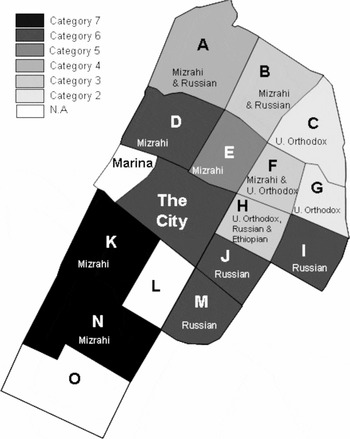
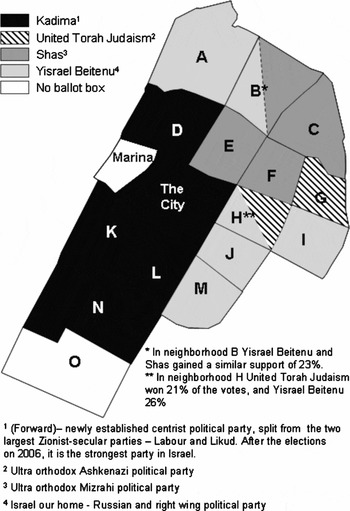
The class differences identified in the 1960s are still found today, and the range of difference in the city is only increasing (Figure 1). The ethnoclass differences are expressed, among other ways, in voting patterns for national-level politics (Figure 2). In the immigrant communities in the city, however, the ethnic division does not mirror the class division, meaning that it is not possible to identify a class hierarchy among different immigrant groups. The division between Israeli-born residents and immigrants—mainly Mizrahim who arrived in the 1950s—has been joined by another division over the years: between the Haredi community (ultraorthodox Jews) and other Jews. There are a number of concentrations of Haredi in Ashdod.
A map of socioeconomic ranking and the distribution among Ashdod neighborhoods of Jews, the ultraorthodox, and others, based on origin. The map is based on data analysis of the Central Bureau of Statistics (1998, 2004).

A map of political dominance. Source: Data analysis of election results of ballot boxes from http://www.knesset.gov.il.elections17/heb/index.asp

In 2004, the Central Bureau of StatisticsFootnote 55 defined neighborhood G and the northern part of neighborhood C as homogeneous ultraorthodox areas, meaning that they display an obvious ultraorthodox lifestyle that includes many yeshivas (religious institutions of learning), division into residential courtyards according to Jewish religious sects, and a high vote count for ultraorthodox parties. Alongside these two main concentrations of ultraorthodox Jews are other, less homogenous concentrations, such as in neighborhoods A (the northeastern section), neighborhoods B and D (the southeastern section), and neighborhood H (the northwestern section). In contrast to the lack of congruence between ethnicity and class in the city's immigrant communities, the ultraorthodox/secular dichotomy shows a clear class hierarchy: the ultraorthodox are the poorest community in the city.
This demographic-spatial dynamic is seen in many conflicts between the secular and ultraorthodox populations in the city, not just in lifestyles but also in the housing market, where the secular and ultraorthodox compete. This competition is characterized not by tolerance and recognition of differing housing needs, as would be expected in a multicultural urban model, but by spatial aggression reminiscent of cities with an ethnic and racial split where there is a fight over resources.Footnote 56
In this competition, the rabbis of the ultraorthodox community declare which areas are suitable for ultraorthodox housing, and these instantly turn into ultraorthodox targets. In this way, in recent years the eastern part of neighborhood F and parts of neighborhoods B, C, H, and I have all been transformed. In 2000 the rabbis' stamp of approval on an area caused a 20 percent increase in apartment prices.Footnote 57
The competition is not limited to the housing market but also exists in other areas, such as politics. For example, Rabbi Efraim Weber, a member of the Ashdod Municipality Council representing ultraorthodox political party Yahadut Hatorah, declared that by 2015, Ashdod will have an ultraorthodox mayor, based on an analysis of the number of pupils in ultraorthodox institutions compared to their secular counterparts. According to the municipality's analysis in 2005, although the ultraorthodox community accounts for 15 percent of the city's population, 30 percent of the city's pupils study in ultraorthodox institutions. A senior official in the municipality who commented on Rabbi Weber's statement in the Ashdod News added a spatial element to the discussion:
I think that there will only be an ultraorthodox mayor in 2020. It would have happened much sooner if it hadn't been for the large wave of immigration from the Soviet Union in the 1990s that postponed ultraorthodox control by a number of years. . . . If the messiah doesn't arrive by 2020 they will no longer be living and then the revolution will occur. If the rabbis call on their disciples to come and live in Ashdod the demographic story will be over even before then.Footnote 58
As this official recalled, during the years 1989–2005, 71,500 immigrants arrived in the city, most of them hailing from the former Soviet Union (FSU). The immigration policy in the 1990s was driven by clear ethnonational interests of preserving the Jewish majority vis-à-vis the Arab population, creating an Ashkenazi majority, and, as hinted by the municipality official mentioned previously, preserving the dominance of the secular population over the ultraorthodox.Footnote 59 In 2005, Ashdod became the city with the largest Russian-speaking population in Israel (hereafter the Russians)—61,259 residents, making up 27 percent of the city's population.Footnote 60 This is the largest community in the city, joining the 11,000 residents who immigrated to Israel from the Soviet Union in the late 1960s and 1970s.Footnote 61
In addition, exclusionist motivations with regard to immigrants were also still at work in the 1990s, for which the ordering of space was a means of implementation. In peripheral towns in Israel, the proportion of immigrants from the FSU is significantly higher than the Israeli average. This phenomenon has been mistakenly attributed to the impact of the free market; however, it is hard to ignore government direction that guided construction to the periphery and partial public funding that helped underwrite the sweep of new neighborhoods constructed in these areas.Footnote 62 Thus, a different social mosaic was formed in Ashdod than that of the rest of Israel. The proportion of immigrants and their descendants—from the 1950s mainly from Middle Eastern countries, from the 1970s from the Soviet Union, from the 1980s and 1990s from Ethiopia, from the 1990s from the FSU, and in more recent years from France—is higher than the overall proportion within the Jewish population in Israel.
Space in Ashdod has not been unaffected by the intensive immigration of the 1990s and the early 21st century. During this period, the plans for various neighborhoods of Ashdod continued to be implemented, with the addition of new neighborhoods, including “the City” and “the Marina.” Three of these neighborhoods have been built in the last five years through extensive construction, with an average annual growth of approximately 8,000 residents since the beginning of the 1990s. The Russian population is found in all of the city's neighborhoods, although in some neighborhoods it dominates, comprising at least 40 percent of inhabitants.Footnote 63
Tzvika Lotan, manager of the city's community centers, describes this phenomenon, stating that “the Russian takeover of the new neighborhoods was so extensive that there were almost no remaining signs of old-time Israeli character.” Moreover, he cynically observes the changing ethnic composition of the city:
Residents of Ashdod have been known to warn visitors—perhaps in jest, perhaps not—that if they're not fluent in Russian they shouldn't risk entering these neighborhoods. . . . Apart from street names written in Hebrew, there is almost no sign of the official state language. Even the newspaper stands are brimming with Russian-language newspapers and magazines. . . . You can get up in the morning and go to bed at night without having spoken one word of Hebrew and feel completely fine.Footnote 64
We should not be led astray by this description of a multicultural reality, however. The evolution of the Russian area in neighborhoods J and M was the conclusion of two demographic processes that demonstrate the nature of the relationship between the Russians and the more established population, mainly Mizrahim. The first was the entry of Russians into these neighborhoods while they were in the process of being built, attracted by enticing conditions and the general help of the state, as offered to all immigrants during those years.Footnote 65 The second was the departure of existing residents, as described by a neighborhood-M resident from the Soviet Union who said, “The Moroccans hate us. All of the Moroccans in this neighborhood sold their apartments and ran away from here the minute we arrived.”Footnote 66
Competition for the city's resources also began quickly, starting with employment. The rapid growth in the city's population caused mainly by immigration from the FSU, alongside insufficient development of employment as well as traditional industry's abandonment of the city in favor of priority development areas A or abroad,Footnote 67 placed Ashdod on the unsavory list of cities hit by unemployment.Footnote 68 This situation struck the Russian community first and foremost, but the more established community was also affected and pointed fingers of blame at the Russians.Footnote 69 The attention of the municipality also became an object of competition, with the established population claiming that the mayor's roots were Russian and that he therefore focused only on the new residents, neglecting the old.Footnote 70 Similar complaints were also heard from new residents: “No one in the municipality speaks Russian, and the money only goes to the older communities.”Footnote 71
The peak of competition can be seen in local politics. In the 1993 local-authority elections, no Russian representatives were elected to the city council, and thus no Russians filled powerful roles in local government. However, in the 1998 elections, Simon Katzenelson, a Russian immigrant, created the “Ashdod is our home” list. This list has served as a model for the national party “Israel is our home.”Footnote 72 This transition to the symbolism of “Ashdod is our home,” emphasizing the connection of the Russian community to Ashdod and its feeling of ownership of the city, became a strong political force for the Russians, and they went on to win eight out of twenty-five seats on the city council. A non-Russian city resident described the feeling in the municipality a number of months after the elections: “Everyone there is Russian, everyone speaks Russian, and they treat me as though I don't exist.”Footnote 73
Ethiopian enclaves, albeit smaller ones, also sprung up in Ashdod, primarily in the less affluent neighborhoods. The economic situation of the Ethiopians is particularly poor, as described by one school principal: “We discovered that the disturbances and lack of concentration among Ethiopian pupils were caused by hunger.”Footnote 74 The Ethiopians do not fit the Ashdod vision of multiculturalism. In 2000, the mayor threatened to close off the city to Ethiopians (he later apologized), and from the reactions of Ethiopians, it was clear that they were not glad to be living thereFootnote 75 because the multicultural vision passes them over. As of 2002, there was no Ethiopian community center in Ashdod, and according to the Ethiopians there had not even been a community evening organized.Footnote 76
The physical structure of the city, as discussed at the outset, implies the potential for creating a multicultural space, but this is not enough to create an urban multicultural reality. Despite the growing social and cultural differences in Ashdod, it has not achieved Young's ideal of a multicultural city that legitimizes difference but not exclusion.Footnote 77 In its place, there is competition over resources, whereby each group tries to increase its power in order to enjoy a distribution of resources that benefits its own community while depriving others.
Likewise, Young's condition for the creation of diversity, occurring in the meeting of different groups in the city through a partial mix of uses and the resulting activity and interest in urban space, is also limited in Ashdod. Communities are losing their heterogeneous characters, and they increasingly congregate in their own centers—Ethiopians in a number of state religious schools, Russians in neighborhood centers, and the ultraorthodox in their neighborhoods. The city was meant to act as a meeting place for the different communities, but the city cannot compete with other neighborhood centers—in particular, shopping centers and malls.Footnote 78 To a certain degree in recent years, the latter have served as meeting places for some of the communities in the city.
CONCLUSION: THE LIMITATIONS OF THE MULTICULTURAL PARADIGM
Throughout this article, we have examined the prospect of urban multiculturalism in the Israeli city of Ashdod vis-à-vis the intricate metrics of modernization and ethnonationalism. This prospect is sometimes endorsed by the city's leaders, but it simultaneously answers the logic of ethnonationalism that not only works toward a homogenous collective and homogenous space but also endorses Western and Eurocentric proclivities and biases. Thus, this logic facilitates practices of inclusion and exclusion in parallel, both tangibly and symbolically. Our discussion also points to how the advance of ethnonationalism is intertwined with the logic of the market, encouraging social hierarchies and stratifications that carry the stamp of “ethnoclassism” along First and Third World dichotomies.
Yet, these processes do not completely foreclose the prospect of multiculturalism, because they cannot completely forestall bottom-up forces that promote it either intentionally or inadvertently. The assessment of Ashdod as a potential site of urban multiculturalism becomes nuanced and intriguing as we take into account city planning that considers a modern vision of the city and ethnonational logic, on the one hand, and forces of bottom-up initiatives, on the other.
The modernist-planning approach in Ashdod sought to blur cultural difference through an emphasis on the universal (such as egalitarian and uniform neighborhoods), which was embedded in the Israeli ethnonational project of the melting pot. Here, planning can be seen as a tool of social and cultural control, serving an ideological agenda.Footnote 79 Despite the power of this approach, which in the name of the ethnonational modernization project ignores difference and aspires to create homogeneous identity, difference is demanded in the everyday practices of city dwellers through needs derived from their economic and social status as well as from their culture (whether Mizrahi, Russian, Ethiopian, or ultraorthodox). This issue is central to the debate on multiculturalism, planning, and the politics of the city. Where there exist differences in class, culture, values, and behavior among groups, strict adherence to principles of equality is actually likely to perpetuate the inferior status of the other.
In past and in recent years, the presence of immigrants in the modern city has not fulfilled the melting-pot vision. In fact, the modernist model that seeks to level the range of identities has become an indication of a multicultural option that grows from the bottom up. Instead, we see Ashdod as a project of “alternative modernity.” This concept focuses on the significance of modernity in daily life among societies and spaces that are not part of the First World. This type of modernity corresponds to the postcolonial vision of multiculturalism presented in our theoretical framework. It rejects the bourgeois ethos of modernity and instead seeks recognition of the fact that different modernization projects have not had uniform results.Footnote 80 At the basis of this cultural theory lies recognition of many expressions of modernity. The capitalist economy, technology, and bureaucratic organization of the state are inherent elements of modernity, but they lead to different types of modernity that diverge from the binary view of modernity versus traditionalism.
Indeed, this critique, suitable for our examination of the multicultural city in Israel, undermines the view that a city with many cultural communities is a multicultural city. In reference to our theoretical framework that ranks approaches on multiculturalism and the city, Ashdod's official planning and policy still serves the modernist–ethnonationalist project. This affects the day-to-day life of the city's communities, whose boundaries and components are an expression of the many categories created in the processes of establishing ethnonationality (Mizrahim, Russians, Ethiopians, and the ultraorthodox). These communities compete with one another for the right to the city in its broader sense.
This article argues that despite the many expressions of multiculturalism found in Ashdod and in statements of the municipality, the city is not institutionally organized to create a multicultural alternative in the way proposed by Young, for example.Footnote 81 The case of Ashdod highlights the difficulty of enlisting difference to create a multicultural alternative that challenges the national rationale. The increase in the diversity of cultures in Ashdod is an expression of the development over time of the nation- and state-building project in Israel, which was based, among other things, on the absorption of immigrants and the creation of space that closed off the Israeli-born from the immigrant population. This rationale of closing off one from the other was adopted by the ultraorthodox population, which found its way to Ashdod. Ashdod is the space of the most cutoff ethnocultural groups in Jewish society in Israel, and here, it would appear, lies the potential for multiculturalism.
The city has not disputed the ethnonational project and its guiding rationale, however, and any time a new wave of immigration has reached Israel, Ashdod has been the first to absorb new immigrants, with an emphasis on the ethnonational importance of this act. The Ashdod municipality, for example, continues to hold immigrant festivals that focus both on the unique cultural motifs of each community and on the contribution of the city to immigrant absorption, an ethnonational project at its most basic level. This can also been seen in the cultural symbols of the community: the symbols cultivated are those that have been adopted by nationalism, even if they have been given an engineered status of equality in the national pot. Examples include the decision to create a memorial to the victims of the historic Kishinev pogromFootnote 82 in the center of “Little Russia” or a memorial to those Mizrahim who perished in the disaster of the ship Egoz.Footnote 83 Ashdod is still trying to grasp both ethnonationalism and multiculturalism without reconciling the tension between the two.
Beyond challenging the logic of ethnonationalism, we also question the separation and contact among communities in the city. Thanks to the structure of neighborhoods and the internal movement of city residents, the closing off of immigrant communities—mainly Mizrahim and Russian—is still maintained to a large extent. An exception to this spatial separation between the two communities is found in the older neighborhoods of the city, where the socioeconomic status is relatively low. These neighborhoods allow a spatial integration of the lower classes. In the new neighborhoods, a high degree of segregation is maintained between Mizrahim and immigrants from the FSU, with the older community for the most part inhabiting neighborhoods with a slightly higher socioeconomic status than the Russian-dominated neighborhoods (see Figure 2).
This segregated urban space encapsulates the inherent sociopolitical tension between the multicultural reality (i.e., ethnic and social diversity) and the ethnonational stratification, exclusion, and inclusion. This tension is spatially manifested: it expresses the theoretical framework presented in this article while raising doubts about the ability of Ashdod, or any Israeli city that is part of the ethnonational project, to define itself as a multicultural city.