Introduction
Although the plant growth regulator chlormequat is approved for use, there are indications that it may affect mammalian reproduction. The first of these indications was provided by Danielsen et al. (Reference Danielsen, Larsen and Binder1989) who found that sows had impaired oestrus when fed grain from crop treated with chlormequat. Subsequently the advisory body to the Danish pig industry recommended limited use of grain (maximum 30% of diet energy) from crop treated with chlormequat to breeding stocks due to the risk of reproduction problems (Pedersen et al., Reference Pedersen, Kjeldsen, Danielsen, Skriver and Nielsen1990). More recently, it was shown in mice that feeding food and water containing chlormequat did not affect reproduction in female mice (Langhammer et al., Reference Langhammer, Kuhla, Schneider, Renne, Spitschak and Hagemeister1999), whereas reproduction in male mice was compromised (Torner et al., Reference Torner, Blottner, Kuhla, Langhammer, Alm and Tuchscherer1999). The available results regarding the effect of chlormequat on mammalian reproduction are summarized by Sørensen and Danielsen (Reference Sørensen and Danielsen2006).
In grain crop, plant growth regulators are used to reduce the length and strengthen the straw in order to reduce the risk of lodging and thus the risk of difficulties during harvesting. It is anticipated that in the European Union, approximately 70% of the wheat crop is treated with plant growth regulators. Among the plant growth regulators, chlormequat is by far the most common. Residues of chlormequat, also known as chlorocholine chloride (CCC), are allowed in food products. Examples of maximum residue limits (MRL) of chlormequat are 5 mg/kg for oat, 2 mg/kg for wheat and rye, and 0.05 mg per kg for milk and milk products (EU Commission, 2000). Acceptable daily intake (ADI) for human is 0.05 mg/kg body weight (FAO and WHO, 1997).
In the present paper, we report the results of a newly conducted pig experiment where pigs received dietary chlormequat in amounts of up to 0.05 mg/kg BW per day.
Material and methods
All chemicals were bought from Sigma unless otherwise stated. The chlormequat was mixed into the diet and given to the experimental animals at three levels (three treatment groups), i.e. 0 mg CCC/kg BW per day (Control), 0.025 mg CCC/kg BW per day (0.025 CCC) and 0.05 mg CCC/kg BW per day (0.05 CCC), according to the procedure described below.
Animals and feeding
Male progeny from 24 mother sows were used in the experiment. The 24 mother sows were inseminated and allocated among the three treatment groups. From the day of insemination, the mother sows received the experimental diets. The piglets were weaned at 4 weeks of age and two male littermates (hereafter called boars) continued on the same treatment as the dam until termination of the experiment. Thus according to the design, each treatment group should consist of 16 boars. The daily feed allowance for the boars was adjusted according to age starting with 0.3 kg/day at 4 weeks of age, and then gradually increasing to 2.5 kg/day at 17 weeks of age. From 17 weeks of age to termination of the experiment, the feed allowance was held constant at 2.5 kg/day.
The CCC (Acros Organics, New Jersey, USA) was mixed into a fraction of the feed at a level of 25 mg/kg feed (CCC concentrate feed). The rest of the feed remained without CCC (control feed). Based on the body weight of individual animals, the ‘CCC concentrate feed’ was mixed with ‘control feed’ to reach the scheduled levels of CCC to the individual animals in the ‘0.025 CCC’ and ‘0.05 CCC’ treatment groups. Animals in the control group received only control feed. Each animal was weighed every second week, and based on the weight and the expected gain, the scheduled amount of CCC was adjusted every week. All batches of ‘CCC concentrate feed’ were analysed before use by an LC/MS/MS method (Vahl et al., Reference Vahl, Graven and Juhler1998) and the content of chlormequat was measured to 22.2 ± 1.7 mg/kg. The straw used for bedding was organic and thus had not been treated with CCC. All animals were housed and fed in individual pens.
Diets were designed for six categories of animals (pregnant and lactating mother sows, piglets until 6 weeks of age, pigs from 6 to 9 weeks of age, pigs from 9 to 15 weeks of age, pigs from 15 to 21 weeks of age and pigs from 21 weeks of age to termination of the experiment). The diets were mainly based on organic wheat and soya bean meal and balanced with synthetic amino acids (lysine, methionine and threonine), minerals and vitamins according to Danish recommendations.
Blood samples were collected from vena jugularis at 20 weeks of age and analysed for the content of chlormequat according to the LC/MS/MS method described by Poulsen et al. (Reference Poulsen, Christensen, Sørensen, Leffers and Andersen2007).
Semen sampling and analyses
At 7 months of age the boars commenced the training to mount a dummy and deliver an ejaculate. Ejaculates were collected three times from each boar for in vitro fertilization (IVF) and semen analyses. One boar from each treatment group was collected at each day of collection and there were at least 5 days between two successive collections of individual boars. The boars were 369 ± 30 days of age at the time of semen collection. The semen was kept at room temperature and brought to the laboratory and later weighed. Two samples were taken for measurement of total sperm density and two samples were taken for measurement of dead sperm density in a semen cell counter (NucleoCounter SP-100; ChemoMetec, Allerød, Denmark), according to the manufacturer’s instructions. Based on these measures, total number of sperms and fraction of live sperms were calculated. An aliquot of the semen was diluted in an extender to a concentration of 25 million sperms per ml. A sample of this semen dilution was kept at 17°C overnight and then used for IVF.
In vitro fertilization
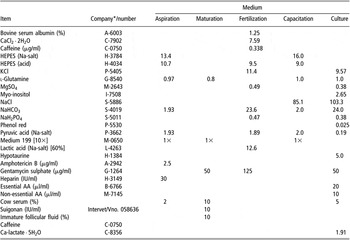
Cumulus–oocyte complexes (COC) from 2 to 6 mm follicles, from abattoir-derived ovaries, of post-pubertal pigs were aspirated into 10 ml tubes. The sedimented COCs were transferred to a Petri dish with the aspiration medium (Table 1). COCs with an intact compact cumulus, several cellular layers deep and with a homogenous cytoplasm were selected for the experiment and transferred to mature for 42 h in four-well dishes (approximately 50 COCs per well) with a 400 μl maturation medium (Table 1) at 38.5°C in a humidified atmosphere with 5% CO2. Whenever the COCs (and subsequently the presumptive zygotes) were in four-well dishes they were covered with 400 μl mineral oil (Sigma M-5310).
Media used in in vitro fertilization (units are in mmol unless otherwise stated)

HEPES = 4-(2-hydroxyethyl)-1-piperazineethanesulfonic acid; AA = amino acid.
*Sigma unless otherwise indicated.
All media were adjusted to 280 ± 8 mOsm and to pH 7.25 except for capacitation medium that were adjusted to pH 7.8.
After the 42 h maturation, COCs were washed twice in fertilization medium (Table 1). Groups of 50 COCs were then transferred to a 400 μl fertilization medium ready for fertilization.
Sperms in the semen dilution were washed twice in 0.9% (w/v) NaCl containing 1% fatty acid-free bovine serum albumin and twice in capacitation medium (Table 1) by centrifugation (300 × g, 10 min) and resuspension. After the last wash, the sperms were diluted in a capacitation medium. After a 2 h capacitation period, approximately 40 000 sperms in 15 μl were added to the groups of 50 COCs. Fertilization was performed for 4 h at 38.5°C in a humidified incubator gassed with 5% CO2 in air.
The groups of presumptive zygotes were transferred to falcon tubes with aspiration medium (with 5% cow serum but without Amphotericin B and heparin) and vortexed to remove cumulus cells, then transferred to a Petri dish and washed in culture medium (Table 1). Finally the presumptive zygotes were placed in four-well dishes in culture medium at 38.5°C in a humidified incubator gassed with 5% CO2 in air. The zygotes/embryos were evaluated for cleavage to more than the one-cell stage on day 5.
In vivo fertilization
Gilts (248 ± 34 days of age) were used for artificial insemination to obtain a measure of in vivo fertilization competence of semen. When a gilt showed oestrus, an ejaculate was collected from a boar and the gilt was inseminated with the whole ejaculate. There were at least 5 days between semen collections within individual boars. Three gilts were inseminated per boar. The gilts were slaughtered 4 weeks after insemination and the number of embryos in the uterus was counted.
Statistical methods
Originally, it was hypothesized that chlormequat at the highest level may have an adverse effect on semen characteristics. Thus a one-sided test was planned to test this hypothesis. Given a significant outcome of this test, a supplementary test would then be carried out to test whether the lowest chlormequat level might also have adverse effects. Conversely, given a non-significant outcome of the test, no further test would then be carried out. Since the one-sided test for adverse effects of the highest chlormequat dose in no instance gave significant outcomes, no supplementary tests were carried out.
The statistical model in the one-sided test for the data of Table 2 included the effect of treatment, the mother sow, the boar and the effect of date of semen collection as random effects:

where ytmbd are the observations for treatment (t = 1,…,3), mother sow (m = 1,…,nt), boar (b = 1,…,ntm) and date (d = 1,…,nD). αt represents the treatment effect, β the effect of boar age AGEtmbd, εtm the random effect of mother sow, εtmb the random effect of boar, εd the random effect of date and εtmbd the residual error. The random effects are assumed to be independently and normally distributed. For the variable ‘fraction of live sperms’, the arcsine-transformed proportions were analysed. In case a random effect was estimated to be zero, it was excluded from the model.
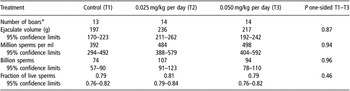
Characteristics of semen from boars exposed to different levels of chlorocholine chloride (CCC) (Control, 0.025 or 0.050 mg CCC/kg live weight per day) during their entire life including the foetal stage (LSMeans)

*Three ejaculates per boar.
The probability πtmbd that the in vitro fertilized oocytes underwent cleavage to more than the one-cell stage (Table 3) was fitted with a logistic mixed model:
Fraction of oocytes developed to more than the one-cell stage at day 5 after fertilization with semen from boars exposed to different levels of chlorocholine chloride (CCC) (Control, 0.025 or 0.050 mg CCC/kg live weight per day) during their entire life including the foetal stage

Same boars and ejaculates as in Table 2.
*For 80% of the observations, the number of oocytes was between 47 and 57; minimum number was 31 and maximum number was 66.

The probability that artificial insemination of gilts resulted in a pregnancy (Table 4) was fitted with a similar logistic model with the age of the inseminated gilt as an additional covariate.
Insemination of gilts with semen from boars exposed to different levels of chlorocholine chloride (CCC) (Control, 0.025 or 0.050 mg CCC/kg live weight per day) during their entire life including the foetal stage

Same boars as in Table 2.
*Three gilts were inseminated per boar.
The number of embryos (Table 4) was fitted with a Poisson model, where logit(πtmbd) was replaced with log(λmbd) in the previous model and λmbd represented the expected number of embryos.
Results
A total of 41 boars completed the experiment, i.e. 13 from Control, 14 from 0.025 CCC and 14 from the 0.05 CCC groups. Four boars, with all treatment groups represented, were not willing to mount the dummy and deliver semen samples, one mother sow only had one male piglet, one boar developed hernia and was slaughtered and one boar died before adulthood. One boar from Control had less than one million sperms per ml in the third of the three semen samples; thus data from this sample were excluded.
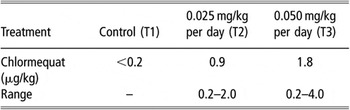
Semen volume, sperm concentration, fraction of live sperms and total number of sperms were not lower in the 0.05 CCC group than in the control group (Table 2). Thus chlormequat had no adverse affect on these semen characteristics. The fraction of porcine oocytes that developed to more than the one-cell stage at day 5 after IVF with boar semen was between 0.80 and 0.84 and not lower (P = 0.88) in the 0.05 CCC group than in the Control group (Table 3). The fraction of gilts being pregnant after one insemination with semen from the boars was between 0.45 and 0.56 and not lower (P = 0.65) in the 0.05 CCC group than in the Control group (Table 4). The number of embryos in the pregnant gilts was between 13.0 and 13.6 and not lower (P = 0.36) in the 0.05 CCC group than in the Control group (Table 4). Chlormequat was absorbed to the blood and the concentration was doubled in serum of the 0.05 CCC group compared to the 0.025 CCC group (0.9 v. 1.8 μg/kg), whereas chlormequat was not detectable in serum of the control group (Table 5).
Chlormequat in serum of boars (20 weeks of age) exposed to different levels of chlorocholine chloride (CCC) (Control, 0.025 or 0.050 mg CCC/kg live weight per day) during their entire life including the foetal stage

Same boars as in Table 2.
Discussion
The semen characteristics were within the normal range for boars (Hansen et al., Reference Hansen, Christensen, Stryhn, Hedeboe, Rode and Boe-Hansen2002; Lin et al., Reference Lin, Tholen, Jennen, Ponsuksili, Schellander and Wimmers2006); thus the experimental boars can be regarded as representative for the population. The relatively low fraction of gilts being pregnant after artificial insemination compared to standard may be because gilts were inseminated only once whereas standard practice is usually twice.
The ADI level of 0.05 mg chlormequat/kg BW was used as one of the three treatment levels in the present investigation. The ADI is based on the no observed adverse effect level (NOAEL) of 4.7 mg/kg bw per day for diarrhoea, vomiting and salivation in a study of toxicity in dogs, and using a safety factor of 100 (FAO and WHO, 1997). We wanted to test whether the 0.05 mg chlormequat/kg BW per day had an effect on semen fertilizing capacity in the boar.
Little is known about the potential effect of chlormequat on mammalian male reproduction. The only other report in the scientific literature that approaches the question of male reproduction after intake of chlormequat in amounts that are within the range acceptable for humans is that of Torner et al. (Reference Torner, Blottner, Kuhla, Langhammer, Alm and Tuchscherer1999). Their experiment was conducted with male mice and the experimental animals were exposed to chlormequat from the embryonic stage as in the present experiment. Chlormequat was administered via three sources, i.e. in grain from chlormequat-treated wheat crop, chlormequat mixed into chlormequat-free wheat and chlormequat mixed into water. The analysed levels of CCC in feed dry matter and water were in the range between 0.20 and 0.21 mg/kg. Daily intake was not reported but if it were anticipated that mice have a daily feed intake equivalent to 15% of their body weight, the animals would have a daily intake of approximately 50% of the ADI. This level is comparable to the 0.025 CCC group in the present experiment. The fertilization competence of sperm was tested in IVF and the fraction of mice oocytes that was fertilized with sperm from the male mice fed wheat from chlormequat-treated crop, or water mixed with chlormequat, or chlormequat-free wheat mixed with chlormequat was 0.21, 0.30 and 0.30, respectively, compared to 0.61–0.65 for control mice (Torner et al., Reference Torner, Blottner, Kuhla, Langhammer, Alm and Tuchscherer1999). These results suggest that chlormequat intake at a level that is acceptable for humans, has a detrimental effect on the in vitro fertilizing competence of spermatozoa of mice. It is a matter of concern that the results of Torner and co-workers have not been included in the toxicological evaluations by FAO and WHO; the latest evaluation of chlormequat was published in 1999 (FAO and WHO, 1999). The mode of action is not known. Apparently, interaction with the oestrogen receptor can be excluded (Andersen et al., Reference Andersen, Vinggaard, Rasmussen, Gjermandsen and Bonefeld-Jørgensen2002; Sumbayev et al., Reference Sumbayev, Bonefeld-Jørgensen, Wind and Andreasen2005). In the present investigation with pigs as the experimental animals, there were no adverse effects of chlormequat on the included parameters for semen quality. These parameters included semen in vitro fertilizing competence, which was also included in the mice study of Torner et al. (Reference Torner, Blottner, Kuhla, Langhammer, Alm and Tuchscherer1999). This deviation in results between the mouse and the present pig experiment may indicate large species differences in the sensitivity to chlormequat exposure. If so, it is not known whether humans would mostly resemble the pig or the mouse with regard to sensitivity to chlormequat exposure. The reported blood levels of chlormequat clearly show that the experimental animals have been chronically exposed.
Outside the scientific literature, FAO and WHO (1997) refer to a two-generation study (F0 being the first generation) where chlormequat was administered to rats at dietary levels of 0, 300, 900 or 2700 mg/kg feed (Hellwig et al., Reference Hellwig, Deckardt, Freisberg and Hildebrand1993). In this study, the F1-generation produced fewer pups per litter at the highest level, but it is not known whether this result can be attributed to the male, the female or both. However, at 900 mg/kg feed, equivalent to a daily intake of 69 mg chlormequat/kg BW, rat fertility was not affected. Based on these data a NOAEL of 69 mg/kg BW per day was determined by FAO and WHO (1997). This level is several thousand fold higher than the daily dose of approximately 0.025 mg/kg BW, which had a detrimental effect on semen IVF competence in the mice study of Torner et al. (Reference Torner, Blottner, Kuhla, Langhammer, Alm and Tuchscherer1999). Even though the response parameters were not the same in the two studies, such a difference in reproductive toxicity to a pesticide between two rodent species seems unexplainable. Unlike the results of Hellwig et al. (Reference Hellwig, Deckardt, Freisberg and Hildebrand1993), the results of Torner et al. (Reference Torner, Blottner, Kuhla, Langhammer, Alm and Tuchscherer1999) apparently have never been considered in the toxicological evaluations sponsored by FAO and WHO.
The lack of knowledge about the potential effect of chlormequat on mammalian reproduction also includes the lack of knowledge about the stage of life where an effect might be exerted. Thus, the treatments in the present experiment were commenced as early as the embryo–foetal stage so as not to miss an important time window, i.e., the mother sows to the experimental animals were given the experimental diets from the day of artificial insemination and throughout pregnancy. During the subsequent lactation, the mother sows continued on the same experimental diet until weaning of the piglets. After weaning, the boars continued in the same treatment group as their mother until termination of the experiment. Thus, the experimental design should secure that all the time windows open for chlormequat affecting reproduction were included; however, our results from boars could not confirm the indications that chlormequat may be detrimental to male fertility.
In summary, the plant growth regulator chlormequat could not be proven to be detrimental to selected reproduction traits in the male pig. This is in contrast to results from the male mouse. Further work needs to be carried out to clarify whether there are large species differences with regard to susceptibility to chlormequat exposure.
Acknowledgement
Technical staff in the barn and laboratory are acknowledged for their skilful work. ChemoMetec is acknowledged for providing the NucleoCounter for counting sperms in the semen samples. The project was supported by grants from the Ministry of Science, Technology and Innovation.