Readmissions to acute care hospitals create a burden for patients and their health, accounting for increased costs, resources, and time for healthcare providers, payers, and ultimately the healthcare system.
Despite some progress, healthcare-associated infections (HAIs) continue to impact patients in the United States. One in 25 hospital patients develops at least 1 HAI during hospitalization.Reference Magill, Edwards and Bamberg 1 Estimates suggest HAIs result in $28 billion to $34 billion in excess healthcare costs each year.Reference Scott 2 Although the number of central line–associated bloodstream infections (CLABSIs) has decreased over the last decade,Reference Wise, Scott and Baggs 3 , 4 it is estimated more than 30,000 occur nationally in hospital wards and critical care units. CLABSIs may lead to longer hospital stays, increased mortality, and increased costs.Reference Jarvis 5 – Reference Warren, Quadir, Hollenbeak, Elward, Cox and Fraser 8
Readmissions or rehospitalizations are challenging because they occur frequently and are costly to payers, such as Medicare.Reference Ashton, Kuykendall, Johnson, Wray and Wu 9 , Reference Jencks, Williams and Coleman 10 Rates of hospital readmission among adults can vary from 5% to 29%Reference Hasan 11 – Reference Thomas and Holloway 15 and are responsible for up to 60% of hospital expenditures.Reference Weinberger, Oddone and Henderson 16 Prior research indicates there exists an association between having a HAI and becoming rehospitalized. In one single-center study, HAI incidents were the cause of 14.3% of readmissions.Reference Sreeramoju, Montie, Ramirez and Ayeni 17
The ongoing problem of hospital readmissions continues to result in serious public health consequences by creating a burden on patients and generating unnecessary healthcare costs. Previous studies of CLABSI have focused on the visit in which the CLABSI occurred and do not examine the issue of readmission. The purpose of this analysis was to determine whether an association exists between patients identified as having a CLABSI and subsequent readmission to acute care hospitals.
METHODS
We conducted a retrospective cohort study for the years 2008–2009 to compare the rate of hospital readmissions among those with a hospital-onset CLABSI to frequency-matched control subjects. Since, as previously shown, International Classification of Diseases, Ninth Revision, Clinical Modification (ICD-9-CM) codes are not sufficiently able to identify CLABSI cases in administrative files,Reference Sherman, Heydon and St John 18 we linked data from the National Healthcare Safety Network (NHSN) to identify CLABSI cases among a population of hospitalized Medicare enrollees identified from the Medicare Provider Analysis and Review (MedPAR) database and Beneficiary Annual Summary File obtained from the Centers for Medicare and Medicaid Services (CMS). The methods for linking NHSN and MedPAR data sets to identify individual Medicare recipients with a HAI and frequency matching of uninfected patients have been previously described.Reference Malpiedi, Peterson and Soe 19 – Reference Yi, Baggs, Gould, Scott and Jernigan 21 The Centers for Disease Control and Prevention Human Research Protection Office determined this work was exempt from the regulations under 45 CFR 46.101(b)(5). This work was conducted under a data use agreement with CMS.
Data Sources and Linkage
Cases of hospital-onset CLABSI were identified using data extracted from the NHSN CLABSI surveillance module for admissions. CLABSIs were defined according to the standard NHSN protocol. Laboratory-confirmed bloodstream infections not secondary to another HAI were considered to be central line associated if a central line or umbilical catheter was in place at the time or within 48 hours before the onset of the infection. 22 Admission dates, date of birth, sex, facility and its location, and date of infection were captured electronically. For this analysis, only MedPAR data from the years 2008–2009 were available to us from Colorado, Illinois, New Hampshire, New York, Pennsylvania, South Carolina, Tennessee, and Virginia, chosen owing to their participation in NHSN. The MedPAR database contains claims for beneficiaries from certified inpatient hospitals and skilled nursing facilities. 23 Only claims from inpatient hospital stays were included. This database along with the Beneficiary Annual Summary File provided information on admission dates, date of birth, sex, and facility for linking as well as information on diagnosis and procedures using ICD-9-CM codes, reimbursement cost of the claim, beneficiary status, and CMS chronic conditions. An encrypted beneficiary identifier was available in order to follow beneficiaries longitudinally and determine their readmission status, including readmission to other facilities. Unique healthcare facilities from the NHSN facility file were mapped to the CMS provider identifier using the reported CMS provider identifier when available or facility name and location from NHSN and data from the CMS Cost Reports, 2004–2009.
For both data sources, we limited the population to those older than 64 with a valid date of admission from January 1, 2008, through December 31, 2009, a valid date of birth, and designation of sex and facility. In the MedPAR file, patients were also limited to those who aged into the Medicare recipient cohort with or without end-stage renal disease, were enrolled in Medicare Part A and B throughout their eligibility, and never enrolled in a Medicare Advantage (Health Maintenance Organization) program. We also eliminated hospital visits to certain special units such as psychiatric and swing units. To identify individuals with CLABSI, CLABSI events reported to NHSN were linked to hospital claims data in MedPAR using a combination of 4 variables, including hospital admission date, date of birth, sex, and unique facility identifier.Reference Malpiedi, Peterson and Soe 19 , Reference Yi, Baggs, Gould, Scott and Jernigan 21 Only unique, exact matches among those variables were included in the analysis.
Control Selection and Frequency Matching
To control for potential confounding, first, potential controls were limited to the same facilities, age, primary ICD-9-CM diagnoses, and diagnosis-related groups observed in the population of patients with CLABSI. Patients with a diagnosis consistent with CLABSI (ICD-9-CM 999.31) but not identified as NHSN cases were eliminated from the potential control pool. Second, 5 non-CLABSI control stays were selected such that the frequency of the primary ICD-9-CM procedure category, based on single-level Clinical Classification Software available from the Agency for Healthcare Research and Quality, 24 and intensive care unit status were similar between CLABSI stays and non-CLABSI stays.Reference Yi, Baggs, Gould, Scott and Jernigan 21 Therefore, patients with CLABSI (as reported to NHSN) made up our exposed group, whereas frequency-matched controls without CLABSI made up our unexposed group for comparison.
Outcome
Hospital readmissions occurring 1 to 30 days after the initial hospital discharge (index hospitalization) represented the primary outcome of the study. Patients discharged from their index hospitalization and readmitted on the same day were considered transfers and excluded from the analysis along with patients who died during the index hospitalization. We also considered the first hospital readmission after the index hospitalization regardless of timing of readmission as a secondary outcome.
Statistical Analysis
For univariate analysis, we used the χ2 test for dichotomous outcome measures and the Fisher exact test as appropriate. The t test and Wilcoxon rank sum test were used for continuous variables. Potential confounders and interaction terms were assessed in both stratified and multivariable analyses. Potential interaction terms were assessed in the stratified analysis using the Breslow-Day test.
To assess the association between CLABSI and the rate of first rehospitalization, the rate of initial readmission among those with a CLABSI and those without was compared through survival analysis using a Cox proportional hazard model. Patients were censored at death or the end of 30 days for the primary analysis. For our secondary outcome, time was allowed to accumulate from the time of discharge until readmission, death, or the end of the study period. Multivariate models included terms for age, race, sex, index hospitalization length of stay (LOS), presence of an ICD-9-CM procedure code for insertion of a central line, individual CMS chronic conditions, and indication of care in an intensive care unit. These terms were based on the patient’s index hospital stay. Given that the comorbidity scoreReference Gagne, Glynn, Avorn, Levin and Schneeweiss 25 violated the proportional hazards assumptions, models were stratified by comorbidity score. The final model was determined by assessing potential confounding in the multivariate models using methods previously described by Kleinbaum and Klein.Reference Kleinbaum and Klein 26 For the final models, all the terms but the CMS chronic condition terms were included. In addition, because certain terms were found to be significant effect modifiers by the Breslow-Day test in the stratified analyses, a secondary analysis was conducted to evaluate those terms in multivariate Cox proportional hazard models. Two significant interaction terms, index hospitalization LOS and the CMS chronic condition rheumatoid arthritis, were included in the final model. Confounding was assessed as previously, and all terms including the CMS chronic conditions were included in those models.
In addition, to compare the potential reasons for readmission, we examined the frequency of the most common ICD-9-CM primary diagnosis category for the first readmission visit by CLABSI status. Differences in frequencies by CLABSI status were assessed using the χ2 test or the Fisher exact test as appropriate. We also examined the frequency of patients discharged and readmitted within the same day by CLABSI status along with admission type for the subsequent stay.
Analyses were conducted using SAS, version 9.3, statistical software (SAS Institute). Alpha was set to .05 for all statistical analyses.
RESULTS
MedPAR and NHSN data from 8 states were linked to determine which individuals in the MedPAR data set experienced a CLABSI during hospitalization. In those 8 states, there were more than 3.95 million MedPAR records available and 4,747 CLABSI events among patients older than 64 years reported to NHSN. Of those 4,747 NHSN records, 1,967 (41%) linked to a MedPAR inpatient hospital claim record. Given the proportion of persons older than 64 who use Medicare as the primary payer, who are enrolled in both Parts A and B and not the Medicare Advantage program and have aged into the Medicare cohort, only 49.8% or 2,364 NHSN events were expected to link. Therefore, our adjusted linkage rate is 83.2% (1,967/2,364). After limiting potential controls to those claims with same facilities, age range, range of primary ICD-9-CM diagnoses, and range of diagnosis-related groups, 1.05 million non-CLABSI patients remained eligible to be selected as controls. After frequency matching, 9,835 controls were randomly selected for 1,967 cases, resulting in a total of 11,802 patients selected for the study. For all selected patients, hospital readmissions after discharge from the index hospitalization were identified.
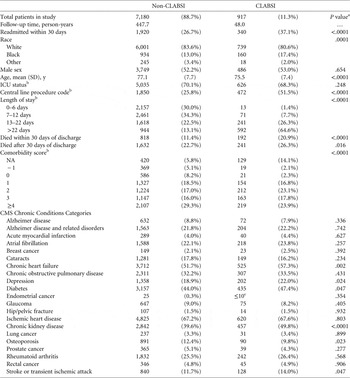
Among the 11,802 patients, 8,097 patients survived the index hospitalization and were not transferred or rehospitalized on the same day of discharge (Table 1). Among the 8,097, a total of 917 (11.3%) had a CLABSI during the index visit and 7,180 did not have a CLABSI (88.7%). Demographic and clinical characteristics varied among those with and without a CLABSI (Table 1).
Demographic and Clinical Characteristics of Study Population

NOTE. Data are no. (%) of patients unless otherwise specified. CLABSI, central line–associated bloodstream infection; CMS, Centers for Medicare and Medicaid Services; ICU, intensive care unit; NA, not applicable.
a P values based on χ2 tests.
b During the index CLABSI visit.
c In accordance with the CMS data use agreement, the actual number and percentage were not displayed for cell sizes ≤10.
Overall, 2,260 of these patients (27.9%) were readmitted within 30 days (Table 1). Of the 917 with CLABSI, 340 (37.1%) were readmitted within 30 days compared with 26.7% among non-CLABSI (P<.0001). The rate of readmission within 30 days was 7.1 events per person-year for those with CLABSI. Among non-CLABSI patients, the rate of readmission within 30 days was 4.3 events/person-year. Therefore, the rate of readmission within 30 days was 1.7 times higher among CLABSI patients compared with patients without a CLABSI (IRR, 1.7 [95% CI, 1.5–1.9]). In addition, 550 (60.0%) of those with a CLABSI and 3,962 (55.2%) of those without a CLABSI were ever readmitted during the study period, resulting in overall readmission rates of 2.5 events/person-year and 1.4 events/person-year, respectively. The overall rate of readmission was 1.8 times higher for those with a CLABSI (IRR, 1.8 [95% CI, 1.6–1.9]).
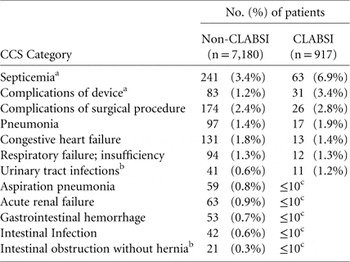
When adjusting for potential confounders, our Cox proportional hazards model demonstrated a borderline significant association between CLABSI and 30-day readmission (IRR, 1.2 [95% CI, 1.0–1.3]). We also observed a borderline association between CLABSI and all readmissions in the Cox proportional hazards model (IRR, 1.1 [95% CI, 1.0–1.2]). In addition, we examined the 10 most common primary ICD-9-CM discharge Clinical Classification Software categories for the first readmission visit by CLABSI status (Table 2). Septicemia was the most common diagnosis category for readmission among those with a CLABSI and was reported more than twice as often compared with those without CLABSI (P<.0001). Complications of a device, urinary tract infections, and intestinal obstruction without hernia were also more commonly reported among those with a CLABSI. In total, the most common primary categories accounted for 63% of the readmission events among those with a CLABSI.
Most Frequent Primary ICD-9-CM Discharge CCS Category for the First Readmission Visit by CLABSI Status

NOTE. Table includes 12 Clinical Classification Software (CCS) categories because for central line–associated bloodstream infection (CLABSI), the 10th through 12th categories each contained an equal number of events. ICD-9-CM, International Classification of Diseases, Ninth Revision, Clinical Modification.
a P<.0001.
b P<.05.
c In accordance with the CMS data use agreement, the actual number and percentage were not displayed for cell sizes ≤10.
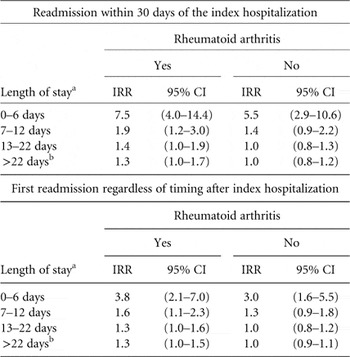
In our secondary analysis, which included potential effect modifiers, the final stratified Cox models demonstrated a statistically significant association between CLABSI and readmission to an acute care hospital modified by the effect modifiers LOS and rheumatoid arthritis (Table 3). As the index visit’s LOS decreased, the rate of readmission for those with a CLABSI increased compared with those without a CLABSI. For example, for CLABSI patients with LOS less than or equal to 6 days, the rate of readmission within 30 days was 5.5 to 7.5 times greater than that of patients without a CLABSI. A positive history of rheumatoid arthritis also increased the hazard ratio for readmission. However, for patients without a history of rheumatoid arthritis and with LOS greater than 6 days, the rate of readmission within 30 days was not significantly higher for CLABSI patients compared with non-CLABSI patients. When analyzing all readmissions during the study period, the hazard ratios decreased slightly compared with 30-day readmissions.
Final Hazard Ratios for CLABSI at the Specific Levels for the Interaction Terms of Length of Stay and Rheumatoid Arthritis Among Patients Who Were Readmitted Within 30 Days of the Index Hospitalization and for Time to First Readmission After Index Hospitalization

NOTE. Cox proportional hazards models were stratified by Gagne comorbidity score and included age, sex, race, intensive care unit status, central line procedure code, and Centers for Medicare and Medicaid Services (CMS) chronic conditions as covariates. Terms for length of stay and the CMS chronic condition rheumatoid arthritis and the effect modification by central line–associated bloodstream infection (CLABSI) for both of those terms were also included in the model. IRR, incidence rate ratio.
a During the index CLABSI visit.
b Reference category.
Although our primary analysis eliminated those patients who were discharged and readmitted on the same day, patients with a CLABSI were more likely to be discharged and readmitted on the same day. Of the 1,239 CLABSI patients who did not die in the hospital, 321 (25.9%) were discharged and readmitted on the same day whereas only 856 (10.6%) of the 8,055 non-CLABSI patients were readmitted (P<.0001). Of those admitted on the same day as discharge, those with a CLABSI were more likely to have an urgent or emergency readmission (33% vs 23%, P=.0004).
DISCUSSION
In our study, CLABSI was determined to be significantly associated with readmission to an acute care hospital. Further, readmission rates were highest among patients with shorter LOS during their index visit or a history of rheumatoid arthritis. Although our study focuses specifically on CLABSI, our findings are consistent with previous studies suggesting that HAIs may increase the risk of rehospitalizations and have adverse health impact and burden that extend beyond hospital discharge.Reference Sreeramoju, Montie, Ramirez and Ayeni 17 , Reference Emerson, Eyzaguirre, Albrecht, Comer, Harris and Furuno 27 – Reference Murphy, Avery, Dubberke and Huang 29
It is important to note there are few studies specifically examining the issue of CLABSI and hospital readmissions. Although the results are statistically significant, further research is needed, especially among different populations to determine the consistency of these findings. If confirmed, our findings further reinforce the need to prevent CLABSI because this may benefit beyond the index visit, though the total burden of readmissions attributable to CLABSI may not be large.
Our analysis also identified LOS and a diagnosis of rheumatoid arthritis as potential effect modifiers. Few studies have established relationships between rehospitalization and LOS, as well as between rehospitalization and rheumatoid arthritis. Kaboli et alReference Kaboli, Go and Hockenberry 30 concluded that patients with an increased LOS had a higher likelihood of readmission, a 3% increase for every 1 extra day of stay. In our analysis, a longer LOS during the index hospital stay was also associated with a higher rate of rehospitalization (data not shown), but if a patient was exposed to CLABSI in the index hospitalization, a shorter LOS indicated a higher rate of readmission compared with those without a CLABSI but similar LOS (Table 3). We also found that exposure to CLABSI increased the rate of rehospitalization among patients diagnosed with rheumatoid arthritis (Table 3). The reasons for this association are unclear. Future studies could examine the potential interaction between LOS and rheumatoid arthritis with readmission following CLABSI as well as possible mechanisms for effect modification.
Our study had a number of strengths. First, NHSN and MedPAR data were linked to identify patients who were both infected with CLABSI and rehospitalized. Therefore, we did not depend on the patients’ ICD-9-CM codes to identify CLABSI because previous research has shown their inability to properly differentiate HAIs.Reference Kaboli, Go and Hockenberry 30 , Reference Goto, Ohl, Schweizer and Perencevich 31 In fact, one study found that administrative data often misclassified non-CLABSI cases as true CLABSI cases, producing a different number of cases compared with that of surveillance data.Reference Sherman, Heydon and St John 18 Studies using only ICD-9-CM codes for identification of CLABSI suffer from strong misclassification bias in determining the exposure status. Also, data for readmissions were based on beneficiary claims in the MedPAR data set, which are reliable for identifying longitudinal visits for beneficiaries even across different facilities, and also provide additional demographic and clinical information valuable for risk adjustment. Furthermore, when we examined the primary diagnosis code of the first readmission, among those with a previous CLABSI we observed an increase in diagnostic categories consistent with CLABSI, including septicemia and complications of a device.
A limitation of our analysis is the inability to differentiate between a true, unplanned rehospitalization and a planned hospital visit following discharge. It is possible or even likely that some of the readmissions included in the analysis represent planned readmission. However, the frequency of planned readmission would not be expected to have varied by CLABSI status given the frequency matching in the cohort. Hence any potential bias would be nondifferential and bias toward the null. Furthermore, because administrative data was used, we are unable to specifically determine how the preceding CLABSI was potentially related to the increase in the rate of readmissions. In addition, administrative data are not collected for research purposes, and therefore, misclassification may occur for other data derived from the MedPAR data source.Reference van Walraven and Austin 32 , Reference Scott, Sinkowitz-Cochran and Wise 33 Another limitation is the potential for mismatches in the NHSN and MedPAR data linkage. By using specific requirements and allowing for only exact matches among our linkage variables, the likelihood of a mismatch is small. Furthermore, since CLABSIs are rare and we eliminated patients who did not link but had an ICD-9-CM code consistent with CLABSI, it is unlikely that our controls experienced a CLABSI. Again, such misclassification would have biased our results toward the null. Additionally, although we attempted to control for confounding through matching and multivariate models, there is potential for unmeasured confounding to exist in our analysis given the availability of data elements in our data sources. Finally, because the finding of the effect modifiers LOS and rheumatoid arthritis were unexpected, our control selection did not take this finding into account, and although our results would not be expected to be biased, future studies of readmission and HAI should consider the role of LOS into the design of the study.
In conclusion, our study found a significant association between CLABSI and the risk of readmission to an acute care hospital. Prevention of CLABSI may therefore reduce patient burden and healthcare costs associated not only with hospitalizations during which CLABSIs occur, Reference Scott 2 , Reference Scott, Sinkowitz-Cochran and Wise 33 , Reference Dunagan, Woodward and Medoff 34 but also by prevention of a proportion of subsequent readmissions to the hospital and their associated costs.
Acknowledgments
The findings and conclusions in this report are those of the authors and do not necessarily represent the official position of the Centers for Disease Control and Prevention.
Financial support. None reported.
Potential conflicts of interest. All authors report no conflicts of interest relevant to this article.