Implications
High levels of performance were achieved from finishing lambs offered high feed value grass silage supplemented with low levels of concentrate. Although the response to grass silage feed value declines as concentrate feed level increases, the response is still present at high-concentrate inputs. Lambs offered ad libitum concentrate had daily weight gain similar to that achieved preweaning on many sheep units. Increasing the maturity of maize at harvest improved lamb performance. Lamb carcass gain response to increased concentrate feed level was linear and increased as forage feed value declined. Therefore, increasing the feed value of the forage in the diet of finishing lambs either shortens the finishing period, or enables maintenance of animal performance while reducing daily concentrate feed required by up to 0.5 kg per lamb.
Introduction
Prime lamb production in Ireland is grass based and seasonal, with lambing normally targeted to coincide with the start of grass growth in spring. Consequently, around 60% of sheep throughput at export abattoirs occurs during the second 6 months of the year; ∼20% of sheep are slaughtered in the first quarter of each year, which helps maintain continuity of supply to export markets. As grass growth rate declines during the last quarter of the year to as low as zero, a large proportion of these lambs are finished on concentrate diets or on diets containing conserved forages and/or concentrate.
Grass silage is the main forage produced, in Ireland and the United Kingdom, for feeding livestock during the winter feeding period. Crop yield is the major factor affecting the cost of silage (Keady et al., Reference Keady, Kilpatrick, Cushnahan and Murphy2002), but forage digestibility and feed value decline as crop yield increases (Keady et al., Reference Keady, Mayne and Fitzpatrick2000). Increasing silage digestibility has been shown to improve animal performance. On the basis of a review of 23 comparisons involving lactating cows, 30 comparisons involving finishing beef cattle and nine comparisons involving pregnant ewes, Keady et al. (Reference Keady, Hanrahan, Marley and Scollan2012) concluded that, on average, each 10 g/kg increase in digestible organic matter digestibility (DOMD) increased milk yield of dairy cows by 0.33 kg/day, carcass gain of beef cattle by 22.8 g/day and lamb birth weight by 52.3 g, respectively.
Maize silage offers the potential to achieve substantially increased forage yield without compromising digestibility or feed value. Major developments in plant breeding coupled with improvements in agronomic practices, particularly the development of the complete plastic mulch (CCPM) system, have considerably increased the potential yield and feeding value of maize at more northern latitudes (Keady, Reference Keady2005). The CCPM system, as described by Keady (Reference Keady2005), increases the concentrations of dry matter (DM) and starch, and hence feed value, at harvest relative to the crop sown in the open (Keady et al., Reference Keady, Kilpatrick, Mayne and Gordon2008b; Keady and Hanrahan, Reference Keady and Hanrahan2009). Furthermore, the CCPM system enables the yield of DM to be increased by as much as 5 t/ha, depending on sowing date and variety sown (T.W.J. Keady unpublished data). This increased yield potential of forage maize, compared with grass, means that the cost of maize silage is similar to that of grazed grass when offered to lactating dairy cows (Keady et al., Reference Keady, Kilpatrick, Cushnahan and Murphy2002).
Results from previous studies have shown that the inclusion of maize silage in diets based on grass silage increases the performance of finishing beef cattle (Keady, Reference Keady2005; Keady et al., 2007 and 2012) and lactating dairy cows (Keady Reference Keady2005; Keady et al., 2003 and Reference Keady, Mayne and Kilpatrick2008b). More recently, Keady and Hanrahan (Reference Keady and Hanrahan2008 and 2009) concluded that maize silage can replace high feed value (HFV) grass silage in the diet of pregnant ewes. However, there is a paucity of data on the effects of maize silage on the performance of finishing lambs.
The price of concentrate feed is volatile; thus, prices have varied by up to 25% over a 12-month period (Breen and Hanrahan, Reference Breen and Hanrahan2011). Therefore, when the price of concentrate relative to that of animal product is high, one of the potential benefits of including either maize or HFV grass silages in the diet of lactating dairy cows, finishing beef cattle, pregnant ewes or finishing lambs is that animal performance can be maintained, while reducing the level of concentrate supplementation required, referred to as ‘potential concentrate sparing effect’, thus reducing the costs of production and price risks.
The aims of the current study were to: (i) evaluate the effects, on finishing lambs, of the feed value of maize silage and grass silage when combined with various concentrate feed levels and (ii) determine the potential concentrate sparing effect of replacing medium feed value (MFV) grass silage with either HFV grass silage or with maize silage from crops harvested at different stages of maturity, and thus differing in feed value.
Material and methods
Forages
Two grass silages, differing in feed value, were produced from herbage harvested from the primary growth of predominantly perennial ryegrass swards. Herbage was mown using a mower conditioner (Kuhn FC 302G, Kuhn S.A., Serverne, France). The herbage to produce the HFV silage was ensiled on 11 May following a 24 h wilt, whereas that for the MFV silage was ensiled on 8 June following a 3 h wilt. In both cases the herbage was precision chopped, using a trailed harvester (JF FCT 1050 harvester; JF-Stroll, Sondeborg, Denmark), and treated with a bacterial inoculant (Ecosyl; Ecosyl Products, Stokesley, North Yorkshire, UK) at the rate of 3 l/t. The inoculant was applied through a pump applicator and discharged into the auger chamber of the harvester. The herbage for the HFV and MFV grass silages was ensiled in trench silos. Each silo was consolidated during filling by rolling, after each load of herbage was added, with an industrial loader. Two sheets of black polythene (500 gauge) were used to seal each silo and the entire surface was then weighted with a layer of tyres.
Two maize silages, either grown in the open or under CCPM system (to produce the MFV and HFV maize silages, respectively), were produced from the variety Benicia. The maize that was sown in the open was planted on 8 May, whereas the maize sown under the CCPM system was planted on 16 April. Both crops of maize were planted using a Samco maize drill (Samco Engineering Ltd, Adare, Co. Limerick, Ireland). Both crops of maize were harvested on 16 October, using a self-propelled precision-chop harvester fitted with a grain cracker, and ensiled with an inoculant-based additive (Silo-King MS; Fulton, Illinois, USA). The procedures at ensiling were as described above for grass silage.
Animals and management
Suffolk-X lambs (154 female and 126 male castrates; initial live weight 36.1 kg) were purchased from local markets in the autumn and were grazed as one mob at pasture between purchase and the initiation of the study. Immediately before the commencement of the study, all animals were treated for internal and external parasites using Moxidectin (1.0% w/v Cydectin; Fort Dodge, South Hampton, UK) administered subcutaneously, and closantel (Flukiver; Janssen Animal Health, Buckinghamshire, UK) administered orally. The animals were allocated to one of 14 groups of 20 according to live weight and sex while ensuring that farm of origin was not confounded with group. One group of animals (n = 20), chosen at random, was slaughtered to determine initial carcass weight. The remaining groups were allocated at random to one of 13 experimental treatments.
The 13 treatments consisted of four silages (MFV and HFV grass silage, and MFV and HFV maize silage) each supplemented with 0.2, 0.5 or 0.8 kg concentrate per lamb daily. The final treatment consisted of concentrate offered ad libitum and supplemented with 0.5 kg of the HFV grass silage per lamb daily. The study was initiated on 11 November.
The lambs were housed in slatted pens and each treatment involved one pen of six and two pens of seven lambs; animals were assigned to pens on the basis of live weight (light, medium or heavy) subject to the constraint that three castrates were included in every pen.
The forages were offered once daily (at about 1000) in sufficient quantity to allow a refusal of 50 to 100 g/kg offered. The animals on the ad libitum concentrate treatment received sufficient concentrate (once daily) to allow a refusal of 50 to 100 g/kg after their allowance of HFV grass silage was offered.
The lambs offered 0.2 kg concentrate daily received their concentrate as soya bean meal (to avoid risk of protein deficiency). All other lambs were offered a pelleted concentrate that consisted of 370, 300, 200, 100 and 30 g/kg of barley, citrus pulp, soya bean meal, maize meal and molasses, respectively. A mineral and vitamin supplement was offered to all lambs: 20 g/day for lambs on grass silage diets or ad libitum concentrate, and 30 g/day to lambs on maize silage diets. In all cases, this supplement was mixed with the concentrate before feeding.
Measurements
The yield of forage maize was determined by harvesting two random plots (4.8 m by a minimum of 110 m) per treatment and weighing the herbage. A representative sample of herbage from each plot was taken for the determination of DM at 100°C.
Silage offered was sampled daily for determination of oven DM (85°C for 22 h) and refusals were also sampled for the determination of DM.
Concentrate intake was recorded daily for the duration of the study and forage intake was recorded for 4 consecutive days each week. Daily intake of DM was calculated as described by Keady et al. (Reference Keady, Steen, Kilpatrick and Mayne1994) on a pen basis over these 4 days and expressed on a per lamb basis. Dried samples of the silage offered were bulked weekly for the determination of ADF, NDF and ash. The concentration of water-soluble carbohydrates (WSC) in the grass silages was determined for one sample (dried at 60°C) per week. Starch and WSC concentrations of the maize silages were determined for one sample per week, which was dried at 60°C. A sample of silage, as offered, was taken once weekly for the determination of pH and the concentrations of ethanol, propanol, gross energy, CP, ammonia nitrogen, acetate, propionate, butyrate, valerate and lactate. A composite sample of silage, as offered, was taken once weekly for near IR spectroscopy and analysed for DM digestibility (DMD) and metabolisable energy (ME) concentrations for the grass silages, and ME concentration for the maize silages.
Samples of the pelleted concentrate and of soya bean meal were retained weekly for the determination of oven DM (100°C), CP and ash; the pelleted concentrate was also analysed for ADF and NDF.
Live weight was recorded immediately before the start of the study and on the day before slaughter.
A blood sample was taken from the jugular vein of each animal on the day before slaughter (before the daily food allowance was offered) and subsequently analysed for total protein, albumin, globulin, urea, glucose, β-hydroxy butyrate (BHB), non-essential fatty acids (NEFA), glucose and phosphorus.
Six, seven and seven lambs per treatment (the pens containing lambs with heavy, medium and light initial live weight, respectively) were slaughtered after 70, 76 and 82 days on trial, respectively. Slaughter was at an EU-approved abattoir under continuous veterinary inspection by the Department of Agriculture, Food and the Marine. Carcass weight was recorded for each lamb and daily carcass gain was calculated using an estimate of initial carcass weight (y) on the basis of initial live weight (x) and the relationship (y = 0.444x – 0.838) between live weight and carcass weight obtained from the 20 animals in the initial slaughter group. Carcasses were classified for conformation (E (best), U, R, O, P (worst)) and fatness (1 (least fat) to 5 (fattest)), by trained abattoir personnel, according to the EU Lamb Carcass Classification Scheme. The conformation classes were mapped onto a 5-point ordinal scale (E = 5 to P = 1) for statistical analysis.
The efficiency of energy utilisation was calculated per pen using data on food intake and composition, and daily gain in live weight and carcass weight during the experimental period.
Chemical analyses
Corrected silage DM was calculated as described by Porter and Murray (Reference Porter and Murray2001). Chemical composition of silages, concentrate and soya bean meal was as described by Keady et al. (Reference Keady, Mayne and Marsden1998 and Reference Keady, Mayne, Fitzpatrick and Marsden1999). The DMD and ME concentrations of the grass silages and the ME concentration of the maize silages were predicted as described by Park et al. (Reference Park, Agnew, Gordon and Steen1998) and Givens et al. (Reference Givens, Cottyn, Dewey and Steg1995), respectively. Blood constituents were determined as described by Keady and Hanrahan (Reference Keady and Hanrahan2012b).
Statistical analysis
One lamb died during the study and two other lambs were excluded from the final data set because they failed to grow; there was no association with diet. A total of 19 lambs developed lameness and required treatment; all treatments except the HFV grass silage with 0.5 kg concentrate were represented. Animal performance data, carcass classification scores and data on blood constituents were analysed as a completely randomised study using Proc MIXED of SAS (2000). The linear model included farm of origin as a random effect, with sex and treatment as fixed effects. In addition, a lameness score (0 or 1) was included as a covariate in the final model. Pre-experimental live weight was included as a covariate in the model for final live weight. Orthogonal polynomials were used to evaluate the linear and quadratic response to concentrate level for each combination of forage type and feed value, and orthogonal contrasts were used to evaluate the effects of feed value, forage type and their interaction on the responses to level of concentrate. Least squares means were also estimated for each silage to facilitate assessment of the overall differences among the four silages (using the Tukey–Kramer procedure) and comparisons with the ad libitum concentrate treatment. Food intake and food efficiency data were analysed on a per-pen basis using Proc GLM (SAS 2000). The linear model had treatment as a fixed effect with three replicates. The partition of differences among treatments was as already described.
Results
The mean DM yields and DM concentrations for the maize forages grown in the open and under the CCPM system were 10.42 and 14.21 t/ha and 185 and 250 g/kg, respectively.
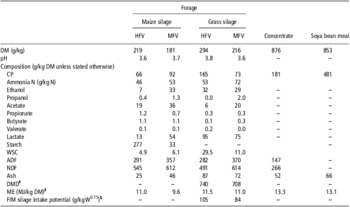
The chemical composition data for the silages and concentrates are presented in Table 1. The silages were all well preserved, as indicated by pH and concentrations of ammonia nitrogen and butyrate. The two grass silages differed in feed value, as indicated by DMD and concentrations of ME, CP and DM. The two maize silages also differed in feed value as indicated by the concentrations of ME, starch and NDF.
Chemical composition of the silages and concentrate

HFV = high feed value; MFV = medium feed value; DM = dry matter; WSC = water soluble carbohydrate; DMD = dry matter digestibility; ME = metabolisable energy; FIM = feed into milk.
‡Determined by NIRS except for concentrate and soya bean meal, which are book values.
As there were significant interactions (P < 0.05 or greater) between concentrate feed level and forage for feed intake, animal performance traits and blood composition of the individual treatments means are presented. Furthermore, the main effects of forage on the measured traits are also presented.
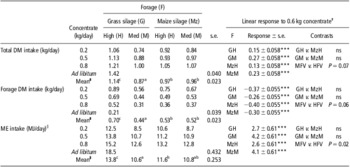
The effects of forage type, feed value and concentrate feed level on food and energy intakes are presented in Table 2. The lambs offered concentrate ad libitum had significantly (P < 0.001) higher mean values for total DM and ME intakes than lambs on any other treatment. Relative to lambs offered the MFV grass silage, the two maize silages increased intakes of forage DM and total DM. Lambs offered the HFV grass silage had significantly higher forage and total DM intakes than lambs offered either the HFV or MFV maize silages. The pattern of differences among the silages in ME intake followed that for DM intake, with the exception that the ME intake of lambs offered the MFV maize silage did not differ from that of lambs offered the MFV grass silage. There was no evidence for a non-linear response to concentrate level for intakes of forage DM, total DM or ME with any of the silages. With all silages, the total DM intake and ME intake increased linearly (P < 0.001) with concentrate allowance and the intake of forage DM declined linearly (P < 0.001). Although the responses in DM intake to change in concentrate allowance did not differ because of the type of forage (maize v. grass), the magnitude of the response was affected by feed value (P = 0.06 and P = 0.07 for forage and total DM intakes, respectively), and this difference was significant (P < 0.05) for ME intake. The increase in ME intake as a level of concentrate supplement increased was greater with MFV silages, which reflected the smaller reduction in intake of MFV silages as concentrate level increased.
Effect of forage type, silage feed value and concentrate level on DM and energy intakes

DM = dry matter; ME = metabolisable energy.
†The difference between performance with supplements of 0.8 kg and 0.2 kg concentrate.
‡Main effect of forage excluding the ad libitum concentrate treatment.
§ME intake.
abcMeans with a superscript in common are not significantly different.
ns = P > 0.05; *P < 0.05; **P < 0.01; ***P < 0.001.
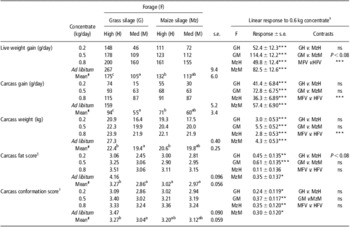
The effects of forage type, feed value and concentrate feed level on live weight and carcass weight traits are presented in Table 3. The performance of lambs offered concentrate ad libitum was significantly (P < 0.001) greater than that with any other treatment for all performance traits.
Effect of forage type, silage feed value and concentrate level on lamb performance

†The difference between performance with supplements of 0.8 kg and 0.2 kg concentrate.
‡Mean effect of forage excluding the ad libitum concentrate treatment.
§5-point scale: 1 = leanest, 5 = fattest.
∥5-point scale with 1 = poorest (P) to 5 = best (E) on E, U, R, O, P grid.
abcMeans within a row with a superscript in common are not significantly different.
ns = P > 0.05; *P < 0.05; **P < 0.01; ***P < 0.001.
The response in average daily live weight gain to increased concentrate level was significantly greater for MFV silages (P < 0.001). Type of forage had no effect on the response to concentrate level in the case of the HFV silages; however, in the case of MFV silages, the response was greater with grass silage than with maize silage (P < 0.07) (the corresponding difference for final live weight was significant; P < 0.05). A similar pattern of effects was evident for carcass gain and final carcass weight but with a significant (P < 0.05) quadratic trend in the case of the MFV grass silage. The average differences among the four silage types showed that average daily live weight and carcass gains, and final live weight and carcass weight, were all significantly (P < 0.01) higher for lambs on diets based on HFV grass silage than those on any other silage. The poorest performance always occurred with the MFV grass silage, although the differences between this and the MFV maize silage were not significant (P > 0.05). Relative to the MFV maize silage, there was a tendency for the HFV maize silage to increase live weight gain (P = 0.08) and carcass gain (P = 0.07).
Results for carcass fatness and conformation scores are presented in Table 3. Both fat score and conformation score increased significantly (P < 0.05) as concentrate level increased with all silages except for fat score of lambs offered HFV maize silage. The significant responses to concentrate level were linear in all cases, except for fat score with MFV grass silage (significant quadratic response; P < 0.01), reflecting the fact that there was no numerical difference in average fat score between the 0.5 and 0.8 kg levels of concentrate when offered with MFV grass silage. Lambs offered the HFV grass silage diet had significantly better conformation than those offered the MFV grass silage and significantly fatter carcasses than those offered any of the other three forages.
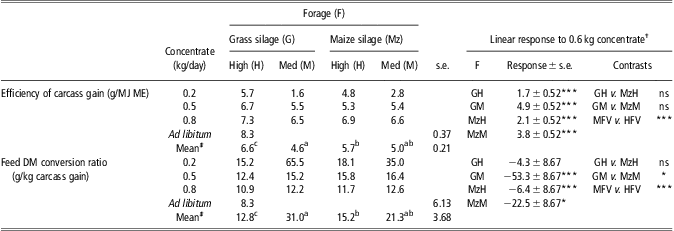
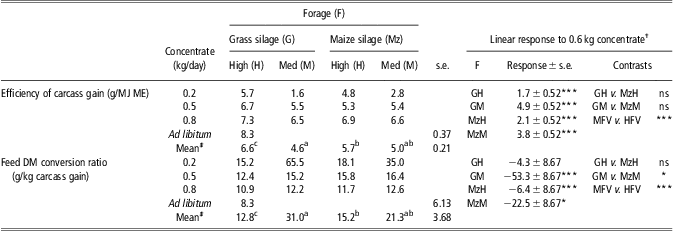
The effects of treatment on feed utilisation are summarised in Table 4 in terms of the efficiency with which estimated ME intake was converted to carcass gain and as the ratio for the conversion of total DM intake to carcass gain. The overall means for the silage types showed that the efficiency of conversion of ME to carcass gain was significantly higher with the ad libitum concentrate diet than the mean value for any of the silage types (P < 0.01) and was higher for the HFV grass silage (P < 0.05) than for any other silage. The lowest efficiency was with the MFV grass silage, which differed significantly (P < 0.05) from that for the HFV maize silage, whereas the value for MFV maize silage was intermediate. The pattern of effects in terms of feed conversion ratio exactly mirrored the differences in the efficiency of ME utilisation. The efficiency of conversion of ME to carcass gain increased linearly (P < 0.01) with concentrate feed level for all silages, except the MFV grass silage where the response was curvilinear (P < 0.01). The average linear response was significantly greater for the MFV silages (P < 0.01). A similar pattern of effects was evident when feed conversion ratio was considered; however, in addition the effect of increased concentrate level was significantly greater (P < 0.05) with the MFV grass silage than with the MFV maize silage.
Effect of forage type, silage feed value and concentrate level on efficiency of feed utilisation
ME = metabolisable energy; DM = dry matter.
†The difference between performance with supplements of 0.8 kg and 0.2 kg concentrate.
‡Main effect of forage excluding the ad libitum concentrate treatment.
abcMeans within a row with a superscript in common are not significantly different.
ns = P > 0.05; *P < 0.05; **P < 0.01; ***P < 0.001.
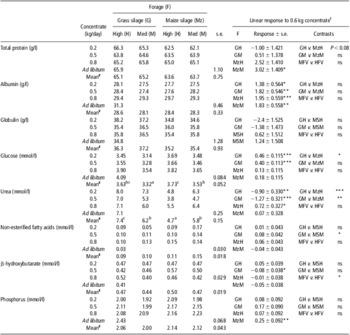
The effects of forage type and concentrate level on blood concentrations of total protein, albumin, urea and glucose are presented in Table 5. The only significant effect on total protein concentration was a linear increase with concentrate level with the MFV maize silage, although a similar, but non-significant pattern, was evident with the HFV maize silage. The concentration of blood albumin increased significantly with all silages as concentrate level increased and these changes were unaffected by forage type or silage feed value. Dietary treatment did not significantly (P > 0.05) alter globulin concentrations. Animals on MFV grass silage had lower blood glucose concentration than those on any of the other three silage types and the concentration of this metabolite increased significantly with concentrate feed level on both MFV and HFV grass silage, but there was no significant change with concentrate feed level in animals offered the maize silages. The difference in response to concentrate between the HFV grass and HFV maize silage was significant (P < 0.05) but the corresponding difference for MFV silages was not significant (P = 0.16). Treatment effects on urea concentration were highly significant. Lambs offered the HFV maize had the lowest concentration, whereas those offered the HFV grass silage had the highest concentration. The concentration of this metabolite declined significantly with increasing concentrate level for both grass silages but increased with concentrate level for diets based on maize silage, although the change was not significant with the MFV maize silage. The pattern of change with concentrate level was significantly quadratic in all cases (P < 0.001 except for the HFV grass silage where P < 0.05). With both maize silages, the lowest concentration occurred with the 0.5 kg level of concentrate.
Effect of forage type, silage feed value and concentrate level on various blood constituents

†The difference between performance with supplements of 0.8 kg and 0.2 kg concentrate.
‡Main effect of forage excluding the ad libitum concentrate treatment.
abcMeans within a row with a superscript in common are not significantly different.
ns = P > 0.05; *P < 0.05; **P < 0.01; ***P < 0.001.
In the case of NEFA and BHB, lambs offered the MFV grass silage exhibited a linear decline in BHB as concentrate level increased (P < 0.05), whereas NEFA increased linearly (P < 0.05). There was a significant quadratic response in BHB concentration to concentrate feed level with both HFV silages; the concentration was least when 0.5 kg of concentrate was offered in the case of HFV grass silage and greatest at this concentrate level with the HFV maize silage.
Phosphorous concentration in blood increased as concentrate feed level increased but the change was only significant (P < 0.05) for animals on MFV maize silage
Discussion
The primary objective of the current study was to evaluate the effects of the feed value of grass and maize silages and concentrate feed level on the performance of finishing lambs. The potential concentrate sparing effect of maize and HFV grass silages was also of interest. The grass silages offered in the present study differed in terms of feed value, as indicated by differences in digestibility and intake potential. The MFV grass silage used in the present study had a similar feed value to the mean for silages produced in Ireland (Keady, Reference Keady2000). Furthermore, the grass silages were representative of the range of silage offered in sheep units in Ireland and the United Kingdom. In the current study, increasing the feed value of grass silage increased carcass gain by 69%. The two maize silages offered also differed in feed value (as indicated by the concentrations of starch, NDF and ME) and were representative of the range of maize silages produced in Ireland and the United Kingdom (Keady, Reference Keady2005). The levels of concentrate offered in the current study ranged from 16% to 84% of total DM intake and this is representative of the range of concentrate inputs used by commercial lamb finishers in Ireland and the United Kingdom.
Inadequate intake of protein has detrimental effects on animal performance (Phipps et al., Reference Phipps, Weller, Smith and Fulford1981). Thus, the 0.2 kg concentrate treatment was offered as soya bean meal, which had a similar ME concentration as the pelleted concentrate. The pelleted concentrate used was formulated so that the diet with the lowest CP concentration would supply sufficient protein to meet animal requirements. The fact that blood protein concentration was not affected by any of the treatment factors indicates that protein supply was adequate for all dietary treatments. Furthermore, the concentration of blood urea was well above the lower bound of the normal range for this metabolite (3.4 to 7.3 mol/l; Castlejon and Leaver, Reference Castlejon and Leaver1994) with all diets. There was a significant linear relationship between daily nitrogen intake and blood urea concentration as described by the following equation:
 $${{\rm{Blood}} \ {\rm{urea}} \ {\rm{(mmol/l)}}\,{\rm{ = }}\,{\rm{2}}{\rm{.74}}\,{\rm{(s}}{\rm{.e}}{\rm{.}}\,{\rm{0}}{\rm{.87)}}\,{\rm{ + }}\,{\rm{0}}{\rm{.13}}\,{\rm{(s}}{\rm{.e}}{\rm{.}}\,{\rm{0}}{\rm{.032)}}\cr \quad X\,{\rm{(}}{{R}^{\rm{2}}} \,{\rm{ = }}\,{\rm{0}}{\rm{.6}}{{{\rm{0}}}^{{\rm{\ast\ast}}}} {\rm{)}}$$
where X = nitrogen intake (g/day).
Effects of grass silage feed value on animal performance
The feed value of any silage is determined by its intake characteristics and digestibility. Steen et al. (Reference Steen, Gordon, Dawson, Park, Mayne, Agnew, Kilpatrick and Porter1998) concluded that digestibility and the protein and fibre fractions are the major factors affecting grass silage DM intake. More recently, Keady et al. (Reference Keady, Mayne, Offer and Thomas2004) concluded that forage intake potential was a key variable in a model developed to predict feed intake by lactating dairy cows offered silage-based diets. In the present study, the concentrations of DM, CP, ADF, NDF and ME differed between the two grass silages, clearly illustrating major potential differences in intake characteristics and consequently feed value.
Increasing silage digestibility has been shown to increase the performance of finishing lambs, ewes in mid and late pregnancy, beef cattle and dairy cows (Keady et al., Reference Keady, Hanrahan, Marley and Scollan2012). From a review of the literature, Keady et al. (Reference Keady, Hanrahan, Marley and Scollan2012) concluded that, although the mean response to each 10 g/kg increase in silage DOMD was an increase of 22.8 g/day in carcass gain of beef cattle, the response to DOMD varied significantly with the forage : concentrate (F : C) ratio of the diet. Keady et al. (Reference Keady, Hanrahan, Marley and Scollan2012) concluded that at F : C ratios of 100 : 0, 80 : 20, 60 : 40 and 40 : 60 each 10 g/kg increase in DOMD increased carcass gain by 33, 24, 16 and 8 g/day, respectively. In the current study where concentrate constituted 19%, 43% and 63% of total DM intake, carcass gain increased by 19, 7 and 9 g/day, respectively, per 10 g/kg increase in silage digestibility, a reflection of the fact that silage accounted for a declining proportion of the diet. Fitzgerald (Reference Fitzgerald1987) reported daily carcass gains of 9.1 and 7.3 g per 10g/kg increase in silage digestibility when concentrate constituted 0% and 30% of total DM intake, respectively.
Although increasing the feed value of grass silage increased ME intake by 32%, carcass gain and fat score increased by 41% and 15%, respectively. Although the lipid and protein concentrations of carcass gain were not determined in the current study, increasing silage feed value improved the efficiency of ME utilisation for carcass gain. Similarly, Steen et al. (Reference Steen, Kilpatrick and Porter2002) and Keady et al. (Reference Keady, Lively, Kilpatrick and Moss2008a) reported that increasing the feed value of grass silage improved the efficiency of feed utilisation by finishing beef cattle.
The differences among treatments for both fat and conformation scores were reduced considerably when carcass weight was included as a covariate. Treatment effects on conformation score were no longer significant. However, carcasses from lambs offered concentrate ad libitum were still significantly fatter (score 3.7 (s.e. 0.12) v. 2.8 to 3.1 (s.e. 0.09) for the other treatments). This is consistent with the well-known phenomenon that at high rates of gain the proportion of fat in the gain is increased (Black, Reference Black1983). Some caution is advised in relation to the results for carcass classification as the implementation of the classification system delivered poor discrimination among carcasses. This conclusion is informed by the fact that, although the overall s.d. for carcass weight was 3.5 kg, 79% of all carcasses were in fat class 3 and 78% were given an ‘R’ for conformation.
Effects of maize silage and comparison with grass silage
On the basis of a review of 34 comparisons involving lactating dairy cows and nine comparisons involving finishing beef cattle, Keady (Reference Keady2005) concluded that replacing a proportion of the forage component of diets based on grass silage with maize silage increased milk yield per cow by 1.4 kg/day, ranging from −1.1 to +5 kg/day and carcass gain per head by 0.11 kg/day, ranging from −0.13 to +0.3 kg/day, respectively. More recently, Keady and Hanrahan (Reference Keady and Hanrahan2008 and 2009) concluded that maize silage can replace HFV grass silage in the diet of pregnant ewes. In the current study, the response to maize silage varied with feed value of the grass silage used in the comparison. Similarly, Keady et al. (Reference Keady, Kilpatrick, Mayne and Gordon2008b) and Keady and Hanrahan (Reference Keady and Hanrahan2009) reported that the response to maize silage tended to decline, as grass silage feed value with which it was compared increased.
Major changes occur in the chemical composition of maize as it matures. The concentrations of ADF and CP decline, whereas starch concentration increases (Phipps et al., Reference Phipps, Sutton, Beever and Jones2000; Keady et al., 2003 and Reference Keady, Mayne and Kilpatrick2008b) owing to the fact that the proportion of plant weight accounted for by the cob increases with maturity. Whilst the optimum stage to harvest grass to be ensiled for feeding to lactating dairy cows, finishing beef cattle or pregnant ewes is at the leafy immature state the optimum state (Keady et al., Reference Keady, Gordon and Moss2012), to harvest maize for ensiling is when the plant approaches maturity. From a review of the literature, Keady (Reference Keady2005) concluded that the optimum stage of maturity at which to harvest maize silage is when crop DM is ∼300 g/kg, whereas more recently Keady et al. (Reference Keady, Kilpatrick, Mayne and Gordon2008b) concluded that the optimum stage to harvest was at a DM concentration of ∼280 g/kg. In the current study, although the DM concentration of the high-DM maize silage as fed was only 219 g/kg, it was 250 g/kg at harvest. The lower DM concentration for the silage as fed was associated with daily usage rate and the exposure of the silage face to rainfall, which was well above normal during the experimental period. However, the forage was mature at harvest as is evident from the starch concentration in the silage. The tendency towards a higher level of animal performance with the more mature maize silage is consistent with previous results for finishing beef cattle (Keady, Reference Keady2005; Keady et al., Reference Keady, Lively, Kilpatrick and Moss2008a), lactating dairy cows (Keady, Reference Keady2005; Keady et al., Reference Keady, Kilpatrick, Mayne and Gordon2008b) and pregnant ewes (Keady and Hanrahan, Reference Keady and Hanrahan2009). Although increasing the maturity of maize at harvest increased ME intake by 7.8%, carcass gain was increased by 15% with no change in fat score. The improvement in animal performance due to increased maturity of maize at harvest is reflected in the higher efficiency of feed utilisation (Table 5). Previously, Keady et al. (Reference Keady, Kilpatrick, Mayne and Gordon2008b) concluded that the response, in terms of milk production of dairy cows, to maturity of maize silage at harvest was because of increased feed intake. However, using finishing beef cattle Keady et al. (Reference Keady, Lively, Kilpatrick and Moss2008a) and Keady et al. (2012) concluded that increasing maturity of maize silage at harvest increased efficiency of feed utilisation based on carcass gain per unit ME intake.
In the current study, the relative increase in forage DM intake associated with changing from MFV to HFV was 3% and 68% for maize and grass silage, respectively. Similarly, Keady et al. (2003 and Reference Keady, Mayne and Kilpatrick2008a) reported that the feed value of grass silage had a greater effect on forage DM intake than was recorded for maize silage. Replacing grass silage with maize silage in the current study altered forage DM intake by +19% and –25%, respectively, for the MFV and HFV silages. Keady et al. (Reference Keady, Mayne and Kilpatrick2003) reported that replacing low feed value (LFV), MFV and HFV grass silages with maize silage altered daily forage DM intake by +1.85, +1.45 and −0.10 kg/cow. Similarly, Keady et al. (Reference Keady, Kilpatrick, Mayne and Gordon2008b) reported that replacing MFV and HFV grass silages with maize silage altered forage DM intake by +2.25 and 0.51 kg/cow daily.
Effects of concentrate feed level on animal performance
The observed increase in DM intake as concentrate feed level increased is associated with the reduction of forage, and thus fibre, in the diet and in the degree of resistance to breakdown in the reticulo-rumen, which controls feed intake on forage-based diets. Previously, Keady et al. (Reference Keady, Kilpatrick, Mayne and Gordon2008b), using dairy cows, Keady et al. (Reference Keady, Lively, Kilpatrick and Moss2008a) and Steen et al. (Reference Steen, Kilpatrick and Porter2002), using beef cattle, and Keady and Hanrahan (2009, Reference Keady and Hanrahan2010 and Reference Keady and Hanrahan2012a), using sheep, reported increased total DM intake for forage-based diets as concentrate feed level increased.
Using dairy cows and beef cattle, respectively, Keady et al. (Reference Keady, Mayne, Offer and Thomas2004) and McNamee et al. (Reference McNamee, Kilpartick, Steen and Gordon2001) reported that increasing silage intake potential and concentrate feed level are major determinants of concentrate substitution rate. The increased DM substitution rate for concentrate (0.59 to 0.84 kg/kg for the MFV and HFV grass silages) because of increased silage feed value in the current study is similar to rates reported for beef cattle (0.58 and 0.80 kg/kg) and lactating dairy cows (0.16 and 0.66 kg/kg) by Keady et al. (Reference Keady, Kilpatrick, Mayne and Gordon2008a and Reference Keady, Lively, Kilpatrick and Moss2008b), respectively. It is of interest to note in the current study that increasing concentrate feed level had a linear effect on substitution rate.
The observation that the response in animal performance (73 and 125 g carcass gain per 1 kg concentrate DM for the HFV and MFV silages, respectively) to increasing concentrate feed level differed with forage feed value is probably because of differences in substitution rate affecting total DM and ME intakes. Fitzgerald (Reference Fitzgerald1987) reported responses in carcass gain of 183, 222 and 230 g/kg concentrate DM for HFV, MFV and LFV grass silages, respectively. These high responses were probably because of the very low levels of performance achieved when these silages were offered as the sole diet. Similarly, previous authors, working with beef cattle (Steen et al., Reference Steen, Kilpatrick and Porter2002; Keady et al., Reference Keady, Lively, Kilpatrick and Moss2008a) or dairy cows (Keady et al., 2003 and Reference Keady, Mayne and Kilpatrick2008b), have reported lower responses in animal performance when animals were offered HFV grass silage compared with those offered MFV grass silage. In the current study, an additional 12.8 and 7.1 kg concentrate DM was required for lambs to gain an extra 1 kg of carcass when offered HFV and LFV grass silage, respectively.
The efficiency of conversion of ME intake to carcass gain improved as concentrate feed level increased. For example, with the HFV grass silage, when concentrate accounted for 16% and 86% of food intake 169 and 117 MJ of ME was required to produce each kg of carcass gain, respectively. Reynolds et al. (Reference Reynolds, Tyrrell and Reynolds1991) reported a greater expenditure of energy by gut tissues when cattle were offered high-forage relative to high-concentrate diets, which probably accounted for the difference in the efficiency of utilisation of ME between the two diets.
Potential concentrate sparing effect
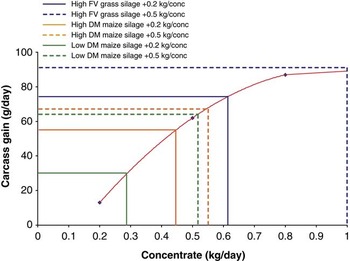
One of the potential benefits of including maize silage or HFV grass silage in the diet of finishing lambs is that this would maintain animal performance while reducing concentrate feed level, which is referred to as ‘the potential concentrate sparing effect’. In the current study, each of the silages was offered ad libitum and supplemented with 0.2, 0.5 or 0.8 kg concentrate per lamb daily. The response in daily carcass gain as the level of concentrate supplementation was increased from 0.2 to 0.8 kg and was quadratic for the lambs offered the MFV grass silage. The data presented in Figure 1 show that the potential concentrate sparing effect of the maize silages and the HFV grass silage declined as concentrate feed level increased. The HFV grass silage and the HFV and MFV maize silages offered with 0.2 kg concentrate per lamb daily sustained the same daily carcass gain, as the MFV grass silage supplemented with concentrate at 0.61, 0.45 and 0.29 kg daily. Therefore, the concentrate sparing effect was 0.41, 0.25 and 0.09 kg per lamb daily for the HFV grass silage and the HFV and MFV maize silages, respectively. Similarly, the concentrate sparing effect of the HFV grass silage and the HFV and MFV maize silages supplemented with 0.5 kg concentrate per lamb daily was 0.5, 0.05 and 0.01 kg concentrate per lamb daily. In previous studies with ewes in late pregnancy, Keady and Hanrahan (Reference Keady and Hanrahan2009) reported that HFV grass silage could reduce concentrate requirement in late pregnancy by at least 80%. The daily concentrate sparing effect from maize silage inclusion in diets based on grass and offered to dairy cows and beef cattle have varied from 1.7 to 3.4 kg per lactating cow (Keady et al., 2003 and Reference Keady, Mayne and Kilpatrick2008b) and from 0 to 2.5 kg per beef animal (Keady et al., 2007, Reference Keady, Lively, Kilpatrick and Moss2008a and 2012), respectively.
Effect of grass silage feed value (FV) and maize silage dry matter (DM) concentration on potential concentrate sparing effect (PCSE) (solid line and broken lines refer to PCSE when medium FV silage is supplemented with 0.2 and 0.5 kg concentrate, respectively).

It is concluded that the use of the CCPM system increased the DM yield of maize by 36%. Increasing grass silage feed value increased animal performance. Substitution effect of feeding concentrate increases as grass silage and maize silage feed value increase.
Acknowledgement
The authors wish to thank Mr N McNamara and Mr T Lally for technical assistance, and Mr P Connelly and Mr T Keane for care of the animals.