In October 1941, it was said that the Jews of this town were to be liquidated. Because they did things with the partisans. Who said this first, I can't say. It spread by word of mouth.
—Leopold Winter, 3rd Company, 691st Infantry RegimentFootnote 1On October 10, 1941, the soldiers of the 3rd Company, 691st Infantry Regiment were uneasy.Footnote 2 The task ahead of them was something new. They were to kill the entire Jewish population of Krucha, a town in central Belarus. A few hours later, Private Wilhelm Magel stood with another soldier in front of four Jewish women and an old man with a long, white beard. The company First Sergeant, Emil Zimber, ordered the Jews to turn away from the shooters, but they remained facing the German soldiers. Zimber gave the order to fire but Magel and his colleague, a former divinity student, did not aim at their targets. They requested to be relieved from the execution detail and were assigned to guard the remaining Jews who were waiting in the village square for their turn.Footnote 3 This German Army unit without assistance of any other organization murdered a minimum of 150 Jewish men, women, and children in Krucha that day.
This killing resulted directly from an anti-partisan conference that had taken place more than a week earlier at the headquarters of Army Group Center (Rear) (rückwärtige Heeresgebiet Mitte, or rHGM) in Mogilev.Footnote 4 Two officers from the 1st Battalion (of which 3rd Company was a part) had returned from this conference with the message “where there is a Jew, there is a partisan.” A week later, the battalion commander, Major Alfred Commichau, ordered that all Jews in his area of control be killed. The Mogilev conference offers us the rare opportunity to investigate the relationship between the anti-partisan war and the Wehrmacht's participation in the Holocaust on the ground. The evidence strongly suggests that, at least in Army Group Center (Rear), the anti-partisan war was used as a vehicle with which to enlist greater support from the Wehrmacht in executing Nazi genocidal policy.Footnote 5 Jews were added to an approved list of enemies to be systematically eliminated. This article will examine how the Mogilev conference accomplished this expansion of Wehrmacht responsibility into genocide and present evidence of this increased complicity in the murder of Jews throughout rHGM and Belarus.
It is important to recognize that Wehrmacht complicity in the Holocaust did not occur in a vacuum, but in the context of a military campaign and of long-term cultural and organizational inputs such as latent anti-Semitism, military discipline, and social-psychological pressures. The intent of this article is not to discount these, but to investigate how the anti-partisan war and the Jew-Bolshevik-partisan construct were used to incorporate the Wehrmacht more fully into the Nazi genocidal project in practice at the local level.Footnote 6 The nature of the partisan threat was intentionally mobilized to provide useful ideological, psychological, and tactical expedients with which to incorporate the Wehrmacht further in the process of the Holocaust in the east. The Mogilev conference, which has often been mentioned in passing but not yet analyzed in detail in the historical literature, is a very significant event and crucial stepping-stone in this regard.Footnote 7
The German Army had a history of harsh treatment of civilians, extending at least back to the Franco-Prussian War of 1870-71, its colonial experience, and certainly through World War I. Isabel Hull, in her study of the institutional and doctrinal development of the Imperial German Army, describes an organizational history of violence that is helpful in explaining the behavior of the Wehrmacht in the Soviet Union.Footnote 8
The actions of the Wehrmacht in Belarus also are reminiscent of atrocities committed by German soldiers in World War I. John Horne and Alan Kramer note three dimensions that led to the myth of the franc-tireur or partisan in this war and thus to the violence inflicted upon the local French and Belgian civilian populations that resulted in 6,500 civilian deaths.Footnote 9 They argue that “first, a set of fictional representations of the enemy crystallized in the first few days of the war … portraying the enemy as the exact opposite of the German soldier and the qualities he embodied.” The “circumstances of the invasion” imposed by the Schlieffen Plan and the “exhaustion and nervousness of troops in a hostile land” were the second dimension. Last, “the defining feature of the franc-tireur fear of 1914 was its capacity to convince large numbers of people that something which was an illusion was actually happening.”Footnote 10 The evidence of German behavior toward civilians in general and Jews in particular demonstrates that a very similar dynamic was in operation in the Soviet Union in fall 1941. Finally, as Omer Bartov points out, one must take into account the tradition of draconian discipline in the German army. He notes, “the strict obedience demanded from the troops, and the draconian punishments meted to offenders, doubtlessly played a major role in maintaining unit cohesion under the most adverse combat conditions.”Footnote 11 This discipline and cohesion combined with a mythic association of Jews, Bolsheviks, and partisans as contributing factors to participation in atrocities.
One must, however, be careful not to draw too straight a line from colonial or Imperial German military practices to Operation Barbarossa. Certainly, the Wehrmacht was different from these earlier organizations. It was larger, increasingly less professional, and more highly ideologically influenced. It also fought under the banner of an openly racist regime and in arguably more desperate conditions. Yet, one cannot also discount the important influence of institutional memory and culture on the decision making of the army, at both high and low levels. Militaries, like other large bureaucratic organizations, tend to be conservative, resistant to change, and likely to retain practices from previous eras. They are even more likely to do this as, given their specialized tasks, they are less susceptible to intervention by civilian authorities. In the case of the German army, used to ignoring weak civilian intervention in the past, it was at least somewhat unprepared for the powerful interference that Hitler represented. In any case, the Wehrmacht entered the Soviet Union with a set of baseline practices and default responses to dealing with civilians that already tended toward the more extreme.
“To be handled as Freischärler”: Wehrmacht Policy Toward Jews and Civilians in the Soviet Union, 1941
[Your] sense of justice has to take second place behind the necessity of war … One of the two enemies must perish; bearers of the enemy view are not to be conserved, but liquidated.
—Lieutenant General Müller to General Staff Officers and Military Judges, June 11, 1941Footnote 12From the very beginning, the Nazi political and military leadership was in agreement that the war in the Soviet Union was to be different from that in France or even Poland: it was to be a war of annihilation. To highlight this fact, the Army High Command disseminated two important documents before the invasion. In the first, the “Guidelines for the Behavior of the Troops,” issued to company level prior to June 21, soldiers were informed that “Bolshevism is the mortal enemy of the German people” and that “this war demands ruthless and aggressive action against Bolshevik agitators, snipers, saboteurs, and Jews and tireless elimination of any active or passive resistance.”Footnote 13 The order went on to note that the “Asiatic soldiers of the Red Army are obtuse, unpredictable, underhanded, and unfeeling.”Footnote 14 Jews were thus explicitly targeted as enemies to be eliminated by the military.
The companion piece to the Guidelines was a May 13, 1941, Führer Decree, which suspended prosecution of German soldiers for most actions in the east. It clearly stated, “punishable offenses committed against enemy civilians, until further notice, no longer come under the jurisdiction of the courts-martial and the summary courts-martial.” This decree removed enemy civilians from protection of military law, giving German soldiers legal impunity in their treatment of civilians. A later clause authorized “punitive measures” against villages under the authority of battalion commanders.Footnote 15 Any prosecution of crimes was to be considered only if “necessary for the maintenance of discipline or the security of the troops.”Footnote 16 Thus, German soldiers were not only given the freedom to do as they pleased, but they were also encouraged to be violent. Indeed, this decree even provided a justification for this violence, blaming “the break-down in 1918, the time of suffering of the German people after that, and the numerous blood sacrifices of the movement in the battle against national socialism” on “Bolshevist influence” and instructed the troops to defend themselves “ruthlessly against any threat by the enemy civil population.”Footnote 17 The overall effect of these orders was to release German soldiers from the constraints of “civilized” warfare and both to rationalize and promote brutal behavior toward civilians and “enemies.”
Additional directives, all of which made it to the lower levels, supported these guidelines. The Commissar Order stated that “political representatives and commissars are to be eliminated” and that “the decision rests with an officer of disciplinary power whether that person is to be eliminated. Identification as political functionary is sufficient proof.”Footnote 18 A personal message from Hitler to the troops on the eve of the invasion reinforced the anti-Semitic message from the “Guidelines.” “Alone for more than two decades,” the Führer claimed, “the Jewish-Bolshevik rulers from Moscow have sought to set fire to not only Germany but all of Europe. It was not Germany but the Jewish-Bolshevik rulers in Moscow that have steadfastly sought to force their domination not only spiritually but above all physically upon ours and other European peoples.”Footnote 19 These then were the explicit messages and justifications that German soldiers carried with them into the Soviet Union.
As the campaign in the east progressed, messages from the top continued to escalate. On July 3, Stalin addressed the Soviet people via radio. “The enemy,” he said, “must be hunted down and exterminated, and all his plans foiled.”Footnote 20 This declaration probably delighted Hitler and prompted his statement made on July 16 that “The Russians have now ordered partisan warfare behind our front. This partisan war again has some advantage for us; it enables us to eradicate everyone who opposes us.” Regarding the security situation in the east, Hitler went on to advise that “the best solution was to shoot anyone who looked sideways.”Footnote 21
This exhortation to more brutal behavior was then echoed and refined by Field Marshal Wilhelm Keitel, head of the Armed Forces, in a cluster of orders. An order on September 8 regarding the treatment of Soviet POWs reiterated that they were not entitled to treatment in accordance with the Geneva Convention. Further, in a section entitled “Segregation of civilians and politically undesirable PWs taken during the Eastern Campaign,” Keitel noted that “the special conditions of the Eastern Campaign demand special measures that can be carried out on their own responsibility, free from bureaucratic and administrative influences.”Footnote 22 As the German army already segregated Jewish soldiers and civilians (along with commissars), there can be little doubt who would be treated by these special measures. On September 12, Keitel issued a memorandum whose subject was “Jews in the newly Occupied Soviet Territories.” He informed the troops that “the fight against Bolshevism necessitates indiscriminate and energetic accomplishment of this task, especially against the Jews, the main carriers of Bolshevism” and forbade the use of Jews as workers in German units.Footnote 23 Finally, on September 16, in response not to a partisan movement in Russia but to the growing insurgency in Serbia and attacks by resistance groups in western Europe, Keitel published a memorandum entitled “Communist Insurrection in the occupied territories.” This document called for “the most drastic means” to combat resistance and suggested the reprisal ratio fifty to one hundred communists for every German soldier killed.Footnote 24 It is important to note this greater European context for an escalation in violence against civilians; however, the connection to anti-Jewish policy is also vital. In Serbia, commanders not only voluntarily chose the higher 1:100 ration for reprisal killings but also immediately began substituting Jews for communists as victims, even though the order did not mention Jews at all. This decision in a separate theater at roughly the same time as the Mogilev conference indicates an important uniformity of reception of the Jew-Bolshevik-partisan calculus among army commanders in which they seem to have automatically understood that Jews were synonymous with partisans.
At the same time, important decisions regarding the Final Solution were also being made. Reinhard Heydrich had already been authorized by Göring on July 31, 1941, to begin preparing plans for a comprehensive mass murder of European Jews beyond that taking place in the Soviet Union. Yet this plan still lived only on paper. Regarding European Jews, Hitler, in a meeting on August 19, would only promise Goebbels to begin deportations of German (and, thus, European Jews) “immediately after the end of the campaign.”Footnote 25 Hitler, however, had been personally receiving the reports of the Einsatzgruppen beginning on August 1.Footnote 26 By mid-September, he had changed his mind regarding deportations. On September 18, Himmler recorded that “The Führer wishes that the Old Reich and Protectorate be emptied and freed of Jews from west to east as quickly as possible.”Footnote 27 The first deportations to the east began on October 15.Footnote 28
A final important context for the Mogilev conference was the Jew-Bolshevik-partisan calculus. In this formulation, all Jews were Bolsheviks, all Bolsheviks were partisans (or at the very least supporters of partisans), and thus, all Jews were also partisans or partisan supporters. This formula is important in explaining the murder of Jews under the guise of the anti-partisan war. The Jew as the supporter of Bolshevism was part and parcel of much Nazi anti-Semitic propaganda. Moreover, it was a well-known trope not limited to Nazis, but pervasive among conservatives in general. For instance, as early as 1935, the German war ministry characterized Soviet party functionaries as “mostly dirty Jews.”Footnote 29 Its extension to partisans was something newer, however. Emphasizing the communist and “enemy” nature of Jews likely helped to activate in the Wehrmacht a greater support for genocidal policy based on latent anticommunist feeling and the appearance of a legitimate military threat. In effect, this construction along with the criminal orders “militarized” the Jewish population of the Soviet Union and allowed them to be “legitimately” targeted by the army.
These high-level directives found their expression in low-level orders and policies prior to September 1941 as well. In July, units were instructed that captured partisans (in civilian clothes) were to be treated as Freischärlers, that is, summarily executed; in addition, civilians who in any way supported these partisans were also to be treated in this way.Footnote 30 RHGM ordered that all former Soviet soldiers found west of the Berezina River were to be summarily executed if they had not turned themselves in by August 15.Footnote 31 Female Soviet soldiers were to be shot out of hand. In the early days of the war, however, the German army's contact with “partisans” consisted mainly of identifying and capturing bypassed Soviet troops. Though not presenting a general military threat, these bands could be locally dangerous and could have fueled rumor and overreaction. These partisans were certainly not the partisans of 1943–44.
The Wehrmacht also had already established that Jews were a different category of civilians, an inferior one. Jews were the first to be identified and used for forced labor. In July, for example, the 350th Infantry Regiment (a unit subsequently represented at the Mogilev conference) “evacuated” the male Jewish populations of the Bialowiezer Forest, which was to be Göring's private hunting preserve.Footnote 32 The division order specified that “all Jewish men [were] to be placed in a camp and to be concentrated into work details.”Footnote 33 The 403rd Security Division's intelligence section observed that “not all soldiers have the proper attitude toward the Jews. They do not approach the Jewish laborers with the desirable ruthlessness and the distance that should be self-evident for national socialist soldiers. Emphasis must be given to intervene against this thoughtlessness.”Footnote 34 Such a statement demonstrates both that there was a “proper” attitude of brutality to be taken with Jews and that military authorities, at least in this division, were intent on imposing it.
In addition, groundwork had already been laid for cooperation between the Einsatzgruppen of the SD and the Wehrmacht. In a directive on June 15, 1941, the 28th Infantry Division (also assigned to rHGM), informed its units that “the Reichsführer SS [Himmler] is carrying out special tasks in the rear areas with his own organs and under his own responsibility. In the rear army areas, only a small group of Security Police and the SD (Sonderkommandos) is to be used to carry out certain tasks specified at the outset of operations … Sonderkommandos of the Security Police and SD work together with the Army Ic.”Footnote 35 RHGM stated clearly in an order dated June 24, 1941, that the Einsatzkommandos were “subordinate to the commander [of Army Group Center (Rear)] concerning march, supply, and accommodation.”Footnote 36 The true nature of this relationship between the army and the Einsatzgruppen would quickly encompass far more than logistical support. This combination of sanctioned brutality toward civilians, official anti-Semitism, and organizational cooperation with the Sipo-SD, along with the Jew-Bolshevik-partisan calculus, permeated the environment in which the Mogilev conference took place.
Jews were already specifically targeted by various SS units. In an operations order issued on July 17 to the SD operating in POW camps, officials were instructed that “all Jews” were among the elements to be singled out and murdered.Footnote 37 The SS Cavalry and Infantry Brigades had also already begun killing Jews and civilians in the context of operations. The SS Cavalry Brigade under Hermann Fegelein reached Baranowicze on July 27, 1941. After a meeting with Erich von dem Bach-Zelewski, the Higher SS and Police Leader for Army Group Center and Himmler's representative, Kurt Knoblauch, Fegelein ordered his men to “handle all Jews [with the exception of skilled workers, doctors, etc.] as plunderers,” that is, to kill them.Footnote 38 Soon, this killing extended to women and children as well. Himmler had ordered on July 31 that “all Jews must be shot. Drive the female Jews into the swamps.”Footnote 39 Gustav Lombard, commander of the 1st Regiment, had then informed his troops that “in future not one male Jew is to remain alive, not one family in the villages.”Footnote 40 The 2nd SS Cavalry Regiment reported in the same period, “We drove women and children into the marshes, but this did not yield the desired result, as the marshes were not deep enough to drown them. In most places, the water was not more than three feet deep.”Footnote 41 These units had already been conflating Jews and partisans and had also been working with rHGM and General Schenckendorff. Schenckendorff himself was fully aware that the majority of killings reported to him as partisans and “plunderers” were primarily Jews.Footnote 42 These killing operations were important as prehistory to the conference, for their key commanders, Fegelein and Lombard, would participate in the conference.
The Mogilev Anti-Partisan Conference, September 24–26, 1941
The town of Mogilev is a provincial capital, located on the Dnieper River in eastern Belarus. Founded in the thirteenth century, the city functioned as a center for commerce between Russia and western Europe.Footnote 43 The Germans entered the largely destroyed city on July 26 after almost a month of stiff resistance. On September 7, the staff of rHGM set up the corps headquarters in the city.Footnote 44 Belarus or White Russia was a complicated zone of occupation for the Germans. The Wehrmacht quickly conquered the wooded and swampy region, advancing more than 280 miles from Warsaw to Minsk in less than two weeks. While the armored spearhead rushed forward, infantry units followed more slowly behind to reduce the huge pockets of encircled Red Army units. Given the sheer numbers of soldiers involved, however, large groups of versprengte (dispersed or bypassed) Red Army soldiers remained at large in the countryside.
While most of these groups were leaderless and probably seeking either to return to Soviet lines or simply to return to their civilian lives, there were some armed groups carrying out minor attacks on German infrastructure and units. The popular image of the partisan movement, however, is the 1943–44 version of agile, vicious guerillas harrying German troops in the snows of Russia. The effectiveness of the partisans in German rear areas is still under debate; only now can much of the triumphalist Soviet historiography of the partisan effort be more evenly evaluated. Certainly, as time passed, the partisan movement had increasingly greater impact on the German war effort by tying down troops, destroying communications, and interrupting logistics efforts. Though Russia had a history of effective partisan units such as the Cossacks, Stalin's prewar refusal to countenance any thought of combat behind the lines left the Soviet Union woefully unprepared for the occupation of its territory. In summer 1941, large-scale, organized partisan resistance had not yet developed, and only fifteen regular or security divisions were employed in the rear areas out of 100+ divisions fighting the Red Army.Footnote 45 One historian goes so far as to argue that the “fragmented and largely unpopular partisan movement posed no major threat to the German occupation” through the end of 1941.Footnote 46
In any case, in summer and fall 1941, the partisan organization and combat ability remained “rudimentary at best.”Footnote 47 This was partly owing to the resolute refusal of Soviet authorities to prepare for any kind of guerilla warfare despite Russia's relatively proud history of using such irregular formations. The advance of German forces also rapidly swallowed large amounts of territory, leaving little time to organize. The effect was that vast amounts of Soviet territory extended hundreds of miles behind the front lines and that resistance movements in these areas were at first left to spontaneous and scattered groups of NKVD, die-hard communists, so-called “destruction battalions,” and dispersed Red Army soldiers willing to carry on a fifth-column war in the enemy rear. Indeed, at this point in the campaign one can reasonably argue as Hannes Heer does for an “anti-partisan war without partisans.”Footnote 48
Thus, the actual partisan threat in rHGM was still low in summer and fall 1941, which makes both the Wehrmacht paranoia of it and the use of the civilian “danger” as a cover for more direct genocidal policies more apparent. As early as July 1941, for example, rHGM warned of “partisan detachments” and ordered that they and any civilians supporting them be treated as Freischärlers, that is, summarily executed.Footnote 49 Casualty figures do not support the depiction of a lethal partisan movement, however. RHGM reported a total of 1,993 German soldiers killed between June 1941 and March 1942, which equates to 200 soldiers a month.Footnote 50 The 286th Security Division in the same area reported a total of eighteen killed and fifty wounded (of whom twenty-two were not evacuated) between June and December of 1941, out of an average strength of 5,700.Footnote 51 Yet from August through December, the same division reported 598 enemy combatants killed in action and 8,131 prisoners taken. This works out to roughly thirty partisans killed for every German and one German killed for every 451 prisoners taken. These casualties hardly indicate a vibrant and dangerous insurgency.Footnote 52 Ratios such as these would be extraordinary for actual combat, let alone for fighting against an elusive enemy such as the partisans. This begs the question, who were the Germans fighting? Along with bypassed soldiers and questionably suspect civilians, unarmed civilian Jews must enter the picture.
The regional characteristics of Belarus, or the Belarusian Soviet Socialist Republic as it was called at the time, are important to both the nature of the Mogilev conference and the events that followed. In many ways, this region was fundamentally different from the regions occupied by the Germans to the north and south, the Baltic states and the Ukraine. Specifically, Belarus had no highly developed or long-running nationalist movement. Thus, it had far fewer local inhabitants willing to support the Nazis for promises of eventual sovereignty.
Partially due to the lack of a more polarizing nationalist influence, relations between Jews and non-Jews were comparatively better in Belarus, decreasing the appeal of Nazi anti-Semitic propaganda. Indeed, in some instances this led to notable support and rescue of Jews. Barbara Epstein notes in her study of the Minsk ghetto that “if the Germans assumed unanimous local support, they turned out to have been wrong.”Footnote 53 Moreover, “the large numbers of Jews and Byelorussians who engaged in resistance from outside the organized underground also played a crucial role, creating a solidarity between Jews and non-Jews.”Footnote 54 This reticence of locals to collaborate caused an even greater manpower problem for the killers, to the extent that units of Lithuanian and Latvian collaborators were brought in to fulfill the roles that locals did in the Baltic and Ukraine.
On September 16, rHGM requested that officers who “as a result of their performance and experience in the battle against partisans can provide a valuable experience report” participate in a three-day “exchange of experiences.”Footnote 55 General Max von Schenckendorff, the commander of this rear area, welcomed the officers who represented units from across rHGM.
An analysis of the participants yields some important clues about the nature of this conference. Sixty officers from various units in rHGM traveled to Mogilev. Wehrmacht personnel represented an overwhelming eighty-two percent of the participants and came mostly from the three major divisions in rHGM (221st, 286th, and 403rd Security Divisions) as well as rHGM staff and one representative of the Army High Command. Also important is that thirty-eight percent of the officers attending were commanders at the battalion or company level.Footnote 56 More than half of the army officers were captains or lieutenants. Thus, the attendees were heavily Wehrmacht, largely junior officers and low-level commanders who were responsible for executing policy rather than making it. In this context, we see another example of the center-periphery dynamic in Nazi policies, with local actors contributing directly to what became higher-level policy.
Some of these men had already distinguished themselves as particularly violent or complicit with genocidal policy. Major Johannes Waldow, 3rd Battalion commander in the 354th Infantry Regiment, 286th Security Division, is a prime example. Less than a week earlier, his battalion had directly supported Einsatzkommando 8 and participated in the murder of 1,000 Jews in the town of Krupki. Captain Balitzki of the 350th Infantry Regiment also attended. An officer in this regiment had earlier recommended that “the Jewish Question must be more radically solved. I recommend the collection of all the Jews living in the countryside in guarded detention and work camps. Suspect elements must be eliminated.”Footnote 57 Thus, some of the Wehrmacht officers who attended had likely been chosen for their extreme and brutal records rather than in spite of them.
Ranks of officers who participated in a three-day exchange of experiences against partisans at the Mogilev conference. Source: “Teilnehmer-Verzeichnis am Partisanen-Lehrgang vom 24.9.1941,” Sept. 23, 1941, Bundesarchiv Militärarchiv (Freiburg) (BAMA): RH 22-225.

The non-army attendees are also very important to an understanding of the tenor of the Mogilev conference. First among these was Arthur Nebe, the commander of Einsatzgruppe B, the mobile killing unit assigned to murder the Jews overtaken by Army Group Center. Nebe had “promptly” volunteered for service in the east with the Einsatzgruppen in an attempt to advance his career and “curry favor” with Heydrich.Footnote 58 He had also arranged for 100 people to be shot as a demonstration for Himmler on August 15, 1941, and had experimented with dynamite and exhaust gas as killing methods on mentally disabled people in September.Footnote 59 By the end of the year, more than 190,000 Jews had been murdered in Belarus, most of them by units under Nebe's command.Footnote 60
Nebe was joined in Mogilev by the Higher SS and Police Leader for Army Group Center, SS-Obergruppenführer Erich von dem Bach-Zelewski. Philip Blood described him as obsessed with restoring family honor after the disgraceful death of his uncle and most of his unit at the hands of HeHe tribesman in German East Africa and a man who “behaved like the champion of all the Nazi rhetoric and dogma that punctuated the SS cult.”Footnote 61 After some early criticism for not being sufficiently radical, Bach-Zelewski strove to be more extreme and won the patronage of Himmler himself.Footnote 62 His frequent meetings with the head of the SS bear out this close relationship. He was “a driven man motivated to exterminate Jews and Communists in the name of Lebensraum.”Footnote 63 Moreover, Bach-Zelewski had already proven himself a great supporter of anti-Jewish actions. It is not surprising then that he would go on to become the Chief of Anti-Partisan Warfare where he would again preside over the wholesale slaughter of civilians and Jews during massive sweeps and the creation of “dead zones” in Belarus. Bach-Zelewski would go on to command the large “anti-partisan” operations such as Hamburg and Bamberg in summer 1942 that would murder huge numbers of Jews.
The cast of experienced killers was rounded out by men such as the commander of the SS-Cavalry Brigade, Hermann Fegelein, and the commander of its Cavalry Regiment 1, Gustav Lombard. Interestingly, the other regimental commander, Franz Magill, was not invited to participate. He was, perhaps, viewed as the less extreme officer, having mainly restricted himself to killing Jewish men.Footnote 64 This brigade began killing Jews in early August in the Pripet marshes and would kill more than 11,000.Footnote 65 Also present were the commander of Police Regiment Center, Lieutenant Colonel Max Montua, and the commanders of Police Battalions 307 and 316, which had already conducted numerous mass killings of Jews.Footnote 66
It was, then, both these experienced killers who had already been dealing with the “Jewish Question” and Wehrmacht officers—some with proven records of violence and complicity—who arrived in the regional capital of Mogilev on the morning of September 24, 1941.Footnote 67 General Max von Schenckendorff encouraged them to participate in a “frank discussion because the war against the partisans is completely new to all of us.”Footnote 68 He informed them from the outset that “townspeople will be used [by the partisans] as guides, scouts, and informants. Particularly the elderly, women, and adolescents, because they are least suspicious, will be utilized for reconnaissance.”Footnote 69 The commanding general thus convened the conference by unequivocally defining women, children, and the elderly as enemy combatants.
The morning was taken up by fifteen-minute presentations of lessons learned in the anti-partisan war by various high-level commanders, including SS-Cavalry Brigade commander Fegelein, Lieutenant Colonel Montua of Police Regiment Center, and Colonel von Rekowski of the 354th Infantry Regiment, whose 3rd Battalion had murdered 1,000 Jews a week prior.Footnote 70 At 11:30 a.m., Einsatzgruppe commander Arthur Nebe gave a presentation that covered three areas: first, “cooperation between the troops and the SD during anti-partisan operations”; second, “the selection and employment of local collaborators”; and third, and most ominously, “the Jewish Question with particular consideration toward the anti-partisan war.”Footnote 71 While we do not know what exactly was said here, it is safe to assume that the importance of killing Jews and likely the increased participation of the Wehrmacht in this endeavor were stressed. Nebe had already reported in July that “a solution of the Jewish Question during the war seems impossible in this area [Belarus] because of the tremendous number of Jews.”Footnote 72 Certainly he was referring here to the insufficient numbers of Einsatzgruppen killers available. Nebe must have been interested in leveraging the manpower of the Wehrmacht in solving this problem.
This manpower problem originated from a convergence of several factors. First, as discussed, sometime in late July 1941 the decision had been made to kill all Jews, regardless of age or sex. This naturally increased the number of Jews to be shot to such an extent that the Einsatzgruppen and SS foresaw problems in accomplishing this mission, as Nebe indicated. Second, Hitler's decision to allow deportations of Jews from Europe meant that room would have to be made for them. This would entail killing operations directed at the main ghetto cities, one of which was Minsk. These operations would then occupy much of the SS/SD killing manpower, leaving little for other areas. Third, with the advance deeper into the Soviet Union beyond what had been the Pale of Settlement, Jews were more geographically dispersed, making operations against them more manpower intensive. Christian Gerlach argues that an early October killing of women and children in Mogilev marked the “start signal” for the general murder of Jews in rHGM.Footnote 73 Certainly, as we have seen, this massacre had already begun; however, Gerlach is correct in marking an important surge of Police Battalion activity in killing, particularly in the countryside, which is further evidence of an expansion in targets.
Nebe was followed after lunch by Bach-Zelewski, who spoke on “The Capture of Commissars and Partisans in ‘Scouring-Actions.’”Footnote 74 The Higher SS- and Police Leader (Höhere SS- und Polizeiführer, or HSSPF) had already been particularly active in such operations with the SS Cavalry Brigade in the Pripet marshes. In the afternoon, the officers observed a model operation conducted by Police Regiment Center, which demonstrated the occupation of a village by surrounding it, and also the dissemination of leaflets. In the evening after dinner, the participants adjourned for a concert of Russian music in the headquarters building.Footnote 75
The next morning, the exchange of experiences continued with SS Cavalry Regiment 1 commander Gustav Lombard leading off. Then, various company grade officers gave short classes or led sand-table exercises on a variety of tactical situations, such as the entry of a battalion into an unsecured area, securing a stretch of highway, and reacting to the murder of a mayor by the partisans.Footnote 76 In the afternoon, the collection of officers observed an actual operation conducted by 7 Company, Police Battalion 322. Approximately fourteen kilometers northwest of Mogilev, a town was searched and its inhabitants interrogated. A summary written afterward stated, “Suspicious strangers to the village [Ortsfremde] and a few Jews were discovered (32 executions).”Footnote 77 Supporting the police was a sixteen-man detachment from the SD.Footnote 78 The war diary of Police Battalion 322, which carried out the operation, provides more telling detail. “Strangers to the village, in particular partisans, could not be found. Instead, the investigation of the population revealed 13 Jewish men, 27 Jewish women, and 11 Jewish children. Of these 13 men and 19 women were executed with the help of the SD.”Footnote 79 Here the participants were provided with a real, firsthand model that accepted the murder of Jews as a default targeting option in the anti-partisan war.
At dawn the final morning, the participants observed another actual operation, carried out this time by Security Regiment 2. According to the operations order, the goal was to “practically experience not only the registration of a town but also the seizure of partisans, commissars, and communists and the investigation of the local population.”Footnote 80 The order contained descriptions of the individuals targeted, who appeared to be mainly former communist functionaries, though four individuals were suspect because they apparently spent large amounts of time in the forest.Footnote 81 After the suspects were rounded up, the participants were to observe the interrogation of these suspect civilians and a subsequent “instruction” of the population.Footnote 82 Upon completion of this operation, the participants left to return to their units.
The final product of this conference was a sixteen-page summary of the lessons learned under the signature of General Schenckendorff. This document began with a discussion of the history of partisan warfare and went on to discuss organization, equipment, and tactics of the partisans as well as recommended techniques for combating them. Much of the document was devoted to the nuts and bolts of conducting various forms of anti-partisan operations. Other recommendations, however, advocated far more extreme measures. Readers were advised that the elderly, women, and children were used for enemy reconnaissance.Footnote 83 Moreover, streets were to be kept free of “wanderers,” who were to be handed over to the Geheimfeldpolizei (GFP, or military secret field police), SD, or civilian labor camps. The guideline was to be “streets free of any Russian.”Footnote 84 Individuals not native to a village, for whom the mayor was not willing to vouch, were also to be turned over to the GFP, SD, or nearest transfer camp.Footnote 85 The most chilling statement introduces the section on fighting the partisans. “The enemy must be completely annihilated,” it declared. “The constant decision between life and death for partisans and suspicious persons is difficult even for the hardest soldier. It must be done. He acts correctly who fights ruthlessly and mercilessly with complete disregard for any personal surge of emotion.”Footnote 86 This document was distributed down to the company level in all units in Army Group Center (Rear), which meant that its lessons both became approved policy and reached units that had not had representatives in Mogilev. Even more telling, it appears that this same document was retransmitted to the police battalions in November 1941.Footnote 87
License to Kill: The Impact of the Mogilev Conference on Wehrmacht Participation in the Holocaust in Army Group Center (Rear)
In fall 1941 around the end of September, a training course was held in the city of Mogilev. As far as I remember, the regimental commander and an officer from each battalion took part. From my battalion, I/691, the adjutant, Lieutenant Großkopp was sent … The subject of the training was primarily Jews and partisans.
—Josef Sibille, former commander of 1 Company, in a letter to the court, 1953Footnote 88Reports indicate that large partisan bands remain in the large swampy forest near the village of Moschkowo. Further, there is regular traffic of strangers to the region who possess no identification, and nonnative Jews also roam around in the entire region.
—Report of 1st Company, 354th Infantry Regiment, October 30, 1941Footnote 89Jews were not mentioned specifically at all in Schenckendorff's sixteen-page summary of the Mogilev conference. What, then, was the impact of the conference on the Wehrmacht's participation in genocidal policy? It seems that a goal and a result of the conference was to incorporate the army more fully in killings of Jews, in conjunction with an increasing brutality toward civilians in general. What evidence supports this? First, it is no great leap to assume that Nebe's presentation regarding the “Jewish Question” and the partisan war contained exhortations for the killing of Jews during and also outside anti-partisan options, perhaps as targets themselves in the anti-partisan war. He was, after all, presiding at the time over the murder of hundreds of thousands of Jews in Belarus. Indeed, the very nature of the attendees strongly suggests that the inclusion of Jews as targets was an experience to be shared. Second, the model operations carried out reinforced the messages from the conference. Jews were clearly both targeted and executed in the operation carried out by Police Battalion 322. In this action, the murder of Jews present in the village was obviously a default position when other “suspects” could not be found. Finally, throughout the conference (and in meetings afterward at corps level), increased cooperation with the SD was encouraged. In several cases later, this cooperation entailed support of the Einsatzgruppen in mass killing.
The most damning evidence appears a little over two weeks after the conference. In the small town of Krucha, soldiers of the 3rd Company, 691st Infantry Regiment of the 339th Infantry Division rounded up and executed all the Jews in their area. The order to do so originated from their battalion commander. The battalion adjutant, Lieutenant Großkopp, had just returned from the Mogilev conference with the message that “where the partisan is, there is the Jew. Where the Jew is, there is the partisan.”Footnote 90 The commander of the 1st Company, who refused to carry out this order, wrote after the war to the prosecuting attorney in the 3rd Company case supporting this connection. He recalled that an anti-partisan conference had taken place in Mogilev and further contended that “the main subject was Jews and partisans.” He further believed that the conference and the battalion order to kill all the Jews in the area in early October were connected.Footnote 91 The battalion commander, upon receiving this message from the conference, ordered his battalion to carry out mass shootings of all Jewish men, women, and children in his area of operations. This is significant because it is rare documentary evidence of the German army independently carrying out Nazi genocidal policy. It did not merely assist other killing units, but instead carried out all aspects of the mass killing on its own … and by all accounts as a result of the Mogilev conference.
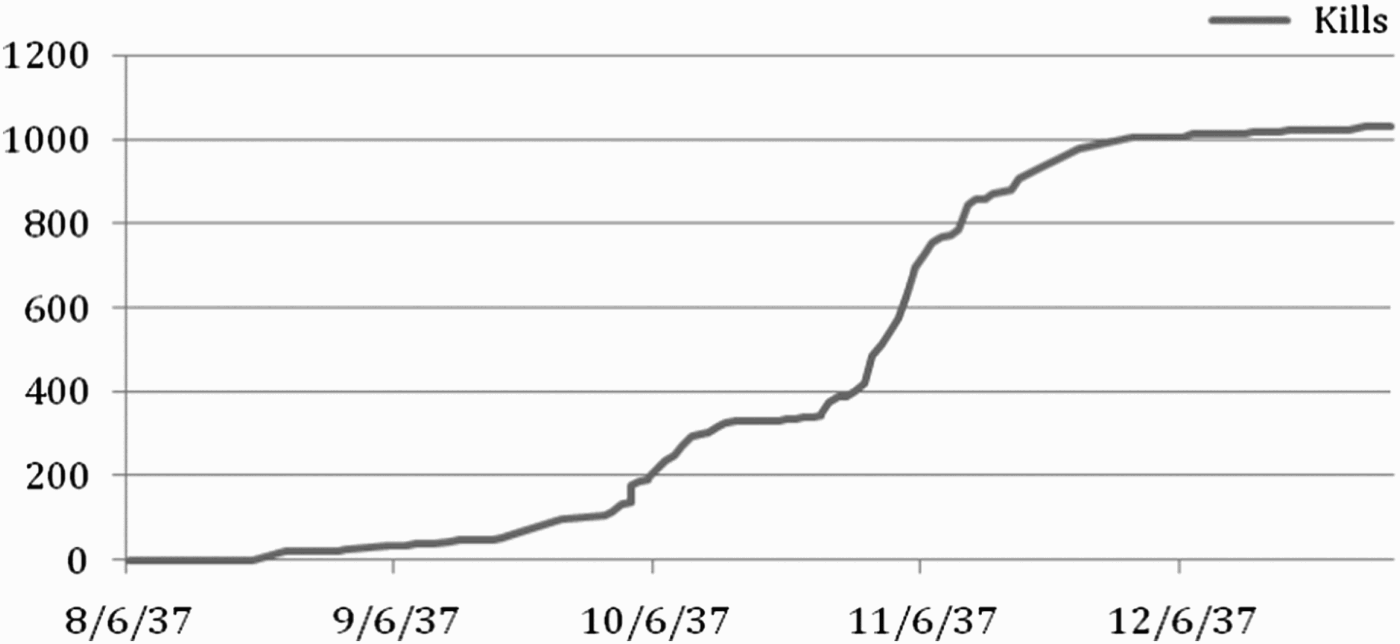
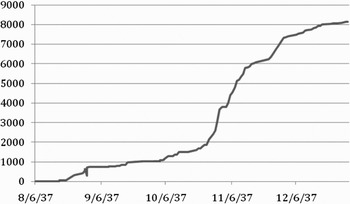
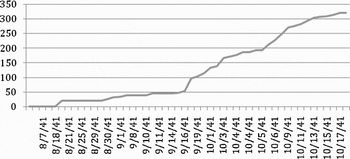
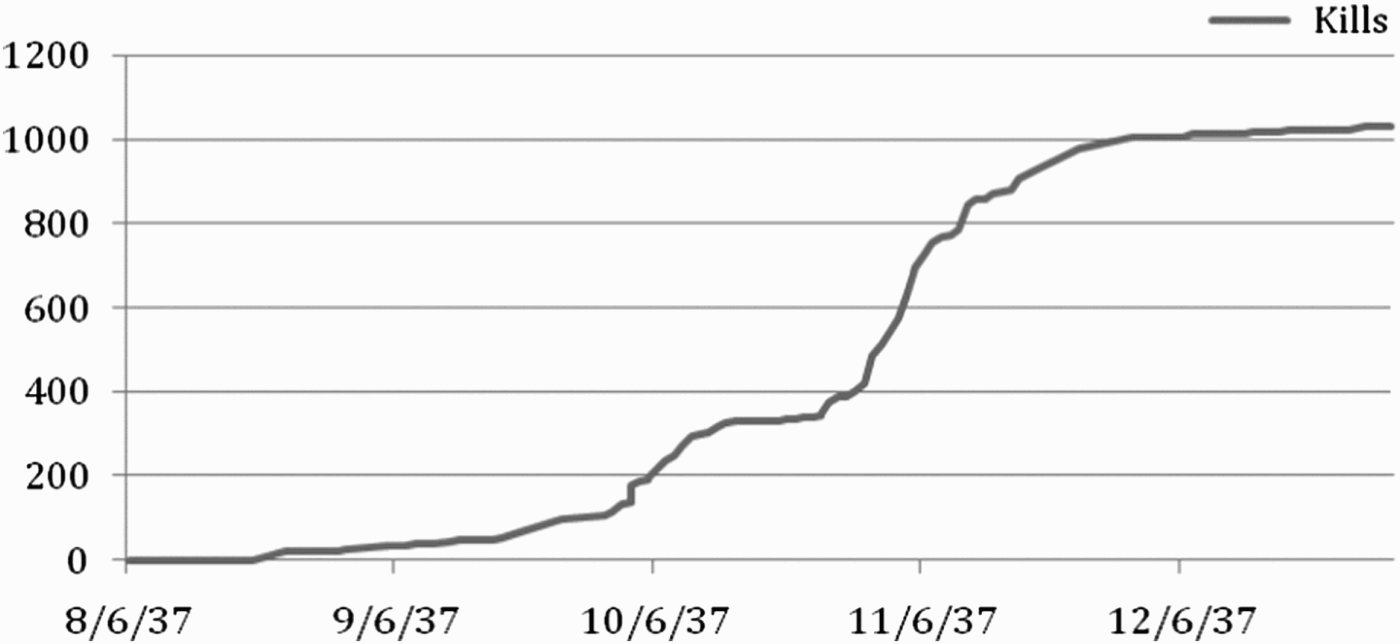
A survey of operations reports across Army Group Center (Rear) also provides quantitative evidence for a deadlier turn in anti-partisan operations. We can see the stark increase in individuals killed in the 286th Security Division beginning in October (see Figures 2, 3, and 4). The 354th Infantry Regiment was the main combat force in this division and had three attendees at the conference. The 1st Company reported that it had shot three Jewish families and two young Jewish-looking women it termed “Flintenweiber,” or female soldiers, though they were shot trying to flee and there is no evidence they were armed.Footnote 93 It is important to note that with typical euphemistic language, the identity of these victims remains intentionally unclear. Categories such as partisan, partisan-helper (Partisanenhelfer), suspect civilians (verdächtige Zivilisten), strangers to village (Ortsfremde), wanderer (Wanderer), and civilians without identification (Zivilisten ohne Ausweis) could easily be applied to both Jews and non-Jews. Yet the numbers here are striking and demonstrate a marked increase in violence against civilians, as partisan activity had not increased to the same extent and German casualties do not indicate any real combat.Footnote 94 In the October reports from the 350th Infantry Regiment (which also had attendees at Mogilev), every Jew mentioned was “shot while trying to escape.”Footnote 95 Captain Balitzki, an attendee at the conference from the 350th Infantry Regiment, wrote on October 14 that “it is unacceptable that officers have to shoot while the men watch. The majority of the men are too soft. This is a sign that they have never or only poorly been instructed about the meaning of the ‘Partisan War.’”Footnote 96 This officer, a leading figure at Mogilev, apparently found some of his men had not yet absorbed its lessons, though he and his fellow officers were attempting to model this brutal behavior for them. It is also worth noting that the numbers of those captured skyrocketed as well. This was no benign activity either, as these people were handed over to the SD or transfer camps with typically lethal results, their deaths merely being delayed.
Running totals of individuals reported killed by the 286th Security Division, August-December 1941. Source: BAMA, RH 26-286-2, -3, -4.Footnote 92
Running totals of individuals reported captured by the 286th Security Division, August-December 1941. Source: BAMA, RH 26-286-2, -3, -4.

Running totals of individuals reported killed by the 354th Infantry Regiment, August-November 1941. Source: BAMA, RH 26-286-2, -3, -4.

Another observable effect of the conference was an increase in collaboration with the SD by Wehrmacht units. Westermann notes that Himmler “placed great emphasis on maintaining a cooperative relationship” with the army and had already encouraged his leadership on August 2 to “maintain the ‘greatest amity’ with” the Wehrmacht. Footnote 97 This cooperation was manifested after the conference in two ways: first, increased use of SD detachments in interrogations of suspect civilians and vetting of local auxiliaries, and second, increased support of those SD units directly involved in anti-Jewish measures far beyond mere logistical support. Three days after the conference, rHGM instructed its units that “cooperation is to be still more closely organized between the divisions and the SD and GFP … Requests for local [ortsfesten] operations by individual troops of the Einsatzkommandos of the SD are to be requested from the commander.”Footnote 98 “Cooperation with the SD” was also on the agenda for the rHGM staff meeting with its subordinate division staffs on September 30 as a lesson from the conference.Footnote 99 In its report for the period from September to December 1941, the intelligence section of the 286th Security Division appeared happy to report that “constant contact was maintained with the Security Service, specifically the Einsatzgruppe of Gruppenführer Neumann, the Einsatzkommando 8 of Sturmbannführer Dr. Bratfisch [sic], and in particular with Untersturmführer Reschke's Orscha-based squad.”Footnote 100 In November, the 339th Infantry Division (which contained the 691st Infantry Regiment) published a guide to the duties and responsibilities of the security forces. Under the SD, listed as “keywords” were “politically suspect civilians, Bolsheviks, Jews, and gypsies.” Among the SD responsibilities were listed “Solution of the Jewish Problem” and the “Gypsy Question.” Finally, the memo instructed that “the troops must shoot Jews and gypsies only if they are proven to be partisans or their supporters. In all other cases, they are to be handed over to the SD.”Footnote 101 Thus, we can see both a clear knowledge of the mission of the SD and an emphasis on increased cooperation and coordination with it. In its most extreme form, the 707th Infantry Division to the west in the Reichskommissariat Ostland, on the orders of its commander, explicitly targeted Jews in the countryside, freeing the SD to focus on cities.Footnote 102
The preponderance of the evidence surrounding the Mogilev conference and the turn in Wehrmacht “security” operations that followed demonstrates that these three days were an important galvanizing moment in increasing the complicity of the German army in the Holocaust in Belarus. The conference instructed the Wehrmacht intentionally to target Jews in its anti-partisan operations. The verbal transmission of guidance regarding Jewish policy was not without precedent. On July 8 in Bialystok, Himmler himself met with Bach-Zelewski, General von Schenckendorff, Colonel Montua of Police Regiment Center, and the commanders of Police Battalions 322 and 316. That same night the police began killing Jews there.Footnote 103 Christopher Browning has convincingly argued that at the end of July/beginning of August 1941, Himmler verbally notified subordinates that now all Jews, regardless of age or sex would be targeted for execution.Footnote 104 Shortly afterward, Jewish women and children who had been previously excluded from mass shootings were now included. Given the attendees at the conference, the nature of the presentations, and the actions that followed, it appears that such a discussion also occurred in Mogilev.
Why? As mentioned, anti-Jewish policy had changed radically the month before, and the numbers of Jews to be killed had now greatly increased. This increase in targets spawned the deployment of more police battalions to the east. It seems logical, then, that the SS also desired that the Wehrmacht be more closely incorporated into this process. Nebe himself had already noted that manpower limitations would prevent him from killing the many Jews in Belarus. Given the prior history of the German army regarding civilians and the already well-established belief that the Jews were behind Bolshevism, the anti-partisan war was the perfect vehicle for leveraging the combat power of the army against the “Jewish Problem.” The commander of the German army, Field Marshal von Brauchitsch, published “Guidelines for the Fighting of Partisans” to the entire army one month after the Mogilev conference. An indication of the important and far-reaching impact of the conference is that he copied word for word the closing text of Schenckendorff's summary: “The constant decision between life and death for partisans and suspicious persons is difficult even for the hardest soldier. It must be done. He acts correctly who fights ruthlessly and mercilessly with complete disregard for any personal surge of emotion.”Footnote 105
Conclusions: Anti-Partisan War as Anti-Jewish War
Because enemy mines are to be expected throughout the “Triangle” region, “Minesweeper 42s” (members of Jewish labor battalions or captured bandits with hoes and rollers) are to be available in sufficient quantities. Units are to equip themselves with cords to use as leashes with which to control the Jews or bandits.
—Operations order for anti-partisan Operation “Dreieck-Viereck,” September 11, 1942Footnote 1062nd Battalion, 727th Infantry Regiment, which was employed as the lead battalion, broke the enemy resistance in a quick attack, in spite of the fact that the advance proceeded slowly due to heavy mining. 4 “Minesweeper 42s” were blown up into the air, thereby sparing any losses of our own troops.
—After-Action Report, Operation “Dreieck-Viereck,” October 19, 1942Footnote 107How and why did the German army become so deeply involved in enacting Nazi genocide? Clearly, from the perspective of those such as Nebe and Bach-Zelewski, additional manpower was necessary in fall 1941 to accomplish the murder of the expanded number of targeted Jews resulting from the inclusion of women and children. Including Jews under the aegis of the anti-partisan war was intended to ease and expand the participation of the army in the Nazi racial project. Indeed, the SS/SD lacked the ability to search systematically for Jews in small villages in the countryside. By killing Jews in the course of its normal anti-partisan patrolling in these areas, however, the Wehrmacht relieved the Einsatzgruppen of this difficulty. The quotations above demonstrate that in a little over a year, the Wehrmacht had become comfortable with using Jews and other civilians as human minesweepers.
While the Wehrmacht was not in opposition to the execution of the Final Solution in the east, it was sometimes reluctant to dirty its own hands in it. Incorporating Jews into an already hyper-aggressive anti-civilian policy likely eased this transition and paved the way for greater complicity by the army up to and including shooting. Raul Hilberg explained some of this complicity saying, “the generals had eased themselves into this pose of cooperation through the pretence that the Jewish population was a group of Bolshevist diehards who instigated, encouraged, and abetted the partisan war behind the German lines.”Footnote 108 For both officers and soldiers who may have been loathe to kill women and children, explicitly connecting all Jews with a developing anti-partisan movement would have both partially allayed these concerns as well as lessened inhibitions by placing anti-Jewish actions (and any resistance to them) in the context of “legitimate” combat operations.
Testimony from former soldiers of 3rd Company supports this conflation. One soldier claimed “it was generally known that Jews made up the lion's share of the partisans and that the partisans were constantly supported by the Jews in the villages, particularly the women.”Footnote 109 Another noted that “at the time of the shooting, many attacks by the partisans had taken place and that the battalion had suffered losses.” He continued, “the members of the company were of the opinion that the Jewish shooting was a reprisal and preventive measure as a result of partisan attacks … Any harmless civilian could be a partisan. There were observations of Jews supplying the partisans.”Footnote 110 There is little indication, however, that the unit had taken any serious casualties. Certainly the 286th Division which had occupied the same area had not. While at some level these statements certainly reflect the postwar environment and attempts at self-exculpation, they are also likely echoes of justifications from 1941, regardless of whether the men believed them then. In many ways, remarks such as these parrot similar ideas from the Mogilev conference.
Anti-Semitism among the officers and men also likely eased this transference. This prejudice could come from a variety of sources. Certainly some men carried anti-Jewish feelings from home.Footnote 111 The official sanction of discriminatory measures and then outright collaboration in mass killing by the army inevitably allowed those with racist predilections to act on them and normalized anti-Jewish brutality within an organizational climate that prescribed excessive brutality against civilians as a matter of course. Cases of Wehrmacht participation in killing throughout Belarus repeatedly feature officers and men who stand out in the memories of their comrades as particularly virulent anti-Semites, convinced Nazis, or simply brutal men.Footnote 112 A soldier in 3rd Company remembered, for example, one sergeant who was “radically opposed to partisans and Jews.”Footnote 113 Racially minded soldiers and officers were often tasked or volunteered to carry out Jewish killings, allowing a minimum of compulsion and disruption of unit morale.
Finally, the tactics of participation allowed soldiers to compartmentalize and minimize any psychological trauma associated with the murder of people who did not fit the conventional image of the enemy. Consider the tactics and procedures involved in capturing partisans in “small operations” that were demonstrated at the Mogilev conference and disseminated to the units in rHGM. Villages were to be surrounded in the last hour of darkness or shortly before dawn. Assault troops were then to enter the village and assemble the population and the mayor. Those who were not native to the village (Ortsfremde) or who supported the partisans were to be identified and handed over to the SD, GFP, or nearest transfer camp.Footnote 114 If Jews were by definition partisan supporters, the import of these tactics was clear. Moreover, in operations where the Wehrmacht assisted in the murder of Jews, these were the same tactics used to identify and round up the victims. The use of these tactics had a secondary effect: they could help to minimize the psychological discomfort inherent in these actions, which was one of the reasons the Wehrmacht had attempted to limit or avoid direct participation.
Assisting in this process was the use of vague and euphemistic terminology in both reporting those killed and describing those targeted. Terms such as “stranger to village,” “wanderer,” “suspect civilian,” “partisan helper,” and “civilian without identification” demonstrate the inexact and elastic nature of these categories. Moreover, consider the equally fluid “evidence” used to prove collusion with the enemy and the very real situations of Jews. German persecution of the Jews inevitably induced behaviors among the victims that were then cited as evidence justifying the necessity of the persecution. Women, children, and the elderly were particularly suspect as supporters; in many areas, Jewish men had either been killed or had fled, leaving a majority of women and children. Behavior such as running or hiding was highly suspect; Jews naturally often attempted to hide from the Germans, particularly in the forest. Civilians without identification were immediately suspect; Jews did not receive identification cards from German authorities (with the exception of work permits, which also clearly identified them as Jews). Thus, if they were caught outside their villages, they would likely have forged identification or no identification at all. Finally, the SD was to be used to ferret out suspected communists and partisans … as well as find and kill Jews. The cumulative effect of these similarities was that Jews could be easily merged into categories that amounted to death sentences.
This “tactical muscle memory” drawing on a similarity with actual anti-partisan actions created at least a semblance of familiarity and an illusion of legitimate military operations to those who wished to take comfort in it. A similar type of emotional refuge could be found in the compartmented nature of these operations: sentry duty on the encirclement, searching of houses, escorting victims. Every action but actual shooting offered soldiers the opportunity to tell themselves they weren't actually participating in murder. This was important because many soldiers recognized that these killings did not fall under the category of conventional combat. Private Magel admitted that “we also knew that the Jews hadn't done anything and that the shooting represented an injustice, at least as far as it concerned women and children.”Footnote 115 It is also interesting to note here that Magel appears to have still believed that male Jews may have deserved to be shot. The illusion of a standard military operation and the false justification of Jews as partisans may have helped soldiers relieve the cognitive dissonance resulting from their knowledge that these actions were beyond the bounds of conventional warfare. A comment from a soldier involved in the 354th shooting a week before the conference is instructive. “We soldiers were merely employed in the encirclement,” he said. “We had nothing to do with the killings.”Footnote 116 Surely this is postwar self-exculpation but also likely demonstrates a conscious distancing from the act itself, and one that probably was in effect at the time as well. Given the well-known concerns of both the SS and the Wehrmacht regarding the psychological impacts of face-to-face killing on their personnel, the utility of the similarity between anti-partisan and anti-Jewish operations was not lost on army leadership.
The Mogilev conference is not a smoking gun proving beyond a shadow of a doubt that the Wehrmacht was specifically ordered to increase its complicity in the Holocaust; however, few decisions regarding the evolution of the Final Solution are clear and simple. The conference and the events that followed provide convincing evidence that Mogilev represented a very important chapter in the German army's participation in the Holocaust, at least in Belarus. The prior records of the conference participants, the messages and “demonstration” operations observed, as well as the subsequent sharp increase in divisional “body counts” and killings of Jews are all signs pointing to the significance of this event.
The conference by itself cannot be seen as the sole cause of increased Wehrmacht complicity in the Holocaust, but more as a point of convergence, a lens that focused a variety of existing factors and influences to mobilize the support of the army in genocidal policy. Extant anti-Semitism and anti-Bolshevik fervor combined with a history of paranoia and excessive brutality toward civilians. In Mogilev, men such as General Schenckendorff, Nebe, and Bach-Zelewski intentionally blurred the line between the “Jewish Question” and the traditionally more legitimate anti-partisan war. They instructed lower-level officers, men at the sharp end of the spear, at least some of whom had been selected intentionally for their past record of brutality and/or extreme beliefs. These men of action then brought this message back to their units, resulting in an observable change in behavior of the Wehrmacht in Belarus.
To understand the larger context of the Mogilev conference better, the Serbian experience provides a valuable comparison. In the Balkans in fall 1941, the Wehrmacht faced a real insurgency and a dangerous movement that inflicted very real casualties. Here, too, the German military viewed the local population through a racial lens and adopted the most extreme of measures to subdue them.Footnote 117 Military-aged male Jews and gypsies were routinely executed in reprisal for German casualties. On September 23, 1941 (the day before the Mogilev conference began), Wehrmacht troops launched a “punitive expedition” in Serbia, executing 1,127 “suspected communists” and interning more than 20,000 men.Footnote 118 After this operation, the commanding general who was not as brutal was demoted for being “too slack.”Footnote 119 After a concerted and ruthless campaign against partisans and civilians alike, the Balkan insurgency was, in fact, brought to heel. As Christopher Browning notes, however, “if the policies of the Wehrmacht did not yet constitute the ‘Final Solution’ … the killing of adult male Jews and ‘Gypsies’ simply because of the ethnic identity was quite simply genocide.”Footnote 120 The tribunal in the Hostage Trial at Nuremberg concluded emphatically that “pre-existing international law has declared these acts … unlawful.”Footnote 121
Thus, Serbia provides an important prehistory and continuity for the Mogilev conference. Even before Barbarossa, we see a Wehrmacht tendency to incorporate racial thinking in its attitudes toward local populations. The army also demonstrated its ready acceptance of Jews and other “racially inferior” groups as legitimate targets for execution in reprisal for a communist-inspired resistance. In addition, German commanders were already being recognized positively for their extreme brutality. Mogilev, then, represented both a continuation of these trends and a departure: no longer were only male Jews targeted and no longer were these killings associated with a legitimate counterinsurgency. Instead, though the anti-partisan war served an important rhetorical purpose, the Wehrmacht was harnessed directly to the Nazi genocidal project in killings that even commanders in Serbia would have recognized had no connection to the war.Footnote 122
It is a sad tribute to the effectiveness of the intentional conflation of Jew, Bolshevik, and partisan that the instrumentalization of this concept on the ground has not been more deeply explored. The view that the anti-partisan war was a simple counterinsurgency action is one perpetuated by the killers themselves. Phillip Blood rightly describes this process as “how the fallacy of anti-partisan warfare expunged the record of Bandenbekämpfung [bandit fighting].”Footnote 123 The Nuremburg Tribunals did not uncritically accept the term as one synonymous with a “clean” anti-partisan war, as some argue. During the High Command Trial at Nuremburg, the tribunal categorically dismissed any legality of German reprisal killings, stating that “the safeguards and preconditions required … were not even attempted to be met or even suggested as necessary.” Referring to the Hostage Case, it termed the killings, in this case in the Balkans where “hostages” were overwhelmingly male Jews as long as the supply lasted, to be “merely terror murders.”Footnote 124 While the court recognized the theoretical legality of reprisals and hostage killings after a lengthy list of requirements had been met, it noted that such a case of the correct use of reprisal could not be found in the war and roundly condemned the German army for its actions. It is perhaps more correct, however, that the police battalions found that “the destruction of the Jews could be semantically disguised as Bandenkampf and later after the war used with initial success as an exculpatory myth for the perpetrators.”Footnote 125 This was not a successful legal strategy at the Nuremburg hearings but may have had more success in later German judicial investigations that only occasionally resulted in trials (and even less often in convictions) and certainly in the constructed memory of veterans. It appears that the Wehrmacht benefited from a similar mythmaking strategy. If the German army used the anti-partisan war as an excuse to murder Jews, historians of the Holocaust must examine and deconstruct this justification. Victimization of Jews was not due to frustration or losses in the vein of the My Lai massacre, but instead to a conscious, deeper incorporation of the Wehrmacht in Nazi genocidal policy.Footnote 126
One prominent historian has suggested that “evidence for the motivation of central and regional [army] commanders in the murder of Jews is lacking” but contends that the food shortage played a decisive role.Footnote 127 While these economic concerns were certainly important for some leaders, particularly in the civilian realm, the Mogilev conference and the events surrounding it offer an alternative explanation for the motivation of army decision makers at the regional (and local) levels. It seems that the military leaders involved were first concerned with perceived security considerations where Jews were all supporters of the Bolsheviks and thus partisan supporters. This justification dovetailed nicely with existing Wehrmacht violence against communists and Red Army soldiers. Second, however, one cannot overlook the very real possibility that at Mogilev these leaders were informed of their role in the overall Nazi genocidal project and needed no secondary justification as camouflage for their actions.
The Holocaust and the anti-partisan war have long remained separated in the historiography of the period with anti-Jewish actions remaining part of a history of Nazi genocide and the anti-partisan war a part of the military history of the war on the Eastern Front. This is a false division. As Edward Westermann concludes, the “fact that the Jewish population of the Soviet Union became a major target of the anti-partisan campaign is indisputable.”Footnote 128 The Mogilev conference shows that these two were never separate, but intentionally connected in an effort to include the combat power of the Wehrmacht more efficiently in Hitler's genocidal projects in the east.