The development of a household emergency plan is often regarded as one of the key elements in individual and family preparedness, which is an important part of public health emergency preparedness.Reference Levac, Toal-Sullivan and OSullivan1-4 Having such a plan could prove more valuable for rapid-onset disasters such as tornadoes when warnings are only issued minutes before they strike and little time is allowed for weighing different options.Reference Simmons and Sutter5,Reference Hoekstra, Klockow, Riley, Brotzge, Brooks and Erickson6 Of a national representative sample, 45% reported that they had emergency plans in 2016, while the percentage was 2% higher for respondents in areas prone to tornadoes.7,Reference Dutwin and Lavrakas8
Despite the prominence of household emergency plans in individual and family preparedness, empirical evidence is sparse concerning what types of plans are more helpful in actual disaster settings. In addition, few studies have examined the importance of family involvement in the effectiveness of a household emergency plan, even though it is recognized that families play an important role in providing support, and mitigating the negative effects of stressful experiences of disasters while discussions among family members are encouraged for their importance to a successful planning process.Reference Chie, Okumura, Tai-Yuan and Wakai9
Furthermore, this study directs attention to the unique vulnerabilities, needs, and challenges of older adults, guided by the social vulnerability perspective, which emphasizes that people with certain characteristics are vulnerable to disasters in the preparation, response, and recovery process. Older adults are over-represented in those who were injured and killed in disasters, especially tornadoes.Reference Legates and Biddle10,Reference Deng, Lv, Xue, Kang, Dong and Zhang11 Some studies have found higher levels of barriers faced by older adults in being prepared for disasters, which could be related to their declined health and disabilities.Reference Dostal12 But there are also studies showing that older adults could be more prepared than younger adults, which is contradictory to common beliefs.Reference Heller, Alexander, Gatz, Knight and Rose13,Reference Adams, Kaufman, Van Hattum and Moody14 For example, a national survey showed that older adults were more likely to be prepared and to have a household emergency plan.7 Our understanding of this subject is still very limited when considering the conflicting evidence and nuances in various contexts.
This study identified different patterns of household emergency plans based on their components and examined how effective they were when associated with those patterns and family discussions in the past two tornadoes in 2013. Built upon the Selection, Optimization, and Compensation theory (SOC) developed in gerontology, this study developed four hypotheses to investigate how the age factor was presented in the above-mentioned processes.Reference Baltes, Baltes, Baltes and Baltes15-Reference Weigl, Mueller, Hornung, Zacher and Angerer17
Tornadoes, like other rapid-onset disasters, could present great threats to properties and people’s physical and mental health.Reference Simmons and Sutter5,Reference Bourque, Siegel, Kano, Wood, Rodríguez, Quarantelli and Dynes18 The Enhanced Fujita Scale, implemented by the National Weather Service (NWS) since 2007, categorizes tornadoes into 6 categories (EF0 to EF5) according to their wind speeds and the degree of damage.Reference McDonald, Mehta, Smith and Womble19 Tornadoes rated as EF-4 or EF-5 could cause astonishing damage and casualties. For example, in 2011, an EF-5 tornado in Joplin directly killed 159 people and an EF-4 tornado in Tuscaloosa resulted in 72 deaths.20,21
The average lead time for warnings by the National Weather Service (NWS) is merely 13 minutes, which is not enough time for information seeking, and is responsible for some of the major casualties.Reference Simmons and Sutter5,Reference Hoekstra, Klockow, Riley, Brotzge, Brooks and Erickson6,Reference Bourque, Siegel, Kano, Wood, Rodríguez, Quarantelli and Dynes18 Therefore, being prepared in advance is essential to minimizing the risks of fear, anxiety, death, injuries, and other short and long-term health and mental health consequences.Reference Norris, Friedman and Watson22-Reference McNeill and Ronan24 For instance, research has shown that having a household emergency plan promotes protective and life-saving actions in tornadoes.21,Reference Cong, Liang and Luo25
Governmental and non-governmental agencies provide a variety of guidelines for developing effective household emergency plans. For example, the Department of Homeland Security suggests that families should consider and plan alternative shelters, evacuation routes, and methods of communication.26 The American Red Cross recommends that families record important contact info, designate an out of town contact, select a meeting place for a variety of instances/situations, and learn of disaster plans at work, school, and daycare to ensure family reunification.27 The Federal Emergency Management Agency (FEMA) suggests that a Family Emergency Communication Plan should include important contact information, social media accounts, medical information, and emergency meeting places, etc.23 Specifically for tornadoes, FEMA emphasizes the importance for the plan to include places to take shelter, either at home or in the community to provide sufficient protection.28
It is noted that there is a great deal of variance in individuals’ planning process. Consistent with the social vulnerability perspective, studies have found that gender, socioeconomic status, race, age, media exposure, and experience are often related to different levels of disaster preparedness.Reference Ekenga and Ziyu2,Reference Norris, Smith and Kaniasty29,Reference McNeill, Dunlop, Heath, Skinner and Morrison30 For example, households with older adults, female-headed households with higher education and income levels, individuals that had experienced disasters previously, and those with more emergency-related media exposure tend to be better prepared.Reference McNeill, Dunlop, Heath, Skinner and Morrison30-Reference Paek, Hilyard, Freimuth, Barge and Mindlin33 Moreover, people living in areas with a history of tornadoes are likely to include a process in their plans for household members to get in touch with each other and to check on neighbors.34
In the meantime, discussions among family members during the planning process could help to address individuals’ needs, reach consensus, and implicitly or explicitly execute drills.4 The American Red Cross encourages families to evaluate the needs of each family member and make plans by discussing potential disasters relevant to their geographical area, identifying responsibilities among them, and practicing plans.35
Despite those recommendations, actual emergency plans developed by individuals could be very different from each other. Few empirical studies have evaluated the quality of those emergency plans developed and examined how helpful they are. Based on prior knowledge and recommendations of different agencies in including critical components such as shelter places, important contact information, and re-unification places, we formulated the following hypotheses:
H1: There are different patterns of household emergency plans; household emergency plans with critical components would be more helpful during actual disaster situations.
H2: Household emergency plans that have been discussed with family members would be more helpful during actual disaster situations.
As some subgroups in the population are shown to be more vulnerable and experience disproportional hardships in coping with disasters, we chose to take a deeper look at older adults in these settings.Reference Enarson36-Reference Tobin-Gurley, Peek and Loomis40 Older adults are more likely to be physically impaired and face more limitations, which prevent them from securing transportation and communication services before, during, or after disasters.Reference Adams, Kaufman, Van Hattum and Moody14,Reference Ngo41-Reference Sanders, Bowie and Bowie44 However, the Selection, Optimization, and Compensation theory (SOC) developed in gerontology, directs attention to processes that enable them to maintain regular functions.Reference Baltes, Baltes, Baltes and Baltes15-Reference Weigl, Mueller, Hornung, Zacher and Angerer17 The selection process of the theory refers to reducing the number of options that are more than allowable by available internal and external resources. Optimization refers to the process of maximizing gains and practicing goal-related skills, acquiring goal-related resources, and modeling others for the realization of goals. Compensation is to activate latent resources and acquire new resources to mitigate losses. Based on this theory, better preparation efforts, such as developing an effective household emergency plan, help older adults to concentrate on a few well-thought-out and viable options (selection) and compensate for their generally declined resources (compensation). The practice or mental visualization of those plans further helps them achieve higher performance when a real disaster occurs (optimization). Thus, we hypothesize that:
H3: A well-developed household emergency plan could be more helpful for older adults than for younger adults.
H4: Discussions among family members could make the plan more helpful for older adults than for younger adults
METHODS
Subjects and Survey Instrument
The data were obtained in 2014 between July and September, more than one year after the EF5 tornado in Moore, Oklahoma (May 20, 2013), and the EF4 tornado in Hattiesburg, Mississippi (February 10, 2013). A telephone survey based on landline and random-digit-dialing was conducted with residents aged 18 years and older, in selected zip codes on tornado tracks with the approval of the Institutional Review Board at Texas Tech University. According to the American Community Survey, in 2012, Moore had a larger percentage of Caucasians (78.5%) than Hattiesburg did (42.8%) and had a slightly smaller percentage of older adults (8.9%) than Hattiesburg (11.0%). Relatively speaking, Hattiesburg residents had higher levels of education as 31.3% of those who were 25 years old or older had a bachelor’s degree or higher, whereas that number was 22.3% for Moore residents.45
We oversampled older adults to be approximately 50% of the total sampling frame. Completed interviews were obtained from 536 respondents. The minimum response rates were between 3.8% and 6.3%, and minimum cooperation rates were between 36.7% and 52.5% for different locations and different population segments, which were generally comparable to other telephone surveys.Reference Dutwin and Lavrakas8,46 The survey included a wide range of questions. Some questions were regarded as core questions and were administered to all respondents. These questions included those about demographics, tornado shelter utilization, warning and evacuation, health, and psychological well-being, etc. Some questions were randomly administered to two-thirds of the respondents. Those questions included mental health utilization, emergency preparation, damage and loss, and recovery, etc. The purpose of the randomly assigned questions to a proportion of respondents is to reduce the burden on the respondents without leaving out important theoretical constructs. In addition, this method makes it possible to use multiple imputations to augment the dataset when needed.Reference Little and Rhemtulla47 Since emergency preparation was a randomized section, only 335 respondents were asked to provide answers to whether they had a household emergency plan before the event. Among them, 242 reported that they had a plan. After removing missing values in other analytical variables (8%), the working sample included 223 cases who reported having an emergency plan before the tornadoes.
Measures
The dependent variable was the effectiveness of the household emergency plan in response to tornadoes. Respondents were asked: ‘How much did the emergency preparation plan help you during this tornado?’ The options included: (1) No help at all; (2) Some help; and (3) A lot of help. Based on this question, we constructed a new dichotomous variable indicating whether the plan was very effective: 0, for no help at all or some help; and 1, for a lot of help. The dichotomization roughly divided the sample into half and could increase the statistical power in data analysis by avoiding categories with a small number of observations.
Predictors included whether the plan was discussed with family members based on the question: ‘Did you ever discuss the plan with your family before the tornado?’ It was coded as 0 for No and 1 for Yes. Predictors also included the attributes of the plan. Six dichotomous variables (yes and no) were used to form typology groups based on whether it contained the following components: when to take action (0 = No, 1 = Yes), an identified place in the home to take shelter (0 = No, 1 = Yes), an identified place outside the home to take shelter (0 = No, 1 = Yes), a plan telling you what to do when you are in different situations (0 = No, 1 = Yes), telephone numbers that you may need (0 = No, 1 = Yes), and a re-unification place that members in the household are aware of (0 = No, 1 = Yes).
Several critical demographic variables were controlled. They included age (0 = 64 or younger, 1 = 65 or older), gender (0 = male, 1 = female), race (1 = white, 0 = others), education (high school or less, some college, college, graduate or professional degree), and marital status (0 = unmarried, 1 = married). Education was used as a proxy to the socioeconomic status because there was substantial missingness in self-reported incomes (i.e., 18% of cases). The location of data collection (0 = Moore, 1= Hattiesburg) was also controlled.
Statistical Analysis
Latent Class Analysis (LCA) was used to develop typologies of household emergency plans. LCA is a person-oriented statistical technique used to identify unmeasured class membership, i.e., latent class, among cases based on observed variables.Reference Hagenaars and McCulcheon48 For example, it has been used to identify different resilience patterns among disaster victims based on observed psychopathology clusters or to identify different inter-generational relationship types based on a variety of indicators of interactions between parents and children.Reference Dutwin and Lavrakas8,Reference Van Gaalen and Dykstra49
In this study, LCA is used to identify different types (i.e., latent classes) of household emergency plans, based on observations of whether individuals’ emergency plans had each of the six components or not. Logistic regression was used in predicting the effectiveness of plans, as the effectiveness of a plan was a dichotomous variable. The key predictors included whether the plan was discussed with family members and membership in different latent classes were identified, i.e., different types of plans. The analysis was run separately for those who were younger than 65 and those who were 65 years or older. The analysis was also run for the whole sample to identify whether the potentially observed differences between the younger cohort and the older cohort were statistically significant (i.e., H3 & H4) by including two interactions: (1) the interaction between age groups and household emergency plan types, and (2) the interaction between age groups and whether the plan was discussed with family members. STATA 15 (StataCorp LLC, College Station, TX) was used for all the analyses.
RESULTS
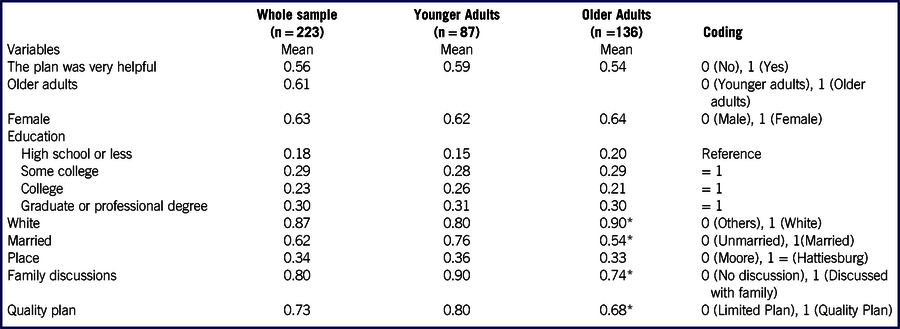
Table 1 showed that older and younger adults did not differ significantly in education, gender, and reporting on the effectiveness of household emergency plans. Older adults were more likely to be white (χ2 (1) = 4.54, P < 0.05) but less likely to be married (χ2 (1) = 11.12, P < 0.05) and to have discussed the plan with family members (χ2 (1) = 7.94, P < 0.05). Older adults were also less likely to have quality household emergency plans (χ2 (1) = 3.94, P < 0.05), the meaning of which was explained below in Table 2.
Descriptives

* significant difference (p < .05) between age groups by χ2 tests.
Latent Class and Typology Developed
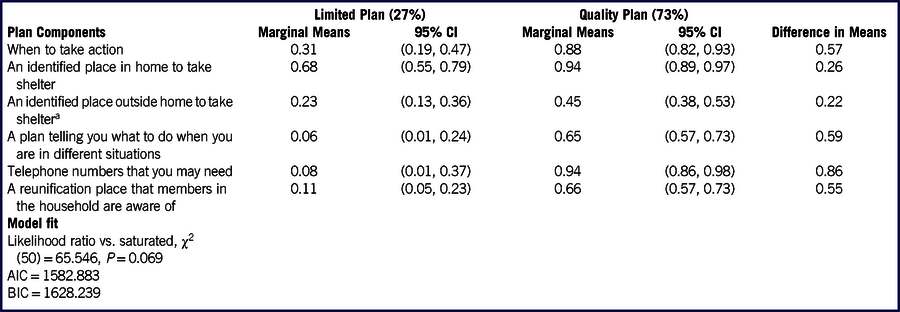
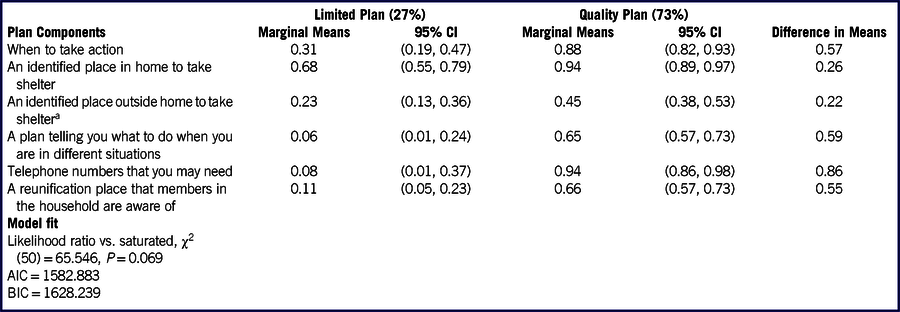
a For example, this could be necessary when the home does not have a shelter, and a neighbor’s shelter or community shelter is identified.
Table 2 showed the result of a two-latent-class model. It did not differ significantly from the saturated model (χ2 (50) = 65.546, P > 0.05) and thus displayed a good fit. In comparison, the three-latent-class model did not converge. Consequently, a two-latent-class model was adopted for the remainder of this study. As seen in Table 2, 27% of plans were classified into the first class whereas 73% were classified into the other. Based on the marginal means of each observable variable in each identified class, we named the first class as limited plans and the other as quality plans. Limited plans, on average, were very unlikely to include a plan telling people what to do when they are in different situations (6%), telephone numbers that they may need (8%), and a re-unification place that members in the household are aware of (11%). What was infrequently included were when to take action (31%) and having an identified place outside the home to take shelter (23%). However, 68% of those plans did have an identified place in the home to take shelter. In contrast, quality plans excelled in almost every dimension, particularly concerning an identified place in the home to take shelter (94%), telephone numbers that people may need (94%), and when to take action (88%). Quality plans outperformed limited plans in other dimensions, but with smaller margins: having an identified place outside the home to take shelter (45%); a plan telling people what to do when they are in different situations (65%); and a re-unification place that members in the household are aware of (66%).
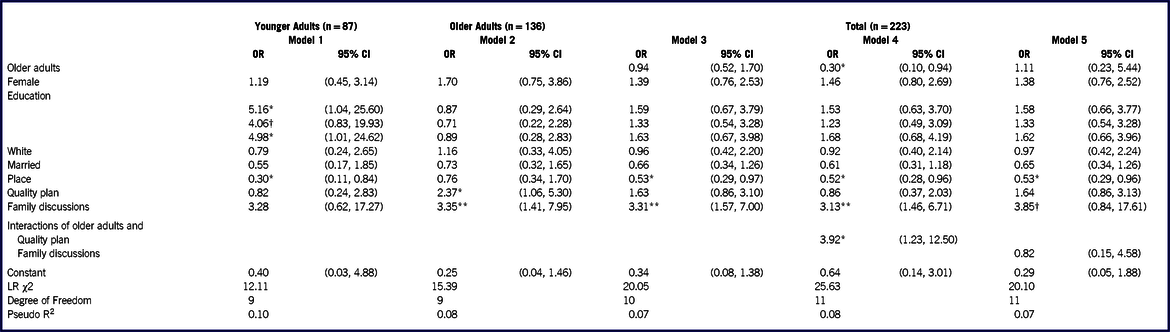
As shown in Model 1 of Table 3, significant predictors for younger adults included place (Adjusted Odds Ratio, OR = 0.30, P < 0.05) and education; those who had some college education (OR = 5.16, P < 0.05) and graduate or professional degrees (OR = 4.98, P < 0.05) were significantly more likely than those with high school or lower certificates to report the plan as very helpful. For older adults, both discussing with family members (OR = 3.35, P < 0.05) and having a quality plan (OR = 2.37, P < 0.05) increased the helpfulness. To test whether the differences between older adults and younger adults in the impact of family discussions and plan types were statistically significant, the interaction between age groups and plan types was included in Model 4 and the interaction between age groups and family discussions was included in Model 5. Model 4 indicated that the difference between older and younger adults in terms of having a better plan was statistically significant (OR = 3.92, P < 0.05), while Model 5 showed that the difference in family discussions was not (OR = 0.82, P > 0.05).
Odds Ratio (OR)a of Predicting a Plan Provided a Lot of Help versus No help or Some help (n = 223)

a Odds Ratios here are adjusted odds ratios, controlling for other variables in the model.
†, P < 0.1; *, P < 0.05; **, P < 0.01.
DISCUSSION
This study examined peoples’ perception of the effectiveness of household emergency plans in two of the past violent tornadoes, the components included in those plans and whether those plans were discussed among family members. We also took a social vulnerability approach and directed attention to age differences.
Two latent types of household emergency plans were identified: quality plans and limited plans. Our results further suggested that the quality plans were more likely to be viewed as helpful, which supports H1. A closer examination of the two age groups revealed interesting differences between older and younger adults. Although quality plans did not show additional benefits for younger adults, they were evaluated more favorably among older adults. The difference was statistically significant as shown by the significant interaction between age groups and plan types, which supports H3, that a well-developed household emergency plan could be more helpful for older adults than younger adults. A possible explanation is that a limited plan is viewed as helpful as a quality plan by younger adults because they are more resourceful and can take actions with minimum guidance, instructions, and preparation at the time of an emergency. However, for older adults with declined physical health and cognitive function, a detailed and easy-to-follow plan would be more beneficial.Reference McLaughlin and Mayhorn50
Also, the results showed that plans could be more helpful if they had been discussed among family members, which supports H2. Interestingly, such added value was only found among older adults, but not younger adults. The difference did not reach statistical significance, which means partial support to H4. Collectively, the findings highlighted the importance of discussing plans among family members and having a support network in place for older adults.
The identification of two latent classes of household emergency plans (i.e., limited and quality) could prove valuable when setting priorities for improving disaster preparedness. As shown in this study, the biggest difference between quality plans and limited plans is whether there were telephone numbers that people may need. Ninety-four percent of quality plans had telephone numbers that respondents may need, but only 7% of limited plans had them. The difference was 87%. Differences were least apparent in whether the plan had an identified place outside the home to take shelter (22%, i.e., 45% – 23%) and an identified place in the home to take shelter (26%, i.e., 94% – 68%). An identified place outside the home to take shelter was likely to be missing even in quality plans, as only 45% of this type had that component. Thus, when resources are limited, the education and outreach efforts should take varied strategies for those people who tend to have a quality plan, and those who do not.
Although older adults are generally regarded as a vulnerable population, some studies indicate more resilience among older adults relative to younger adults, such as indicators that older adults are more robust in the face of disaster-related stress.Reference Adams, Kaufman, Van Hattum and Moody14 The vulnerability and resilience of older adults are nuanced, and the current study suggests that whether older adults are better or less prepared could be highly sensitive to how preparedness is measured. A supplemental χ2 test on the difference between older adults and their younger counterparts in their likelihood of having a household emergency plan did not show significant differences (χ2 (1) = 0.00, P > 0.5), which suggests that older adults may not necessarily be regarded as less prepared if being prepared is simply measured by whether a plan is in place.7 Nevertheless, this study looked deeper into what was included and found that older adults were less likely to have a quality plan that is rich in content. Older adults were also less likely to have a plan that had been discussed with family members. Both factors were important for improving the helpfulness of plans should violent tornadoes occur. Thus, using the parameter of having a household emergency plan as a measure of preparedness could over-simplify the process and hide older adults’ vulnerability. This could reduce the effective allocation of resources and efforts.
Limitations
There are some limitations to this study. First, the study was conducted one year after the tornadoes, which could result in memory bias. Second, income was not controlled due to many missing values. Instead, we used the education level as a proxy of socioeconomic status. Furthermore, the plans we examined were not specific to tornadoes and the components included in the plan might not be comprehensive enough to cover all important dimensions as recommended by disaster management agencies and organizations. Moreover, the dependent variable was individuals’ subjectively evaluated helpfulness of those plans, which could be different from other objectively measured effectiveness variables. Additionally, although our study adopted a random sampling strategy, several factors could contribute to sampling errors. They include reliance on landlines, which excluded those who did not have landlines at home, and the use of a single language, which could exclude those who have language barriers.
Besides, telephone surveys usually have low response rates, which could result in self-selection into the study, as females, whites, and the more educated were overrepresented in the sample.Reference Dutwin and Lavrakas8 Nevertheless, some research shows that telephone surveys could match those high response face-to-face interviews in representativeness on many topics.51 Social desirability could also be a concern since 72% of respondents in this study reported that they had a plan, which was higher than what was found in a national sample in tornado-prone areas (i.e., 47%).7 However, the high percentage of having a plan could be related to residents’ exposure to many violent tornadoes in these areas. Particularly, the Oklahoma City area, where Moore is located, is one of the metropolitan areas with the highest risks of tornadoes in the world.52
CONCLUSIONS
Regardless of the limitations, this study is one of the first to investigate how the patterns of household emergency plans differed and how their effectiveness was evaluated in tornadoes for different age groups. The general conclusion is that a better planning process is more important for older adults than for younger adults. The findings are consistent with the Selection, Optimization, and Compensation theory and highlight older adults’ need for additional preparation and family support in disasters. Programs that serve older adults should be tailored to improve the plan’s comprehensiveness and encourage family discussions. This study provides important empirical evidence and policy implications, on how outreach and education efforts could be customized, and prioritized for diverse populations. Future research could examine factors that contribute to the quality of emergency plans and other contextual factors that affect the effectiveness of those plans. The guiding framework of this study could also be extended to other types of disasters and emergencies, such as earthquakes and mass shootings, and therefore enrich theoretical development for a more disaster-resilient society.
Acknowledgments
This material is partially based upon work supported by the National Science Foundation under Grants CMMI 1839516 and CMMI 1400224. The research presented in this paper is that of the authors and does not reflect the official policy of the National Science Foundation. The Institutional Review Board (IRB) at Texas Tech University approved the data collection (Protocol 504002). The authors worked together on instrument development, data analysis, and manuscript development.