1. Introduction
The importance of extension in agricultural systems has been questioned due to its low effectiveness in improving farmer's welfare (Rivera and Gustafson, Reference Rivera and Gustafson1991; Carney, Reference Carney1998), in spite of extensive literature showing the positive impact of extension on agricultural performance (Birkhaeuser et al., Reference Birkhaeuser, Evenson and Feder1991; Evenson, Reference Evenson2001). In addition, public provision of extension services represents a heavy fiscal burden for governments. Experiences in a number of locations around the world are demonstrating that inefficiencies in resource allocation are unavoidable if a service such as extension is provided free of charge to stakeholders who might be able or willing to contribute in order to obtain appropriate service (Schwartz, Reference Schwartz1994; Dinar, Reference Dinar1996; Carney, Reference Carney1998; Chapman and Tripp, Reference Chapman and Tripp2003; McFeeters, Reference McFeeters2004).
There is no single accepted definition of extension. Although the meaning of the term is well known and accepted by people who work in extension organizations and services, the wider community understands it less. A proposed, general definition is that extension involves the conscious use of communication of information to help people form sound opinions and make good decisions (van den Ban and Hawkins, Reference Van Den Ban and Hawkins1996). Often, the breadth and depth of extension activities exceed this definition. Depending on the extension approach, the portfolio of activities undertaken by extension workers could be as diverse as farm visits or training courses to the building up of institutional linkages or the direct provision of inputs and credit (Katz, Reference Katz2003).
This study treats information and knowledge as agricultural inputs and as the goods that extension services provide. The underlying hypothesis is that as a good, information, has a market, with incentives for private participation. The objective of the research is to determine the marginal value of information to farmers and derive their willingness to pay (WTP) for it. Though a hypothetical value, WTP can help to establish boundaries for information supply price, and guide the implementation of private participation in extension services. Agricultural extension is viewed as a service that can be publicly funded with additional contributions from farmers, but is delivered in a private way. Farmer contributions have two purposes other than supporting the system. First, they increase the incentives for extension delivery. Second, they enhance the accountability of extension agents to farmers.
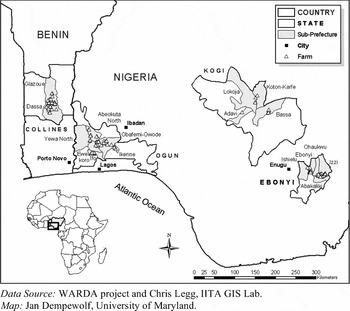
The project on which the research is based was initiated by the West African Rice Development Association (WARDA, now Africa Rice Center) in 1999 to develop participatory tools to enhance farmer participation in developing new rice varieties and explore alternative ways to increase the efficiency of agricultural extension. The project areas of intervention are villages in Ogun, Kogi, and Ebonyi states in Nigeria and Dassa and Glazoue sub-prefectures in Benin (figure 1).
Location of the study sites.

Rice is a main staple and cash crop in Nigeria and Benin, and these countries have a comparative advantage to produce it locally (Ahoyo Adjovi, Reference Ahoyo Adjovi1996; Akpokoje et al., Reference Akpokoje, Lancon and Erenstein2003), however there has been a remarkable decrease in rice yield over the last 20 years, particularly in Nigeria (FAO, 2004; WARDA, 2005b). The public delivery of rice technologies in Nigeria and Benin has been inefficient, a problem accentuated by elevated costs (Akpokoje et al., Reference Akpokoje, Lancon and Erenstein2003).
Since the mid 1980s, the agricultural extension in Nigeria and Benin operated under the training and visit (T&V) approach (Shaib et al., Reference Shaib, Aliyu and Nbakshi1998). Despite efforts to replace it, this scheme still persists in the extension strategy of the Agricultural Development Program (ADP) in Nigeria and the Rural and Development Regional Action Centre (CARDER) in Benin. T&V belongs to the transfer of technology model and concentrates on the transfer of scientific agricultural knowledge and technology from research institutions to farmers. Subject matter specialists train frontline extension agents on new but simple technical issues, while extension agents visit contact farmers to deliver the technological messages (Benor et al., Reference Benor, Harrison and Baxter1984). Three main criticisms of T&V in West Africa are that: (1) the system was designed for homogeneous and controlled conditions, neglecting the tremendous heterogeneity of West African physical, social and economic conditions; (2) T&V had a top–down structure for the delivery of scientific knowledge, restricting farmer participation in the technology generation process; (3) the system was not cost effective or financially sustainable (Idowu, Reference Idowu1988; von der Lühe, Reference von der Lühe1991; GTZ, 2004).
Similar situations have been recognized in a number of different countries, where subsequently extension services have been handed out to private providers or the funding of this activity has been diversified (Carney, Reference Carney1998; Berdegué and Marchant, Reference Berdegué, Marchant, Rivera and Zijp2002; Katz, Reference Katz2002; Rivera and Zijp, Reference Rivera and Zijp2002; Chapman and Tripp, Reference Chapman and Tripp2003; Davidson and Ahmad, Reference Davidson and Ahmad2003; McFeeters, Reference McFeeters2004). The conclusion has been the same with either strategy: not all services need to be publicly provided (Sulaiman and Sadamate, Reference Sulaiman and Sadamate2000).
To assess the level that stakeholders are willing to contribute to extension information about rice varieties, we develop a methodology to estimate WTP for information. The rice varieties we evaluated include inter-specific crosses (New Rice for Africa, or NERICA) and other local and improved rice varieties produced by the Africa Rice Center (WARDA). The innovative aspect of the research is the use of conjoint analysis to estimate the value of information and its effect on farmers’ perceptions and preferences. Findings demonstrate that farmers value information about seed and have a positive WTP for it. Thus, there are possibilities for private participation in providing agricultural extension.
2. Theoretical approach
Demand for seed varieties
Rice in West Africa is a staple good that is produced, consumed and sold by the household. Farmers must select rice with traits that are desirable for on-farm consumption as well as production and sales. Given these conditions, the framework of utility maximization is more complete than that of profit maximization. In consumer theory, demand functions are derived by considering a model of preference-maximizing behaviour, coupled with underlying economic constraints. Under normal circumstances, consumers choose the good that satisfies better their needs or expectations, or that provides them with a higher utility (Luce, Reference Luce1959; McFadden, Reference McFadden and Zarembka1973). The consumers cannot choose a good that they cannot afford because their demand is constrained by their budget.
Utility maximization has been used as the theoretical framework to model rice attribute preferences in several studies in West Africa, where markets are typically incomplete (Adesina and Zinnah, Reference Adesina and Zinnah1993; Diagne and Arsene, Reference Diagne and Arsene2002; Dalton, Reference Dalton2004). These studies have also treated varieties as bundles of characteristics or traits, drawing on the Lancaster theory of consumer choice (Reference Lancaster1966). The Lancaster theory of consumer choice (Reference Lancaster1991) proposes that consumers choose attributes of goods rather than the goods themselves. In other words, utility is provided by the attributes a good possesses instead of the good per se. Individual preferences determine the relative weights given to the various attributes when choices are made. The relationship between goods and attributes as well as among attributes is objective and determined by the consumption technology.
In this study, the consumption technology is the seed variety, or genotype that is consumed by the farmer as a production input. Building on the Lancaster theoretic framework, conjoint analysis (CA), or choice modeling methodology (Bateman et al., Reference Bateman, Carson, Day, Hanemann, Hanley, Hett, Jones-Lee, Loomes, Mourato, Ozdemiroglu, Pearce, Sugden and Swanson2003) allows a utility function to be modeled as the sum of utilities that product attributes generate to a consumer. The methodology is a survey-based, stated preference technique for valuation that relies on individual backgrounds to estimate the marginal contribution of a specific product characteristic to overall preference ratings (Hamath et al., Reference Hamath, Faminov, Johnson and Crow1997). The underlying premise is that consumers evaluate a product by adding utilities from each attribute (Baidu-Forson et al., Reference Baidu-Forson, Ntare and Waliyar1997a). Stated preference methods have been widely used in environmental valuation (Hanley et al., Reference Hanley, Mourato and Wright2001), transportation (Hensher, Reference Hensher1994), tourism (Louviere and Timmermans, Reference Louviere and Timmermans1990), and marketing (Green and Srinivasan, Reference Green and Srinivasan1978, Reference Green and Srinivasan1990).
A number of studies have employed CA to evaluate farmers’ preferences in crops and other technical innovations in West Africa, particularly where revealed preference approaches are not feasible because of incomplete markets or regulated pricing that constrains price differentials among varieties (Adesina and Zinnah, Reference Adesina and Zinnah1993; Baidu-Forson et al., Reference Baidu-Forson, Ntare and Waliyar1997a; Baidu-Forson et al., Reference Baidu-Forson, Waliyar and Ntare1997b; Ndjeunga and Nelson, Reference Ndjeunga and Nelson2005). Similarly, prices for rice varieties included in this study were not observable. CA was used to decompose the structure of farmers’ preferences, given their overall evaluations of a set of rice seed alternatives that were pre-specified in terms of level of different attributes (Green and Srinivasan, Reference Green and Srinivasan1978). Farmers prefer one variety based on its attributes and how they perceive them. Choices or preferences among alternatives depend on the attributes of the variety of rice seed, the characteristics of farmers, including whether or not they sell it, and the level of information they have about the variety.
There are different ways of measuring preferences, mainly: choice experiments, contingent ranking, contingent rating, and paired comparisons (Bateman et al., Reference Bateman, Carson, Day, Hanemann, Hanley, Hett, Jones-Lee, Loomes, Mourato, Ozdemiroglu, Pearce, Sugden and Swanson2003). In choice experiments, respondents choose their most preferred option among different alternatives. In contingent ranking, respondents rank a set of alternative options. For contingent rating, individuals are asked to rate a series of alternatives individually on a semantic or numeric scale. In a paired comparison, respondents choose their preferred option out of a set of two choices and indicate the strength of their preference in a numeric or semantic scale. Choice experiments and contingent ranking share similarities, since contingent ranking could be understood as a sequential choice exercise. Both methods should include a status quo alternative to ensure welfare consistent results (Hanley et al., Reference Hanley, Mourato and Wright2001). Contingent ranking was selected because: (1) it provides more statistical information than choice experiments, which leads to tighter confidence intervals (Hanley et al., Reference Hanley, Mourato and Wright2001); (2) unlike rating systems (contingent rating and paired comparisons), ranking levels are comparable across respondents (Mackenzie, Reference Mackenzie1993); (3) rice farmers have a well-developed skill for ordering or ranking a set of varieties based on their different attributes (Baidu-Forson et al., Reference Baidu-Forson, Ntare and Waliyar1997a).
Demand for agricultural information
While it is true that extension activities involve more than information provision, it has also been recognized that extension activities associated with dissemination of information and direct contact with farmers are those that have been commercialized, or transferred to the private sector (Le Gouis, Reference Le Gouis, Rivera and Gustafson1991). Literature on farmers’ WTP for the information provided by extension services is scant. Dinar (Reference Dinar1996) estimated demand for and supply of extension visits in Israel, deriving WTP for these services from the per hectare value added by subtracting the production cost (including extension) from the revenue. This approach provides a factual estimate of the extension price, but if the value added is not due exclusively to an increase in the number of extension visits, the extension activity might be overvalued. Where extension services are not strong and structured, as they are in Israel, the validity of the approach is questionable. Application of the method requires detailed information not only about farm production but also about extension performance.
Holloway and Ehui (Reference Holloway and Ehui2001) focused on the cash income constraint in a model of consumer demand, deriving the amount of income that a dairy producer in Ethiopia is willing to forgo to obtain an additional unit of service rendered. The decision the dairy producer has to take is whether or not to participate in the market. Market participation depends on the increased price he can obtain for a better product. The WTP is estimated only for individual extension visits. The suitability of this approach depends on the reliability of market prices and the extent to which production is commercially oriented.
Sulaiman and Sadamate (Reference Sulaiman and Sadamate2000) estimated the WTP for extension services for Indian conditions using a contingent valuation method. Farmers were asked directly about their WTP for extension services and valid agricultural information. The authors used a linear discriminant function to predict farmers’ behaviour and evaluate the determinants of their willingness or unwillingness to pay. One caveat of this approach, as in any contingent valuation exercise, is that the WTP is a hypothetical value. Hypothetical values cannot always be correlated with capability or readiness to pay. As explained by Mitchell and Carson (Reference Mitchell and Carson1989) strategic behaviour or compliance bias might affect responses.
When farmers are familiar with fee-based extension services and can give a plausible value, as was the case in the Indian study, the methodology is appropriate. By contrast, financial participation for extension is rare in West Africa. In this study, the WTP value for information had to be estimated indirectly. Conjoint analysis, most commonly applied in market research, provides a powerful theoretical basis for doing so.
By treating information about the seed variety as a product attribute, it is possible not only to evaluate how preferences change but also to estimate the marginal value of the information itself. The product delivered by extension services is information about new technologies, which are improved rice varieties. The information variables account for extension activities conducted during the introduction of the new varieties.
3. Research design
Site selection
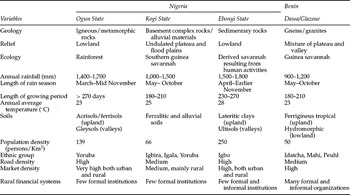
The WARDA project identified rice producers in study areas and conducted on-farm trials. The farmers participating in the project represent the population sampled for this research. The sites studied were originally selected based on ecological criteria used to classify the production conditions of upland rice and test varieties. While there is a preference for lowland cultivation in Nigeria as well as Benin, upland production has great potential in both countries. Villages in three states of Nigeria (Ogun, Kogi, and Ebonyi) and two sub-prefectures in Benin (Dassa and Glazoue) are included. Each site has unique ecological features and social and economic conditions, summarized in table 1 (WARDA, 1999).

Dassa and Glazoue in Benin, and Kogi in Nigeria are classified as Guinea savannah. Rainfall in these sites varies from 900 to 1,200 mm per year in Benin and from 1,000 to 1,500 mm per year in Kogi, allowing in both cases a crop-growing period of 180 to 210 days. There is a marked dry period in the sub-prefectures of Benin, which has been extending in length over the last several years. Drought-resistant varieties represent an important alternative for rice producers in this area.
Kogi state, located in the central plateau of Nigeria, also has a dry period but the villages under evaluation are close to the Lokoja River, which carries water throughout the year. Lowland rice production is more important than upland production in this state, although upland rice is an alternative for small farmers with limited access to good quality land. Kogi and Benin farmers participating in the project had limited experience in upland rice production.
Ogun state in the Southeast is classified as a rainforest area but it also has some savannah areas. The average annual rainfall in this state varies from 1,400 to 1,700 mm per year, allowing a crop-growing period of around 270 days. Upland and lowland rice production are important and farmers are organized in an association called ORGA (Ogun State Rice Growers Association). Ogun state is relatively wealthy with high road density, and a stronger extension office (OGADEP, Ogun State Agricultural Development Project). Farmers have access to village and regional markets and are quite familiar with rice varieties.
Ebonyi state, located in the Southwestern part of Nigeria, is a secondary savannah as a result of human activities and high population density. The volume of rainfall is greater in Ebonyi than in the other sites (1,500 to 1,800 mm per year) and is distributed from April to early November, with a growing period of 230 to 270 days. Traditionally, Ebonyi farmers are rice producers and they are very familiar with rice varieties. The rice produced in Ebonyi is marketed to states around the region, and the rice production and commercialization chain is therefore more developed. Farmers participating in the project take on other roles in the rice production chain in addition to farming, including parboiling, milling, and trading. This diversity of functions affects the way they perceive and assess rice quality attributes.
Data
The sample of farmers was defined by the WARDA project, since these represent the population with potential willingness to pay for seed and seed-related information. Participating farmers were identified in a two-step process. First, rice-growing villages were located with the help of the agricultural extension officials. Next, farmers were called to community planning meetings and invited to participate in the project. A total of 272 farmers decided to enroll in the project activities, including 176 from Nigeria (57 in Kogi, 49 in Ogun, and 70 in Ebonyi), and 96 from Benin (46 in Dassa and 50 in Glazoue).
Three tools generated the primary data. The first tool was a household survey conducted during 2002–2003, addressed to each farmer participating in the project. The survey covered general household characteristics, rice production, market information, and farmer perceptions of rice attributes. Survey data provided the explanatory variables for the econometric analysis.
The second tool was an on-farm trial. Each of the 272 participating farmers agreed to implement an on-farm trial during two cropping seasons to test an improved rice variety and compare it to the local variety in use. Farmers were responsible for: (a) managing of the plot; (b) evaluating rice varieties already available in the area and the new varieties available in stock; (c) selecting the most preferred rice varieties to be tested in WARDA experimental fields in each site; (d) selecting the improved variety to be tested in their own on-farm trial; and (e), providing periodic information to the WARDA technicians about the status of the on-farm trials. WARDA provided the seed and the necessary inputs for the on-farm trials free of charge, most importantly fertilizer and extension assistance. Participation in the on-farm trial is one of the two extension variables included in the analysis.
The third tool was a field day activity where the contingent ranking (CR) method was used to elicit farmers’ preferences for rice varieties. The exercise was carried out in the WARDA experimental field in each site in 2002 after the first cropping season of the on-farm trial. Only 201 farmers of the 272 participating in the project could attend the field day. The task for farmers was to rank a sample of varieties in order of preference, with and without information about the seed. While the ranking in itself is the dependent variable in the analysis, the information obtained in the field day experience represents the second extension variable. Probability of ranking inconsistency increases when the sample size increases (Baidu-Forson et al., Reference Baidu-Forson, Ntare and Waliyar1997a). For this reason, the number of varieties evaluated was limited to five in Kogi, six in Ogun, seven in Ebonyi, and eight in Dassa and Glazoue.
Two scenarios were implemented. In the scenario with ‘no information’, the rice seed samples were presented unidentified to the farmers and they had to base their judgment solely on the characteristics they could see or deduce from the physical appearance of the seed. Observable seed characteristics can provide some genetic information – depending on the farmer's prior knowledge. For example, experienced farmers might recognize seed of a well-known local variety and the variety that they were evaluating in the on-farm trials.
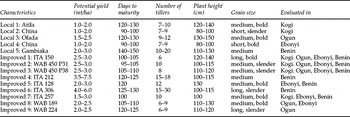
In the scenario ‘with information’, seed samples were labeled with their local and WARDA names, and information about variety characteristics was provided orally and on paper, as shown in table 2. Farmers were guided around the experimental field where the varieties were at the final stage of development and could visually compare the performance, similarities, and differences among the varieties.
Varieties evaluated by farmers and information provided at field day

Source: WARDA, Nigeria.
Rice varieties
The rice varieties ranked by farmers correspond to both lowland and upland rice production. They included the most preferred local variety and improved varieties with ITA and WAB prefixes. ITA varieties are relatively old varieties produced by the International Institute of Tropical Agriculture (NCRI, 2000). WAB varieties are entirely new varieties bred at WARDA. Among them, WAB 450 P31 and WAB 450 P38 are NERICA (New Rice for Africa) varieties.
NERICA varieties are the result of a novel, inter-specific cross between rice originating in Asia (O. sativa) and rice originating in Africa (O. glaberrima) with the purpose of cross-introgressing traits between these species. These crosses are characterized by their high, stable yield (from O. sativa) and the ability to resist or tolerate adverse environmental and biological conditions (from O. glaberrima). NERICA varieties have short stalks, mature early, and compete well with weeds. In addition, they have higher protein content (WARDA, 2005a). NERICA thus represents a technology with the potential to increase farmers’ welfare. WAB 450 P38 has recently been officially released in Nigeria as NERICA 1, though this release does not correspond to the period of our analysis.
4. Econometric model
Specification
The model states that when farmers select rice seed among alternative options, they actually compare single attributes (r i) of the variety (R). The selection process is influenced by the characteristics (f i) of the farmers (F) and information about the seed (Y). As in a random utility approach (Luce, Reference Luce1959; McFadden, Reference McFadden and Zarembka1973), the variety selected is assumed to provide farmers the highest level of utility. The utility function is therefore defined as

Farmers select the best of the options according to the level of related information, Y. Rice choices are made independent of the consumption of the other goods, Z. Since utility is not directly observable, an indirect utility function (V) is specified. In theory, seed price (P) is an argument in the indirect utility function that is finally expressed as a function of

Plausibly, the farmers’ best choice could be a variety of seed that is not available. Then, farmers would select the next accessible variety with the attributes that fit their requirements, as their second best choice that attains a lower level of utility. Utility is not amenable to direct estimation. The utility level generated by each variety can be indirectly expressed by a preference ranking, implying that

where income (M) does not vary across the samples ranked by a farmer, the term drops out (Mackenzie, Reference Mackenzie1993; Baidu-Forson et al., Reference Baidu-Forson, Ntare and Waliyar1997a). In other words, the farmer remains at the same utility level, while rice seed price changes. The indirect utility function can be linearly specified as (McFadden, Reference McFadden and Zarembka1973; Hanley et al., Reference Hanley, Mourato and Wright2001)

The advantage of the linear model is that the coefficients of the independent variables are marginal utilities: MUri = ∂V/∂ri = bri (Mackenzie, Reference Mackenzie1993). The marginal utility of an independent variable represents the relative change in the value of the independent variable needed to change utility by one unit (keeping the other variables constant). The ratio of marginal utilities of two attributes is the marginal rate of substitution (MRS). The MRS expresses the amount of an attribute the consumer is willing to give up in order to obtain one more unit of another attribute at the same level of utility: MRSr 1r2 = MUr 1/MUr 2 = br 1/br 2. When one of the attributes is price, the equation is the inverse compensated demand for the attribute. The ratio of a given attribute or extension variable coefficient to the seed price (P) coefficient is the inverse compensated demand or implicit price ratio (Hanley et al., Reference Hanley, Mourato and Wright2001) for the attribute

As specified, the model could be directly calculated using a normal linear probability model (LPM). The LPM model is a simple ordinary least square (OLM) regression that relates the probability of a ranking occurrence to the attributes of the varieties. Due to the discrete nature of the dependent variable, the LPM is constrained by its linear definition, heteroscedasticity, and non-normality of the disturbances (Gujarati, Reference Gujarati1995). Logit or probit maximum likelihood models can be used to accomplish the same estimation, and these are more appropriate in dealing with discrete dependent variables. Both models adjust better to a probability curve by using a logistic and a normal distribution function to estimate the probability of a certain ranking occurrence. They also have the advantage that the utility function itself remains linear in the parameters. The difference between the output of an ordered probit and logit is minimal (Gujarati, Reference Gujarati1995; Greene, Reference Greene2003), although probit is preferred when the order value of the dependent variable is important.
Notice that although the estimator for parameter b is known, the asymptotic distribution of the implicit price ratio estimator is not known, given that it is not a linear function of the parameter (Hanley et al., Reference Hanley, Mourato and Wright2001). The standard errors of the implicit price ratios for the information attributes were then estimated using the delta method. The delta method, in essence, expands a function of a random variable about its mean, usually with a one-step Taylor approximation, and then takes the variance.
The model is built around a latent regression in the same manner as a binomial probit model, where the respondents have their own intensity of opinion that depends on certain measurable factors or deterministic element x and certain unobservable factors or stochastic element ɛ (McFadden, Reference McFadden and Zarembka1973; Hanley et al., Reference Hanley, Mourato and Wright2001)

K* is unobserved, but what is observed are threshold values of K
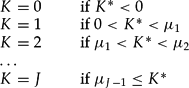
Then, for polytomous responses with ranking outcomes Ki = 1, 2, 3, . . ., i, the probability p of observing Ki is
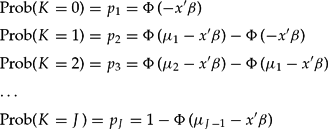
where Φ represents a normal cumulative distribution function, x a vector of independent variables, and μ is the unknown parameter to be estimated with β.
Equation (4) was estimated with a multinomial ordered probit model specified as the probability of ranking K [Pr (K)], where

The vectors of the parameter estimates δ, φ, γ, and φ are embedded in the coefficient vector β′ equation (6), R accounts for variety attributes, F for farmer characteristics, Y for seed-related information from extension activities, P for rice seed price, and α represents the conventional intercept plus the additional intercept dummies or threshold variables (Hamath et al., Reference Hamath, Faminov, Johnson and Crow1997). In addition, in order to have positive probabilities: 0 < μ 1 < μ 2 < ⋅⋅⋅ < μ j−2 (Greene, Reference Greene2003).
Explanatory variables
As compared to Asian or American rice, there are no pre-established market standards for rice grain or agronomic quality properties in Nigeria or Benin. Farmers surveyed identified five attributes (R) they consider when selecting varieties of rice seed: potential yield, days to maturity, tillering capacity, plant height, and size of the grain. Each of these is a fundamental agronomic characteristic of importance to farmers who consume seed as a production input, although grain size is also an attribute sought by those who consume the product. Grain size coded as an effect dummy (best option = 1; indifferent = 0; worst option = −1). The best option corresponds to rice with long, bold grains, while the worst option is represented by small, slender grains.
Attributes omitted from the analysis were grain color, height uniformity and milling capacity. Grain color, although important, was not included because of the sizable difference between the color of the local varieties that were parboiled and milled locally and the color of the improved varieties that were parboiled and milled under experimental conditions. Farmers listed height uniformity only because the latest materials were released unfinished and still demonstrated low field stability and height disparities. Milling attributes reflect a more complex problem concerning processing methods and grain quality. Technical information about the levels of related agronomic characters per variety was insufficient.
In similar studies, an orthogonal array was developed to generate product profiles that consumers then evaluated (Mackenzie, Reference Mackenzie1993; Baidu-Forson et al., Reference Baidu-Forson, Ntare and Waliyar1997a). As compared to hypothetical varieties in the research development pipeline, we are dealing with finished varieties. Finished varieties have attribute levels that vary under farmer conditions depending on interactions of the genotype with the environment. Here, expected (in a statistical sense) levels of variety attributes are drawn from multi-year, multi-locational trial data that account statistically for variation in management and growing conditions (table 2).
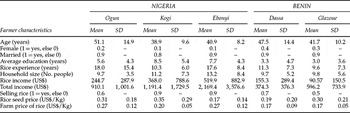
Farmer characteristics (F) include: age, gender, years in school, marital status, experience in rice production, the size of the household, income from rice production, and whether or not the farmer sells rice (summarized in table 3). Age, gender, and marital status characterize rice producers, and affect variety preferences. Years of school and experience in rice production express farmer knowledge. Farmer knowledge could affect preferences for rice seed and ability to assimilate seed-related information effectively. Income earned from rice sales reflects the extent of commercial orientation and the economic situation of the farmers. In West Africa, household size is also an indicator of better economic status.
Descriptive statistics for farmers surveyed

Information provided through extension activities (Y) was measured by two dummy variables. ‘On-farm trial experience’ took the value of 1 when the farmer evaluated the variety he or she grew in the on-farm trial, and zero otherwise. After observing the variety on the farm, farmers became familiar with its attributes and their judgment was affected by the information acquired with this activity. The value of ‘field day information’ was 1 when the information in table 2 was provided at the field day activity and zero if the farmer was presented only with unidentified seed samples.
Since not all of the improved varieties have been officially released, a set of seed prices was not available in each case. Several varieties have been used by farmers for some years, but improved varieties, such as the NERICAs, are completely new to farmers. Contingent valuation (CV) was used to elicit prices paid by farmers for seed of improved varieties (P). Given the number of varieties in evaluation, the open-ended question format provided a more simplified exercise for the farmers. According to the NOAA blue ribbon panel (Arrow et al., Reference Arrow, Solow, Portney, Leamer, Radner and Shuman1993), a binary dichotomous choice question is the most desirable form of CV elicitation. The efficiency of the dichotomous choice formats, however, is constrained by the larger samples required to collect information by respondent. This makes surveys more expensive and time consuming. Due to the limited size of the sample in our study, an open-ended elicitation format was employed. Moreover, farmers surveyed are accustomed to paying for rice seed, which they buy in the market or from extension offices. A limitation of the CV method is that strategic behavior could lead to understated or overstated rice seed prices (Hoehn and Randall, Reference Hoehn and Randall1987). Farmers could perceive this exercise as a market test to determine future seed costs, demonstrating strategic behavior and ‘underpledging’ in their responses (Mitchell and Carson, Reference Mitchell and Carson1989). Rice seed availability in the study areas is a problem identified by farmers, so that ‘underpledging’ would carry the risk that seed might not be provided. Under these conditions it is in the farmers’ interest to state their true willing-to-pay price for the rice seed.
5. Results
Descriptive statistics
Farmer characteristics, rice seed price of sampled varieties elicited from farmers, and the farm price of rice are summarized in table 3 by site. Farmers are considerably older in Dassa and Ogun than in other sites. Women participate more in rice production in Benin, where it is more likely to be a task for which they are responsible. In Nigeria, men's agricultural work is often related to crops such as yam or cassava, while women undertake the production of vegetables and cash crops, including tomatoes, groundnuts, and pepper to meet their own consumption needs. In Nigeria either the husband or wife manages rice plots. Women are often in charge of smaller rice plots for family consumption needs, while men manage the larger rice plots for commercial sales. On the other hand, in Benin, rice production is most likely a task for the wife, which explains the difference in gender composition of the sample across countries.
Households in the sites surveyed are often organized around a male household head with several wives. Polygamy is socially accepted and it also provides additional household labor (White, Reference White2002). This fact is especially important for rice production, since labor is the most expensive variable cost. Female household heads are mainly widows. The average household size of a rice-producing family in either country is above ten members. The household size is particularly large in Ebonyi, which also shows the highest labor cost among the sites.
Rice production is more extensive in Nigeria than in Benin and the production chain is more developed, especially in Ebonyi state. A higher percent of farmers selling rice was reported in the Nigerian sites, which is also linked to a relatively higher quality of the final product sold. Except for Kogi, in the other two states in Nigeria, farmers sell processed rice (parboiled and milled). Survey data also indicate that farmers in the Nigerian states of Ogun and Ebonyi generate a larger percentage of their income from rice production, which is probably due to greater experience in cropping rice in these two states relative to the other sites. Total income is considerably higher in Nigeria than in Benin.
Table 3 also shows that, except for Ebonyi, rice seed price for the improved seed samples elicited from farmers is higher than the actual farm gate price of the local rice. One explanation for this finding could be that Ebonyi is the site with the greatest degree of specialization in rice production and marketing. Farmers in Ebonyi are involved in more than one step of the production chain and almost all of them sell parboiled and milled rice. The milling facilities are organized in a milling company and have developed essential quality standards based on the characteristics of the most important rice types produced in the state. A large percentage of the population in the state is involved in rice production, generating an excess supply that is traded in neighboring states. An improved rice variety must demonstrate similar or better quality characteristics to compete with the local varieties.
Ordered probit results
Complete and valid information was gathered for 201 farmers (30 from Kogi, 38 from Ogun, 49 from Ebonyi, 40 from Dassa, and 44 from Glazoue), generating for each case scenario a total of 150 usable rankings in Kogi (30 observations * 5 varieties evaluated), 228 in Ogun (38 * 6), 343 in Ebonyi (49 * 7), 320 in Dassa (40 * 8), and 352 in Glazoue (44 * 8).
The model was estimated for each site and for all respondents. Each site had a different number of varieties evaluated. For the model considering all respondents, rankings were adjusted to include only the four varieties evaluated in every site: the local one, ITA 150, WAB 450 P31, and WAB 450 P38. The transitivity property of the rankings enables recoding. Given the reduction in the number of variety attributes, samples pooled at country levels revealed no additional information and are not reported.
A number of formal approaches can be used for testing for model specification, the most common of which are the Lagrange multiplier (LM) test, the likelihood ratio (LR) test, and the Wald test. In each of these approaches, two models are formulated, a restricted model and an unrestricted model. The likelihood ratio test is preferred when a direct comparison is made between nested hypotheses that can be treated with parameter restrictions (Ramanathan, Reference Ramanathan1998). The test statistic is defined by the ratio of the maximum value of the likelihood function under the null hypothesis (the restricted model) divided by its maximum value when no restrictions are imposed. The test statistic is asymptotically distributed as chi-squared, with degrees of freedom equal to the difference in estimated parameters (Mazzanti, Reference Mazzanti2001).
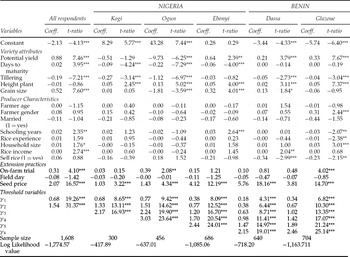
Table 4 summarizes the results of six separate probit models representing each site and the pooled sample. The pooled model was compared to: (1) an unrestricted model that allows for site-specific marginal and fixed effects; and, (2) an unrestricted model that allows for country effects. The null hypothesis, that separate site effects is equal to zero, was rejected with a Swait–Louviere log-likelihood ratio test at the 1 per cent significance level. In other words, data do not support the hypothesis that the underlying population parameters are similar across sites. When the sites are pooled by country, the differences are not as strong and the null hypothesis is rejected with only a 10 per cent significant level.
Ordered probit results

Notes: *denotes significances at the 10% level, ** at the 5% level, and *** at the 1% level.
The Swait–Louviere Log Likelihood Ratio Test used to compare the pooled model vs individual site samples rendered a value of 19.75, which was higher than the chi-squared critical value of 13.27 at 1% with 4 degrees of freedom.
The Swait–Louviere Log Likelihood Ratio Test used to compare the pooled model vs country samples rendered a value of 3.29, which was higher than the chi-squared critical value of 2.71 at 10% with 1 degree of freedom.
The signs of the regression coefficients indicate the direction of effect of each variety attribute, seed-related information, and farmer characteristics. The ranks ranged in value from 0 to 3 for the pooled model, 4 for Kogi, 5 for Ogun, 6 for Ebonyi, or 7 for Dassa and Glazoue. Since a higher rank indicates a stronger preference for the rice variety, utility increases with a positive sign and decreases with a negative sign. The magnitude of the coefficients is more complex to interpret because the probit function uses a normal distribution to adjust the probability curve for the different utility thresholds (rankings). Hamath et al. (Reference Hamath, Faminov, Johnson and Crow1997) explain that, since the utility of preference is an ordinal measure, the relative magnitude of the coefficients is more important than their absolute magnitude. The sign and significance of the variables allow inferences to be drawn about: (a) the importance of variety attributes to farmers, (b) the effects of farmer characteristics on the way they rank varieties, and (c) the influence of information in the ranking process.
Farmers in each site stated preferences for a distinct set of variety attributes, as expressed in the divergent combinations of signs and significance of coefficients. The model estimated for all respondents suggests that, in general, farmers prefer varieties with higher potential yield. Still, while a strong preference for yield potential is observable in Ogun, Ebonyi, Dassa, and Glazoue, the same cannot be said for Kogi. Yield is typically the primary advantage of improved varieties over local ones, although farmers are not always looking for the single variety with the greatest yield potential, but for greater stability as well as other characteristics. Furthermore, farmers do not generally attain yield potential on their farms, due to a combination of environmental and management factors. Though surprising, these findings coincide with those obtained by Dalton (Reference Dalton2004) in his hedonic analysis of the economic value of rice traits.
Days-to-maturity is a significant attribute for farmers in the Nigerian site regressions as well as the pooled regression. In Nigeria, farmers prefer early maturing varieties. In Ebonyi, China is a short cycle variety that allows farmers to enter the market early in the season, but its yield is still modest and consumers pay a lower market price for its short grain. The indifference of farmers in Dassa and Glazoue to early maturity could be explained by the varieties used as local controls in these sites and their grain size characteristics. In Dassa and Glazoue, Gambiaka is a variety with an extra-long cycle and low drought tolerance, but a good-sized grain that consumers appreciate. The coefficient on grain size has the expected positive sign in Kogi, Ebonyi, and Dassa, as well as the pooled model – demonstrating farmer preference for long-bold grains. Grain size is of statistical significance in all sites except Kogi and specially Glazoue, where the local, medium-sized grain is highly demanded by farmers.
The tillering capacity of the plant is an important attribute to rice farmers in all of the sites except Ebonyi, and in the pooled model. Nonetheless, the highest tillering plants are not the most preferred. For some farmers high tillering capacity is an indicator of higher yield, although a plant that produces more tillers has less vigor to produce bold grains (Myers McClung, Reference Myers McClung, Smith and Dilday2002). Plant height is a statistically significant factor in variety rank for farmers in all the sites except for the pooled sample. Farmers state a clear preference for taller varieties in the sites. Where only the panicle is cut at harvest, short varieties demand more effort for an activity that already demands a lot of labor (Dalton, Reference Dalton2003).
The set of farmer characteristics that influence how they rank varieties also depends on the site. The extent of formal education is significant only in Ebonyi and Glazoue sites and in the pooled model. The sample included relatively few cases of single-headed households, and marital status had no effect on variety rank. The gender of the farmer is a statistically significant determinant only in Glazoue, where women participate intensively in rice production. Participation in the market as a rice seller mattered in the Benin sites. The effect of selling rice is negative, indicating that to keep rice for home consumption gives farmers a higher utility. Income generated from rice production is a determining farmer characteristic only in Dassa and Glazoue, which are the sites with the lowest total income.
The information provided to farmers during the field day has no significant effect on their variety ranking in any site. Moreover, the coefficient for this variable is negative in all cases, suggesting that the information provided during the field day activity did not increase the utility level of farmers. On the other hand, the second information variable, reflecting farmers’ experience in on-farm trials, is statistically significant in Ogun, Glazoue, and the pooled sample. Across sites, the seed price is a statistically significant and positive factor in a variety's rank. Consistent with consumer theory, these results confirm that the higher the preference for the variety and its attributes, the higher the willingness to pay for seed.
The threshold variables can be interpreted as the numerical linkages between the utility function of respondents and the preference rankings of rice varieties. As shown in table 4 the threshold coefficients obtained are consecutively higher, positive, and significant, which implies that the model specification is correct (Hamath et al., Reference Hamath, Faminov, Johnson and Crow1997; Greene, Reference Greene2003).
WTP for seed-related information
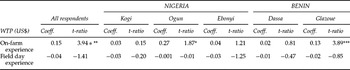
In the context of this study, information is understood as a message including data, ideas, or facts that are new and valuable to the person that obtains them. Knowledge is the ability to use information, and the development of this ability involves a learning process. The ratio of a given attribute or extension variable coefficient to the seed price coefficient is the inverse compensated demand for the attribute (Mackenzie, Reference Mackenzie1993) or the WTP value for each attribute (Hanley et al., Reference Hanley, Mourato and Wright2001). These values and their significance level are presented in table 5.
WTP for information variables

Note: *denotes significances at the 10% level, ** at the 5% level, and *** at the 1% level.
Positive as well as negative WTP values were discovered. The negative values could be interpreted as a lack of farmer interest in field days or on-farm trials unless there is compensation. The on-farm trial experiment included the seed, fertilizer and extension service, and the opportunity to observe the variety closely throughout a cropping period. In comparison, the field day activity is a single day of exposure to rice varieties where farmers are told about some characteristics of improved varieties and can visually compare their field performance to that of the local check only at that point in time. In the pooled regression model, WTP is significant and positive for the on-farm experiment (US$ 0.149), but the field day activity does not influence variety rank or increase the utility of farmers. Farmers in Ogun state are willing to pay more for on-farm trials than farmers in other sites. Ogun farmers are willing to pay US$ 0.273 for the whole on-farm trial package, as compared to US$ 0.127 in Glazoue. Farmers from Dassa, Kogi, and Ebonyi show no interest in paying for the on-farm trial activity. In Dassa, Ebonyi, and Kogi the improved varieties tested appear not to have represented a real advantage compared to the local variety included in the trial, or to alternative activities. Rice production is a labor-demanding activity and many farmers opt either for other crops such as cassava or yam, or for other non-agricultural activities such as commerce.
The coefficients for the field day activity suggest a negative WTP for this activity, although they are not statistically significant. Clearly, the information provided to farmers was not enough in quantity or quality to affect their preferences. Nor do improved varieties show a strong technological advantage.
6. Conclusion
An ordered probit regression was specified to estimate the indirect utility function of rice farmers in selected project sites of Benin and Nigeria, where the ratio of an extension activity coefficient to the seed price coefficient is the inverse compensated demand for the activity. Farmers were asked to rank a sample of rice varieties with and without seed-related information. The rankings represent the relative level of farmer utility. The model was built around a latent regression where the respondents have their own intensity of opinion. Explanatory factors included variety attributes, farmer characteristics, and extension variables in addition to a price. The rice seed price was elicited through contingent valuation using an open-ended survey. The sample of farmers evaluated in this study included rice farmers who decided to participate in the project, enabling us to generalize only over a comparable population rather than the entire rice-farming population.
The variety attributes evaluated in this study (potential yield, tillering capacity, size of the grain, height of the plant and days to maturity) are those that have been addressed specifically by plant breeders. The probit coefficients indicate that these attributes are important determinants of the seed preferences stated by farmers, although, in many cases, the sign of coefficient seems to contradict that sought by rice researchers. This is most evident for potential yield and plant height. Finding similar patterns with the application of a hedonic analysis, Dalton (Reference Dalton2004) concluded that although yield has served as a defining factor for promoting a new variety for official release, high yield was not a significant determinant of farmer WTP for new rice varieties in West Africa. Most farmers do not obtain yield potential under their growing conditions, and yield stability, as well as other attributes, may also be of concern to them.
Plant height is an important indicator for farmers and, conventionally, rice breeders tend to select stronger and shorter rice plants to avoid lodging from high winds. Plant height was a Green Revolution breeding priority because it indirectly affected yield performance. Depending on the method they use to harvest and other uses of rice straw, farmers might have a preference for rice plants with medium to tall stature. In the study sites, farmers cut rice panicles and leave the plant on the ground, so that short plants are inconvenient. Tall plants are easier for harvesting, since farmers do not have to bend and the process can be accomplished more effectively. Furthermore, rice production is already a fundamentally labor-intensive activity that competes for inputs with other crops, such as yam and cassava, which demand less labor and have a higher transformation and storage capacity. It is understandable that farmers decide to crop a rice variety that demands less effort.
In general, differences across the regions for preferred attributes express the high degree of physical, social, and economic heterogeneity among the sites. This heterogeneity can help to explain the mixed results obtained with respect to the role of farmer characteristics in predicting rice variety preferences. Education was a significant factor in several sites. In theory, educated farmers can assimilate information and convert it into knowledge more effectively than farmers with limited education, although this is not always the case. The extent of farming experience, expressed as the number of years growing rice, generates relevant knowledge. Surprisingly, this variable was significant only in Glazoue.
The importance of the introduced technology, the content of the activities, and the experience of the farmers regarding specific topics of discussion can influence their WTP for extension activities. Extension activities are usually time consuming, but if the content is new and valuable to farmers, the incentives to participate may be sufficient without a direct financial compensation. In this case, the content is information about improved rice varieties, some of which are already known to farmers.
This research suggests that rice farmers participating in the project have a positive WTP value for information but mainly for hands-on experience (on-farm trials). Since all farmers evaluated are project participants, there is probably an upward bias in WTP, if any, relative to the general rice-growing population. Clearly, willingness to participate in the project however does not necessarily translate into willingness to pay for extension.
Overall, research findings support the hypothesis that extension activity has potentially positive marginal benefits. The level of marginal benefits may still be too low to encourage the participation of the private sector in extension, at least at the individual level. Even when farmers are willing to pay for a better service, their contribution is limited by their incomes. Group contributions could be a more feasible alternative to increase incentives for private participation. Even when the extension service is not fully paid for by farmers, contributions to extension and/or the number of contributors should be high enough to allow the development of the system. If incentives are to be increased, the technology offered with the extension service has to create a technological advantage that is sufficient to make farmers ‘willing to pay’ – or even better – ‘able to pay’.
Moreover, the fact that WTP is positive does not necessarily mean that private delivery of technologies is optimal. The size of WTP may be too small to attain the socially optimal level of delivery. Paid extension involves not only the interests of farmers, but also those of extension agents and the government. Findings indicate only that extending seed-related information in a private way is feasible. Determining the optimal level of delivery is beyond the scope of this paper, and more research is needed to explore the appropriate institutional arrangement that would suit the specific conditions in the target areas. Outcomes from experiences in other countries can help to guide the process.
The project on which this research is based was initiated by the West African Rice Development Association (WARDA, now Africa Rice Center), with the University of Hohenheim and the German Ministry of Economic Cooperation (GTZ/BEAF). The authors thank Bonwoo Koo from the Department of Management Sciences–University of Waterloo, Svetlana Edmeades from the Agriculture and Rural Development – World Bank, and Latha Nagarajan from the International Food Policy Research Institute (IFPRI), for their valuable comments. We would like as well to thank Ekin Birol from Department of Land Economy and Homerton College, University of Cambridge, Volker Hoffmann from University of Hohenheim, Alicia Jimenez from the University of Guadalajara, and Agustin Munyemana formerly WARDA staff, for the reviews and suggestions on earlier versions of this work. Koffi Amegbeto from the International Center for Agricultural Research in the Dry Areas (ICARDA), and James Hanson and William Rivera at the University of Maryland provided valuable suggestions and literature during the development of this research. The authors also would like to thank the two anonymous reviewers for their helpful comments.