Antarctica has only two native vascular plants: Colobanthus quitensis (Kunth) Bartl. (Caryophyllaceae) and Deschampsia antarctica Desv. (Poaceae). The populations of these species are normally found in ice-free coastal areas (Alberdi et al. Reference Alberdi, Bravo, Gutiérrez, Gidekel and Corcuera2002). Nevertheless, the increasing number of visitors (scientists, logisticians and tourists) have probably contributed to the propagule dispersal of plant species (Chwedorzewska Reference Chwedorzewska2009, Chown et al. Reference Chown, Huiskes, Gremmen, Lee, Terauds, Crosbie, Frenot, Hughes, Imura, Kiefer, Lebouvier, Raymond, Tsujimoto, Ware, van De Vijver and Bergstrom2012) that may potentially be successfully adapted to the current conditions in Antarctica that have undergone regional warming (King et al. Reference King, Turner, Marshall, Conolley and Lachlan-Cope2003, Convey & Smith Reference Convey and Smith2006). A third vascular plant, Poa annua L. (Poaceae), a non-native species introduced from Europe, has been reported (Olech Reference Olech1996), which was initially found at anthropogenic sites, but recently its natural colonization of the moraines of the retreating Ecology Glacier has been reported near the Arctowski Polish Antarctic Station (Olech & Chwedorzewska Reference Olech and Chwedorzewska2011). Here we report the presence of a recently arrived (Hughes & Convey Reference Hughes and Convey2012) vascular plant, Juncus bufonius L. var. bufonius (Juncaceae), near the same base, associated with D. antarctica, C. quitensis and mosses that grow in the same habitat.
During activities in the field in December 2009 near the Arctowski Polish Antarctic Station, we collected both native vascular plants (C. quitensis and D. antarctica) with the soil associated with their roots (GPS position: 62°09′73′′S, 58°28′27′′W, 23 m a.s.l.), within ASPA No. 128, western coast of Admiralty Bay, King George Island, South Shetland Islands (with the corresponding Permit from Chilean Antarctic Institute No. 410/509). The collected samples (soils and native plants) were duly transported to our laboratory in South America in sealed boxes for future research.
In the laboratory, plants and soil were separated. The two native vascular plants were separated and propagated vegetatively, in plastic pots in a mixture of organic soil:peat:vermiculite (3:2:1, v:v:v) at 15 ± 2°C in a growth chamber (Forma Scientific) with a photosynthetic photon flux density (PPFD) of 120 ± 20 μmol photons m-2 s-1 and seeds collected from the native plants were placed to germinate in the same conditions. The percentage of germination expected for D. antarctica was low, which is consistent with the bibliographic background data which indicated that the species has a low germinative capacity both in the laboratory and in the field (McGraw & Day Reference McGraw and Day1997). Surprisingly, after approximately two weeks, some seedlings could be seen.
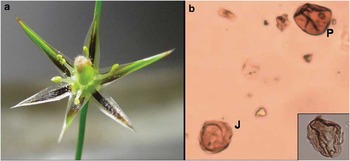
Many plant seedlings grew under these conditions and developed spikes. At the same time, from the presumed D. antarctica plants propagated vegetatively, spikes also emerged. The spikes obtained by both reproductive forms were compared and showed similar morphological characteristics, however, when they bloomed (Fig. 1a) it became clear that they belonged to different taxonomic entities.
Identification of Juncus bufonius. a. Details of the flower. b. Evidence of the presence of Juncaceae pollen in soils associated with the plants collected in the field. The insert shows in detail pollen of the Juncaceae family. J = Juncaceae pollen, P = Poaceae pollen.

Samples of these plants, propagated vegetatively and sexually, as well as of plants collected directly from the field were identified. The samples turned out to belong to the genus Juncus, allocated to J. bufonius L. of the Juncaceae family. Both cultivated and field samples are currently preserved at the herbarium of the Faculty of Agronomy at the University of Concepción (CONC). In addition to P. annua and Poa pratensis (Hughes & Worland Reference Hughes and Worland2010), this is the third non-native vascular plant species discovered in Antarctica and the fifth component of the Antarctic vascular flora.
In order to find some additional supporting evidence for the presence of this family on King George Island, samples of the soils collected with the plants and cryopreserved in appropriate conditions were dried and analysed palynologically in search of pollen corresponding to the Juncaceae family. Indeed, in addition to pollen grains belonging to the Caryophyllaceae and Poaceae families, as was to be expected, Juncaceae pollen was also found (Fig. 1b).
The main objective of this work is to report, for the first time, the appearance and apparent successful establishment of a new vascular plant on King George Island. The biological invasions, through the introduction of new species into the Antarctic ecosystem, are sounding the alarm regarding the consequences of increased global warming and increased human impact on this region of the planet (Chown et al. Reference Chown, Huiskes, Gremmen, Lee, Terauds, Crosbie, Frenot, Hughes, Imura, Kiefer, Lebouvier, Raymond, Tsujimoto, Ware, van De Vijver and Bergstrom2012).
As Wester (Reference Wester1992) pointed out, there are no infallible methods to determine if a species is an alien or native, but if a plant was not previously recorded, has no closely related indigenous relatives, seems incapable of dispersing over great stretches of open ocean without human assistance and prefers disturbed habitats of anthropic origin it seems reasonably safe to assume the species is an alien, and J. bufonius meets all of these assumptions. Moreover, it has been demonstrated that the seeds of J. bufonius can be dispersed more than 15 000 km attached to motor cars and germinate successfully (Schmidt Reference Schmidt1989). Non-native species introduction by contaminated vehicles with non-Antarctic soils have been reported recently (Hughes et al. Reference Hughes, Convey, Maslen and Smith2010).
Juncus bufonius is abundant in Patagonia (Moore Reference Moore1983) and has also been found on sub-Antarctic islands (Frenot et al. Reference Frenot, Chown, Whinam, Selkirk, Convey, Skotnicki and Bergstrom2005) where it was introduced probably from Europe. Future research may usefully consider the species, possible origin, most probable route of introduction, spatial distribution and abundance and, if feasible, propose an eradication plan.
Acknowledgements
This work was financed by the INACH T_03-09 project of the Chilean Antarctic Institute. We thank INACH, the Chilean Navy and the Arctowski Polish Antarctic Station for their logistical support, and I. Cid and H. Veas for their technical assistance. We also thank H. Lowry for her assistance in revising the English and K. Hughes for his valuable assistance in reviewing this paper.