

Introduction
The hen's egg consists of yolk (30–33 percent), albumen (approximately 60 percent) and shell (9–12 percent; Ahmadi and Rahimi, Reference Ahmadi and Rahimi2011). Egg quality refers to its inherent properties that determine its excellence and acceptability to the consumer (Singh, Cheng and Silversides, Reference Singh, Cheng and Silversides2009). Even under the most favourable conditions, egg quality is relatively unstable, as the interior quality of the egg deteriorates from the time it is laid to the time it is consumed. Quality changes may render eggs useless for food before they reach the consumer. Egg quality and composition also change in accordance with level of production and age of layer. The proportion of yolk increases with age while the proportions of albumen and shell thickness decrease (Akbar et al., Reference Akbar, Gavora, Friars and Growe1983; Fletcher et al., Reference Fletcher, Britton, Pesti and Savage1983).
Genetic differences in egg shell formation characteristics exist between species, and between breeds, strains and families within species (Buss, Reference Buss1982). Albumen quality is a standard measure of egg quality that is most often measured as the height of the inner thick albumen. Albumen height (AH) can give a measure of the freshness of the egg because the height of the inner thick albumen decreases in the logarithmic scale with storage time (Silversides and Scott, Reference Silversides and Scott2001). The major influences on AH are the strain and age of the hen laying the egg and storage time and conditions (Williams, Reference Williams1992). Eggs increase in weight over a production, while egg shell thickness and strength usually decreases (Anderson et al., Reference Anderson, Tharrington, Curtis and Jones2004). The trend in egg consumption is moving from shell egg consumption towards egg products, leading to a greater focus on the internal egg composition (Hartmann et al., Reference Hartmann, Strandberg, Rydhmer and Johansson2002). Production of good quality eggs should thus contribute to the economic fortunes of the poultry farmer but in Ghana little work has been done on egg quality characteristics of chickens. Characterization of egg quality traits however constitutes and important step in the development of sustainable breeding programme for local avian genetic resources. The objective of the present study therefore was to assess the effect of storage on the quality characteristics of local chicken eggs and compare them with those of SASSO T44 chickens.
Materials and methods
Egg quality parameters of local chickens from the Forest and Savannah zones of Ghana and SASSO T44 chickens (a strain of the Label Rouge from France) kept at the Livestock and Poultry Research Centre (LIPREC), University of Ghana were measured. LIPREC is located on latitude 05°40′N and Longitude 00°16′W on the Accra Plains, which forms part of the Coastal Savannah. Annual rainfall of the ARC is 785 mm with a range of 128–1709 mm distributed bimodally. The long rainy season usually occurs between March and July with a peak in June and the short rainy season occurs between August and November with a peak in October. Mean monthly temperatures range from 24.8 °C in August to 28.3 °C in February with a mean of 26.9 °C. Relative humidity at 1500 h ranges between 58 and 83.7 percent and is slightly lower at 0900 h.
Management of the experimental chickens has been described by Osei-Amponsah, Kayang and Naazie (Reference Osei-Amponsah, Kayang and Naazie2012). A total of 140 eggs were collected from the two local ecotypes – forest (98) and savannah chicken (52) and 107 eggs from the control population (SASSO T44). Eggs were collected and stored from 0 to 21 days at room temperature (27 °C) and a relative humidity (60 percent) and stored at the Animal Biotechnology Laboratory of the Department of Animal Science, University of Ghana, Legon. Egg quality characteristics were measured at 3-day intervals over the study period of 21 days. Eggs were weighed individually at day of collection and on the day of taking measurements. Egg quality traits evaluated were egg weight (EW), AH, albumen weight (AW), yolk weight (YW) and Haugh unit (HU). Eggs were collected and weighed using an electronic beam balance (OHAUS, 2006). Egg length and width were measured with the aid of a pair of vernier callipers calibrated in mm. Eggs were later carefully opened and content poured into a tripod micrometer (Froning and Fank, Reference Froning and Fank1958) to determine the maximum AH at its widest part at a position half-way between the yolk and the outer margin. The yolk and albumen were carefully separated and weighed separately using the beam balance to determine their respective weights. Albumen, yolk and shell ratios were determined as their weights relative to egg weight. In order to correct for the difference in egg weight, the AH was converted into HUs (Haugh, Reference Haugh1937). HUs were calculated for individual eggs using the formula:
 $${\rm HU}=100\,{\rm log \lpar }H - 1.7\, W^{0.37}+7.57{\rm \rpar \comma \; }$$
where HU is the Haugh unit; H is the height of the albumen (mm); and W is the weight of the egg (g).
Analysis-of-variance (ANOVA) procedures were used to isolate the effect of ecotype on egg quality characteristics while variations in egg quality characteristics of the experimental chicken were depicted in line graphs using the software SPSS (SPSS, 2007).
Results
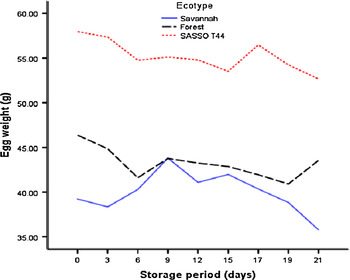
Eggs of the French SASSO T44 chickens were significantly (P < 0.05) heavier with heavier shells and yolks compared with those of local chickens with the forest birds being superior to the Savannah ecotypes (Table 1). The SASSO T44 chickens were superior (P < 0.05) to the local chicken ecotypes in most of the internal egg quality traits except yolk ratio (Table 2). Within the local ecotypes eggs from chicken from the Forest zone were heavier than eggs from their Savannah counterparts. Irrespective of ecotype, there is a general reduction in EW with storage time (Figure 1).
Variations in egg weight of experimental chickens during storage.

Means and standard errors of external quality traits of experimental chickens.

Within columns means followed by different superscripts are significantly (P < 0.05) different.
Means and standard errors of internal egg quality traits of experimental chickens.

Within columns means followed by different superscripts are significantly (P < 0.05) different.
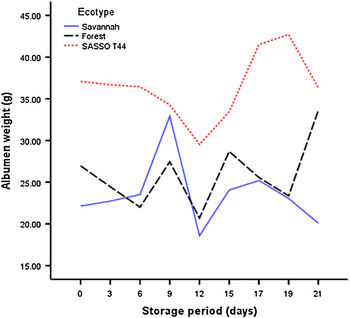
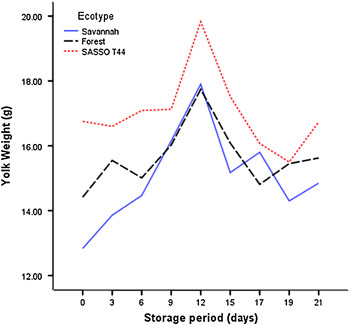
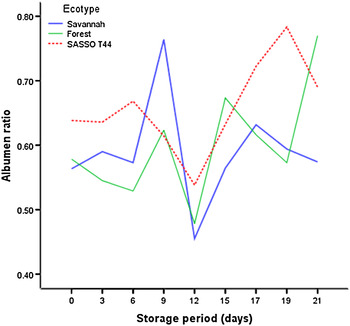
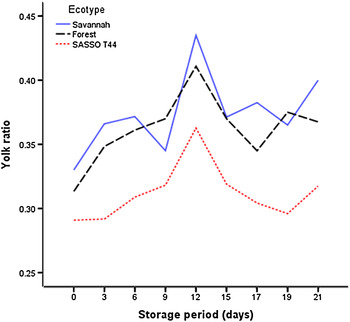
The trend in AW and YW were similar for local chicken ecotypes and SASSO T44 chicken studied (Figures 2 and 3) with more erratic fluctuations in AW than YW. AW of the SASSO T44 chicken was higher than those of the local ecotype during the entire storage period (Figure 2). The local chicken ecotype eggs had similar albumen ratios to SASSO T44 (Figure 4) but their yolk ratios were higher than the control population at every storage period (Figure 5). Fluctuations in YW and yolk ratio followed a similar pattern as shown in Figures 3 and 5.
Variations in albumen weight of experimental chickens during storage

Variations in yolk weight of experimental chickens during storage

Variations in albumen ratio of experimental chickens during storage

Variations in yolk ratio of experimental chickens during storage

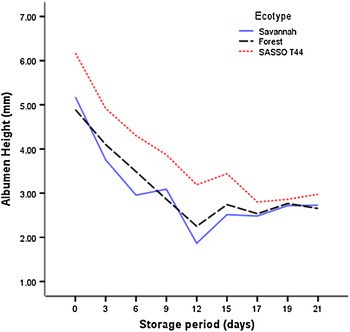
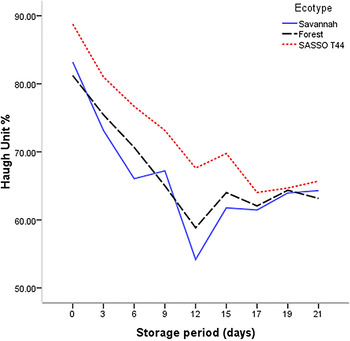
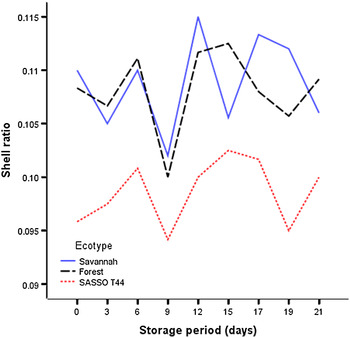
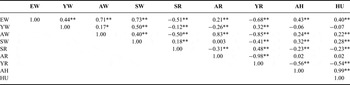
Correlation co-efficients between the egg quality traits indicated highly significant (P < 0.01) correlations between EW and AW, shell weight, AH and HU (Table 3). However, the correlation between EW and shell ratio and yolk ratio were negative. Table 3 also shows a highly significant (P < 0.01) negative correlation was recorded between AW and yolk ratio as well as between yolk ratio and AH and HU. A highly significant (P < 0.01) positive correlation was also recorded between AH and HU. The trend in AH and HUs were observed to be similar as shown in Figures 6 and 7 but conversion to HUs narrowed the gap in egg quality of local and SASSO T44 chicken. Variations in shell ratio by storage periods followed a specific pattern in all the experimental groups with the local chickens having a higher shell ratio at every point (Figure 8).
Variations in albumen height of experimental chickens during storage

Variations in Haugh unit of experimental chickens during storage

Variations in shell ratio of eggs of experimental chickens during storage

Phenotypic correlation co-efficients between egg quality traits local and SASSO T44 chickens.

** – Highly significant (P < 0.01); * – Significant (P < 0.05).
EW, egg weight; YW, yolk weight; AW, albumen weight; SW, shell weight; SR, shell ratio; AR, albumen ratio; YR, yolk ratio; AH, albumen height; HU, Haugh unit.
Discussion
The superiority of the SASSO T44 in most of the egg quality traits is to be expected as it has relatively larger eggs and most of the quality traits are positively correlated to egg size. This is in line with other findings of Islam and Dutta (Reference Islam and Dutta2010) as well as Moula et al. (Reference Moula, Diaw, Salhi, Farnir, Antoine-Moussiaux and Leroy2013). The significantly (P < 0.05) higher shell ratios of the local chickens indicates a possible relatively stronger shells compared with those of SASSO T44 chickens. This is an advantage as egg shells need to be strong enough to remain intact throughout the chain from the time that the egg is laid until it is used by the consumer and to keep the contents of the egg safe from microbial contamination (Jacob, Miles and Mather, Reference Jacob, Miles and Mather2000). Scott and Silversides (Reference Scott and Silversides2000) found that eggs from ISA-Brown hens were heavier than those from ISA-White hens and had more shell and albumen, but less YW and AW. The superiority of the forest chickens over the savannah chickens within the local chicken ecotypes could be attributed to genotype as all experimental animals were raised on-station. Fayeye et al. (Reference Fayeye, Adeshiyan and Olugbami2005) evaluated thirteen internal and external egg traits of 30 eggs of Fulani-ecotype chickens and the indices of internal egg quality indicated that the Fulani-ecotype chicken is highly desirable producing eggs with good shell thickness which could be genetically exploited to reduce losses due to cracked eggs. SASSO T44 is a strain developed from the Franch Label Rouge and has been selected over the years as a larger breed for meat production resulting in relatively bigger eggs of its hens. EW influences the weight of components of eggs especially egg albumen and yolk (Tadesse et al., Reference Tadesse, Singh, Mengistu, Esatu and Dessie2013). Furthermore, egg size increases with increasing hen age but the increase in weight is not accompanied by a proportional increase in shell weight, so that the ratio of shell weight to EW (percentage shell) decreases (Ahmadi and Rahimi, Reference Ahmadi and Rahimi2011).
SASSO T44 chickens were superior in most of the internal quality traits particularly AH which is also highly significantly (P < 0.01) correlated to HU. While heavier YWs were recorded in the control population (SASSO T44 chickens), the yolk ratios were higher in the local ecotypes due to a relatively higher AW in the control population. Furthermore, the relatively higher (P < 0.05) yolk ratios of local chicken eggs which is in line with findings of Moula et al. (Reference Moula, Diaw, Salhi, Farnir, Antoine-Moussiaux and Leroy2013) may indicate their relative higher yolk richness. Local breeds adapted to less industrial production systems have the potential to offer more flavour products for increasingly health-conscious consumers (Moula et al., Reference Moula, Antoine-Moussiaux, Farnir and Leroy2009) and high egg quality traits for local chickens of Nigeria have also been reported by Momoh, Ani and Ugwuowo (Reference Momoh, Ani and Ugwuowo2010).
Average EW, AH, shell weight and shell ratio obtained in the present study for the local ecotypes were lower than those of Chatterjee et al. (Reference Chatterjee, Rai, Kundu, Sennai and Sunder2007) who reported average EW of 48.5 g and AH of 6.77 mm for the indigenous Nicobari chicken of India. However, values of the average AW, albumen ratio, YWs and yolk ratio reported for the three ecotypes in the present study were higher than those reported by Chatterjee et al. (Reference Chatterjee, Rai, Kundu, Sennai and Sunder2007). Monira, Salahuddin and Miah (Reference Monira, Salahuddin and Miah2003) also reported relatively higher EWs for White Leghorn, Barred Plymouth Rock, Rhode Island Red and White Rock than those recorded in the present study. The difference in the results can be attributed to genetic differences of the chicken strains involved as the White Leghorn has been selected for improved egg production performance. External and internal egg quality traits have genetic basis and can also be affected by non-genetic factors (Alsobayel and Albadry, Reference Alsobayel and Albadry2011).
HU of 45.81, 54.2, 45.81 and 58.68, respectively for White Leghorn, Barred Plymouth Rock, Rhode Island Red and White Rock (Monira, Salahuddin and Miah, Reference Monira, Salahuddin and Miah2003) are lower than those obtained in the present study. With the exception of AH values of egg quality traits of local Ghanaian ecotypes were higher than those reported for Ethiopian indigenous chickens (Mogesse, Reference Mogesse2007) while HUs are comparable between Ghanaian and Ethiopian chicken ecotypes. Our results for shell, albumen and YW are comparable with those obtained by Vij, Tantia and Vijh (Reference Vij, Tantia and Vijh2006). Average AH and HU reported for Fayoumi chickens and its crosses naked neck and Rhode Island Red chickens raised under semi-scavenging conditions in Bangladesh were slightly better than those obtained in the present study (Zaman Sørensen and Howlider, Reference Zaman, Sørensen and Howlider2004). Furthermore, Varguez-Montero et al. Reference Varguez-Montero, Sarmiento-Franco, Ronald Santos-Ricalde and Segura-Correa2012 found a significant effect of housing system on egg quality of Rhode Island Red hens. With the exception of the AH and HU egg quality characteristics obtained for local and SASSO T44 chicken are higher than those reported for the Fulani-ecotype chicken (Fayeye et al., Reference Fayeye, Adeshiyan and Olugbami2005).
The effect of storage period on egg quality traits of the experimental chickens revealed some interesting results. In general, EW declined with increasing storage period due to loss of carbon dioxide (CO2). There were fluctuations in AW of eggs of all the experimental chicken indicating biological reactions within the egg. Irrespective of ecotype, YW increased till the 12th day and fell indicating due to deterioration of the previtelline membrane which surrounds the yolk. Albumen ratio levels fluctuated with storage time and getting to the lowest level on day 12 in all the ecotypes studied. This can be attributed to loss of CO2 through the shell causing the albumen to become more transparent and increasingly watery in storage (Benton and Brake, Reference Benton and Brake2000). The trend in the yolk ratio was also similar to YW peaking around day 12 of the study period. This can be explained by the negative correlation between AW and yolk ratio. AH as expected decreased consistently up to day 12 and then stabilized. The fluctuations in the HU followed closely that of AH. This is consistent with the findings of Silversides and Scott (Reference Silversides and Scott2001). In general, the albumen quality of eggs decline with increasing storage time and poor storage conditions. During storage the thick albumen becomes thinner allowing greater movement of the yolk (Jacob, Miles and Mather, Reference Jacob, Miles and Mather2000). EW, AH and yolk height, HU, albumen and yolk indices decrease with increase in storage time (Tabidi, Reference Tabidi2011) and poor storage can result in deterioration in its quality and consequently loss and waste of eggs (Raji et al., Reference Raji, Aliyu, Igwebuike and Chimora2009; Khan et al., Reference Khan, Khan, Bukhsh, Abass and Javed2013).
Room storage condition (ambient temperature) could be responsible for the relatively lower HUs obtained in the present study. Egg handling and storage practices have a significant impact on the quality of eggs reaching the consumer. Albumen quality is a standard measure of egg quality and it is influenced by genetic and environmental factors. The AH of eggs is at a maximum when the eggs are laid and decreases with increasing storage time (Jin et al., Reference Jin, Lee, Lee and Han2011).
Irrespective of ecotype, the HU declined sharply with increasing storage time. All the three ecotypes had very high HU values when the eggs were fresh but egg quality reduced significantly after 2 weeks of storage. This is in line with the findings of other researchers (Alsobayel and Albadry, Reference Alsobayel and Albadry2011; Tabidi, Reference Tabidi2011). HU is affected by many factors such as the storage time, temperature, age of hen, strain of bird, nutrition, disease, supplements, artificial exposure to ammonia, induced moult and medication (Ahmadi and Rahimi, Reference Ahmadi and Rahimi2011). Poor storage conditions present nutritional challenges in many areas of the world where eggs are stored without refrigeration due to economic or energy constraints. For instance, eggs stored in the layer house have been reported to have poorer albumen quality than those stored in the cooler conditions (Miles and Henry, Reference Miles and Henry2004). Increasing storage time also had a detrimental effect on albumen quality. Quality declined more rapidly in eggs stored at ambient temperature than in cooler temperatures (Miles and Henry, Reference Miles and Henry2004). The present study confirms that eggs stored at ambient temperatures and humidity lower than 70 percent will lose 10–15 HU in a few days from the point of lay (Ahmadi and Rahimi, Reference Ahmadi and Rahimi2011).
Conclusions
Local chicken eggs have relatively stronger shells and yolk ratios compared with SASSO T44. However, the egg quality of local chickens is lower than SASSO T44 due to the negative correlation between yolk ratio and AH, the main determinant of egg quality. Within the local chicken population, birds from the forest zone were superior in AH but the two local ecotypes did not differ significantly in HUs. Egg quality traits deteriorated under room temperature storage conditions. Deterioration of egg quality of chicken eggs could be minimized by storing at cooler temperatures and at a higher relative humidity or where not possible utilizing the eggs within a week of lay.
Acknowledgements
Appreciation is expressed to the DURAS Project for permission to use data and the University of Ghana Graduate Fellowship programme for award of fellowship to R. Osei-Amponsah. The Carnegie – funded University of Ghana “Next Generation of Academics in Africa” Project for the Write-Shop held in June, 2013 facilitated the preparation of the manuscript for publication and the authors are grateful to the co-ordinator, mentors and all participants for their valuable inputs.
Statement of interest
The authors declare no conflict of interest.