1. Introduction
Current literature suggests that WTO accession, and more generally international economic agreements, can serve as a source of external pressure and credible commitment to overcome opposition and to lock in domestic economic reforms (e.g., Staiger and Tabellini, Reference Staiger and Tabellini1999; Davis, Reference Davis and Odell2006; Basu, Reference Basu2008; Lamy, Reference Lamy2012; Aaronson and Abouharb, Reference Aaronson and Abouharb2014; Zoellick, Reference Zoellick2014).Footnote 1 However, the effects of WTO accession on domestic economic reforms have been heterogeneous, even among seemingly similar political-economic systems. For instance, Drabek and Bacchetta (Reference Drabek and Bacchetta2004) show that the impacts of WTO accession on policy making and institutional reform differed across Eastern European transitional countries.Footnote 2 Similarly, China and Vietnam both have socialist market economies, but while the Chinese leadership was quite successful in using the WTO as a means to impose market discipline on state-owned enterprises (Breslin, Reference Breslin2003; Thun, Reference Thun2004; Steinfeld, Reference Steinfeld2010), their Vietnamese counterparts have failed to do so since the country formally joined the WTO in January 2007.Footnote 3 As a result, reforming the state-owned enterprises, particularly the state business groups and state general corporations, has once again become a central component in the government's recent efforts to restructure the economy.Footnote 4
So why does WTO accession foster economic reforms in some countries but not in others? Since the existing literature generally takes it for granted that WTO accession will bring about positive institutional changes, it does not provide a framework for understanding outcome heterogeneity. Moreover, the literature focuses largely on the supply side of institutional changes (i.e., by means of the WTO accession), implicitly assuming the existence of demand for domestic institutional changes (otherwise, why bother joining the WTO in the first place?). In fact, however, successful institutional change requires both supply and demand. Moreover, in the process of institutional change, the interaction between demand and supply also plays an important role.
In this paper, we argue that in order to understand how WTO accession impacts domestic reforms, it is essential to understand the political economic environment of the acceding country, and thereby the interaction between external pressures from WTO accession and the country's response. In particular, we should not underestimate the ability of politicians to use international trade agreements to advance their policy preferences and, at the same time, circumvent these very agreements. As a result, international trade agreements may not be conducive to reform as expected and, in some cases, may even be counterproductive. This paper will illustrate these insights by analyzing the political economy of state-owned enterprise reform backsliding in the context of Vietnam's accession to the WTO.
Through an analysis of aggregate data and 40 interviews with senior government officials, politicians, policy analysts, and state-owned enterprise managers, we find that in Vietnam WTO accession has not only failed to foster the long-needed reform of state-owned enterprises (SOEs), but also strategically presents as posing a serious external threat that demanded quickly building up the SOE sector, which is, in hindsight, a ‘reversed SOE reform’. The key reason for this failure lies in the Vietnamese party-state's priority to preserve the primacy of the SOE sector. Faced with looming competitive pressures from liberalization as Vietnam was joining the WTO, the Vietnamese party-state decided to consolidate existing state general corporations (SGCs) into giant and highly diversified state economic groups (SEGs) in order to strengthen the SOE sector.
The formation of SEGs, which are considered as Vietnam's socialist ‘commanding heights’, has had many critical ramifications. As far as the WTO accession is concerned, the SEGs have disabled, at least partly, many of the potentially positive impacts of WTO accession. First, the formation of SEGs, which inevitably reinforces the monopoly, or dominant market, position of these SEGs, goes against the spirit of fair competition and significantly reduces the effectiveness of Vietnam's 2005 Competition Law. Second, the move to highly diversified business groups, which include banking and finance, has created new forms of directed credit and cross-subsidies among the SOEs. Through a complex nexus of pyramidal and cross ownership structures, these subsidies, which are in principle prohibited by the WTO, have been transformed into internal transactions, and are therefore very difficult to detect and/or sanction. Third, as the dominant position of SEGs is reinforced, the government can use industrial policies, in principle targeted at an entire industry, to deliberately support targeted SEGs without being accused of violating the ‘national treatment’ principle. Finally, the wave of SEG acquisitions of commercial banks after WTO accession has provided SEGs with abundant sources of capital. The expectation of reform-minded policy makers that competitive pressure, particularly from foreign banks, would force banks to be more profit-oriented, thereby hardening SOEs’ budget constraints, has not yet been realized.
The rest of the paper is organized as follows. Section 2 traces the emergence of the SEG model on the eve of Vietnam's WTO accession. Section 3 then provides a brief explanation for the emergence of SEGs, thereby providing an overview of the political-economic situation in Vietnam before its gaining entry to the WTO. This section shows that three factors, namely the primacy of the SOE sector, the aspiration for economic independence and proactive integration, and the urgent need for revitalizing the SOE sector, are major determinants of the emergence of SEGs on the eve of formal WTO accession. Section 4 analyzes interactions between Vietnam's WTO accession and its domestic political economy. It shows that although the WTO accession was neither the only nor the most decisive factor underlying the formation of the SEGs, it did serve as an important catalyst to facilitate the emergence of sufficient consensus to help accelerate the growth of SEGs in both scale and scope. This section also shows that although a change in premiership played an important part in the growth of the SEG model in general, its impact occurred mostly after Vietnam had already joined the WTO. Section 5 analyzes in detail how the SEGs disabled, at least partly, the WTO's potential impacts on SOE reform. Section 6 concludes and presents some policy implications.
2. The formation of state economic groups since 2005
Vietnam started market-oriented reform (Doi Moi) in1986. In the last three decades, the Vietnamese party-state has removed many key elements of central planning such as collectivization, price control, foreign trade monopoly, as well as the comprehensive planning itself, but it has never given up on SOEs. Developing state-owned large-scale corporations that play ‘the leading role’ in the domestic economy and, at the same time, can compete in international markets has always been a top priority in Vietnam's SOE development policy. In Vietnam, the idea of experimenting with the state business groups (SBGs) was inspired by the role of the keiretsu and chaebols in the successful industrialization of Japan and South Korea (Perkins and Vu-Thanh, Reference Perkins and Vu-Thanh2011).Footnote 5 This idea was first implemented by Decision 91 of Prime Minister Vo Van Kiet dated 7 March 1994 that establish 18 ‘pilot’ SBGs, often referred to as SGCs 91.Footnote 6 According to Decision 91, the SGCs 91 should ‘have an important position in the national economy, ensure necessary requirements for the domestic market, and have the potential of expanding business relationships outside the country’.
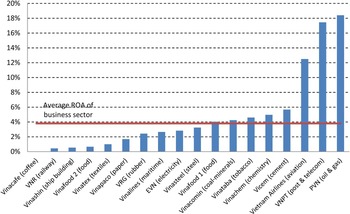
In the early 2000s, SOE reform in general and the experiment with state business group model in particular came to a standstill. Despite obvious advantages and the government's preferential treatment, the performance of the SOE sector had not improved. Even worse, the SOE sector was financially outperformed by the private sector. According to the Enterprise Survey data, in the early 2000s, pre-tax returns on total assets (ROA) of the SOE sector is only about two-thirds of the average for the entire enterprise sector.Footnote 7 Even more disappointing, despite their monopoly position, giant scale, and numerous privileges granted by the state, 10 out of the 18 SGCs had ROA lower than the average of the economy, which was 3.8% in 2001 and 4.3% in 2002 (Figure 1). It is obvious that the party and the government could not be satisfied with this poor performance, especially in the context of increasing competition from the private sector, both domestic and foreign, after the 1999 Enterprise Law and the US–Vietnam Bilateral Agreement (US-VN BTA) in 2001.
Return on assets of the SGCs 91 (2001)

In this context, Resolution of the Third Plenum of the 9th Party Central Committee (2001) on SOE reform doubled down on its commitment to the state sector:
The state economic sector plays the decisive role in holding fast the socialist orientation, stability, and economic, political and social development of the country. State-owned enterprises … must constantly innovate, develop and improve efficiency, hold key positions in the economy, be an important material instrument for the state to orient and regulate the macroeconomy, be the core force, the main contributor for the state economic sector to perform the leading role in the socialist-oriented market economy, and be the main force in international economic integration’. (italics added)
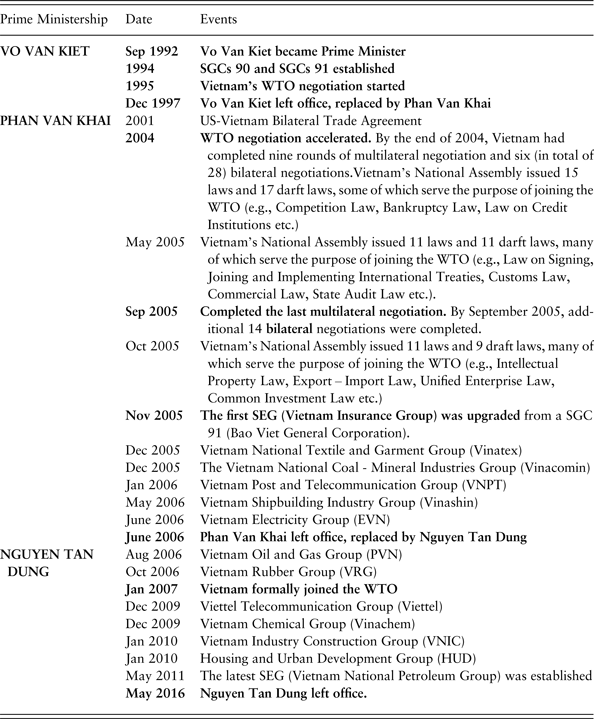
Also in this document, for the very first time, the concept of ‘state economic groups’ was formally introduced as the next step of the state business group model, with the aim to ‘compete and integrate into the international economy’. Following this Resolution, the government issued Directive 01 (16 January 2003), asking the Steering Committee for State-Owned Enterprise Innovation and Development to coordinate with the line ministries to conduct studies and surveys in order to develop the state economic groups. This began with four industries: oil and gas, post and telecommunications, construction, and electricity, which happened to be either natural resource exploitation or non-tradable. Since the introduction of this policy, the first SEG – Vietnam Coal Corporation (Vinacoal) – was established on 8 August 2005.Footnote 8 As can be seen from Table 1, which lists major milestones in the development of SEG, WTO negotiation, and WTO-related reforms between 1992 and 2016, by the time Vietnam officially joined the WTO, eight SEGs had already been established, and by mid-2011, there were total 13 SEGs (Table 1). Among these SEGs, six were formed between November 2005 and June 2006 during the tenure of Prime Minister Phan Van Khai, and the remaining seven under the tenure of his successor Nguyen Tan Dung.Footnote 9
Timeline of SEG development, WTO accession, and WTO-induced reforms

Source: Compiled by the author.
3. A brief explanation for the emergence of SEGs on the eve of WTO accession
This section briefly analyzes the major factors that contributed to the emergence of the SEGs in 2005 and 2006, thereby providing an overview of Vietnam's political economy in the immediate pre-WTO period. As observed by Grindle and Thomas (Reference Grindle and Thomas1989), good knowledge of circumstances surrounding a particular policy initiative is essential to understanding the nature and dynamics of decision making – how the policy initiative got on to the agenda, who the stakeholders were, what types of public officials were involved in decision making, how and to what extent changes were introduced, and the timing of decision making.
3.1 A political-economic ‘constant’: the leading role of the SOEs
Since the 1992 Constitution, Vietnam has considered itself a socialist market economy. In the spirit of a ‘market economy’, official documents of the party-state have always insisted that all economic sectors are important to the national economy. However, because of the ‘socialist orientation’, despite the fact that the party-state publicly admits the relative inefficiency of the state vis-à-vis private sector, ‘the leading role’ of the state sector has always been an immutable constant in the nation's economic development strategy.Footnote 10 In this strategy, the SOEs are instruments for the state sector to perform the leading role, and the SEGs and SGCs are the ‘commanding heights’ of the state sector.
The dominant role of the SOEs in Vietnam has been maintained not by market competition, but thanks to systematic preferential treatment from the state (Pham, Reference Pham, Sam and Tuan2008). The SOEs used to enjoy a separate legal playing field until the promulgation of the Unified Enterprise Law in 2006, which was written under the pressure of imminent WTO accession. However, today the SOEs still enjoy monopoly, or dominant position, in many strategic industries.Footnote 11 Moreover, they are allowed favored access to critical resources – such as land, credit, and natural resources – and lucrative opportunities – such as public investment and government procurement.
In addition to credit and investment, the SOEs are entitled to many other privileges vis-à-vis private enterprises. The SOEs were allowed to use state capital without paying dividends until very recently.Footnote 12 They are generally not subject to hard budget constraints and virtually never face bankruptcy.Footnote 13 The SOEs were designated to disburse the majority of ODA capital.Footnote 14 In many cases, they are also granted state-owned land for free, or if they must lease land, then the rent is substantially subsidized. Moreover, they then can use the leased land as collateral for bank loans, while private businesses do not have such an option. SOEs, backed by the state, are also given priority access to credit and scarce foreign exchange for less than the market value.
3.2 Achieving ‘economic independence’ and ‘proactive integration’ through SOEs
Economic independence and self-reliance have always been a key objective of Vietnam's industrial development strategy in particular and of its economic development strategy in general. The issue is that Vietnam's approach to realizing these objectives contains two fundamental paradoxes. The first paradox is that the government wants rapid industrialization and modernization even when the starting point of the economy is very low, and thus lacks most of the necessary material, technological, management, and institutional foundations.
The second paradox is that during the cold war, the motivation behind the independent and self-reliant viewpoint is understandable. However, in the 1990s and especially in the 2000s, as the country has become integrated into a world economy, which is increasingly interdependent and globalized, the old dogmas of economic independence and self-reliance have become far less compelling.
Recently, along with the process of international economic integration, the ‘independence and self-reliance’ objective has been combined with the fashionable phrase of ‘proactive international integration’. The Social-Economic Development Strategy (SEDS) 2001–2010 was the first official document that mentioned the goal of ‘fastening the objective of building an independent and self-reliant economy with international economic integration’ (italics added). However, this document explicitly acknowledged that the exact meaning of ‘independent and self-reliant economy’ and ‘international economic integration’ is still ambiguous and even lacks coherence. As a result, the actual priority may well be subject to subjective interpretation and depends on the specific case under consideration. For example, the policy to selectively build some heavy industries, such as oil refining, shipbuilding, and even textiles, through the formation of SGCs and SEGs was justified by the ‘independence and self-reliance’ mantra. The slogan also allows the industries in which the state sector has the dominant position to enjoy many privileges and generous protection from the state (see Athukorala, Reference Athukorala2006, Perkins and Vu-Thanh, Reference Perkins and Vu-Thanh2011).
3.3 An urgent need for revitalizing the SOE sector
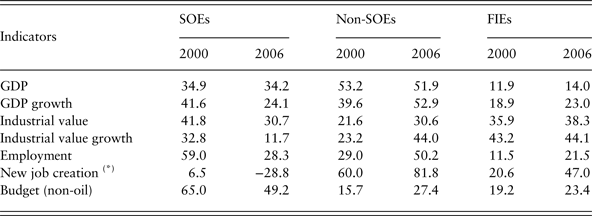
SOEs have always played a central role in the government's economic development strategies. Until the end of the 1990s, it made sense that the government treated the SOE sector as the key driver of growth. However, with the continuous expansion and development of the private sector since the Enterprise Law was enacted (1999) and the US–Vietnam BTA was signed (2001), the role of the SOE sector relative to the private sector declined seriously, at least during the period before Vietnam's joining the WTO (Table 2).
Relative contribution to the economy of the three economic sectors 2000–2006 (%)
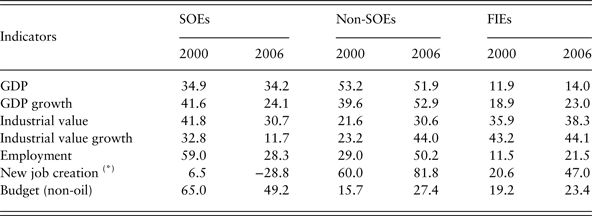
Notes: *New job creation data are for 2001 and 2006.
Sources: Budget data are calculated from: Ministry of Finance's Annual Budget Reports (various years), http://mof.gov.vn/webcenter/portal/btc/r/lvtc/slnsnn; General Statistical Office's Yearbooks (various years), https://www.gso.gov.vn/Default.aspx?tabid=706&ItemID=13412.
Table 2 shows that the contribution of the SOE sector to the economy is disproportionate to the favors and resources it enjoys. It also reveals that in all comparative dimensions, from GDP to industrial production value, job creation, and budget, the relative contribution of the SOE sector declined significantly between 2000 and 2006. In 2000, the SOE sector was still the biggest contributor in terms of GDP growth, industrial production value, employment, and non-oil budget, but by 2006 this was no longer the case. Even more disappointing, the SOE sector's contribution to the growth of industrial production value was just over 10%, while its contribution to new job creation was negative.Footnote 15 For the party-state, given its objective of ‘becoming an advanced industrial country by 2020’ and given the fast growth of its young labor force, this situation posed a very serious problem.
Another troubling fact facing the party-state leadership was that the SOE sector in general and the SGCs in particular failed both the competitive and crisis resilience tests (e.g., the Asian Financial Crisis during 1997–1998) when the economy became more liberalized and open. By the mid-2000s, the party-state faced a strategic dilemma, which was how to reshape and foster the declining and inefficient SOE sector so that it could really play the leading role in the economy. It also had to answer a big question: could the SOE sector stand post-WTO competition, which was sure to be even more intense?
4. Interactions between Vietnam's WTO accession and its domestic political economy
The previous sections have analyzed the major political economy factors contributing to the emergence of SEGs in Vietnam. This section will analyze how WTO accession interacted with these factors to provide important justifications and, thereby, helped accelerate the growth of SEGs on the eve of Vietnam's joining the WTO.
Within the Vietnamese party-state, while a minority of reform-minded politicians and policy makers expected accession to the WTO to become an opportunity for SOE reform, the majority of conservative-minded politicians and policy makers feared that the state-owned enterprises would be threatened by foreign competition on the domestic market, and thus would gradually lose their position in the economy (Interviews 14.01.03(a), 14.03.21, and 14.03.30(b)). These conservatives, therefore, faced a dilemma. On the one hand, they were aware that in order to reinforce the party-state's performance legitimacy, joining the WTO was inevitable; on the other hand, they feared that WTO accession would erode the primacy of the SOE sector and, therefore, Vietnam's socialist orientation. The solution to this situation was that in parallel with the WTO accession process, the SOE sector, especially its pillars (i.e., the SGCs and SEGs), should be built up quickly.
This view has been expressed consistently in important documents of the Vietnamese Communist Party (VCP). For example, less than one month from the date Vietnam officially joined the WTO, the VCP's Central Committee issued a special resolution (Resolution No. 08-NQ/TW dated 5 February 2007) on major undertakings once Vietnam became a WTO member. This resolution reaffirms the Party's approach to the SOE sector, stating the imperative to enhance SOEs’ competitiveness by:
Effectively transforming some state general corporations into state economic groups, operating as holding companies with the equity participation of domestic private and foreign investors, in which the State holds a controlling stake. Focusing on the reorganization, innovation, and enhancement of efficiency and competitiveness of large enterprises in important sectors in order to effectively perform the role as the main force in international economic integration, and of commercial banks and state financial institutions in order to maintain the leading role in the domestic financial and monetary markets. (italics added).
As we will see, although the WTO accession is neither the only nor the most decisive factor underlying the formation of the SEGs (which, in hindsight, is a ‘reversed SOE reform’), it did serve as an important catalyst to facilitate the emergence of sufficient consensus to quickly expand the SEGs in both scale and scope.
4.1 The WTO accession as a catalyst for the emergence of SEGs
As observed by the IMF (2006), ‘the prospect of WTO accession has increased the urgency of reforms of SOEs to prepare them to meet the challenges of exposure to global competition’. In the run-up to WTO accession, there had been a genuine fear that many Vietnamese firms, particularly the SOEs, would lose market share to, and be over taken by, foreign invested enterprises (FIEs) in key sectors. As one of the most senior leaders put it: ‘There was an opinion that if we join the WTO, all tariffs and protections should be removed, foreign firms, which are much stronger than ours, and their products will flood into the country. How could we possibly deal with that? It was this fear that constrained us and made many party officials wary of joining [the WTO]’ (Interview 14.03.21).
This fear became an obsession with politicians who worried about the future of SOEs. These politicians feared that a large number of inefficient SOEs could not stand up to the intense competition from mighty multinational corporations (MNCs), threatening the very core of the regime's ‘socialist orientation’ and economic development strategy (Interviews 14.01.28, 14.01.29(a), 14.03.21). The logical reaction of these politicians was to find ways to quickly develop SOEs, especially the most important ones – namely the SEGs and SGCs. Our interviews reveal that the hasty transformation of SGCs into SEGs in the mid-2000s can be interpreted as a pre-emptive strategy adopted by the Vietnamese party-state in response to the anticipated competitive pressures upon Vietnam after joining the WTO. This strategy is candidly summarized by a former senior advisor to Prime Minister Phan Van Khai: ‘The establishment of large state economic groups was a reaction to the WTO. The state decided to take advantage of the situation to transform big state general corporations into ‘the iron fists’ of the state, especially given the fact that the domestic private sector is still quite weak, and therefore cannot compete with powerful multinational corporations’ (Interview 13.11.29).
In general, they had three options, which were not necessarily mutually exclusive. The first option was to protect important SOEs from competition through tariffs and non-tariff barriers. The second option was to maintain an unequal playing field between the SOE and the private sectors. And the third option was to strengthen the SOEs. In the context of WTO membership, the first option would have been difficult for Vietnam's trading partners to accept, and the second option obviously violates the basic principles of the WTO.
Although the state pursued all of these options, the third one proved to be most attractive. Putting aside the way in which the SOEs were strengthen for a moment, this option was not formally in conflict with Vietnam's WTO commitments. Most importantly, this option is consistent with Vietnam's ‘political-economic constant’, i.e., the primacy of the state sector. Moreover, this option resonated with the party-state goal of ‘fostering the state sector’, with its principle of ‘proactive integration’, and with its desire to be ‘independent and self-reliant’.
4.2 The WTO accession as a ‘consensus builder’ for the formation of SEGs
The decision to build the SGCs into SEGs was a strategically important one, and, as such, required consensus agreement in the Politburo and Central Committee. It was even more so given the fact that the expansion of the SEG model went against existing policies adopted by both the VCP and government in the first half of the 2000s, in which ‘[a] key part of SOE reforms were measures to encourage large enterprises to restructure and downsize in order to reduce losses and unserviceable debts, and to improve competitiveness’ (Abonyi et al., Reference Abonyi, Bernardo, Bolt, Duncan and Tang2013: 99). Moreover, Prime Minister Phan Van Khai's original intention was not to quickly extend the SEG model, but to experiment with it so that informed decisions could be made about the next step of the SGC reform (Interviews 13.11.29, 14.01.07, 14.03.21).Footnote 16
Interestingly, although there seemed to be a perception consensus emerged among politicians that SOEs should be rapidly strengthened, different sides of the debate employed very different rationales related to threats and opportunities from WTO accession. Reform-minded politicians generally saw WTO accession as an opportunity; and in order to take advantage of this opportunity, Vietnam needed competitive enterprises. However, since the domestic private sector at that time was relatively weak, the most feasible option was to strengthen the state-owned enterprises, especially those with most potential, i.e., the biggest SGCs. On the other hand, conservative-minded politicians saw WTO accession more like a threat. Their prescription for mitigating this threat was to increase the size and expand the scope of the largest state-owned enterprises, namely the biggest SGCs.
As former Prime Minister Phan Van Khai recalls: ‘some party officials opposed the establishment of the first state economic groups in 2005 and 2006, but they were the minority. Almost everybody realized that we must have strong economic groups capable of competing and creating wealth efficiently. The only unfortunate thing is that we did it wrong, as evidenced in many absurd investments and failures in improving quality and efficiency. The fact is that when the issue [strengthening of state economic groups] was discussed, there was indeed a consensus in understanding and perception’ (Interview 14.03.21).
4.3 WTO accession and SEG emergence: causal relationship or mere co-occurrence?
We have argued so far that the imminent WTO accession was a major factor contributing to the emergence of the SEG model in Vietnam. We have shown that the potential of WTO accession served as an important catalyst to facilitate the emergence of sufficient consensus regarding the need to strengthen SGCs. This consensus in turn helped accelerate the transformation of SGCs into SEGs. One can argue, however, that the co-occurrence of WTO accession and SEGs’ emergence does not necessary imply ‘causation’.
What would happen to the SEG model in the mid-2000s if Vietnam had had no chance to join the WTO in the near future? To answer this question, let us consider the period from 2001 to mid-2006, during which Phan Van Khai was the prime minister, and Nguyen Tan Dung was deputy prime minister in charge of the economy and, at the same time, the Head of the Steering Committee for State-Owned Enterprise Innovation and Development. In the first three years of this government tenure, efforts to improve the status, expand the scope, and enhance the scale of SGCs generally failed.
Firstly, to improve the status of the SGCs, the Steering Committee for State-Owned Enterprise Innovation and Development, under the leadership of Nguyen Tan Dung, proposed that 21 largest SGCs should be put directly under the management of the prime minister rather than under line ministries or local governments as was currently the case. This proposal met with opposition from the Prime Minister's Research Council (PMRC), which was essentially the advisory committee of the then Prime Minister Phan Van Khai. According to the PMRC, this experiment should apply to no more than four SGCs, namely those in electricity, petroleum, aviation, and rail industries. Meanwhile, the other SGCs should be exposed to market forces; or, if the government still wanted to keep them under its control, then they should be managed by a single line ministry, not the prime minister himself, to ensure accountability (Interviews 14.01.05, 14.01.24(a)). The result was that during Phan Van Khai's tenure, the centralization of control of SGCs under the prime minister was never adopted.
Secondly, Nguyen Tan Dung has been very persistent with the policy that allows state conglomerates to horizontally diversify their businesses (Interviews 14.01.05, 14.01.07, 14.03.07), including into activities virtually unrelated to their core business. Again, this proposal met with stiff opposition from Phan Van Khai's Prime Minister's Research Council (Interviews 14.01.07, 14.01.10, 14.01.24(a)). This policy was only adopted in the Resolution of the 10th Party Congress in April 2006, that is two months before Phan Van Khai left his office.
Thirdly, in the first half of his second term (i.e., 2001–2004), Prime Minister Phan Van Khai also experimented with a strategy to accelerate the growth of the textile industry by transforming the Textile General Corporation, which is a major SOE, into a larger Textile Business Group with an investment up to US$4 billion. This project faced opposition from many sides, including some foreign trade partners, and was immediately suspended. According to a former Vice President of the Vietnam Chamber of Commerce and Industry, also in this period, a number of SGCs, such as the Vietnam Coal and Mineral General Corporations and the Viet Nam Construction Investment and Export-Import Corporation (CONSTREXIM) wished to pilot the SBG model, but their proposals were rejected by Phan Van Khai's government (Interview 14.01.24(a)). This case shows that even the Prime Minister is bound by collective decision making and has difficulty exerting his own policy preferences.
The implementation of SEG model, however, experienced an important shift during the period 2005–2006. If during the period 2001–2004 this policy faced many obstacles, and therefore its implementation was almost at a stand still, in the last seven months of Prime Minister Phan Van Khai's tenure – from November 2005 to June 2006 – six SEGs were established (Table 1). What explains this sudden shift? Among four determining factors that we have analyzed so far, namely ‘the political-economic constant’, ‘economic independence and proactive integration’, ‘the urgent need for revitalizing the SOE sector’, and ‘the WTO accession’, the first two factors had essentially been stable during the tenure of Prime Minister Phan Van Khai, implying that they were not the main causes behind the sudden change in policy direction. Arguably, the last two factors were relatively more important in explaining the quick emergence of SEGs.
It is worth examining another alternative hypothesis, that is the rise of SEGs in 2005–2006 was due to the change in premiership rather than the pending WTO accession per se. Indeed, one author has attributed the rise of SEGs in Vietnam to Nguyen Tan Dung, who succeeded Phan Van Khai in June 2006 (Huy-Đức, Reference Huy-Đức2012).
It is important to remember, however, that before Nguyen Tan Dung became prime minister, six SEGs had already been established, despite the fact that the then Prime Minister Phan Van Khai only considered the SEG model as a policy experiment. Phan Van Khai – the prime minister who introduced ‘market economy’ to Vietnam – had strong belief in the equality of all economic sectors and in the need for the state to restrain itself from competing with the private sector. Therefore, although the experiment with the state business group model was launched since 1994 under Prime Minister Vo Van Kiet (Decision No. 91), Phan Van Khai had still been very cautious in its experimentation (Interviews 13.11.29, 14.01.07, 14.01.29(a), 14.03.21). In addition, as analyzed earlier, in the first half of the 2000s, despite the persistent push by then Deputy Prime Minister Nguyen Tan Dung, efforts to accelerate the development of SGCs generally failed.
It is also important to remember that collective decision making is a core principle of the Vietnamese party-state, especially when it comes to significant decisions. As former Prime Minister Phan Van Khai recalled, ‘the decision to form state economic groups was discussed very carefully within the Standing Cabinet, and then in the Cabinet as a whole. Once the consensus has been reached, I would delegate the issuing authority to Deputy Prime Minister Nguyen Tan Dung … Later when I retired, he then took the initiative in establishing SEGs himself’ (Interview 14.03.21).
In summary, the most important factors that explain the emergence of SEGs on the eve of Vietnam's formal WTO accession are (i) the primacy of the SOE sector, (ii) the economic independence and proactive integration strategy, (iii) the urgent need for revitalizing the SOE sector, (iv) the change in leadership, and (v) the WTO accession. We have shown that factor (i) has been persistent; factors (ii) and (iii) have been relatively stable but were becoming more urgent on the eve of WTO accession; factor (iv) became effective only after Nguyen Tan Dung became prime minister, that is from July 2006 onwards. Thus, the last factor – WTO accession, or more precisely, the interaction between the WTO accession and the other factors -– played a decisive role not only for the emergence but also for the expansion of the SEG model during the period 2005–2006. In other words, although the WTO accession was neither the only nor the most decisive factor underlying the emergence of the SEGs in the mid-2000s, it did serve as a critical catalyst to help accelerate the process of establishing SEGs in Vietnam.
5. How have the SEGs disabled WTO's potential positive impacts on SOE reform?
Theoretically, WTO accession had the potential to bring about many positive impacts on the reform of the SOEs. There had been the hope, shared among reform-minded politicians and policy makers, that WTO accession would foster SOE reform by transforming the rules of the game in which SOEs operate. Indeed, Vietnam had to create or modify around 500 laws and regulations to accommodate WTO's core underlying values, such as free trade, fair competition, and non-discrimination. Both trade and entry barriers were brought down, and Vietnam had to commit to eliminating all prohibited subsidies to SOEs. Thus, it was expected that SOEs would be subject not only to stronger market competition and more credible government disciplines, but also to harder budget and credit constraints.
However, our interviews with senior members of Vietnam's US-VN BTA, WTO, and TPP negotiation teams reveal that Vietnam's negotiators have always received orders from the country's leadership to minimize the commitments that can potentially negatively affect SOEs, even at the cost of having to compromise in other areas (Interviews 14.01.03, 14.01.29(b), 14.03.30(a)). The realization of positive reform effects depends critically on the internal political economic response of the member countries. This section will show that in Vietnam, once established, the SEGs were able to disable, at least partly, many potential reformative impacts of the WTO accession on themselves.
5.1 Evasion of competition policy
Vietnam issued the Competition Law in 2005 to meet the requirements of WTO accession.Footnote 17 By enacting the Competition Law, the Vietnamese government committed to ensure the freedom of all businesses to compete in a fair environment. Indeed, a whole section of the Working Party Report is devoted to clarifying Vietnam's commitment on its competition policy (paragraphs [104] to [109]). Nevertheless, the formation of SEGs goes against this spirit and significantly reduced the effectiveness of Vietnam's Competition Law. In many cases, the state economic groups were formed by merging or consolidating a number of state-owned enterprises operating in the same or related fields. In principle, since the act of merger, and/or consolidation, leads to economic concentration, it should fall under the purview of the competition agency. Specifically, according to Article 18 of Vietnam's Competition Law, ‘[a]ny economic concentration shall be prohibited if the enterprises participating in the economic concentration have a combined market share in the relevant market of more than fifty (50) percent’. If this Article were ownership-neutral and strictly applied, then the formation of all SEGs would blatantly violate the Competition Law since, according to Vietnam Economic Concentration Report 2012, published by Vietnam Competition Authority (VCA) in 2008, there were as many as 23 SEGs and SBGs with more than a 50% share of their relevant markets. However, according to Article 25 of the Competition Law, the Prime Minister is able to make exemptions for ‘economic concentration (that) has the effect of extension of export or contribution to socio-economic development and/or to technical and technological progress’, and since SEGs were established by the Prime Minister himself to lead the country's development, they were eligible for exemption by default. As analyzed earlier, even after joining the WTO, in addition to better access to credit and investment, the SOEs in general and the SEGs in particular are also entitled to many other privileges vis-à-vis private enterprises.
Since 2011, admitting that mistakes and failures had resulted from the extension of the SEG model and expansion of the SEGs into non-core businesses, the party and government demanded that the SEGs and SGCs urgently restructure their business lines, focusing on a number of key areas and sectors of the economy.Footnote 18 Unfortunately, this policy has been carried out in ways that go against the spirit of the Competition Law, as illustrated by the following two cases.
In the first case, Vietnam Electricity Group (EVN) was forced to abandon EVN Telecom, which is almost irrelevant to the group's core business. Instead of requiring EVN Telecom to be dissolved, the government, by administrative order and completely bypassing the Competition Law, merged EVN Telecom with a military-run telecommunication company – Viettel – which already had a 37% market share on the country's mobile phone market.Footnote 19
In the second case, until recently Vietnam Airlines and Jetstar were effectively the only two competitors in Vietnam's domestic aviation market. By the end of 2011, Vietnam Airlines and Jetstar Pacific accounted respectively for 80% and 17% market share of the domestic aviation market in Vietnam. Vietnam Airlines is a SGC 91 corporation, wholly owned by the state. Jetstar Pacific is a shareholding company with three owners. In 2011, the State Capital Investment Corporation (SCIC) was the major shareholder, with 70% of shares, Qantas Airways (Australia) held 27%, and Saigon Tourist (an SOE owned by Ho Chi Minh City government) held 3% of shares.Footnote 20 In an effort to ‘restructure’ the state economic groups and general corporations, in 2012 (21 February 2012) Prime Minister decided to transfer the entire state capital managed by SCIC at Jetstar Pacific to Vietnam Airlines, thereby turning Jetstar's biggest competitor (i.e., Vietnam Airlines) into their controlling shareholder – again, in contravention of the spirit, if not the letter, of the Competition Law.
In summary, the emergence of SEGs not only makes WTO rules on competition – which are inherently weak – irrelevant, but also evades Vietnam's own competition policy. As a result, competition pressures have failed to force SEGs to become more competitive and efficient.
5.2 New forms of directed lending and cross-subsidies among the SOEs
The move to widely diversified business, which includes banking, insurance, and financial companies, has produced new forms of directed credit and cross-subsidies among the SOEs. It should be noted that these subsidies, which are prohibited by WTO, have been transformed into internal transactions, and are therefore very difficult to detect, and, even if detected, very difficult to sanction.
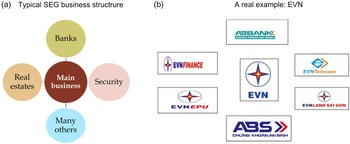
Imagine an SGC originally had a core business and a few related businesses. Now this SGC is upgraded to a SEG with all accompanying ‘usual suspects’ such as real estate, banks, financial and insurance companies as illustrated in Figure 2. Originally, as a SGC, the corporation has only three main sources of credit, namely grants or soft loans from the state, bank credit (including directed credit), and trade credit – the first two sources are the most important. As discussed in Section 2, upon WTO accession, direct credit from the state and the directed lending will be prohibited, and so in principle these sources would vanish. This credit crunch is clearly a big shock for the SGC, which used to rely almost entirely on easy credit without having to worry about its efficiency.
Business Structure of a SEG – The Case of Vietnam Electricity (EVN)

In this context, the decision to upgrade SGCs 91 to SEGs with diversified business has solved the problem of credit depletion. With this new business model, the SEGs can raise capital from a variety of sources – from their financial company, from idle funds of their insurance company, and, most importantly, from the commercial banks owned by the SEGs themselves – then channel credit to their various business activities. In favorable economic conditions, with these abundant internal sources of capital, the SEGs no longer need government subsidies or directed credit from other commercial banks.
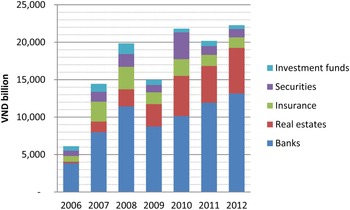
The wave of SGCs and SEGs investing into the banking sector began in 2005 when bank share prices soared and banks rushed to issue shares to raise capital. The SEGs found that it was a golden opportunity to acquire their own banks, thereby securing an abundant and stable source of funding. This is the reason why during the period 2006–2008 investment by the SEGs and SGCs in the financial sector experienced such a sharp increase (Figure 3), in which investment in banks alone accounted for nearly 60%. In 2009, due to the effects of Vietnam's anti-inflation policy and the global financial crisis, the investment of the SEGs and SGCs in banking decreased somewhat, but they increased again immediately in 2010. Moreover, despite the government's policy of forcing the SEGs and SGCs to divest their non-core businesses since 2010, investment in the banking sector continued to grow in 2011 and 2012. By the end of 2013, all 10 surviving SEGs owned at least one bank, with different ownership levels.Footnote 21
Investment into Non-core Businesses of SEGs and SGCs (2006–2012)

Of course, raising capital through internal loans has certain limitations, since SEGs and SGCs are supposed to comply with government regulations, especially in the banking sector. For example, according to the Law on Credit Institutions (2010), banks can only lend to any single borrower (including its owners) maximum of 15% of its charter capital, and to a group of related borrowers maximum of 25% of its charter capital. However, again, the rules are not strictly enforced; and, more pointedly, this provision can be circumvented easily since, for instance, corporation A can borrow from the bank owned by corporation B and vice versa. If not proved to be collusive, this sort of action cannot be sanctioned by either domestic financial regulations or the WTO rules.
5.3 National treatment in disguise
WTO rules require that a member country gives others the same treatment as its own nationals. As such, products, services or intellectual property – either imported or produced by foreign invested enterprises – should receive equal treatment vis-à-vis domestic companies. Moreover, once equal treatment has been granted to FIEs, it is neither desirable nor feasible to deny the same treatment for domestic private enterprises. As a result, a strict application of the national treatment principle will not only effectively prevent the government from tilting the playing field in favor of SOEs, but also help foster the private sector, which in turn will exert competition on SOEs.
For a long time in Vietnam, there has existed discrimination between the state and private sectors. In principle, after joining the WTO, following the ‘national treatment’ principle, discrimination was supposed to be eliminated. In practice, however, the emergence of mammoth SEGs reinforced discrimination, disguising it under new legitimate forms. Thus, even though the degree to which the government can favor the state sector has been reduced by WTO membership, it has by no means been eliminated.
Almost by default, the SEGs are given privileged access to state-controlled resources, the most important of which include land, natural resources, development assistance credit, public investment (especially infrastructure), and public procurement. WTO accession largely leaves these privileges intact.
In addition, the monopoly or quasi-monopoly status of the SEGs means that they set the rules in most industries where they operate. Moreover, this monopoly position gives the SEGs many other advantages. First, the government can use industrial policy, which is in principle supposed to support an entire sector, to deliberately support a targeted SEG. However, if a SEG happens to be the only firm in that industry, then the industry-supporting policy in practice becomes a SEG-supporting policy. Second, as state companies, SEGs are often tasked with drafting the strategy and development plan for the whole industry. In other words, SEGs naturally become the agenda-setter and even policy maker in almost every sector where they operate. As a result, the WTO's ‘national treatment’ is much less relevant for these state conglomerates.
5.4 The role of foreign banks has been modest even after financial opening
Banking liberalization is another possible WTO-related mechanism of reform. The opening of the financial services market induced by WTO accession can effectively foster competition among commercial banks, including foreign banks, thus forcing state-owned commercial banks to become more profit-oriented (Justin Yifu Lin, Reference Lin2001). SOEs would have to accept interest rates closer to market rates, thereby hardening their budget constraints. However, in the case of Vietnam, as the SEGs and SGCs are allowed to own banks, this competitive effect has been significantly reduced because the supposedly arm's-length relationship between SEGs and banks has been transformed into internal transactions within SEGs.
In 2006, shortly before WTO accession, Vietnam had five joint-venture banks, 31 branches of foreign banks, and no wholly owned foreign banks. Shortly after joining the WTO, the number of foreign branches soared, and by 2012 this figure had reached 50. Similarly, a series of wholly owned foreign banks were opened soon after Vietnam joined the WTO, although the number of banks has remained relatively stable since then. Thus, the entire increase in the number of banks during in the period 2006–2012 was from the foreign sector.
However, in terms of market share, the foreign sector did not experience any significant changes during the same period. In contrast, the most important changes happened in the domestic banking sector. The market share of the private joint-stock banks increased sharply from about a quarter in 2006 to more than a half in 2012. In the same period, the share of state-owned commercial banks declined from more than two thirds to just less than 40%.
At the first glance, it looks like the increasing role of domestic private banks is very positive. However, evidence indicates that an important part of this so-called private credit is indeed provided by private banks to their owners – the SEGs and SGCs – sometimes via roundabout and complicated mechanisms (Vu-Thanh et al., Reference Vu-Thanh2014). Between 2005, when the SEGs and SGCs started owning joint-stock banks, and 2012, 15 out of 34 private banks were owned by the SEGs and SGCs. This fact partly explains the strong correlation between the increased share of joint-stock banks and the level of investment in the banking sector of the SGCs and SEGs during the period 2006–2012 (see Figure 3). Moreover, city and provincial governments, who can own SGCs, also joined the bonanza of investment in the banking sector using their influence to direct credit from their banks to their SGCs.
6. Conclusion
This paper argues that in Vietnam, WTO accession has played a catalytic role in accelerating the growth of state economic groups, and that the emergence of these groups has, in turn, partly disabled not only WTO's potentially positive impacts on the SOE sector but also Vietnam's own efforts to reform state conglomerates. This paper also argues that although external pressures – the WTO in this case – can be conducive to economic reform, it is the interactions between external pressures and internal political economy that determines a country's policy direction.
During the process of Vietnam's acceding to the WTO, reform-minded politicians expected that WTO accession would be an opportunity to create pressure on SOEs – the core of the socialist market economy – and force them to reform to become more competitive. In reality, the potential threats caused by WTO accession to the SOE sector convinced both reform-minded and conservative-minded politicians of the urgent need to foster the growth of the SOEs, particularly the ‘commanding height’ SEGs. As such, the WTO accession has contributed to the emergence of the SEGs that have not only become ‘too big to reform’ but also disabled many of the potentially reformative impacts of WTO accession to the advantage of themselves.
An implication of this paper is that WTO accession does not necessarily bring about positive effects, because any external impact inevitably creates internal reactions, which can serve to preserve the status quo. These reactions can be both interest-based and ideological and driven by the interests of domestic incumbent firms. It follows that the interaction between these internal and external forces will determine the final outcomes. Another implication of this paper is that we should not underestimate the ability of politicians to use international trade agreements to leverage their policy choices for their personal interests, and that these policy choices, in turn, may circumvent these very agreements. Consequently, international trade agreements may not necessarily be conducive to reforms, and, in some cases, can even become counterproductive. It follows that the degree to which the positive effects of the WTO accession can be realized depends critically on the domestic political economy of the member country under consideration, and that in order to understand the real impacts of the WTO accession, it is essential to deeply analyze its interaction with and the reaction of the domestic political economy.
It is interesting to compare Vietnam to China with respect of how these two countries employed WTO accession to foster SOE reform. Although this China–Vietnam comparison deserves a separate paper, it is worth emphasizing briefly that while SOE reform in China during the pre-WTO period had faced similar opposition as in Vietnam (Pei, Reference Pei2013), its leadership, however, deliberately integrated SOE reform measures into China's WTO commitments, and then borrowed WTO as a ‘strategic maneuver’ to change the role of government as well as other interest groups in the SOE reform program. For example, China not only agreed to put subsidies to SOE in the Agreement on Subsidies and Countervailing Measures but also made it relatively easy for disputing parties to invoke countervailing measures. China also committed to opening up its financial and distribution sectors to foreign competition where SOEs used to enjoymonopoly. In contrast to Vietnam, as Bajona and Chu (Reference Bajona and Chu2004) observed, in China ‘the SOE reforms become a duty to fulfil an international commitment without the consent of the ministries’ and ‘[g]iven China's tendency to recognize the legitimacy of international law, the enforcement of reforms is much easier through the WTO and through the domestic bureaucracy'.
It is also interesting to connect ideas of this paper to the literature on international standard compliance. The case analyzed in this paper goes beyond the ‘mock compliance’ described by Walter (Reference Walter2008) in his discussion of the compliance heterogeneity adopted by Indonesia, Malaysia, South Korea, and Thailand after the Asian Financial Crisis with respect to the international regulatory standards. In the case of Vietnam's WTO accession, obviously there have been elements of mock compliance. For instance, new laws and regulations in line with the WTO principles were issued; outright subsidies to the SOEs as well as other differential treatments were removed. But at the same time, as shown in this paper, the policy of building up the SEGs is indeed a ‘reversed SOE reform’. Vietnam's WTO accession helped consolidate the position of SOEs, perhaps far beyond what might have happened if Vietnam had not joined the WTO.
Our results complement the insights of the Kucik and Reinhardt (Reference Kucik and Reinhardt2008) paper about the endogenous nature of a country's WTO membership and its domestic institutional design. Kucik and Reinhardt provide very convincing empirical evidence that WTO membership alters incentives and induces countries to restructure their domestic institutions (i.e. anti-dumping mechanism) to take advantage of opportunities brought about by the WTO accession. This is exactly what we observe in our case study: the pending WTO accession motivated the building up of SEGs to face the challenges as well as to explore the opportunities. A closely related insight offered by Kucik and Reinhardt is that in order to convince skeptical domestic groups, the government should have the credible capacity to use anti-dumping to defend weak sectors. In our case study, having the SEGs built up played a critical role in persuading conservative-minded politicians that the government possessed powerful ‘commanding heights’ to control the economy and defend the country's economic sovereignty when needed.
Looking forward, in light of the findings of this paper, it seems that both positive expectations of the proponents and negative reactions of the opponents with regard to the so-called ‘21st-century’ Trans-Pacific Partnership (TPP) agreement have been exaggerated. Once again, this paper suggests that domestic political economy factors will determine the heterogeneity of both compliance outcomes and institutional change in the participating countries.