INTRODUCTION
In the world's tropical rain forests, some plants continuously flower throughout the year (Michaloud et al. Reference MICHALOUD, CARRIÈRE and KOBBI1996, Newstrom et al. Reference NEWSTROM, FRANKIE and BAKER1994, Sakai Reference SAKAI2000). These continuously flowering plants, which mostly inhabit forest floors and forest edges, include pioneer plants (Davies & Ashton Reference DAVIES and ASHTON1996, Kamoi et al. Reference KAMOI, KENZO, KURAJI and MOMOSE2008, Momose 2004, Rivera & Borchert Reference RIVERA and BORCHERT2001), figs (Harrison Reference HARRISON2003, Michaloud et al. Reference MICHALOUD, CARRIÈRE and KOBBI1996) and herbs (Sakai Reference SAKAI2000). The flowering phenology of other plants in the forest considerably differs from that of continuously flowering plants (Sakai et al. Reference SAKAI, MOMOSE, YUMOTO, NAGAMITSU, NAGAMASU, HAMID and NAKASHIZUKA1999a). Among these other plants, canopy trees, such as dipterocarps, and subcanopy trees synchronously flower at 1- to 10-y intervals (general flowering; GF), and these trees simultaneously produce many flowers to increase plant fitness. However, continuously flowering plants produce flowers throughout the year, with a certain amount of continuous reproductive success (Tokumoto et al. Reference TOKUMOTO, SAKAI, MATSUSHITA, OHKUBO and NAKAGAWA2014). Because continuous flowering is influenced by climate fluctuations and continuous pressure from predators, excess production of reproductive organs may reduce the detrimental effects of such fluctuations in climate and predators (Kamoi et al. Reference KAMOI, KENZO, KURAJI and MOMOSE2008).
Studies conducted in temperate regions have focused on the phenomenon of excess production of reproductive organs (Holtsford Reference HOLTSFORD1985). Five hypotheses have been advanced: the resource boom hypothesis (a resource boom promotes the production of excess flowers and produces fruits only under appropriate conditions), selective fruit hypothesis (in the event of selective fruiting, plants select only higher quality fruits), pollinator attraction hypothesis (excess flowers contribute to the attraction of pollinators), male function hypothesis (pollen from excess flowers may contribute to the fertilization of other flowers), and reproductive assurance hypothesis (production of excess reproductive organs can assure reproductive success, with extra organs functioning as compensatory reproductive organs. In the event that one or several reproductive organs are damaged by predators, the other reproductive organs are available.) Although these hypotheses are not mutually exclusive, a previous study of the excess production of reproductive organs by a continuously flowering shrub, Melastoma malabathricum (Melastomataceae), provided evidence only for the resource boom hypothesis. This species frequently aborts reproductive organs under suboptimal weather conditions, particularly when solar radiation is low, and the response to weather conditions differs among reproductive stages, from bud formation to fruit maturation (Kamoi et al. Reference KAMOI, KENZO, KURAJI and MOMOSE2008).
Another continuously flowering shrub, Dillenia suffruticosa (Griff. ex Hook. f. & Thomson) Martelli (Dilleniaceae), often suffers from fruit predation by flies of the Drosophilidae and Tipulidae (Y. Tokumoto, unpubl. data), potentially indicating the reproductive assurance hypothesis. Furthermore, D. suffruticosa occasionally produces fruits that do not have mature seeds and have only immature seeds or unfertilized ovules. However, floral display effects on pollinators are not detected, because the main pollinators, such as carpenter bees, visit the flowers regardless of flower number (Y. Tokumoto, unpubl. data). The former phenomenon does not support the selective fruit hypothesis and the latter does not support the pollinator attraction hypothesis. Because the reproductive organs of both D. suffruticosa and M. malabathricum are aborted in young buds, the male function hypothesis is not a viable explanation for the excess production of reproductive organs by these continuously flowering plants (Kamoi et al. Reference KAMOI, KENZO, KURAJI and MOMOSE2008). Thus, the excess production by D. suffruticosa may be consistent with both the resource boom and reproductive assurance hypotheses, and the relative importance of the two hypotheses could differ between the stages of bud formation and fruit maturation.
To test the two hypotheses that may contribute to the excess production of the reproductive organs by a continuously flowering shrub, we examined (1) the factors determining the fate of reproductive organs during budding and fruit maturation; (2) the relationships between the reproductive organ status of D. suffruticosa and resource availability traits that could affect reproductive success, such as individual size, leaf area, leaf chlorophyll concentration, light environment and climatic conditions (precipitation, temperature and PAR) and (3) the factors contributing to excess production of reproductive organs, particularly within the context of the resource boom and reproductive assurance hypotheses.
METHODS
Study site
This study was conducted at the Lambir Hills National Park (LHNP) in Sarawak, Malaysia (4°14′N, 114°03′E). The annual mean temperature is 25.8°C, and the annual mean precipitation has been 2600 mm over the last 10 y (Kume et al. Reference KUME, TANAKA, KURAJI, KOMATSU, YOSHIFUJI, SAITOH, SUZUKI and KUMAGAI2011). In this region, the period from January to March is associated with reduced precipitation, but no obvious dry season is evident (Kume et al. Reference KUME, TANAKA, KURAJI, KOMATSU, YOSHIFUJI, SAITOH, SUZUKI and KUMAGAI2011). LHNP is in an old-growth lowland mixed dipterocarp forest. Trees of Dipterocarpaceae, Fabaceae, Anacardiaceae and Sterculiaceae dominate the canopy and emergent layers (Lee et al. Reference LEE, ASHTON, YAMAKURA, DAVIES, ITOH, CHAI, OHKUBO and LAFRANKIE2003). In LHNP, a canopy crane 81 m tall was installed in 2000 to allow the observation of general flowering and water and carbon budgeting. Meteorological data (precipitation, temperature and PAR) were monitored at the top of the crane (Kume et al. Reference KUME, TANAKA, KURAJI, KOMATSU, YOSHIFUJI, SAITOH, SUZUKI and KUMAGAI2011).
Study species
The study species D. suffruticosa is distributed in South-East Asia, from Peninsular Malaysia to the Philippines (Hoogland & Wadhwa Reference HOOGLAND and WADHWA1996), and it grows in secondary forests, swampy grounds, and along roadsides in both sand and clay soils (Kochummen Reference KOCHUMMEN and Whitmore1972). The species grows to a maximum height of 15–20 m in < 10-y-old secondary forests and sometimes forms clumps, with ramets sprouting from the ground. Although D. suffruticosa regularly produces many inflorescences, individual plants over 15–20 m tall in secondary forests have been observed to produce only a few inflorescences (Y. Tokumoto, pers. obs.). The cymose (primarily cincinnate) inflorescence contains 6.4 ± 1.5 (mean ± SD, N = 185) reproductive organs per inflorescence (Horn Reference HORN2009). The inflorescence develops between the wings of terminal leaves, and the flower buds bloom 26.0 ± 9.2 d (N = 756) after the formation between the wings. Each flower has 7.6 ± 0.8 (N = 421) ovaries and each ovary has 9.4 ± 2.0 (N = 6236) ovules. Each hermaphroditic flower has about 175 stamens and 100 staminodes (Hoogland 1952) associated with polyandry: in addition, each flower has poricidal anthers, five sepals, five yellow petals and concave stigmas (Endress Reference ENDRESS1997). Flowers open from 05h00 to 17h00 and are produced almost every day at the individual plant or population level (Tokumoto et al. Reference TOKUMOTO, SAKAI, MATSUSHITA, OHKUBO and NAKAGAWA2014). Because the flower does not produce nectar, visitors to the flower obtain only pollen (Endress Reference ENDRESS1997, van der Pijl Reference VAN DER PIJL1954), and pollen limitation rarely occurs (Y. Tokumoto, unpubl. data).
Mature fruits open 31.4 ± 2.6 d (N = 462) after flowering. In mature fruits, three kinds of seeds are observed: mature seeds, immature seeds and unfertilized ovules. The mean dry weight of mature seeds was 6.8 ± 1.7 mg (N = 1780), which have a red seed coat weighing 2.1 ± 0.8 mg. Dry immature seeds weighed 1.9 ± 1.4 mg (N = 5487), and the dry weight of the yellow or white seed coat was 0.5 ± 0.6 mg. Dry unfertilized ovules did not have a seed coat and weighed 0.2 ± 0.1 mg (N = 22148).
Only mature seeds are capable of germinating (Y. Tokumoto, unpubl. data). The fruit/seed predators are insects, mammals and birds (Y. Tokumoto, unpubl. data). The primary insect predators are those of the order Diptera; in 86.8% (N = 293) of infested reproductive organs, 94.7% were in the Nematocera suborder and 5.3% in the Brachycera suborder. Small numbers of insects were in the orders Lepidoptera (5.9%; N = 18), Hymenoptera (2.6%; N = 8), Coleoptera (1.0%; N = 3) and unknown order (3.6%; N = 11). An automatic camera (Field Note II; Marifu Shoji) detected only one mammal predator Chiropodomys gliroides (Muridae) (Payne & Francis Reference PAYNE and FRANCIS2005). Birds in the Pycnonotidae, Nectariniidae and Chloropseidae were the main avian predators and seed dispersers (Kamoi pers. comm.).
Individual plant sizes and branch characteristics
We randomly selected 41 D. suffruticosa plants in November 2011, along a roadside. To quantify the resource availability for each individual plant, we measured diameter at breast height (dbh) of the largest stems using digital callipers to the nearest 0.01 mm in November 2011 and March 2012. To exclude the effects of allocation on growth, the measurements were averaged and the dbh ranged from 12.3 to 81.0 mm (median = 26.5 mm; N = 41).
On four to five marked branches of each plant (a total of 185 branches), we measured the leaf area, chlorophyll concentration index and light environment (designated as branch characteristics). We recorded leaf numbers on branches, leaf length and leaf width. Each leaf that had been damaged by herbivores, such as lepidopteran larvae, was classified into one of five categories based on the percentage of damage (1 (0%), 2 (1–25%), 3 (26–50%), 4 (51–75%) and 5 (76–100%)). We measured leaf areas (N = 10) using ImageJ software (Schneider et al. Reference SCHNEIDER, RASBAND and ELICEIRI2012) and constructed an allometric equation for leaf area (cm2) based on leaf length (cm) and width (R 2 = 0.99). We also calculated a leaf area that included the predation score:
 $$\begin{eqnarray*}
{\rm Leaf\ area}\;&{\rm = }&\;{\rm (1}{\rm .25}\;{\rm - }\;{\rm (category\ for\ predation/4)}\nonumber\\
&&{\rm \times }\;{\rm 0}{\rm .78}\;{\rm \times }\;{\rm (leaf\ length}\;{\rm \times }\;{\rm leaf\ width)}\;^{{\rm 0}{\rm .99}}
\end{eqnarray*}$$
SPAD scores, which (within species) are comparable to leaf chlorophyll concentrations, were measured three times per leaf (SPAD-502; Konica Minolta Optics, Inc.). We measured the light environments of inflorescences on marked branches using Optleaf film (R-3D; Taisei Environment & Landscape Corp.). We measured pre-exposure colour scores using a D-Meter RYO-470 (Taisei Environment & Landscape Corp.); three films were attached to each branch for 2–3 d. We recorded post-exposure colour scores and calculated the discolouration rate (DR) of each film, which was the log-transformed percentage of the post-exposure colour score divided by the pre-exposure colour score. Using the DR, the PAR on each target inflorescence was calculated using the following formula (Kenzo et al. Reference KENZO, YONEDA, AZANI and MAJID2010; R 2 = 0.98):
 $$\begin{equation*}
{\rm PAR}\;{\rm = }\;{\rm - 103}\;{\rm \times }\;{\rm DR}^{\rm 2} \;{\rm + }\;{\rm 107}\;{\rm \times }\;{\rm DR}\;{\rm + }\;{\rm 200}
\end{equation*}$$
To obtain the light environment of each branch, we divided the calculated PAR by the total PAR during the film exposure period, which was measured at the top of the canopy crane. In terms of branch characteristics, total leaf area per branch ranged widely from 168 to 4032 cm2 (median = 1021 cm2), and the SPAD score was 36.7 ± 5.4 (N = 185). The light environment of each inflorescence was 42.7% ± 19.7%.
Assessment of the fates of reproductive organ and reproductive success
To evaluate the reproductive success of D. suffruticosa, we counted the reproductive organs in inflorescences on marked branches and monitored them every day in the early morning from November 2011 to March 2012. In addition, we marked newly produced inflorescences on marked branches and counted the total number of inflorescences. We found 1190 marked reproductive organs in 185 inflorescences. Because we monitored reproductive organs every day and set nylon bags under the inflorescence, the abscised reproductive organs of each individual were identified. Abscised reproductive organs were transported to the laboratory and stored in plastic cases (with controlled humidity) to evaluate factors affecting the fate of the reproductive organs. In our preliminary survey during June–August 2011, predators emerged from abscised reproductive organs within 30 d. The reproductive organs were reared for another 30 d and checked for further predators. Based on field observations and incubations results, we classified the fates of the reproductive organs into five categories: intact abscised (Intact; seed predators did not emerge from abscised reproductive organs), depredated by insects (Insect; insects emerged from abscised reproductive organs), preyed on by mammals (Mammal; reproductive organs disappeared and only pedicels remained), preyed on by birds (Bird; reproductive organs were pecked by birds and abscised) and unknown. Mature fruits were gathered and dried at 50°C for 48–72 h, and the number of seeds of each type (mature, immature and unfertilized ovules) was counted. Although highly damaged reproductive organs abscised, a few damaged reproductive organs remained on the inflorescence and could set fruit. We categorized the damaged reproductive organs as depredated reproductive organs and the fruit as mature fruits. Because the seed set of damaged reproductive organs could not be correctly calculated, we did not include the data in seed set results. Five marked reproductive organs did not mature within the research period; hence, these fruits were excluded from the statistical analyses.
Statistical analyses
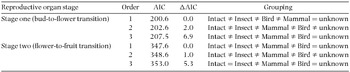
Because the percentages of each factor affecting the fate of the reproductive organs differed between flower buds and immature fruits, we divided the reproduction period into two stages: the bud-to-flower transition (stage one) and the flower-to-fruit transition (stage two). To analyse differences in the percentages of the fates of reproductive organs at each stage, we computed generalized linear mixed models (GLMMs). In each model, we used the number of reproductive organs featuring each fate of the reproductive organ in each inflorescence as response variables, and the five potential fates of the reproductive organs (Intact, Insect, Mammal, Bird and Unknown) as explanatory variables, with a Poisson distribution and logarithmic link. The total numbers of reproductive organs in each inflorescence were added as an offset term in the model, and individual plants and inflorescences nested in individual plants were random effects in the model. When differences in the fates of the reproductive organs were detected from the analysis of deviance, we performed model selection methods that regrouped the categories of the five fates, based on Akaike's information criterion (AIC). For details on the grouping methods of the explanatory variables based on AIC, see Kenta et al. (Reference KENTA, INARI, NAGAMITSU, GOKA and HIURA2007).
Multiple regression analyses were conducted to evaluate the effects of plant and branch characteristics and climatic conditions on the status of the reproductive organs that were both abscised and retained at each stage. The Unknown category had only one reproductive organ; thus this category was excluded from further analysis. During stage one of bud development, we included five reproductive organ statuses as response variables. One status was ‘bud remaining until flowering’. The other four statuses were the four fates of reproductive organs: Intact, Insect, Mammal and Bird. During stage two of fruit development, we included five reproductive organ statuses as response variables. One status was ‘mature fruit’ and the others were the four abovementioned fate categories. Initially, we searched for applicable cumulative climatic conditions (precipitation, temperature and PAR) at each stage using the deviance information criterion (DIC; Spiegelhalter et al. Reference SPIEGELHALTER, BEST, CARLIN and VAN DER LINDE2002). We constructed GLMMs with Markov Chain Monte Carlo (MCMC) estimations. We ran 1300000 iterations with a burn-in phase of 300000 and a thinning interval of 1000, in multivariate distributions. The five reproductive organ statuses were the response variables, and each cumulative climatic condition was a fixed effect. The prior distributions of fixed-effect parameters were the less-informative normal distribution, Normal (0, 10000000000; Hadfield 2010). The random effects were individual plants and branches nested in individual plants, and prior distributions were the inverse Wishart distribution, W −1 (1, 0.002).
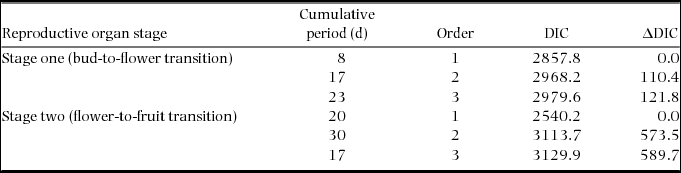
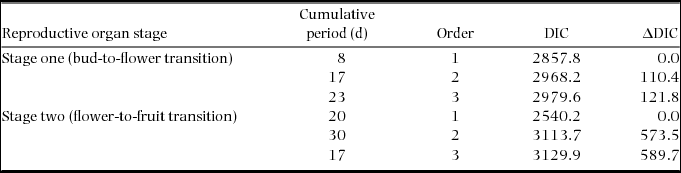
The number of days of cumulative climatic conditions used in this analysis at stage one began from the day of formation of the inflorescence in the leaf wing to 26 d after inflorescence formation. Stage two lasted from flowering to 31 d after flowering. The best-fit cumulative climatic condition at stage one was estimated from inflorescence initiation to 8 d later, whereas that of stage two was from flowering to 20 d later (Appendix 1).
Next, we reconstructed the GLMMs of the MCMC estimation using the same number of iterations, same burn-in and same thinning interval. The reproductive organ statuses at each stage served as response variables. The dbh, total leaf area on each branch, average SPAD score for each branch, light environment of each branch and applicable cumulative climatic conditions were fixed effects. The random effects and the prior distributions of fixed and random effects were the same as previously described.
To evaluate the factors affecting seed statuses, we constructed GLMMs featuring MCMC estimations in the same configurations as described above, with the same fixed and random effects and prior distributions. Because the days to maturity varied among fruits, we recorded the cumulative days from flowering to maturity for each fruit and applied the cumulative climatic conditions (precipitation, temperature and PAR) of each fruit as fixed effects. To confirm that the iteration numbers of all MCMC estimations were adequate, we ran the Gelman–Rubin convergence test and measured the differences in potential scale reduction factors from unity.
All statistical analyses were performed using the R version 3.1.1. (Vienna, Austria).
RESULTS
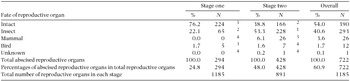
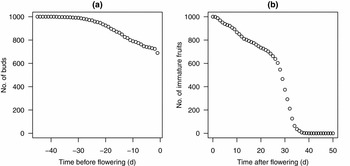
Of the 722 abscised reproductive organs, 294 (40.7%) and 428 (59.3%) fell at stages one and two, respectively (Table 1). The proportion of reproductive organs affected during stage one of bud development and the percentage representation of each fate differed significantly (χ2 = 136, P < 0.01). Based on AIC groupings, the most common reproductive organ fate was intact (76.2%, Table 1, Appendix 2), followed by insect infestation (22.1%, Table 1, Appendix 2). Bird predation accounted for only 1.7% of reproductive organs. Mammal predation was not detected at stage one. The proportion of reproductive organs affected during stage two and the percentage undergoing each fate differed significantly (χ2 = 128, P < 0.01). The trend of fruit fate during stage two differed from the bud fate during stage one (Table 1). During stage two, the most common reproductive organ fate was insect infestation (53.3%; Table 1, Appendix 2), followed by intact (38.8%). Although both mammal and bird predation were observed during stage two, the percentages for these two fates were extremely low compared with insect infestation and intact. Over the course of development from bud to flower (stage one), the number of buds decreased over 40 d. During stage two of fruit development, immature fruits decreased over 30 d and drastically decreased at about 30 d, as the fruits had matured (Figure 1). In total, about 60% of reproductive organs failed to set fruit (Table 1), and average fruit set per inflorescence was 39.0% ± 31.2% (N = 185).
The percentages of reproductive organ fates of Dillenia suffruticosa exhibiting the five fates of reproductive organs (abscised intact reproductive organs (Intact), insect-predated reproductive organs (Insect), mammal-predated reproductive organs (Mammal), bird-predated reproductive organs (Bird) and unknown) during stage one (bud-to-flower transition) and two (flower-to-fruit transition) and overall (bud-to-fruit transition) in Lambir Hills National Park. Differences among the percentages of the fates of reproductive organs with different superscripts at the same stage indicate statistically significant differences from the results of the best-fit model based on AIC scores (Appendix 2).

Time-series for the remaining number of reproductive organs of Dillenia suffruticosa during two stages in Lambir Hills National Park, Malaysia: during stage one (bud-to-flower transition) (a): stage two (flower-to-fruit transition) (b). Y-axis: numbers of remaining buds and immature fruits; the initial numbers of reproductive organs is corrected as 1000. X-axis: time after flowering; zeroes represent flowering days. Stage one lasted from the formation of inflorescences to flowering. Stage two lasted from flowering to fruit maturity.

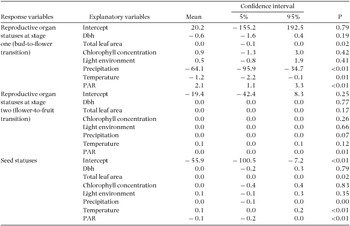
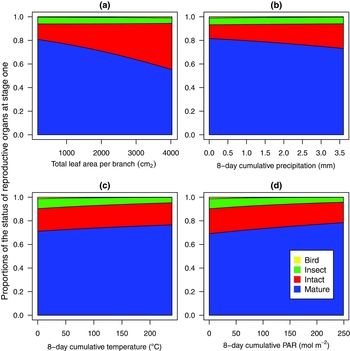
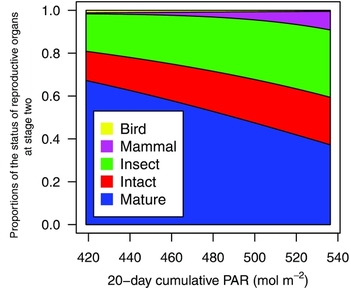
During stage one, 8-d cumulative climate conditions affected the fate of reproductive organs (Table 2; Figure 2). Larger total leaf area and more cumulative precipitation were associated with lower percentages of buds remaining until flowering and an increase in abscised intact reproductive organs (Figure 2a, b). Unlike the two variables mentioned above, cumulative temperature and PAR contributed to high percentages of buds remaining until flowering (Figure 2c, d). During stage two, only the 20-d cumulative PAR affected the fates of reproductive organs (Table 2). Cumulative PAR enhanced insect infestation and reduced fruit maturation (Figure 3).
Results of multiple regression analyses examining the factors affecting the reproductive organ statuses (flower/fruit, abscised intact reproductive organ, insect-predated reproductive organ, mammal-predated reproductive organ, bird-predated reproductive organ) at each stage and three seed statuses of Dillenia suffruticosa with mean and lower and upper 95% confidence intervals of posterior distributions of each factor in Lambir Hills National Park, Malaysia.

Proportional changes in the statuses of the reproductive organs of Dillenia suffruticosa at stage one (bud-to-flower transition) in Lambir Hills National Park with changes in the significant variables from multiple regression analysis: total leaf area per branch (cm2) (a): 8-d cumulative precipitation (mm) (b): 8-d cumulative temperature (°C) (c): 8-d cumulative PAR (mol m−2) (d). Y-axis: proportions of the status of reproductive organs. Colours indicate each status of the reproductive organ; from the bottom, buds remaining until flowering (Mature) (blue), abscised intact reproductive organs (Intact) (red), insect-predated reproductive organs (Insect) (green) and bird-predated reproductive organs (Bird) (yellow).

Proportional changes of reproductive organ statuses of Dillenia suffruticosa at stage two (flower-to-fruit transition) in Lambir Hills National Park with changes in 20-d cumulative PAR (mol m−2). Y-axis: proportions of the status of reproductive organs. Colours indicate each status of the reproductive organ; from the bottom, mature fruits (Mature) (blue), abscised intact reproductive organs (Intact) (red), insect-predated reproductive organs (Insect) (green), mammal-predated reproductive organs (Mammal) (purple) and bird-predated reproductive organs (Bird) (yellow).

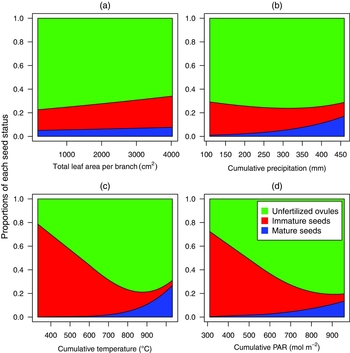
Seed production was affected by total leaf area and cumulative climatic conditions (Table 2, Figure 4). As leaf area increased, unfertilized ovules decreased and the levels of mature and immature seeds increased (Figure 4a). Higher cumulative precipitation, temperature and PAR led to lower percentages of immature seeds, with higher proportions of mature seeds and unfertilized ovules (Figure 4b, c, d). Average seed set per fruit was 6.2 ± 9.0% (N = 421).
Proportional changes of each seed status in mature fruits of Dillenia suffruticosa in Lambir Hills National Park with changes in the significant explanatory variables from multiple regression analysis: total leaf area per branch (cm2) (a): cumulative precipitation from flowering to maturity (mm) (b): cumulative temperature (°C) (c): cumulative PAR (mol m−2) (d). Y-axis: proportions of each seed status. Colour indicates each seed status: mature seeds (blue), immature seeds (red) and unfertilized ovules (green).

DISCUSSION
Resource limitation of the reproductive success and the resource boom hypothesis
One of the fates of the reproductive organs, intact, was not affected by predators. Because pollination did not occur at stage one, the factors causing the abscission of intact reproductive organs at stage one may not feature pollen limitation, but rather resource limitation. However, the factors causing the abscission of reproductive organs at stage two might include both resource and pollen limitations (Knight et al. Reference KNIGHT, STEES, VAMOSI, MAZAR, BURD, CAMPBELL, DUDASH, JOHNSTON, MITCHELL and ASHMAN2005). When the survival curves at stage two of D. suffruticosa were compared with those of canopy trees such as dipterocarps, the shapes differed profoundly. The survival curves of canopy trees exhibited a greater than 90% decrease in reproductive organs within 20 d of flowering (Momose et al. Reference MOMOSE, NAGAMITSU and INOUE1996, Nakagawa et al. Reference NAKAGAWA, TAKEUCHI, KENTA and NAKASHIZUKA2005, Sakai et al. Reference SAKAI, MOMOSE, YUMOTO, KATO and INOUE1999b, Tokumoto et al. Reference TOKUMOTO, MATSUSHITA, TAMAKI, SAKAI and NAKAGAWA2009), mainly caused by pollen limitation (Ghazoul et al. Reference GHAZOUL, LISTON and BOYLE1998, Kenta et al. Reference KENTA, SHIMIZU, NAKAGAWA, OKADA, HAMID and NAKASHIZUKA2002, Sakai et al. Reference SAKAI, MOMOSE, YUMOTO, KATO and INOUE1999b). However, syncarpous plants are able to share attached pollen among ovules and the pollen tubes grow from the attached stigmas to different ovaries. This mechanism contributes to prevention of pollen limitation compared with apocarpous plants such as dipterocarp trees (Endress Reference ENDRESS1982). Dillenia suffruticosa is able to set fruit at relatively low pollinator densities and pollen limitation rarely occurs (Tokumoto et al. Reference TOKUMOTO, SAKAI, MATSUSHITA, OHKUBO and NAKAGAWA2014, Y. Tokumoto, unpubl. data). Thus, abscission of intact reproductive organs in stage two might be caused by resource limitation and not pollen limitation.
Among the individual and branch characteristics, only total leaf area affected the fates of reproductive organs at stage one as well as seed status (Table 2, Figure 2a, 4a). SPAD scores, light environment and dbh affect fruit set in other species (Ichie et al. Reference ICHIE, KITAHASHI, MATSUKI, MARUYAMA and KOIKE2002, Niesenbaum Reference NIESENBAUM1993, Somanathan & Borges Reference SOMANATHAN and BORGES2000, Stephenson Reference STEPHENSON1981), but they are not important in D. suffruticosa. However, branches with large leaf areas decreased the survival of early-developing reproductive organs and positively affected seeds in mature fruits.
The costs of current and future reproductive investments feature trade-offs (Obeso 2002). Several studies have shown that branches lacking leaves exhibited reduced production of reproductive organs (Cunningham Reference CUNNINGHAM1997, Niesenbaum Reference NIESENBAUM1993). In D. suffruticosa, the relationship between total leaf area per branch and the number of inflorescences produced by the same branch was significantly positive (Y. Tokumoto, unpubl. data). Thus, branches with large leaf areas might supply an insufficient amount of photosynthetic resources for the survival of reproductive organs at stage one, but a sufficient amount for further formation of inflorescences. In mature fruit, the percentage of unfertilized ovules declined with increased leaf area (Figure 4a). Previous research has demonstrated that seed set increases with increased leaf area (Ishizaki et al. Reference ISHIZAKI, NARUMI, MIZUSHIMA and OHARA2010, Mothershead & Marquis Reference MOTHERSHEAD and MARQUIS2000), and under resource-limiting conditions, plants will limit both fruit set and further production of new reproductive organs (Burd Reference BURD1998, Medrano et al. Reference MEDRANO, GUITIÁN and GUITIÁN2000, Wesselingh Reference WESSELINGH2007). Thus, branches with greater leaf areas may limit the number of reproductive organs to some extent at stage one, investing in further production of inflorescences and increased the number of mature seeds in the fruits at maturity.
The fate of buds during stage one was primarily affected by the abscission of intact reproductive organs (Table 1). Because all cumulative climatic conditions (precipitation, temperature and PAR) affected the survival of reproductive organs at stage one (Table 2, Figure 2) and only PAR affected those at stage two (Figure 3), climatic conditions had a greater impact on survival at stage one compared with stage two.
Work on other continuously flowering species has shown that the early stages of reproductive organs are sensitive to the effect of temperature on respiration rate (Kamoi et al. Reference KAMOI, KENZO, KURAJI and MOMOSE2008), and the reproductive organs of D. suffruticosa at stage one might be more sensitive to climatic conditions than at stage two. Temperature and PAR positively affected the reproductive organs at stage one and seed status (Figure 2c, d, 4c, d). The respiration rates of both reproductive organs and whole plants generally increase with high temperature, and increased plant growth is evident at optimal temperatures (Flanagan & Johnson Reference FLANAGAN and JOHNSON2005, Ogawa et al. Reference OGAWA, ABDULLAH, AWANG and FURUKAWA2005). Increased PAR tends to increase fruit set and seed weight in mature fruits (Figueroa-Castro & Valverde Reference FIGUEROA-CASTRO and VALVERDE2011, Zhang et al. Reference ZHANG, HU, ZHOU, XU, YAN and LI2005). Thus, higher temperatures and PAR were necessary for the survival during budding and seed set of D. suffruticosa. The response to precipitation differed between stage one and the seed status. Increased precipitation decreased survival at stage one and increased mature seed rate. These results indicate that water demands differ between the different reproductive stages and the demand for water at fruit maturity might be higher than at stage one. Previous research has shown that the water demands of reproductive organs increased with the progression of reproductive stages (Kamoi et al. Reference KAMOI, KENZO, KURAJI and MOMOSE2008), and more precipitation resulted in higher seed set (Shem-Tov & Gutterman Reference SHEM-TOV and GUTTERMAN2003). Thus, precipitation induced abortion of reproductive organs at stage one, but more precipitation was needed to improve seed set at maturity.
According to the resource boom hypothesis, excess reproductive organs respond to the unpredictable abundance of resources, and some of the organs become mature if resources are sufficient (Holtsford Reference HOLTSFORD1985). The results described above demonstrate that less precipitation and higher temperature and PAR reduced the abortion rate at stage one. Higher PAR and larger leaf area resulted in higher seed set indicating that the reproductive success of D. suffruticosa increases with sufficient resources, which supports the resource boom hypothesis. Many studies have compared reproductive success with and without sufficient resources, such as fertilizers and water, and results have suggested that the addition of resources improves reproductive success (Campbell & Halama Reference CAMPBELL and HALAMA1993, Muños et al. Reference MUÑOS, CELEDON-NEGHME, CAVIERES and ARROYO2005). Previous research on continuously flowering species in the same region as our study site has also shown that higher radiation decreases the abortion rate (Kamoi et al. Reference KAMOI, KENZO, KURAJI and MOMOSE2008). Because climatic conditions and leaf areas affected the seed set of D. suffruticosa, the resource boom hypothesis might be appropriate to explain the behaviour of continuously flowering plants in the South-East Asian tropics.
Predation of reproductive organs and the reproductive assurance hypothesis
At stage two, the fates of reproductive organs were mainly insects and intact, and the status of the reproductive organs was only affected by PAR (Table 2). Although abscissions of intact reproductive organs accounted for about 40% of the fate of immature fruits (Table 1), the percentage of abscised intact reproductive organs seldom changed with changes in PAR (Figure 3). Generally, fruit set increases with increases in PAR (Zhang et al. Reference ZHANG, HU, ZHOU, XU, YAN and LI2005). Our study showed that insect predation risk increased with PAR, and high PAR reduced reproductive success. Insect predation plays an important role in abscission at stage two, and most insect predators of D. suffruticosa fruits were in the dipteran order. According to a previous study, the flight activities of flies are triggered by increases in light intensity (Shipp et al. Reference SHIPP, GRACE and SCHAALJE1987). Thus, predators of this species might respond to high PAR and attack the reproductive organs. Therefore, the survival of reproductive organs at stage two may not be directly affected by PAR, but might be vulnerable to indirect effects that induce insect predation.
The reproductive assurance hypothesis asserts that excess production of reproductive organs serves as a compensatory measure in the case of plant damage (Holtsford Reference HOLTSFORD1985). Based on the results of the fates of reproductive organs during stage two of fruit maturation, insect predation was high, and D. suffruticosa produced fruits that had few mature seeds if precipitation, temperature and PAR were low (Figure 4b, c, d). Considering the high predation rates at stage two and the differences in the degrees of maturation and infestation, fruits with lower amounts of mature seeds may serve as reproductive organs to predators. However, the reproductive organs of D. suffruticosa, in which a small number of ovaries were preyed upon by insects, did not abscise until fruit maturation (Y. Tokumoto, unpubl. data). Because a small amount of ovule infestation does not result in abortion (Goto et al. Reference GOTO, OKAMOTO, KIERS, KAWAKITA and KATO2010), D. suffruticosa exhibits predation tolerance and was able to set seeds. These results indicate that D. suffruticosa produces compensatory reproductive organs for predators, potentially supporting the reproductive assurance hypothesis.
The reproductive organs of M. malabathricum are rarely infested by predators (Kamoi et al. Reference KAMOI, KENZO, KURAJI and MOMOSE2008). Melastoma malabathricum inhabits low-nutrient soils and accumulates aluminum in its leaf tissues (Davies & Semui Reference DAVIES and SEMUI2006, Kamoi et al. Reference KAMOI, KENZO, KURAJI and MOMOSE2008, Watanabe Reference WATANABE1997). Aluminium accumulation sometimes functions as a toxin for other species. Although chemical defence against predators in the reproductive organs has not been studied, further studies of relationships between seed predator fauna and chemical defences might reveal alternative strategies for different predators within continuously flowering plants in South-East Asia.
CONCLUSION
Dillenia suffruticosa exhibited high reproductive success under conditions of little precipitation, and high temperature and 8-d cumulative PAR at stage one. In addition, this species required high PAR to ensure high seed set, but a low 20-d cumulative PAR after flowering to achieve a high fruit set to escape predators. This species must adapt to contradictory requirements to increase its fitness. Climatic conditions in the South-East Asian tropics unpredictably fluctuate in 30- to 60-d cycles (Miyakawa et al. Reference MIYAKAWA, SATOH, MIURA, TOMITA, YASHIRO, NODA, YAMADA, KODAMA, KIMOTO and YONEYAMA2014). Species need to produce fruit continuously under any climatic conditions. This behaviour is consistent with both the resource boom and reproductive assurance strategies. Frequent production of reproductive organs compensates for climatic and predation effects and enhances reproductive success (Lay et al. Reference LAY, LINHART and DIGGLE2011). Although this study examined the results over only 5 mo, long-term changes in climate fluctuation patterns due to climate change might also affect the reproductive success of D. suffruticosa.
ACKNOWLEDGEMENTS
We are grateful to Forest Department Sarawak and Sarawak Forestry Corporation for research permission and kind supports. We are greatly appreciative of Dr Tomonori Kume (National Taiwan Univ.) for providing the climate data at research site. We thank Dr Tomoaki Ichie (Kochi Univ.) for cooperating a photosynthetic analyser for SPAD scores (SPAD-502); Professor Tatsuhiro Omata (Nagoya Univ.) for cooperating Opt-leaf film analyser (D-Meter); Dr Masanori J Toda (Hokkaido Univ. Museum) for identification of one of the insect predators, Scaptodrosophila fly; Dr Tiansawat Pimonrat (Chiang Mai Univ.) for information about seed germination strategies of D. suffruticosa; Ms Tamaki Kamoi for seed dispersers’ information; Mr Keneddy bin Eli for assisting with the field survey. This study was financially supported by the Research Institute for Humanity and Nature project (D-04), and Japan Society for the Promotion of Science (JSPS) KAKENHI Grants-in-Aid for Young Scientists (A) 20–687002 and for JSPS Fellows 22–6034.
Candidate models to determine the cumulative number of days of climate conditions (precipitation, temperature and PAR) affecting the proportions of five reproductive organ statuses (flower/fruit, abscised intact reproductive organ, insect-predated reproductive organ, mammal-predated reproductive organ, bird-predated reproductive organ) of Dillenia suffruticosa in each stage based on DIC scores. The cumulative periods were the cumulative days from inflorescence formation to flowering in stage one of bud formation and from flowering until fruit maturation in stage two of fruit maturation. The best-fit model and the following two best models were ordered based on DIC scores.
Results of model selection to determine the appropriate grouping of five fates of reproductive organs (abscised intact reproductive organs (Intact), insect-predated reproductive organs (Insect), mammal-predated reproductive organs (Mammal), bird-predated reproductive organs (Bird) and unknown) that affect the proportional differences in the fates of reproductive organs of Dillenia suffruticosa at each stage based on AIC scores. For the details of the fates of reproductive organ, see assessment of the fates of reproductive organs and reproductive success in methods.