


With the increasing use of assisted reproductive technologies and delayed childbearing, multiple pregnancies have become more common. In monochorionic diamniotic twin pregnancies, selective fetal growth restriction (sFGR) affects approximately 15–20% of cases and is closely associated with unequal placental sharing and Doppler abnormalities (Prasad et al., Reference Prasad, Khalil, Kirkham, Sharp, Woolfall, Mitchell, Yaghi, Ricketts, Popa, Alfirevic, Anumba, Ashcroft, Attilakos, Bailie, Baschat, Cornforth, Da Silva Costa, Denbow, Deprest and Yinon2024; Zhang et al., Reference Zhang, Liu, Wei, Luo, Shi, Lin, He and Wei2021). Additionally, improved economic conditions have provided families with more resources and willingness to attempt assisted reproduction, further increasing the likelihood of multiple pregnancies. Previous cohort studies suggest that CRL discordance and abnormal cord insertion are associated with sFGR, though their predictive performance varies and may depend on outcome definition (Romanenko et al., Reference Romanenko, Sulimenko and Ovcharenko2021; Soni et al., Reference Soni, Gebb, Paidas Teefey, Coleman, Moldenhauer and Khalek2025).
Compared to singleton pregnancies, multiple pregnancies have a 1−4 times higher rate of adverse pregnancy outcomes. Unique complications of MC twin pregnancies, such as twin-to-twin transfusion syndrome (TTTS), sFGR, and twin anemia-polycythemia sequence (TAPS), significantly endanger maternal and infant health (Gu et al., Reference Gu, Yu, Weng, Chen and Ye2022). As a common complication, sFGR affects 12−25% of MC twins, and its severe complications, varied clinical course, and pregnancy outcomes pose challenges for gestational management and prenatal counseling (Aragie & Oumer, Reference Aragie and Oumer2021).
Early pregnancy ultrasound detection aimed at forecasting adverse outcomes in MC twin pregnancies has garnered extensive attention. Current biomarkers include inconsistencies in the nuchal translucency, abnormal ductus venosus pulsatility index, disparate placental sizes, and abnormalities in cord insertion and crown-rump length (CRL). Some studies have suggested that abnormal cord insertion and discrepancies in CRL show promising potential for early prediction of sFGR (Couck et al., Reference Couck, Mourad, Deprest, De Catte, Devlieger and Lewi2018; Kalafat et al., Reference Kalafat, Thilaganathan, Papageorghiou, Bhide and Khalil2018; Lee et al., Reference Lee, Lee, Park, Han, Kim, Boo and Ryu2021). However, despite these factors showing predictive value, existing research on their capability to serve as independent predictors of adverse outcomes in MC twin pregnancies during early pregnancy remains inconclusive, indicating a need for further exploration.
In monochorionic diamniotic (MCDA) twin pregnancies, sFGR is closely related to unequal placental sharing and intertwin vascular anastomoses. Abnormal cord insertion, particularly marginal or velamentous insertion, may reflect unequal access to placental territory and has therefore been investigated as a potential marker of later growth imbalance. CRL discordance in the first trimester has also been proposed as an early marker of unequal embryonic development. However, the reported predictive performance of these markers has varied across studies, partly because of differences in study design, sample size, timing of assessment, and outcome definitions. Moreover, standardized antenatal diagnosis of sFGR usually incorporates fetal size, intertwin growth discordance, and umbilical artery Doppler findings, whereas many retrospective studies rely on postnatal birth-weight discordance.
Previous studies have evaluated first-trimester CRL discordance and abnormal cord insertion as possible markers of adverse outcomes in monochorionic twin pregnancies (Pandya et al., Reference Pandya, Colmant, Stirnemann, Salomon and Ville2022; Soni et al., Reference Soni, Gebb, Paidas Teefey, Coleman, Moldenhauer and Khalek2025). However, evidence remains limited regarding their relative contribution to later growth discordance or sFGR-related outcomes in routine clinical cohorts. In particular, the comparative value of CRL discrepancy and cord insertion status in early pregnancy remains uncertain, and their clinical usefulness may be influenced by outcome definition, sample size, and the availability of antenatal Doppler-based assessment. Therefore, this study aimed to explore the association of first-trimester CRL discrepancy and abnormal cord insertion with subsequent postnatal birth-weight discordance suggestive of sFGR in MCDA twin pregnancies. Rather than establishing definitive clinical predictors, this study was designed to provide exploratory evidence for early risk stratification and to inform future prospective studies using standardized antenatal sFGR criteria.
Materials and Methods
General Information
This study was conducted as a retrospective cohort research, approved by the Ethics Review Committee of Jiaxing Maternal and Child Health Hospital [2021 (Medical Ethics) -50]. All pregnant women participating in the study signed informed consent forms.
Inclusion criteria: Pregnant women diagnosed with MCDA twin pregnancies by ultrasound examination during early pregnancy at our hospital from January 2015 to December 2021; available first-trimester ultrasound records, including CRL measurements and cord insertion assessment; and available delivery and neonatal birth-weight data.
Exclusion criteria: Pregnant women with severe cardiac diseases, renal diseases, or other chronic illnesses that could affect pregnancy outcomes; cases of pregnancy termination or transfer to another hospital for treatment; cases with incomplete medical records; cases with one or both fetal losses before delivery; and cases with major fetal structural anomalies identified during pregnancy.
Information on TTTS, TAPS, assisted reproductive technology conception, Doppler findings, and placental sharing was reviewed when available, but these variables were not consistently available for all patients because of the retrospective design.
A total of 131 pregnant women with MC twin pregnancies identified during early pregnancy ultrasound checks from January 2015 to December 2021 were selected for this retrospective study. Pregnancy was confirmed as MCDA twins. The gestational age was determined based on the last menstrual period or the CRL of the larger twin. CRL was measured when the fetus was in a supine position, taking a median sagittal section; the discrepancy between twins was calculated, with a discrepancy ≥6 mm marked as significant CRL inconsistency (Pandya et al., Reference Pandya, Colmant, Stirnemann, Salomon and Ville2022). Based on early pregnancy CRL difference, samples were divided into the discrepancy group (≥6 mm, n = 26) and the normal group (<6 mm, n = 105). Additionally, data on cord insertion were collected and divided into two groups. Normal cord insertion was defined as insertion within the placental disc. Due to the limited number of cases, marginal and velamentous cord insertions were initially combined as an abnormal cord insertion group (n = 27). Where sample size allowed, subgroup analyses separating marginal and velamentous cord insertion were conducted to explore differences in sFGR-related outcomes.
The normal group included 104 cases with normal cord insertion in both twins, and final pregnancy outcomes were subsequently tracked. Potential clinical confounders, including maternal age, gestational age at delivery, neonatal birth weight, CRL discrepancy, abnormal cord insertion, ART conception, TTTS, TAPS, fetal structural anomalies, Doppler findings, and placental sharing, were considered where data were available. However, ART conception, TTTS, TAPS, detailed Doppler classification, and placental sharing were not systematically recorded in all cases, limiting their inclusion in multivariable analysis.
Methodology
A GE E8 color Doppler ultrasound instrument, with a probe frequency of 3.5 MHZ, was used. The CRL in early pregnancy was measured from the outer edge of the fetal crown to the outer edge of the rump, with the fetal body naturally curved. Each fetus was measured three times, and the average was recorded; the same method was applied to both fetuses, and the placental insertion conditions of both were noted. The measurements were conducted by a sonographer certified by the Chinese Fetal Medicine Foundation, with an additional consultation with another sonographer in case of anomalies. An electronic neonatal weighing scale (error < 10 g) was used to measure the newborns’ weight within 10 minutes after birth; the weight discrepancy between the twins was calculated. Because the study was retrospective and complete antenatal Doppler-based classification was not available for all cases, the outcome was defined as postnatal birth-weight discordance suggestive of selective fetal growth restriction. A birth-weight discrepancy ≥20% was considered indicative of potential sFGR, calculated as: (weight of the larger newborn − weight of the smaller newborn) / weight of the larger newborn × 100%.
Statistical Methods
Statistical Package for the Social Sciences (SPSS) version 23.0 was used for statistical analysis. Quantitative data were presented as mean ± standard deviation (SD), and comparisons between groups were performed using the t test. Categorical variables were compared using the chi-squared (χ2) test or Fisher’s exact test, as appropriate.
To further evaluate the association between early pregnancy ultrasound findings and subsequent postnatal birth-weight discordance suggestive of sFGR, logistic regression analysis was performed. Results were reported as odds ratios (ORs) with 95% confidence intervals (CIs) and p values. The predictive performance of CRL discrepancy and abnormal cord insertion was assessed by calculating sensitivity, specificity, positive predictive value (PPV), negative predictive value (NPV), and the area under the receiver operating characteristic curve (AUC).
Given the limited number of sFGR-related events in this cohort, extensive multivariable adjustment was not performed to avoid model overfitting. Potential confounders such as maternal age, gestational age at delivery, ART conception, TTTS, TAPS, fetal structural anomalies, Doppler findings, and placental sharing were considered; however, several of these variables were unavailable or incompletely recorded because of the retrospective design. Therefore, the regression results should be interpreted as exploratory and primarily reflecting associations rather than definitive independent predictive effects. A p value < .05 was considered statistically significant.
Results
Comparison of General Characteristics Between Patients With and Without sFGR
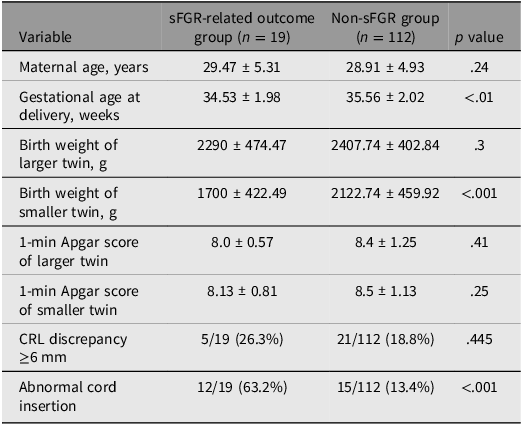
Baseline characteristics according to the presence or absence of postnatal birth-weight discordance suggestive of sFGR are shown in Table 1. Among the 131 MC twin pregnancies, 19 cases were classified as having sFGR-related outcome and 112 cases were classified as non-sFGR. Maternal age did not differ significantly between the sFGR-related outcome group and the non-sFGR group (29.47 ± 5.31 vs. 28.91 ± 4.93 years, p = .24). Gestational age at delivery was significantly lower in the sFGR-related outcome group than in the non-sFGR group (34.53 ± 1.98 vs. 35.56 ± 2.02 weeks, p < .01). The birth weight of the smaller twin was also significantly lower in the sFGR-related outcome group (1700 ± 422.49 g vs. 2122.74 ± 459.92 g, p < .001), whereas the birth weight of the larger twin and 1-minute Apgar scores did not differ significantly between groups.
Baseline characteristics according to sFGR-related outcome

Note: The outcome was defined as postnatal birth-weight discordance suggestive of sFGR. CRL, crown-rump length; ART, assisted reproductive technology; TTTS, twin-to-twin transfusion syndrome; TAPS, twin anemia-polycythemia sequence. Major fetal structural anomalies were excluded when identified. ART conception, TTTS, TAPS, detailed Doppler classification, and placental sharing were not consistently available because of the retrospective design.
CRL discrepancy ≥6 mm was observed in 5 of 19 cases (26.3%) in the sFGR-related outcome group and 21 of 112 cases (18.8%) in the non-sFGR group. Abnormal cord insertion was observed in 12 of 19 cases (63.2%) in the sFGR-related outcome group and 15 of 112 cases (13.4%) in the non-sFGR group. Information on ART conception, TTTS, TAPS, fetal structural anomalies, detailed Doppler findings, and placental sharing was not consistently available for all cases; therefore, these variables were not included in the main comparative table or multivariable model.
Association Between CRL Discrepancy and sFGR-Related Outcome
Among the 131 MC twin pregnancies, 26 cases had a CRL discrepancy ≥6 mm, whereas 105 cases had a CRL discrepancy <6 mm. Postnatal birth-weight discordance suggestive of sFGR occurred in 5 of 26 cases (19.2%) in the CRL discrepancy group and in 14 of 105 cases (13.3%) in the normal CRL group, with no statistically significant difference between groups (p = .445).
In univariate logistic regression analysis, CRL discrepancy ≥6 mm was not significantly associated with sFGR-related outcome (OR = 1.55, 95% CI [0.50, 4.77], p = .445). The sensitivity, specificity, PPV, and NPV of CRL discrepancy for identifying sFGR-related outcome were 26.3%, 81.3%, 19.2%, and 86.7% respectively. The AUC was 0.538, indicating limited discriminative ability.
Comparison Between the Abnormal and Normal Cord Insertion Groups on the Occurrence of sFGR
A significant difference in the occurrence of postnatal birth-weight discordance suggestive of sFGR was observed between the abnormal cord insertion group (n = 27) and the normal cord insertion group (n = 104, p < .001). Specifically, 12 of 27 cases (44.4%) in the abnormal cord insertion group experienced sFGR-related outcome, compared with 7 of 104 cases (6.7%) in the normal cord insertion group. Subgroup analysis separating marginal (n = 15) and velamentous (n = 12) cord insertions showed sFGR-related outcomes in 6/15 (40%) and 6/12 (50%) of cases respectively; however, due to small numbers, these differences were not statistically significant, and the results should be interpreted with caution.
In univariate logistic regression analysis, abnormal cord insertion was significantly associated with an increased risk of sFGR-related outcome (OR = 11.09, 95% CI [3.77, 32.62], p < .001). The sensitivity, specificity, PPV, and NPV for abnormal cord insertion to identify sFGR-related outcome were 63.2%, 86.6%, 44.4%, and 93.3% respectively, with an AUC of 0.749, indicating moderate discriminative ability (Table 2). The ROC curves for CRL discrepancy and abnormal cord insertion are shown in Figure 1.
Logistic regression and predictive performance of crown rump length (CRL) discrepancy and abnormal cord insertion for sFGR-related outcome

Note: The outcome was defined as postnatal birth-weight discordance suggestive of sFGR. OR, odds ratio; CI, confidence interval; PPV, positive predictive value; NPV, negative predictive value; AUC, area under the receiver operating characteristic curve.
Receiver operating characteristic (ROC) curves of crown rump length (CRL) discrepancy and abnormal cord insertion for identifying sFGR-related outcome. The ROC curves compare the discriminative performance of CRL discrepancy ≥6 mm and abnormal cord insertion for identifying postnatal birth-weight discordance suggestive of sFGR. CRL discrepancy showed limited discriminative ability (AUC = 0.538), whereas abnormal cord insertion showed moderate discriminative ability (AUC = 0.749).

Discussion
In previous studies, some researchers believed that discrepancies in CRL were closely related to inconsistent development in twins, while others have shown that abnormal cord insertion is significantly associated with twin development inconsistency (Noll et al., Reference Noll, Javinani, Slaghekke, Haak, van Klink, Van der Meeren, Lopriore, Russo, Aertsen, Shamshirsaz, Shinar, Bennasar, Tiblad, Herling, Lewi and Verweij2026; Pandya et al., Reference Pandya, Colmant, Stirnemann, Salomon and Ville2022; Xu et al., Reference Xu, Zhou, Huang, Chen and Huang2019). However, there has been considerable debate about the efficacy of early pregnancy ultrasound in predicting adverse outcomes for twin pregnancies. A retrospective cohort in MCDA twins found that placental proximal cord insertion was independently associated with sFGR and abnormal umbilical artery Dopplers, reinforcing the importance of placental factors in growth discordance. Mechanistically, superficial placental vascular branching and abnormal cord attachments contribute to uneven placental territory and growth restriction in MCDA twins (Lin et al., Reference Lin, Wang, Li, Yuan, Zhao and Wei2023; Spekman et al., Reference Spekman, Ros, Lewi, Slaghekke, Verweij, Noll, van Klink, Haak, van der Meeren, Groene and Lopriore2025).
Unlike prior studies that often applied antenatal Doppler-based sFGR criteria or focused on composite adverse outcomes in highly selected referral populations, the present study advances the literature by quantitatively comparing the predictive performance (sensitivity, specificity, PPV, NPV, AUC) of first-trimester CRL discrepancy and abnormal cord insertion for a uniform endpoint of postnatal birth-weight discordance in a consecutive routine clinical MCDA cohort with complete early ultrasound data. This research was undertaken because the relative contribution of these two easily obtainable first-trimester markers remains uncertain, and most previous studies either examined them separately or lacked head-to-head comparisons of their discriminative ability in the same real-world cohort. Our findings provide exploratory, hypothesis-generating evidence that abnormal cord insertion has moderate discriminative ability (AUC 0.749) whereas CRL discrepancy does not, thereby filling a gap in the literature and informing the design of future prospective studies that should use standardized antenatal Doppler-based sFGR definitions and adjust for key confounders.
In the research concerning CRL discrepancy and twin development inconsistency, Xu et al., believed that when there is a significant discrepancy in CRL during early pregnancy between twins, the incidence of inconsistent development significantly increases (Xu et al., Reference Xu, Ru, Yang, Gu, Dai, Yang and Zhang2012). This study mainly targeted dichorionic twins. The principle can be simply understood as the asynchrony in early development between two independent individuals leading to differences later on. The rare phenomenon of superfetation (where the second egg is fertilized within 48 hours after the first egg) helps us understand this (Santana et al., Reference Santana, Silveira, Costa, Souza, Surita, Souza, Mazhar, Jayaratne, Qureshi, Sousa, Vogel and Cecatti2018). Chen and Yu (Reference Chen and Yu2021) showed that CRL could serve as an effective early marker for judging inconsistent growth in twins, regardless of being MC or dichorionic twins. In MC twins, it is also believed that uneven early blastomere division is a reason for later inconsistent development, offering an explanation for this phenomenon. In this study, we verified whether CRL discrepancy in MC twins could predict sFGR later on, and our findings were inconsistent with previous studies. In contrast, CRL discrepancy ≥6 mm was not significantly associated with subsequent sFGR-related outcome in this cohort (OR = 1.55, 95% CI [0.50, 4.77], p = .445). Its predictive performance was also limited, with a sensitivity of 26.3% and an AUC of 0.538. However, this argument may be affected by measurement errors, despite averaging and operations by experienced sonographers, since measurements of head-torso length are influenced by fetal movement, selected sections, magnification factors, and so on, leading to objective measurement errors. Second, the sample size may have affected the reliability of the findings. Twin pregnancies are less common than singleton pregnancies, and sFGR-related outcomes are even less frequent. This study included 131 MC twin pregnancies, with only 19 cases classified as having postnatal birth-weight discordance suggestive of sFGR. The small number of sFGR-related cases limited the statistical power and the ability to perform extensive multivariable adjustment. Therefore, the observed associations, particularly for CRL discrepancy, should be interpreted cautiously and require validation in larger cohorts (Monteleone et al., Reference Monteleone, Petersen, Peregrino, Miorin, Gomes, Fujii and Soares2019; Vannuccini et al., Reference Vannuccini, Bolzonella, Colucci, Nicchi, Strambi and Di Tommaso2023).
At the same time, we further evaluated whether abnormal cord insertion was associated with subsequent sFGR-related outcome. The results showed that the incidence of postnatal birth-weight discordance suggestive of sFGR was significantly higher in the abnormal cord insertion group than in the normal cord insertion group. Logistic regression analysis showed that abnormal cord insertion was associated with an increased risk of sFGR-related outcome (OR = 11.09, 95% CI [3.77, 32.62], p < .001). In addition, abnormal cord insertion showed moderate discriminative ability, with a sensitivity of 63.2%, specificity of 86.6%, PPV of 44.4%, NPV of 93.3%, and AUC of 0.749. Previous studies have suggested that abnormal cord insertion may reflect unequal placental sharing in monochorionic twins and may contribute to later intertwin growth imbalance. In the present cohort, abnormal cord insertion was also associated with a higher occurrence of sFGR-related outcome, which is broadly consistent with these reports (Cambiaso et al., Reference Cambiaso, Zhao, Abasolo, Aiello, Oepkes, Lopriore and Klumper2016). However, unlike larger prospective studies using standardized antenatal Doppler-based definitions and classifications of sFGR, our retrospective dataset relied on postnatal birth-weight discordance and did not allow definitive assessment of clinical predictive performance (Sukhwani et al., Reference Sukhwani, Antolin, Herrero, Rodriguez, de la Calle, Lopez and Bartha2021; Wang et al., Reference Wang, Shi, Wang, Yuan, Wei and Zhao2022). Therefore, in MCDA twins, abnormal cord insertion should be regarded as a potential risk marker rather than a confirmed independent predictor. This study did not include dichorionic twins; due to the relative independence of the two placentas, the impact of cord insertion abnormalities on growth in dichorionic twins may differ and is less well studied.
When analyzing the gestational age at delivery, newborn weights, and Apgar scores (1 minute) of fetuses from both groups of pregnant women, we found that the gestational age at delivery for the sFGR group was significantly smaller than the control group. However, since the gestational age at delivery was mostly over 34 weeks, there were no apparent differences in the newborn scores and the larger fetus’s birth weight. Identifying sFGR early and minimizing low birth-weight newborns and adverse maternal-fetal outcomes remains a focal point in our work.
Several limitations should be acknowledged. First, this was a retrospective single-center study with a relatively small sample size. Only 19 cases were classified as having sFGR-related outcome, which limited statistical power and restricted the ability to perform extensive multivariable adjustment. Second, although potential confounders such as ART conception, TTTS, TAPS, fetal structural anomalies, Doppler findings, gestational age at assessment, gestational age at delivery, and placental sharing are clinically relevant, several of these variables were unavailable or incompletely recorded in this retrospective dataset. Therefore, residual confounding cannot be excluded. Third, marginal and velamentous cord insertions were combined as a single abnormal cord insertion group due to the limited number of cases. While subgroup analysis suggested potential differences in sFGR-related outcomes between marginal and velamentous insertions, the sample size was too small to draw definitive conclusions. Future larger studies should evaluate these two entities separately, as they may have distinct pathophysiological and clinical implications. Finally, sFGR was defined based on postnatal birth-weight discordance rather than established antenatal Doppler-based criteria, and therefore the results indicate potential associations rather than definitive antenatal predictive ability.
Conclusion
In this retrospective MCDA twin cohort, abnormal cord insertion was associated with an increased risk of postnatal birth-weight discordance suggestive of sFGR, whereas CRL discrepancy ≥6 mm was not significantly associated with this outcome. Although abnormal cord insertion showed moderate discriminative ability, the findings should be interpreted as exploratory because of the limited sample size, small number of outcome events, incomplete adjustment for potential confounders, and use of postnatal rather than standardized antenatal Doppler-based sFGR criteria. These results suggest that assessment of cord insertion in early pregnancy may contribute to risk stratification in MCDA twin pregnancies, but larger prospective studies using standardized antenatal sFGR definitions and Doppler-based classifications are needed before abnormal cord insertion can be considered a clinically validated predictor.
Data availability statement
The datasets used and/or analysed during the current study are available from the corresponding author on reasonable request.
Author contributions
We declare that all the listed authors have participated actively in the study and all meet the requirements of the authorship. Jing Luo & Ping Xu designed the study and wrote the paper, Dr. Lin Ai undertook the statistical analysis, Dr. Ying Feng contributed to the correspondence and paper revision. All authors reviewed the manuscript.
Funding
This study is funded by the Application of inconsistent head and hip length and abnormal umbilical cord insertion in predicting adverse pregnancy outcomes in monochorionic twins (No. 2022AD30079).
Competing interests
All authors declare that they have no conflicts of interest relevant to this work.
Ethics approval and consent to participate
This study was conducted as a retrospective cohort research, approved by the Ethics Review Committee of Jiaxing Maternal and Child Health Hospital [2021 (Medical Ethics) −50]. All pregnant women participating in the study signed informed consent forms.
Consent for publication
All pregnant women participating in the study signed informed consent forms, agreeing for their medical information to be used for scientific research.