INTRODUCTION
Sponges are among the most ancestral metazoans (Medina et al., Reference Medina, Collins, Silberman and Sogin2001) and may hold many clues to our understanding of the evolution of early animal and developmental processes (Martindale, Reference Martindale2005). The ‘World Porifera Database’ enlists 8132 valid species of sponges (van Soest et al., Reference Soest, Boury-Esnault, Janussen and Hooper2005). Sponges, besides their fundamental role in marine ecological processes, are an important source of secondary metabolites, useful for mankind in the pharmaceutical industry. However, of late, there has been a continuous threat to these sessile organisms due to habitat destruction and indiscriminate fishing activities (Vinod et al., Reference Vinod, George Rani, Sanil, Jayaprakash, Manjebrayakath and Thankappan2007).
A sharp divide is apparent between information known about deep-water sponges and more poorly known, but richer, shallow-water sponges (Barnes & Bell, Reference Barnes and Bell2002). Sublittorally, sponges are found mainly on hard rock substrates, but can occur on algae, or even loose on stable sediment bottoms (Picton et al., Reference Picton, Morrow and Soest2007). Massive or erect sponges are usually easy to spot, whereas encrusting sponges can be more cryptic owing to their small size and/or location (Picton et al., Reference Picton, Morrow and Soest2007).
A study on the diversity and taxonomy of sponges from different waters is of paramount importance as sponges are known to have both historical and evolutionary significance (Hooper & van Soest, 2002). Many sponge species are notoriously difficult to identify, because morphological characters for comparative morphology are scarce and prone to homoplasies, highly variable or otherwise unsuitable for unambiguous identification and hence have frequently been regarded as widely distributed (‘cosmopolitan’) (Wörheide et al., Reference Wörheide, Erpenbeck and Menke2007).
The class Calcarea (especially the Calcinea) has a reputation of being obscure and taxonomically difficult (Manuel et al., Reference Manuel, Borojevic, Boury-Esnault, Vacelet, Hooper and Soest2002). However, the use of numerical analyses of shape, size and distribution of spicules, and detailed histology have thrown new light on the classification of Calcarea, revealing that the species diversity in calcareous sponges is much higher than was previously expected (Wörheide & Hooper, Reference Wörheide and Hooper1999, Reference Wörheide and Hooper2002; Borojevic & Klautau, Reference Borojevic and Klautau2000; Rapp et al., Reference Rapp, Klautau and Valentine2001; Rapp, Reference Rapp2004a, Reference Rappb).
The history of spongology of the Indian Ocean is rather a short one (Thomas, Reference Thomas, Pillai and Menon2000). Thomas (Reference Thomas1983) described 481 species of marine sponges while only 451 species have been reported from India by Pattanayak (Reference Pattanayak1999). Sponges of class Demospongia are represented by the maximum number of species forming 88.8% followed by class Hexactinellida which represents 9.1% and the least by class Calcarea having only 2.1% of the total marine sponges from the Indian region (Thomas, Reference Thomas1983). There is a close relationship of the sponge fauna of the Indian Seas with that of the Australian region, Red Sea and the Pacific Ocean (Thomas, Reference Thomas1983). The sponge fauna of the Indian region is known from the papers of Carter (Reference Carter1887), Dendy (Reference Dendy1916), Burton Reference Burton(1930, Reference Burton1959), and Thomas Reference Thomas(1968, Reference Thomas1984). Along the east coast of India Dendy (Reference Dendy1887) and Ali (Reference Ali1954) described the sponge fauna of Madras while those of Orissa State were investigated by Annandale (Reference Annandale1915) and Bapuji et al. (Reference Bapuji, Sree, Mishra, Vimala, Sahu, Choudhury and Thomas1999). Comparatively, poor data are known on the shallow-water marine sponge fauna of peninsular India. Shallow-water marine sponges collected from India were studied by Burton & Rao (Reference Burton and Rao1932).
Sponges are well known for their association with other animals and plants (Bowerbank, Reference Bowerbank1873; Dendy, Reference Dendy1905, Reference Dendy1921; Annandale, Reference Annandale1911, Reference Annandale1914; Devanesan & Chacko, Reference Devanesan and Chacko1941; Rao, Reference Rao1941; Nayar & Mahadevan, Reference Nayar and Mahadevan1965). Sponges are known to occur as foulers and also in association with oysters (Annandale, Reference Annandale1914; Dharmaraj et al., Reference Dharmaraj, Chellam and Velayudhan1987).
The aim of the present paper is to identify and report information about a calcareous sponge found during the routine cleaning operations of onshore oyster Pinctada fucata culture tanks.
MATERIALS AND METHODS
A sponge sample was collected from the onshore pearl oyster (Pinctada fucata) culture tank of 1-ton capacity at a depth of a metre at Visakhapatnam Regional Centre of Central Marine Fisheries Research Institute (CMFRI). In situ information was first recorded, and photographs were taken using a Sony W220 camera. Laboratory studies encompass external morphology and skeletal arrangement. Morphology was noted and the specimen was observed under a stereomicroscope in order to analyse the anastomosis pattern of the cormus, distribution of oscula and the presence or absence of water-collecting tubes. The samples were preserved in ethanol for further study. Skeletals and spicules analysis was done using an Olympus compound microscope 10× and 40× objectives. Sections were prepared in order to analyse the organization of the skeleton and establish the presence or absence of cells with granules. The section was hand-cut using a clean scalpel mounted on a slide and analysed. For the spicule analysis, small pieces of the cormus were transferred to test tubes and dissolved in bleach. After digestion of the soft tissue, the spicules were spread out on microscopic slides and analysed. Measurements (length and width) of 34 spicules of each type were taken using an ocular micrometer. The results are presented in tabular form, featuring length (number, minimum, mean, maximum and SD [σ]) and width (number, mean and SD). Microphotographs of the spicules and sections were taken. Identification was done using the key and guide given by Hooper (Reference Hooper2000), Klautau & Valentine (Reference Klautau and Valentine2003) and Picton et al. (Reference Picton, Morrow and Soest2007).
Synonym: Clathrina coriacea (Montagu, 1818).
ETYMOLOGY
Latin clarus (= bright). Describing the bright surface (Klautau & Valentine, Reference Klautau and Valentine2003).
TYPE MATERIAL
Diameter: 18 mm; station: onshore tanks at Visakhapatnam Regional Centre of CMFRI; VSCC1, coll. S. Veena, 12 August 2010.
DESCRIPTION
Colour: live sponge was white and after preservation, light brown.
Consistency: soft and delicate.
Odour: none.
Contraction: no noticeable contraction when the animal was compressed.
DIAGNOSIS
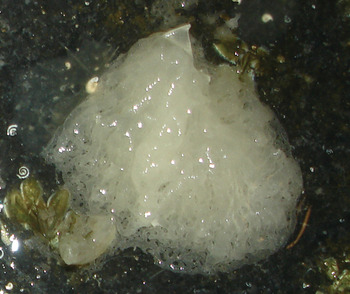
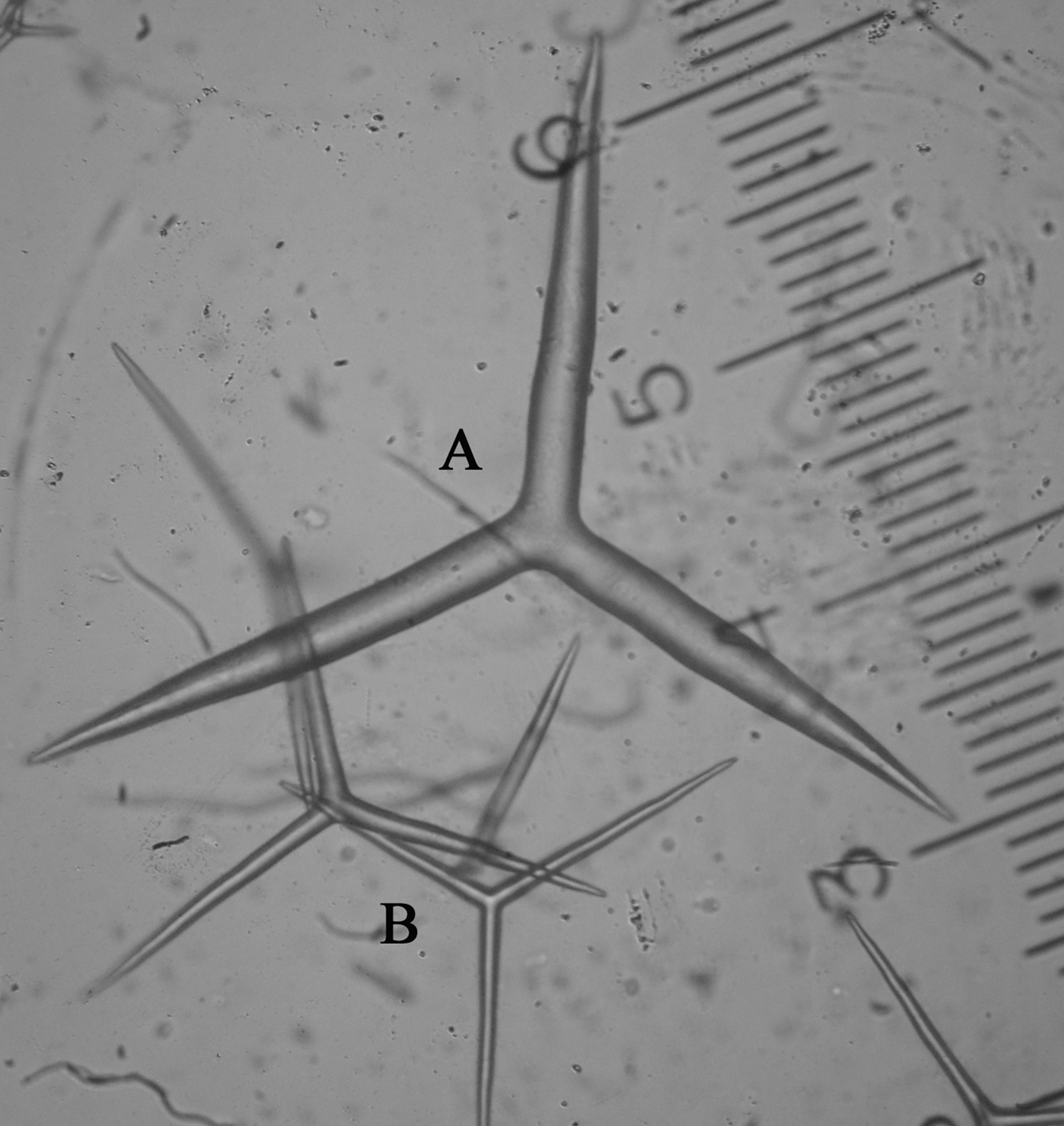
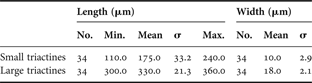
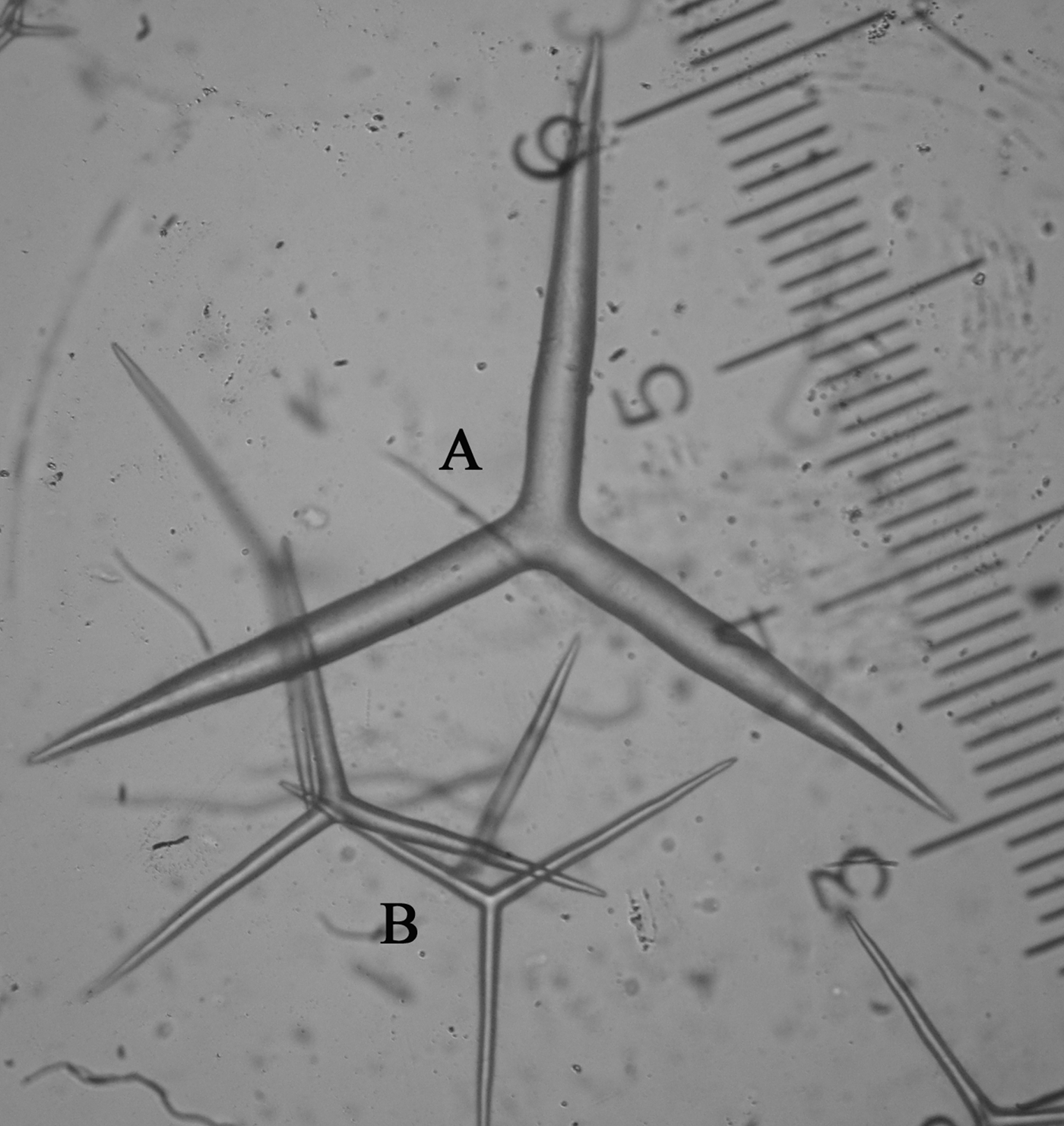
Small, flat but not tubular and has meshes consisting of a network of thin walled tubes which are a compact mass attached directly to the substrate. The surface cormus comprises tightly-knit tubes, several tubes joining to share one common oscule, slightly raised above the surface (Figure 1). There are no erect free branches. Cells with granules were not observed. The skeleton comprises two size-classes of equiangular and equiradiate triactines (Figure 2). Actines are conical and straight, with a sharp tip. The large triactines are located only in the external tubes, delimiting the cormus, while the smaller triactines are found inside the cormus. The measurements are all tabulated (Table 1).
Clathrina clara: specimens found on Pinctada fucata shell.

Light microscopy view of Clathrina clara spicules: (A) large triactines; (B) small triactines.
Spicule measurements of Clathrina clara Klautau & Valentine, Reference Klautau and Valentine2003.
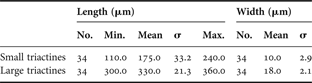
No., number; Min., minimum; σ, standard deviation; Max., maximum.
HABITAT
The species was observed as a fouler on the oyster (Pinctada fucata) in onshore culture tanks.
REMARKS
Symbiotic association between this sponge and the oyster was noted since there was no external or internal damage observed on the oyster.
DISCUSSION
The genus Clathrina is defined almost exclusively by negative characters (Borojevic & Boury-Esnault, Reference Borojevic, Boury-Esnault, Vacelet and Boury-Esnault1987). Moreover, its skeleton is also simple, comprising only a few spicule types: diactine, triactine and/or tetractine. The genus Clathrina is represented by more than 40 described species in all seas (Klautau & Valentine, Reference Klautau and Valentine2003). The classification is difficult due to the existence of only a few, easily recognizable morphological criteria that can be used as descriptors, especially in species whose skeleton is composed only of triactines (Borojevic & Boury-Esnault, Reference Borojevic, Boury-Esnault, Vacelet and Boury-Esnault1987).
The use of statistical analyses of shape, size and distribution of spicules has thrown new light on the classification of the group, and previous numbers of species in any given geographical area are expected to be underestimated (Thomas, Reference Thomas1996; Wörheide & Hooper, Reference Wörheide and Hooper1999; Borojevic & Klautau, Reference Borojevic and Klautau2000; Klautau & Borojevic, Reference Klautau and Borojevic2001; Rapp et al., Reference Rapp, Klautau and Valentine2001; Klautau & Valentine, Reference Klautau and Valentine2003; Rapp, Reference Rapp2004b).
The present species identification was done by studying the type of spicules and pattern of spicule arrangement. The large size of the triactines that remain on the surface of the tubes in Clathrina clara is enough to differentiate it from the other clathrinas (Klautau & Valentine, Reference Klautau and Valentine2003). The next feature is the tip of the actines which is sharp in Clathrina clara similar to that noted by Klautau & Valentine (Reference Klautau and Valentine2003) whereas for the other species (blunt in C. ceylonensis, conical in C. coriacea and cylindrical in C. clathrus) as noted by Hooper (Reference Hooper2000), Klautau & Valentine (Reference Klautau and Valentine2003) and Picton et al., (Reference Picton, Morrow and Soest2007). Hence these species were all ruled out. However, the species Clathrina primordialis is similar to C. clara since both have the tip of actines sharp and also two size-classes of triactines (Klautau & Valentine, Reference Klautau and Valentine2003). But it is easy to differentiate the two species by the anastomosis of the tubes (tight in Clathrina clara and loose in C. primordialis), and by the size of the spicules (Klautau & Valentine, Reference Klautau and Valentine2003). As recorded by Klautau & Valentine (Reference Klautau and Valentine2003) the length and thickness of the two size-classes of triactines of Clathrina primordialis are 91.9/9.6; 86.6/11.3 µm, while in C. clara recorded in the present study are 175.0/10.0; 330.0/18.0 µm. Hence this species was confirmed as Clathrina clara. A note to be made here is that the size of the spicules of Clathrina clara differed when compared with the descriptions given by Klautau & Valentine (Reference Klautau and Valentine2003) where they noted these as 84.5/9.8 µm; 164.5/21.8 µm. This difference may be due to the ambient environmental conditions. There are reports of putative environmental influences on spicule size in Demospongiae (Chondrilla) (Solé-Cava et al., Reference Solé-Cava, Klautau, Boury-Esnault, Borojevic and Thorpe1991; Klautau et al., Reference Klautau, Russo, Lazoski, Boury-Esnault, Thorpe and Solé-Cava1999) and in H. (Cyliconema) apertum apertum (Tabachnick & Menshenina, Reference Tabachnick, Menshenina, Hooper and Soest2002).
Sponges constitute a major group among 12 different taxa of marine animals and plants which can cause considerable damage to the calcium carbonate secreting animals such as molluscs, corals, barnacles, etc. (Thomas, Reference Thomas, Pillai and Menon2000). Annandale (Reference Annandale1911) discussed in detail the association of some sponges with molluscs of the family Vermetidae from the Bay of Bengal and in a later publication (Annandale, Reference Annandale1914) he dealt with similar association with oysters and mussels from the Madras Harbour. Dharmaraj et al. (Reference Dharmaraj, Chellam and Velayudhan1987) also studied the fouling and association with oysters. In the present study, no damage caused by the sponge to the oyster Pinctada fucata was noted during observation for a period of 4 months (August to December) and only symbiotic association was seen between the animals.
The number of calcareous species from the Indian Region, as now understood, comprises a total of ten widespread species (Thomas, Reference Thomas1983). Family Clathrinidae has henceforth not been described from Indian waters except Clathrina coriacea from Andaman waters (Pattanayak, Reference Pattanayak2006). Clathrina clara has been identified from the reefs at Christmas Island, Indian Ocean by Klautau & Valentine (Reference Klautau and Valentine2003). The shallow-water sponges from this area have not been recorded and this study reports the identification of the present sample to the species level. This article reports Clathrina clara as a new species identified not only from this area but also adds this species as a new record to the taxonomic list for India.
ACKNOWLEDGEMENTS
The authors thank Dr G. Syda Rao, Director of CMFRI for his constant encouragements. We also thank Michelle Klautau, Universidade Federal do Rio de Janeiro, Instituto de Biologia—Departamento de Zoologia, Laboratório de Biologia de Porifera, Avenida Brigadeiro Trompowski, Ilha do Fundão–Rio de Janeiro, Brazil for her help with the identification; and Mrs Padmaja Rani for her help in acquiring the specimen. This research received no specific grant from any funding agency, commercial or not-for-profit sectors.