The fermentation process is a stressful environment for starter cultures and stress responses are important for bacteria. Lactic acid bacteria have developed stress-sensing systems that detect stresses and withstand harsh conditions (Tsakalidou and Papadimitriou, Reference Tsakalidou and Papadimitriou2011). Furthermore, changes in some factors, including temperature, nutrient, pH, and water availability or osmotic pressure in the environment, could affect bacterial behavior and produce different dairy products such as sour cream and Kermanshahi roghan. Roghan is a fat-rich yogurt by-product, which is traditionally produced in western Iran. There are differences between the two products that can be considered as stressful conditions. These differences include the fat content of milk (3–5%) and cream (30–45%) (Gunstone, Reference Gunstone2004), various temperatures for production of roghan (4°C) and sour cream (25°C), and the kind of bacterial starter culture usually used to produce sour cream (mesophilic Lactococcus lactis ssp. cremoris and L. lactis ssp. lactis) and roghan (thermophilic S. thermophilus and L. delbrueckii subsp. bulgaricus) (Hutkins, Reference Hutkins2006). For several years, considerable attention has been paid to knowledge of bacterial stress response for improvement of starter culture technology and dairy products production (Tsakalidou and Papadimitriou, Reference Tsakalidou and Papadimitriou2011). In other words, bacteria in yogurt's cream (cold stress) and sour cream have different stressful conditions. As mentioned earlier, temperature and osmotic pressure play an important role in the fermentation process as stressful conditions that affect the acidity and subsequently, protein and fatty acid compositions of dairy products. This study aimed to compare the effect of different ratios of Streptococcus thermophilus to Lactobacillus bulgaricus (3 : 1, 1 : 1, and 1 : 3) under the various stressful temperatures (37 and 45°C) on the fatty acid quality of Kermanshahi roghan (yogurt by-product) and sour cream to obtain a formula for producing a kind of animal fat with healthier properties than milk and cream.
Materials and methods
Cow milk (2 l) was collected from a farm in Kermanshah, Iran. The milk samples were carried to the laboratory at 4°C and divided into two parts used for yogurt production and separating of cream (4000 × g for 20 min at 4°C). Milk and cream were pasteurized at 95°C for 5 min in a water-bath (Memmert, Germany). The bacteria were obtained from yogurt starter culture YC-380 (Chr-Hansen culture CH9, Denmark). The microbial suspensions (6 × 10⁸ CFU/ml) as a starter culture (SC.) in various ratios of S. thermophilus to L. bulgaricus (SC.1 is 3 : 1; SC.2 is 1 : 1 and SC.3 is 1 : 3) were inoculated to milk and cream samples (5% v/v), then incubated at 37 and 45°C (until pH 4.6 was reached). Afterward, the samples were stored overnight at 4°C.
Roghan preparation
Yogurt samples were diluted with water (1 : 1), churned for 6 h, and stored overnight at 4°C. The cream was separated from the doogh (diluted yogurt) and incubated at 45°C for 5 min in a water-bath, then centrifuged at 4000 × g for 10 min at 4°C. Finally, supernatant (roghan) was collected and stored at −20°C until analysis. The samples and controls were prepared in triplicate, and the experiment was replicated on different days.
Fatty acid extraction and analysis
After lipid extraction (Folch et al., Reference Folch, Lees and Sloane Stanley1957), 10 μl of internal standard (C13 : 0, 30 mg/ml; Sigma-Aldrich, Buchs, Switzerland) was added to 100 μl of extracted samples and hydrolyzed with 400 μl of 0.1 M NaOH in methanol (Merck, Munchen, Germany) at 37°C for 30 min. Afterward, the hydrolyzed samples transferred to −20°C for 5 min. For transesterification 1 mL of boron trifluoride in methanol (14%, Sigma–Aldrich, Ontario, Canada) was used, and the mixture was heated at 37°C for 30 min. The samples were transferred at −20°C for 10 min and 2.5 ml of saturated sodium chloride (Merck, Munchen, Germany), and 2 ml n-hexane (Sigma-Aldrich, Ontario, Canada) were added. The samples were centrifuged (4000 × g, 1 min) and frozen for 1 h. Finally, the upper layer was evaporated under nitrogen in ice until the sample reached 50 μl. After methylation, the aliquots were frozen for further analysis. The samples were analyzed using a gas chromatograph (Varian, model 3800CP, Walnut Creek, CA, USA). The gas chromatograph conditions and oven temperature are given in online Supplementary Table S1.
The samples (1 μl) were injected manually and their peaks were compared with the standard peaks (Sigma, USA). Based on a single point internal standard (Cicchetti et al., Reference Cicchetti, Merle and Chaintreau2008), each peak area was calculated and expressed in percentages to determine the relative composition of each fatty acid methyl ester. Fatty acids were classified into three groups (based on the number of carbon atoms and dietary safety) included short-chain fatty acids (SCFA, C4-C10), saturated fatty acids (SFA, C12-C20), and unsaturated fatty acids (USFA, C18 : 1t n-9 and C18 : 1c n-9, C18 : 2 n-6, and C18 : 3 n-6).
Statistical analysis
The data were presented as mean ± sem and analyzed using statistical Statistica 5.0 (Statsoft, Tulsa, USA). An analysis of variance (ANOVA) was used to assess the differences between means, with a significance level of P < 0.05. The Tukey test was used to determine the possible significant differences (P < 0.05) among values.
Results
The results collectively indicated that the ratio of bacteria and fermentation temperature could significantly affect fatty acid profiles.
Samples made by SC.1 at 37°C
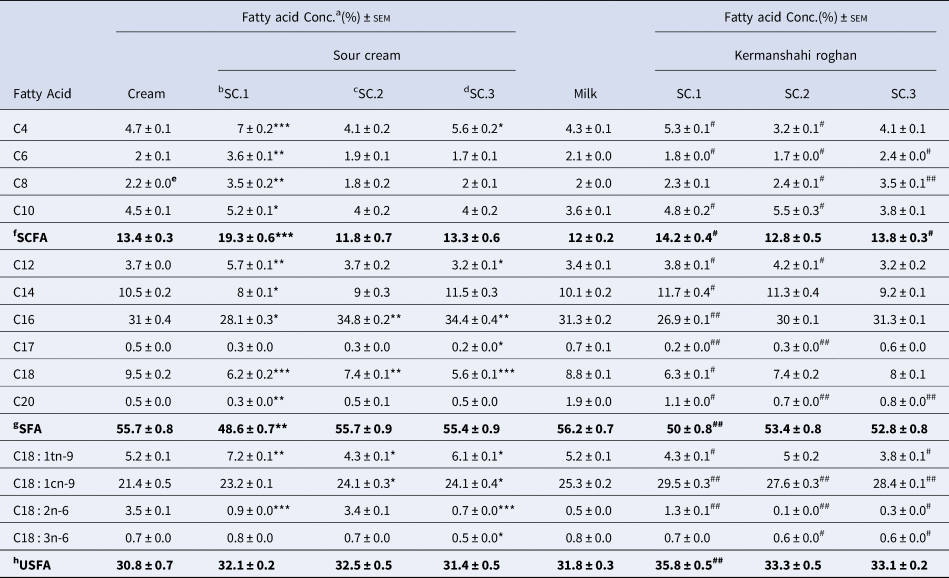
As Table 1 shows the level of SCFAs (sour cream: P < 0.001, roghan: P < 0.05) and USFAs (roghan: P < 0.01) significantly increased while the amount of SFAs of two samples (P < 0.01) decreased compared to cream and milk. Results indicated higher proportions of C4, C6, C8 and C10 as well as C18 : 1t n-9 in sour cream, and C4, C10 and C18 : 2 n-6 as well as C18 : 1c n-9 in roghan. Moreover, there was a significant difference in the amount of C14, C16 (P < 0.05) and C18 (P < 0.001) in sour cream samples compared to those in cream. Our results showed lower proportions of C16 (P < 0.01) and C18, C18 : 1t n-9 (P < 0.05) in roghan samples.
Fatty acid profiles of cream, sour cream, milk, and roghan produced at 37°C

a Conc.: Concentration.
b SC.1: Starter culture (S. thermophilus to L. bulgaricus ratio is 3 : 1).
c SC.2: (S. thermophilus to L. bulgaricus ratio is 1 : 1).
d SC.3: (S. thermophilus to L. bulgaricus ratio is 1 : 3).
e ± 0.0: sem < 0.1.
f SCFA: sum of Short Chain Fatty Acids ± sum of sems.
g SFA: sum of Saturated Fatty Acids ± sum of sems.
h USFA: sum of Unsaturated Fatty Acids ± sum of sems.
* P < 0.05, **P < 0.01, ***P < 0.001 vs. cream fatty acid; #P < 0.05, ##P < 0.01, ###P < 0.001 vs. milk fatty acid; n = 3.
C4: Butyric acid, C6: Caproic acid, C8: Caprylic acid, C10: Capric acid, C12: Lauric acid, C14: Myristic acid, C16: Palmitic acid, C17: Margaric acid, C18: Stearic acid, C20: Arachidic acid, C18 : 1tn-9: Elaidic acid, C18 : 1cn-9: Oleic acid, C18 : 2n-6: Linoleic acid, C18 : 3n-6: α-Linolenic acid.
Samples made by SC.2 at 37°C
As shown in Table 1, there were no significant differences between fatty acid profiles of test samples and controls.
Samples made by SC.3 at 37°C
As shown in Table 1, there was no significant difference between fatty acid profiles of sour cream and roghan samples compared to controls, except for the amount of SCFAs which increased significantly (P < 0.05) in roghan samples. The amount of C4 in sour cream and C6 as well as C8 in roghan increased compared to cream and milk.
Samples made by SC.1 at 45°C
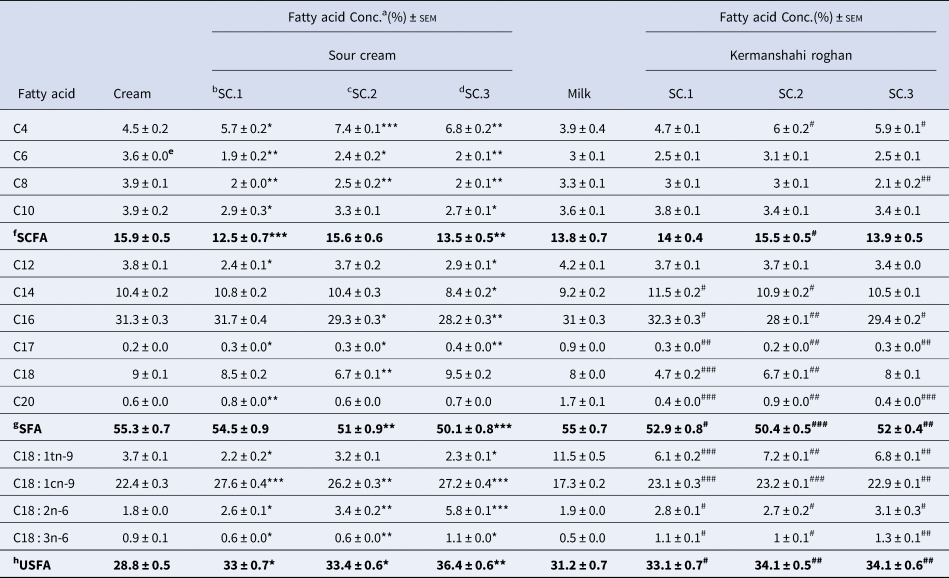
As illustrated in Table 2, the SCFA content of sour cream samples was lower than cream (P < 0.001) whilst for SFAs there was a numerical (non-significant) difference. There was no difference between roghan and milk SCFAs although the amount of SFAs in roghan was lower than milk (P < 0.05). On the other hand, the level of USFAs in two test samples increased (P < 0.05). There was an increase in amount of C4, C18 : 1c n-9 and C18 : 2 n-6 in sour cream and of C18 : 1c n-9, C18 : 2 n-6 and C18 : 3 n-6 in roghan samples compared to controls. Results also indicated lower proportions of C12 and C18 : 1t n-9 in sour cream and C17, C18, C20 and C18 : 1t n-7 in roghan.
Fatty acid profiles of cream, sour cream, milk, and roghan produced at 45°C

a Conc.: Concentration.
b SC.1: Starter culture (S. thermophilus to L. bulgaricus ratio is 3 : 1).
c SC.2: (S. thermophilus to L. bulgaricus ratio is 1 : 1).
d SC.3: (S. thermophilus to L. bulgaricus ratio is 1 : 3).
f SCFA: sum of Short Chain Fatty Acids ± sum of sems.
g SFA: sum of Saturated Fatty Acids ± sum of sems.
h USFA: sum of Unsaturated Fatty Acids ± sum of sems.
e ± 0.0: sem < 0.1.
* P < 0.05, **P < 0.01, ***P < 0.001 vs. cream fatty acid; #P < 0.05, ##P < 0.01, ###P < 0.001 vs. milk fatty acid; n = 3.
C4: Butyric acid, C6: Caproic acid, C8: Caprylic acid, C10: Capric acid, C12: Lauric acid, C14: Myristic acid, C16: Palmitic acid, C17: Margaric acid, C18: Stearic acid, C20: Arachidic acid, C18 : 1tn-9: Elaidic acid, C18 : 1cn-9: Oleic acid, C18 : 2n-6: Linoleic acid, C18 : 3n-6: α-Linolenic acid.
Samples made by SC.2 at 45°C
As Table 2 presents, there was no differences in the amount of SCFAs in sour cream, whereas this group of fatty acids increased in roghan (P < 0.05). The level of USFAs increased in sour cream (P < 0.05) and roghan (P < 0.01) while the level of SFAs in two test samples (sour cream: P < 0.01 and roghan: P < 0.001) had significantly decreased compared to cream and milk. Our results revealed that the proportions of C4, C18 : 1c n-9 and C18 : 2 n-6 in sour cream and C4, C18 : 1c n-9, C18 : 2 n-6 and C18 : 3 n-6 in roghan were significantly higher than controls. There was a decrease in C16 and C18 in sour cream and C16-C20 as well as C18 : 1t n-9 contents in roghan samples.
Samples made by SC.3 at 45°C
As shown in Table 2, sour cream SCFA levels were significantly decreased (P < 0.01) and USFAs were increased (P < 0.01) in two test samples compared to controls. Besides, SFAs of sour cream and roghan samples were significantly lower than those of cream and milk. Our results revealed higher proportions of C4, C18 : 1c n-9, C18 : 2 n-6 and C18 : 3 n-6 in sour cream and C4, C18 : 1c n-9, C18 : 3 n-6 and C18 : 2 n-6 in roghan compared to controls. In addition, the amount of C12, C14, C16 and C18 : 1t n-9 in sour cream as well as C16, C17, C20 and C18 : 1t n-9 in roghan samples were lower than in cream or milk.
Discussion
Starter culture bacteria play a vital role in the production of different dairy products (Tidona et al., Reference Tidona, Meucci, Povolo, Pelizzola, Zago, Contarini, Carminati and Giraffa2018). In that case, bacteria withstand stress conditions of milk or cream during fermentation and change product compositions (Heller, Reference Heller2001). Here, our results demonstrated a difference between fatty acid profiles of sour cream and roghan.
These results revealed, during sour cream production using SC.1, 2, and 3 at 37 and 45°C, the SCFA (except for SC.1 at 37°C) and SFA levels decreased while the amount of USFA increased. This contrast with the data of Yilmaz-Ersan (Reference Yilmaz-Ersan2013) who showed that the level of USFA (unlike SFA and SCFA) decreased. It seems that these differences are due to the type of bacteria in the starter culture (L. acidophilus) and the temperature (25°C) used in their study. Another possibility is that the S. thermophilus used in our study can produce a lot of acid in a short time, which can be considered a stressful condition for bacteria. The bacteria respond to environmental stresses (low pH and high temperature) by changing the composition of membrane fatty acids such as USFA at 45°C (or 37°C) compared to 25°C (Mehmood et al., Reference Mehmood, Masud, Abbass and Maqsud2009). On the other hand, our results are consistent with the study of Ekinci et al. (Reference Ekinci, Okur, Ertekin and Guzel-Seydim2008), maybe due to their using a temperature (42°C) close to the temperature of our study and a similar mix of bacteria (S. thermophilus and L. bulgaricus) (Tamime and Robinson, Reference Tamime and Robinson2007). Our results demonstrated that during roghan production using SC.1, 2, and 3 at 37 and 45°C, SCFA and USFA levels increased, whereas the amount of SFAs decreased. Our findings differ from the results of Mehta (Reference Mehta2013) regarding differences between roghan fatty acid profiles and Dynamix ghee. These differences can be attributed to the production process and heat clarification of roghan (45°C) and ghee (103°C) (Sserunjogi et al., Reference Sserunjogi, Abrahamsen and Narvhus1998). In other words, the pattern of SCFA, SFA, and USFA changes in sour cream were relatively similar to roghan, especially the samples were made by SC.1 at 37°C and SC.2 at 45°C, while the difference in the composition of fatty acids shows that the roghan fatty acid profiles is potentially more suitable for healthy consumption than sour cream. The noticeable point in these results were that the major components of fatty acids in samples (especially in roghan) and level of C14-C18 and C18 : 1t n-9 as a trans fatty acid (especially in roghan) decreased, since these fatty acids play an important role in our health (Serini et al., Reference Serini, Fasano, Piccioni, Cittadini and Calviello2011). The anti-inflammatory properties and anti-cancer effects of C4 have been shown (Yu et al., Reference Yu, Waby, Chirakkal, Staton and Corfe2010). On the other hand, C18 : 1c n-9 (oleic acid) is involved in the production of myelin, and the LDL-lowering effects of this fatty acid can slow the progression of atherosclerosis. Also, an increase of C18 : 2 n-6 level and a decrease of C14-C18 level have demonstrated anti-atherogenic and anti-thrombogenic activity (Ulbricht and Southgate, Reference Ulbricht and Southgate1991; Ozcan et al., Reference Ozcan, Akpinar-Bayizit, Yilmaz-Ersan, Cetin and Delikanli2016).
In addition, C18 : 1t n-9 (elaidic acid) as a trans fatty acid decreased in roghan (all samples) and sour cream (some samples). Several epidemiological studies have indicated that trans fatty acids are associated with cardiovascular diseases, cancers, diabetes, obesity, and brain function (Dhaka et al., Reference Dhaka, Gulia, Ahlawat and Khatkar2011; Russell et al., Reference Russell, Ross, Fitzgerald and Stanton2011). The results of this study showed a significant difference between roghan and sour cream fatty acid profiles at 37°C.
In conclusion, based on fatty acid profiles we have demonstrated that roghan is potentially more suitable as a healthy dairy product than sour cream. Furthermore, the appropriate starter cultures for the production of sour cream and roghan with the best fatty acid profiles are SC.1 and SC.2 at 37 and 45°C, respectively.
Supplementary material
The supplementary material for this article can be found at https://doi.org/10.1017/S0022029920001053
Acknowledgments
This work was supported by Kermanshah University of Medical Sciences.