While few could doubt the influence of the US constitution in the history of constitutional democracy, 225 years after its enactment we still have not solved a fundamental question of constitutional design: are shorter constitutions better? The US constitution is famous for its brevity; for years, American lawyers have praised this feature as the secret to its endurance and durability. Globally, however, the US constitution has been a model more in the abstract; relatively few countries have directly copied it. In fact, over time, constitutions have grown longer as they have begun to cover more topics.Footnote 1 But the question remains: is this trend more likely to produce better governance outcomes?
In this article, we take a new approach to this question. First, we note the paucity of previous research on the relationship between constitutional length and governance outcomes. Then, we justify our decision to focus on Organisation for Economic Co-operation and Development (OECD) countries. In the subsequent section, we present two puzzling empirical observations. First, ‘locking’ constitutions does not work, since it is not the case that more rigid constitutions are less frequently amended. Secondly, if we control for length, there is a positive correlation between constitutional rigidity and frequency of amendments. In other words, longer constitutions are more difficult to amend and are also more frequently amended than shorter ones.
The next section of the article explains why. We present a model explaining what it means to ‘lock’ a constitution, and how a ‘locked’ constitution requires an overwhelming majority of the relevant constitutional authority – and/or the voting public – to change it. If, despite ‘locking’, amendments are more frequent, it means that overwhelming majorities had judged them to be necessary.
Next, we clarify why constitutional length is an important indicator of substantive restrictions in constitutions. Then we conduct an empirical test of our theoretical argument. Constitutional rigidity makes it more difficult to amend inappropriate and harmful provisions in a constitution, which exacerbates the effects of political and economic shocks. Indeed, we find that constitutional length has a negative effect on GDP per capita, even after controlling for standard economic variables (for example, education and investment).
The final section answers the question: why are longer constitutions more rigid? We find a correlation between the length of a constitution and corruption. While we cannot assess the causal direction of this relationship, it is possible that in more corrupt countries vested interests lock the constitutions in order to prevent change. Alternatively, it could be that the political system tries to reduce corruption by protecting constitutional rules from future generations. In either causal pathway, we expect corruption to be associated with lower incomes. However, even controlling for corruption, we find that constitutional length continues to exercise an independent and negative influence on GDP per capita.
Literature Review
The ideal length of a constitution has been debated since at least the US Constitutional Convention of 1787. James Madison famously advocated a framework constitution that simply delineates government responsibility. By contrast, Anti-Federalists feared that brevity might leave important rights unprotected, which prompted the subsequent enactment of a more detailed Bill of Rights.Footnote 2 Despite the historical roots of this debate, the comparative constitutions literature has only recently begun to assess the impact of constitutional length on governance outcomes cross-nationally, thanks to the advent of statistical computing software and new databases, such as the Comparative Constitutions Project (CCP).
Constitutional length has been studied as a dependent variable. Several studies find that legal origins matter.Footnote 3 This is partly because the British Parliament originally drafted most common law constitutions as acts granting their colonies independence, and British legislation in general tends to be longer than that of its continental counterparts.Footnote 4 Ginsburg also finds that levels of democracy (as measured by POLITY scores), the age of a constitution and ethnolinguistic fractionalization are all associated with longer constitutions.Footnote 5
With regard to the relationship between constitutional length and amendments, Lutz predicts that longer constitutions will be amended more frequently because they are more likely to contain detailed provisions that risk becoming obsolete over time.Footnote 6 When such provisions restrict the actions of the governing majority, they will either be amended or removed completely. Negretto confirms Lutz’s predictions for constitutions in Latin America insofar as longer constitutions tend to be subject to more frequent amendment.Footnote 7 This argument is not dissimilar to those we present below, but we also connect our findings to a theoretical model about the rigidity of the constitutional amendment process and the economic effects of constitutional length.
There has been far less research on constitutional length as an independent variable affecting political behavior and economic outcomes. One branch of literature attempts to assess the impact of length on constitutional endurance. Based on the US experience, many political scientists had long assumed that shorter constitutions last longer. However, Hammons finds that among US states, longer constitutions endure significantly longer.Footnote 8 Using 184 constitutions from the CCP dataset, Elkins, Ginsburg and Melton come to a similar conclusion cross-nationally, finding that constitutions with greater detail (measured as the number of words divided by the number of topics) tend to last longer.Footnote 9 They argue that because more detailed constitutions enshrine more rights and benefits, a broader range of competing interest groups has an incentive to protect the constitution from attempts to replace it.
Montenegro posits that countries with higher levels of distrust have lower levels of economic development.Footnote 10 He uses the length of a country’s constitution as a proxy for a political culture of distrust, because countries with greater distrust are more likely to write more detailed laws in order to constrain other political actors. Ultimately, he finds that longer constitutions are associated with lower GDP per capita. Bjørnskov and Voigt empirically corroborate the correlation between social distrust and constitutional garrulity.Footnote 11 While these findings are not dissimilar from our own, our reasoning relies more upon political institutions than culture. Cultural arguments are poorly suited to addressing the questions we raise below because they risk overlooking the interactions between culture and constitutions. In other words, it is entirely possible that constitutions influence cultures rather than vice versa.Footnote 12
Other scholars have found a relationship between economic wealth and constitutional length, but this relationship has not been the focus of a sustained research agenda. Ginsburg finds that gross national product (GNP) has a negative effect on constitutional length.Footnote 13 However, as we discuss below, we believe that constitutional length affects income, not vice versa. It is not clear why constitutional drafters would respond to lower incomes by making their constitution shorter, unless they believed that a shorter constitution provided more opportunities for economic growth. As such, we accept the existing literature as evidence suggesting that our results are not spurious, even though it presents a different causal argument.
A Note on our Sample: The Oecd
Our empirical strategy requires us to focus on constitutional systems in which the text of the document does in fact regulate political practice. If political actors disregard or refuse to enforce the constitution, we would be unable to draw valid inferences from any statistical relationship. Of course, this implies a trade-off between the number of countries in the sample and the reliability of information on each; the more countries we include, the more likely it is that some possess constitutions that are only weakly enforced. Moreover, some governments, particularly revolutionary regimes, might promulgate constitutions as statements of ideology rather than binding constraints on government operations. Including such countries would decrease the reliability of our results by increasing the noise.
One option might have been to restrict the sample to democracies. We reject this approach for two reasons. First, there remains considerable debate regarding the necessary conditions for a country to be accepted as a democracy. There are several competing measures, such as Polity and Freedom House, but the correlation between them is far from perfect. Secondly, even among countries labeled as democracies, the extent to which the formal constitutional texts constrain political actors varies significantly. Developing democracies have electoral institutions, but those institutions do not necessarily have the authority or power to constrain elites. This becomes even more problematic when considering ‘quasi-democracies’ or ‘electoral authoritarianism’.
By contrast, we believe that membership in the OECD is a more reliable indicator of constitutional governance. The OECD is a fairly exclusive organization that sets criteria for admission. Members must commit to democracy, the rule of law, human rights, free market economics and sustainable development.Footnote 14 Because the OECD externally verifies that these conditions are met before admitting a country, we can be more confident that its members meet these minimum standards. As such, the constitutions of these countries more likely govern and bind political activity, which should minimize the noise in our data. Despite the selection bias, there is sufficient variation even within the OECD in terms of constitutional length to allow us to draw inferences.
We should also explain our decision to focus on a cross-section rather than a time-series analysis. Through the CCP, we have detailed information about constitutions extant during the year 2006, as well as some data about previous constitutions at the time of their adoption. Unfortunately, we do not possess yearly data on constitutional features, particularly length. Extending the sample to other years would require extensive data collection; we would need not only a copy of the constitution for each year in order to account for amendments, but also an official English-language translation. For example, the Mexican constitution had been amended in sixty-five of the years between 1917 and 2006, meaning we would need to obtain sixty-six separate documents.Footnote 15 Perhaps future research can extend our analysis to ensure that our conclusions hold over time, but for the present purposes we believe 2006 to be a sufficiently representative year (notably, it occurs before the 2008 Financial Crisis).Footnote 16
The Puzzling Failure of Constitutional Locking
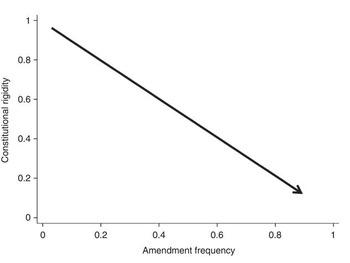
We start by focusing on the relationship between constitutional rigidity and amendment frequency. If ‘founding fathers’ lock a constitution with higher barriers to amendment, they do so to prevent future generations from changing it. Therefore, their intention is to restrict the frequency of constitutional amendments (as Figure 1 indicates). If there is not a negative relationship between rigidity and the frequency of amendments, then the constitutional assembly would not bother locking the constitution with costly amendment procedures. As such, in equilibrium, it is safe to assume that constitutional drafters impose higher barriers when they want to decrease the likelihood of future amendments.
Expectation of relationship between constitutional rigidity and amendment frequency

So, the expectation of a negative slope is not simply our own expectation (as outside observers); it is also shared by the ‘founding fathers’ of the constitution. In other words, it is an equilibrium expectation, shared by observers and actors alike.
Our next step is to compare our theoretical expectations about the relationship between constitutional rigidity and amendments with the constitutional experiences of OECD members. In our empirical analyses, we rely on data from the CCP.Footnote 17 As Elkins, Ginsburg and Melton point out, devising a cross-national measure of rigidity is particularly difficult because amendment procedures in two different constitutions are not always directly comparable.Footnote 18 For example, it is not immediately clear if a supermajority in the legislature is more or less burdensome than concurrent majorities of two different legislative chambers.
We use the CCP’s Amend_Rate variable to measure rigidity because it accounts for both de jure amendment procedures and de facto political institutions in each country. This variable is the predicted probability that a constitutional amendment will be successfully proposed and adopted for each constitution in the CCP dataset. The variable is derived from regressing the observed amendment rate on a set of amendment procedure variables (such as the number of government bodies required for approval, etc.) and political variables (such as whether the country has a common law legal system or underwent a transition from authoritarianism).Footnote 19 In our analysis, we subtract the Amend_Rate probability from 1 in order to obtain the rigidity of a constitution (in other words, the predicted probability that it will not be amended).
For the frequency of amendments, we use CCP data on the number of constitutional amendment events. The data list the years in which the constitution was successfully amended, but not the number of individual attempts, much less failed attempts. For example, the Bill of Rights to the US constitution is counted as a single entry because all ten amendments were ratified as a package in 1791. Given that we are interested in the rigidity of constitutions and attempts to change the constitutional text, we believe that the number of amendments is less relevant than the fact that a supermajority of the country agrees to an amendment in the first place. To obtain the frequency of ‘amendment events’ (which hereinafter we will refer to as ‘amendments’ for brevity), we count the number of years with a successful amendment, and then simply divide that by the number of years the constitution had governed the country. Because we are interested in countries that are governed by their constitutions, we only include amendments passed under a democratic government, as indicated by POLITY scores (see Online Appendix A for coding guidelines).Footnote 20
As an example of how we operationalize our data, we consider the case of the US constitution. Article V requires that any constitutional amendment be approved by two-thirds of each chamber of Congress as well as three-quarters of the states. Since the admission of Hawaii in 1959, this means that effectively any amendment must be approved by thirty-eight different states. Using this information, as well as additional data on US political institutions, the CCP calculated an Amend_Rate score of 0.036 (or 0.964 for the rigidity), implying that article V imposes high barriers to amendment. Indeed, the US constitution has only been amended thirteen times since it became a democracy according to POLITY, with the abolition of the slave trade in 1809.Footnote 21
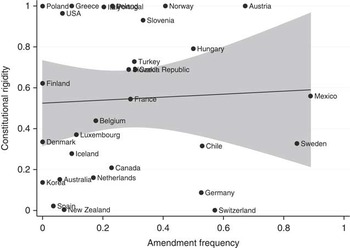
The US experience, although important, is not necessarily representative. In Figure 2, we present the relationship between constitutional rigidity and the frequency of amendments for all OECD countries in our sample. This relationship has a slightly positive slope, albeit not statistically significant. There is considerable variance, but we still observe a clear cluster of constitutions in the bottom-left corner that both contain lax amendment procedures and pass few amendments. The results thus far directly contradict our theoretical expectation. This is our first puzzle: why does locking a constitution fail to work?
Constitutional rigidity vs. number of amendment events in OECD

One possibility is that some intervening variable mediates the relationship between constitutional rigidity and amendments. In theory, if we were to control constitutional rigidity and the frequency of amendments for any random feature of constitutional design, the negative slope should be preserved, because we would not expect the third variable to affect one of the two axes positively but affect the other negatively. However, the puzzling results in Figure 2 compel us to consider alternatives. We know that longer, more detailed constitutions constrain the discretion of future generations. By covering more issues, longer constitutions are also at greater risk of including provisions contrary to the preferences of future generations. Could constitutional length be the missing link between amendment rigidity and frequency?
To test this intuition, we use the variable length from the CCP dataset, which counts the number of words in each constitution as of 2006. As Huber and Shipan note, languages vary in terms of the number of words they use to express the same concept, so CCP uses the official English-language translation of each constitution.Footnote 22 This allows cross-national comparisons to be more meaningful (although admittedly, translations can vary in terms of their verbosity). We take the log of the number of words rather than the absolute value because we expect the marginal effect of each additional word to decrease at higher values.Footnote 23 In other words, we expect the difference between 1,000 and 2,000 words to have a larger impact than between 101,000 and 102,000 words, even though the absolute difference in both cases is 1,000 words.
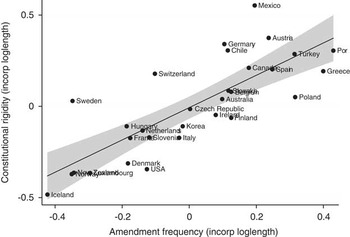
In this case, not only do the data from the OECD contradict our expectations from Figure 1; the expectation of negative slope is also contradicted by the data, but in a much more pronounced way. Now the relationship in Figure 3 is clearly positive and highly significant (at the 0.001 level). Given our expectation of a negative slope, Figure 3 is even more puzzling. It demonstrates that longer constitutions are both more rigid and more frequently amended than shorter ones. Before proceeding, it is worth presenting two brief case studies to show that Figure 3 is not simply a statistical artifact but in fact reflects the experiences of OECD countries (notice that even the United States is not a noticeable outlier in Figure 3).Footnote 24 Later, we present a more rigorous explanation for this relationship.
Constitutional rigidity vs. number of amendment events in OECD (controlling for length)

At approximately 4,090 words, Iceland’s constitution is one of the shortest in the OECD. Under Article 79, a constitutional amendment can be passed by a simple majority of two consecutive sessions of the Althingi, with a general election held in between. Legislators are unlikely to propose an amendment that would prompt voters to vote them out of office, so this requirement imposes relatively little additional burden on the amendment process. A few sections, such as those detailing the powers of the Althingi, have an even lower threshold and can simply be amended through ordinary legislation. Despite the relative ease of amendment, the constitution has only been amended on seven occasions since 1944, most of which expanded the franchise and rights protections.
By contrast, at 50,700 words, Mexico’s 1917 constitution is the longest in the OECD and also one of the most difficult to amend. According to Title VIII, any amendment must be passed not just by two-thirds of the Congress, but also by a majority of state legislatures, which drastically increases the number and diversity of potential veto players in the process. Despite this, the constitution had been amended on over sixty-five occasions between 1917 and 2006 – almost once per year – adding over 500 separate amendments. Moreover, many of these amendments were required to counteract the revolutionary ideology that Mexico’s drafters enshrined in the constitution. Because the constitution is so long and covers so many facets of political life, amendments have been required for relatively mundane matters, such as rules governing the expulsion of expatriates and foreign investment in the energy sector.
Theoretical Analysis of Constitutional Rigidity and Quality
Constitutions are typically amended after extraordinary procedures, such as qualified majorities in one chamber, concurrent majorities in two chambers, and possibly a ratifying referendum. These high barriers to approval and modification guarantee that, at the moment of adoption or modification, the constitution is located in the ‘constitutional core’ of a country. The core of a political system is a technical term referring to the set of points that cannot be upset by the existing rules. It includes the constitutional text, insofar as it cannot be replaced under the prevailing rules for amendment.
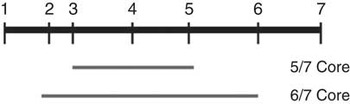
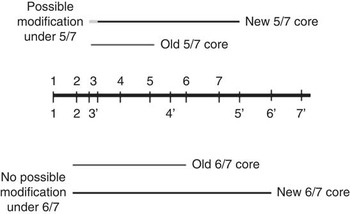
To simplify matters, let us consider a body that decides by a qualified majority rule along a single dimension (such as a parliament with a single chamber).Footnote 25 In Figure 4, we present a seven-member body that decides by a qualified majority of 5/7 or 6/7. The reader can verify that when the qualified majority increases from five to six members, the core expands (from the three to five segment to the two to six segment).
Unicameral core in one dimension with 5/7 and 6/7 majorities

The same argument applies for a referendum that requires a high threshold for participation. If the usual popular participation in a country is 40 per cent, and the requirement for constitutional revision is 60 per cent, then effectively the amendment must receive the support of a percentage of the population that clears both hurdles. So, proponents of a constitutional revision would have to mobilize at least half of the usual 40 per cent of voters (that is, 20 per cent) and the remaining 20 per cent to reach the participation threshold. That would mean a qualified majority of 40/60 (or two-thirds). If, on the other hand, the opposition asks its supporters to abstain, then unanimity of the 60 per cent that participates is needed for a constitutional revision. We see how participation requirements are de facto qualified majority requirements for the participants.
We argue that a constitution will be located inside the core of the political system. Indeed, any proposal outside the core would be defeated by a point inside the core. As for constitutional revisions, we argue that the only way they become an option is if a point that had been inside this core is now located outside. In other words, a constitutional revision can involve only points (and provisions) that used to be centrally located inside the body politic of a country but are not anymore.
This change can occur only with significant modification of the positions of the individual players (or an exogenous shock that makes the previous positions no longer tenable). Figure 5 presents such a modification.
Change of core in one dimension under 5/7 and 6/7 majority

In our example, out of the seven members, five have changed their opinion and moved to the right (some significantly so). In particular, Players 1 and 2 remained in place, while Player 3 moved slightly to the right (from 3 to 3’), Player 4 moved by a substantial amount (to position 4’, leapfrogging Player 5’s previous location), and Players 5, 6, and 7 in their new positions (5’, 6’ and 7’) moved beyond the previous political space (that is, beyond point 7). This is a political shift so radical that it is difficult to imagine in any real polity except during a revolution.
Despite this shift, there is considerable overlap between the old 5/7 core and the new core. If constitutional amendment requires a 5/7 majority, the only provisions that could be revised are those falling in the (3,3’) area. Yet if the required majority for constitutional revision is 6/7, then there is no possibility of such a modification, despite the significant shift in public opinion. Then Voter 2 will preserve the existing constitution by voting down the amendment. From the above discussion, it follows that a constitutional change requires a point of the previous constitutional core (an article or section of the existing constitution) to be located outside the polity’s current core.Footnote 26
To corroborate that our theoretical analysis does in fact describe political behavior during constitutional amendment debates, we consider an instructive example from Greece. The Greek constitution imposes formidable barriers to amendment, requiring ‘two separate parliamentary votes on either side of a general election and a majority of three-fifths of the total number of seats in at least one of the votes’.Footnote 27 Starting in 1997, Greece embarked upon the most extensive constitutional revision in Europe since the Second World War. The process was concluded during the spring of 2001, a year after the 2000 general election.
The amendments covered ‘either by adding to or rephrasing them, 48 out of 119 articles of the constitution’, and created ‘four new articles’.Footnote 28 Despite the scale of the revision, the two main parties together held over 90 per cent of the seats in Parliament and passed the amendments over the objections of minor parties. The process was also streamlined when the president of the Parliament ruled that it need only vote on constitutional amendments in a single vote taken at the end of the entire process. Moreover, members of Parliament did not have the right to propose amendments during the debates, but only before the process started. Only the Socialist Party rapporteur, government minister Evangelos Venizelos, had the right to amend the proposed text.Footnote 29
This account of the Greek case might suggest that all the institutional constraints were bypassed, and that the 2001 amendments represented a broad agreement between the two major parties. Yet these restrictions meant that the parliamentary groups of each party replaced Parliament as the locus of constitutional decision making, and that the government’s positions changed many times to accommodate the group. In fact, Venizelos was defeated even on issues that he had declared to be ‘matters of principle’.Footnote 30 Even in this extreme case, in which the electoral system was designed to produce single-party governments, and when parliamentary rules were distorted such that they transferred agenda-setting powers to the corresponding minster and precluded amendments, the prevailing rules guaranteed that an extraordinary parliamentary majority (on the order of 90 per cent) voted for the proposed amendments.
On the basis of the above analysis, given the large size and central location of these constitutional cores, it is very likely that the two cores (at time t and t+1) will overlap. Points at the intersection of the two cores cannot be subject to constitutional revisions (by the definition of ‘core’). The only provisions that could be changed are ones that belong in the core at time t but not at time t+1. Unlike ordinary legislation that (usually) requires a simple majority in the legislature to pass, and can be changed by a new majority (left succeeding right or vice versa), the required constitutional majorities must include parts of the previous majorities. Consequently, constitutional revision requires a massive change in the opinions of the political actors.
Generally speaking, constitutions can include three different kinds of provisions. First, constitutional provisions can regulate technical or innocuous matters that do not influence political behavior (such as descriptions of the national flag). Secondly, constitutions can contain aspirational goals, such as the right to work (included in many post-World War II constitutions), which do not impose any specific obligations on the government, and consequently are not judicially enforceable (not surprisingly, none of these countries has completely abolished unemployment). Thirdly, constitutions contain restrictive or prescriptive statements, such as sections detailing government structure and citizens’ rights. For example, the US president cannot circumvent the constitutional requirement to seek the ‘advice and consent’ of the Senate for presidential appointments.Footnote 31 While these three categories might be straightforward at the theoretical level, empirically there is no reliable way of distinguishing between constitutions that contain many substantive restrictions and those that are simply garrulous.Footnote 32
The analysis above helps demonstrate that, given the difficulties imposed by constitutional rigidity, constitutional revisions will be undertaken only on restrictive provisions, not on innocuous statements or aspirations. Even if such statements are considered obsolete, there is no immediate need to expend the time and costs needed to overcome the obstacles to amendment (locking).Footnote 33 Constitutional revisions can occur only because the preferences of political actors changed (in other words, they recognize that they had made a mistake in the original constitution) or because external conditions changed significantly such that the existing constitution is considered insufficient (for example, an economic crisis). The very attempt to amend the constitution indicates that the existing constitution had – in the opinion of overwhelming majorities in the country – serious shortcomings, and that overwhelming majorities understood and suffered from these shortcomings. This is a fundamental point of our argument: frequent revisions indicate that a constitution is not simply garrulous, but also imposes significant negative costs on society.
Constitutional Length as an Indicator of Restrictions
But why is constitutional length associated with more rigid constitutions? The literature has not sufficiently addressed the reasons why constitutions vary in length. We accept that there are some factors that influence constitutional length independently of political choice, such as legal origins or culture. However, throughout this article we argue that constitutional length is at least in part the result of a deliberate choice by the drafters. Therefore it is worth exploring how and why length might affect political and economic outcomes.
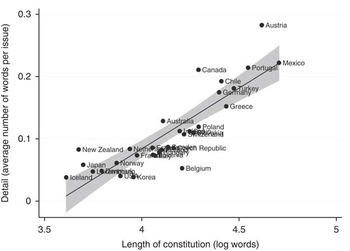
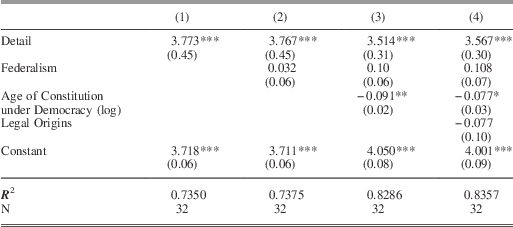
In Table 1, we assess which factors influence constitutional length. We know from previous studies that more recent constitutions tend to be longer and cover more subjects.Footnote 34 Moreover, common law countries tend to have longer constitutions, a legacy of British legislation,Footnote 35 so we include a dummy variable for legal origins (from LaPorta et al. Reference LaPorta, Florencio and Andrei2008). Federal constitutions might also be longer because they must describe the powers and responsibilities of several different levels of government, so we incorporate a variable indicating if a country has independent subnational governments.Footnote 36 Finally, we include the variable Detail from the CCP, which is simply the length of the constitution divided by the number of topics covered out of a list of ninety-two possible (scope). Table 1 indicates that long constitutions have more detailed provisions; all other variables lose significance, except for the age of the constitution, which still loses much of its explanatory power. Figure 6 shows the location of the different OECD countries for the length and detail variables.
Constitutional length vs. detail for OECD members

Constitutional Length Regressed on Constitutional Restrictions (‘Detail’) and Age of Constitution

Note: robust standard errors in parentheses. The dependent variable is constitutional length (logged). *p<0.05, **p<0.01, ***p<0.001
Although the Detail variable could be either an indicator of innocuous garrulity or of substantive restrictions imposed by the constitution, our analysis in the previous section indicates that ‘detail’ implies restrictions (because constitutional revisions are undertaken despite high barriers to amendment). In other words, longer constitutions are ‘bad’ because they contain restrictions that cause harm to an overwhelming majority of the population.
We had expected a negative relationship between constitutional rigidity and the frequency of amendments (as in Figure 1). This intuitive expectation was founded on the analysis above, which demonstrated that ‘unlocking’ a constitution is a difficult task. Yet as Figure 2 demonstrated, locking does not work, and when considered in conjunction with the length of a constitution, it turns out that longer constitutions are more frequently amended despite locking (Figure 3). In other words, longer constitutions are ‘bad’ because they are restrictive.
What are the Negative Effects of Long Constitutions?
Why are longer constitutions judged inappropriate and amended more frequently by citizens or their representatives? Given that change requires overwhelming majorities, we would expect political actors to expend effort on amendments when problematic provisions have real effects (direct or indirect) on these majorities.
Constitutional restrictions can cause two types of negative effects. A ‘direct effect’ implies that the required supermajority believed or understood that some constitutional provisions were imposing direct costs by erecting barriers to necessary action. However, the converse is not true; if the constitution permitted an action that was at some point in time deemed inappropriate or harmful, the majority would choose statutory or regulatory means of redress rather than constitutional change (as long as that means itself is not constitutionally prohibited). By contrast, an ‘indirect effect’ implies that a constitutional provision posed a conflict with the country’s international obligations or met with objections from foreign actors (for example, European Union conditions for membership or obligations deriving from trade agreements). While the constitutional provision itself might not impose direct costs, majorities within the country will nonetheless amend it if they wish to avoid costs imposed by foreign actors.
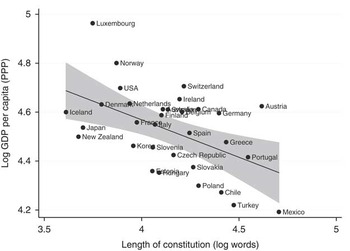
Because we feel we cannot adequately measure indirect effects, or direct effects that occur in some countries but not in others, we simply acknowledge such variance as noise. Instead, we must focus on variables that are common across countries and shape the opinion of the required overwhelming majorities. There is one obvious candidate: GDP per capita or income. In Figure 7, we plot the general relationship between average GDP per capita (PPP) over 2006–11 and constitutional length for OECD countries.Footnote 37 While there is significant variance, the relationship is clearly negative; lower GDP per capita is strongly associated with longer constitutions among OECD countries.
GDP per capita (PPP) vs. constitutional length (log words)

Constitutions have a crucial role in determining the rules of economic, political and social games played inside a country, and indeed Figure 7 indicates a correlation between length and income. However, GDP per capita is a complex phenomenon, the causes of which are still the subject of considerable research and debate. To account for this, and to ensure that the relationship depicted in Figure 7 is not spurious, we control for several key economic variables suggested by the literature,Footnote 38 including natural resources, gross savings, openness to trade and investment, each as a percentage of GDP. We also include the proportion of the labor force that held at least a secondary degree in the expectation that a more educated workforce would contribute to higher incomes.Footnote 39 All data are from the World Bank’s World Development Indicators.Footnote 40
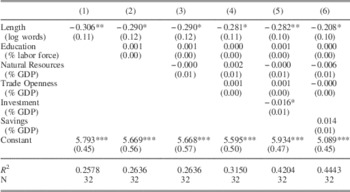
Because of the small size of our sample, we are limited in the number of variables we can include in the model. We use robust standard errors and perform several checks in order to ensure that our results are not driven by outliers.Footnote 41 We also introduce the variables step-wise in order to identify which ones affect the significance of the relationship between constitutional length and GDP per capita. Even after introducing these controls in Table 2, the relationship remains significant at conventionally accepted levels of 0.05 in all models. In short, we are confident that the relationship not only holds when controls are introduced, but also that constitutional length is correlated with low income.
GDP per Capita Regressed on Constitutional Length

Note: robust standard errors in parentheses. The dependent variable is average GDP per capita (PPP) during 2006–11. Independent variables are averaged over 2000–06. Source: World Bank 2014. *p<0.05, **p<0.01, ***p<0.001
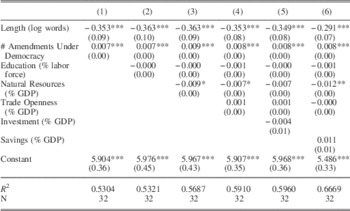
If longer constitutions are ‘bad’ when they impose restrictions, then amending them may help fix problematic provisions, at least in the short term. As such, we introduce the number of times the constitution has been amended under a democratic government into the model. As seen in Table 3, the number of amendments is significantly (and positively) correlated with higher levels of GDP per capita. Moreover, the inclusion of the frequency of amendments does not affect the magnitude of the coefficient of constitutional length, and even increases its significance. Our argument presents an important – and yet relatively unexplored – relationship between constitutional length and income. At the very least, we propose that political economists consider incorporating constitutional length as an independent variable in the economic development literature.
GDP per Capita Regressed on Constitutional Length (and Amendments)

Note: robust standard errors in parentheses. The dependent variable is average GDP per capita (PPP) from 2006–11. Independent variables are averaged over 2000–06. Source: World Bank 2014. *p<0.05, **p<0.01, ***p<0.001
We conclude with a qualitative example of how constitutional restrictions can negatively affect GDP per capita. Article 16 of the Greek constitution precludes the existence of private universities (Greece is the only OECD country with such a constitutional prohibition). The article has come under attack, particularly in light of problems in the Greek public education system. Yet the three-fifths majority needed to amend the constitution is unlikely to be achieved, which precludes the possibility of improving the higher education system through competition. This, in turn, makes the Greek economy less competitive and lowers the earning potential of Greek labor. In short, the article has important socioeconomic consequences.
Why are Longer Constitutions Locked? Corruption
Although the regression results in Tables 2 and 3 suggest a correlation between constitutional length and GDP per capita, they do not unpack the causal relationship. We start with the question of why longer constitutions contain more rigid amendment procedures than shorter ones. The obvious answer is that the constituent assembly had wanted to include more provisions that could not be easily modified by future majorities. This choice indicates less trust in the democratic process and fear that the drafters’ own preferences would be overturned. However, we expect such ‘locking’ to go beyond the normal precommitment functions of a constitution; after all, framework constitutions can constrain future generations even with relatively short provisions, such as those that protect private property.Footnote 42
Broadly speaking, constitutional locking can either distribute benefits toward future majorities or away from them. In the first scenario, drafters – knowing perhaps that they cannot trust political elites to respect rights or adopt sound economic policies – write longer constitutions in order to protect the majority. In this case, drafters are aware of the risks posed by corruption and seek to protect the populace. In the second scenario, corrupt special interest groups convince the drafters to protect their interests from subsequent challenges or attacks. This is the typical case of elite capture: the use of government office or legal authority to sequester resources or protect private privileges.
Let us use an example to demonstrate the two different causal pathways. Consider a constitution that includes specific provisions about state ownership over natural resources. For example, Article 33 of the Indonesian constitution grants the state ownership over the ‘land, waters, and natural resources’ and requires it to utilize them for the benefit of the people.Footnote 43 All else equal, such a constitution will be longer than one without such provisions. One possible explanation is that the environment in the country was in danger, and therefore the constituent assembly sought to protect it. Another equally plausible explanation of such a provision is that it gives the government a monopoly over natural resources and allows political elites to distribute the rents to their favored clients. Far from preserving ecosystems for future generations, the provision protects the right of the government to exploit them. Such provisions also require more bureaucracy, creating even more opportunities for rent seeking and patronage.
We will not speculate here as to which of the two possible causal pathways prevails, or on the motives of constitutional drafters. The two causal pathways are nearly observationally equivalent. It is also possible that the final draft of the constitution is the product of a compromise between representatives of competing interests, meaning that the pathways are not mutually exclusive. We simply expect a correlation between corruption and the length of the constitution. Whatever the initial motivations of the drafters, once in place, longer constitutions tend to impose more restrictions, which creates more opportunities for rent-seeking behavior as citizens and political actors attempt to circumvent the rules.
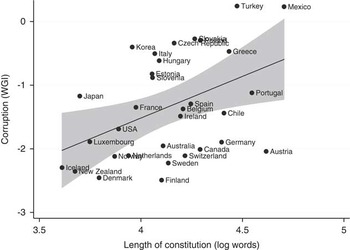
We test this conjecture empirically in Figure 8. The literature on corruption lacks a universally accepted measure. Existing measures tend to focus on either subjective perceptions of corruption or objective measures of variables assumed to be associated with corruption. Of the former, the World Bank’s World Governance Indicators (WGI) and Transparency International Corruption Perceptions Index (CPI) are the most prominent. CPI uses the perceptions of businessmen, analysts and country experts to rank each country every year.Footnote 44 The WGI create a composite score ranging from −2.5 to 2.5 using a basket of expert assessments and field surveys.Footnote 45 For both measures, higher scores indicate better control of corruption (less corruption).
Corruption (WGI) vs. constitutional length (log words)

There are many concerns in the literature about the reliability of such perceptions-based measures, as we cannot determine exactly what respondents factor into their answers.Footnote 46 It is also possible that perceptions-based measures are biased against poorer countries, to the extent that country experts and businessmen associate poverty with corruption. To make sure our results are not driven by problems endemic to any single survey, we use both WGI and CPI in our tests. We find the two variables to be highly correlated (0.988) during 2000–05, suggesting that they are capturing similar information about perceptions of corruption within OECD member countries. As an alternative, we also consider general government consumption from the WDI dataset in the expectation that higher levels of public expenditures create more opportunities for corruption.
For ease of reference, we take the inverse of the WGI and CPI scores such that higher scores indicate higher levels of corruption. As seen in Figure 8, higher levels of corruption as measured by WGI lead to longer constitutions (correlation coefficient 0.457, p-value 0.009). We received similar results when plotting CPI scores against constitutional length (not shown). Again, the results cannot determine which of the causal pathways in practice makes constitutions in more corrupt countries longer, but they do strongly imply that one of the two pathways explains what is at work.
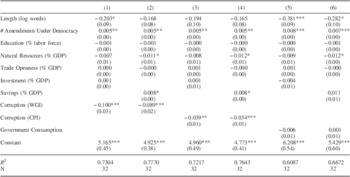
We conclude with an empirical test of the effect of corruption on GDP per capita to see if it reduces the effect of constitutional length. In Table 4, we revise our statistical model from Table 2 to include our measures of corruption. Comparison of Tables 2 and 4 indicates that corruption has a negative effect on income (as expected), but that this effect does not entirely eliminate the negative effect of constitutional length. Corruption reduces the statistical significance of length in Models 2 and 4, but does not eliminate it. So, regardless of the causal connection between corruption and length of constitution, the length of a constitution is negatively connected with per capita GDP even if one controls not only for relevant economic variables, but also for corruption.
GDP per Capita Regressed on Constitutional Length and Corruption

Note: robust standard errors in parentheses. The dependent variable is average GDP per capita (PPP) from 2006–11. Independent variables are averaged over 2000–06. Sources: WDI, WGI and TI. *p<0.05, **p<0.01, ***p<0.001
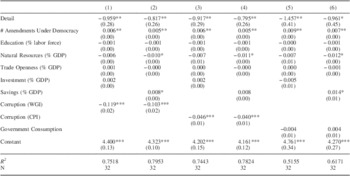
In Table 4, we used the length of a constitution as a proxy for substantive restrictions. As noted above, the CCP dataset includes another variable, Detail (length/scope), that conceptually also acts as an objective indicator of constitutional restrictions. In Table 5, we check the robustness of our results using this Detail variable in place of Length. The relationship between Detail and GDP per capita is even stronger; constitutional detail has a negative effect on wealth even if we control for corruption and all the economic variables we had included in Table 3. In other words, although corruption and constitutional restrictions are correlated, Length is not simply a proxy for corruption.
GDP per capita Regressed on Constitutional Restrictions (Detail) and Corruption

Note: robust standard errors in parentheses. The dependent variable is average GDP per capita (PPP) from 2006–11. Independent variables are averaged over 2000–06. Sources: WDI, WGI and TI. *p<0.05, **p<0.01, ***p<0.001
Conclusions
This article presents an important, yet underappreciated, effect of constitutional length. We have demonstrated that longer constitutions in OECD countries undergo more frequent revisions, despite the fact that they are more difficult to revise. We have demonstrated that the procedural hurdles for amendment included in a constitution require that any revisions to the constitution have the support of overwhelming majorities. We demonstrated that this simple fact implies that long constitutions are ‘bad’ because they are restrictive and impose objective costs on society that require redress.
We then connected constitutional length with two substantive variables: GDP per capita and corruption. We saw that longer constitutions are associated with lower per capita GDP and higher levels of corruption. The first result can be explained by the fact that restrictive revisions included in the long constitutions impede widely desirable outcomes (economic wealth) for a period of time (until the required majorities can pass an amendment, if they can). The second, the correlation between the length of the constitution and corruption, does not reveal a precise causal link. It might be that constitutional drafters attempted to use a longer constitution in order to address (pre-existing) corruption, or that they sought to protect special interests by including more constitutional issues. In either case, longer constitutions ultimately generate more opportunities for corruption and exploitation. The exact nature of the causality should be a subject of further investigation.
The first four parts of the article provided the causal argument, and the remainder demonstrated an empirical relationship between the aggregate variables for economic wealth, corruption and constitutional length. The causal connections here are inherently opaque, because each of these variables attempts to measure a latent concept. Yet we offered the simplest possible explanations that are consistent with the existing literature, and find support in the data. By focusing on constitutional length, our analysis also expands upon the literature that uses ‘leximetric’ analysis of constitutions.Footnote 47 A key difference between our work and prior studies is that we were able to assess ‘garrulity’Footnote 48 and other cultural features associated with a constitution as well as the negative qualities of long constitutions, namely undue restrictions on the discretion of political majorities. Constitutional provisions that require overwhelming majorities to amend them cannot be innocuous, and must contain restrictions or other content that have a real effect on political behavior.
Further research is needed to determine precisely which constitutional topics in longer constitutions have the strongest negative impact on economic wealth. We suspect that socioeconomic issues (for example, natural resources, the right to work) will prove more important than more innocuous matters (for example, the national flag) or technical fixes (for example, the boundaries of electoral constituencies). Legislators and constitutional drafters who are motivated by corrupt incentives would likely focus on socioeconomic regulations that could protect or increase their rents. Unfortunately, there are currently no datasets that contain information about the length of each topic within national constitutions (hence our decision to use the average variable Detail). While collecting these data require considerable effort, based on the preliminary results in our article we believe doing so would greatly contribute to our understanding of the political economy of constitutions.