Introduction
Social media, which refers to internet-based technologies that allow individuals to communicate and connect (Kaplan & Haenlein, Reference Kaplan and Haenlein2010), is reshaping stakeholders' ability to influence firm behaviors around the world (Carty, Reference Carty2002; Luo, Zhang, & Marquis, Reference Luo, Zhang and Marquis2016). Research shows that social media can enhance the ability of individual stakeholders (e.g., consumers, employees, and community members) to create, disseminate, and process information about firm misdeeds (Coombs, Reference Coombs1998; Pitt, Berthon, Watson, & Zinkhan, Reference Pitt, Berthon, Watson and Zinkhan2002) and organize collective actions to engage with firms and elicit positive responses (Jurgens, Berthon, Edelman, & Pitt, Reference Jurgens, Berthon, Edelman and Pitt2016; Parent, Plangger, & Bal, Reference Parent, Plangger and Bal2011). This literature focuses on the dyadic stakeholder–firm relationship, explaining how stakeholders use social media to initiate, organize, and deliver protests (Ganesh & Stohl, Reference Ganesh and Stohl2013) or mobilize social pressures to change firm behaviors (Luo et al., Reference Luo, Zhang and Marquis2016; Zhang & Luo, Reference Zhang and Luo2013).
The literature has paid insufficient attention to the insight in stakeholder theory that stakeholder influence often goes beyond the dyadic stakeholder–firm relationship and stems from collective claims and pressures from a network of different stakeholder groups (Frooman, Reference Frooman1999; Mattingly, Post, Preston, & Sachs, Reference Mattingly, Post, Preston and Sachs2004; Rowley, Reference Rowley1997). Forming a collective influence is critical for stakeholders when their direct impact on firms is constrained, for example, due to their lack of a formal relationship with firms' operations (Eesley & Lenox, Reference Eesley and Lenox2006) or lack of regulatory support to fight firms' misdeeds alone (Zhao, Tan, & Park, Reference Zhao, Tan and Park2014). Compared with dyadic relationships, we know much less about social media's role in shaping the relationships between stakeholder groups and enabling them to influence firm behaviors collectively. This motivates us to introduce the stakeholder multiplicity perspective in stakeholder theory (Neville & Menguc, Reference Neville and Menguc2006) to understand how social media shapes collective stakeholder influence. This perspective explains why the relationship between different stakeholder groups can generate a collective influence on firms that is stronger than a stakeholder group's independent influence, demonstrating a multiplicity effect of stakeholder influence. According to this perspective, while firms focus their attention on salient stakeholders whose claims are powerful, legitimate, and urgent (Mitchell, Agle, & Wood, Reference Mitchell, Agle and Wood1997), lower-salience stakeholders can leverage the action of higher-salience stakeholders to influence firm behaviors (Frooman, Reference Frooman1999; Neville & Menguc, Reference Neville and Menguc2006). This insight leads us to explore social media's possible stakeholder multiplicity effect, which extends its role in the dyadic stakeholder–firm relationship.
Another gap in the literature on social media empowerment is its lack of attention to institutional variation. Social media is found to similarly enhance stakeholder capabilities to directly influence firms in different institutional environments (Earl & Kimport, Reference Earl and Kimport2011; Luo et al., Reference Luo, Zhang and Marquis2016; Zhang & Luo, Reference Zhang and Luo2013). We recognize that social media may enable individuals to access information and organize themselves in different institutional environments. However, studies show that a firm's response to stakeholders and the relationships between stakeholder groups vary significantly across institutional conditions such as regulation formulation and enforcement (Matten & Moon, Reference Matten and Moon2008), the level of corruption and the type of political ideologies (Ioannou & Serafeim, Reference Ioannou and Serafeim2012), or the local government's bureaucratic capacity (Marquis & Bird, Reference Marquis and Bird2018). Therefore, it is important to study institutional variation to understand the boundary condition of social media's stakeholder multiplicity effect.
Motivated by these research gaps, this study investigates social media's stakeholder multiplicity effect and its regional institutional variation in a particular stakeholder environment in China that involves consumers and law-enforcing agencies. This stakeholder environment is consistent with the empirical context originally used to demonstrate the stakeholder multiplicity perspective. In the original research, Neville and Menguc (Reference Neville and Menguc2006) demonstrated that consumers and employees (lower-salience stakeholders) can leverage the action of governments (higher-salience stakeholders) to pressure firms to assume their environmental responsibility. In China, individual consumers continuously find it costly to hold firms accountable for misdeeds (Thomas, Reference Thomas2018) due to law enforcement issues (Li & Zhou, Reference Li and Zhou2012; Wei, Reference Wei, Micklitz and Saumier2018) and the nascent state of independent consumer rights agencies (Overby, Reference Overby2006). In contrast, law-enforcing agencies in China have a strong impact on firms (Ahlstrom, Bruton, & Lui, Reference Ahlstrom, Bruton and Lui2000; Child & Lu, Reference Child and Lu1996), which is consistent with the high salience of law-enforcing agencies in different countries considering their power to enforce rules (Agle, Mitchell, & Sonnenfeld, Reference Agle, Mitchell and Sonnenfeld1999; Harvey & Schaefer, Reference Harvey and Schaefer2001). Moreover, law-enforcing agencies' responses to firm misdeeds and consumer claims vary by regions in China (Thomas, Reference Thomas2018). Therefore, the stakeholder environment involving consumers and law-enforcing agencies is an ideal arena for examining the stakeholder multiplicity effect and the institutional variation of this effect.
Drawing on the stakeholder multiplicity perspective, we hypothesize that law-enforcing actions have a mediating effect on the association between consumers' social-media-based collective actions and firms' response to consumer claims, which demonstrates the social media's stakeholder multiplicity effect. Specifically, we argue that using social media to organize collective actions enables Chinese consumers (lower-salience stakeholders) to drive law-enforcing agencies (higher-salience stakeholders) to investigate their alleged firm misdeeds, which in turn elicits firms' positive responses to their claims. Next, we focus on bureaucratic capacity and government intervention in crisis-affected regions to examine the institutional contingency of this stakeholder multiplicity effect. These variables are likely to affect law-enforcing agencies' response to consumers' collective actions and firms' response to consumer claims in the face of law-enforcing actions, thus influencing the mediating effect of law-enforcing actions.
By analyzing 506 consumer crises faced by large foreign and domestic firms in China from 2000 to 2020, we find that firms are more likely to assume responsibility and take remedial action (i.e., an accommodative response) when confronted with social-media-based collective actions than when they are confronted with traditional approaches of making complaints to firms or mass media. This empowering role of social media is mediated by law-enforcing action, suggesting a stakeholder multiplicity effect. Furthermore, in crisis-affected regions where local governments have solid bureaucratic capacity, law-enforcing agencies are more likely to initiate investigations into consumer claims following social-media-based collective actions. In crisis-affected regions with strong government intervention in firms' operational decisions, firms are less likely to make an accommodative response to consumer claims despite law-enforcing actions.
Our findings offer new insights into the growing research on social media's relationship with stakeholder influence. The stakeholder multiplicity effect reveals social media's dual mechanisms to empower stakeholders: a capability-enhancing mechanism that enables stakeholders to challenge firms directly and a relationship-shaping mechanism that enables lower-salience stakeholders to leverage the influence of higher-salience stakeholders to challenge firms collectively. We find that the effect of the relationship-shaping mechanism is more potent than that of the capability-enhancing mechanism in China, while this effect is influenced by the local government's bureaucratic capacity and its level of intervention in firms' operational decisions. These findings complement the extant knowledge about social media's role in the dyadic stakeholder–firm relationship, enabling a more complete understanding of social media's relationship with stakeholder influence. Our research also contributes to the stakeholder multiplicity perspective in stakeholder theory. This perspective helps unpack stakeholder influence stemming from the inter-stakeholder relationship. However, it lacks empirical evidence in different institutional contexts, downplays the driver of collective stakeholder influence, and is mainly silent about the multiplicity effect's boundary conditions. Our findings fill these gaps by verifying its explanatory power in a responsive authoritarian regime such as China, revealing social media as a driver of the connection between otherwise separated stakeholders, and identifying the multiplicity effect's boundary conditions rooted in the local institutional environment. Practically, our findings suggest that managers incorporate social media's role as a potential catalyst for stakeholder relationship change into their stakeholder management strategies.
Theoretical Background
Prior research has shown that social media empowers individual stakeholders to become better informed and well-organized, thus enhancing their ability to drive changes in firm behavior. On the one hand, social media helps stakeholders acquire, process, and disseminate information. Jurgens et al. (Reference Jurgens, Berthon, Edelman and Pitt2016) explained that social media allows people to efficiently access rich information about a firm's history and behavior, refine and frame this information as evidence of firm misdeeds, and quickly increase the relevance of this information to a person's situation and identity. Social media also expedites information transmission to reach superconnectors or individuals who strongly impact public opinion (Uzzi & Spiro, Reference Uzzi and Spiro2005). For these reasons, it is difficult for firms to control the dissemination of information and temper the accumulation of social pressure to protect their images (Berthon, Pitt, Plangger, & Shapiro, Reference Berthon, Pitt, Plangger and Shapiro2012). On the other hand, social media helps individuals coordinate among themselves to pursue a common goal (George & Leidner, Reference George and Leidner2019). Enhanced information dissemination increases the likelihood of people participating in collective actions, strengthens the organization of actions, and extends the scope of the mobilization process in collective actions (King, Reference King2008b; Jurgens et al., Reference Jurgens, Berthon, Edelman and Pitt2016). For example, social media can rapidly turn anecdotal consumer complaints into organized consumer activism. Through collective actions, stakeholders can engage in private politics to negotiate with and press the firm to achieve their goals (Baron & Diermeier, Reference Baron and Diermeier2007; King, Reference King2008a).
This literature highlights social media's contribution to individual stakeholders' direct influence on firm behaviors. For example, during BP's Deepwater Horizon oil spill crisis, Twitter users' critics led to BP's increasing claims to express concerns with and offer remedies to victims (Walton, Cooley, & Nicholson, Reference Walton, Cooley and Nicholson2012). Native Americans and environmentalists broadcast live on Facebook their protests against Dakota Access LLC's oil pipeline project, leading to the temporary halt of its construction in affected areas (Hersher, Reference Hersher2017). Individuals also use social media to mobilize social pressure to change firm behaviors in contexts where norms of corporate social responsibility (CSR) are underdeveloped (Luo et al., Reference Luo, Zhang and Marquis2016; Marquis & Bird, Reference Marquis and Bird2018; Zhang & Luo, Reference Zhang and Luo2013). Zhang and Luo (Reference Zhang and Luo2013) reported that firms responded more quickly to activists' online campaigns by donating when they were shaming targets of the campaign. Luo et al. (Reference Luo, Zhang and Marquis2016) showed that following a major earthquake in China, the number of articles published on major websites about corporate donations created social pressure to influence firms' donation speed. This focus on social media's impact on the dyadic stakeholder–firm relationship is in line with the conventional view of media as a corporate governance mechanism (Aguilera, Desender, Bednar, & Lee, Reference Aguilera, Desender, Bednar and Lee2015; Dyck, Volchkova, & Zingales, Reference Dyck, Volchkova and Zingales2008; Dyck & Zingales, Reference Dyck and Zingales2002; Miller, Reference Miller2006). This view emphasizes that different forms of media can prompt firms to make changes by directly reporting on and investigating firm behaviors (Bednar, Boivie, & Prince, Reference Bednar, Boivie and Prince2013).
What remains downplayed in the literature on social media empowerment is the stakeholder theory's long-held insight that firms need to respond to collective claims and pressures from a network of different stakeholder groups (Frooman, Reference Frooman1999; Mattingly et al., Reference Mattingly, Post, Preston and Sachs2004; Rowley, Reference Rowley1997). The collective influence is critical for secondary stakeholders (e.g., nonprofit organizations and community members), who lack a formal relationship with firms (Eesley & Lenox, Reference Eesley and Lenox2006; Mitchell et al., Reference Mitchell, Agle and Wood1997; Zietsma & Winn, Reference Zietsma and Winn2008). It is also important for primary stakeholders (e.g., consumers, employees) who lack salience to increase firms' attention and elicit positive responses (Zhao et al., Reference Zhao, Tan and Park2014). In contrast to social media's role in the dyadic stakeholder–firm relationship, we know much less about how it enables different stakeholder groups to influence firms collectively. This research gap motivates us to draw on the stakeholder multiplicity perspective in stakeholder theory (Neville & Menguc, Reference Neville and Menguc2006) to investigate how social media drives multiple stakeholders' collective influence.
Building on Venkatraman's (Reference Venkatraman1989) framework of ‘fit’, the stakeholder multiplicity perspective uses three forms of fit between stakeholder groups to theorize why the inter-stakeholder relationship can generate more substantial influence on firms than a stakeholder group's independent influence. These forms of fit explain why different stakeholder groups can exert a collective influence on firms or create a multiplicity effect of stakeholder influence based on the direction, strength, and synergies of their claims. First, ‘fit-as-matching’ indicates that different stakeholder groups have a matched stance toward a firm in their claims. The matched direction of claims can combine the salience of stakeholder groups, thus increasing the salience of these claims perceived by firms and enabling stakeholders to attain the firm's managerial attention. Second, ‘fit-as-moderation’ indicates that a firm's perception of one stakeholder group's salience and its response to this stakeholder's claims is contingent upon its perceived salience of another stakeholder group. The proposition is that higher-salience stakeholders' claims can strengthen the perceived salience of lower-salience stakeholders' claims, thus increasing a firm's likelihood of substantively responding to lower-salience stakeholders. Third, ‘fit-as-gestalts’ describes that different stakeholder groups form a synergistic relationship to deal with a firm, such as building on each other's claims or developing strategic cooperation to investigate firm behaviors. The total salience of different stakeholder groups with a synergistic relationship is greater than the sum of their individual salience, allowing lower-salience stakeholders to exert a significant influence on firms. Neville and Menguc (Reference Neville and Menguc2006) used a stakeholder network involving governments, consumers, and employees to empirically demonstrate these propositions. This stakeholder network features a hierarchy of salience where the government is the most influential stakeholder group, and the government enables consumers and employees to increase their impact on firms' environmental behavior.
Motivated by this work, we build on the three forms of fit and utilize a similar stakeholder network (lower-salience consumers and higher-salience law-enforcing agencies) to theorize about social media's stakeholder multiplicity effect. Our premise is that while social media may enhance stakeholders' ability to directly influence firm behavior, it should also make a distinct contribution to empowering lower-salient stakeholders, provided that it enables them to leverage the influence of higher-salience stakeholders.
Focusing on social media's role in the dyadic stakeholder–firm relationship, the extant research highlights social media's similar contribution to stakeholder influence across institutional environments (Earl & Kimport, Reference Earl and Kimport2011; Zhang & Luo, Reference Zhang and Luo2013). We acknowledge this universal capability-enhancing effect of social media. For example, even in contexts where the government tends to control social media and restrict grassroots protests (King, Pan, & Roberts, Reference King, Pan and Roberts2017; Kojima, Choe, Ohtomo, & Tsujinaka, Reference Kojima, Choe, Ohtomo and Tsujinaka2012), individuals can actively use social media to access information and develop collective actions (Tai, Reference Tai and Meikle2018). However, the lack of attention to institutional variations may constrain research from fully explaining social media empowerment's ultimate effect because it is influenced not only by stakeholder capability but also by the institutional environment. A firm's response to stakeholders and the form of inter-stakeholder relations are subject to the influence of formal and informal institutions that define appropriate and acceptable relationships among social actors (Barley & Tolbert, Reference Barley and Tolbert1997). Comparative CSR research has shed good light on this point (Matten & Moon, Reference Matten and Moon2008). For example, firms in the UK have higher rates of stakeholder engagement than those in other European countries except Norway, partly due to the difference in CSR policies (Welford, Reference Welford2005). The variation in regulation formulation and enforcement in China, India, and Russia is related to the different approaches that stakeholders use to fight firm misdeeds (Zhao et al., Reference Zhao, Tan and Park2014). Subnational regions differ in their institutions as well (Meyer & Nguyen, Reference Meyer and Nguyen2005), leading to local governments' different responses to civic activism against firms' pollution behavior (Marquis & Bird, Reference Marquis and Bird2018). Therefore, we expect to observe institutional variation in stakeholder groups' collective influence driven by social media and firms' response to this influence.
We examine the stakeholder multiplicity effect and its institutional variation in the context of consumer crises in China. A consumer crisis occurs when consumers' claims and actions against a firm's perceived unethical behavior garner significant attention and potentially harm the firm's performance (Coombs & Holladay, Reference Coombs and Holladay2012). The protection of consumer rights in China has historically been marred by lax law enforcement (Tan, Reference Tan2009; Wei, Reference Wei, Micklitz and Saumier2018). Despite the growing sophistication of the consumer protection law and the food safety law, these laws remain inadequately enforced, and the public lacks trust in them (Liu, Pieniak, & Verbeke, Reference Liu, Pieniak and Verbeke2013; Xu, Reference Xu2012). For example, the courts are broadly less sympathetic to individual consumers' claims for punitive compensation to which they are entitled under these laws (Thomas, Reference Thomas2018). The law enforcement challenge dissuades Chinese consumers from seeking formal avenues for dispute resolution (Overby, Reference Overby2006), which is manifested in food safety crises (Yang, Reference Yang2013). This stakeholder environment, which involves lower-salience consumers and higher-salience law-enforcing agencies, is ideal for investigating social media's stakeholder multiplicity effect.
Hypotheses Development
Our first hypothesis establishes a positive relationship between social-media-based collective actions and firms' accommodative response to consumer claims. This hypothesis is in line with the existing insight that social media can facilitate individual stakeholders' collective actions and thereby increase their chance of receiving favorable reactions from firms (Eesley & Lenox, Reference Eesley and Lenox2006; Murillo-Luna, Garces-Ayerbe, & Rivera-Torres, Reference Murillo-Luna, Garces-Ayerbe and Rivera-Torres2008; Odziemkowska & Henisz, Reference Odziemkowska and Henisz2021). Next, we draw on the stakeholder multiplicity perceptive to hypothesize law-enforcing actions' mediating effect on this relationship. We explain that while social media enhances Chinese consumers' collective action ability, this enhanced ability elicits a firm's accommodative response mainly because it can motivate law-enforcing agencies to investigate alleged firm behaviors. Thus, social media drives a multiplicity effect on consumers' influence on firm behaviors. Finally, we use bureaucratic capacity and government intervention to examine the institutional variation in social media's stakeholder multiplicity effect.
Social-Media-Based Collective Actions and Firm Responses
Collective actions through social media facilitate information exposure (Barnett, Henriques, & Husted, Reference Barnett, Henriques and Husted2020), motivating a firm to opt for an accommodative response. First, social-media-based collective actions can magnify the scale and visibility of complaints, expand complaints across stakeholder groups, and foster a unified victim identity among affected stakeholders (Schneider & Kozinets, Reference Schneider and Kozinets2011). Widespread complaints and strengthened victim identity reduce a firm's capacity to de-escalate tension through a defensive posture (Berthon et al., Reference Berthon, Pitt, Plangger and Shapiro2012; Gregoire, Salle, & Tripp, Reference Gregoire, Salle and Tripp2015). Second, during the collective action process, social media enables consumers to efficiently share information and accumulate evidence of a firm's misdeeds, which reinforces stakeholders' attribution of the firm's responsibility in a consumer crisis (Jurgens et al., Reference Jurgens, Berthon, Edelman and Pitt2016) and potentially incurs significant reputational damage to the firm (Coombs, Reference Coombs1995). In this high-responsibility-attribution situation (Bundy & Pfarrer, Reference Bundy and Pfarrer2015), an accommodative response may attract fewer stakeholder penalties as it tends to be interpreted as a sign of goodwill (Pfarrer, DeCelles, Smith, & Taylor, Reference Pfarrer, DeCelles, Smith and Taylor2008). Third, social-media-based collective actions strengthen public access to details about firm behaviors and improve a firm's understanding of its responsibility, as external investigations disclose more information over time. When the transparency of information increases, the use of defensive strategies to distort the truth could yield diminishing returns and expose firms to escalated risks (Bundy & Pfarrer, Reference Bundy and Pfarrer2015; Pfarrer, DeCelles, Smith, & Taylor, Reference Pfarrer, DeCelles, Smith and Taylor2008; Pfarrer, Smith, Bartol, Khanin, & Zhang, Reference Pfarrer, Smith, Bartol, Khanin and Zhang2008). These factors reduce a firm's capacity to use a defensive response to mitigate potential reputational and economic damage and increase the likelihood of doing so via a more accommodative response. Therefore, we hypothesize the following:
Hypothesis 1 (H1): In a consumer crisis, consumers' social-media-based collective actions are positively related to firms' accommodative responses.
Stakeholder Multiplicity Effect: The Mediating Role of Law-Enforcing Action
We utilize the three forms of fit from the stakeholder multiplicity perspective to hypothesize the mediating role of the law-enforcing action in predicting a stakeholder multiplicity effect. First, social-media-based collective actions should motivate law-enforcing agencies to probe into consumer allegations about firm misdeeds. The stakeholder multiplicity perspective implies that two stakeholder groups should be more likely to develop a synergistic relationship (indicating fit-as-gestalts), such as governments' drawing on consumer claims to investigate firm behaviors, when there is a match between their agendas and their stances toward a firm (indicating fit-as-matching). This proposition helps explain why the law-enforcing agency in China might be sympathetic to and make a substantive response to consumers' collective actions even though the policy remains restrictive to grassroots protests (Fu, Reference Fu2017; Kojima et al., Reference Kojima, Choe, Ohtomo and Tsujinaka2012). Social-media-based collective actions increase the public visibility of consumer claims that target consumer rights protection. Consumer rights protection is an essential part of the national agenda for modernization (Davis, Reference Davis, Garon and Maclachlan2006), which requires effectively punishing firm misdeeds and addressing consumer complaints. Taking action to investigate alleged firm misdeeds should enable the law-enforcing agency to strengthen its perceived governing capability and performance legitimacy in terms of consumer rights protection. Therefore, social-media-based collective actions align the stance toward affected firms between law-enforcing agencies and consumers, which, according to the stakeholder multiplicity perspective, should prompt them to form a synergistic relationship, such as leveraging one another's claims and actions to investigate firm misdeeds. This explanation of the law-enforcing agency's substantive response to consumer actions is in line with existing studies showing that, given China's responsive authoritarian system, the government tends to make a substantive response to individual stakeholders' highly visible claims when they share the agenda to protect labor rights or the environment (Cai, Reference Cai2004; Liu, Lo, Zhan, & Wang, Reference Liu, Lo, Zhan and Wang2015; Marquis & Bird, Reference Marquis and Bird2018). In contrast, mismatched agendas and stances may hamper stakeholder groups from developing synergistic relationships. Examples include the Chinese government's repression of consumer protests that it viewed as involving an anti-government agenda (Yang, Reference Yang2013). Building on these considerations, we expect that Chinese consumers' social-media-based collective actions will motivate law-enforcing actions rather than incurring repression because these actions support the government's agenda to enhance consumer rights protection.
The three forms of fit also anticipate that law-enforcing actions can strengthen the perceived salience of consumer claims, thus forming a collective influence between consumers and law-enforcing agencies to motivate firms' accommodative response to consumer claims. The following example illustrates a typical law-enforcing action in response to social-media-based collective actions. In 2017, the General Administration of Quality Supervision, Inspection, and Quarantine (AQSIQ) announced on its website that it had noticed the online and offline protests by car owners of Honda CR-V, promising to be based on the result of a product defect investigation to ‘urge the firm to fulfill their responsibility for product safety … and address customer complaints’. Honda released a recall plan a few months following this announcement. As discussed in the previous hypothesis, this law-enforcing action signals a matched stance toward firm misdeeds between the law-enforcing agency and consumers (fit-as-matching). The stakeholder multiplicity perspective predicts that when two stakeholder groups' directions of claims matches, these claims' perceived salience will combine to press firms to respond substantively to the claims (Mitchell et al., Reference Mitchell, Agle and Wood1997).
Meanwhile, law-enforcing agencies are more salient stakeholders than individual consumers, meaning that their claims feature a greater degree of perceived power, legitimacy, and urgency by firms (Mitchell et al., Reference Mitchell, Agle and Wood1997; Neville, Bellm, & Whitwell, Reference Neville, Bellm and Whitwell2004). Resource dependence theory (Pfeffer & Salancik, Reference Pfeffer and Salancik1978) supports the law-enforcing agency's role as a higher-salience stakeholder considering its power in enforcing the rules and in China, particularly because firms often rely on this agency to handle political and regulatory hazards (Chen, Jiang, Liang, & Wang, Reference Chen, Jiang, Liang and Wang2011). In this case, as fit-as-moderation expects, the supportive claims of law-enforcing agencies as higher-salience stakeholders should strengthen the perceived salience of consumer claims.
In addition, while law-enforcing actions draw on consumer claims to investigate firm behaviors, consumers are likely to interpret the law-enforcing action as a backing for their attribution of responsibility and are incentivized to take further action. This interpretation is in line with people's self-confirming bias, where they selectively process information to validate their existing beliefs (Nickerson, Reference Nickerson1998). Building on each other's claims and actions to escalate their action, consumers and law-enforcing agencies form a synergistic relationship (fit-as-gestalts) that strengthens the salience of consumer claims and enables these claims to generate greater pressures on firms than that consumers can generate alone.
Considering the influence of the three forms of fit, we expect that law-enforcing actions can strengthen the salience of consumer claims perceived by firms. The heightened salience of consumer claims should affect a firm's evaluation of the cost and benefit of using a defensive or accommodative response to address consumer crises. This assumption echoes the research suggesting that the salience of stakeholder claims can influence the effect of firms' response strategies in stakeholder crises, such as Arthur Andersen's downfall following its defensive response in the Eron scandal (Bundy & Pfarrer, Reference Bundy and Pfarrer2015). When consumer claims are perceived as powerful, legitimate, and urgent, a firm may find it difficult to use a defensive posture to reduce social pressure and expect an accommodative response to attract fewer reputational and economic penalties from stakeholders. Our qualitative data show that the collective influence of consumers and law-enforcing agencies can be potent, leading firms to opt for an accommodative response even if they are not at fault. For example, in response to consumer complaints about Procter & Gamble's skincare product, the National Bureau of Quality Inspection (NBQI) released a preliminary investigation report in 2006. This report indicated that the product contained banned substances such as chromium and neodymium. The report agitated consumers to initiate class-action lawsuits. In response, the company chose to halt the sale of the product and issue refunds for purchased items. However, a few weeks later, the NBQI and the Ministry of Health determined that chromium and neodymium were inadvertently present in raw materials and that their microscale use was unlikely to pose a health risk.
Based on the above discussion, we hypothesize that law-enforcing actions play a critical mediating role in the relationship between social-media-based collective actions and firms' accommodative responses.
Hypothesis 2 (H2): Law-enforcing actions mediate the relationship between social-media-based collective actions and firms' accommodative responses to consumer claims.
Institutional Variation in the Stakeholder Multiplicity Effect
We focus on the regional variation in the local government's bureaucratic capacity and its intervention in firms' operational decisions to examine the institutional variation in China. These institutional conditions could influence either the law-enforcing agency's response to consumer actions or the law-enforcing action's impact on a firm's accommodative response to consumer claims. In this way, they moderate the stakeholder multiplicity effect.
As the first institutional condition, the local government's bureaucratic capacity to implement its functions may influence the government's response to the pressure of civic activism (Marquis & Bird, Reference Marquis and Bird2018). Examples of strong bureaucratic capacity include an effective judicial system that supports the public in solving problems through legal means (Gallagher, Reference Gallagher2017), effective property rights protection (Campbell & Lindberg, Reference Campbell and Lindberg1990), and efficient public administration (Skocpol & Finegold, Reference Skocpol and Finegold1982). Local governments in China with strong bureaucratic capacity are more adept at enforcing laws and collecting and processing information to inspect firm behaviors (Gallagher, Reference Gallagher2017; Van Rooij & Lo, Reference Van Rooij and Lo2010). They are responsive to civic activism that has gained widespread public attention in order to maintain their perceived performance legitimacy, which is the case in their dealing with the public's protests against firms' environmental pollution (Marquis & Bird, Reference Marquis and Bird2018). For this reason, we expect that local governments with strong bureaucratic capacity are likely to take action to investigate alleged firm misdeeds following consumers' social-media-based collective actions that heighten the visibility of consumer complaints. In addition, existing research suggests that strong bureaucratic capacity demonstrates high-level professionalization and institutionalization of social control techniques, which can reduce the government's use of coercive measures for social control (Huang & Yang, Reference Huang and Yang2002). Therefore, bureaucratic capacity should positively moderate social-media-based collective actions' association with law-enforcing actions, meaning that governments with stronger bureaucratic capacity are more likely than others to take law-enforcing actions (instead of taking no reactions or repressive approaches) to handle consumers' collective actions. We hypothesize the following:
Hypothesis 3 (H3): The level of local governments' bureaucratic capacity strengthens the relationship between social-media-based collective actions and law-enforcing actions.
Another institutional condition describes government officials' intervention in firms' operational decisions through the discretionary interpretation and application of laws and regulations (Hellman & Schankerman, Reference Hellman and Schankerman2000). Firms in regions of strong government intervention may be less likely to make an accommodative response to consumer claims in the face of law-enforcing actions because of their incentive to leverage close government relations to address consumer complaints (Wu & Davidson, Reference Wu and Davidson2011). In the case of government intervention, officials control firms' access to economic resources and opportunities and create extra costs for firms (Sanyal, Reference Sanyal2005), which motivates firms' rent-seeking activity often through bribery (Buchanan, Reference Buchanan, Buchanan, Tollison and Tullock1980; Gao, Reference Gao2011; Manion, Reference Manion2004). In this way, government intervention leads to a transactional relationship between firms and government officials in the latter's interest (e.g., personal benefits and local economic growth). This close relationship with officials potentially affects firms' tendency to pursue government support and protection rather than responding substantively to consumer claims despite the law-enforcing action driven by consumer actions. The 2008 Sanlu milk scandal in China provides an example. Milk farmers in the Sanlu group added melamine to milk to make it appear to contain more protein. This led to urinary problems in 294,000 children and the death of 6 babies (Spencer, Reference Spencer2008). Consumers started complaining about Sanlu's baby formula on BBS in May 2008, followed by fast-growing social media complaints and media reports in the following months. In early August, Sanlu asked the municipal government to step in to control media reports on the issue (Blanchard, Reference Blanchard2008). In early September, the general AQSIQ claimed that an investigation was underway. However, Sanlu kept concealing information and never publicly accepted its responsibility until the top leaders of the firm and the local government were dismissed or arrested. Scholars attributed this partly to the local government's close relationship with the business (Xinhua Agency, 2008). Based on these considerations, we hypothesize that government intervention negatively moderates law-enforcing actions' association with firms' responses. Therefore:
Hypothesis 4 (H4): The level of government intervention weakens the relationship between law-enforcing actions and firms' accommodative responses to consumer claims.
In Figure 1, we summarize the relationships among consumers' social-media-based collective actions, law-enforcing actions, and firms' accommodative responses, as well as the moderating effects of bureaucratic capacity and government intervention on these relationships.
Social media's stakeholder multiplicity effect on firms’ response to consumer crises in China

Methods
Sample and Data
We constructed a database to examine the impact of social media on firm behaviors and law-enforcing actions during consumer crises. This database includes high-profile and disruptive consumer crises encountered by large foreign and domestic firms in China from 2000 to 2020. Our focus was on firms listed in the Fortune China 500 and Fortune Global 500 that offered products and services to individual consumers in China. To compile a comprehensive dataset, we collected organizational and financial data from various sources, including the ORIANA database, China's Ministry of Commerce database, annual reports, and online resources. Both ORIANA and China's Ministry of Commerce databases have been commonly used in prior research (Ma, Tong, & Fitza, Reference Ma, Tong and Fitza2013; Zhao, Ma, Park, & Luo, Reference Zhao, Ma, Park and Luo2023). After removing firms due to incomplete data, our final database comprises 60 MNCs and 95 Chinese firms, spanning 12 consumer goods and services industries in China. As per the Global Industry Classification Standard (GICS), these industries include auto components; automobiles; beverages; distribution; electronic equipment, instruments and parts; food products; healthcare providers and services; household products; multiline retail; pharmaceuticals; personal products; textiles, apparel, and luxury goods. We focused on large firms in consumer goods and services industries because they are deeply involved in the mass market, generate a broad social impact, and are subject to local cultural and market factors (Fry, Keim, & Meiners, Reference Fry, Keim and Meiners1982). They are at the center of the consumer crisis.
We then tapped multiple sources to identify the consumer crises experienced by these firms. First, we used Factiva, a widely used database for news articles (Kim, Kim, & Qian, Reference Kim, Kim and Qian2018; Zhao et al., Reference Zhao, Ma, Park and Luo2023), to collect articles about each firm's consumer challenges in China published in major international and local media outlets, such as Forbes, Fortune, BusinessWeek, The Wall Street Journal, Nation's Business, The New York Times, The Economist, People Daily, Sohu.com, Sina.com, and Xinhua.org. We found that, regardless of whether a firm is foreign or Chinese, the Chinese press provides more elaborate information about the processes and outcomes of consumer crises in China. For example, the Xinhua News Agency website maintains a yuqing (public opinion) platform that releases articles concerning popular social issues daily, including information about Chinese and foreign firms. Second, we used Google and Baidu to find firm information related to consumer challenges. Third, we checked specialized scandal sections at Sina.com.cn and People.com. They are the two major news content providers with full-time staff members who collect news related to firm scandals from mass media nationwide daily.
We combined three keywords from the above information sources to find potential consumer crisis events: a firm's name, the Chinese expressions for ‘consumer’, and keywords indicating a potential crisis. The crisis keywords include those describing firm misdeeds (e.g., mislead, fraud, and cheat), firm outcomes (e.g., penalty, apologize, and recall), consumer behavior (e.g., complaint, critique, and blame), and general negative keywords (e.g., crisis, scandal, and conflict).
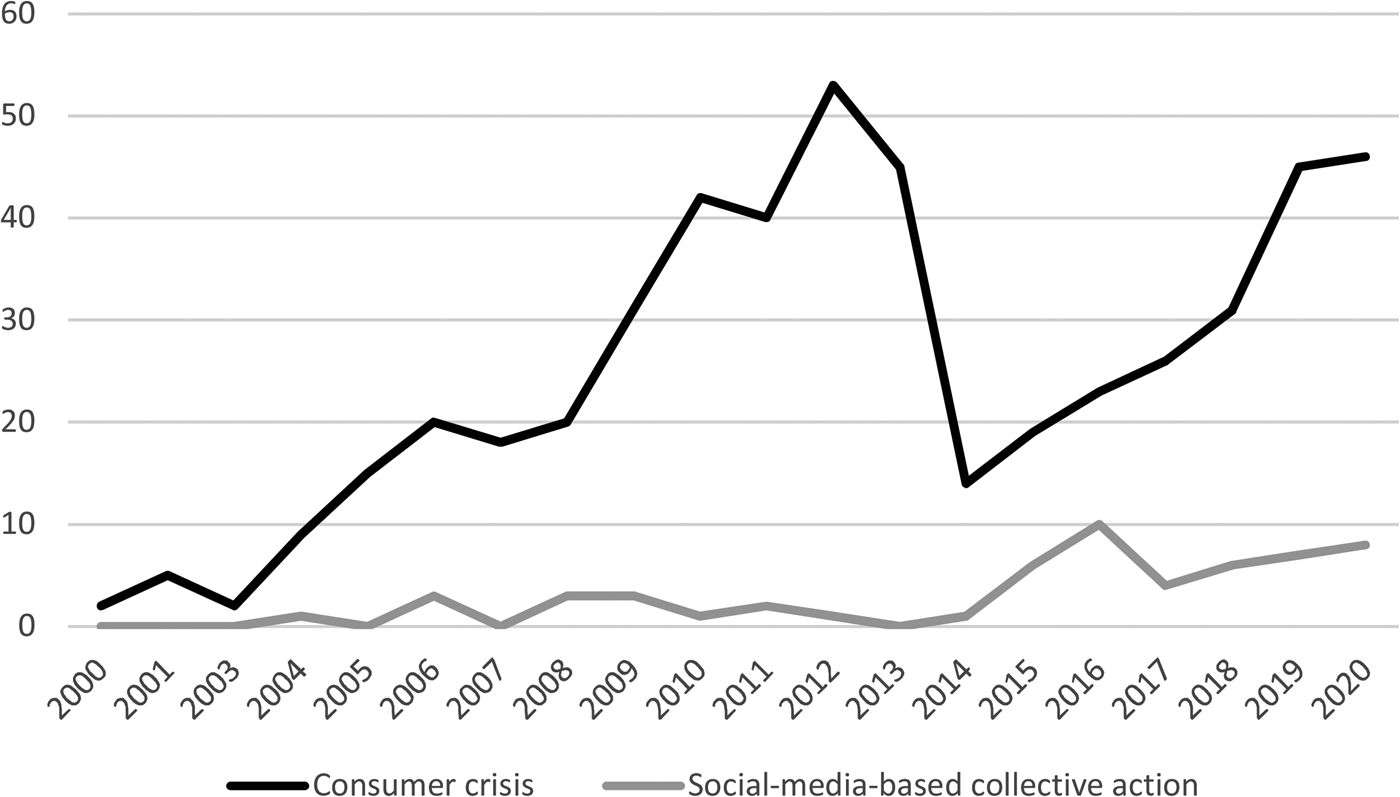
A consumer challenge must meet the following criteria to define a consumer crisis in the database. First, a challenge is linked to perceived violations of consumer rights. We identified nine issues concerning the violation of consumer rights: product quality problems, hazardous substances, marketing fraud, price fraud, labeling fraud, double standards (e.g., different product recall policies in Europe and China), internal management faults (e.g., violations of internal sanitation policy), unhealthy food (e.g., genetically modified food), and cultural discrimination (e.g., product design perceived to insult Chinese culture). Second, at least one of the eight most widely read Chinese news sites (based on Alexa), Sina, Sohu, QQ, NetEase, CCTV, Xinhuanet, People, and ifeng, reported the challenge. This protocol meets the visibility standard for a stakeholder crisis (Coombs & Holladay, Reference Coombs and Holladay2012). Third, a consumer crisis disrupts business operations or performance. We identified seven disruptive outcomes, including an administrative or legal penalty, compensation, removal-from-shelf, product return, product recall, store closure, and a decrease in sales estimated by a third party. The final dataset includes 506 consumer crises in 155 firms between 2000 and 2020. We analyzed each crisis and removed cases lacking information on consumer actions or firm responses. Figure 2 illustrates the overall growth of consumer crises and consumers' social-media-based collective actions that large companies have encountered in China.
Consumer crises and consumer collective actions in China for Fortune China 500 and Fortune Global 500, 2000–2020

Consumers' perceptions of firm misdeeds can drive a crisis, and they may not correctly attribute responsibility to the firm. In addition, a crisis may have its roots in problematic regulation formulation and enforcement (Zhao, Reference Zhao2013). For example, consumers might find quality flaws in a firm's electronic goods despite the suppliers having passed the central governments' quality certification requirements. Thus, this article takes a realistic view of social media's impact on firm responses, regardless of whether the responsibility is correctly attributed.
Measurement
Social-media-based collective action
The research team went through iterations of coding and discussion to focus on particular individual behaviors in each crisis case to define social-media-based collective actions. As a result, this dummy variable indicates whether consumers use social media (e.g., BBS, QQ, Weibo, and Weixin) to call for more consumers to jointly protest a firm, organize crowd formation to make protests, or organize joint lawsuits. Focusing on these behaviors ensures a precise and replicable coding process. Our measure aligns with existing studies that focus on gathering and coordinating individuals to pursue a common goal to define social-media-based collective actions (Etter & Albu, Reference Etter and Albu2021; Obar, Zube, & Lampe, Reference Obar, Zube and Lampe2012). We used 1 to indicate the presence of social-media-based collective action and 0 otherwise.
Law-enforcing action
The team analyzed each crisis case to develop a dummy variable for law-enforcing action. This variable describes whether law-enforcing agencies (e.g., the Administration for Industry and Commerce, the Food and Drug Administration, the AQSIQ) followed up on social-media-based collective actions (e.g., online or offline protests, joint lawsuits) to investigate firm misdeeds claimed by consumers. The previously mentioned Honda case illustrates how we coded the crisis case to identify this variable. In December 2017, consumers complained about the Honda CR-V on BBS, which grew into online activism. In February 2018, the general AQSIQ followed up to initiate the investigation. We use 1 to indicate the law-enforcing action in this case. We used 0 to describe cases where the law-enforcing agency did not explicitly take action or did not take action because of consumers' collective actions. For example, we excluded cases where the law-enforcing agency investigated firm behavior because a few individual consumers made complaints to the agency or because the agency found firm misdeeds during its routine inspection of product quality.
Accommodative response
Following existing studies (Benoit, Reference Benoit1997; Coombs, Reference Coombs2007; Coombs & Holladay, Reference Coombs, Holladay, Millar and Heath2004), we used a dummy variable of accommodative response to indicate whether a firm has publicly acknowledged its responsibility and promised to take corrective actions in response to consumer actions. Benoit (Reference Benoit1997) proposed 14 types of firm communication strategies for dealing with a crisis, ranging from ‘simple denial’ to ‘mortification’. Among these strategies, ‘corrective action’ and ‘mortification’ demonstrate an ‘accommodative response’. Accordingly, we identify an accommodative response when a firm provides a plan to address consumers' complaints (e.g., compensation and product recall) and public acknowledgment of its misdeed (e.g., apology). We used 1 to indicate the presence of an accommodative response and 0 otherwise.
Bureaucratic capacity
We followed existing research (Marquis & Bird, Reference Marquis and Bird2018) to use the National Economic Research Institute (NERI) Index of Marketization (Wang, Hu, & Fan, Reference Wang, Hu and Fan2021) to construct a firm-level continuous variable of bureaucratic capacity. We focused on this index's three indicators of legal framework development – the protection of property rights, the effectiveness of judicial systems, and the efficiency of public administration. We first obtained the regional-level (provinces or municipal cities) scores of the three indicators from the index. We extrapolated the data for 2020 because the NERI updated the index up to 2019. We then calculated a firm-level score by averaging the scores of three indicators in a particular firm-year across all regions of crisis occurrence.
Government intervention
We developed a firm-level continuous variable of government intervention to indicate firm leaders' perceptions of the extent to which the local government has excess interventions in various operational decisions, which is consistent with the conventional measure (Gao, Reference Gao2011; Hellman & Schankerman, Reference Hellman and Schankerman2000). We first obtained regional-level (provinces or municipal cities) government intervention scores from the NERI Index of Marketization (Wang et al., Reference Wang, Hu and Fan2021). This score captures the local government's perceived level of intervention in operational decisions via administrative review and approval, law enforcement, industry access approval, investment approval, and so on. We extrapolated the data for 2020 because the NERI updated the index up to 2019. We then calculated a firm-level index by averaging these scores in a particular firm-year across all regions of crisis occurrence. A government intervention score is a reverse number, meaning that the higher the score is, the lower the level of intervention. To facilitate interpretation, we used the inverse of the firm-level index (subtracting from 10) as the proxy of government intervention.
Control variables
We controlled event-level, organizational, and environmental factors that may influence the relationships between social-media-based collective actions, law-enforcing actions, and firm responses. We controlled three event-level factors. Stakeholders' high responsibility attribution in a crisis event may increase the chance that a firm accepts responsibility (Coombs, Reference Coombs1995; Coombs & Holladay, Reference Coombs, Holladay, Millar and Heath2004). Thus, we controlled for the level of responsibility attribution. We followed the coding scheme of extant studies (Coombs, Reference Coombs2004; Wei, Ouyang, & Chen, Reference Wei, Ouyang and Chen2017) to identify whether consumers perceive that a firm intentionally conducted a misdeed. We also controlled for the crisis's geographic scope and severity level, which may influence responses by law-enforcing agencies and firms. Crisis scope indicates whether a crisis occurred at the regional or national level. Crisis severity indicates whether a crisis involves injuries or the death of consumers.
We controlled for six organization-level factors. Studies show that local consumers perceive foreign firms as less welcome than local firms do (Kostova & Zaheer, Reference Kostova and Zaheer1999; Wu & Salomon, Reference Wu and Salomon2017). Thus, foreign firms may be more likely to attract consumer challenges that raise the attention of law-enforcing agencies. Additionally, foreign firms may be more likely to make an accommodative response to reduce the intensity of consumer challenges because of this liability of foreignness (Zaheer, Reference Zaheer1995). We used a dummy variable for foreignness to distinguish a foreign firm on the Fortune Global 500 list from a Chinese firm on the Fortune China 500 list. Scholars argue that a firm's level of social approval (or disapproval), i.e., stakeholders' high (or low) affinity with the firm, influences the firm's response in a crisis (Bundy & Pfarrer, Reference Bundy and Pfarrer2015). Thus, we use the presence of a firm's consumer crisis in previous years to indicate that the firm has a higher level of social disapproval among consumers than firms with no previous consumer crisis. State-owned enterprises (SOEs) have incentives to pursue the government's social and political agendas to secure social stability (Bai, Lu, & Tao, Reference Bai, Lu and Tao2006). Thus, they might be more likely to make an accommodative response in response to law-enforcing actions than non-SOEs who prioritize financial goals. We followed prior studies to control state ownership as a continuous variable indicating the percentage of stakes owned by the government (Zhou, Gao, & Zhao, Reference Zhou, Gao and Zhao2017). Profitable and large firms are exposed to stronger social monitoring (Kostova & Zaheer, Reference Kostova and Zaheer1999). We controlled for firm performance by using return on assets (ROA) and for firm size by using revenue (logged). We used the information of parent firms for foreign firms. The length of operation influences a firm's experience dealing with consumers and law-enforcing agencies. We thus controlled for firm age, measured as the number of years since a foreign firm's first operational subsidiary in China or since a domestic firm's foundation.
We controlled for the intensity of consumer complaints and the internet use rate, which demonstrates the features of the public in crisis-affected regions that may influence law-enforcing agencies' and firms' response to social-media-based collective actions. The intensity of consumer complaints reflects local people's consumer rights awareness and their tendency to claim their rights, which may in turn influence law-enforcing agencies' and firms' experiences with consumer complaints and their approaches to dealing with these complaints. To develop a firm-level index of this variable, we first obtained the yearly number of consumer complaints in each province or municipal city in China, weighted by GDP size, from the NERI Index of Marketization (Wang et al., Reference Wang, Hu and Fan2021). We then calculated a firm-level index by averaging these scores in a particular firm-year across all regions of crisis occurrence. We controlled for the Internet use rate because the public's access to the internet may influence social-media-based collective actions' diffusion speed and their ability to attract attention from the public, which may in turn influence perceived pressure and urgency by law-enforcing agencies and firms to respond to collection actions. This variable is measured by the ratio of internet users to the country's population in a particular year.
Analysis
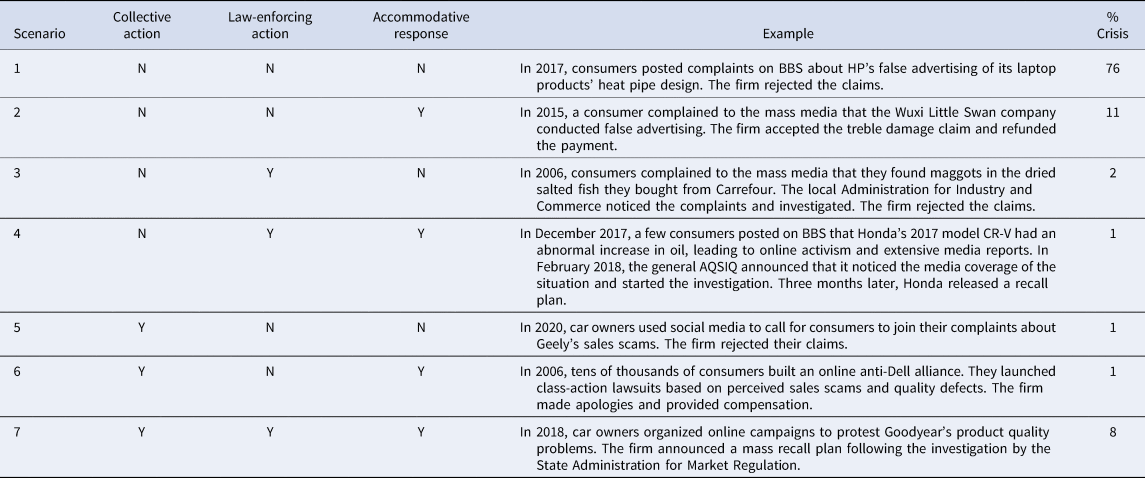
We analyzed qualitative data to develop variables for the regression analysis. At the center of this analysis is identifying different consumer crisis scenarios that demonstrate variances in the presence and sequence of the following events: social-media-based collective actions, law-enforcing actions, and firm responses. Table 1 explains the seven crisis scenarios covered by the dataset. By analyzing the sequences of events, we ensure that law-enforcing actions occurred after consumers' collective actions, followed by firms' accommodative responses. Thus, we reduce concerns about reverse causality caused by the law-enforcing action's potential influence on consumers' collective actions via social media. To test our hypotheses, we employed logistic regression for the primary analyses while using the instrumental variable to address potential endogeneity issues caused by unobservable confounders as a robustness check (Bascle, Reference Bascle2008). The logistic regression formulas are as follows:


where Z i refers to the firm's accommodative response to the crisis i; Y i refers to the law-enforcing action in response to the crisis i; X1i refers to the social-media-based collective action in the crisis i; X2i and X3i refer to the local government's bureaucratic capacity and its level of intervention in firms' operational decisions in the regions of the crisis i, respectively; Controlsi refers to the vector of control variables; E refers to the vector of regression coefficients of control variables; and $\varepsilon _i$ is the robust error term.
Consumer crisis scenarios

Results
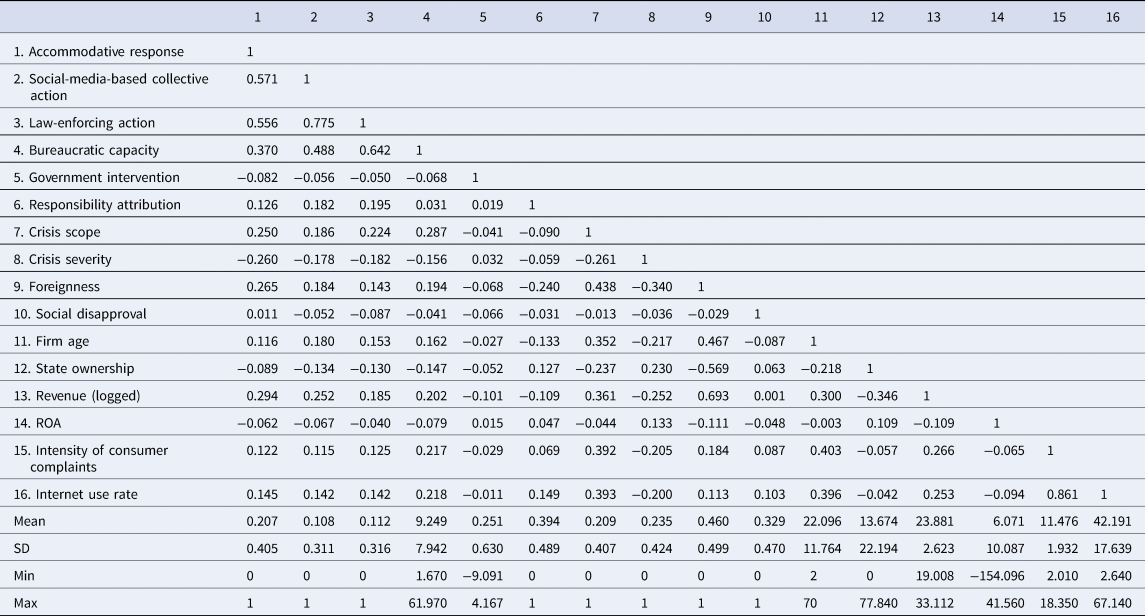
Table 2 reports the descriptive statistics and correlations for the variables. The absolute correlations between foreignness and revenue (r = 0.693) and between foreignness and state ownership (r = −0.569) are greater than 0.5. Since the regression results are consistent if we exclude any one of these variables, we report all of them in the results to capture their possible influence on the law-enforcing action or the firm's response. The variance of the inflation factor (VIF) ranges from 1.03 to 4.49, which is well below the cutoff value (VIF < 10) suggested by Stevens (Reference Stevens2009). These values indicate that the multicollinearity of independent variables and controls is not a major concern.
Correlation matrix and descriptive statistics

Notes: N = 498; absolute correlation values larger than 0.089 are significant at the 95% level.
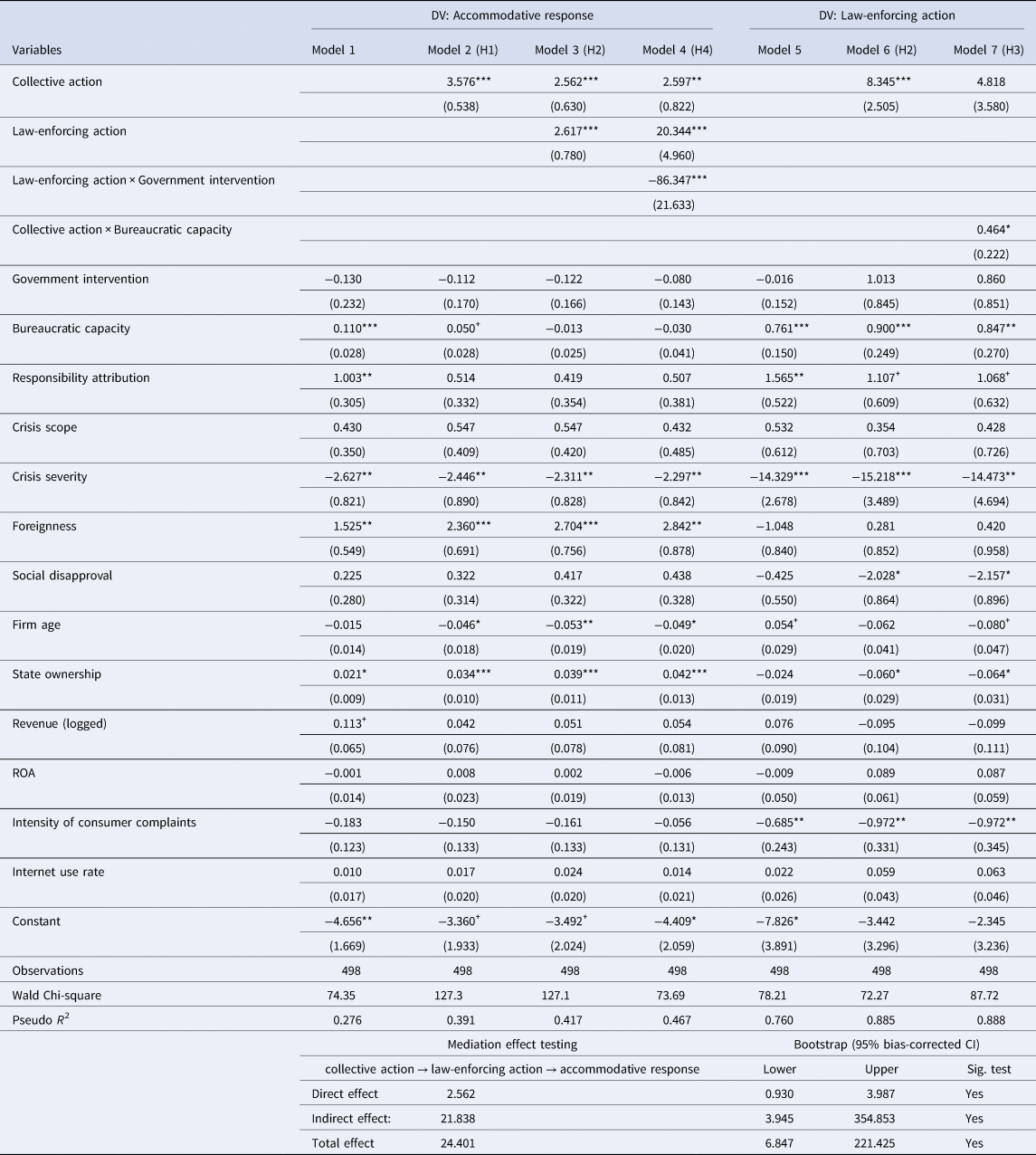
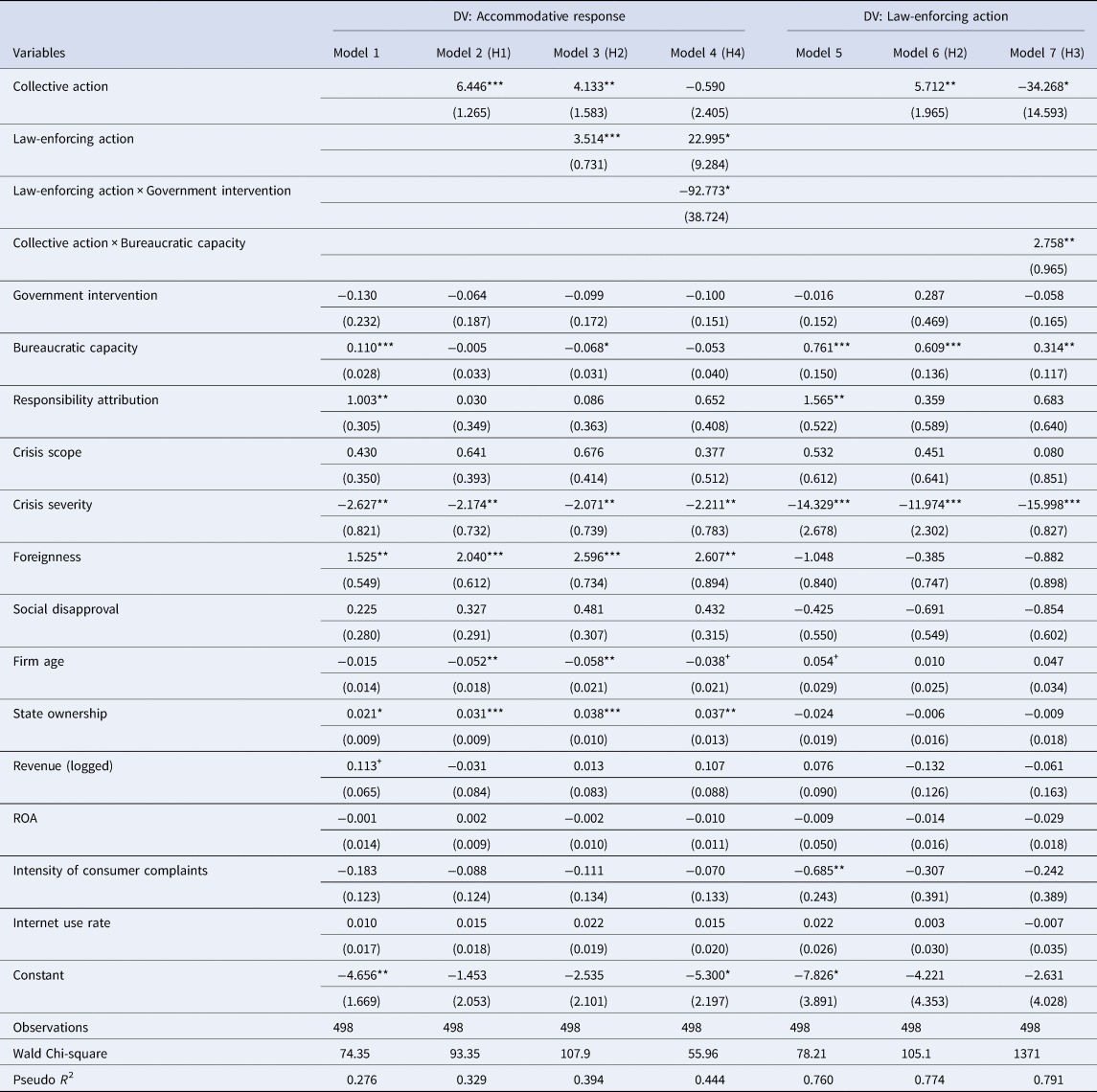
Table 3 presents the results of the logistic regressions. Models 1 and 5 include only the control variables to predict the firm's accommodative response and the law-enforcing action, respectively. The results show that crisis severity significantly reduces a firm's likelihood of making an accommodative response. Foreignness and state ownership significantly increase a firm's likelihood of making an accommodative response. Intensity of consumer complaints and crisis severity significantly reduce the likelihood of law-enforcing action. Bureaucratic capacity and responsibility attribution significantly increase the likelihood of law-enforcing action.
Regression results of the logistic models

Notes: Robust standard errors in parentheses; ***p < 0.001, **p < 0.01, *p < 0.05, +p < 0.1; the results are consistent if year, industry, and country dummies are controlled, yet the sample size is deducted.
Models 2, 3, and 6 test the mediating effect of law-enforcing actions on the relationship between social-media-based collective actions and firm responses or the stakeholder multiplicity effect of social media empowerment.
In the first step, as demonstrated in Model 2, we used logistic regression to test the relationship between social-media-based collective actions and firm responses. We find that firms are significantly more likely to make an accommodative response if consumers organize collective actions through social media (b = 3.576, p < 0.001), supporting H1. In the second step, as shown in Model 6, we estimated the effect of collective action on law-enforcing action. The results show that the regression coefficient is positive and significant (b = 8.345, p < 0.001). In the final step, as shown in Model 3, we estimated the law-enforcing action's impact on the firm's accommodative response. The results show that the regression coefficient is positive and significant (b = 2.617, p < 0.001). These three steps collectively support H2, demonstrating a mediating effect of law-enforcing action. Model 3 also indicates that the effect of social-media-based collective action remains significant (b = 2.514, p < 0.001), even when controlling for law-enforcing action. According to Baron and Kenny's (Reference Baron and Kenny1986) approach to mediation tests, this result suggests that law-enforcing action partially mediates the effect of collective action.
We adopted a two-stage approach (Shaver, Reference Shaver2005) to further verify the mediating effect of law-enforcing action. This approach accounts for the potential correlation of regression error terms in the standard test of the mediating effect proposed by Baron and Kenny (Reference Baron and Kenny1986). The first stage repeated the second step in the previous analysis, using logistic regression to estimate the effect of social-media-based collective action on law-enforcing action and obtaining predicted values of law-enforcing action. The second stage included the predicted values of law-enforcing action as an instrument and the collective action variable to predict the firm's accommodative response. The results show that the regression coefficient of the predicted law-enforcing action is positive and significant (b = 4.013, p < 0.001), while the coefficient of collective action remains significant (b = 2.000, p < 0.05). These results increased our confidence in the partial mediating effect of law-enforcing action.
We also checked the bias-corrected bootstrap confidence interval (CI) to compare the direct and indirect effects (via the law-enforcing action) of social-media-based collective action on firm responses. We find that the indirect effect is 21.838, with a bias-corrected CI of [3.945, 354.853]. This indirect effect is calculated by multiplying the effect of social-media-based collective action on law-enforcing action (8.345) by the effect of law-enforcing action on accommodative response when collective action is included (2.617). This result suggests that law-enforcing action significantly mediates the relationship between social-media-based collective action and a firm's accommodative response. Additionally, the results indicate that the indirect effect of social-media-based collective action (21.838) is greater than its direct effect (2.562). This finding suggests that social media's empowerment mechanism of reshaping the relationship between individual consumers and the law-enforcing agency (or the stakeholder multiplicity effect) has a stronger influence on firm responses than does its mechanism of enhancing consumers' ability to organize collective actions.
In addition, we used crosstabs to validate the logistic regression results because a few key variables in this study were dichotomous. The results show that social-media-based collective action has a significant association with the accommodative response (Pearson χ 2 = 162.56, p < 0.001) and law-enforcing action (Pearson χ 2 = 299.37, p < 0.001). Moreover, the law-enforcing action was significantly related to the accommodative response (Pearson χ 2 = 153.84, p < 0.001). These results are consistent with those reported in Table 3.
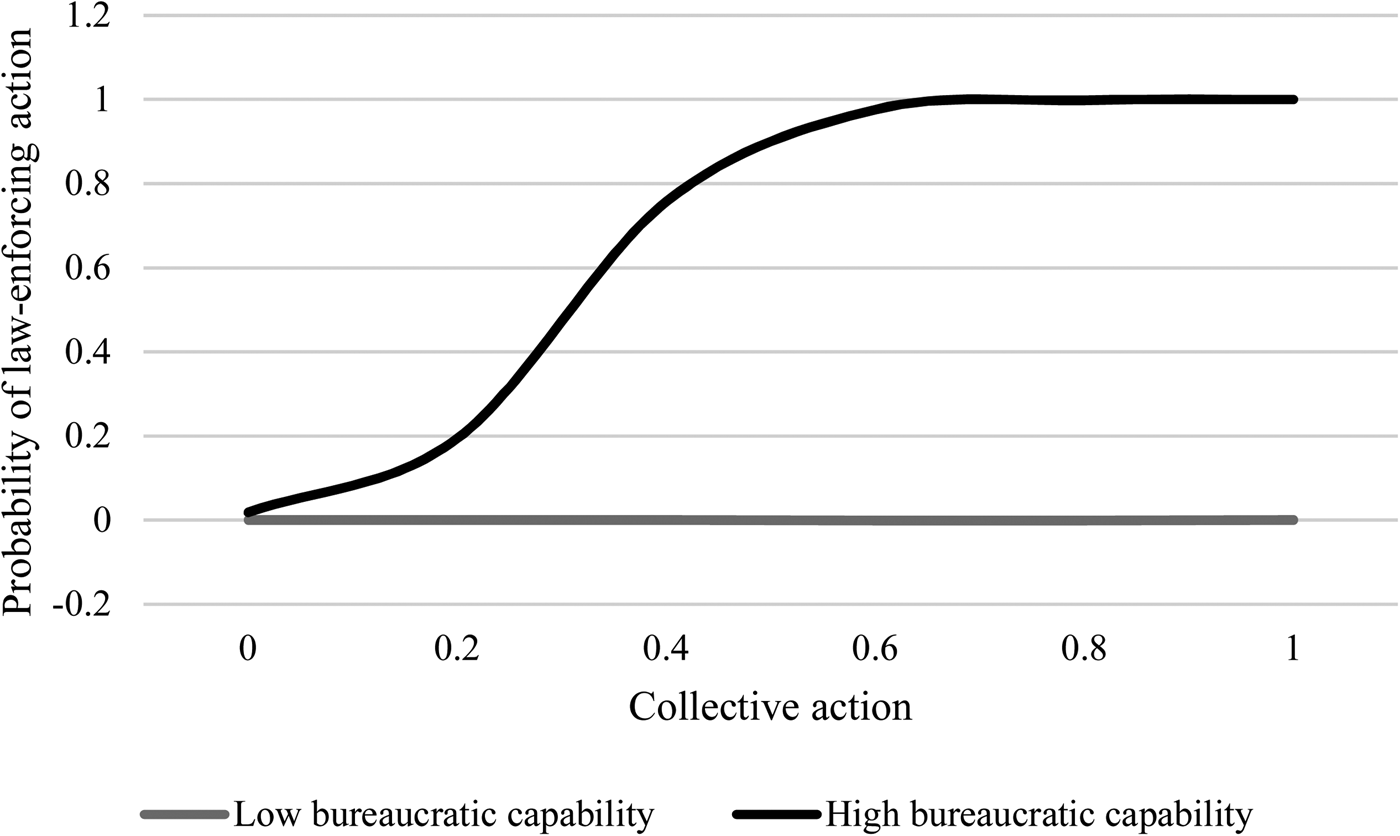
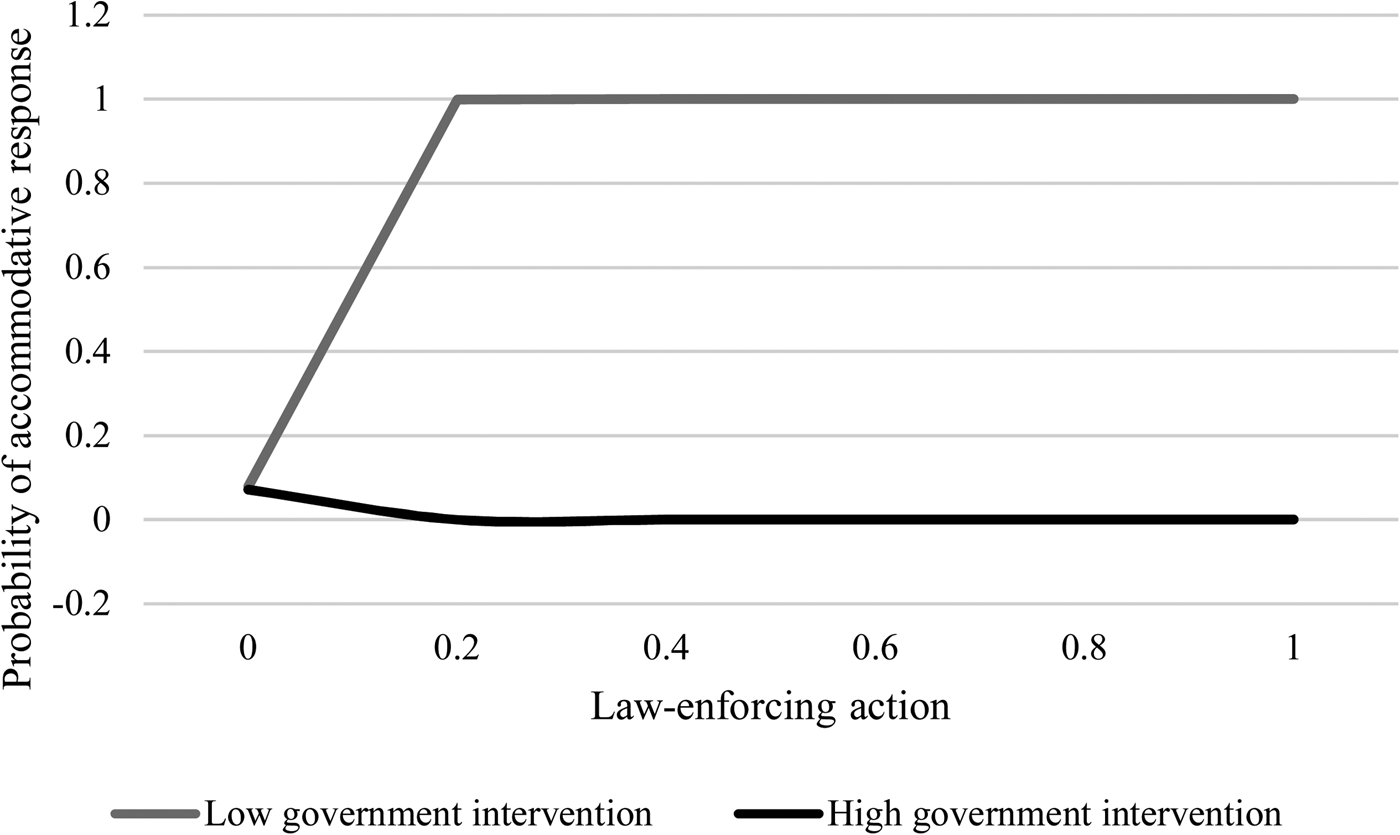
Models 4 and 7 in Table 3 test the boundary conditions of the law-enforcing action's mediating effect. Model 7 tests the interaction between collective action and local government's bureaucratic capacity, showing that the coefficient is positive and significant (b = 0.464, p < 0.05). This finding aligns with our prediction that bureaucratic capacity positively moderates the impact of collective action on law-enforcing action, supporting H3. To visualize this moderating effect, Figure 3 plots the effect of collective action on the probability of law-enforcing action at low (one standard deviation below the mean) and high (one standard deviation above the mean) levels of bureaucratic capacity. The plot indicates that the effect of collective action is significantly positive when bureaucratic capacity is high, but nearly negligible when bureaucratic capacity is low. Model 4 tests the interaction between law-enforcing action and local government intervention, showing that the coefficient is negative and significant (b = −86.347, p < 0.001), supporting H4. Figure 4 visualizes this interaction effect by plotting the effect of the law-enforcing action on the probability of a firm's accommodative response at low and high levels of government intervention. The plot reveals that the law-enforcing action has a strong positive effect on a firm's accommodative response when government intervention is low, whereas this effect is nearly zero when government intervention is high.
The interaction effect of social-media-based collective action and bureaucratic capacity

The interaction effect of law-enforcing action and government intervention

Since we may omit unobserved time-varying confounders that might influence consumers' social-media-based collective actions, we adopted the instrumental variables method to mitigate endogeneity issues. We identified two instruments for social-media-based collective action: the yearly number of mobile phone subscribers in a region and the yearly length of long-distance optical cable lines in a region. We collected data for these variables from the China Stock Market & Accounting Research Database (CSMAR). The number of mobile phone subscribers indicates the devices used for social media, whereas the length of long-distance optical cable lines reflects the coverage and capacity of regional communication networks. These variables create conditions that enable consumers to easily access the internet, thereby facilitating the use of social media for collective action. Thus, these variables are related to social-media-based collective actions without directly influencing legal enforcement actions or firms' accommodative responses.
Following Bascle's (Reference Bascle2008) procedures, we inspected the relevance and exogeneity of these instruments. We used ivreg2 in STATA 15.1 to check the first-stage F statistic and Hansen J statistic. The F statistic is 21.38, which exceeds the cutoff value of 9.08 provided by Stock and Yogo (Reference Stock and Yogo2004), suggesting the instruments' adequate relevance. Moreover, the Hansen J statistic is 1.942, with a p-value of 0.163, suggesting that the instruments meet the exogeneity requirement. Overall, these instruments have adequate validity both theoretically and empirically.
Consequently, we employed a two-stage model using these instruments as a robustness test. The first-stage equation uses logistic regression to predict endogenous variables with the instruments and all controls. The second-stage equation uses logistic regressions to predict the accommodative response and the law-enforcing action with the predicted collective action estimated from the first-stage equation. We then used the regression coefficients and their significance to test the hypotheses. The results reported in Table 4 are consistent with those reported in Table 3, further validating our findings.
Regression results of the instrumental variable model

Notes: Robust standard errors in parentheses; ***p < 0.001, **p < 0.01, *p < 0.05, +p < 0.1; the results are consistent if year, industry, and country dummies are controlled, yet the sample size is deducted; instruments for social-media-based collective action: the yearly number of mobile phone subscribers in a region and the yearly length of long-distance optical cable lines in a region.
Overall, the empirical results support our argument regarding the stakeholder multiplicity effect of social media empowerment. They demonstrate that social media can empower lower-salience stakeholders to leverage the influence of higher-salience stakeholders to elicit favorable responses from firms.
Discussion
Theoretical Contributions
Drawing on the stakeholder multiplicity perspective in stakeholder theory, this paper theorizes and empirically demonstrates a stakeholder multiplicity effect of social media empowerment. Our findings contribute to the growing conversation about social media's relationship with stakeholder influence by going beyond the conventional focus on social media's influence on the dyadic stakeholder–firm relationship and identifying the institutional variation in social media empowerment. The literature emphasizes that social media enables individual stakeholders to acquire, produce, and disseminate information and coordinate collective actions to directly alter firm behaviors (Etter, Ravasi, & Colleoni, Reference Etter, Ravasi and Colleoni2017; Jurgens et al., Reference Jurgens, Berthon, Edelman and Pitt2016). We know much less about how social media may shape different stakeholder groups' collective influence on firms. Addressing this research gap, our study shows that while social-media-based collective actions increase Chinese consumers' likelihood of receiving firms' accommodative responses compared to other complaint channels, firms respond accommodatively primarily because these collective actions motivate law-enforcing agencies to investigate alleged firm misdeeds. In this case, social media empowers lower-salience stakeholders (consumers) to drive and leverage the actions of higher-salience stakeholders (law-enforcing agencies) to influence firm behaviors. This finding reveals that in our context, social media's conventional capability-enhancing mechanism does not fully explain stakeholder influence. Instead, it takes effect primarily through the reshaped inter-stakeholder relationship that creates a collective influence on firms. Moreover, the effect of the relationship-reshaping mechanism (21.838) is more potent than that of the capability-enhancing mechanism (2.562), suggesting the importance of incorporating this mechanism into our understanding of social media's contribution to stakeholder influence. We found that the bureaucratic capacity and government intervention of local governments in crisis-affected regions reinforce and weaken the effect of the relationship-reshaping mechanism, respectively. These findings introduce the stakeholder multiplicity perspective (Neville & Menguc, Reference Neville and Menguc2006) to critically examine the conventional focus on the dyadic stakeholder–firm relationship, enriching the understanding of how social media empowers stakeholders under what institutional conditions.
Our findings also extend the understanding of the stakeholder multiplicity perspective in stakeholder theory. It is a long-established insight in stakeholder theory that stakeholders can form alliances to influence firms (Frooman, Reference Frooman1999), and firms need to respond to stakeholders as a network (Rowley, Reference Rowley1997). More recently, scholars have made an effort to theorize the attributes (e.g., direction, strength, and synergy) and forms (e.g., fit-as-matching, fit-as-moderation, and fit-as-gestalts) of the aggregate stakeholder claims made to an organization, leading to a stakeholder multiplicity perspective of stakeholder influence (Neville & Menguc, Reference Neville and Menguc2006). While theoretically sound, this perspective lacks empirical evidence, pays less attention to the driver of collective influence, and sheds little light on the multiplicity effect's boundary conditions. Our research addresses each of these omissions.
First, more than a decade after its original theorization, the stakeholder multiplicity perspective still ‘remains conceptual and so requires testing’ (Neville & Menguc, Reference Neville and Menguc2006: 389). Some research has considered the collective influence of different stakeholder groups on firm behaviors. For example, Odziemkowska and Henisz (Reference Odziemkowska and Henisz2021) reported that firms in a country have greater corporate social performance (CSP) when there are more interactions between CSP stakeholders (e.g., NGOs and community organizations) and sociopolitical actors (e.g., politicians and regulators) in the country. Hiatt, Grandy, and Lee (Reference Hiatt, Grandy and Lee2015) reported that oil and gas firms are more likely to adopt internal practices to respond to climate change advocacy organizations' interactions with regulators when there are more activist protests. However, there is a lack of empirical demonstration of how lower-salience stakeholders leverage higher-salience stakeholders' actions to create a collective influence on firm behaviors. Our research builds on the central propositions of the multiplicity perspective about the three forms fit to address this omission. It adopts a similar structure of the stakeholder network as initially used to theorize the perspective (lower-salience individual stakeholders and higher-salience governments) to generate empirical evidence to support the perspective. In addition, the theorization of the stakeholder multiplicity perspective has drawn heavily on cases in democratic regimes that feature openness and responsiveness to stakeholder challenges (e.g., Harvey & Schaefer, Reference Harvey and Schaefer2001). Our study affirms the explanatory power of this perspective in a new institutional context (a responsive authoritarian regime), extending the generalizability of this perspective.
Second, while elaborating on three forms of fit between stakeholder groups, the stakeholder multiplicity perspective discusses little about what drives the connection and fit between otherwise separate stakeholder groups. Understanding this driver is especially important in contexts where the fit does not easily occur because higher-salience stakeholders (e.g., regulatory agencies) lend inconsistent and unreliable support to lower-salience stakeholders (e.g., consumers). Our research shows that by increasing the public visibility of lower-salience stakeholders' claims that match the government's agenda in the responsive authoritarian regime, social-media-based collective action can trigger the three forms of fit between lower-salience and higher-salience stakeholders. This finding enriches the understanding of what drives the stakeholder multiplicity effect under what conditions.
Third, in its original theorization, the stakeholder multiplicity perspective largely ignores the multiplicity effect's boundary conditions, making this effect ‘a simplistic conception’ (Neville & Menguc, Reference Neville and Menguc2006: 388). Our research identifies local institutional conditions that influence two critical components of the multiplicity effect: the higher-salience stakeholder's response to the lower-salience stakeholder and the firm's response to the collective influence of these stakeholder groups. First, bureaucratic capacity describes the government's capacity to address individual stakeholders' claims and inspect firm behaviors. We find that law-enforcing agencies in regions where governments have stronger bureaucratic capacities are more responsive to consumer claims against firm misdeeds. Second, in regions with stronger government intervention in economic activities, firms are less likely to make accommodative responses to consumer claims. These findings suggest a general boundary condition of the stakeholder multiplicity effect that deserves further investigation: institutional opportunities in the local environment that enable lower-salience and higher-salience stakeholders to create a collective influence on firm behaviors. In our study, these opportunities are demonstrated by the Chinese government's responsiveness to social grievances aligned with the government's agenda and the regional variance in bureaucratic capacity and government intervention. We encourage future research to explore the existence and form of institutional opportunities in different contexts to develop a more complete understanding of the boundary conditions of the stakeholder multiplicity effect.
Managerial Implications
Scholars have reminded managers of the dynamic nature of who counts as stakeholders and who matters to businesses. Freeman (Reference Freeman1984: 25) posited that ‘groups which 20 years ago did not affect the actions of the firm, can affect it today, largely because of the actions of the firm which ignored the actions of these groups’. Mitchell et al. (Reference Mitchell, Agle and Wood1997) noted that stakeholder attributes such as legitimacy and power are mutable and socially constructed. Other scholars suggest that firms consider social‒political sources of changes in the stakeholder environment to foresee better and adapt to such changes (Hart & Sharma, Reference Hart and Sharma2004; Post, Preston, & Sachs, Reference Post, Preston and Sachs2002). Although it is reasonable to expect that managers are aware of stakeholder dynamics, extant research suggests that they focus primarily on the hierarchy of salience in the incumbent stakeholder network to direct stakeholder orientations and strategies (Adams, Licht, & Sagiv, Reference Adams, Licht and Sagiv2011; Bundy, Shropshire, & Buchholtz, Reference Bundy, Shropshire and Buchholtz2013) and evaluate the approaches that stakeholders could take to influence firms (Eesley & Lenox, Reference Eesley and Lenox2006; Frooman & Murrell, Reference Frooman and Murrell2005). Consequently, firms often marginalize lower-salience stakeholders owing to the low costs associated with infringing upon their rights. While this approach to stakeholder management provides useful guidance for firms to navigate competing and diverse stakeholder claims, it might leave them ill-equipped to address the rising influence of lower-salience stakeholders in the digital age. Our research reveals that social media can empower these stakeholders to mobilize and leverage the action of higher-salience stakeholders to exert significant and collective influence on firm behaviors. Companies that neglect this evolving inter-stakeholder relationship in the digital age risk growing stakeholder challenges that disrupt their operations. Therefore, this research encourages managers to incorporate social media's role as a potential catalyst for stakeholder relationship changes in their stakeholder management.
Limitations and Future Research Directions
A limitation of this study is that our findings might be specific to China characterized by a restrictive yet responsive state system and to a particular type of stakeholder claim. Higher-salience stakeholders' responsiveness to lower-salience stakeholders' claims is critical for the stakeholder multiplicity effect of social media empowerment. In highly restrictive authoritarian settings where individual stakeholders face a corrupt and less responsive state system, they may tend to utilize social media to navigate their tension with the government and destabilize the political system rather than developing a synergistic relationship with the government to address firm misdeeds (e.g., Eickelman & Anderson, Reference Eickelman and Anderson2003; Olukotun, Reference Olukotun2002). Even within a responsive authoritarian regime, the government's responsiveness to individual stakeholders may vary by the nature of their claims. The Chinese government, for example, tends to fabricate social media posts to distract the public's attention rather than substantively addressing these claims when the claims are related to socially and politically sensitive issues (King et al., Reference King, Pan and Roberts2017). Further exploration of the stakeholder multiplicity effect's boundary conditions at the level of the claim, the stakeholder, and the institutional environment could challenge or extend our findings.
The interaction between social media's different empowerment mechanisms is another factor that has not been fully explored in the current study and deserves further investigation. We find that social media enables Chinese consumers to organize collective actions to engage with firms (the capability-enhancing mechanism) directly and allows them to drive law-enforcing action to create collective pressure on firms (the relationship-reshaping mechanism). While recognizing the role of each mechanism, this study has not examined the potentially complicated mutual relationship between these mechanisms that strengthens stakeholder influence over time. For example, law-enforcing action driven by consumers' social-media-based collective actions could galvanize more consumers to use social media to disseminate information and participate in collective actions. In this way, the reshaped relationship between consumers and law-enforcing agencies can reinforce consumers' motivation and ability to engage in social-media-based collective actions. In addition, this mutual influence between social media's empowerment mechanisms may be contingent on the substantiveness of the law-enforcing action or the history of interaction between consumers and law-enforcing agencies in the region. We expect future research to explore the relationships among social media's different empowerment mechanisms to improve the understanding of social media's relationship with stakeholder influence.
Finally, this article builds on the literature on social media empowerment and the stakeholder multiplicity perspective to theorize the possible causal relationships between variables. However, our variables do not directly capture the intentions and decisions of stakeholders and firms that causally drive these relationships. For example, we do not have data about how law-enforcing officers perceive consumers' collective actions or how firm managers interpret the implications of the law-enforcing action. Therefore, a cautious reader could treat our findings more like a description of correlational relationships that shed light on the stakeholder multiplicity effect of social media empowerment. We encourage future research to collect qualitative data and use specifically designed variables to capture the causal mechanisms underlying this stakeholder multiplicity effect.
Data availability statement
The data that support the findings of this study are available from the corresponding author, upon reasonable request.
Acknowledgements
This research was supported by the National Natural Science Foundation of China under Grant No. 72302213 and Zhejiang Provincial Natural Science Foundation of China under Grant No. LQ24G020004, and Zhejiang Provincial Philosophy and Social Sciences Planning Project Special Project under Grant No. 23YJZX18YB.
Meng Zhao (meng.zhao@ntu.edu.sg) is a senior lecturer at the Nanyang Business School, Nanyang Technological University. He is the founding director of the Yunus Center for Social Business & Microfinance, Renmin University of China. Zhao's work has explored business sustainability in emerging markets, social entrepreneurship, and hybrid organization management.
Seung Ho (Sam) Park (sampark@hsu.edu.hk) is a distinguished university professor and dean of the School of Business at the Hang Seng University of Hong Kong. With over three decades of research on emerging markets, his work has explored sustained firm growth, multinational firm operations, and corporate reputation and sustainability. He is a fellow of the Academy of International Business and has been recognized among Stanford's top 2% of the most cited scholars in business and management.
Lingli Luo (lingliluo@intl.zju.edu.cn) is an assistant professor at the International Business School, Zhejiang University. She received her PhD from the Business School at the University of New South Wales. Her research focuses on behavioral strategy, organizational aspirations, and foreign investments in emerging economies. She serves as an associate editor of Australian Journal of Management and an editorial board member of Asia Pacific Journal.