INTRODUCTION
The Autonomous Region of Madrid is a small region of 8021 km2 in the centre of Spain, with a steadily growing population of 6 458 684 inhabitants (INE [Instituto Nacional de Estadistica] 2011). The Region has the highest population density in Spain (805 inhabitants km−2 in 2010; INE 2011). It also has the highest per person annual income of all the Spanish regions (€ 31 577 in 2007; IESTADIS [Instituto de Estadistica de la Comunidad de Madrid] 2011). Massive residential and infrastructure developments have occurred in the last two decades (Sánchez-Herrera Reference Sánchez-Herrera2005; Fernández Reference Fernández2008), and there is great pressure on the rich natural and cultural heritage of the region (Delgado Reference Delgado2008; Rodríguez-Rodríguez Reference Rodríguez-Rodríguez2008). Numerous new urban developments have resulted in a high number of residents living inside or in the vicinity of the Region's protected areas (PAs) (Delgado Reference Delgado2008), and continued growth of visitors to its natural areas and PAs (Gómez-Limón et al. Reference Gómez-Limón, Múgica, Medina and De Lucio1994; Barrado Reference Barrado1999; Rodríguez-Rodríguez Reference Rodríguez-Rodríguez2009). The urban green spaces and recent developments of leisure-oriented peri-urban parks around the main cities of the Region seems to be insufficient to reduce the high demand for nature-based leisure activities in the Region (Barrado Reference Barrado1999; Rodríguez-Rodríguez Reference Rodríguez-Rodríguez2010). Consequently, most visitors in search of nature head to the PAs of the Region, resulting in the temporary overcrowding of their best-known zones (Gómez-Limón et al. Reference Gómez-Limón, Múgica, Medina and De Lucio1994, Reference Gómez-Limón, Múgica, Muñoz and De Lucio1996; Barrado Reference Barrado1999; Rodríguez-Rodríguez Reference Rodríguez-Rodríguez2009). Similar developments in and around PAs have occurred elsewhere (Radeloff et al. Reference Radeloff, Steward, Hawbaker, Gimmi, Pidgeon, Flather, Hammer and Helmers2010).
The degree of knowledge and the valuation of natural resources by society, in particular by the local populations where those resources are located, is crucial for the success of nature conservation policies (Borrini-Feyerabend et al. Reference Borrini-Feyerabend, Kothary and Oviedo2004; Sánchez-Herrera Reference Sánchez-Herrera2005; Diego & García Reference Diego and García2006; Stolton Reference Stolton2009). Public information, communication and participation-based strategies have proven efficient in making local populations more favourable to nature conservation (Borrini-Feyerabend et al. Reference Borrini-Feyerabend, Kothary and Oviedo2004; Fraser et al. Reference Fraser, Dougill, Mabee, Reed and McAlpine2006). These integrative strategies are especially relevant regarding PAs, multivariate places where numerous opposing interests coincide (Smith Reference Smith1999; Corraliza et al. Reference Corraliza, Martín, Berenguer and Moreno2002a; Sánchez-Herrera Reference Sánchez-Herrera2005).
Citizens' preferences are based on perceptions (Adamowicz et al. Reference Adamowicz, Swait, Boxall, Louviere and Williams1997) and, in the end, those preferences will determine the orientation on the use of natural resources of a territory fostered by public administrations, be this use conservationist or ‘productive’ (Sánchez-Herrera Reference Sánchez-Herrera2005; Azqueta et al. Reference Azqueta, Alviar, Domínguez and O'Ryan2007). Hence, it is worthwhile to regularly collect information on social perceptions of selected natural features to see if they meet (or how much they differ from) their management targets (Adamowicz et al. Reference Adamowicz, Swait, Boxall, Louviere and Williams1997). In spite of their direct implications for conservation, issues related to public use, social perception, valuation, visitors' expectations and the degree of satisfaction with visited places are barely considered in the management of PAs (Corraliza et al. Reference Corraliza, García and Valero2002b; Múgica & Gómez-Limón Reference Múgica and Gómez-Limón2002; Fraser et al. Reference Fraser, Dougill, Mabee, Reed and McAlpine2006), leading to discontent and mistrust in local populations (Corraliza et al. Reference Corraliza, Martín, Berenguer and Moreno2002a; Stolton Reference Stolton2009).
Some of these variables can be assessed through well-established methodologies, such as the contingent valuation method (CVM), a survey-based approach to measuring non-market values (Alberini et al. Reference Alberini, Kanninen and Carson1997) that has been used to estimate economic value of natural resources for many years (Boxall et al. Reference Boxall, Adamowicz, Swait, Williams and Louviere1996; Hanley et al. Reference Hanley, Wright and Adamowicz1998). CVM belongs to a wider class of preference elicitation methods called ‘stated preference’ methods, where the willingness to pay to enjoy (or to be deprived of) a natural good or service is obtained by directly asking a target group(s) of people through interview (Boxall et al. Reference Boxall, Adamowicz, Swait, Williams and Louviere1996; Azqueta et al. Reference Azqueta, Alviar, Domínguez and O'Ryan2007). Despite its constraints (Alberini et al. Reference Alberini, Kanninen and Carson1997; Hanley et al. Reference Hanley, Wright and Adamowicz1998), CVM remains a useful approximation of the total economic value (direct use, potential use and non-use values) of natural goods and services (Carson et al. Reference Carson, Hanemann, Kopp, Krosnick, Mitchell, Presser, Rudd, Smith, Conaway and Martin1997; Azqueta et al. Reference Azqueta, Alviar, Domínguez and O'Ryan2007). It has been used to justify some famous legal judgments, as happened when establishing economic compensations for the Exxon Valdez accident in Alaska (Carson et al. Reference Carson, Hanemann, Kopp, Krosnick, Mitchell, Presser, Rudd, Smith, Conaway and Martin1997).
Many studies on public use characterization, visitor preferences, visitor influx to recreational sites, activities performed by visitors, and visitor impacts on PAs in the Region of Madrid were conducted in the 1990s (Gómez-Limón & De Lucio Reference Gómez-Limón and De Lucio1992; Gómez-Limón & García-Avilés Reference Gómez-Limón and García-Avilés1992; Múgica Reference Múgica1994; Gómez-Limón et al. Reference Gómez-Limón, Múgica, Medina and De Lucio1994, Reference Gómez-Limón, Múgica, Muñoz and De Lucio1996; Barrado Reference Barrado1999). The enormous social, economic and environmental changes that have occurred in the Region of Madrid in the 12–15 year-period since previous studies (Sánchez-Herrera Reference Sánchez-Herrera2005; Landa Reference Landa2007) suggest that it is necessary to analyse, update and broaden knowledge of the fundamental social and environmental variables concerning the people living in the most important nature islands of the Region. The objectives of this paper were to: (1) analyse the current degree of knowledge of the PAs of the Region of Madrid, the perception of their conservation state, the subjective importance attached to them and the activities performed in them by local populations; and (2) test the hypothesis that economic support for PAs by residents decreased between two very different phases in the Spanish economy (end of 2006 to mid-2007, when there was high gross domestic product [GDP] growth, and mid-2009, when severe recession took over) as an indicator of the ‘objective valuation’ of PAs by local populations in densely-populated industrialized regions.
METHODS
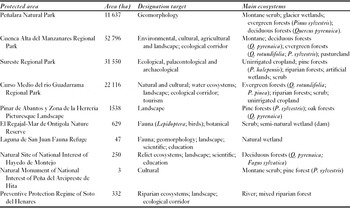
I conducted telephone interviews with residents chosen at random from the telephone directory living inside or in the vicinity of each of the 10 PAs of the Region of Madrid (see Table 1 for their main characteristics): (1) between November 2006 and July 2007, when the annual average GDP growth in Spain was high (+3.9% in 2006 and +3.8% in 2007; INE 2011), and (2) in June 2009, when the average growth of the Spanish GDP for the second term of 2009 was markedly negative (–4.2%; INE 2011).
Main characteristics of the protected areas considered in the study.

In 2006–2007, I interviewed up to 30 residents per PA (both familiar or unfamiliar with the PA) ≥ 18 years old during the evenings (from 17 to 21 h) and, in 2009, I surveyed up to 30 people familiar with each particular PA (in total 300 interviews in 2006/2007 and 401 interviews in 2009). In both cases, a brief introduction explaining the purely academic purpose of the study and identifying the institution supporting the research (IEGD-CSIC [Institute of Economics, Geography and Demography, Spanish National Research Council]) was supplied to each interviewee to reduce the strategic bias of his/her response.
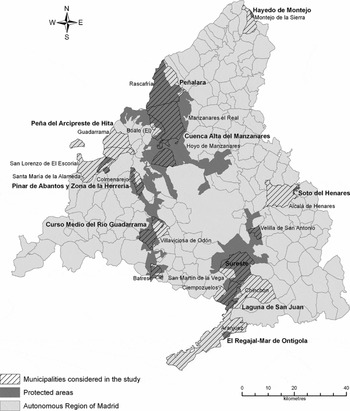
Both sets of interviews targeted residents in municipalities whose territories were included entirely or mostly within the 10 PAs of the Region, irrespective of the distance of each resident's home from the PA. In the case of PAs encompassing numerous municipalities (the three regional parks), the populations most in contact with each PA were selected. Thus, out of these municipalities, only the three of them with the highest proportion of their territory inside the PAs were selected for the surveys, and sample sizes were allocated according to their relative populations. Seventeen municipalities overlapping fully or partially with the 10 PAs of the region were selected using Arc-GIS software (Fig. 1). Sample size n was selected according to:

the formula for infinite or very numerous populations, with a confidence interval of 95.5% or 2σ, with both p (the probability of success) and q (the probability of failure) being equal to 50%, and where E is estimated error (Sierra-Bravo Reference Sierra-Bravo1991).
Protected areas of the Autonomous Region of Madrid and the municipalities considered in the study.

In the 2009 survey, seven variables associated with the 10 PAs of the Autonomous Region of Madrid were analysed. The specific questions (in quotes) for each variable in the order they were asked in the interview were:
(1) Degree of knowledge of the PA (n = 401): ‘Do you know, physically or culturally, the PA named X (full name)?’
(2) Regular activity performed in the PA (n = 300) and (if yes) which one (n = 87): ‘Do you perform any regular activity in PA X (full name)? Which kind of activity? Please specify’.
(3) Perception of the conservation state of PA and reason (n = 236): ‘What do you think the conservation state of PA X (full name) currently is: very good, good, medium, poor, or very poor? Why?’
(4) Personal importance of the PA and reason (n = 300): ‘What is the personal importance given by you to PA X (full name)? Is it: very important, important, not very important, or unimportant for you? Why?’
(5) Degree of agreement with the public financing of the PA (n = 300): ‘Do you agree with the state financing of PA X (full name)?’
(6) Willingness to pay higher taxes to conserve the PA (n = 300): ‘Would you be willing to pay higher taxes to conserve PA X (full name) for the future?’
(7) Willingness to accept the establishment of an entrance fee to the PA (n = 300): ‘Would you be willing to accept an entrance fee to PA X (full name)?’
The sample size n given for variables 2–7 indicates the number of people familiar with the PAs (n = 300) out of the total number of people surveyed (n = 401). Sample size for variable 3 was lower (n = 236) than the rest because some people could not say what the current conservation state of the PA was, either because they never visited it or because it was over three years since their last visit. Similar case exclusions of respondents were conducted by Adamowicz et al. (Reference Adamowicz, Swait, Boxall, Louviere and Williams1997). To better understand variables 3 and 4 and compare results among PAs more easily two indexes were employed: the perception index (PI), which measured to which extreme of perception (positive or negative) the majority opinion was biased (values ranged from –200 to +200), and the importance index (II) which measured the degree of personal importance given to each PA by local residents (values ranged from a minimum of 100 to a maximum of 400). These indexes can be expressed as:
PI = % (of people responding) ‘very good’ (× 2) + % ‘good’ − % ‘poor’ − % ‘very poor’ (× 2)
II = % (of people responding) ‘unimportant’ + % ‘not very important’ (× 2) + % ‘important’ (× 3) +% ‘very important’ (× 4)
For the purposes of this study, variable 4 was considered as ‘subjective’ valuation of the PA in contrast to variables 5–7, which were considered ‘objective’ valuations of the PA because they hypothetically imply some individual effort in the form of future payments for each respondent rather than merely an importance statement. Variable 4 can also be more strongly influenced by the response bias (Azqueta et al. Reference Azqueta, Alviar, Domínguez and O'Ryan2007). For 5–7, a CVM following a single-bounded model (dichotomous choice: ‘for’ versus ‘against’) was applied (Alberini et al. Reference Alberini, Kanninen and Carson1997; Carson et al. Reference Carson, Hanemann, Kopp, Krosnick, Mitchell, Presser, Rudd, Smith, Conaway and Martin1997). For those variables, no specific figures were requested or suggested. The aim of questions 5–7 was not to extract the exact quantities the residents would be willing to pay to conserve or use their nearby PAs, rather it was to explore the degree of agreement by residents with the state financing of nearby PAs and their willingness to pay for the conservation of these PAs through tax (variables 5 and 6) or by a ‘pay-per-use’ scheme (variable 7). Questions 6 and 7 were asked as independent, unrelated questions and thus neither the compatibility of both forms of payment nor the possibility of excluding one form of payment were mentioned, in order to reduce the strategic bias of the responses and the statistical noise. Nevertheless, although an exact entrance fee was not specified for variable 7 during the interviews, when asked for an estimated quantity by some of the respondents, it was explained that this entrance fee would likely be ‘small’ (c. € 1–2 per person).
Out of the seven variables, the hypothesis that the effect of the economic crisis would reduce the objective (economic) valuation of PAs by local populations was tested by comparing the results of variables 5–7 for both the 2006–2007 and 2009 surveys. The existence of differences or correlations was analysed using ANOVA, T-tests or χ2-tests (α = 0.05), using SPSS software.
RESULTS
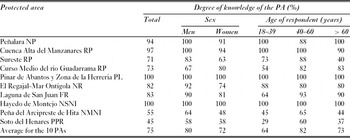
The degree of knowledge of the PAs of the Region of Madrid by residents reached 75% on average. It ranged from 100% for the two best-known PAs (Pinar de Abantos y Zona de la Herrería Picturesque Landscape and Natural Site of National Interest of Hayedo de Montejo), to 45% for the least-known PA (Preventive Protection Regime of Soto del Henares) (see Table 2).
Total percentage, per sex and age groups, of residents familiar with the protected areas (PAs). NP = Natural Park, RP = Regional Park, PL = Picturesque Landscape, NR = Nature Reserve, NSNI = Natural Site of National Interest, NMNI = Natural Monument of National Interest, PPR = Preventive Protection Regime.

There were no differences in the degree of knowledge between sexes (p = 0.479), however age groups differed; the 18–39 year old group knew their adjacent PAs significantly less well than the 40–60 year old group (p = 0.001), whereas the degree of knowledge among the > 60 year old group was intermediate between these and did not differ significantly from the other groups.
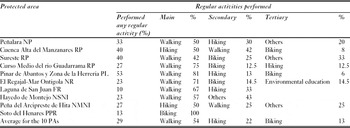
On average, 29% of residents performed regular activities in the PAs of the Region. The PA where the largest proportion of residents performed activities on a regular basis was Pinar de Abantos y Zona de la Herrería Picturesque Landscape (53% of residents). In contrast, the least regularly visited PA was Laguna de San Juan Fauna Refuge, where only 10% of residents familiar with the PA performed a regular activity. There were no differences in the percentage of regular activities performed in PAs between sexes (p = 0.64) or age groups (p = 0.18) (Table 3).
Percentage of residents familiar with the PAs who performed a regular activity in it, and main activities they performed. NP = Natural Park, RP = Regional Park, PL = Picturesque Landscape, NR = Nature Reserve, NSNI = Natural Site of National Interest, NMNI = Natural Monument of National Interest, PPR = Preventive Protection Regime.

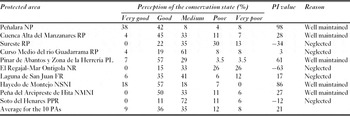
Most residents (36%) perceived the conservation state of their adjacent PA as ‘good’, and 35% considered it as ‘medium’. The best perceived PA regarding its conservation state was Peñalara Natural Park (PI +98). In this PA, residents who considered its conservation state was ‘good’ or ‘very good’ (80%) were far more abundant than those who considered it ‘poor’ or ‘very poor’ (12%). The main reason given for this positive perception was the ‘good maintenance’ of the PA and its infrastructure. In contrast, El Regajal-Mar de Ontígola Nature Reserve was considered to be the most poorly conserved (PI –63); the proportion of residents considering its conservation state to be ‘poor’ or ‘very poor’ (52%) considerably outnumbered the proportion of those who perceived it as ‘good’ or ‘very good’ (15%); the main reason for this opinion being that it was ‘neglected’ (Table 4).
Perception on the conservation state of the PA by residents and main reason of the majority perception. PI = Perception Index, NP = Natural Park, RP = Regional Park, PL = Picturesque Landscape, NR = Nature Reserve, NSNI = Natural Site of National Interest, NMNI = Natural Monument of National Interest, PPR = Preventive Protection Regime.

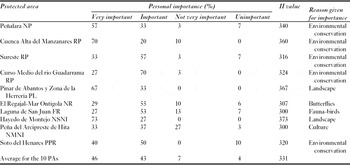
The subjective importance given to nearby PAs by residents was high (II +83) and was positively correlated with the use they made of them (p < 0.001).The residents who had a high subjective valuation of their PAs outnumbered those who had a low valuation eightfold (89.1% versus 10.9%, respectively) (Table 5).
Personal importance of the PA for residents and main reason for the majority importance. II = Importance Index, NP = Natural Park, RP = Regional Park, PL = Picturesque Landscape, NR = Nature Reserve, NSNI = Natural Site of National Interest, NMNI = Natural Monument of National Interest, PPR = Preventive Protection Regime.

The II ranged from a maximum of 373 for the Natural Site of National Interest of Hayedo de Montejo (primarily important for ‘landscape’ reasons), to a minimum of 300 shared by the Laguna de San Juan Fauna Refuge and by the Natural Monument of National Interest of Peña del Arcipreste de Hita (important for faunistic and cultural reasons, respectively).
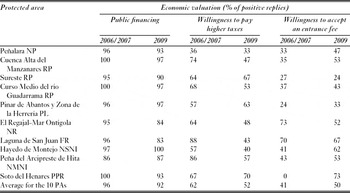
The three economic variables varied between the survey periods (Table 6). Favourable opinion towards state financing of PAs has tended to decrease between 2006–2007 and 2009 (p = 0.049), but remained nevertheless at a very high level (96% in 2006–2007 and 92% in 2009). It was independent of the use of the PAs by residents (p = 0.68). However, willingness to pay higher taxes significantly decreased between the study periods (p = 0.029), and was positively correlated with the use of the PAs by residents (p = 0.001). In contrast, willingness to accept an entrance fee to the PA significantly increased (p = 0.039) and was negatively correlated with the use of the PAs by residents (p < 0.001).
Economic valuation of the PA by residents, measured by its three constituent variables, for both 2006/2007 and 2009. NP = Natural Park, RP = Regional Park, PL = Picturesque Landscape, NR = Nature Reserve, NSNI = Natural Site of National Interest, NMNI = Natural Monument of National Interest, PPR = Preventive Protection Regime.

DISCUSSION
The degree of knowledge of PAs by residents was moderately high, considering that the people interviewed lived inside or in the vicinity of the PAs. It was also highly variable among PAs; the most visited PAs historically, along the mountain ranges of the Region, were also the PAs best known by residents (Gómez-Limón et al. Reference Gómez-Limón, Múgica, Muñoz and De Lucio1996; FIDA [Fundación para la Investigación y el Desarrollo Ambiental] 2005).
The ‘public use’ of the PAs of the Region of Madrid by residents was low. Less than one-third of the residents performed a regular activity in their neighbouring PA. The main activity was ‘walking’, practised by over half the residents who visited the PAs regularly. Other popular activities in the PAs of the Region were ‘hiking’ and ‘biking’, as is consistent with the activities most demanded by visitors to other PAs in Europe (Stolton Reference Stolton2009). The remainder of activities performed were heterogeneous and represented 11% of the total activities performed. These results are partially consistent with the results on main activities performed by visitors to different PAs in Spain (Corraliza et al. Reference Corraliza, García and Valero2002b; Gómez-Limón Reference Gómez-Limón2002) and in the Region of Madrid (Gómez-Limón et al. Reference Gómez-Limón, Múgica, Medina and De Lucio1994, Reference Gómez-Limón, Múgica, Muñoz and De Lucio1996), where sedentary activities dominate (such as ‘having lunch’, ‘resting’ and ‘swimming’), followed by ‘walking’, and where other more dynamic activities are the minority. Recreation activities are considered as the most prevalent and serious threat to European PAs (Nolte et al. Reference Nolte, Leverington, Kettner, Marr, Nielsen, Bomhard, Stolton, Stoll-Kleemann and Hockings2010) and to the PAs of the Region of Madrid (Rodríguez-Rodríguez Reference Rodríguez-Rodríguez2008). However, none of the main stated leisure activities regularly performed by residents in the PAs of the Region constituted a serious threat to the conservation of these PAs or their resources, as long as they did not imply fire lighting (Vilar et al. Reference Vilar, Woolford, Martell and Martín2010). The marked geographical and temporal bias of the influx of visitors to the PAs of the Region may temporarily overcrowd some sites (mainly picnic areas) leading to the degradation of nearby natural resources and their associated public use infrastructures (Gómez-Limón et al. Reference Gómez-Limón, Múgica, Medina and De Lucio1994, Reference Gómez-Limón, Múgica, Muñoz and De Lucio1996; Barrado Reference Barrado1999); adequate visitor control and proper installation and maintenance of public use infrastructures (such as information panels and/or litter bins) in these sites remains a management issue.
The global ‘perception of the conservation state’ of the PAs of the Region of Madrid was slightly positive. It is remarkable that residents related the conservation state of a PA mainly to its management and that they were quite critical of implemented management activities (see Corraliza et al. Reference Corraliza, Martín, Berenguer and Moreno2002a). Thus, PAs were well perceived as a result of ‘good maintenance’ (such as regular cleaning activities, vegetation clearance, fire prevention interventions or active surveillance), or poorly perceived because of ‘neglect’ (for example existence of litter or development of impacting activities). This social perception indicates recognition of management. Conversely, it ascribes the greatest responsibility for existing conservation problems in PAs to management, thus exonerating visitors from responsibility for the conservation state of the PAs. Complementary to what was stated by Hillery et al. (Reference Hillery, Nancarrow, Griffin and Syme2001), this result seems to confirm that not only visitors to PAs, but also residents who do not visit PAs are unaware of human-induced impacts on visited natural areas. Therefore, broader environmental education is needed for the general public, and especially for residents and visitors, as the last are the two key social groups regarding PA conservation globally (Borrini-Feyerabend et al. Reference Borrini-Feyerabend, Kothary and Oviedo2004; Fraser et al. Reference Fraser, Dougill, Mabee, Reed and McAlpine2006; Stolton Reference Stolton2009).
The ‘subjective importance’ given to PAs by residents was consistent with another study on the topic examining a sample of five natural parks in Spain, where the proportion of surveyed people who considered the designation of these PAs to be ‘positive’ was over four times higher than the proportion of those who considered that designation as being ‘negative’ (Corraliza et al. Reference Corraliza, Martín, Berenguer and Moreno2002a). Even though the Natural Monument of Natural Interest of Peña del Arcipreste de Hita was the least subjectively valued of all the PAs in the Region, the percentages of residents who considered this PA as ‘very important’ or ‘important’ were much higher (more than twice) than the percentages representing ‘not very important’ or ‘unimportant’. This reflects the values that predominantly urban societies place on PAs, which encompass far more than traditional direct use consumptive values (Brotherton Reference Brotherton1996; Carson et al. Reference Carson, Hanemann, Kopp, Krosnick, Mitchell, Presser, Rudd, Smith, Conaway and Martin1997; Azqueta et al. Reference Azqueta, Alviar, Domínguez and O'Ryan2007), as the PAs of the Region of Madrid provide little economic input to the region's GDP and are costly to maintain. Social values also include non-consumptive direct use values (such as those arising from the health benefits related to the contact with biodiversity; Fuller et al. Reference Fuller, Irvine, Devine-Wright, Warren and Gaston2007), option values (the possibility of directly using some of the natural values in the future; Azqueta et al. Reference Azqueta, Alviar, Domínguez and O'Ryan2007) and non-use values (such as the existence value of natural resources; Walpole et al. Reference Walpole, Goodwin and Ward2001; Azqueta et al. Reference Azqueta, Alviar, Domínguez and O'Ryan2007). There was a remarkably close relationship between the reasons given by residents to explain the importance of the PAs and the official designation targets for each PA.
The joint ‘economic valuation’ of PAs by residents is difficult to interpret. On the one hand, a huge majority of residents is in favour of the ‘public financing of PAs’. On the other hand, only half of them would be ‘willing to pay higher taxes to conserve them’ or ‘willing to accept an entrance fee’. Overall, considering the condition of the Spanish economy when the 2009 survey was conducted, both the subjective and objective valuations of the PAs of the Region by residents can be considered as high, as anticipated for post-materialistic societies (Díez Reference Díez2004). Urban populations with a high income level and an adequate knowledge and awareness of environmental issues have the highest degree of environmental compromise among the Spanish population (Díez Reference Díez2004). These social and economic characteristics could be applied to the population of the Region of Madrid.
The high economic valuation of the Region's PAs by residents in their vicinity was stable over time, did not seem to be strongly influenced by changes in economic variables, such as inflation or even income levels (Carson et al. Reference Carson, Hanemann, Kopp, Krosnick, Mitchell, Presser, Rudd, Smith, Conaway and Martin1997), and was not driven by any recent catastrophic event that locally increased social environmental concern temporarily (Anderson Reference Anderson1997; Díez Reference Díez2004). Such high objective valuation by residents, together with their limited use of the PAs, reinforces the theory that the overall valuation of PAs by dwellers in predominantly urban densely-populated regions is strongly driven by option and non-use values (Smith Reference Smith2005). However, in contrast to what has been advocated by other studies (Carson et al. Reference Carson, Hanemann, Kopp, Krosnick, Mitchell, Presser, Rudd, Smith, Conaway and Martin1997), even if the stated economic support for PAs remained high between both survey periods, the results also indicate that the changes in relevant economic variables, such as income level (notably affected by recession), did influence the contingent valuation of PAs, at least in the forms people would be willing to pay to conserve those environmental goods and services.
The initial hypothesis that the current economic crisis may have decreased the economic valuation of the PAs of the Region of Madrid could not be confirmed by the analysis of the three variables studied. However, shifts in the valuation forms between the two periods considered were oriented towards less willingness to pay higher taxes and more willingness to accept a ‘pay per use’ scheme, although regular users strongly opposed the establishment of an entrance fee. Perhaps a dual pricing policy for residents and tourists, as suggested by Walpole et al. (Reference Walpole, Goodwin and Ward2001), could lessen opposition to an entrance fee by this group of residents. Such ‘pay per use’ schemes have been implemented successfully in many PAs worldwide to reduce visitor impacts while providing income for the PAs (Walpole et al. Reference Walpole, Goodwin and Ward2001; Font et al. Reference Font, Cochrane and Tapper2004; Muñoz y Benayas Reference Muñoz and Benayas2007). Despite the depth of the economic crisis at the time of the second survey, over half the respondents were willing to pay higher taxes to conserve the regional PAs. This shows residents continued to value the PAs of the Region highly, as this implies an individual effort both for users and non-users, despite the theoretical character and lack of any exact figure for tax increases.
CONCLUSIONS
These results may help inform and adapt management decisions related to public use and environmental education in the PAs of the Region of Madrid, and provide guidance for other similar regions or countries. Although results based on perceptions are not always strongly correlated with actual environmental measures or conservation targets (Adamowicz et al. Reference Adamowicz, Swait, Boxall, Louviere and Williams1997), local populations' opinions should influence and guide management decisions in PAs (Borrini-Feyerabend et al. Reference Borrini-Feyerabend, Kothary and Oviedo2004; Fraser et al. Reference Fraser, Dougill, Mabee, Reed and McAlpine2006).
Predominantly urban populations in densely-populated industrialized regions seem to hold generally favourable attitudes towards nature conservation policies (Brotherton Reference Brotherton1996) and PAs managers in those regions could (and should) seek potential allies for the conservation of PAs amongst local populations. However, more effort should be expended on better informing, communicating with and involving local populations in conservation policies and practices, not only in the Region of Madrid, but also elsewhere, be it by environmental education, improved interpretation facilities or by direct participation in conservation and management activities (Fraser et al. Reference Fraser, Dougill, Mabee, Reed and McAlpine2006).
Even at the peak of the economic crisis, half of the residents in the PAs of the Region of Madrid were in favour of the establishment of an entrance fee; managers should consider exploring this further as a means of limiting serious impacts by visitors to some PAs of the Region (Rodríguez-Rodríguez Reference Rodríguez-Rodríguez2008). ‘Pay per use’ schemes represent an interesting management option for PAs in densely-populated or heavily-visited areas, but should consider adequate equity prior to their implementation.
Future developments in the valuation of the PAs of the Autonomous Region of Madrid should specify, for the three assessed economic variables, the amount of money to be paid hypothetically by the respondents (in absolute figures or price intervals), in order to obtain a more meaningful economic valuation of the PAs of the region. Future studies should also include some additional variables to specifically address the values assigned to biodiversity by society, as well as other socioeconomic-related variables (such as income level) that may influence people's responses (Azqueta et al. Reference Azqueta, Alviar, Domínguez and O'Ryan2007), although obtaining that sort of information is often delicate. Finally, the inclusion of ‘non-residents’ in a future regional survey would provide an additional comparison between the responses given by these two target groups, whose opinions on PAs often differ and have different management implications (Corraliza et al. Reference Corraliza, García and Valero2002b).
ACKNOWLEDGEMENTS
I would like to thank Doctors Javier Martínez Vega, from the Spanish National Research Council, and María del Mar Otero, from the IUCN Centre for Mediterranean Cooperation (IUCN-Med) for their useful comments on the early drafts of this manuscript. Additionally, I would like to acknowledge Andrea Marshall from the IUCN-Med for proofreading an earlier draft of this article.