Introduction
Anorexia nervosa (AN) is a multifactorial disorder whose risk seems to be determined by both genetic and environmental factors. Although there is some evidence of a possible role of prenatal risk factors in the pathogenesis of this disorder (Cnattingius et al. Reference Cnattingius, Hultman, Dahl and Sparen1999; Connan et al. Reference Connan, Campbell, Katzman, Lightman and Treasure2003; Favaro et al. Reference Favaro, Tenconi and Santonastaso2006, Reference Favaro, Tenconi and Santonastaso2010; Strober et al. Reference Strober, Freeman, Lampert and Diamond2007), no studies to date have explored the role of in utero infections. The findings of a season-of-birth bias (Winje et al. Reference Winje, Willoughby and Lask2008) suggest that the exploration of this hypothesis is worthwhile.
To date, in psychiatry, the hypothesis of a pathogenetic role of prenatal infections has been explored almost exclusively for schizophrenia (Mittal et al. Reference Mittal, Ellman and Cannon2008; Brown & Derkits, Reference Brown and Derkits2010). The findings of the first studies based on ecological measures of viral exposures (Mednick et al. Reference Mednick, Machon, Huttunen and Bonett1988; Barr et al. Reference Barr, Mednick and Munk-Jorgensen1990; Suvisaari et al. Reference Suvisaari, Haukka, Tanskanen, Hovi and Lonnqvist1999) have been confirmed more recently by studies relying on serologically documented maternal exposure to influenza, rubella, toxoplasmosis and other infections (Brown et al. Reference Brown, Begg, Gravenstein, Schaefer, Wyatt, Bresnahan, Babulas and Susser2004; Brown, Reference Brown2006; Brown & Derkits, Reference Brown and Derkits2010).
The pathogenic mechanisms of prenatal viral exposure remain unclear (Fatemi & Folsom, Reference Fatemi and Folsom2009). Some infectious agents, such as rubella or toxoplasma, can cross the placenta and can have a direct effect on fetal neurodevelopment (Fatemi & Folsom, Reference Fatemi and Folsom2009). However, the pathogenic effect of other agents, such as influenza, that only rarely cross the placenta, must be explained in other ways. The hypotheses involve the maternal immunological response (immunoglobulins or cytokines) that may interfere with brain development (Deverman & Patterson, Reference Deverman and Patterson2009) and the teratogenic effects of hyperthermia or influenza remedies (Brown & Derkits, Reference Brown and Derkits2010). Prenatal virus infection can change the expression of some genes in the brain, both directly (Fatemi & Folsom, Reference Fatemi and Folsom2009) and by an increase in maternal glucocorticoids (Silverman et al. Reference Silverman, Pearce, Biron and Miller2005). These epigenetic effects may have important consequences on neurodevelopment (Andersen, Reference Andersen2003; Lupien et al. Reference Lupien, McEwen, Gunnar and Heim2009) and on the prenatal programming of the hypothalamic–pituitary–adrenal axis (Lupien et al. Reference Lupien, McEwen, Gunnar and Heim2009).
The aim of the present study was to explore the role of exposure to four viral infections (rubella, chickenpox, influenza, measles) in increasing the risk for AN in a cohort of 27 682 female subjects born and resident in a definite geographical area. We hypothesized a possible role of viral exposures in the months of pregnancy most crucial for neurodevelopment (third to sixth months of pregnancy).
Method
Study population
All subjects included in the study (n=27 682) were female, born in the Veneto Region between 1 January 1970 and 31 December 1984, and were residing in the urban and suburban areas of Padua (424 km2).
The sample of AN subjects was composed of all known cases of AN after consultation of three registers: the Register of the Eating Disorders Unit of the area, the Public Mental Health Database, and the Register of Hospital Admissions. The Register of the Eating Disorders Unit collects data from the only public Eating Disorders Unit in the city and surrounding area. Patients with any type of eating disorder are included in the register when they are referred to the out-patient unit, when they request a private consultation from therapists of the unit, and when they receive a psychiatric consultation after an admission in Padua Hospital. In this register we found 1972 female subjects with a lifetime eating disorder born between 1970 and 1984. Of this sample, 730 subjects belong to the cohort of the study (397 subjects with a lifetime diagnosis of AN and 330 with bulimia nervosa or other atypical eating disorders without a lifetime diagnosis of AN). After consultation of the Public Mental Health database and the Register of the Hospital Admissions we retrieved five unknown cases with a diagnosis of AN who belong to the cohort. All five subjects had been admitted in a private hospital and were included in the sample after examination of their clinical records. The final sample consisted of 402 AN subjects. Lifetime AN was defined according to Diagnostic and Statistical Manual of Mental Disorders, fourth edition (DSM-IV) criteria, waiving the single criterion of amenorrhea for 3 consecutive months, since in some cases hormone replacement therapy made it difficult to assess the presence of the criterion. The mean age of onset of AN was 18.0 (s.d.=3.8) years and the mean lifetime lowest body mass index was 15.6 (s.d.=1.5, range 8.5–17.5) kg/m2.
The control sample consisted of all the female subjects of the same birth cohort without any type of eating disorder diagnosis (n=26 950).
Representativeness of the sample
The 95% confidence intervals (CIs) of the estimated prevalence of AN in the present study (1.45%, 95% CI 1.3–1.6) are above or partially overlap with the CIs of the estimated lifetime prevalence in the female population in Western countries (Hudson et al. Reference Hudson, Hiripi, Pope and Kessler2007; Keski-Rahkonen et al. Reference Keski-Rahkonen, Hoek, Susser, Linna, Sihvola, Raevuori, Bulik, Kaprio and Rissanen2008; Preti et al. Reference Preti, de Girolamo, Vilagut, Alonso, Graaf, Bruffaerts, Demyttenaere, Pinto-Meza, Haro and Morosini2009; Treasure et al. Reference Treasure, Claudino and Zucker2010). They also are within the CIs of the lifetime prevalence estimated in our previous prevalence study (Favaro et al. Reference Favaro, Ferrara and Santonastaso2003) performed on a representative sample of 934 female subjects born between 1971 and 1979 inclusive using a structured clinical interview with all subjects.
Assessment of AN subjects
All AN subjects recruited in the clinical setting were interviewed face to face (99% of the total sample). Clinical interviews were performed using the eating disorders section of the Structured Clinical Interview for DSM-IV for present and lifetime diagnosis. Age at onset was defined as the first occurrence of an eating disorder diagnosis (Favaro et al. Reference Favaro, Caregaro, Tenconi, Bosello and Santonastaso2009). Social class was determined using an Italian adaptation of Havighurst's formula (Favaro et al. Reference Favaro, Ferrara and Santonastaso2003, Reference Favaro, Tenconi and Santonastaso2006, Reference Favaro, Caregaro, Tenconi, Bosello and Santonastaso2009). This formula calculates social class using paternal and maternal professional status and degree of education. The formula results in a score that ranges from 1 (very high) to 6 (very low social class). We considered as high and medium-high social class subjects who scored 3 or less. All interviewed subjects gave informed written consent for the use of data in an anonymous form. The study has been approved by the Institutional Review Board.
Meteorological and demographical data, and viral exposures
The Italian Statistical Annals of Demographics, Public Health and Meteorology were consulted to collect the required data. The Demographical Annals were consulted to obtain the population density of the different areas around Padua included in the study. We defined ‘urban’ as the area of the city with a population density greater than 2000 inhabitants per km2 and ‘suburban’ as all the areas of the province with a population density greater than 200 inhabitants per km2, but lower than 2000.
The number of monthly cases of influenza, rubella, measles, and chickenpox (retrieved from the Italian Public Health Statistical Annals) were divided for the total living population in that year to obtain an incidence rate. Incidence rates in the considered period were divided into quartiles and the risk of those subjects exposed to the peak incidence (highest quartile) was compared with the risk of subjects exposed to the lowest quartile. The peak quartiles were: measles (⩾158 cases per 1 000 000 population), chickenpox (⩾94 cases); influenza (⩾29 cases) and rubella (⩾44 cases). In Italy, all cases affected by these diseases must be reported to the Ministry of Health. Data about rubella were available from 1970. For this reason, data about rubella exposure for subjects born in the first 6 months of 1970 were not available.
In the Italian Annals of Meteorology we found data regarding monthly average minimum and maximum temperature (degrees Celsius) per month and per year. Meteorological data were surveyed at the Meteorological Station of Venice airport, which is 30 km from Padua.
Statistical analysis
Analysis of seasonality was performed using the Edwards test (Edwards, Reference Edwards1961), which is designed to detect seasonal cyclic trends. Crude odds ratios (ORs), with 95% CIs and Mantel–Haenszel statistics, were used as measures of the relative risk of developing AN. Logistic regression analyses were used to derive a multivariate model of the risk of developing AN using viral exposure as independent variables and taking into account potential confounder variables (socio-economic status, population density and month of birth). These procedures were implemented using SPSS software (SPSS Inc., USA).
Results
Seasonality and meteorological factors
When analysing the month of birth of AN subjects, the Edwards seasonality test was not significant [χ2=3.98, degrees of freedom (df)=2, p>0.1], even after adjusting for season of birth in the control sample (χ2=2.17, df=2, p>0.1). The analysis remained non-significant (n.s.) after dividing the sample according to diagnostic subtype. Using a logistic regression analysis and comparing the risk of those born in the single months of the year with the risk of those born in the month with the lowest number of AN cases (March), we found that being born in June conferred a significantly higher risk (OR 2.2, 95% CI 1.3–3.6, p=0.002). The OR continued to be significant after including urbanization in the analysis as a confounder variable (OR=2.2, 95% CI 1.3–3.6, p=0.002). The average minimum temperature at the first and at the last month of pregnancy in AN subjects was similar to those of controls (mean±s.d.) (first month: 9.4±6.3 v. 9.1±6.5°C, t=0.97, n.s.; month of birth: 9.7±6.6 v. 9.4±6.5°C,t=0.86, n.s.).
Viral exposure
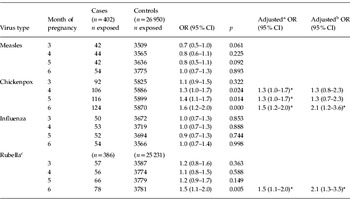
Table 1 shows the ORs for AN according to the exposure to peaks of viral infections in specific months of pregnancy. Exposure during the fourth to sixth months of pregnancy to the peaks of chickenpox and during the sixth month to the peaks of rubella infections was significantly associated with an increased risk of developing AN. The risk for exposure during the sixth month of pregnancy was increased even after controlling for the effects of socio-economic status, urbanization and month of birth (Table 1). In the period considered, the peaks of rubella and chickenpox had a partial overlap as regards months (rubella between February and June; chickenpox between December and May) and years (rubella: years 1973, 1977–1979, 1982–1984; chickenpox: years 1974, 1976–1984). Analyses performed using viral incidence as a continuous variable resulted in a similar level of significance.
Risk of anorexia nervosa in subjects exposed to the peaks of viral infections

OR, Odds ratio; CI, confidence interval.
a Adjusted for socio-economic status and urbanization.
b Adjusted for socio-economic status, urbanization and month of birth.
c Data available for subjects born between July 1970 and December 1984.
* p<0.05.
Subjects exposed during the sixth month of pregnancy at peaks of rubella and chickenpox were compared with non-exposed subjects in relation to age at onset, highest and lowest body mass index, and diagnostic subtype (lifetime restricter subtype versus lifetime presence of recurrent binge eating or purging behaviours). Exposure to the peak of chickenpox was associated with a lower age of onset of AN (17.0±3.3 v. 18.5±3.9 years, t=3.64, p<0.001), whereas no differences emerged for subjects exposed to the peak of rubella (17.4±3.8 v. 18.1±3.7 years,t=1.42, p=0.16). No differences emerged for highest and lowest body mass index, and for diagnostic subtype.
Discussion
This study is the first to explore the possibility that viral exposure during pregnancy could be among the risk factors for the development of AN. We found that exposures to peaks of rubella and chickenpox during the sixth month of pregnancy significantly increased the risk of developing AN. We only used an indirect ecological measure of exposure, so we cannot establish if the risk is due to one of the viruses, to both, or to another environmental factor – including other viruses – whose exposure is similar to that of rubella/chickenpox.
Both rubella and chickenpox viruses are known to cross the placenta and to produce severe fetal syndromes when an infection occurs in the first months of pregnancy (Grose, Reference Grose1999; Brown et al. Reference Brown, Cohen, Greenwald and Susser2000). Although an infection in the later months of pregnancy is less dangerous in terms of severe malformations and survival, the whole range of its effects on the fetal brain is largely unknown. Furthermore, during maternal infections, the fetus is exposed to higher levels of cytokines and corticosteroids that may have important effects on neurodevelopment trajectories (Deverman & Patterson, Reference Deverman and Patterson2009). The susceptibility of pregnant women is also an important factor to be considered. Chickenpox is a very contagious illness, but most women of childbearing age were probably infected during childhood (estimation is 90–95%). Reinfections, although possible, are quite rare. Rubella is less contagious and susceptibility in young women is estimated to be greater than 5% in Italy (Revello et al. Reference Revello, Gorini, Zavattoni, Furione and Gerna2004). However, it was probably higher before the vaccination campaign started. In Italy, rubella vaccination has been recommended since 1972 for pre-adolescent girls (Revello et al. Reference Revello, Gorini, Zavattoni, Furione and Gerna2004), so most women in our sample were not vaccinated.
Our study seemed to show that the window of risk for developing AN is at the end of the second trimester of pregnancy. This is different from what has been found in schizophrenia (Brown & Derkits, Reference Brown and Derkits2010), for which the months implicated are earlier in pregnancy. There is evidence that infection-associated events in early fetal life have a stronger neurodevelopmental impact compared with late pregnancy infections (Andersen, Reference Andersen2003; Meyer et al. Reference Meyer, Yee and Feldon2007). This would be consistent with the characteristics of AN patients who, unlike individuals with schizophrenia, usually have normal intelligence quotient levels and high school achievement (Blanz et al. Reference Blanz, Detzner, Lay, Rose and Schmidt1997). Later exposures, however, could have more subtle effects on neurodevelopment and could interfere with the development of neurocircuits implicated in the pathogenesis of AN (Kaye et al. Reference Kaye, Fudge and Paulus2009) as well as with the programming of the stress response systems (Favaro et al. Reference Favaro, Tenconi and Santonastaso2008, Reference Favaro, Tenconi and Santonastaso2010).
In our sample, we found weak evidence of a season-of-birth bias in the risk of developing AN. The present study is the first to use a large sample born during a definite period of time in a specific geographical region. Years of birth were almost never specified in previous studies that have examined the presence of a season-of-birth bias in AN (Winje et al. Reference Winje, Willoughby and Lask2008), so even in large studies (Eagles et al. Reference Eagles, Andrew, Johnston, Easton and Millar2001; Watkins et al. Reference Watkins, Willoughby, Waller, Serpel and Lask2002; Crisp et al. Reference Crisp, Gowers, Joughin, McChellan, Rooney, Nielsen, Bowyer, Halek, Hartman, Tattersall, Hugo, Robinson, Atkinson and Clifton2006; Button & Aldridge, Reference Button and Aldridge2007) no estimation is possible about the representativeness of the samples. As reviewed by Winje et al. (Reference Winje, Willoughby and Lask2008), studies about season of birth in AN, although using different methods and definitions, tend to find an excess of birth in spring. This is in contradiction with our findings, since in our sample March is the month with the lowest rate of AN births. The observed excess of birth in June in our sample did not seem to be completely mediated by exposure to rubella or chickenpox during the sixth month of pregnancy, since the OR was still significant after including virus incidence in the model. In addition, we found no evidence of any link between temperature at birth or at conception and the risk of developing AN (Waller et al. Reference Waller, Meyer and van Hanswijick2001).
Finally, we found evidence that exposure to rubella and/or chickenpox during the sixth month of pregnancy is associated with a lower age at onset of AN. In a recent report, we found that age at onset is decreasing in younger generations, showing a negative correlation with year of birth (Favaro et al. Reference Favaro, Caregaro, Tenconi, Bosello and Santonastaso2009). Since exposure to chickenpox infections increased during the years considered in the present study (see Supplementary material, available online), this relationship could be due to the overlapping of these two phenomena. However, since a lower age at onset has been associated to a higher number of perinatal complications in a previous study (Favaro et al. Reference Favaro, Tenconi and Santonastaso2006), another possible hypothesis is a link between viral exposure and perinatal complications. It is noteworthy that although viral infection is a known risk factor for several types of pregnancy, delivery and neonatal complications (Goldenberg & Thompson, Reference Goldenberg and Thompson2003; Conde-Agudelo et al. Reference Conde-Agudelo, Villar and Lindheimer2008; Zaki Mel, Reference Zaki Mel2008), no study to date has explored the interaction between these two types of early environmental risk factors. Viral infections might increase the risk of developing a psychiatric illness by increasing the risk of pregnancy and obstetric complications (Wright et al. Reference Wright, Takei, Rifkin and Murray1995; Venables et al. Reference Venables, Liu, Raine and Mednick2007). Since perinatal complications seem to be a risk factor for eating disorders (Cnattingius et al. Reference Cnattingius, Hultman, Dahl and Sparen1999; Favaro et al. Reference Favaro, Tenconi and Santonastaso2006), this hypothesis should also be tested in AN patients.
The main limitation of the present study is the use of indirect ecological measures of viral exposure. Before considering viral infection during pregnancy as a possible risk factor for developing AN, it is necessary to confirm our data with serologically demonstrated maternal infections. In the years considered by the present study, there was only one great peak of influenza (January 1970). This could lead to an underestimation of the effects of this type of viral infection. We used a multiple recruitment strategy (clinical cases and case registers for AN subjects and case register for controls) to ensure a good representativeness of the sample. This could be considered as both a strength and a limitation of the study, because five AN subjects and all controls were not directly interviewed. The recruitment of the AN sample was mainly performed in a clinical setting and their representativeness might be put in doubt. However, our Eating Disorders Unit is the only specialized unit in the city and surrounding area. The estimated prevalence of AN in the Padua area is within the 95% CIs of the lifetime prevalence rate of our previous study (Favaro et al. Reference Favaro, Ferrara and Santonastaso2003). For this reason, we believe that our sample of AN subjects could be considered as fairly representative of AN cases in the population. We found relatively low incidences of viral diseases in the population as reported by the Italian Statistical Annals of Public Health. For a number of reasons, it is possible that these reports are somewhat underestimated. However, we used these reports to identify the months when the peak of infections occurred, and only as a secondary analysis we explored the effect of incidence as a continuous variable.
In conclusion, in utero exposure to viral infection could be a risk factor for developing AN. We need further epidemiological and serological studies to confirm this hypothesis. It is the role of future research to understand the complex relationship between viral infection, maternal nutritional factors and exposure to stress, since both nutrition and stress can influence infection susceptibility. Furthermore, the role of specific obstetric complications as mediating factors between viral infection and subsequent risk for a psychiatric disorder need to be explored. As for schizophrenia (Brown & Derkits, Reference Brown and Derkits2010), the progressive acknowledgement of the role of prenatal factors in the pathogenesis of psychiatric disorders demonstrates the importance of public health and social interventions to improve the health status of pregnant women and those of childbearing age.
Note
Supplementary material accompanies this paper on the Journal's website (http://journals.cambridge.org/psm).
Acknowledgements
The study was performed with financial help from the University of Padua. We acknowledge the help of Giorgio Rossetto for his technical support in handling the population data.
Declaration of Interest
None.