INTRODUCTION
The burden of cancer is increasing worldwide. An estimated 5 million people every year are diagnosed with cancer, and it is projected that this number will rise to 15 million new cases by 2020 (Bray, Reference Bray, Jemal and Grey2012). The prevalence of cancer in the Kingdom of Saudi Arabia is somewhat higher among women (52%) than men (48%). The most common type of cancer among Saudis is breast cancer, followed by colorectal cancer and non-Hodgkin lymphoma (Saudi Cancer Registry, 2014). Epidemiological reports and previous studies have shown that the general population of Saudi Arabia has become more aware of the increased incidence of cancer, particularly colorectal and breast cancer (Aljebreen, Reference Aljebreen2007; Amin et al., Reference Amin, Suleman and Al Taissan2012; Al Diab et al., Reference Al Diab, Qureshi and Khaled2013).
Regardless of the numbers, statistics, and percentages, a diagnosis of cancer has a major impact on a patient's life. The term “quality of life” (QoL) refers to a multidimensional concept that has been developed and is commonly used as a measure of the patient's physical, psychological, social, and spiritual dimensions or domains. The assessment of patient quality of life (QoL) could provide deeper understanding of how this disease influences their lives (Jansen et al., Reference Jansen, Herrmann and Stegmaier2011). It would also provide additional information that could be employed in designing treatment strategies, particularly in the palliative care of cancer patients (Chambers et al., Reference Chambers, Meng and Youl2012).
According to the World Health Organization (2013), palliative care is defined as an approach that improves the quality of life of patients and their families while facing the problems associated with a life-threatening illness through prevention and relief of suffering by means of early identification and impeccable assessment and treatment of pain and other problems—physical, psychosocial, and spiritual. Satisfaction with palliative care indicates that the benefits of cancer center improved the quality of life of patients with advanced terminal disease through control of physical symptoms and that the care was focused on their needs (Asadi-Lari et al., Reference Asadi-Lari, Tamburini and Gray2004).
Cancer has a major impact on patients' lives and can lead to difficulties in playing assigned individual roles and fulfilling responsibilities. Recent evidence has shown that assessment of patients' quality of life improves communication between the patient and healthcare providers and offers nurses a more holistic view of the patient (Varricchio & Ferrans, Reference Varricchio and Ferrans2010). Nurses working in palliative care settings have a positive impact on the quality of life of their patients, but they have no systematic standards for assessing these outcomes (Jocham et al., Reference Jocham, Dassen and Widdershoven2006; Davidson & Mills, Reference Davidson and Mills2005). Fukui et al. (Reference Fukui, Ogawa and Yamagish2010) reported that patient acceptance of a prescribed treatment has a strong relationship with their satisfaction with the care they received. Ezat and colleagues (Reference Ezat, Fuad and Hayati2014) determined that patient satisfaction was strongly associated with good quality of life among cancer patients from a standpoint of general satisfaction. They found that feeling at peace and having a sense of meaning in life were more important to patients than being active or achieving good physical comfort. Research from Miyashita et al. (Reference Miyashita, Misawa and Abe2008) and Wong et al. (Reference Wong and Feilding2008) has shown that patient satisfaction with their treatment can provide a beneficial effect for their mental and physical health status.
Systematic quality of life assessment in palliative care settings will help establish excellent clinical service. Palliative care is aimed at controlling physical symptoms and the psychosocial aspects of a patient's illness, as well as achieving good quality of life for patients (World Health Organization, 2013). Palliative care is in fact the achievement of the best quality of life for patients (Jocham et al., Reference Jocham, Dassen and Widdershoven2006). Accordingly, the outcomes of care should be measured in terms of the extent to which this goal is achieved. In providing care for terminally ill cancer patients, nurses help patients to cope with the side effects of therapy and to adjust to changes in body image, function, and appearance as well as to a life with a chronic disease. This holistic approach to providing nursing care can assist the patient in maintaining or improving their life, and as a result, the quality of their life. The nurse may help the patient to make necessary changes to adjust to a life with cancer and to find a new perspective on living with the illness.
Regardless of the considerable significant development and progress of palliative care in many countries, there are still significant gaps to be addressed. The implementation of a comprehensive palliative care programs is recommended for all countries with the purpose of improving the quality of life of the majority of cancer patients and their families (Sepulveda et al., Reference Sepulveda, Marlin and Yoshida2002). The present researchers share this interest to generate substantive inquiry into this concept. Furthermore, there is a scarcity of information about the quality of life of cancer patients in Saudi Arabia, particularly those in palliative care. Our study aimed to determine the relationship between quality of life and satisfaction with care among cancer patients in palliative care in Saudi Arabia.
MATERIALS AND METHODS
A total of 130 cancer patients were invited to participate in a cross-sectional study. Patients were recruited from a large tertiary hospital within the Ministry of Health in Saudi Arabia. The hospital was selected because it has oncology specialties and provides easy access to respondents. Ethical approval was obtained from the institutional review board (IRB) of the Ministry of Health. Only Saudi cancer patients with a confirmed diagnosis were included in the study. Patients who were below 17 years of age and those unwilling to participate were excluded from our study.
After IRB approval, the researchers distributed questionnaires to eligible participants. Informed consent was obtained prior to distribution of questionnaires. The objectives of the study, procedures, anonymity, and confidentiality were assured and explained to participants. The researchers also checked all relevant medical records to confirm patients' diagnoses. Microsoft Excel was utilized for data coding. To ensure confidentiality of all results, questionnaires were coded and tallied in Excel. The data were double-entered and crosschecked for missing data.
Instrumentation
There were three research tools employed in our study. One tool measured the demographic profiles of respondents (e.g., age, gender, and type of cancer). The other two measured patient quality of life and satisfaction with care.
Quality of Life
We utilized the standardized European Organization for Research and Treatment of Cancer–Palliative Care (EORTC QLQ–C15–PAL) questionnaire, which was developed to assess the quality of life of palliative cancer care patients (Groenvold, Reference Groenvold, Petersen and Aaronson2006). The QLQ–C15–PAL is an abbreviated 15-item version of the EORTC QLQ–C30, and was developed specifically for use in palliative care. QLQ–C15–PAL scores are directly comparable with scores derived from the parent instrument (the QLQ–C30). It includes those elements of the QLQ–C30 identified as most relevant and important for palliative care, that is, physical and emotional function, pain, fatigue, nausea/vomiting, appetite, dyspnea, constipation, sleeping difficulties, and overall QoL. The QLQ–C15–PAL has good content validity as a “core palliative care questionnaire” that assesses the symptoms and problems for which patients are frequently treated. The validated Arabic translation version was employed for data gathering. Official permission was obtained to use this tool. It incorporates four abbreviated scales measuring physical function, emotional function, nausea and vomiting, and fatigue.
Patient Care Satisfaction
The EORTC IN-PATSAT32 is a 32-item questionnaire that measures patients' appraisal of hospital doctors and nurses, as well as aspects of care organization and services. It addresses technical competence, information provision, interpersonal skills, availability, waiting time, access, comfort, and overall perception of care. The IN-PATSAT32 is a stand-alone questionnaire enabling assessment of the contribution of patient satisfaction with oncology-relevant aspects of care by comparison with treatment, psychosocial intervention, or healthcare services across countries from various sociocultural backgrounds. The researchers utilized this validated Arabic questionnaire and followed the supplemented scoring manual. The questionnaire can also serve to highlight aspects of care that need improvement in an oncology setting. Multi-trait scaling analysis revealed excellent internal consistency and convergent validity, although some scales within the IN-PATSAT32 were relatively highly correlated. Test–retest data on 130 patients showed high reliability for most scales. The scales of the IN-PATSAT32 were able to discriminate clearly between patients with differing care expectations and differing intentions (Brédart et al., Reference Brédart, Bottomley and Blazeby2005).
Statistical Analysis
Background profiles were expressed as proportions of the categorical variables, and means, standard deviations, and interquartiles for continuous variables. The strength of association between physical function, emotional function, and global health status with general satisfaction was analyzed using the Pearson correlation coefficient. Multiple linear regression analysis was utilized in evaluating the relative importance of physical function, emotional function, and global health status in predicting general overall satisfaction.
Three separate models were analyzed. In the first, physical function was entered. In the second, physical and emotional function were entered simultaneously. In the third, physical and emotional function and global health status were entered simultaneously. Significant findings were determined when the two-tailed p value was ≤0.05. The data were processed and analyzed using IBM SPSS software (v. 22).
RESULTS
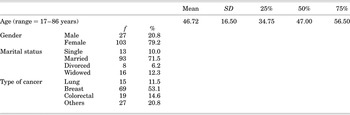
Some 130 patients diagnosed with various cancers participated in our study. Participants were mostly female (103/130, 79%) and married (93/130, 71%), and more than half had breast cancer (69/130, 53%). They were between 17 and 86 years of age (mean = 46.7, SD = 16.50) (Table 1).
Background profile (N = 130)

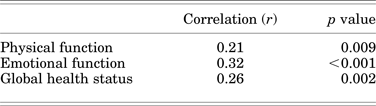
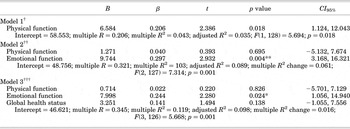
The correlation test showed that physical function had a weak relationship while emotional function and global health status had moderate relationships with general satisfaction (r = 0.21, p < 0.01; r = 0.32, p < 0.001; r = 0.26, p < 0.01; respectively) (Table 2). In the first model of the multiple linear regression analysis, physical function alone significantly predicted general satisfaction (p < 0.05). In the second model, emotional function significantly predicted general satisfaction (p < 0.01), while physical function did not. In the third model, emotional function predicted general satisfaction (p < 0.05) while physical function and global health status did not (Table 3). These results suggest that emotional function is the most important factor in predicting satisfaction among cancer patients. An increase in emotional function leads to increased general satisfaction.
Pearson correlations among physical function, emotional function, global health status scales and general satisfaction (N = 130)

Multiple linear regression analysis of physical function, emotional function, and global health status as predictor variables and general satisfaction as dependent variable

*Significant at p < 0.05; **significant at p < 0.01; †physical function; ††physical function and emotional function; †††physical function, emotional function and global health status.
DISCUSSION
This aim of our study was to determine the quality of life among palliative cancer patients in Saudi Arabia and its relationship to satisfaction with care. Quality of life is an important outcome measure among cancer patients who require palliative care. Various studies have revealed that cancer influences not only patients' health but also their QoL (Bottomley, Reference Bottomley2002; Braun et al., Reference Braun, Gupta and Grutsch2011). Assessment of patient QoL is a necessary component of deciding on a course of treatment, and it requires healthcare professionals to closely monitor their patients (Braun et al., Reference Braun, Gupta and Grutsch2011). To the best of our knowledge, little is known about QoL among cancer patients in palliative care in Saudi Arabia, despite the prevalence of the disease. Our study may provide insights into adequate assessment of QoL among cancer patients in palliative care. This would also enhance the understanding of healthcare professionals about the pragmatic concepts of palliative care, which is essential for attainment of health goals for cancer patients.
Our study posits a significant association between all the studied variables (physical function, emotional function, and global health status) and patient satisfaction. The association of physical function was weak, which may be attributable to the large number of subjects with breast cancer and colorectal cancer, where aggressive treatment affected patients' function. The majority of our respondents were part of a younger population group (mean age = 46.72, SD = 16.50). This is similar to studies performed in Germany and the United States (Engel et al., Reference Engel, Kerr and Schlesinger-Raab2003; Braun et al., Reference Braun, Gupta and Grutsch2011). Nevertheless, our results are limited because of its small sample size and due to the fact that it is not an international study. However, it is worth noting that the prevalence of cancer in Saudi Arabia is highest among the younger population.
The findings of our study indicate the effect of emotional function on the well-being of palliative cancer patients. These results are congruent with previous studies from the United States and Iran (Koloroutis, Reference Koloroutis2004; Torres-Vigil et al., Reference Torres-Vigil, Aday and De Lima2007; Safaee et al., Reference Safaee, Moghimi-Dehkordi and Zeighami2008). This may be due to the fact that participants experienced uncertainty about treatment outcomes, which could result in psychological distress. This is in accordance with another study conducted in Sweden in women who were recently diagnosed with breast cancer and were about to undergo major surgery (Elder et al., Reference Elder, Brandberg and Björklund2005). In another study, a substantial number of breast cancer patients who had completed 25% of their treatment demonstrated a decline in emotional well-being (Janz et al., Reference Janz, Friese and Li2014). When facing such a life-threatening disease as cancer, most individuals need strong emotional support to improve their self-esteem or reduce feelings of uncertainty, and, of course, emotional support plays a vital role in patient QoL. Several studies have shown that emotional support contributes to improved patient well-being (Yoo et al., Reference Yoo, Namkoong and Choi2014; Arora et al., Reference Arora, Finney Rutten and Gustafson2007; Kroenke et al., Reference Kroenke, Kubzansky and Schernhammer2006). In Saudi Arabia, patients obtain strong social and emotional support from family and friends, which helps to alleviate suffering during periods of illness
Cancer patients experience considerable psychological distress associated with the disease and its treatment. Psychosocial management of adjustment problems experienced by patients with cancer is an obvious requirement for more effective treatment of the disease. Shakeri et al. (Reference Shakeri, Kamangar and Ebrahimi2015) found that the quality of life of cancer patients is positively correlated with an avoidant coping style. Nurses have the essential duty of delivering care and nurturing good relationships, so that patients feel supported by and connected to nurses (Chang et al., Reference Chang, Lin and Chang2005).
The quality of care is widely thought to affect the quality of life of palliative cancer patients. A dissatisfied patient is considered psychologically or socially not well, and thus the goal of nursing has not been attained. Satisfaction is the psychological state that results from confirmation or disconfirmation of expectations (Dufrene, Reference Dufrene2000). Enhancement of the quality of healthcare from a patient's perspective may increase their satisfaction, thus improving their quality of life. Effective and supportive communication can assist the patient and his or her family in navigating a successful transition to palliative care (Detmar et al., Reference Detmar, Muller and Schornagel2002). Furthermore, Baile (Reference Baile2006) found that there is a great need for truthful informed consent and that the patient's right to healthcare information and compassionate care are essential.
The results of our study show that it is essential for all members of the healthcare team to be cognizant of the necessary health services and care provision for cancer patients in order to promote patient satisfaction. Palliative care teams should be involved much earlier on in the course of an illness to deliver collaborative care together with the healthcare team. Zimmermann et al. (Reference Zimmermann, Swami and Krzyzanowska2014) demonstrated the benefits of cancer centers providing early specialized palliative care in outpatient clinics, where patients reported improved satisfaction with care when having a team of professionals available to provide additional support in navigating the cancer system and for coping with multiple medical and social issues. Chand and colleagues (Reference Chand, Gabriel and Wallace2013) found that patients should be treated with dignity and respect by the hospital healthcare team, as identified by patients' positive experience of care during palliative consultations. Furthermore, Wentlandt et al. (Reference Wentlandt, Seccareccia and Kevork2016) identified the key elements of quality care and patient satisfaction that can act as a guide for those planning to develop palliative care units. These elements were grouped into six domains: (1) an interprofessional team: a team of experts from multiple disciplines that function as a unit; (2) communication: developing rapport, addressing expectations, providing information, listening actively, and facilitating end-of-life discussions; (3) attentive personalized care: anticipatory and responsive compassionate care with tailored management of physical and nonphysical symptoms; (4) family-centered focus: support of patients and caregivers within the family; (5) accessibility and consistency: appropriate resources and adequate staff to provide consistent care; and (6) a supportive setting: a bright noninstitutionalized setting that hallows both privacy and socialization.
Our study provides insight into the provision of high-quality healthcare services in Saudi Arabia, especially in the field of palliative cancer care, where a comprehensive approach to treatment has not been fully implemented. The sociocultural context of the studied population makes it unique, because, despite the enormous improvement and development in the field of medicine in the Kingdom, palliative care is still in its infancy and not widely recognized by patients and medical professionals alike (Alshammary et al., Reference Alshammary, Alsuhail and Duraisamy2015). Palliative care should be acknowledged as a standard of care for cancer patients in all settings.
The current study is limited in terms of its sample size, so that our results cannot be generalized and do not reflect the quality of life of all cancer patients in Saudi Arabia. Nevertheless, our participants were located in one major region of Saudi Arabia and were recruited from a referral hospital for all cancer patients in that region. Despite this limitation, our study may provide a baseline criterion or comparison for future studies of the quality of life of cancer patients receiving palliative care.
CONCLUSION
Palliative cancer patients' emotional function was more closely associated with overall satisfaction with care than physical function or global health status. It is essential for all palliative care team members to provide adequate emotional support for cancer patients in palliative care in order to improve their quality of life. It is also recommended that the interdisciplinary and collaborative approaches to palliative care be integrated into the treatment of cancer patients.
CONFLICTS OF INTEREST
The authors state that they have no conflicts of interest to declare.
ACKNOWLEDGMENTS
The authors acknowledge the European Organization for Research and Treatment of Cancer for the permission to use the EORTC QLQ–C15–PAL and EORTC IN-PATSAT32 research questionnaires. The authors also express their appreciation for the support provided by the Deanship of Scientific Research at King Saud University through the Research Center at the College of Nursing.