

Introduction
Since the end of the Cold War, several military missions have been undertaken by the ‘international community’ to promote stability and security across the world. Some interventions have been distinguished by a greater consensus than others. Why? What are the elements that make public approval more feasible? The existing literature, which has extensively analyzed the relationship between public opinion and military operations, is still divided over the answers to these questions.
Recently, there has been increasing focus toward the concept of strategic narratives, defined as ‘compelling storylines which can explain events convincingly and from which inferences can be drawn’ (Freedman, Reference Freedman2006: 22). Some scholars have persuasively illustrated how public attitudes regarding military operations are shaped by the cohesiveness and content of the strategic narratives crafted by policy-makers (Freedman, Reference Freedman2006; Ringsmose and Børgesen, Reference Ringsmose and Børgesen2011; de Graaf and Dimitriu, Reference de Graaf and Dimitriu2012). In addition, many official documents and statements by decision-makers have clearly emphasized the role played by strategic narratives to enhance the perceived legitimacy of military operations.
For instance, according to the ‘Communication Guidelines for the Italian Ministry of Defense’ (2013), the armed forces need to better explain the reasons behind their involvement in international operations through a new national strategic narrative.Footnote 1 Since the collapse of the bipolar constraints, Italy has provided significant contribution to global security, sending its troops abroad on numerous occasions. The ‘Guidelines’ clarified that convincing the public is essential, especially in the context of an economic crisis that renders issues of defense unattractive to citizens. Such a view was also adopted by the then Director of Policy Planning in the US State Department, Anne-Marie Slaughter (Reference Slaughter2011), who firmly stated her belief that the United States should develop a national strategic narrative: an understandable and convincing history that provides a new common vision with which all citizens could be identified.
In the above-mentioned examples, the strategic narratives are conceived as crucial tools to convince the public in case of international conflicts. Several scholars have examined the main features that a ‘successful strategic narrative’ should have, such as a consistent set of objectives or credible promises of success (Ringsmose and Børgesen, Reference Ringsmose and Børgesen2011; Jakobsen, Reference Jakobsen2012). Despite a rising interest in strategic narratives in the cases of Denmark, Canada, Norway, France, and the Netherlands,Footnote 2 few studies have adopted the same perspective to examine the Italian defense policy, which also deserves consideration due to its military activism.
The paper is an attempt to fill this gap, providing an original framework for effective strategic narratives in the case of Italy. The military missions undertaken by Italian armed forces in Iraq, Lebanon, and Libya represent the cases through which the framework is assessed.Footnote 3
What strategic narratives have been developed by the Italian government to gain the support of public opinion in its military operations? What are the key factors that have made compelling strategic narratives? Drawing on content and discourse analysis of political debates and public opinion surveys, this paper answers these questions, illustrating the nature of the narratives and providing some insights regarding their effectiveness.
After a brief literature review on public opinion, military operations, and narratives, this paper introduces the Italian case elaborating a framework of analysis through which it investigates the features of a successful strategic narrative. Through case studies this paper illustrates the nature of the narratives crafted by the Italian government between 2003 and 2011.
Public opinion and military operations: alternative explanations and the role of strategic narratives
The literature on public opinion and military interventions is immense. The debate is still lively and controversial, but several viewpoints have gradually acquired relevance due to their explanatory power. The approach based on strategic narratives is just one of the most recent attempts to explore the nexus between public attitudes and missions abroad.
Upon reviewing the literature, it is particularly interesting to glance at the alternative explanations of key variables that guarantee solid support for interventions. The public approves the involvement in a military operation when vital national interests are at stake (Ladd, Reference Ladd1980) or when a specific multilateral framework defines the mission, thus providing international legitimacy and burden sharing. Jentleson (Reference Jentleson1992) argued that, although the public may not be familiar with the situation on the ground, it is often particularly concerned with the aim of the mission. From a different viewpoint, a significant number of scholars (Larson, Reference Larson1996; Klarevas, Reference Klarevas2002; Feaver and Gelpi, Reference Feaver and Gelpi2004) focused on the perceived relative value of the intervention, emphasizing how the public compared costs and benefits related to the engagement in a conflict. Within this broader perspective, some authors devoted more attention to the success of the mission (Record, Reference Record1993) and its ‘halo effect’: an enhanced level of approval after the positive conclusion of the operation (Jentleson, Reference Jentleson1992). Others highlighted the impact of the costs related to the conflict and the ‘casualty aversion effect’. Mueller (Reference Mueller1973) contended that a growing number of deaths would cause a rapid decline of support.
As illustrated by Eichenberg (Reference Eichenberg2005) many scholars have questioned such conventional wisdom, suggesting various competing arguments to explain the willingness of citizens to back military actions that downplay the relevance of casualty sensitiveness. Several studies emphasized the role played by elites in shaping public consensus (Zaller, Reference Zaller1992; Berinsky, Reference Berinsky2007). These authors believed that the cost–benefit calculation made by the public is affected by elite rhetoric in framing the events on the ground. Decision-makers who have direct access to information attempted to influence the perceived costs and benefits of a military operation.
Existing studies have focused mainly on governments’ communications in the case of war, but the features of public discourse still deserve further consideration. The analyses on the ability of the governments to frame political communication to sell the war (Entman, Reference Entman2004) say little about how they succeed in maintaining support for their defense policies. Therefore, Ringsmose and Børgesen (Reference Ringsmose and Børgesen2011) adopted the concept of a ‘strategic narrative’ to understand the ways through which governments build a convincing rationale for a military operation. This paper embraces the same perspective, assuming that the role played by political leaders in shaping public attitudes toward the Italian missions abroad has been fundamental.
We can define strategic narratives as compelling storylines intentionally built to communicate a sense of purpose, linking events to others and explaining ‘who is winning and who is losing’ (Freedman, Reference Freedman2006: 23). Narratives contain stories, but they also encompass broader messages about goals, perceived interests, and actions (Roselle, Reference Roselle2010). ‘A narrative is a story, with temporal sequences of events that offers an explanation and helps to make sense by linking together events in time and space’ (Jankowsky, Reference Jankowski2013: 10). The narrative is not conceived as a form of ‘marketing’; rather, it represents a complex set of coordinated actions performed in conformity with a defined strategy.
The concept of narrative was not created by Freedman, but is derived from the approaches focused on how plots and stories construct social events: it was developed by cognitive psychology with contributions by the sociology of communications and post-structuralist literature. Freedman’s main contribution to narratives was in emphasizing their inner strategic nature. Narratives are strategic because they suggest medium- and long-term goals, or endpoints, and how to arrive at them (Antoniades et al., Reference Antoniades, Miskimmon and O’Loughlin2010). ‘A narrative must provide meaning. A series of events, which are not perceived as such by the audience, is not a narrative but a simple juxtaposition of facts’ (Jankowsky, Reference Jankowski2013: 10). In sum, strategic narratives are ‘representations of a sequence of events and identities, a communicative tool through which political élites attempt to give determined meaning to past, present and future in order to achieve political objectives’ (Antoniades et al., Reference Antoniades, Miskimmon and O’Loughlin2010: 5).
Post-Cold War operations, from peacekeeping to peacebuilding, require sound justifications of military involvement because of the absence of evident national interests in remote regional crises. What are the elements that define effective strategic narratives in shaping public attitudes toward contemporary military missions? The next paragraph provides an original framework of a successful strategic narrative based on the case of Italy.
Italian strategic narratives: an original framework
Looking at the narratives developed by Italian policy-makers makes sense for three main reasons. First, despite the significant dynamism of the Italian defense policy and the considerable military contribution guaranteed by armed forces in multinational operations, the Italian case has been almost completely ignored by the literature on strategic narratives. Second, the extensive variance in terms of types of operations undertaken by Italian soldiers (peacekeeping, counter-insurgency, air strikes, and nation-building) provides a comprehensive picture on how the western elite shapes different plots to convince the public to intervene militarily in the post-2001 scenario. Finally, the literature has demonstrated how a long-established narrative is difficult to modify because each audience has its own historical beliefs and well-settled ideals (Betz, Reference Betz2008). The case of Italy, whose strategic culture is based on deep-rooted values, such as ‘peace’ and ‘multilateralism’ (Ignazi et al., Reference Ignazi, Giacomello and Coticchia2012), enables to examine the ways through which narratives attempt to avoid a dangerous inconsistency between a changing strategic environment and the never-ending relevance of shared beliefs.
Therefore, the specific features of Italian defense and strategic culture render this case extremely relevant for understanding the relationship between strategic narratives, contemporary military operations, and public opinion. Before defining the key elements of an effective strategic narrative it is crucial to better understand the evolution of the post-Cold War Italian defense and the attitudes of its public toward military missions.
International constraints affected Italian foreign policy during the bipolar era, when Italian defense was practically ‘delegated’ to NATO. During the Cold War the level of Italians’ interest toward international affairs was low, whereas the stability in their attitudes over time was significant (Battistelli and Isernia, Reference Battistelli and Isernia1991). The two main political cultures and parties, the Christian-Democrats and the Communists, shared the image of Italy as a ‘pacifist’ and ‘multilateral’ actor.
The end of the Cold War represented a turning point for Italian defense, allowing for greater military dynamism. In the post-bipolar era, Italy has been one of the most active contributors to international security, providing troops to military operations around the world. But Italian decision-makers have still justified the deployment of uniformed citizens abroad through the framework of the ‘peace missions’ (Ignazi et al., Reference Ignazi, Giacomello and Coticchia2012). Such rhetoric has been regularly adopted by all the center-left and center-right governments that approved the operations, thanks to bipartisan support. The level of positive attitudes toward armed forces, traditionally low during the Cold War, almost doubled between 1994 and 2002 (Battistelli, Reference Battistelli2004: 127–128). On one hand, the mainstream view of an anti-military Italian public was not confirmed by the evidence (Isernia, Reference Isernia2001). On the other hand, the Italian public opinion has regularly sustained the ‘peace operations’, especially supporting their ‘humanitarian dimension’ (Battistelli et al., Reference Battistelli, Galantino, Lucianetti and Striuli2012). Findings from a survey commissioned by the Ministry of Foreign Affairs revealed that the Italian public is more rational than expected and citizens are more willing to support the use of force for self-defense, fighting against terrorism, stopping human rights violations, and maintaining peace in civil wars, while they seem to be less in favor of interventions aimed at regime change (Mae-Laps, 2008). On the whole, as reported by ISPO (2012), the ‘peace mission’ was the most appreciated task of the armed forces.
The Italian bipartisan consensus on military operations abroad has been constantly based on the shared values of peace and multilateralism. The missions conducted in the 1990s contributed to enhancing a common view on those conceptual frameworks. However, the transformation of the post-11/9 strategic scenario makes the Italian case interesting to assess the role played by traditional beliefs within the narratives developed to justify new military operations. In other words, are the shared values of peace and multilateralism still crucial in the post-2001 scenario? The dangerous combat interventions undertaken by Italian troops exposed the narrative to the risks related to an inconsistency between rhetoric and reality on the ground. Is such discrepancy decisive to understand an eventual collapse in public support toward operations?
Strategic narratives enable us to understand the attitudes of the public toward post-2001 missions. Recent studies have emphasized the specific requirements for a cohesive and convincing strategic narrative. Above all, the narrative should be embedded within national values and norms; further, consistent and clear goals, compelling cause–effect chains, and credible promises of success contribute to formulating an appealing plot (Ringsmose and Børgesen, Reference Ringsmose and Børgesen2011; Jakobsen, Reference Jakobsen2012). In addition, the coherence of the narrative with the situation on the ground and a strategic communication plan created at the highest level, informed by the principle of unity-of-effort, are crucial (Ringsmose and Børgesen, Reference Ringsmose and Børgesen2011; de Graaf and Dimitriu, Reference de Graaf and Dimitriu2012).
The literature has also increasingly focused on the role played by exogenous factors in influencing the effectiveness of the narrative, such as bipartisan consensus in the political systems, the risks derived from the battlefield, and the international context. Scholars agreed on the centrality of one specific element: counter-narratives. The absence of forceful counter-narratives would strengthen the existing official plot, whereas public support might be ‘eroded by compelling counter-narratives designed to expose internal contradictions or weaknesses within the official strategic narratives’ (Ringsmose and Børgesen, Reference Ringsmose and Børgesen2011: 524).
Adapting the conditions illustrated by the existing literature on the Italian case facilitates the elaboration of a structured framework for a successful narrative. Summarizing the main elements highlighted above, we can define an effective strategic narrative through five indispensable factors:
∙ clarity of the aims of the mission;
∙ consistency with shared values and national interests;
∙ promises of success;
∙ conformity with the situation on the ground; and an
∙ integrated communication strategy.
Moreover, specific attention should be devoted to compelling counter-narratives, whose absence could be crucial for guaranteeing a successful narrative.
The aims of the operation must be very clear, well defined, and easily understandable by the public. In addition, the overall communication efforts should be synchronized and coordinated, putting the narrative at the center of the debate and emphasizing the significant prospects of success of the operation. The coherence between the goals and the expected results is crucial, as is the conformity between the strategic narrative and the situation on the ground. Indeed, the ‘mission creep’ would enlarge a possible gap between the narrative and the operational context: for instance, the widely used definition of ‘humanitarian emergency’ cannot be easily adapted to a combat scenario. Finally, and most importantly, a successful narrative strategy should be consistent with shared national values and interests. In theory, the national features of an effective Italian narrative should be based on the traditional values of peace, multilateralism, and humanitarianism. Those values are not just shared beliefs among Italian public opinion and leaders, but they also represent a constituent part of the national interest, which is already associated with the need to contribute to peace and international security through multilateral operations abroad (Ignazi et al., Reference Ignazi, Giacomello and Coticchia2012). As already stated, shared values are difficult to modify because of their historical, cultural, and political roots. Regarding the post-2001 Italian defense policy, the need to conciliate a narrative based on values such as peace and humanitarianism with a tough military involvement in a highly hostile context of armed interventions could have affected the degree of coherence and consistency of the narrative.
What have been the main features of the Italian narratives of military operations crafted in the post-2001 era? Did the distance between the rhetoric of peace missions and the reality on the ground hinder the possibility for high popular support? Did the narrative’s degree of consistency with core values, such as multilateralism, play a decisive role? Or rather, was the existence of compelling counter-narratives the central element? The next paragraph examines the main traits of the preliminary model of effective narratives in the cases of Italian military operations in Iraq, Lebanon, and Libya.
Italian military operations abroad: effective narratives?
This paper investigates the features of effective strategic narratives of Italian military operations through discourse and content analysis and the level of support expressed by public opinion through polls.
Studies on public opinion are affected by a well-known problem: it is extremely difficult to ‘prove’ the existence of evident correlations between attitudes and political decisions. As stated by Everts (Reference Everts2001), the peril of reducing a heterogeneous reality through unsophisticated models is considerable because of the interlinked nature of the investigated processes. Given the complexity of the topic, the goal of this paper is not to trace statistical correlations between narratives and surveys, ultimately indicating a specific explanatory variable. Rather, it primarily aims to illustrate the nature of the narratives and their features, providing some insights on their effectiveness. In other words, we seek to highlight a process of co-evolution between popular consensus and the presence of the above-mentioned key factors that provide a ‘success story’, illustrating when, how, and with what results Italian political actors have adopted those elements to craft strategic narratives.
The paper adopts a quanti-qualitative approach that combines content and discourse analysis to examine the co-evolution of public support and the features of the strategic narrative elaborated from Iraq to Libya.
Through discourse analysis we inductively observe the textual mechanisms used by political leaders to explain Italian military interventions by looking at recurring concepts, metaphors, and analogies by which meanings are created (Doty, Reference Doty1993). Discourse analysis is used to investigate the ‘discursive battles over meaning and definition of reality’ (Lindekilde, Reference Lindekilde2014: 196), scrutinize the texts in a systematic way, and identify the possible meanings assigned to them. Thus, we have selected the specific quotations that can best emphasize patterns, links, and structures of ideas. Discourse analysis of parliamentary debates, official documents, articles, and interviews emphasizes the textual mechanisms through which decision-makers have developed the ‘story’ of Italian military involvement.Footnote 4
We combine discourse and content analysis, focusing on the conceptual frames that contribute to building the plot. Narratives go beyond simply ‘framing an issue’ because they involve actors, goals, and motivations. In order to avoid conceptual overlaps, we conceive frames as ‘bricks’ for building a specific strategic narrative.Footnote 5 Whereas narratives devote attention to temporality and space, framing can be considered a snapshot of an issue in a specific moment (Freedman, Reference Freedman2006).
Narratives are based on shared values in a particular culture. Thus, through content analysis we focus on several main frames that are related to traditional values in the Italian strategic culture, such as peace or multilateralism. Thanks to content analysis methods (Holsti, 1969), we examine the government’s speeches before the Parliament concerning the operations in Iraq, Libya, and Lebanon.Footnote 6 First, we identified the main conceptual frames that delineate possible strategic narratives, and then we examined a word frequency list, ‘keywords in context’, and the frequency of these categories.Footnote 7 A vocabulary of logically connected terms has been created according to several conceptual frameworks, whose frequency reveals the saliency of alternative plots. Those categories (‘terrorism’, ‘peace/humanitarianism’, ‘threat/security’, ‘national interest/economic interests’, ‘war’, ‘multilateralism’, ‘democracy’, and, only for Libya, ‘immigration’)Footnote 8 have been crafted in order to distinguish different sense-making plots regarding the Italian operations. For instance, the conceptual framework of ‘multilateralism’ is strictly related to the plot of the ‘multilateral guideline’ of Italian defense and foreign policy and the national value of a ‘pacifist identity’; all the terms within these categories are logically connected as bricks for building the storyline. In a similar manner, the category ‘democracy’ collects all the terms that share the same meaning and represent the plot of ‘democratic promotion’. Through content analysis we scrutinized the governmental speeches on the operations before the Chamber of Deputies and the Senate, as well in parliamentary commissions.
The three cases help ensure the highest variance in terms of the type of operation undertaken (from peacekeeping to counter-insurgency) and political majority (center-right in 2001–06 and 2008–11, center-left from 2006 to 2008), while parameterizing key factors such as the international scenario (post-11/9) and the political system (the so-called ‘Second Republic’).
Iraq
Italy did not provide its own contribution of troops at the beginning of the war, ultimately sending ~3000 in the second part of 2003 within the multinational mission. President Berlusconi wanted to distinguish the Italian operation from the previous US intervention, which was firmly opposed by the Italian public. The mission ‘Ancient Babylon’ ended in 2006 when the center-left government took power.
The operation was deeply affected by constant violence, resulting in 33 Italian deaths. On 12 November 2013, the 10th anniversary of the ‘massacre of Nasiriyah’, Italians found out with astonishment that those who died in the bloodiest attack suffered by Italian soldiers after WWII were never awarded the medal for military valor, which is conferred to specific acts of heroism. Such surprise comes from the vivid memory of the so-called ‘martyrs of Nasiriyah’.Footnote 9 Indeed, their sacrifice was interpreted in 2003 as an act of heroism, consistent with the rhetoric of ‘humanitarian assistance’ that shaped ‘Ancient Babylon’. Discourse and content analysis allow for rebuilding the main traits of the strategic narrative crafted by political leaders.
Consistency with common values and communication strategy: To cope with the level of violence on the ground and the negative attitude of the Italian public toward the ‘unilateral war of Bush’,Footnote 10 the government developed a strategic narrative founded on the idea of ‘humanitarian intervention’ within a defined multilateral framework.Footnote 11 Alternative plots, such as ‘democracy promotion’ or ‘war on terror’, played a very marginal role. At the same time, the communication efforts of the cabinet were devoted to removing the military dimension of the mission, emphasizing the humanitarian nature of the operation. For instance, the Italian intervention was presented by the then Minister of Defense, Antonio Martino, as the ‘opposite of war’.Footnote 12 In framing the features of the national operations, Italian leaders distinguished their troops from allied contingents, spreading the image of ‘Italians as good people’. As stated by Martino, ‘We are not perceived as aggressors, but as friends, people who come here to aid’ (Tarquinio, Reference Tarquinio2004).
In terms of the communication strategy, two elements strongly supported the strategic narrative. First, in conformity with the ‘national indifference’ toward military operations, the overall level of information was scarce. The battles on the ground were ‘disclosed’ to the public only months (if not years) later. Any possible reference to war and battles was effectively silenced, also because the cabinet avoided adopting alternative narratives such as the ‘fight against terrorism’, which, at the time, were considered counter-productive: ‘In Italy the attitude towards terrorism is the same we have with death. We think that it concerns others, the Americans and the British, the Spanish and the Israelis but not us’.Footnote 13 Second, in the Parliament the opposition did not question the ‘humanitarian narrative’. Even when the new Prodi’s government decided to bring the troops home, the new political majority focused on the need to restore a pure multilateral tradition of the Italian foreign policy, adopting the same references to the Constitution and the promotion of ‘peace’ embraced by Berlusconi.
As later recognized by Martino, the government ‘probably exaggerated’ in portraying the operation as less aggressive than it was in reality, but the main goal of the intra-governmental coordination was representing ‘Antica Babilonia’ as a ‘humanitarian mission’ (Ignazi et al., Reference Ignazi, Giacomello and Coticchia2012).
Clarity of the aims of the mission and counter-narratives: If the spread of violence fueled the risks of inconsistency between the narrative and the situation on the ground, the opposition refrained from openly contradicting the mission by initially abstaining on the parliamentary vote, sharing the plot of humanitarian emergency. As it emerges from parliamentary debates, the center-left highlighted the continuity between the mission and the unilateral US intervention, whereas the center-right stressed how the mandate was obtained directly from the UNSC Resolutions (1483 and 1511).
The multilateral nature of the operation was the most divisive issue at stake, but the opposition largely approved the story of the ‘humanitarian emergency’.Footnote 14 The official purpose of the operation was to guarantee a security framework for ‘providing aid to the Iraqi people’.Footnote 15 As stated by the Minister of Foreign Affairs, Franco Frattini, Italy intervened to address the humanitarian emergency in order to work toward ‘making peace instead of war’.Footnote 16 The Minister optimistically outlined a local context where the threats could only have originated from bandits. As illustrated by the Minister of Defense, ‘We can assist, allowing the inflow of aid, train their police, provide a framework security, but we cannot engage in combat’ (Novazio, Reference Novazio2004). In addition, the ‘peace and humanitarian narrative’ was strongly related to a multilateral framework and constitutional references, whereas the military dimension in the narrative was only associated with the maintenance of public order, going so far as to remove the concept of war.
Although intended principally to oppose the US unilateral intervention and the rhetoric of the regime change, several alternative counter-narratives shaped the debate, from the ‘war for oil’ to ‘American imperialism’. However, only the Communist Refoundation (RC) party adopted those narratives in the Parliament, whereas the other opposition groups did not use them.
Conformity with the situation on the ground and promises of success: Most studies (Ignazi et al., Reference Ignazi, Giacomello and Coticchia2012) have illustrated the concrete consequences of the ‘humanitarian narrative’ in the case of ‘Ancient Babylon’. Rules of engagement, caveat, tactics, and resources available were planned according to the official purpose of ‘humanitarian assistance’. Therefore, the mission was substantially inadequate to face the threats posed by the violent local scenario: new armored vehicles and helicopters were sent after clashes and deaths on the ground. Even the disposal of the base attacked in November 2003 was directly affected by humanitarian rhetoric: the compound was in the center of the city, without significant barriers (as actually required in a pure humanitarian intervention).
In order to reduce the risks derived from a discrepancy between narrative and operational reality, the government often highlighted the prospects of the success, trying to strengthen the effectiveness of the plot. Ballots, training of Iraqi forces, a new constitution, and aid programs are some of the examples used by decision-makers to comment on the potential positive outcome of the intervention. Even the security environment was portrayed in a rosy picture, stressing the possibility of a withdrawal of western forces at the beginning of 2005 because of the lack of relevant troubles in ‘almost the entire country’ (Orteca, Reference Orteca2004).
In summary, Italy sent troops to Iraq mainly for ‘humanitarian purposes and loyalty to the allies’.Footnote 17 The narrative was based on humanitarian aid, providing security through a peace mission, and a clear distinction between the US approach and the idea that ‘Italians are good people’. The exogenous factors to the narrative were the growing violence on the ground, the lack of support from non-governmental organizations toward the nation-building efforts in Iraq, and the bipartisan consensus over the ‘humanitarian’ nature of the intervention. Despite this consensus, alternative counter-narratives hindered the cabinets’ communication strategy, which was primarily inspired by the removal of the military dimension of the intervention.
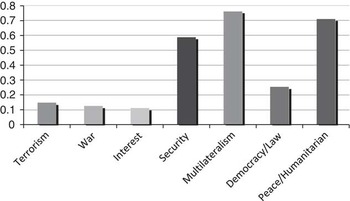
Such removal is confirmed also by content analysis of the parliamentary discussion (see Figure 1). The frame of ‘war’ was irrelevant in the debate, despite the mounting violence on the ground. On the contrary, ‘multilateralism’ and ‘peace’ were fundamental aspects of the narrative. The cabinet constantly focused on the presence of UN multilateral framework for the ‘humanitarian intervention’.
Main frames in parliamentary debates, Iraq (2003–06). Note: For each speech before the whole assembly and the parliamentary commissions, we have calculated the number of times the keyword has been cited. We have then estimated the frequency for each keyword as a percentage of all the words used in the speech.

References to security aspects were relevant: these figures increased after the attack of Nasiriya, while the Italian leaders linked the main threats and menaces to criminal organizations rather than insurgents. Due to the spread of the US plot of the ‘democratic promotion’, one might expect higher frequency for the category ‘democracy’. However, the Italian debate did not devote specific attention to that storyline. Finally, no other narratives (e.g. ‘the war on terror’) were particularly significant.
Therefore, both discourse and content analysis highlighted the use of the ‘humanitarian narrative’. What has been the ‘co-evolution’ between the humanitarian plot and Italian public support toward ‘Ancient Babylon’? The analysis of the polls offers some insights into the effectiveness of the narrative.
The attitude of the Italian public toward the US operation was negative. First, between siding with France and Germany against the war or supporting an American intervention without UN legitimacy, a strong majority of Italians (67%) preferred the first solution (Transatlantic Trends, 2003). Multilateralism still represented a crucial pre-condition for the public. Second, contrary to the conventional wisdoms of the Italian decision-makers, the public opinion was extremely sensitive to the issue of ‘terrorism’, intensely sustaining the ‘US war on terror’ (Eurobarometer, 2003 and 2004). Third, both the majority of center-left (77%) and center-right voters (68%) opposed the invasion (Disarmament Archive SWG – Difebarometro, October 2003). Therefore, even a considerable slice of Berlusconi’s supporters were against the war. According to the same poll, one out of three of the sample shared the counter-narrative based on the idea that Washington had occupied Iraq to control its oil resources.
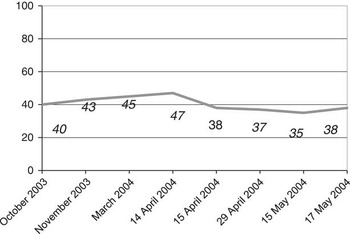
All these elements illustrate the negative attitudes of the public toward ‘Operation Iraqi Freedom’. Figure 2 shows the degree of support for the Italian mission during the first 2 years. The rate of approval, which was always below 50%, is relatively stable.
Italian public opinion support toward ‘Ancient Babylon’. Source: ISPO. Note: Sample size of ~1000. For an overview see Mannheimer (Reference Holsti2004).

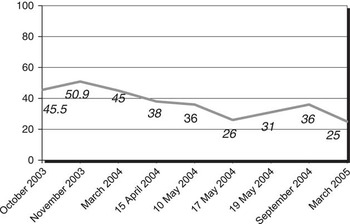
Figure 3, which illustrates the level of support toward the decision to keep the troops on the ground, shows a significant increase in the level of consent only after the attack on the Italian base in November 2003, when the emotional reaction of the public pushed the rate over 50%. After this, the decline was significant.
Support toward Italian military presence in Iraq. Source: Aggregated data, elaboration of the author. Note: Aggregated data are derived from surveys that include the same question (‘Do you agree with keeping Italian troops in Iraq?’). Sample size of ~1000. See: Directa (14 October 2003), Eurisko (14 November 2003, 25 April 2004, 10, 17, and 19 May 2004), ISPO (20 March 2004), SWG (15–16 September 2004), and APCOM-IPSOS (8 March 2005).

Other surveys highlighted similar trends regarding the support of the mission, from 45% in January 2004 (SWG) to 25% in March 2005 (IPSOS). The data related to 2006 are scarce, if not absent, testifying to the growing lack of public interest toward the mission.
Additional polls illustrated how the values of peace, humanitarianism, and multilateralism were deeply shared by the public. In June 2004, 52% of Italians declared themselves ‘in favor of keeping the troops in Iraq after a UN mandate’ (Transatlantic Trends, 2004). At the beginning of ‘Ancient Babylon’, the UN framework was considered a necessary premise for the national military involvement (Directa, October 2003). In other words, the Italian military presence was more widely accepted if connected to a ‘renewed’ multilateral framework. The polls revealed that the public constantly demanded multilateralism and perceived that this framework was lacking. At the same time, Italians proved to be extremely responsive to the plot of the ‘peace and humanitarian mission’. In October 2003, 61% of Italians (compared with a European average of 44%) were in favor of sending troops to ‘a peacekeeping operation’ and 89% supported the idea of ‘strengthening humanitarian aid’ (Eurobarometer).
The public shared the ‘humanitarian narrative’: the perceived discrepancy between reality on the ground and humanitarian tasks of the operation was minimal, as reported by the IPSOS survey of 19 March 2004: 57% of the center-right voters and 46% the center-left electors considered ‘Ancient Babylon’ a humanitarian mission. Despite the gap between the peace rhetoric and growing devastating violence on the ground, the communication strategy based on the removal of the military dimension had proved effective in instilling the humanitarian plot. The opposition shared the humanitarian dimension of the narrative while recurrently emphasizing the lack of the international legitimacy of the intervention. If the increasing violence did not significantly alter the image of a ‘humanitarian mission’, it probably alimented doubts regarding the prospects of success. If kidnapings and attacks did not cause a drop in support, they did coincide with its steady decrease (Figure 2). The results, which are not aimed to test correlations, illustrate a co-evolution of consensus and insecurity on the ground. The narrative was not adapted to the transformed scenario and, above all, no additional efforts were made to clarify goals, focusing merely on the removal of the military dimension.
In conclusion, polls revealed how the Italian public basically shared the humanitarian framework despite the discrepancy between rhetoric and reality, but the presence of a multilateral framework and the supposed success of the mission did not prove to be convincing. The case study highlights the crucial relationship between the narrative crafted by the government and the political opposition that did not entirely accept the plot, ‘amputating’ its multilateral dimension.
Lebanon
Through ‘Operation Leonte’ Italian troops were deployed to strengthen the contingent of UNIFIL (United Nations Interim Force in Lebanon) in summer 2006. The UN mission established in 1978 was expanded and modified after the conflict between Israel and the Shiite militia of Hezbollah (12 July 12 to 14 August 2006). Italy, after having played a very active diplomatic role during the crisis, guaranteed a relevant military contribution, deploying >2500 soldiers and assuming the leadership of the operation.
Consistency with common values: The first main element of the narrative is the (supposed) discontinuity with the Berlusconi government and the continuity with the traditional references of Italian defense and foreign policy (peace and multilateralism). The contrast between the UN peacekeeping operation in Lebanon, the ‘legendary blue helmets’, and the ‘unilateral’ Iraqi mission was at the center of the plot (Nigro, Reference Nigro2006). As stated by the former Foreign Minister Massimo D’Alema, Italy sent its troops in compliance with the constitutional mandate of ensuring the ‘peace’.Footnote 18 Thus, the picture was presented as totally different from Iraq, because of the presence of UN forces.
In addition, the Italian government emphasized the renewed role played by the European Union: ‘After having long been a payer of economic assistance, the EU shows the willingness to become a player’ (D’Alema, Reference D’Alema2006). The values of Atlanticism, Europeism, and global multilateralism were strongly interlinked in the narrative. The center-right, which supported the mission, did not share this view, emphasizing a substantial continuity in the Italian ‘peace policy’ in the region.Footnote 19
The second vital element of the narrative is the predominant ‘peace and humanitarian plot’. As occurred in the case of ‘Ancient Babylon’, the military dimension of the operation was almost excluded from the debate, as the government mainly referred to its diplomatic and humanitarian efforts. The Italian approach was defined as a ‘policy of peace’Footnote 20: the public aim of the intervention was to provide peace within a clear multilateral framework. According to the government, the military nature of the operation would have been quickly replaced by a civil intervention of cooperation. The peculiarities of the Italian military operation were associated with ‘a culture of peace’.Footnote 21 The Italian soldiers were not in Lebanon ‘to make war’ but to ‘give politics and dialogue a chance’.Footnote 22 Once again, the narrative was strongly related to the ‘value of peace’ promoted by the ‘Italian Constitution’.
Integrated communication strategy and conformity with the situation on the ground: The government adopted a prudent communication strategy regarding the possible risks of the operation. While focusing on traditional values and stressing the peacekeeping nature of the intervention, the intra-governmental coordination aimed to ‘prepare’ the public for eventual dangers, emphasizing, at the same time, the differences between a multilateral peacekeeping operation and the ‘unilateralism’ of the Iraqi mission (Ignazi et al., 2012). The Minister of Defense, Arturo Parisi, assumed the leadership, promoting an integrated communication strategy. Parisi persistently described the mission as ‘long, challenging, expensive and risky’ (Nese, Reference Nese2006). Away from the optimism that had marked the early months of ‘Ancient Babylon’, Prodi’s government wanted to avoid an excessive distance between the ‘narrative of peace’ and the unstable security scenario. This prudent approach helped to adequately address the ambiguities related to the nature of the operation (at the boundary between peacekeeping and peace enforcement) and the supposed disarmament of Hezbollah militia.
Clarity of the aims of the mission and promises of success: Given the ambiguity of the context, the Italian government devoted significant efforts toward emphasizing the main goals of the operation: ensuring peace through the strengthening of the Lebanese state, defending the Israeli border, and responding to any armed actions on the ground. The hot issue of the debate was the disarmament of Hezbollah, which was portrayed by the Italian government as the result of a political process rather than the aim of military actions. The absence of violence and the safeguarding of the ceasefire allowed for downsizing the ambiguities in the mandate, highlighting the ‘success’ of the mission, which was also recognized by the subsequent Berlusconi’s government (Nigro, Reference Nigro2008).
Counter-narratives: Contrary to what happened in nearly all Italian military missions abroad, the large majority of pacifist groups and associations showed a positive attitude toward UNIFIL (as well illustrated by the 2006 Perugia-Assisi ‘Peace March’). Several NGOs were directly involved on the ground with projects of development cooperation, whereas Rifondazione, which had opposed all of the most significant Italian interventions in the post-Cold War era, sustained the operation. The Under Secretary of Defense, Patrizia Sentinelli (RC), played an active role in shaping public debate, persistently stressing the non-military dimension of the mission. Even the opposition, despite the differences in terms of continuity/discontinuity in foreign policy, shared the same attention devoted to the central value of multilateralism.
Also, content analysis illustrates the centrality of multilateralism in the plot developed by the Italian government before the Parliament. As shown in Figure 4, ‘multilateralism’ is the most frequent frame in the debate. The effective involvement of UN on the ground has been persistently stressed, along with the ‘traditional peacekeeping’ nature of the operation. Most of the terms related to the category of ‘war’ are connected with the military confrontation that occurred before the deployment of Italian soldiers.
Main frames in parliamentary debates, Lebanon (2006–08). Note: For each speech before the whole assembly and the parliamentary commissions, we have calculated the number of times the keyword has been cited. We have then estimated the frequency for each keyword as a percentage of all the words used in the speech.

The analysis of polls reveals a public opinion consensus toward the mission. The coherence of the narrative with the shared values of peace and multilateralism, the lack of counter-narratives, a prudent communication strategy, the limited degree of violence, and the prospects of success could have facilitated positive Italian public opinion toward the operation. The ambiguity regarding the disarmament of the militias and the nature of the mission have been addressed through an ongoing effort aimed at clarifying the ‘peacekeeping’ nature of the intervention.
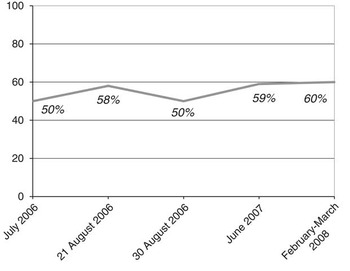
Contrary to the case of Iraq, the percentage of Italian public support for the Lebanon mission has always been >50%. As illustrated by Figure 5, the level of approval grew from 2006 to 2008. Most of the data were collected in the first weeks of the operation, when the concern related to the security environment was at its highest. Then, the public attention toward the intervention collapsed. Few polls were carried out in the following years. The absence of relevant episodes of violence led to the (limited) interest in the non-military dimension of the intervention, such as the development cooperation projects. This has surely helped the government’s communication strategy and its ‘peace and humanitarian’ narrative (Coticchia, Reference Coticchia2014).
Italian public opinion support toward the military operation in Lebanon. Source: Aggregated data, elaboration of the author. Note: The aggregated data are derived from surveys that share the same question (‘Do you support the Italian military operation in Lebanon?’) and a similar sample size. See ISPO-Corriere (July 2006), SWG (August 2006), IPSOS (August 2006), Transatlantic Trends (June 2007), and Mae-Laps (February–March 2008).

Looking at the surveys, the multilateral framework was a very appreciated feature of the narrative. In August 2006, 69% of respondents supported the need to enhance the ‘global role of Europe’, whereas only 25% agreed with the idea of ‘maintaining a privileged relationship with the United States’ (IPSOS, 2006). During the same period, 52% of the interviewees (Sky-Piepoli, August 2006) believed that the mission had fostered the international renown of ‘the EU and the UN’, one of the crucial goals of Prodi’s cabinet throughout the crisis. The legacy of the war in Iraq was still robust and the Italian government’s choice to constantly confront the two interventions proved successful. The ‘peace and humanitarian’ narrative was able to present a peacekeeping operation, emphasizing the consistency with fundamental values such as multilateralism, but avoiding the creation of an unrealistic picture of the situation on the ground thanks to a prudent communication strategy. Exogenous elements, such as the lack of an alternative counter-narrative and the absence of violence, allowed the operation to be presented as a success.
Libya
In the case of the war in Libya (2011), the elaboration of a compelling strategic narrative was extremely complex for the Italian government: doubts and ambiguity affected the national approach to the crisis in its first weeks. The personal friendship between Gaddafi and Berlusconi, economic and strategic interests, historical roots, and concern about the mounting instability in the Mediterranean were the main causes of the hesitant Italian foreign policy (Lombardi, Reference Lombardi2011). The national privileged strategic position in Libya was at risk after allies decided to intervene militarily. Thus, Italy, within the NATO framework, gave its contribution to the operation ‘Unified Protector’, providing bases, navy units, and warplanes. After some weeks of air strikes, the Libyan leader was captured and killed in Sirte at the end of October 2011.
Clarity of the aims of the mission and counter-narratives: The strategic narrative had the intricate task of justifying both the operation and the changed attitude of the government toward Gaddafi, who had previously signed a very important agreement with Italy, fostering border control to prevent the inflow of migrants to the Italian shores. The ‘Treaty of Friendship’ included a clause of ‘non-aggression’, placing explicit constraints on military action.
The Minister of Foreign Affairs, Franco Frattini, who had previously considered the accusation of human right abuses against the Libyan regime as ‘useless’, remarked on his concern about the presence of Al Qaeda in the country and the exodus of migrants toward Italy.Footnote 23 Thereafter, the Italian Minister radically changed his approach, firmly supporting the operation, accordingly modifying his rhetoric: ‘The presence of Al Qaeda behind the uprising was just propaganda’ (Pignataro, Reference Pignataro2011).
As occurred in the past, the bipartisan consensus presented the mission and the President of the Republic, Giorgio Napolitano, was very active in supporting it. However, some political contrasts occurred: the center-left abstained in the Senate and some MPs in the majority coalition signed a different document, asking for greater diplomatic and humanitarian efforts. Moreover, the ‘Northern League’, despite sustaining the government, frequently expressed its doubts on the mission, worrying about an invasion of migrants and accusing the EU of lack of support. Thus, a crucial governmental party introduced an alternative plot to the mission, emphasizing the threats associated with Italy’s involvement and the ‘uselessness’ of the EU, eroding the effectiveness of the traditional multilateral reference.Footnote 24
The opposition party ‘Italia dei Valori’ (IDV) voted against the mission, highlighting the ‘real nature’ of the intervention: ‘We are waging war. We can call it “an action of peace”, but this action is carried out with bombs and weapons’.Footnote 25 The counter-narrative crafted by the IDV aimed at illustrating the inconsistency between the narrative, which silenced the military dimension of the operation, and the nature of the mission.
Consistency with common values and promises of success: Since the very beginning of the operation, the government pushed for a multilateral framework, advocating a stronger role for the Atlantic Alliance. Therefore, the acquired NATO framework was portrayed as a success of the Italian diplomatic pressure, which did not share the ‘coalition of the willing’, despite the involvement in ‘Odyssey Down’. Such participation was presented as a way to avoid the marginalization of Italy in the ‘new Libya’, sharing the responsibilities in the face of threats. Since the very first parliamentary declaration, Frattini had emphasized the ‘loyalty to the Atlantic and European approach’.Footnote 26 Indeed, apart from the hostility of the Northern League toward the EU, and unlike the case of Iraq, the value of multilateralism was the base for bipartisan consensus.
The non-military dimension of the intervention represented the main plot of the narrative. On the one hand, decision-makers emphasized the possibility of a diplomatic solution to the conflict or an immediate ceasefire. On the other hand, the crucial values of multilateralism and humanitarianism were linked together thanks to the UNSC Resolution n.1973, which formally aimed to protect the civilian population. Thus, the Italian government adopted the ‘Responsibility to Protect’ (R2P) as the official goal of the mission. ‘We intervened because when a government not only fails to protect its own people, but it accomplishes violent repression, the international community has the responsibility to protect the population’ (Frattini and Al-Thani, Reference Frattini and Al-Thani2011). Therefore the Italian aim was to use force to prevent a humanitarian catastrophe. Such a view was widely shared by the opposition, which essentially supported the humanitarian plot.Footnote 27 Finally, the Italian colonial legacy played a very marginal role in the debate.
Conformity with the situation on the ground: The strategic narrative was obliged to face the challenges posed by ambiguities related to the military intervention in Libya. On the one hand, the discrepancy between the formal aim of the mission (the R2P) and the operational reality was significant: the mandate was gradually extended and amended, transforming from a military campaign aimed at protecting civilians into a ‘regime change’. Targeted raids on Libyan leadership and the employment of Special Forces and attack helicopters in urban areas openly contrasted with the goals defined by the UNSC 1973. On the other hand, the fluctuating Italian approach moved from skepticism to active participation. The concerns expressed by Italian leaders (from the potential emergence of an ‘Islamic emirate’ to the ‘biblical exodus’ of migrants) did not promptly evaporate in the debate. These contradictions were exploited by the Northern League in its anti-EU counter-narrative: while the government maintained that a multilateral approach was essential in order to share the responsibility of addressing illegal migration, the concrete support received by European allies was considered lacking even by the Minister of Defense, who constantly struggled for full cooperation with Europe.
Communication strategy: The communication strategy was not integrated, as illustrated by the role played by the counter-narrative crafted by the political party ‘Lega Nord’. In addition, at the beginning of the crisis Berlusconi expressed his doubts about the eventual military operation (D’Argenio, Reference D’Argenio2011). Thus, there was limited intra-governmental coordination, with the exception of the constant paradoxical removal of the military dimension of the intervention. Indeed, in conformity with the other cases, the communication strategy was aimed at reducing the level of attention toward the mission, creating a sort of ‘fog of war’ that hindered detailed information. While policy-makers focused on the humanitarian dimension and the possible diplomatic solutions, the official sources provided limited details concerning the operation. As illustrated by the then Chief of Staff of the Air Force, General Giuseppe Bernardis, Italians did not receive information about the mission, which was ‘essentially hidden’ (Bilosolavo, Reference Biloslavo2012).
In summary, the strategic narrative employed by Berlusconi’s government was marked by bipartisan consensus, consistency with the values of peace and multilateralism, a low profile communication strategy, and a focus on non-military and humanitarian dimensions. If the lack of casualties and the (apparent) success of the operation would have fostered the acceptance of the narrative among the public, the contradictions related to mandate, the ambiguous Italian foreign policy, and the absence of concrete support by allies and multilateral organizations (along with the Northern League counter-narrative) would have represented considerable obstacles for the narrative.
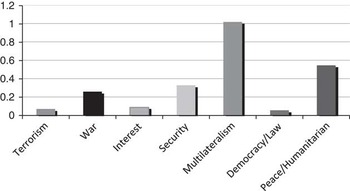
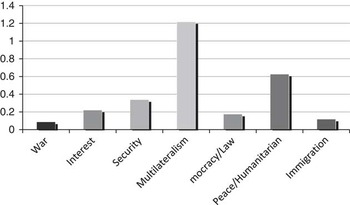
Furthermore, for the operation ‘Unified Protector’ the multilateral frame appeared prominently within the parliamentary discussion. The content analysis stresses the high frequency of the terms related to ‘NATO framework’ or ‘UN Security Council Resolution 1973’ (Figure 6).
Main frames in parliamentary debate, Libya (2011). Note: For each speech before the whole assembly and the parliamentary commissions, we have calculated the number of times the keyword has been cited. We have then estimated the frequency for each keyword as a percentage of all the words used in the speech. The keyword ‘immigration’ has replaced ‘terrorism’, the frequency of which was extremely low (0.008%).

The ‘peace’ frame played a relevant role in the debate while one would expect a different percentage both for ‘national interest’, due to the strong economic and strategic ties between Libya and Italy, and for ‘immigration’. However, the figures are low in comparison with multilateralism and peace. Alternative plots (such as ‘democratic promotion’) are irrelevant.
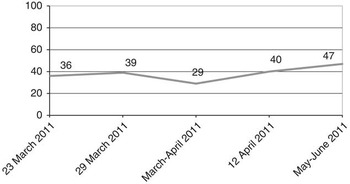
Figure 7 shows the level of Italian public support for the operation in 2011. As happened in the case of Lebanon, the number of polls was scarce and the existing ones were carried out in a limited time frame (February–June 2011), with only a few surveys available in the following months.
Italian public opinion support toward the military operation in Libya (2011). Source: Aggregated data, elaboration of the author. Note: Aggregated data are derived from surveys that share the same question (‘Do you support the military operation in Libya?’) and a similar sample size. See IPR (21 March 2011), Demopolis (29 March 2011), Financial Times/Harris (March–April 2011), Reuters IPSOS/MORI (12 April 2011), and Transatlantic Trends (May–June 2011).

The results illustrate a low degree of approval for the mission in March–April 2011 (from 39 to 29%). Then the level of support gradually increased, but the majority still opposed the military intervention. Several factors emerge by looking at the surveys. The first is the general concern regarding the ‘threat’ of illegal immigration. From 65 to 70% of the public were afraid of a real ‘invasion’ (IPR, 23 March; Demopolis, 29 March). The second is the overwhelming negative judgment (70%) of the ways through which the government had handled the crisis (IPSOS, 12 April). The third factor is the prevalence of those who supported diplomatic solutions, opposing the bombings over Libya: almost 70% of the interviewees were against the air strikes (Demopolis, 28 April). The fourth is the economic dimension: 62% of respondents believed that Italy could not financially provide support to the mission (IPSOS, 12 April), whereas 53% were seriously concerned about the risk of losing economic investments after the war (Demopolis, 29 March). Finally, the main components of the Italian narrative (R2P, humanitarianism, and multilateralism) were shared by the public: 74% of respondents considered the European ‘humanitarian role’ to be crucial (IPR, 24 February), whereas 83% agreed with the ‘need to protect civilians’ (IPSOS Global Advisor, 6–21 April 2011), although the means of ensuring protection were those of diplomacy and cooperation. In fact, only 8.6% positively judged air strikes, whereas almost 57% believed that Italy should have acted through ‘an international peace operation’ (Demos & Pi, 19 May and 8 July). Moreover, the majority of the center-rights voters (54%) also opposed the military action (Demopolis, 28 April). Contrary to what was expected, the ambiguities about the nature of the operation were irrelevant to the Italians, who were the most favorable regarding the removal of Gaddafi among the western public (79% agreed with this option according to the IPSOS Global Advisor, April 2011).
In summary, the strategic narrative crafted by Berlusconi’s government faced three main problems. It was unable to face the persistent concerns of the public regarding the ‘threat of migration’ (which was enhanced by the counter-narrative of the Northern League that eroded the effectiveness of the multilateral framework). ‘Silencing’ completely the military dimension of the operation was extremely complex in the case of air strikes. Finally, the legacies of the political ambiguities in the Italian foreign policy represented significant obstacles for the overall credibility of the plot.
Results and conclusions
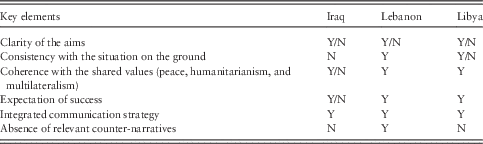
Table 1 summarizes the results that emerged from the case studies, highlighting the correspondence between the key elements that compose a successful narrative and the plots crafted by Italian governments during the crises in Iraq, Lebanon, and Libya. The paper, which is the first attempt to identify the nature of the strategic narratives adopted by Italian cabinets in the post-2001 era, is not aimed at tracing correlations between narratives and polls. In exploring the co-evolution of public support toward military operations and the existing features of the narratives, the paper provides some insights into their effectiveness. Indeed, some general results can be stressed.
Components of a successful narrative
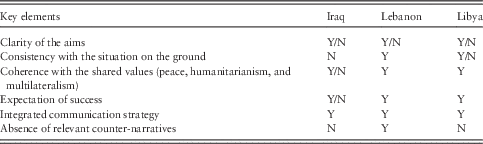
First, the bipartisan consensus per se is not synonymous with high public approval. The Italian public supported the mission in Lebanon, whereas it opposed those in Iraq and Libya. According to our analysis, we should focus more on how and to what extent the opposition shares the main values of the narrative instead of looking simply at the votes expressed before Parliament. The center-left, while approving the ‘humanitarian’ goals of the mission in Iraq, denied its multilateral character, emphasizing the continuity with the American unilateral approach, which the Italian public opposed. In the case of Libya, the Northern League weakened the governmental narrative, underlining the lack of a multilateral support to face the ‘threat’ of migration.
The second result is related to some recurrent elements in the Italian strategic narrative, such as the peace rhetoric and a low profile communication strategy. Both aspects aim to exclude the military dimension of the intervention from the debate. An almost total absence of information is instrumental to avoid a possible discrepancy between humanitarian narratives and combat scenarios. On closer inspection, the positive attitude of the public toward non-military solutions is confirmed. But this does not mean a reluctance to use force, but that a ‘traditional’ peacekeeping operation (Lebanon) is preferred to air strikes (Libya). However, the level of violence on the ground is not a decisive variable per se. The polls, as already demonstrated by recent studies (Coticchia and de Simone, Reference Coticchia and de Simone2014), confute the idea that the Italian public is ‘casualty phobic’. In fact, the highest level of support for the operation ‘Ancient Babylon’ was registered the days following the massacre of Nasiriya.
Third, all narratives contain elements of ambiguity: the massive gap between rhetoric and reality (Iraq), the mandate of the mission (Lebanon and Libya), and the swinging behavior of elites before and during the crisis (Libya). But those contradictions are not crucial unless other exogenous elements (growing violence on the ground or counter-narratives) emerge. A clear, prudent, and flexible narrative that avoids oversimplifications can be adapted to the evolving context and overcome contradictions, whereas a rosy picture of the reality is counter-productive, as shown by ‘Ancient Babylon’.
Finally, the definition of success is an extremely complicated task in current military operations. The absence of widespread violence has been recurrently portrayed as a success per se, focusing on the results obtained in non-military dimensions. The case of Lebanon reveals that the combination between a lack of conflict and massive efforts in development cooperation or diplomatic actions could be effective before the public.
In conclusion, a strategic narrative proved to be ‘successful’ in the Italian case when the following elements were present: bipartisan consensus over the central values of the narrative (peace, humanitarianism, and especially multilateralism), a limited degree of violence on the ground (perceived often as a success per se of the mission), the absence of effective counter-narratives, and constant attention devoted to non-military aspects. A strategic narrative that binds all the above-mentioned aspects, through a prudent communication strategy, will have significant chances to provide public support to a military intervention abroad.
Further research is needed to confirm and expand the model of a ‘successful’ narrative in the Italian case, and additional comparative perspectives are required to generalize the outcomes of the empirical analysis. Nonetheless, despite the specific features of Italian defense and its strategic culture, the paper presents two main implications for the potential generalizability of the findings.
First, strategic narratives should not be realistic, but rather compelling. A certain ambiguity of the storyline could be sometimes inevitable due to the gap between long-established values (such as peace or humanitarianism, which are very difficult to modify) and a risky military environment, where those beliefs may appear as extraneous. In these cases, an integrated communication strategy, aimed at preparing the public opinion and avoiding counter-productive rosy pictures, could be crucial to avoid a collapse of approval toward the intervention. Second, as already tested by literature, casualty aversion per se does not determine the fall of public support. However, mounting insecurity on the ground requires greater flexibility of the narrative to adapt and transform. In this case, a negative narrative dominance (i.e. a more persuasive counter-narrative) could play a fundamental role in hindering the plot’s effectiveness.
Acknowledgments
The research received no grants from public, commercial, or non-profit funding agency. The replication data set is available at http://thedata.harvard.edu/dvn/dv/ipsr-risp