Implications
Reducing methane emissions and increasing the production efficiency are key goals to make livestock production sustainable. At an animal level, these can be accomplished through changes in feeding behaviour and activity of cattle. We found that a reduction of cattle dominance and temperament can work as strategies to manipulate feeding behaviour and activity towards more sustainable livestock. Herd management for reducing feeding competence will promote longer and more frequent meals benefiting feed efficiency and methane emissions. In turn, breeding for calmer cattle can have two effects, reducing activity which benefits efficiency and increase feed intake promoting growth.
Introduction
Livestock are an important contributor to anthropogenic greenhouse gas (GHG) emissions. Enteric fermentation from non-dairy cattle accounted for 21% of the total emissions from agriculture in the period between 2002 and 2012 (FAOSTAT, 2014). The main GHG emitted by cattle is methane (CH4) which has a warming potential 25 times higher than carbon dioxide.
Feed efficiency and growth performance have repeatedly been found to be associated with feeding behaviour in beef cattle (Nkrumah et al., Reference Nkrumah, Okine, Mathison, Schmid, Li, Basarab, Price, Wang and Moore2007; Kelly et al., Reference Kelly, McGee, Crews, Fahey, Wylie and Kenny2010). For example, a longer feeding time (Schwartzkopf-Genswein et al., Reference Schwartzkopf-Genswein, Hickman, Shah, Krehbiel, Genswein, Silasi, Gibb, Crews and McAllister2002) and more frequent feeding bouts (Schwartzkopf-Genswein et al., Reference Shaver, Nytes, Satter and Jorgensen2011) are associated with higher productivity (average daily gain) in feedlot cattle, and a better feed efficiency. However, it is less clear how feeding behaviour affects efficiency for different breeds and diets.
Physical activity can influence total energy expenditure and feed efficiency (Susenbeth et al., Reference Susenbeth, Mayer, Kiehler and Neumann1998; Herd et al., Reference Herd, Oddy and Richardson2004). According to different studies reviewed by Herd and Arthur (Reference Herd and Arthur2009), beef cattle that are more efficient may engage in less daily activity which may have evolved as a mechanism to minimise energy expenditure. However, there are no studies on how differences in feeding behaviour and activity in the pen affect CH4 emissions in beef cattle.
Feeding behaviour and activity are determined by dominance and temperament. For instance, a dominant animal would be able to access resources as it wished, whereas a subordinate might have to adapt to dominant group member preferences. Temperament reflects repeatable between-individual differences in behavioural responses to a challenging situation. Excitable temperaments measured during routine handling have been associated with higher activity in undisturbed group pens of beef cattle (MacKay et al., Reference MacKay, Turner, Hyslop, Deag and Haskell2013). Cafe et al. (Reference Cafe, Robinson, Ferguson, Mcintyre, Geesink and Greenwood2011) found that excitable steers (castrated males) showed shorter feeding bouts and lower feed intake when kept in groups. These behavioural differences could contribute to the improved growth and feed efficiency in calmer beef cattle found previously (Voisinet et al., Reference Voisinet, Grandin, Tatum, O’Connor and Struthers1997; Turner et al., Reference Turner, Navajas, Hyslop, Ross, Richardson, Prieto, Bell, Jack and Roehe2011). This study aimed at understanding the contribution of cattle behaviour to individual differences in feed efficiency, performance and CH4 emissions. Therefore, we investigated the association between feeding behaviour and activity with feed efficiency and CH4 emissions and whether this can be predicted by temperament and dominance in beef cattle.
Material and methods
Animals and experimental design
This experiment was part of a larger project to investigate the effect of cattle breed types, concentrate/fibre ratio and dietary CH4 mitigation strategies on performance, efficiency and CH4 (Duthie et al. Reference Duthie, Rooke, Troy, Hyslop, Ross, Waterhouse and Roehe2015; Troy et al. Reference Troy, Duthie, Hyslop, Roehe, Ross, Wallace, Waterhouse and Rooke2015).
The experiment followed a 2×2×3 factorial design, with two breeds of cattle, two basal diets and three dietary additive treatments. A total of 84 castrated male beef cattle (steers) (Charolais-sired (CHx) n=42; Luing n=42) of 530±114 kg BW were housed at the SRUC Beef Research Centre. Steers were allocated to one of six pens of 72 m2 each, with 14 steers per pen balanced for breed (an equal number of CHx and Luing), sire and live weight (BW). Pens were provided with saw dust bedding, ad libitum access to a water trough and were equipped with automated feeding stations (HOKO feeders; INSENTEC B.V., Markenesse, the Netherlands; Supplementary Material Figure S1) providing ad libitum access to feed. The number of HOKO feeders within each pen was either five feeders (four of the pens) or six feeders (two of the pens). Feeders were filled once a day using a forage wagon with a diet that consisted of either 52 : 48 (Mixed) or 8 : 92 (Concentrate) forage : concentrate ratio (%, dry matter basis) with no additive (Control), calcium nitrate or rapeseed cake as dietary treatments. The composition of the diets and the distribution of diets and additives according to pen can be found in Duthie et al. (Reference Duthie, Rooke, Troy, Hyslop, Ross, Waterhouse and Roehe2015).
Steers were either born and raised at SRUC Beef Research Centre or purchased from Scottish farms during the summer of 2013 and were given 8 weeks to adapt to the facilities and feeding system before the beginning of the experiment. The last 4 weeks of that period doses of additives were gradually increased to allow steers adapt to dietary treatments. On arrival the steers were fed a standard finishing diet for 8 weeks before the experiment started. Subsequently, recordings of feed intake, BW and fat depth were taken over 56 days (referred ahead as 56-day test) to assess the residual feed intake (RFI). Residual feed intake is a feed efficiency measure calculated as the difference between the actual and predicted feed intake required for the level of production achieved (Basarab et al., Reference Basarab, Price, Aalhus, Okine, Snelling and Lyle2003). Methane emitted by the steers at the feeders was assessed on a daily basis. Steers were recorded during 56-day test using two cameras per pen. The cameras covered the complete space available to the steers.
The temperament of the steers was recorded three times throughout the 56-day test by observation of their behavioural response to handling associated with routine weighing.
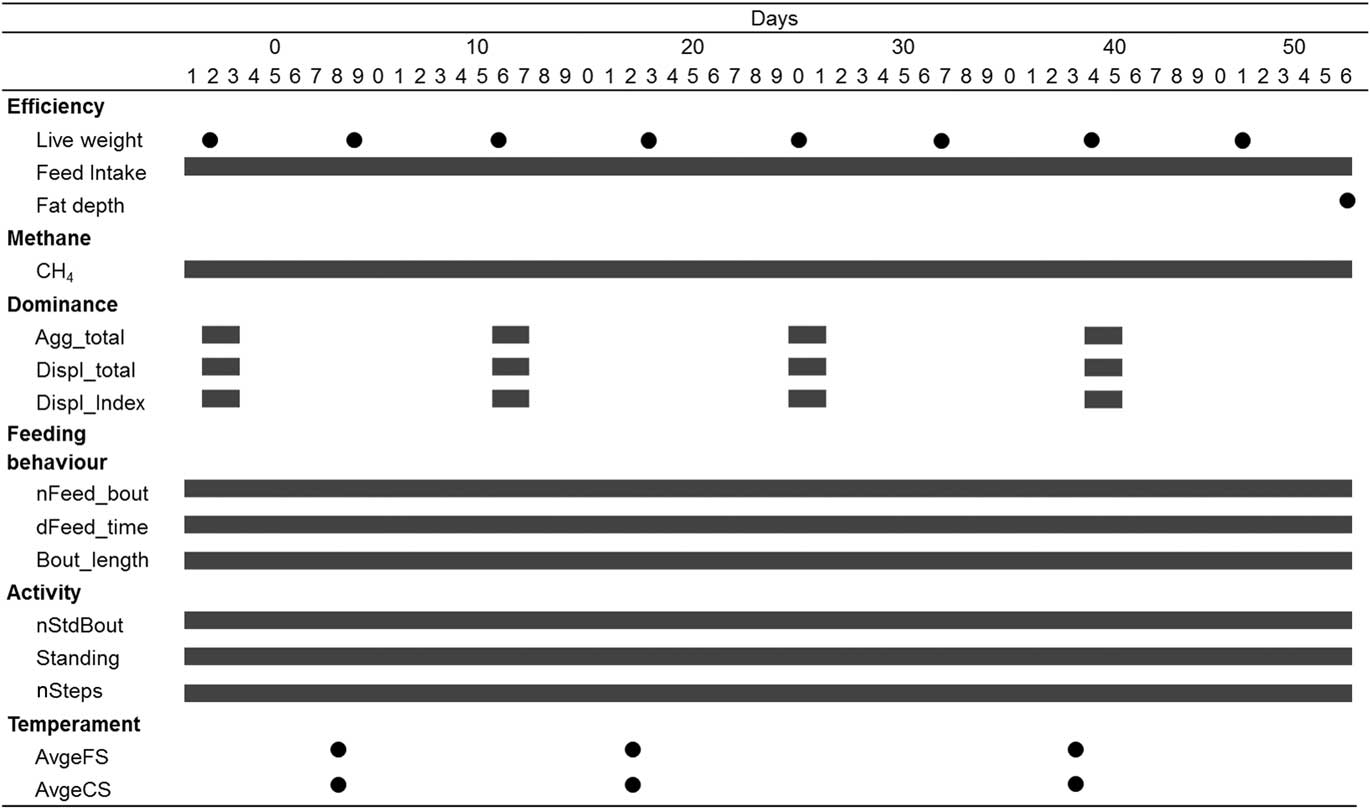
All variables assessed are represented in Figure 1 according to the day of measurement along the 56-day period.
List of performance and behaviour variables assessed each day during an 8-week assessment period in beef cattle. Agg_Total=number of aggressive interactions; Displ_total=number of displacements; Displ_Index=the aggression index is the proportion of interactions in which the steer acted as a displacer; nFeed_bout=average number of feeding events per day; dFeed_time=the total time spent feeding per day; bout_length=duration per visit; Standing=percentage of time that the steer was standing; nStdBout=a count of the number of standing bouts; Standing=percentage of time that the steer was standing; nSteps=number of steps per day; AvgeFS=average of the flight speed test; AvgeCS=average of the Crush Score.

Residual feed intake estimation
The automatic feeders recorded the weight of feed consumed during each feeding event 24 h a day for each steer from which the dry matter intake (DMI) was calculated. Steers were weighed weekly from the beginning until the end of the RFI assessment period. Fat depth at the 12th and 13th rib intercostal space was measured ultrasonically (Aloka 500 machine; BCF technology Ltd, Scotland, UK) at the end (between days 57 and 58) of the RFI assessment period. Growth was modelled by linear regression of BW against test date to describe ADG, and metabolic live weight at mid test (MLW) was calculated as BW×0.75. Feed conversion ratio (FCR) corresponds to the average DMI (kg/day)/average daily gain (ADG). Following Duthie et al. (Reference Duthie, Rooke, Troy, Hyslop, Ross, Waterhouse and Roehe2015), RFI was calculated as the deviation in actual DMI (kg/day) from predicted DMI based on linear regression of actual DMI on ADG, MBW and FD.
Measurement of methane emissions
During the 56-day RFI measurement period, individual enteric CH4 emissions were measured using gas sampling hoods located over the HOKO feeders. As described in Troy et al. (Reference Troy, Duthie, Ross, Hyslop, Roehe, Waterhouse and Rooke2016), the system consists of two head hoods with two large vacuum pumps used to evacuate air from the hoods that pumped the sampled air into an instrumentation cabinet that housed the gas analyser.
The respiration gas was sampled each day of the whole experiment when the steers were feeding and visits shorter than 1 min were not taken into account for CH4 sampling as there was insufficient time to allow the gas analyser to equilibrate.
Behavioural assessments
Feeding behaviour
Feeding behaviour was monitored automatically during the RFI period using the HOKO feeders which recorded every time each steer entered the feeder providing the number and the duration of feeding events per steer per day. The feeders measured the weight of feed consumed during each visit. Feeding events were then refined by eliminating visits in which no feed was consumed and those shorter than 1 min in duration. The daily feed intake was divided by the percentage of DM of the diet to calculate the DMI. The average number of feeding events per day (nFeed_bout), the duration per visit (bout_length) and the total time spent feeding per day (dFeed_time) were calculated. Data from days on which the steers were weighed were excluded due to the risk that weighing could disrupt feeding patterns. Due to the risk that weighing could disrupt feed intake patterns, data from days on which the steers were weighed were excluded from the data analysis.
Activity
Activity was assessed by fitting every steer with an IceTag® sensor (IceRobotics Ltd, Edinburgh, UK; Supplementary Material Figure S2) which remotely and continuously measured activity. As described by MacKay et al. (Reference MacKay, Turner, Hyslop, Deag and Haskell2013), IceTags are triaxial accelerometers that function predominantly as pedometers when attached to the leg of a steer, providing the orientation of the device 16 times/s. This data was used to calculate the percentage of time that the steer was standing (Standing), a count of the number of standing bouts (nStdBout) and the number of steps (nSteps) per day using criteria presented in Tolkamp et al. (Reference Tolkamp, Haskell, Langford, Roberts and Morgan2010). The Motion Index, as an indicator of the overall activity of the steer, was calculated using the average magnitude of acceleration on each of the three axes (Kokin et al., Reference Kokin, Praks, Veermäe, Poikalainen and Vallas2014). The IceTags were attached on a hind leg, between the hock and fetlock joints for two periods of 28 consecutive days. Two periods were required to allow data to be downloaded and Icetags to be reformatted for further use. The first period occurred from week 1 until week 5 of the RFI period and the second period started on week 6 and finished 1 week after the end of the RFI period. Data from the day on which the IceTags were fitted and removed were discarded as they did not represent the data for a full day and included locomotion during handling.
Dominance
Dominance was assessed a posteriori from the recorded images using Observer XT 11.5 software (Noldus, Wageningen, the Netherlands). The analysis was based upon an adapted ethogram from MacKay et al. (Reference MacKay, Turner, Hyslop, Deag and Haskell2013) assessing agonistic interactions between steers at the HOKO bin feeders in the home pen. As the number of feeders was lower than the number of steers, they often engaged in agonistic interactions to displace others in order to access the feed. Fresh feed was added every morning (approximately at 0800 h) and observations were made thereafter. During pilot observations in the current study little interaction was observed after 1.5 h following food provision, so samples of 90 min were used. Behaviour was recorded on 2 consecutive days a week (Tuesday and Wednesday) on weeks 1, 3, 5 and 7 of the 8-week RFI trial. These days were selected as they involved the least disturbance of the steers for routine procedures. All observations were performed by a single observer.
For each observation, the date of the observation, time of the interaction, behaviour of the aggressor, and identity of the aggressor and recipient were recorded. The variables measured were the number of events involving physical contact (Cont_Total), number of aggressive interactions (Aggr_Total) and number of displacements (Displ_Total) as defined by MacKay et al. (Reference MacKay, Turner, Hyslop, Deag and Haskell2013). The aggression index (Aggr_Ind) provided information on the proportion of interactions in which the steer acted as an aggressor (index values close to 1 indicated that the steer was more often the aggressor than recipient). The displacement index (Displ_Ind) summarised the proportion of displacements that the steer initiated relative to all displacements it was involved in, giving a general impression of social status (Galindo and Broom, Reference Galindo and Broom2002).
Temperament assessment
Temperament was assessed by performing a crush score (CS) and a flight speed (FS) test, as described by Turner et al. (Reference Turner, Navajas, Hyslop, Ross, Richardson, Prieto, Bell, Jack and Roehe2011), both undertaken during routine weighing in a chute (i.e. crush) on three occasions (day 8, 22 and 43 of the RFI assessment period). Steers were moved in groups from their home pen to a holding pen that led to a semi-circular single-file race and then the crush. Each steer was confined in the crush with its head secured in the bail. Crush score of the steer was monitored based on signs of restlessness on a six point scale for 10 s providing a categorical behavioural score based upon the reaction to being restrained (Turner et al., Reference Turner, Navajas, Hyslop, Ross, Richardson, Prieto, Bell, Jack and Roehe2011). Steers that struggled the most violently received a high score. The weight was recorded and the steer was released directly into a straight race. In the race, a digital flight speed metre consisting of two motion sensors (located 1 m and 5 m from the crush exit) recorded the time taken to travel the intervening 4 m as a measure of the FS (m/s). Crush score and FS were recorded on each of the three test days.
Statistical analysis
Analyses were carried out with the Statistical Analysis System version 9.4 (SAS Software; SAS Institute Inc, Cary, NC, USA; 2002–2008). Variables were checked for normality using Kruskal–Wallis tests.
Initially, a Pearson’s correlation (Proc Corr) matrix was created between explicative variables of the same behaviour group, for example temperament and dominance variables that explain feeding behaviour and activity models and at the same time activity and feeding behaviour variables that explain the performance and CH4 models. This sought to identify measures that provided similar information and those that required separate inclusion in multivariate models. Subsequently, the effect of temperament and dominance (both the raw and index traits) on feeding behaviour and activity was calculated by analysis of variance using linear mixed models (Proc Mixed) first by univariate models and thereafter by multivariate models. Similarly, the impact of feeding behaviour and activity on CH4 and performance was assessed using Proc Mixed. For every outcome variable (performance, CH4, feeding behaviour and activity) ‘diet’ and ‘breed’ were used as explanatory variables and ‘pen’ as a random effect. Dietary treatment (control, nitrate, rapeseed cake) had no effect on feeding behaviour, temperament, activity and dominance, therefore it was not included in the model. In the univariate models, the association of feeding behaviour and activity with performance and CH4 emissions was assessed using each of the variables. The same procedure was undertaken to assess the association of temperament and dominance with feeding behaviour and activity. Each individual variable that showed a P-value lower than 0.25 became a candidate for the multivariate model. The candidate variables were then added into the multivariate model in a stepwise fashion. If two of the selected traits were highly correlated (r>0.9) a selection was made to remove one from the analyses. The retained trait was that which showed the least correlation with other traits, therefore maximising independence relative to other traits. Candidate variables were kept in the model with significance of P<0.05. When candidate variables showed significant effects the rate of each component of variation was calculated using restricted maximum likelihood (REML). Statistical significance was assumed at P⩽0.05 and tendencies at P⩽0.1 for all analyses.
Results
Association of feeding behaviour and activity with performance and methane emissions
The effects of basal diet, breed and additives on performance and CH4 emissions were reported in Duthie et al. (Reference Duthie, Rooke, Troy, Hyslop, Ross, Waterhouse and Roehe2015) and Troy et al. (Reference Troy, Duthie, Hyslop, Roehe, Ross, Wallace, Waterhouse and Rooke2015), respectively. The main results found were that steers fed with a concentrate diet ate less (DMI) (P<0.001), were more efficient (lower RFI) (P<0.01) and produced less CH4 (g/kg DMI) than those fed with a mixed diet (P<0.001). Also, steers fed the mixed diet produced 17% less CH4 (g/kg DMI) when nitrate was added (P<0.01). CHx steers had lower DMI (kg BW; P<0.01), greater ADG (P<0.01) and were more efficient (lower RFI; P<0.01) than Luing steers. No effect of dietary additives was found in any of the performance traits.
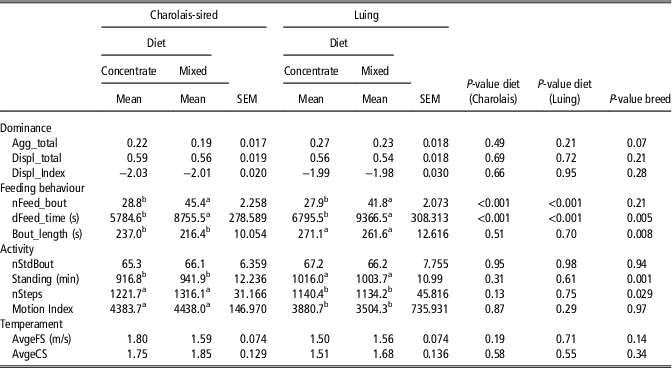
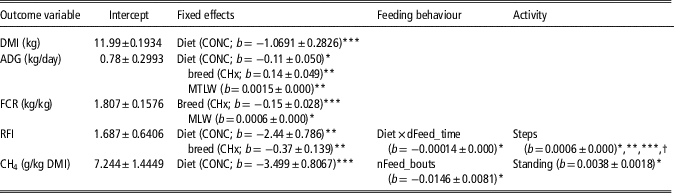
Table 1 provides mean values for feeding behaviour and activity for the two breeds and diets. The models that best explained the influence of feeding behaviour and activity on performance and CH4 emissions are shown in Table 2. FCR showed a non-parametric distribution and was transformed using logarithm base 10. Neither feeding behaviour nor activity had a significant impact on DMI, ADG or FCR. Feeding behaviour determined RFI by the interaction between diet×dFeed_time suggesting that steers fed a mixed diet were more efficient (decreased RFI) when the time spent feeding was higher (P=0.039) but no effect was detected in concentrate-fed steers. There was also a tendency for lower RFI in steers that were less active, as shown by taking fewer nSteps (P=0.071). Methane emissions (g/kg DMI) were lower in steers that ate more frequently (nFeed_bouts) (P=0.041) and spent a shorter time standing (P=0.037).
Mean (±SEM) of each dominance, feeding behaviour, activity and temperament trait according to breed and diet in beef cattle

Agg_Total=number of aggressive interactions; Displ_total=number of displacements; Displ_Index=the aggression index is the proportion of interactions in which the steer acted as a displacer; nFeed_bout=average number of feeding events per day; dFeed_time=the total time spent feeding per day; bout_length=duration per visit; nStdBout=a count of the number of standing bouts; Standing=percentage of time that the steer was standing; nSteps=number of steps per day; Motion Index=indicator of the overall activity of the steer was calculated using the average magnitude of acceleration on each of the three axes; AvgeFS=average of the flight speed test; AvgeCS=average of the Crush Score.
a,b,cValues within a row with different superscripts differ significantly at P<0.05.
Mean (±SEM) weight of each diet, breed, feeding behaviour and activity trait with a significant effect on multivariate models of performance and CH4 emissions in beef cattle

DMI=dry matter intake; ADG=average daily gain; FCR=feed conversion ratio; RFI=residual feed intake; CH4=methane; CONC=concentrate; CHx=Charolais sired; nFeed_bout=average number of feeding events per day; dFeed_time=the total time spent feeding per day; Standing=percentage of time that the steer was standing; nSteps=number of steps per day.
†, *, ** and *** symbols refer to a tendency, P<0.05, P<0.01 and P<0.001.
Association between temperament and dominance with feeding behaviour
Table 1 provides mean values for feeding behaviour, dominance and temperament for each breed. The number of feeders in each pen did not affect feeding or social behaviour. In addition, there was no difference between breeds in their temperament and temperament was not affected by diet. Table 3 shows the models that describe the effect of diet, breed, temperament and dominance on feeding behaviour. Mixed fed and calmer steers ingested more DMI as indicated by the negative association between DMI and diet (P=0.001) and AvgeFS (P=0.0319). The frequency of feed bunk visits (nFeed_bouts) was influenced by diet, temperament and dominance. Steers fed a forage diet (P<0.0001) and those that were temperamental (AvgeFS; P=0.0026) and dominant (Displ_Tot; P=0.0207) visited the feeder more often. Feeding bout length (bout_length) was influenced by breed, temperament (AvgeFS) and dominance (Displ_Tot). CHx steers (P=0.0497), those with poorer temperament (AvgeFS; P=0.0397) and greater dominance (Displ_Tot; P=0.0002) had shorter feeding bouts. Total feeding time (dFeed_time) was determined by diet (P=0.0001), breed (P=0.0067) and dominance (Displ_Index; P=0.0299) and was lower in CHx steers those fed with a concentrate diet and in subordinate steers.
Mean (±SEM) weight of each diet, breed, temperament and dominance trait with a significant effect on multivariate models of feeding behaviour in beef cattle

DMI=dry matter intake; nFeed_bout=average number of feeding events per day; bout_length=duration per visit; dFeed_time=the total time spent feeding per day; CONC=concentrate; CHx=Charolais sired; Displ_total=number of displacements; Displ_Index=the aggression index is the proportion of interactions in which the steer acted as a displacer; AvgeFS=average of the flight speed test; AvgeCS=average of the Crush Score.
*, ** and *** symbols refer to a tendency, P<0.05, P<0.01 and P<0.001.
Association of temperament and dominance with activity
The models that explain the effect of diet, breed, temperament and dominance on activity are shown in Table 4. Breed affected Standing (P<0.001) and nSteps (P=0.0110), indicating that CHx steers stood for a shorter period but had a higher number of steps. The number of standing bouts (nStdBout) was affected by AvgeCS (P=0.0005) meaning that more temperamental steers had more frequent standing bouts. No other associations between temperament, dominance and activity were found.
Mean (±SEM) weight of each diet, breed, temperament and dominance trait with a significant effect on multivariate models of activity in beef cattle

Standing=percentage of time that the steer was standing; nStdBout=a count of the number of standing bouts; nSteps=number of steps per day; CHx=Charolais sired; AvgeCS=average of the Crush Score.
* and *** symbols refer to P<0.05 and P<0.001 respectively.
Discussion
The main aim of the study was to assess the effects of feeding behaviour and activity on performance, feed efficiency and CH4 emissions. Research on beef cattle have indicated the capacity of temperament (Nkrumah et al., Reference Nkrumah, Okine, Mathison, Schmid, Li, Basarab, Price, Wang and Moore2007) and dominance (Gonzalez et al., Reference González, Ferret, Manteca, Ruíz-de-la-Torre, Calsamiglia, Devant and Bach2008) to affect feeding behaviour and activity patterns, this association was also assessed to understand the underlying traits that drive variations in productivity and CH4. Understanding the associations between these traits might constitute the basis for designing breeding, handling and management strategies to improve efficiency and mitigate GHG emissions in beef cattle. The results show that feed efficiency (RFI) was not influenced by feeding behaviour and activity (except in interaction with diet type) but that CH4 emissions (g/kg DMI) were lower when steers ate more frequently and spent less time standing. Feeding behaviour itself was influenced by temperament and dominance whereby temperamental and dominant steers ate more frequently but in shorter bouts. For temperamental steers, this reduced their daily DMI whilst for dominant steers it increased their total daily feeding time. Activity was unaffected by dominance but temperamental steers had more frequent standing bouts. The analysis accounted also for the breed, diet and use of dietary additives which offers the possibility to understand the effect of feeding behaviour and activity on performance and CH4 emissions in a selected range of diets and breeds that are commercially relevant.
Effect of feeding behaviour and activity on growth performance and methane emissions
In the current study, feeding behaviour largely had no effect on DMI or ADG, contrasting with several studies reporting a significant association. Assessing DMI, Nkrumah et al. (Reference Nkrumah, Okine, Mathison, Schmid, Li, Basarab, Price, Wang and Moore2007) have reported that a high feeding duration is correlated with high feed intake for time spent at the feeder and time consuming feed (r=0.27 and 0.33, respectively). Regarding growth, Schwartzkopf-Genswein et al. (Reference Schwartzkopf-Genswein, Hickman, Shah, Krehbiel, Genswein, Silasi, Gibb, Crews and McAllister2002) reported a positive correlation (r=0.38) between bunk attendance duration and ADG, which were similar to what Hicks et al. (Reference Hicks, Owens and Gill1989) had already stated. Nkrumah et al. (Reference Nkrumah, Okine, Mathison, Schmid, Li, Basarab, Price, Wang and Moore2007) found that the number of visits to the feeder and feeding bout duration correlated with ADG (r=0.25 and 0.18, respectively). These associations could not be confirmed in this study suggesting that individual attributes of feeding behaviour were poor predictors of DMI and ADG in this population. The reason for the discrepancy with the mentioned studies is unclear. However, we hypothesise that the way data was analysed might have had an effect. For instance, both Schwartzkopf-Genswein et al. (Reference Schwartzkopf-Genswein, Hickman, Shah, Krehbiel, Genswein, Silasi, Gibb, Crews and McAllister2002) and Nkrumah et al. (Reference Nkrumah, Okine, Mathison, Schmid, Li, Basarab, Price, Wang and Moore2007) used Pearson correlations to assess associations whereas in our study multivariate ANOVA models were used accounting for several factors such as breed, diet, weight or pen, which might have restricted the association likelihood estimation between explained and explanatory variables.
Feed efficiency was assessed in this study using two different measures: FCR and RFI. Traditionally, feed efficiency has been expressed as the ratio of feed intake to BW gain (FCR). We did not find any effect of activity and feeding behaviour on FCR but only a breed and MLW effect. RFI has been suggested to be a better estimate of feed efficiency as it is independent of growth and body size (Crews, Reference Crews2005). The association between RFI and feeding time in the mixed diet fed steers shows that steers that spent a longer time eating the less nutrient-dense diet made more efficient use of the feed. An increased daily time spent eating may increase total salivary secretion (Beauchemin et al., Reference Beauchemin, Eriksen, Nørgaard and Rode2008). Saliva modulates rumen pH, which usually is beneficial for rumen fermentation (Owens et al., Reference Owens, Secrist, Hill and Gill1998) and likely improving digestion of the nutrients. In addition, an increase in the time spent eating can be a consequence of a reduction in intake rate (g/min). It is likely that the accessibility of fibrolytic microbiota to feed will increase if the intake rate is low and meals are frequent rather than if feeding occurs rapidly in large bouts. Increased saliva production can be a consequence of higher ruminating times (González et al., Reference González, Manteca, Calsamiglia, Schwartzkopf-Genswein and Ferret2012). Forage-based diets stimulate a greater time spent ruminating per day and per unit of intake compared with diets with higher concentrate proportion (Faleiro et al., Reference Faleiro, González, Blanch, Cavini, Castells, Ruíz de la Torre, Manteca, Calsamiglia and Ferret2011). This may be the reason why the effect of feeding time on feed efficiency is more evident with fibrous compared with concentrate-based diets.
There was a tendency (P=0.071) for greater activity (more frequent steps) to be associated with poorer feed efficiency (RFI). This finding agrees with other studies. Herd et al. (Reference Herd, Oddy and Richardson2004) attributed a 5% contribution of activity to the total variation in RFI found between cattle lines divergently selected for high and low RFI. Richardson et al. (Reference Richardson, Kilgour, Archer and Herd1999) reported that the variation in RFI explained by daily pedometer count could reach up to 10%. Breeding or managing steers in such a way that they show diminished activity and energy depletion may be effective in improving feed efficiency.
This experiment also investigated the possible effect of feeding behaviour and activity on enteric CH4 emissions. Respiration chambers, the gold-standard approach for CH4 assessment, require the isolation of a steer, which affects feed intake (Llonch et al., Reference Llonch, Troy, Duthie, Somarriba, Rooke, Haskell, Roehe and Turner2016b) and possibly feeding behaviour and activity. The hoods fitted above the feeders in the home pen, which have been shown to robustly measure CH4 emissions in group-housed steers (Troy et al., Reference Troy, Duthie, Ross, Hyslop, Roehe, Waterhouse and Rooke2016), were regarded as the preferable method to study the association of CH4 emissions with feeding behaviour and activity.
The results of the current study show that steers with frequent feeding bouts (nFeed_bouts) emitted less CH4. One could hypothesise that this association is due to changes in rumen retention time and digestibility. The association between DMI, retention time and feed digestibility has been confirmed by several studies (Colucci et al., Reference Colucci, Chase and Van Soest1982; Shaver et al., Reference Schwartzkopf-Genswein, Atwood and McAllister1986; DeVries and von Keyserlingk, Reference DeVries, von Keyserlingk and Weary2009). Ørskov et al. (Reference Ørskov, Reid and Kay1988) reported that variation in ruminal retention time among cattle might be explained by differences in DMI but also by differences in feeding behaviour. In this sense, it could be argued that a steer showing highly distributed feeding patterns will improve the digestion of feed and increase the production of CH4, however the results of this study show the opposite.
An explanation for the apparently beneficial effect of frequent feeding visits on CH4 emissions could result from the way that CH4 was sampled in this study. Enteric CH4 is mostly exhaled during respiration; therefore, less frequent but longer feeding bouts would allow a greater level of CH4 to accumulate. On the contrary, steers that visited the feeder more frequently but for shorter visits may have performed much of their chewing and rumination out of the feeder. However, as our analysis found no relationship between bout_length and CH4 emissions, the impact of this artefact may not have been great. Alternatively, increased activity around the pen could also facilitate gas distribution within the rumen, easing rumen gas exhalation in more active steers.
The results also revealed that steers that spent the longest time standing emitted more CH4. In turn to the association between activity and feed efficiency we hypothesise that activity might influence, or be influenced by, feeding behaviour. For instance, the association between higher CH4 emissions and a greater standing time could potentially result from more time spent at the feeder, which is actually where the CH4 was monitored in this experiment. In a study conducted with respiration chambers, Nkrumah et al. (Reference Nkrumah, Crews, Basarab, Price, Okine, Wang, Li and Moore2006) found a positive relationship between feeding time and CH4 emissions. Using a laser detector, Chagunda et al. (Reference Chagunda, Ross, Rooke, Yan, Douglas, Poret, McEwan, Teeranavattanakul and Roberts2013) found that during feeding, cows produced a 34% more, measured in ppm, CH4 than when idle. In our study we found an association between feeding visits and CH4 emissions. Thus it is possible that steers showing more activity in the pen also show more feeding activity, which ultimately affects CH4 emissions. Although it is not possible to establish which is the cause and the consequence in such relationship, activity in the pen could still partially explain variations in CH4 emissions and be used to monitor them in beef cattle production.
Association between temperament and dominance with feeding behaviour and activity
According to our results, feeding behaviour is partially explained both by temperament and dominance traits. Although no change in total feeding duration was shown, more temperamental steers visited the feeder more frequently, had shorter meals and a decreased feed intake. MacKay et al. (Reference MacKay, Turner, Hyslop, Deag and Haskell2013) also found that temperamental steers eat less feed per day. Van Reenen et al. (Reference Van Reenen, O’Connell, Van der Werf, Korte, Hopster, Jones and Blokhuis2005) suggested that in response to any challenging stimuli, temperamental steers will exhibit an active coping response manifest as a greater behavioural reaction relative to the level of internal stress they are experiencing compared with less temperamental steers. This may suggest that temperamental steers are more reactive to external stimuli (i.e. social interactions) increasing the likelihood of disruption of feeding events leading to a large number of shorter feeding bouts with a reduction in total feed intake. As discussed in the previous section, more frequent feeding bouts leads to a decrease in CH4 emissions. In addition, the reduction in feed intake by temperamental steers may have implications for both feed efficiency and CH4 emissions. Using the same population of steers, Llonch et al. (Reference Llonch, Somarriba, Duthie, Haskell, Rooke, Troy, Rainer and Turner2016a and Reference Llonch, Troy, Duthie, Somarriba, Rooke, Haskell, Roehe and Turner2016b) demonstrated that a decrease in feed intake results in an increase in feed efficiency but also in CH4 emissions per kg of DMI, possibly due to a reduction in passage rate. At the same time, Llonch et al. (Reference Llonch, Somarriba, Duthie, Haskell, Rooke, Troy, Rainer and Turner2016a) demonstrated that the population group of steers considered more temperamental also showed a lower ADG (kg/day) compared with calm steers, possibly due to increased energy expenditure. Thus, breeding for less temperamental steers would have multiple and contrasting effects on efficiency and CH4 emissions. Calmer steers will show poorer feed efficiency but increased growth and will have a controversial effect on CH4 emissions, due to effects on eating frequency and DMI. The goal is to complement this breeding strategy with appropriate feeding management to counteract the decrease in feed efficiency (when increasing intake) which could be achieved by promoting longer times spent eating, therefore improving digestion of feed.
A similar association between feeding behaviour and dominance was seen as between feeding behaviour and temperament. The relationship between feeder access and dominance behaviour has been extensively described in cattle (Harb et al., Reference Harb, Reynolds and Campling1985; Gonzalez et al., Reference González, Ferret, Manteca, Ruíz-de-la-Torre, Calsamiglia, Devant and Bach2008 and Reference González, Manteca, Calsamiglia, Schwartzkopf-Genswein and Ferret2012; DeVries and von Keyserlingk, Reference DeVries, von Keyserlingk and Weary2009) where it is generally accepted that dominant steers limit access of subordinates to feed. In this study, a strong association was found between feeding behaviour and total displacements or displacement index, whereby dominant steers showed more frequent but shorter feeding bouts. This result suggest that if subordinate steers can be fed at their wish they will probably show a similar pattern than dominant steers, with frequent and short feeding bouts, and as discussed earlier, potentially reduce CH4.
The results also show that dominant steers spent a greater time feeding compared with subordinates which they could achieve as they were not displaced so frequently. The same association was found by De Vries et al. (Reference DeVries and von Keyserlingk2004) who showed that subordinate cows have to adapt to the feeding patterns of dominant animals and access feed when it is available which results in less frequent but longer feeding bouts and less time spent eating than dominants. In our experiment, the increased daily feeding time did not affect DMI which suggests that dominant steers must have slowed their ingestion rate. The impact of greater feeding time, potentially due to higher dominance rank, on RFI have been discussed in the previous section whereby a longer time feeding, in fibrous fed steers, is associated with greater feed efficiency. Strategies to reduce dominance behaviour (e.g. by increasing the feeding space or reducing the stocking rate) will increase both the frequency and the average time spent eating by the herd which in this study simultaneously improved efficiency and reduced CH4 emissions and at the same time reduces agonistic behaviour thereby benefiting animal welfare.
Evidence was found indicating that decreased activity, in the form of fewer steps, is associated with greater feed efficiency. On the other hand, our results show that temperamental steers were more active (more frequent standing bouts) which confirms the results of MacKay et al. (Reference MacKay, Turner, Hyslop, Deag and Haskell2013) who found that steers with high flight speed were most active in the home pen. In this regard, the effect of activity on feed efficiency could be partially mediated by temperament. More temperamental steers are more reactive to potentially threatening external stimuli. As a result, the energy expenditure dedicated to body movement is likely to be higher which may decrease the quantity of resources that can be dedicated to growth and compromise efficiency. An association between temperament and feed efficiency has been reported by Voisinet et al. (Reference Voisinet, Grandin, Tatum, O’Connor and Struthers1997) and Nkrumah et al. (Reference Nkrumah, Okine, Mathison, Schmid, Li, Basarab, Price, Wang and Moore2007). In contrast, Llonch et al. (Reference Llonch, Somarriba, Duthie, Haskell, Rooke, Troy, Rainer and Turner2016a) could not find such a relationship but temperamental steers grew more slowly. Presumably in the latter study, the DMI was also reduced to some extent in more temperamental steers which reduced the impact on feed efficiency. Minimising the effects of activity on RFI offers a strategy to improve efficiency. Improving temperament may be a potential way to reduce activity with downstream benefits for growth rate and efficiency.
Conclusions
More time spent feeding on fibrous diets is associated with greater feed efficiency possibly due to greater secretion of saliva and increased access of microbiota to fibre. Dominant steers were able to eat for a longer period each day which suggests that management aimed towards reducing competition for feed could help to increase the average herd feeding time and improve feed efficiency. More frequent feeding bouts contributed to a reduction in CH4 per feed intake. Dominant steers accessed the feeders more frequently suggesting that if access to feed is not restricted steers show a pattern of frequent but short feeding bouts. Temperamental steers reduced feed intake which previous studies have found to increase feed efficiency but to reduce growth rate and increase CH4 emissions per feed intake. Steers that were more active in the pen had a poorer RFI, presumably because of the energetic demands of body movement. Considering that activity is partly explained by temperament, management or breeding strategies that improve temperament will reduce activity and ought to benefit feed efficiency if the opposing effects on increased feed intake are controlled.
Acknowledgements
The authors would like to acknowledge Mhairi Jack, Matt Turner and the staff at the SRUC Beef Research Centre for their technical help during the experiment. The first author of this paper received support from a Marie Curie Intra-European Fellowship within the 7th European Community Framework Programme (PIEF-GA-2012-331505). This project was funded by AHDB Beef & Lamb (a division of the Agriculture and Horticulture Development Board), the Scottish Government strategic research programme, and DEFRA as well as the devolved administrations through the UK Agricultural Greenhouse Gas Inventory Research Platform.
Declaration of interest
Authors declare that they do not have any conflicts of interest.
Ethics statement
This experiment was approved by the Animal Experiment Committee of SRUC in accordance with the requirements of the UK Animals (Scientific Procedures) Act 1986.
Software and data repository resources
Data have not been deposited in an official repository.
Supplementary material
To view supplementary material for this article, please visit https://doi.org/10.1017/S1751731118000617