Climate change is easily one of the most contentious policy problems facing the United States. A majority of climate scientists agree that the earth has warmed over the last 100 years and that human-made greenhouse gasses are the cause (e.g., Doran and Zimmerman Reference Doran and Zimmerman2009; IPCC 2007; Oreskes Reference Oreskes2004, but also see Bray Reference Bray2010), yet a nontrivial portion of the US population diverges sharply from this dominant scientific position (see, for example, Jenkins-Smith, Herron, and Silva Reference Jenkins-Smith, Herron and Silva2010, 41–45; Leiserowitz Reference Leiserowitz2006; Nisbet and Myers Reference Nisbet and Myers2007). Why? Past research usually points to the public's lack of climate change knowledge (e.g., Kellstedt, Zahran, and Vedlitz Reference Kellstedt, Zahran and Vedlitz2008), finds that media over report the views of climate change skeptics in a misplaced quest for “balanced” reporting (e.g., Boykoff and Boykoff Reference Boykoff and Boykoff2007, but see Swedlow and Wildavsky Reference Swedlow and Wildavsky1995), or the public simply take cues from opinion leaders whom they trust (e.g., Malka, Krosnick, and Langer Reference Malka, Krosnick and Langer2009). This article moves beyond the predominant concern with climate change knowledge, messaging structures, and cue taking in past research, and shifts the focus to characteristics intrinsic to the individual. The research presented here assesses the extent that the cultural theory (CT) developed by Mary Douglas, Aaron Wildavsky, and others (see, e.g., Schwarz and Thompson Reference Schwarz and Thompson1990; Thompson, Ellis, and Wildavsky Reference Thompson, Ellis and Wildavsky1990) can help political scientists understand why so many Americans do not align themselves with the majority of scientists and can help policy makers broker compromises on climate change policy.
The standard one-dimensional conception of ideology has provided incredible explanatory power over a host of issues (see, for example, Jacoby Reference Jacoby2010), including climate change. Generally, research has shown that liberals are more concerned about climate change, (e.g., Wood and Vedlitz Reference Wood and Vedlitz2007; Zia and Todd Reference Zia and Todd2010) consider it to be more of a threat (Leiserowitz Reference Leiserowitz2006), and are more supportive of policies that address the causes and consequences of climate change (e.g., Jones Reference Jones2010) than are conservatives. On one hand, pitting liberals against conservatives leads to a polarized perception of the climate change issue and provides little practical guidance for policy makers who may be seeking compromise solutions. On the other hand, and as the following analysis shows, CT's two-dimensional conceptualization of people's beliefs systems offers a more nuanced perspective on climate change opinion. This strategy allows political scientists to identify cultural sources of public agreement and disagreement with the majority of scientists and allows policy makers to identify climate change policies that are likely to be acceptable to a broad cross-section of the public.
CULTURAL THEORY AND ENVIRONMENTAL ISSUES
In this analysis the traditional version of CT, developed by Thompson, Ellis, and Wildavsky (Reference Thompson, Ellis and Wildavsky1990), is used. This variant of CT relies on the classic grid-group distinction, producing a typology of cultural types. The dimension of group measures the extent to which individuals value group membership; grid measures the extent to which group prescriptions constrain individuals. Orthogonal, the two dimensions produce four cultural types: individualists (low grid/low group), egalitarians (low grid, high group), hierarchs (high grid/high group), and fatalists (high grid/low group). Individualists (e.g., entrepreneurs) value a society where individuals compete freely and group constraints are few; egalitarians (e.g., members of a co-op) value communal commitments and reject social stratification; hierarchs (e.g., most soldiers) value the ordering of society into tightly prescribed groups in which roles are clearly defined; and fatalists (e.g., many illegal immigrants) are not part of any collective undertaking, yet they still find their lives tightly constrained by the prescriptions and actions of others.
Past public opinion research using CT has demonstrated a remarkably consistent relationship between CT and attitudes toward environmental issues, especially for egalitarians and individualists (Ellis and Thompson Reference Ellis and Thompson1997; Jenkins-Smith and Smith Reference Jenkins-Smith, Smith, Coyle and Ellis1994; Jones Reference Jones2010). On one hand, egalitarians generally view nature as incredibly fragile and susceptible to injury from human activity (Schwarz and Thompson Reference Schwarz and Thompson1990; Thompson, Ellis, and Wildavsky Reference Thompson, Ellis and Wildavsky1990). Thus, egalitarians perceive a higher level of environmental risk for most issues, and climate change is no exception (Jones Reference Jones2010; Leiserowitz Reference Leiserowitz2006; Rayner and Malone Reference Rayner and Malone1998; Verweij Reference Verweij, Verweij and Thompson2006; Verweij et al. Reference Verweij, Douglas, Ellis, Engel, Hendriks, Lohmann, Ney, Rayner and Thompson2006). Individualists, on the other hand, view nature as resilient and perceive the environment as self-regulating: things will find equilibrium if simply left to operate in a “natural” market-like state. Consequently, individualists perceive less threat in the environment, including the threat of climatic change. Hierarchs generally are more similar to individualists than to egalitarians on environmental issues (e.g., Ellis and Thompson Reference Ellis and Thompson1997; Gastil et al. Reference Gastil, Braman, Kahan and Slovic2011, this issue), however, this is not the case with climate change, as this article shows. Fatalists are rarely examined in CT studies (see Mamadouh Reference Mamadouh1999); perhaps, given their ineffective lot in life, fatalists are at the whim of others and thus unlikely to hold stable positions. Parting with tradition, fatalists are included in the models presented here.
DATA, VARIABLES, AND METHOD
To assess the extent CT can help us better understand the public's position on the threat of climate change and what policies are likely to be acceptable, an Internet-based survey was administered by Survey Sampling, Inc. (SSI) between June 22 and June 24, 2010. The sample consists of 354 respondents. Respondents were drawn from a large pool of volunteers maintained by SSI and census balanced to mirror the parameters of the national US population.Footnote 1 Past research has shown that such sampling techniques are comparable to more traditional random-digit-dial phone sampling techniques, and exhibit no validity threats despite over representing older and more educated individuals (see Berrens et al. Reference Berrens, Bohara, Jenkins-Smith, Silva and Weimer2003).Footnote 2 Each participant was paid three dollars.Footnote 3
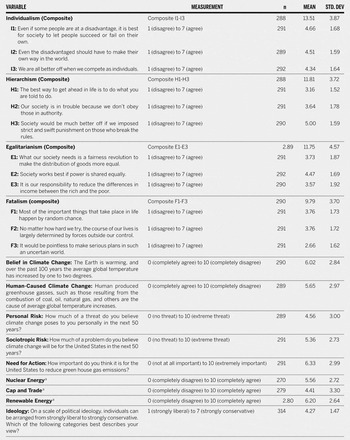
Respondents were asked five questions to elicit their opinion on climate change (with labels for these questions given in parentheses): (1) Whether or not they believe that temperature has increased over the past 100 years (Belief in Climate Change); (2) Whether or not they believe that climate change is caused by humans (Human-caused Climate Change); (3) How much of a threat they believe climate change is to them personally (Personal Risk) and (4) society more generally (Sociotropic Risk); and (5) How important they believe it is that the US take action to reduce greenhouse gas emissions (Need for Action). Additionally, respondents were asked whether they supported or opposed three frequently mentioned policy solutions for climate change: Nuclear Energy, Cap and Trade (a market-based system regulating carbon emissions), and Renewable Energy. Table 1 summarizes relevant descriptive characteristics for these dependent variables.
Ideology, Cultural Types, and Climate Change Opinion—Survey Questions and Average Responses

a Due to space considerations, wording for these questions are not included in table 1. Please contact the author for more information.
Respondents were also asked 12 randomly ordered CT questions: three of the 12 questions correspond to one of the four CT types. Each question asks the respondent to place themselves on a scale from one to seven, where one is strongly disagree and seven is strongly agree (see table 1). Each measure of CT used in the following analysis is a summation of the three questions related to each cultural type and ranges from three to 21. Control variables in the model include Gender, Climate Change Knowledge, Ideology, and Education. Table 1 summarizes relevant descriptive characteristics for these independent variables as well.
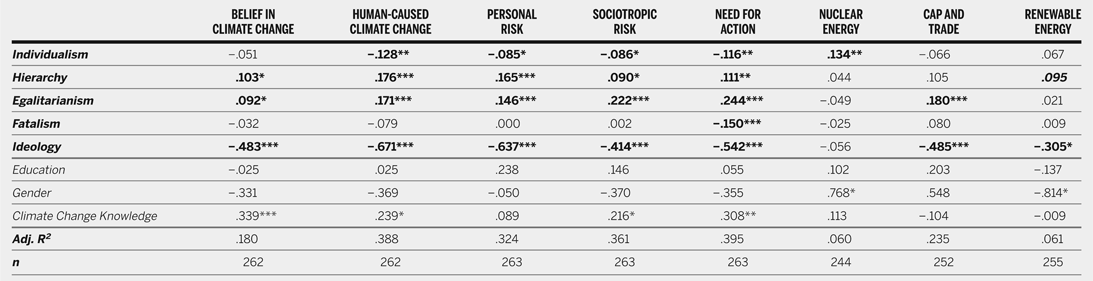
OLS regression analysis is used to assess the relationship between CT and climate change opinion and policy preferences. Table 2 illustrates OLS regression partial coefficients for the examined dependent variables.
Ideology, Cultural Types, and Climate Change, OLS Estimates

* p < .05,
** p < .01,
*** p < .001 (one-tailed)
Due to space and journal content considerations, standard errors, constants, and F-statistics are not reported. Please contact the author for this information.
Ideology performs as previous research expects (Jones Reference Jones2010; Leiserowitz Reference Leiserowitz2006; Wood and Vedlitz Reference Wood and Vedlitz2007; Zia and Todd Reference Zia and Todd2010). As their level of conservatism increases, respondents are less likely to believe climate change is real, that it is caused by humans, and that it poses a threat to them as an individual or to society. Regarding policy preferences, the more conservative a respondent, the less they were likely to support either cap-and-trade regulation or renewable energy. Interestingly, ideology shows no statistically significant relationship to preferences for nuclear energy. Clearly, an ideological divide on the issue of climate change exists. Is the division more nuanced than a simple uni-dimensional distinction between liberals and conservatives? The CT variables in table 2 tell us something different from the ideology measure.
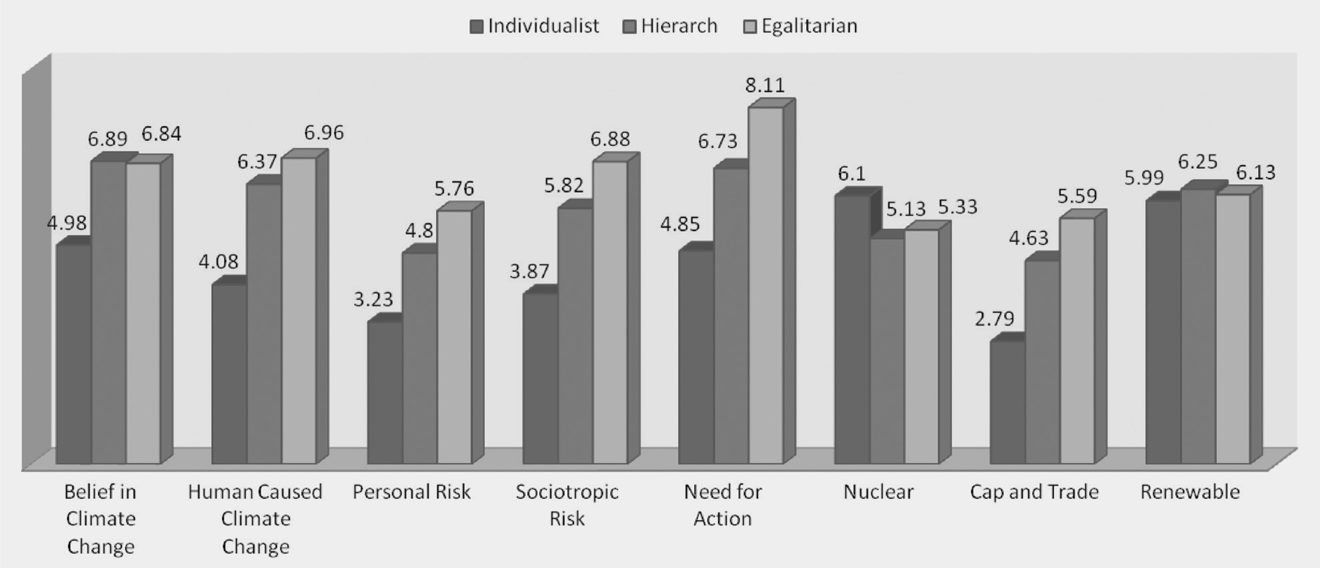
The individualist story is as past research suggests. Individualists are less likely to believe that average global temperature increases are human-induced and, unsurprisingly, individualists are also more likely to view climate change as less of a threat to them personally or society more generally. As a solution to climate change, individualists are more likely to prefer nuclear energy. Also as expected, egalitarians are the exact opposite of individualists. Egalitarians are more likely to believe climate change is real, that humans caused it, and that it is dangerous to both themselves and the broader society. Egalitarians prefer cap and trade as a solution to climate change. Unexpectedly, hierarchs closely align with the egalitarians, with the only difference being that hierarchs do not favor a specific solution for climate change (although their preference for renewable energy approaches statistical significance). Fatalist measures fail to produce significance in all but one regression. The single significant finding shows that fatalism is negatively associated with a perceived need to take action to mediate climate change. Taken in total, the findings suggest an unanticipated cultural coalition between hierarchs and egalitarians who believe climate change is a real threat worthy of action. Opposing this position are the individualists and perhaps the fatalists who probably oppose taking action related to any problem whatsoever.Footnote 4 How closely aligned are the hierarchs and egalitarians? How far away are the individualists? To help unpack each cultural type's positions on climate change, figure 1 illustrates these relationships.
Average Climate Change Opinion and Preferences, by Strong Cultural Type

For figure 1, mean values are reported for three of the four types.Footnote 5 Cultural type categories were generated by selecting the summative CT measure (reported in table 1) that the respondent scored highest on (i.e., egalitarianism, individualism, or hierarchy). For example, if a respondent scored a 20 on egalitarianism, a nine on individualism, a seven on fatalism, and a 12 on hierarchy, that respondent was categorized as a strong egalitarian. Ties were removed from the analysis. Figure 1 shows that hierarch and egalitarian means are quite similar regarding believing that climate change is real and human caused. However, hierarchs also believe climate change to be much less of a threat than egalitarians and are also less interested in taking action. Similarly, the difference between individualists and the other two cultural types is stark. It is clear that even if individualists believe the temperature has changed, generally they do not think it is human-caused or much of a risk. However, there is some hope for compromise in these data. When it comes to policy solutions, a potential compromise position may be found in renewable energy and perhaps in nuclear energy.
DISCUSSION
This brief analysis set out to deploy CT to help explain the divergence in opinion on the issue of climate change between the public and the majority of scientists. To help illustrate the utility of CT, the approach taken here is also a comparative one, looking at CT and ideology side-by-side. As anticipated, CT and ideology tell different stories. The story told by ideology is straightforward—conservatives are much less likely to agree with the majority of scientists and, as such, are less likely to support climate change mediating policies. Liberals, by definition, are the exact opposite. If we only had the ideology measure, then the implication of such consistent findings, all pointing in the same direction, is that climate change is simply a partisan issue, perhaps akin to many other partisan issues such as abortion, gun rights, and gay marriage (although CT-based analyses show more complex patterns of support and opposition on these issues as well, see, e.g., Gastil et al. Reference Gastil, Braman, Kahan and Slovic2011, this issue). With such contentious partisan issues a compromising middle ground appears difficult to find. CT, however, takes us in a different direction.
Hierarchs and egalitarians have similar—but not the same—preferences and opinions related to climate change. Both groups align with the majority in the scientific community. They believe climate change is real, a threat, worthy of action, and tilt towards specific solutions. However, they likely agree with the majority of scientists for different reasons. On one hand, hierarchs value social structures that stratify and place people in their appropriate roles. Scientists could easily be construed as part of a legitimate system of social stratification for many hierarchs. Egalitarians, on the other hand, view nature as incredibly fragile, with humans capable of doing irreparable harm to the environment. For the egalitarian, climate change likely poses a threat to the species, is brought about by a select few corporate and industrial interests (fed by consumerism), and is thus a particularly nefarious collective threat. Meanwhile, individualists, committed to an unconstrained life of freedom to do as they choose, ardently resist claims of human-induced climate change and any notion of threat that would accompany accepting such claims. They likely resist these claims for, at least, two reasons. First, their view of nature is that the environment is resilient. Even if momentarily out of balance, the individualist believes the environment will quickly and naturally return to equilibrium as nature (including humanity, which is part of nature) adapts. Second, climate change solutions necessarily involve extensive regulation of individual choices and likely come with either the creation of new governmental hierarchies or the reinforcement of existing ones. This is hardly the kind of world the individualist is likely to prefer. Interestingly, individualists seem quite willing, however, to support nuclear energy. Finally, there is the fatalist. Fatalists are largely irrelevant, except for the notion that they are more likely to not want to take action. This result is exactly what CT predicts for the fatalist types.
Most importantly, perhaps, CT findings point to a possible compromise position among the three politically relevant cultural types (i.e., individualists, egalitarians, and hierarchs) for policy makers interested in finding public policies that support the majority scientific opinion. Clearly, people with egalitarian and hierarchical tendencies support such efforts. Individualists are the main obstacle: they oppose the idea that climate change is a threat, but they are not, in principle, opposed to solutions. Egalitarians, hierarchs, and individualists all have positive average preferences for nuclear energy (see figure 1), and individualists strongly support this policy solution. Although none of the cultural types showed statistically significant relationships with renewable energy, egalitarians, hierarchs, and individualists generally support renewable energy policies, with mean preferences near six on a scale from zero to ten (again, see figure 1). In fact, none of the cultural types have statistically significant negative relationships with any of the three policy solutions. Perhaps, a mutually agreeable solution for these three cultural types could be found. For example, renewable energy could be sold on a national platform as an opportunity for Americans to innovate and compete in the global market. This strategy would appease individualistic tendencies, while satisfying hierarchs and egalitarians that something is being done about the threat they both see in climate change. In fact, as some cultural theorists suggest, such broad cultural coalitions may be generally required for radical policy change (Coyle and Wildavsky Reference Coyle and Wildavsky1987; but see also Lockhart Reference Lockhart, Ellis and Thompson1997; Lodge and Wegrich Reference Lodge and Wegrich2011, this issue; Swedlow Reference Swedlow2011, this issue). In any case, a CT-based analysis identifies bases for compromise that are not as evident when looking solely at the ideological proclivities of the American public.