





Introduction
It is well established that some articulatory movements are more complex than others due to biomechanical constraints on speech production (e.g., Donegan & Stampe, Reference Donegan, Stampe and Dinnsen1979; Hayes & Steriade, Reference Hayes, Steriade, Hayes, Kirchner and Steriade2004; Jesus & Trabelsi, Reference Jesus, Trabelsi, Gonçalo Oliveira and Amaro2024; Kirchner, Reference Kirchner, Hayes, Kirchner and Steriade2004; Ohala, Reference Ohala1997a; Patience, Reference Patience2022; Solé, Reference Solé2010; Ziegler et al., Reference Ziegler, Lehner, Pfab and Aichert2021). Indeed, it is believed that one of the primary factors that shapes a language’s sound system is articulatory simplicity; small inventories have articulatorily simple sounds, whereas articulatorily complex sounds only tend to be present in larger inventories (Bybee & Easterday, Reference Bybee and Easterday2023; Lindblom & Maddieson, Reference Lindblom, Maddieson, Hyman and Li1988). Articulatory complexity is also considered to be one of the sources of sound change (Beddor, Reference Beddor2023; Blevins, Reference Blevins2004, Reference Blevins2006; Lindblom et al., Reference Lindblom, Guion, Hura, Moon and Willerman1995; Recasens, Reference Recasens2014; Solé, Reference Solé2002, Reference Solé2010; Vennemann, Reference Vennemann, Hoole, Bombien, Pouplier, Mooshammer and Kühnert2012). For example, word/syllable-final obstruent devoicing is a common diachronic process. The complexity of voicing final obstruents may lead to devoicing, which, when combined with perceptual factors, can act as a catalyst for sound change (Blevins, Reference Blevins2006; Ohala, Reference Ohala1997b). Articulatorily complex segments and processes are also generally acquired later by infants (e.g., Jesus & Trabelsi, Reference Jesus, Trabelsi, Gonçalo Oliveira and Amaro2024; Kent, Reference Kent, Ferguson, Menn and Stoel-Gammon1992) and by adults learning a non-native language (e.g., Colantoni & Steele, Reference Colantoni and Steele2008; Patience, Reference Patience2018, Reference Patience2022; Yavaş, Reference Yavaş1997), and they tend to be the most challenging for speakers with certain speech disorders (e.g., Kent, Reference Kent, Ferguson, Menn and Stoel-Gammon1992; Galluzzi et al., Reference Galluzzi, Bureca, Guariglia and Romani2015). Given the important role of biomechanical constraints in shaping speech production patterns, it is common for researchers to test hypotheses or explain results by referring to articulatory complexity or a related construct (e.g., for recent studies on sound change, see Bybee & Easterday, Reference Bybee and Easterday2023; Hoole, Reference Hoole, Aziz Hanna and Smith2022; Nance & Kirkham, Reference Nance and Kirkham2022; Sneller, Reference Sneller2020; for speech disorders, see Romani et al., Reference Romani, Galluzzi, Guariglia and Goslin2017; Ziegler et al., Reference Ziegler, Lehner, Pfab and Aichert2021; for L1 acquisition, see Howson & Redford, Reference Howson and Redford2021; Jesus & Trabelsi, Reference Jesus, Trabelsi, Gonçalo Oliveira and Amaro2024; for L2 acquisition, see Patience & Steele, Reference Patience and Steele2023; Zhou & Rato, Reference Zhou and Rato2024).
However, explaining results with reference to articulatory complexity requires caution. Complexity and difficulty are distinct constructs (see Section “Articulatory complexity versus articulatory difficulty: Related but distinct constructs”), and articulatorily complex movements are not necessarily more difficult (Pouplier, Reference Pouplier, Solé and Recasens2012). The relationship depends largely on the metric used for operationalizing complexity, which is not consistent in the literature. For example, Colantoni and Steele (Reference Colantoni and Steele2008) explained their L2 production results by referring to articulatory complexity, as determined by biomechanical constraints; Romani et al. (Reference Romani, Galluzzi, Guariglia and Goslin2017) based their predictions of speech errors on markedness constraints, under the assumption that such constraints reflect articulatory complexity; Jesus and Trabelsi (Reference Jesus, Trabelsi, Gonçalo Oliveira and Amaro2024) made predictions of L1 acquisition of consonants according to Lindblom and Maddieson’s (Reference Lindblom, Maddieson, Hyman and Li1988) scale of articulatory complexity, which is based on whether consonant articulations deviate from a neutral articulatory position and default phonation.
The different ways in which complexity is operationalized can lead to different predictions about which articulatory movements are most susceptible to sound change, likely to be acquired later, or be produced incorrectly in disordered speech. An additional limitation is that many of these articulatory complexity metrics are only capable of determining complexity according to segments that make up an articulatory class (e.g., voiced obstruents, voiceless stops, and high vowels). They are less useful for comparing the relative complexity of segments that belong to different classes. Consequently, developing models of speech production that can reliably predict which articulatory movements are difficult remains challenging; nevertheless, such models are crucial for understanding which speech production patterns are shaped by biomechanical constraints.
To determine when articulatory complexity reflects articulatory difficulty (AD), it is necessary to distinguish between these constructs and to evaluate which complexity metrics are most informative for predicting difficulty. The goal of this paper is to provide an overview of frequently used methods for establishing articulatory complexity, evaluating their effectiveness in predicting AD, and highlighting their implications for research on speech production. A central claim is that complexity alone is often not sufficient for determining AD, because articulatorily complex movements do not necessarily have articulatory consequences (e.g., non-target realizations). A second goal is therefore to discuss methods that can be used to assess AD more directly.
In the next section, I define the constructs of articulatory complexity and AD, emphasizing why the distinction is important. I then review several commonly used methods for operationalizing articulatory complexity. In Section “Experimental approaches to determining articulatory difficulty,” I examine experimental approaches used to assess AD. The paper concludes by revisiting the importance of the complexity–difficulty distinction for understanding speech production patterns and identifying avenues for future research.
Articulatory complexity versus articulatory difficulty: Related but distinct constructs
As discussed in the previous section, articulatory complexity and AD are two distinct constructs. Nevertheless, some work in the literature treats difficulty not as a possible consequence of complexity, but as part of the definition of complexity itself. For example, Jesus and Trabelsi (Reference Jesus, Trabelsi, Gonçalo Oliveira and Amaro2024) explicitly define articulatory complexity as “the level of difficulty in producing a consonant, considering the movements and coordination of the speech articulators” (p. 1). Lindblom (Reference Lindblom, Lacerda and Bjursäter2011) also links articulatory complexity to AD. In discussing the formation of phonological inventories, he notes that “ease of articulationFootnote 1 is an intuitively appealing explanatory principle” and that “one approach to quantifying this notion was proposed by Lindblom and Maddieson (Reference Lindblom, Maddieson, Hyman and Li1988)” (p. 4). The Lindblom and Maddieson approach, discussed in Section “Lindblom and Maddieson (Reference Lindblom, Maddieson, Hyman and Li1988),” is a scale of articulatory complexity. When discussing acquisition, Lindblom further suggests that children learning their L1 will “search for the phonetic forms of the ambient language in the direction of articulations of low complexity. By staying “easy to produce” a sound system would supplement the child’s attempt to imitate what she hears” (p. 7). Maddieson (Reference Maddieson, Pellegrino, Marsico, Chitoran and Coupé2009) makes the connection even more explicit in his discussion of how complexity can be defined, suggesting that “a more comprehensive approach” may involve “making the common equation of complexity with difficulty” (p. 13). In this view, a linguistic element or pattern is more difficult if it is more complex.
Other examples in which complexity and difficulty are sometimes equated can be found when articulatory complexity scales are considered to be measures of difficulty. Dworzynski and Howell (Reference Dworzynski and Howell2004), for example, describe Jakielski’s Index of Phonetic Complexity (see Section “Jakielski (Reference Jakielski1998)”) as a measure of difficulty: “The second metric to specify the level of phonetic difficulty of words was developed by Jakielski (Reference Jakielski1998)” (p. 152). Later in the same paper, they describe words with intermediate index scores as “medium difficult words,” but then characterize words with higher index scores as “phonetically a lot more complex” (p. 164). Thus, the same metric is used to describe both difficulty and complexity: “an initial rise and medium difficult words being then stuttered at more or less the same rate with an additional rise when words become phonetically a lot more complex” (p. 164). Wolk and LaSalle (Reference Wolk and LaSalle2014) also appear to treat the two constructs as equivalent, asking whether consonants and consonant sequences “may be considered more complex or difficult to produce” (p. 2), and subsequently define phonological complexity as “the level of difficulty of a sound in terms of developmental norms, linguistic complexity and motor production” (p. 3). Overall, the examples presented here demonstrate how the difference between terms such as complexity and difficulty is not always explicit, and the usage suggests that they are to some degree considered to be synonyms of the same construct.
Given this tendency to conflate the two constructs, it is important to begin with clear definitions of articulatory complexity and AD. I follow Dahl (Reference Dahl2004), who discusses linguistic complexity as it relates to grammatical development. He proposes that complexity describes elements of an entire system objectively, whereas difficulty exists at the level of a speaker. While Dahl was not referring specifically to articulation, his conceptualization is useful for the distinction here. Accordingly, “complexity” should be used as a descriptive term to make reference to articulatory configurations that are complex according to at least one criterion. Examples of criteria that have been used to determine complexity include articulatory characteristics, such as number of gestures or degree of articulatory displacement; aerodynamic characteristics, such as the size of the supraglottal cavity above the constriction and its consequences for maintaining voicing; timing-based characteristics, such as whether gestures are coordinated in-phase or anti-phase; and typological or developmental criteria, such as crosslinguistic frequency or order of acquisition (for detailed descriptions, see Section “Approaches to articulatory complexity”).
To illustrate, consider Lindblom et al. (Reference Lindblom, Diehl, Park, Salvi, Clements and Ridouane2011), who compared the articulatory displacement of several consonants in different vocalic environments.Footnote 2 The authors find that the displacement for a uvular place of articulation was greater than the displacement for a velar place of articulation in the /i/ context. According to this metric, a uvular target is more complex than a velar target. This is an objective statement in the sense that it is easily comparable across articulations and it is not dependent on a particular speaker or task. The distance will always be longer for the uvular place of articulation. Moreover, this definition of complexity can be evaluated vis-a-vis the production of different segments. For example, Lindblom also found that the uvular place of articulation requires a greater degree of displacement than a palatal place. In keeping with Dahl’s conceptualization, this evaluation of complexity is not dependent on a speaker or task; it is simply based on an objective metric of comparison (i.e., the degree of displacement). Whether the additional displacement results in greater difficulty would depend on the speaker, the task the speaker is performing, and the way in which difficulty is measured:
Difficulty is a notion that primarily applies to tasks, and, as already noted, is always relative to an agent: it is easy or difficult for someone. Difficulty can of course be understood and measured in many ways. One measure of the difficulty of a task is in terms of “risk of failure”—that is, if a large proportion of all agents fail or one agent fails more often than he or she succeeds, the task is difficult for that agent or group of agents. (p. 39)
This definition highlights that what is articulatorily difficult is specific to a speaker (i.e., an agent in Dahl’s terms) and may vary across groups of speakers and tasks (e.g., what is articulatorily difficult for a child, an adult L2 speaker, and a speaker with a speech disorder may not be the same). AD manifests in some form of articulatory consequence, which can be assessed using different measures. One of these measures is accuracy, which corresponds to Dahl’s term “risk of failure.” For each attempted articulation, the speaker either achieves or fails to achieve the target (i.e., produces a [non-]target realization). The proportion of times that the target is achieved (i.e., percent accuracy) can be used as a measure of difficulty.
Considering again the degree of displacement, one potential articulatory consequence would be undershoot for a uvular place of articulation relative to a velar place, due to the greater displacement required for the former. A given group of speakers may therefore have greater difficulty producing a complete closure for /q/ compared to /k/. Importantly, however, such difficulty cannot be assumed solely on the basis of displacement and must be evaluated for a particular speaker population. For L1 Hul’q’umi’num’ speakers, who maintain a velar–uvular contrast, uvular closure may not pose substantial AD. In contrast, L1 English learners of Hul’q’umi’num’ may experience greater difficulty achieving the uvular target because the contrast is absent from their native phonological system.
More generally, as highlighted in the definition, what is difficult is not fixed across speakers or tasks and may therefore manifest differently depending on the population and context under investigation. For this reason, the degree of AD can change with practice (Stoel-Gammon, Reference Stoel-Gammon2011; Bybee, Reference Bybee2015), as shown in studies where increased experience with a given articulation or sequence was associated with reduced difficulty (e.g., Ben-David & Icht, Reference Ben-David and Icht2018; Tomaschek et al., Reference Tomaschek, Tucker, Fasiolo and Baayen2018). In the example above, the AD experienced by L1 English learners would likely diminish or even disappear with practice.
Difficulty can also be assessed in other ways, including via measures of articulatory stability or coordination. The specific metric used to measure difficulty depends on the research goal and should be selected according to the type of articulatory consequence under investigation, such as why voicing may be more difficult to maintain in velar than bilabial stops (Ohala, Reference Ohala1997a; Yavaş, Reference Yavaş1997) or why VC coordination shifts toward a CV-like pattern as speaking rate increases (Tuller & Kelso, Reference Tuller and Kelso1991). In Section “Experimental approaches to determining articulatory difficulty,” we explore different approaches to assessing AD.
The distinction between complexity and difficulty can help illustrate why the former does not necessarily entail the latter. Articulatory complexity metrics compare properties of articulations that are generally stable across tasks, whereas AD reflects the production consequences associated with those properties for a specific group of speakers performing a given task. In the present paper, I therefore consider complexity and AD as related but different constructs: an articulation may be complex according to a given metric, such as number of gestures, degree of displacement, timing demands, or various biomechanical constraints (see Section “Approaches to articulatory complexity”), but whether that complexity corresponds to AD for a particular group of speakers in a given task is an empirical question.
With this framework in place, two key assumptions follow. First, although articulatory complexity can be used descriptively without implying that it reflects AD, its explanatory relevance depends on whether it does, in fact, have articulatory consequences. If a complexity metric does not correspond to AD, then any relationship between that complexity metric and patterns in acquisition, sound change,Footnote 3 or disordered speech may be attributable to some other factor rather than the assumed role of AD. Likewise, difficulty is outcome-based: an articulation is difficult when the speaker fails to achieve the intended speech target, or when production shows measurable consequences according to another relevant metric. Such consequences may contribute to sound change and non-target production in language learners or speakers with speech disorders. The perspective taken in this paper is that articulatory complexity is most useful for explaining speech production patterns when it reflects AD. In Section “Approaches to Articulatory Complexity,” we evaluate which complexity metrics are most informative.
Second, many terms are used in the literature to refer to complex or difficult articulations, including articulatory simplicity, maximally natural (Lindblom & Maddieson, Reference Lindblom, Maddieson, Hyman and Li1988), articulatory ease, articulatory effort, articulatorily elementary (Lindblom, Reference Lindblom1990b), elaborated articulations (Lindblom, Reference Lindblom1990b), articulatory economy (Ladefoged, Reference Ladefoged1990), articulatory cost (e.g., Kirchner, Reference Kirchner1998), and phonological consequences (Ohala, Reference Ohala1997a), among others. From the term alone, it is not always clear whether these labels refer to complexity, AD, or both. The definitions proposed above help clarify this distinction. Any objective articulatory description that establishes an asymmetry between structures can be understood as a measure of articulatory complexity. Thus, statements such as “an articulation involving more gestures than another,” “a segment requiring greater articulatory displacement than another,” or “gestures coordinated in an in-phase mode are more stable than those coordinated in an anti-phase mode” could be interpreted as metrics of complexity.
Approaches to articulatory complexity
In this section, several approaches to operationalizing articulatory complexity are reviewed. The discussion focuses primarily on segments and segmental sequences, rather than suprasegmental phenomena such as tone, stress, or intonation. Nevertheless, the central distinction developed here also applies to suprasegmentals: a tone pattern, stress pattern, or intonational contour may be complex according to a given metric, but whether that complexity results in AD depends on the speaker, task, context, and measure used. The goal is not to cover all possible forms of complexity, but to review the approaches to articulatory complexity most commonly used in research on speech production.
Note that the approaches discussed in this section are not necessarily intended by their authors as measures of AD. Following Section “Articulatory complexity versus articulatory difficulty: Related but distinct constructs,” however, they are evaluated here primarily in terms of their likelihood of reflecting AD; that is, whether they provide a plausible basis for predicting which articulatory configurations are likely to have articulatory consequences and are therefore best suited for explaining production patterns.
Markedness
Markedness is often used to infer or explain what sounds are challenging for learners to acquire (e.g., Eckman, Reference Eckman, Hansen Edwards and Zampini2008; Gnanadesikan, Reference Gnanadesikan, Kager, Pater and Zonneveld2004; John & Rigoulot, Reference John and Rigoulot2023; Lleó, Reference Lleó2002, Reference Lleó2016; Rowe & Levine, Reference Rowe and Levine2018). Similarly, markedness is used to predict which sounds will be most difficult for speakers with certain learning disorders (e.g., Black & Nozari, Reference Black and Nozari2023; Romani et al., Reference Romani, Galluzzi, Guariglia and Goslin2017; Storkel, Reference Storkel2018; Wolk, Reference Wolk1986) and to predict and explain sound change processes (e.g., Apostolopoulou, Reference Apostolopoulou2022). While markedness relations are valuable, the construct is not always useful for determining whether an articulatory movement or sequence is difficult. Criticisms of markedness and its explanatory value are not new, yet markedness continues to be used as a marker of articulatory complexity. For this reason, in this section I will summarize the main limitations of using markedness as a measure of articulatory complexity that reflects AD.
There are many methods for determining markedness in a contrasting set of sounds, such as by examining phoneme frequency in the world’s phonemic inventories, order of acquisition in children (see Section “L1 order of acquisition”), phonological processes (e.g., marked forms are less susceptible to deletion and assimilation processes), and typological implicational markedness, among others. Some of the frequently discussed markedness relationships include: complex onsets are more marked than singleton onsets (Clements & Keyser, Reference Clements and Keyser1983); glottalized consonants are more marked than non-glottalized consonants (Greenberg, Reference Greenberg1966); nasal vowels are more marked than oral vowels (Greenberg, Reference Greenberg1966); coronal places of articulation are less marked than labial and dorsal places of articulation (Paradis & Prunet, Reference Paradis, Prunet, Paradis and Prunet1991). While certain markedness relationships may be due in part to AD, there are at least three limitations to using markedness to determine AD.
First, while marked phenomena are generally less common, markedness is a descriptive concept that lacks explanatory adequacy, i.e., it does not explain why marked sounds are less common. In fact, markedness is used with different, sometimes contradictory meanings. For example, unmarked phenomena are considered more natural, more frequent, articulatorily more simple, perceptually more salient (sounds with robust spectral cues) or more universal, among other characteristics (Rice, Reference Rice and Lacy2007). Hume (Reference Hume, Van Oostendorp, Ewen, Hume and Rice2011, p. 95) also observes that unmarked sounds can be perceptually less salient (sounds with weak spectral cues), based on the observation that less perceptually salient sounds are more prone to deletion, assimilation, and reduction. The occurrence of these processes is frequently used as a metric for determining markedness; sounds that undergo these processes are considered to be unmarked, whereas sounds resistant to these processes are considered marked. Therefore, when using these processes as criteria for determining markedness, it is not uncommon for unmarked sounds to be perceptually weak (Hume, Reference Hume, Van Oostendorp, Ewen, Hume and Rice2011). The fact that the basis for determining which sounds are marked is not always clear is one reason why markedness is not particularly useful for determining whether a sound is articulatorily difficult.
Second, scholars arrive at sometimes contradictory findings regarding markedness, and markedness has even been argued to be language-specific (Hume, Reference Hume2003). Consider place of articulation. As discussed above, coronal place of articulation is generally considered to be unmarked (de Lacy, Reference De Lacy2006; Paradis & Prunet, Reference Paradis, Prunet, Paradis and Prunet1991; Rice, Reference Rice1996). However, Hume suggests that labial could also be considered the unmarked place of articulation. She bases this argument on several criteria that are frequently used for establishing markedness relations. For example, she argues that labials have been shown to be less salient than other places of articulation in languages such as English and Japanese. Less salient sounds are often considered unmarked; therefore, labials must be unmarked in such languages. Hume also provides evidence from Sri Lankan Portuguese Creole suggesting that labials are the unmarked place of articulation. She reveals that labial nasals, as opposed to coronal and dorsal nasals, are deleted before a word beginning with a vowel or /j/, and that labial nasals, unlike coronal nasals, assimilate to the place of articulation of the following consonant across morpheme boundaries. Segments that are more likely to undergo deletion or assimilation processes are generally considered unmarked. Therefore, these data (and several others presented by the author) suggest that labials are unmarked. Based on this and other observations, Hume argues that markedness should be determined on a language-specific basis, given that labials are only less marked in some languages, whereas coronals are unmarked in others (note that glottal and dorsal places of articulation have also been argued to be less marked, depending on the language of analysis; see Iverson & Kim, Reference Iverson and Kim1987; Lombardi, Reference Lombardi2002). Hume demonstrates that there is not always agreement on what is marked, as it depends on the data (i.e., language, process) being observed. Moreover, not all scholars agree as to what constitutes valid criteria for determining markedness relations (see de Lacy, Reference De Lacy2006, and Hume, Reference Hume, Van Oostendorp, Ewen, Hume and Rice2011 for discussion). Given the fact that markedness relations can vary by language, and that there is often disagreement regarding what is marked, we should not assume that marked sounds are always articulatorily difficult.
Third, markedness is generally determined by comparing members of an articulatory class (e.g., voiceless and voiced stops). It is not always possible to compare members across classes unless the markedness criteria are based on phoneme frequency or L1 order of acquisition. For example, a markedness relation might reveal that stops are less marked than fricatives, and velars are less marked than uvulars (de Lacy, Reference De Lacy2006). Based on these markedness relations, it is not possible to compare /x/ and /q/. In terms of manner, the fricative /x/ is more marked than the stop /q/, whereas when one considers place of articulation, /q/ should be more marked than /x/. Due to the fact that only members of a class can be compared amongst themselves, it is not possible to create hierarchies of markedness of sounds from different sets. Consequently, markedness relations are often insufficient for comparing the potential difficulty of a large set of sounds. While using L1 order of acquisition data to determine markedness avoids this limitation, such an approach is also problematic (see discussion in Section “L1 order of acquisition”).
Given the identified limitations, assuming markedness reflects AD is problematic. As Maddieson (Reference Maddieson, Hardcastle and Laver1999, p. 622) states, when discussing observations of universal tendencies:
Observing a pattern of cross-language similarities is only a very preliminary step. Understanding the basis on which the pattern is founded is the primary goal. What seems to be a unified pattern may have several causes, and conversely a single effect may have different outcomes depending on variations in other factors.
Universal patterns can help identify which articulatory movements might have greater articulatory complexity and are therefore worth examining in more detail. For example, one could examine the articulatory characteristics of highly marked sounds, with the goal of finding an explanation for why such sounds are marked. A large amount of the work on articulatory and aerodynamic constraints has taken this approach, in keeping with Maddieson’s claims that “understanding the basis on which the pattern is founded is the primary goal.” Some of these constraints are discussed in Section “Articulatory and aerodynamic constraints.”
L1 order of acquisition
As mentioned in the previous section, markedness relations are sometimes inferred from L1 order of acquisition, with later-acquired segments often treated as more marked than earlier-acquired segments. A similar logic is sometimes used to determine articulatory complexity: if a segment or sequence is acquired later, it is assumed to be more articulatorily complex (and/or difficult). For example, after presenting asymmetrical L1 English acquisition patterns of coda versus onset stop + /s/ and nasal + /z/ clusters, Xu Rattanasone and Demuth (Reference Xu Rattanasone and Demuth2014, p. 648) suggest that “this asymmetry may be due to articulatory constraints: /s, z/ as a final member of a cluster (e.g., kicks) may be easier to produce than as part of a fricative + stop cluster word-initially (e.g., skate).” For other recent examples, see Moore (Reference Moore2018, p. 936): “By extension, consonants that are more complex to articulate (i.e., later-developing phonemes)”; Amoako et al. (Reference Amoako, Stemberger, Bernhardt and Tessier2020, p. 33): “consonants with less complex articulation appeared earlier than those with more complex articulation: stops and nasals were generally ahead of fricatives and affricates”; and Hurtado and Estrada (Reference Hurtado and Estrada2010, p. 75): “it is one of the last segmental features to be mastered by native speakers (Jimenez, 1987). Due to the complexity of the production of trills, some native speakers favor other Spanish variants.”
These examples demonstrate that it is sometimes assumed that articulatory complexity plays a major role in explaining L1 acquisition patterns. However, equating later acquisition with greater articulatory complexity presupposes that later acquisition has an articulatory basis. Other factors may also be involved, including perceptual salience and input frequency. More salient structures may be acquired earlier because they are more easily discriminable by learners (Archer et al., Reference Archer, Zamuner, Engel, Fais and Curtin2016; Narayan et al., Reference Narayan, Werker and Beddor2010). Similarly, more frequent sounds have been shown to be acquired more rapidly by children (de Boysson-Bardies & Vihman, Reference De Boysson-Bardies and Vihman1991; Edwards et al., Reference Edwards, Beckman and Munson2015; Másdóttir & Stokes, Reference Másdóttir and Stokes2016). Given these potential confounds, L1 acquisition patterns alone do not allow us to reliably infer that the relevant complexity is articulatory in nature.
Further evidence against order of acquisition as a reliable metric of articulatory complexity comes from the fact that acquisition patterns are often different across languages. For example, Bedore (1999, as cited in Cataño et al., Reference Cataño, Barlow and Moyna2009) observes that Spanish-speaking children acquire /l/ at as early as 2.6 years, and as late as 3.6 years. English children, on the other hand, do not acquire /l/ until 5.6 years, or even as late as seven years (Cataño et al., Reference Cataño, Barlow and Moyna2009). Language differences have been reported for other sounds as well (e.g., see McLeod & Crowe, Reference McLeod and Crowe2018 for a crosslinguistic analysis of 27 languages), as have individual differences within the same language (e.g., Chirlian & Sharpley, Reference Chirlian and Sharpley1982; Goad & Ingram, Reference Goad and Ingram1987; Vihman & Greenlee, Reference Vihman and Greenlee1987). Any metric developed solely based on the order of L1 acquisition of segments may come to different conclusions regarding their articulatory complexity, depending on the language and specific study from which the data originate.
An additional limitation of using L1 order of acquisition as a complexity metric is that what is difficult for children is not necessarily difficult for adults, in large part because children are still developing oral motor skills. Children must acquire the ability to move and shape the tongue in a variety of ways, whereas adults have already acquired the articulatory movements of their native language. Thus, articulations that are challenging during development may not be equally difficult for adults (see Kent, Reference Kent, Ferguson, Menn and Stoel-Gammon1992, and Mugitani & Hiroya, Reference Mugitani and Hiroya2012, for several other differences between children and adults). Moreover, the types of articulations possible for children at each stage are limited by biomechanical constraints. Consequently, certain articulations are more challenging for children than for adults (Green & Nip, Reference Green, Nip, Maassen and van Lieshout2010). For example, up until approximately age two, precise motor control of jaw height is limited. This, combined with weak jaw-lip coordination, may explain why children have difficulties with certain vowels and thus only produce vowels involving more extreme jaw positions (e.g., /i/, /u/, /o/, and /ɑ/). This is also likely why children are more successful with lip rounding when the jaw is in a high position (Namasivayam et al., Reference Namasivayam, Coleman, O’Dwyer and Van Lieshout2020).
The discussion in this section has demonstrated several limitations of using L1 acquisition order as a metric for articulatory complexity. Acquisition patterns are influenced by a range of factors beyond articulation; therefore, later-acquired structures cannot be assumed to reflect articulatory factors alone. As a result, complexity determined by L1 acquisition order is unlikely to provide a reliable measure of AD. Despite these limitations, articulatory complexity scales based on L1 acquisition patterns continue to be widely used as predictors of speech production patterns, especially in research on disordered speech and, to a lesser extent, in acquisition studies. Two such scales are discussed in Section “Articulatory complexity scales.”
Articulatory and aerodynamic constraints
Articulatory and aerodynamic constraints are biomechanical and aerodynamic limitations on how speech sounds can be produced and coordinated within the vocal tract. These constraints are often assumed to be (at least) partly responsible for observed patterns in sound change, acquisition and speech disorders. For example, Ohala (Reference Ohala1997a) describes what he refers to as the “aerodynamic voicing constraint” (AVC) and subsequently discusses “some phonological generalizations owing in part to the AVC” (p. 2), such as the tendency for fricatives to have a stronger bias for voicelessness than stops. Similarly, Yavaş (Reference Yavaş1997) examines whether the AVC plays a role in L2 acquisition (see details in Section “Experimental approaches to determining articulatory difficulty”), finding that L2 coda voicing patterns mirror the constraints from the AVC. In this section, I will summarize several constraints, in order to illustrate how these constraints can be interpreted as metrics of complexity that likely reflect which articulatory movements may be difficult. The discussion focuses on stops, fricatives, and coda voicing.
First, let’s consider voiced stops, and the statements of complexity in (1) and (2), which are based on well-established phonetic constraints.
-
(1) Voiced obstruents are more complex than voiceless obstruents.
In order for voicing to occur, subglottal air pressure must remain sufficiently greater than supraglottal air pressure to maintain transglottal airflow (Ohala, Reference Ohala1997a). The vocal tract constrictions in obstruents (complete closure or narrow constrictions) cause the supraglottal air pressure to build. Once the transglottal pressure differential (i.e., subglottal minus supraglottal pressure) falls below the level required to sustain vocal-fold vibration, voicing ceases. Active expansion of the vocal tract, achieved through articulatory movements such as lowering of the larynx or downward motions of the tongue body and tongue tip (Westbury, Reference Westbury1983), contributes to maintaining the necessary transglottal pressure (Willerman, Reference Willerman1994). If we compare the size of the oral cavity in stop production at different places of articulation, a bilabial stop will have a larger oral cavity than a velar stop. The smaller cavity associated with a velar stop would therefore lead to a more rapid build-up of supraglottal air pressure and make maintaining voicing more complex according to this aerodynamic criterion (Ohala, Reference Ohala1997a), as expressed in (2).
-
(2) It is more complex to voice obstruents as the place of articulation becomes more posterior.
This constraint illustrates how differences in supraglottal cavity size can affect the aerodynamic conditions for maintaining voicing. If this complexity corresponds to AD,Footnote 4 maintaining voicing should be more difficult for a velar stop than for a bilabial stop. Such difficulty may explain crosslinguistic patterns: among voiced stops, gaps tend to be more common for velars than for labial or coronal stops (Sherman, 1975, as cited in Ohala, Reference Ohala and MacNeilage1983). The constraint in (2) would also predict greater devoicing of velars than of bilabial and alveolar stops in L2 production (see discussion of Yavaş, Reference Yavaş1997, in Section “Experimental approaches to determining articulatory difficulty”).
Phonetic constraints related to fricatives can also be used for proposing complexity relations:
-
(3) Fricative articulations are more complex than stop articulations.
Fricatives require precise aerodynamic conditions for their production. The velocity of air through the vocal tract and the size of the aperture determine the change from laminar flow to turbulence, as indexed by the critical Reynolds number (Shadle, Reference Shadle1985). As the aperture decreases at a given flow, Reynolds number will increase. Once the threshold value is reached, there will be turbulence (i.e., frication). The articulatory requirements of fricatives are very precise, resulting in a more delicate control required for their production (Hardcastle, Reference Hardcastle1976; see also Willerman, Reference Willerman1994). Small changes in the vocal tract can hinder production of frication; such a high degree of precision is not required in the production of stops (Ohala & Solé, Reference Ohala, Solé, Fuchs, Toda and Zygis2010).
The statements in (1)–(3) indicate that certain segments are complex, due to articulatory and aerodynamic constraints. However, while these constraints can help us predict what segments will be difficult to articulate, they are only useful for determining AD if we compare sets of segments that are similar except for a single constraint. For example, based on (3), we should expect a fricative to be more difficult to realize than a stop, but only if everything else required for the production of the two sounds is equal (e.g., same place of articulation, voicing, position in the word). /χ/ should therefore be more difficult than /q/.
One of the challenges with predicting the difficulty of a given segment is that the articulatory movements may be subject to more than one constraint. The question then becomes how to predict the degree of AD when there are multiple constraints. One possibility would be to assign one point to a segment for each known constraint; segments with the highest sum might then be the most difficult. Some complexity scales have been created adopting this or a similar approach (e.g., Lindblom & Maddieson, Reference Lindblom, Maddieson, Hyman and Li1988; Willerman, Reference Willerman1994). The most frequently used scales will be discussed in Section “Articulatory complexity scales.” While such an approach is straightforward, makes clear predictions, and allows the comparison of any number of sounds, it has at least two limitations. First, it is possible that one type of constraint results in a higher degree of AD than another. In this situation, a simple summing of the number of constraints will not make accurate predictions regarding how difficult a set of segments will be to produce.
To exemplify this point, consider the complexity statements in (4)–(5):
-
(4) Retroflex and uvular constrictions are more complex than those of bilabials, alveolars or velars (Lindblom & Maddieson, Reference Lindblom, Maddieson, Hyman and Li1988; Lindblom et al., Reference Lindblom, Diehl, Park, Salvi, Clements and Ridouane2011; Willerman, Reference Willerman1994).
-
(5) Voicing is more complex for fricatives than for stops (see Ohala, Reference Ohala and MacNeilage1983, Reference Ohala1997a for discussion of phonetic constraints related to voicing stops versus fricatives).
Now, consider the following three segments. For each one, the constraints that make the sounds complex, based on (1)–(5), are listed in square brackets.
/χ/ Voiceless uvular fricative [3, 4]
/ɖ/ voiced retroflex stop [1, 4]
/z/ voiced alveolar fricative [1, 3, 5]
All three segments have characteristics that make them complex. Which of the three segments should be the most difficult to articulate? On the one hand, we could anticipate that /χ/ and /ɖ/ would have the same level of difficulty, given that they have the same number of articulatory constraints (two each); likewise, /z/ would be the most difficult, due to the three constraints. However, it is unknown whether each constraint contributes equally to AD.
The second reason that a simple summing of articulatory constraints may be inadequate for determining difficulty is that two articulatory constraints might interact with each other. For example, even if we assume that retroflex and uvular places of articulation have a similar degree of complexity, as implied in (4), we might find that creating frication with a uvular constriction is more difficult than creating frication with a retroflex constriction, or vice versa.
Overall, articulatory and aerodynamic constraints have a great deal of explanatory power, given that they are grounded in biomechanical limitations. For this reason, considering these constraints provides a useful starting point for establishing whether a given articulatory movement, or set of movements, is likely to result in difficulty. However, as highlighted in this section, the potential for using phonetic constraints to quantify AD is still somewhat limited. In order to develop theories of speech that account for AD (e.g., a theory that can predict how AD will influence sound change, language acquisition, or disordered speech), it is often necessary to create hierarchies of AD of larger sets of sounds. Depending on the language combination, this would include comparing sounds that vary in terms of articulatory targets, degrees of constriction, and voicing. Even if we knew every possible articulatory constraint, they would not be sufficient to compare the relative degree of difficulty of various segments. One possible solution is presented in Section “Experimental approaches to determining articulatory difficulty.”
Articulatory effort
An additional way in which complexity has been theorized is through the concept of articulatory effort (e.g., Boersma, Reference Boersma1998; Flemming, Reference Flemming, Hayes, Kirchner and Steriade2004; Kirchner, Reference Kirchner1998; Lindblom & Maddieson, Reference Lindblom, Maddieson, Hyman and Li1988; Lindblom et al., Reference Lindblom, Diehl, Park, Salvi, Clements and Ridouane2011; Willerman, Reference Willerman1994; Zhang et al., Reference Zhang, Li, Wu, Xie, Lin, Zhang, Heřmanský and Černocký2021; Ziegler et al., Reference Ziegler, Lehner, Pfab and Aichert2021). More effortful articulations are often assumed to have articulatory consequences, and are therefore sometimes treated as more difficult. For this reason, articulatory effort has been used to explain lenition processes (Kirchner, Reference Kirchner1998), sound change (e.g., Boersma, Reference Boersma1998; Lindblom et al., Reference Lindblom, Guion, Hura, Moon and Willerman1995), and speech errors (e.g., Kuruvilla-Dugdale & Mefferd, Reference Kuruvilla-Dugdale and Mefferd2022; see Cantor-Cutiva et al., Reference Cantor-Cutiva, Ensar, Castillo-Allendes, Whitling, Searl and Hunter2025, who report on 16 studies referring to articulatory effort in research on speech disorders), and is a frequently used Optimality Theory constraint (AlOtaibi et al., Reference AlOtaibi, AlQenaie and Park2022; Boersma, Reference Boersma1998; Kirchner, Reference Kirchner1998; Nandelenga, Reference Nandelenga2022).
For example, Lindblom et al. (Reference Lindblom, Guion, Hura, Moon and Willerman1995) argue that speech production reflects a continuous trade-off between communicative demands and articulatory economy. In their adaptive model of sound change, speakers are assumed to produce speech along a continuum ranging from more effortful, perceptually explicit (“hyper”) forms to less effortful, reduced (“hypo”) forms, depending on contextual factors such as predictability and listener needs (see also Lindblom’s [Reference Lindblom1990a] H&H theory). Within this framework, speakers tend to favor productions that reduce articulatory effort when communicative demands allow, which can lead to systematic patterns of phonetic variation. For instance, they note that “assimilations are bio-mechanically easier to produce” (p. 26), which may partially explain the frequent occurrence of assimilatory patterns in connected speech.
Articulatory effort is sometimes explicitly assumed to be a source of difficulty. In a study on the L2 acquisition of the Spanish rhotics /ɾ r/ by L1 English speakers, Hurtado and Estrada (Reference Hurtado and Estrada2010) noticed accuracy differences depending on the word position of the rhotics and the place of articulation of preceding consonants. The authors attribute this difficulty in part to articulatory effort: “The effort involved in the articulation of previous consonants, and the articulatory effort associated to the position of the vibrants within the word are significant factors in the pronunciation of the Spanish vibrants” (p. 81).
Note that some scholars use other terminology, such as articulatory demands (Kuruvilla-Dugdale & Mefferd, Reference Kuruvilla-Dugdale and Mefferd2022) or articulatory cost (Lindblom & Maddieson, Reference Lindblom, Maddieson, Hyman and Li1988).Footnote 5 Nevertheless, what unifies these works and what justifies treating these terms as synonyms of articulatory effort is a similar approach to determining complexity, generally based on distance traveled, energy expended, or a deviation from neutral position.
Boersma (Reference Boersma1998) proposes several factors that influence the effort required to articulate a given segment: energy (e.g., longer distances and moving larger articulators involve more energy and therefore effort), number of gestures (additional gestures are more effortful), and precision (articulatory movements such as fricatives require a more precise articulation, resulting in greater effort). For other similar approaches, see Kirchner (Reference Kirchner1998), Kuruvilla-Dugdale and Mefferd (Reference Kuruvilla-Dugdale and Mefferd2022),Footnote 6 and Elie et al. (Reference Elie, Šimko, Turk, Skarnitzl and Volín2023).
The articulatory constraints discussed by Boersma seem logical. A heavier, slower object, a longer distance, an additional gesture, or a higher degree of precision should increase the effort expended. However, as was highlighted previously, additional complexity, or effort, does not necessarily have articulatory consequences. Let’s first consider the concept of energy expenditure. Boersma (Reference Boersma1998) and Kirchner (Reference Kirchner1998) propose many variables that would be needed to compute the energy that a movement requires, such as time, the distance that the articulator travels, and the velocity and mass of the articulator, among others. While it may be theoretically possible to accurately calculate the energy of an articulation (for example, see Lindblom et al., Reference Lindblom, Diehl, Park, Salvi, Clements and Ridouane2011, who attempt to quantify the degree of energy expenditure by calculating the distance the articulator needs to travel from rest position), such a calculation would be highly complex, and these data are not easily determined. Moreover, Pouplier (Reference Pouplier, Solé and Recasens2012) argues against energy expenditure as a reliable metric of articulatory effort. She discusses evidence from velar loops, which consist of VCV articulations in which the intervocalic velar consonant is articulated with a forward looping motion. This results in the tongue dorsum gesture moving away from the retracted position required for a back vowel, such as in [uɡu]. The dorsum fronting gesture of [ɡ] before a posterior vowel increases the distance that the articulator has to travel, which, based on Boersma’s proposal, would require more effortful production. However, Pouplier refers to work by Perrier et al. (Reference Perrier, Payan, Zandipour and Perkell2003), which demonstrates that it is the anatomical makeup of the tongue and hard palate that causes the forward movement of the tongue in velar loops. Their findings reveal that it is in fact less effortful for the dorsum to move forward, despite traveling a longer distance. Based on Pouplier’s argument, even if we quantify articulatory displacement, it may not be a reliable measure of the total degree of effort required.
A similar conclusion was reported in Van Lieshout (Reference Van Lieshout2017). He investigated the production of /VpV/ sequences with different flanking vowels, designed to create contexts differing by the degree of articulatory displacement (e.g., /iːpæ/ ≈ /uːpɑː/ > /iːpɪ/ > /uːpʊ/). The stimuli were produced at a habitual, slow, and fast rate. Van Lieshout found that the coordination stability was lower in the sequences that required a shorter articulatory displacement, suggesting that these sequences were more difficult (for additional details of this study, see Section “Other approaches to measuring articulatory difficulty”).
Regarding the number of gestures, many speech researchers consider additional gestures (or a similar concept) to result in greater complexity (e.g., Best & Hallé, Reference Best and Hallé2010; Boersma, Reference Boersma1998; Gick et al., Reference Gick, Wilson and Derrick2013; Hardcastle, Reference Hardcastle1976). Gick et al. (Reference Gick, Wilson and Derrick2013) state that segments consisting of two lingual gestures are generally quite complex, given that the two gestures must be carefully coordinated during articulation. They also argue that segments with more constriction locations have a higher degree of complexity, providing the example of [ɹ], which consists of labial, palatal, and pharyngeal constrictions. Hardcastle (Reference Hardcastle1976) views complexity according to the number of “articulatory parameters” required for a segment’s production. He discusses the articulation of /s/, which involves all seven lingual parameters that are used in speech, according to his model. The first four include the horizontal and vertical movements of the tongue body and tongue tip. The other three consist of the tongue body’s movement in a convex or concave pattern with respect to the palate, and the degree of grooving, which involves the tongue tip/blade, although this can extend the length of the tongue, depending on whether the tongue is spread or tapered. Hardcastle argues that complexity could be defined by considering both the number of the seven lingual parameters necessary for an articulation, and the degree of control required by the parameters. Based on this definition, the articulation of /s/ is considered to have a high degree of complexity, given that its production involves all seven lingual parameters, and some of the parameters, such as the degree of tongue grooving required for the /s/ articulation, require very precise control: “In general, complex articulations would involve a greater number of the seven articulatory parameters than less complex articulations” (p. 135).
Pouplier (Reference Pouplier, Solé and Recasens2012) also considers the role of additional gestures, but she proposes that additional gestures do not always result in a higher degree of effort. She refers to speech error research (Pouplier & Goldstein, Reference Pouplier and Goldstein2010), which has found that, when errors occur with repetitive realizations of the top cop /tɑp kɑp/ phrase, instead of a single alveolar and velar gesture with the initial consonant of each word, speakers produce both gestures twice in an overlapping manner in the pre-vocalic phase. Pouplier suggests that this is due to a natural tendency towards a 1:1, in-phase pattern. This pattern is a type of “rhythmic synchrony” (p. 155) that surfaces in challenging contexts, such as when speed requirements increase. She proposes that this optimal coordination leads to increased stability, and argues that additional stability is in fact less complex. Based on this argument, additional gestures may not necessarily increase articulatory effort, as complexity may be greater in less stable patterns of articulatory coordination. This issue is revisited in Section “Other approaches to measuring articulatory difficulty” in the discussion of stability measures for assessing AD.
The articulatory precision constraint discussed by Boersma (Reference Boersma1998) and Kirchner (Reference Kirchner1998) is arguably the least controversial. As discussed in (3) above, some articulations such as fricatives and trills are subject to strict articulatory configurations, which are necessary to realize the target manner. Small deviations in the articulatory configuration could potentially lead to failed fricatives or trills. Kirchner (Reference Kirchner1998) formalizes precision as the relationship between articulatory and acoustic variability, such that articulatory movements are more precise when small articulatory variation leads to large acoustic consequences. He treats precision not as an independent source of difficulty, but as an indicator of articulatory effort: “I understand precision not as a distinct kind of articulatory difficulty, but rather as an alternative strategy for getting at effort comparison” (p. 52). In this sense, fricatives and trills are more effortful and this effort results in greater difficulty: “The difficulty associated with greater precision is ultimately reducible to the notion of effort developed above” (p. 52; see Hardcastle, Reference Hardcastle1976, for a related account of the precise articulatory control required for fricatives; see also Ohala & Solé, Reference Ohala, Solé, Fuchs, Toda and Zygis2010, on the difficulty of fricative production).
Articulatory effort metrics have the advantage that they can be applied to any sound, not only to a set of sounds from the same class. For example, the number of gestures and energy expenditure can be compared quantitatively across segments. Another advantage proposed by Boersma and other authors is that articulatory effort could potentially account for difficulty that arises in sound sequences, by summing the number of gestures, the distance traveled, and the total amount of energy used. Nevertheless, as Pouplier (Reference Pouplier, Solé and Recasens2012) argues, we cannot assume a priori that producing two compared to a single gesture is more difficult. We need to consider the possibility that one highly complex gesture could result in a greater degree of difficulty than two simple gestures. Number of gestures is therefore not likely to reliably reflect AD. The concept of energy expenditure is also problematic, as it is challenging to calculate, and higher energy expenditure may not necessarily result in a more difficult articulation.
Intergestural timing and coordination
A further source of articulatory complexity concerns not only which gestures are produced, but how they are coordinated in time. In Articulatory Phonology (Browman & Goldstein, Reference Browman and Goldstein1992) and the task-dynamic model of motor control (Kelso et al., Reference Kelso, Saltzman and Tuller1986; Saltzman, Reference Saltzman1985), speech gestures are not only specified by their constriction targets, but also by their temporal organization relative to other gestures. This organization is formalized through a coupled-oscillator model of gestural planning (Nam et al., Reference Nam, Goldstein, Saltzman, Pellegrino, Marsico, Chitoran and Coupé2009), in which each constriction gesture is linked with a planning oscillator, and the relative timing of gestures is determined by coupling relations among those oscillators. These coupling relations can be represented in a coupling graph, where nodes correspond to gestures and edges specify whether the target specification is in-phase or anti-phase (Goldstein et al., Reference Goldstein, Nam, Saltzman, Chitoran, Fant, Fujisaki and Shen2009). In this model, syllable structure is partly defined by patterns of intergestural coordination: onset consonants in a CV syllable are coupled in-phase with the following vowel, whereas coda consonants in a VC syllable are coupled anti-phase with the preceding vowel.
This framework provides a way of treating timing as a metric of articulatory complexity. Research on gestural coordination has shown that in-phase coordination can be more stable than anti-phase coordination under certain experimental conditions. One can interpret this in terms of complexity. Coordinating a consonant and vowel in an in-phase relationship (e.g., CV) is less complex than coordinating the timing of a consonant and vowel in an anti-phase relationship (e.g., VC). This asymmetry has been used to explain why CV structures are more common crosslinguistically (Nam et al., Reference Nam, Goldstein, Saltzman, Pellegrino, Marsico, Chitoran and Coupé2009), are acquired earlier than VC structures (Goldstein et al., Reference Goldstein, Nam, Saltzman, Chitoran, Fant, Fujisaki and Shen2009), and why VC sequences may shift toward CV-like timing patterns when produced at faster rates (Tuller & Kelso, Reference Tuller and Kelso1991; see also Section “Other approaches to measuring articulatory difficulty”).Footnote 7
Timing complexity may also arise when multiple coupling demands must be satisfied simultaneously. For example, onset clusters are modeled as involving competing coupling relations: each consonant is coupled in-phase with the vowel, but the consonants must also be at least partially sequential in order to remain perceptually recoverable. This means that consonant gestures in an onset cluster may be coupled both to the vowel and to one another (Goldstein et al., Reference Goldstein, Nam, Saltzman, Chitoran, Fant, Fujisaki and Shen2009), which can be interpreted as a more complex coordination structure than a singleton onset. The greater the number of timing relationships, the greater the complexity. This type of complexity is thus not based on the number of gestures but instead on the coordination of gestures.
Conceptualizing complexity and its relation to difficulty in this way helps clarify the Pouplier (Reference Pouplier, Solé and Recasens2012) example discussed in the previous section. If difficulty were determined simply by the number of gestures, then producing two gestures should always be more difficult than producing one. Nevertheless, Pouplier argues that additional gestures may sometimes result from a shift toward a more stable coordination pattern. In speech error tasks involving phrases such as top cop, speakers sometimes produce both alveolar and velar gestures in an overlapping manner, which would be considered a more complex articulation according to the articulatory effort metrics discussed in the previous section. However, from the perspective of timing relations, this pattern can be interpreted as a shift towards a more stable (less complex) in-phase relation among gestures. In other words, the relevant metric of complexity here is not (only) the number of gestures, but the stability of the coordination relation among them, such as whether gestures are coordinated in-phase or anti-phase. A sequence with fewer gestures may be more difficult if it requires a less stable temporal organization, whereas a sequence with more gestures may be less difficult if those gestures are organized in a more stable timing relation (see further discussion in Section “Other approaches to measuring articulatory difficulty”).
A related way of understanding timing-based complexity is provided by Tilsen’s (Reference Tilsen2016) selection–coordination theory. Tilsen distinguishes between competitive control, in which gestures are selected sequentially, and coordinative control, in which multiple gestures are co-selected and temporally regulated as a unit. Tilsen explains L1 development using this framework, arguing that developmental patterns in speech are shaped by changes in how articulatory gestures are organized and controlled. Specifically, children initially rely on competitive selection of gestures, often producing structures like CCV as separate “co-selection sets” (e.g., {C}{CV}), and only later develop coordinative control that allows for stable temporal overlap within a single set (e.g., {CCV}). In this framework, patterns such as coda deletion and cluster simplification are at least partly due to limitations in the ability to organize and coordinate gestures. For example, compensatory vowel lengthening can be interpreted as a selection error: when a coda consonant is omitted, the preceding vocalic gesture may be reselected in its place, causing the vowel to lengthen. Thus, such patterns reflect not simply deletion, but difficulty suppressing one gesture while selecting and coordinating the next (see also Nam et al., Reference Nam, Goldstein, Saltzman, Pellegrino, Marsico, Chitoran and Coupé2009, for predictions and explanations regarding L1 acquisition patterns).
A limitation of timing-based complexity is that it is best suited to comparing sequences or structures whose coordination relations are known, such as CV versus VC or singleton onsets versus onset clusters. It is less useful for ranking individual segments or comparing unrelated sounds, because timing relations do not by themselves capture the complexity of the gestures being coordinated. For example, the model may predict that an in-phase relation is more stable than an anti-phase relation, but this does not allow us to directly compare a simple gesture in an anti-phase relation with a spatially or aerodynamically complex gesture in an in-phase relation. In such cases, the relative degree of AD can only be determined experimentally, through measures such as timing variability, accuracy, or phase stability.
Summary of articulatory complexity metrics
Taken together, the approaches reviewed in this section show that articulatory complexity can be operationalized in several ways, but that these metrics differ considerably in how directly they are likely to reflect AD. Metrics grounded in biomechanical constraints and coordination stability provide the most reliable predictions about possible articulatory consequences, whereas markedness and L1 acquisition patterns may reflect multiple non-articulatory factors, and articulatory effort does not necessarily correspond to difficulty. Nevertheless, no single metric is sufficient for predicting difficulty in all contexts. Table 1 summarizes the complexity metrics reviewed in this section.
Summary of articulatory complexity metrics

Table 1. Long description
A table with four columns and five rows. The columns are labeled Method, Operationalized, Value for predicting AD, and Main limitations. The rows are labeled with different methods and their corresponding operationalized metrics, values for predicting AD, and main limitations.
One of the major limitations of the measures of complexity discussed up to this point is that most are not well suited to comparing segments across articulatory classes. The following section discusses four complexity scales that can quantify or hierarchically rank segments by degree of complexity, rather than being limited to comparisons among sounds within a single set.
Articulatory complexity scales
Kent (Reference Kent, Ferguson, Menn and Stoel-Gammon1992)
The first scale of articulatory complexity to be reviewed here is based on Kent (Reference Kent, Ferguson, Menn and Stoel-Gammon1992). He examines how the physiological mechanisms involved in segmental articulation become increasingly complex as children advance through successive stages of development. These stages are compared to the phonetic inventories of children with speech disorders (reported in Dinnsen et al., Reference Dinnsen, Chin, Elbert and Powell1990), based on the assumption that complex sounds are acquired later by children and are more difficult for children with disordered speech (see also Jakobson, Reference Jakobson1968). Kent observes similarities between the inventories of the two groups of speakers, which he takes as evidence confirming the segments’ articulatory complexity. Based on his observations, he proposes four stages of increasing complexity, presented in Table 2.
Stages of development summarized from Kent (Reference Kent, Ferguson, Menn and Stoel-Gammon1992, p. 75)

Table 2. Long description
A table with four rows and three columns detailing stages of articulatory development. Column headers are Stage, Main articulatory developments, and Segments/contrasts. The rows describe each of the four stages.
The stages proposed by Kent (Reference Kent, Ferguson, Menn and Stoel-Gammon1992) are not much different from a markedness scale based on L1 order of acquisition, but with an added analysis of the types of articulatory movements that are acquired at each of the four stages. Nevertheless, many studies have operationalized articulatory complexity as a four-point scale based on the segment groupings in Kent’s stages, using this scale to examine the role of articulatory complexity in both typical and disordered speech (e.g., Allison & Hustad, Reference Allison and Hustad2014; Cychosz, Reference Cychosz2017; Kim et al., Reference Kim, Martin, Hasegawa-Johnson and Perlman2010; Kuruvilla-Dugdale et al., Reference Kuruvilla-Dugdale, Custer, Heidrick, Barohn and Govindarajan2018; Stokes & Surendran, Reference Stokes and Surendran2005).
For example, Stokes and Surendran (Reference Stokes and Surendran2005) were interested in determining the relative roles of frequency, functional load, and articulatory complexity (operationalized as a four-level scale based on Kent, Reference Kent, Ferguson, Menn and Stoel-Gammon1992; see Table 3) on consonant development in children learning Cantonese, American English, and Dutch.
Operationalization of articulatory complexity in Stokes and Surendran (Reference Stokes and Surendran2005, p. 582) based on Kent (Reference Kent, Ferguson, Menn and Stoel-Gammon1992)

Table 3. Long description
A table with four rows and three columns comparing articulatory complexity values of consonants in English, Dutch, and Cantonese. The columns are labeled English, Dutch, and Cantonese. The rows are labeled with articulatory complexity values 1 through 4. Each row shows the segments at each complexity level in the three different languages.
Using results from previous work (on 188 children), they calculated correlations between either age of emergence (English, Cantonese) or production accuracy (English, Dutch) with their three independent variables. Articulatory complexity was strongly correlated with age of emergence in English and moderately correlated with age of emergence in Cantonese.Footnote 8 There was also a strong correlation between articulatory complexity and accuracy in English, and a moderate correlation between these variables in Dutch. The authors argue that “we found that ease of articulation accounted for how accurately a segment is articulated for English (40% of variance), but not Dutch (although r = –0.51, articulatory complexity accounted for only 10% of unique variance once frequency was accounted for)” (p. 588).
Kim et al. (Reference Kim, Martin, Hasegawa-Johnson and Perlman2010) examined consonant articulation errors in dysarthric speech from seven speakers with cerebral palsy who completed a word reading task. They calculated the number of errors and examined whether articulatory complexity (operationalized with the same scale as Stokes & Surendran, Reference Stokes and Surendran2005, for English) was a factor influencing the frequency of non-target productions. The results revealed that as the complexity increased, the accuracy score decreased. Based on their results and those from Stokes and Surendran (Reference Stokes and Surendran2005), they concluded that “sounds requiring fine, complex control of the articulators are more likely to be misarticulated in both dysarthric speech and the speech of normally-developing children during phonological acquisition” (p. 767).
In both studies, the authors assume that articulatory complexity, as operationalized according to the stages of acquisition reported in Kent (Reference Kent, Ferguson, Menn and Stoel-Gammon1992), contributes to AD. The other studies cited in this section adopt a similar approach, interpreting complexity according to Kent’s developmental stages and using it to explain patterns in production accuracy. However, because this operationalization is ultimately based on L1 order of acquisition, it is not clear that the observed effects can be attributed to AD per se. As discussed in the previous section, acquisition patterns are influenced by multiple factors beyond articulation, including perceptual, developmental, and language-specific variables. Consequently, metrics derived from L1 acquisition may not provide a reliable indication of AD, and observed relationships between the complexity scale and production outcomes should be interpreted with caution.
Jakielski (Reference Jakielski1998)
Another scale of complexity that is motivated by L1 acquisition patterns is Jakielski’s (Reference Jakielski1998, Reference Jakielski2022) Index of Phonetic Complexity (IPC), which was developed specifically “as a means of quantifying the motoric difficulty of clusters” (Jakielski, Reference Jakielski1998, p. 205). The index is based on phonetic patterns observed in babbling and early word production data presented in the work of MacNeilage and Davis (e.g., Davis & MacNeilage, Reference Davis and MacNeilage1995; MacNeilage & Davis, Reference MacNeilage, Davis and Jeannerod1990a, Reference MacNeilage, Davis, Hardcastle and Marchal1990b). The IPC is frequently used to quantify the articulatory complexity of words in studies of child and adult speech production across a range of languages, including Turkish (Aydin Uysal et al., Reference Aydin Uysal, Fidan, Al-Tamimi and Howell2021), French (Kehoe, Reference Kehoe2024), German (Dworzynski & Howell, Reference Dworzynski and Howell2004), English (Howell et al., Reference Howell, Au-Yeung, Yaruss and Eldridge2006; Quinn, Reference Quinn2021), Spanish (Howell & Au-Yeung, Reference Howell and Au-Yeung2007), and Russian (Gildersleeve-Neumann & Wright, Reference Gildersleeve-Neumann and Wright2010), among others. This index is created using a point system. Structures and sequences that surface in early babbling stages (e.g., basic CV syllable structures, stops, nasals, glides) are considered less complex, and no points are awarded. In contrast, structures and sequences present at later stages (e.g., fricatives, diphthongs, three-segment sequences) are considered more complex and are awarded a single point (Table 4).
Index of phonetic complexity from Jakielski (Reference Jakielski2022, p. 21)

Table 4. Long description
Table with 8 rows and 3 columns. The first column lists index numbers from 1 to 8. The second column lists phonetic features with no points assigned, such as labial or coronal. The third column lists phonetic features with one point assigned, such as dorsal or fricative. Each row represents the different criteria according to which complexity is determined.
An illustrative application of this scale is found in Dworzynski and Howell (Reference Dworzynski and Howell2004), who examined whether phonetic complexity contributes to stuttering rate. Their study included 50 German and 26 English child and adult speakers, and speech data were collected from semi-spontaneous interactions with a speech therapist. Using ANOVAs, the authors compared the IPC scores of stuttered versus non-stuttered words. They found that stuttered content words, but not function words, had higher IPC scores in both English and German, although this effect was restricted to adult speakers. In interpreting these results, the authors describe a relationship between phonetic complexity and stuttering, noting “an initial rise, with medium difficulty words being stuttered at more or less the same rate, followed by an additional rise when words become phonetically much more complex” (p. 164). Here, the classification of words as “medium difficulty” is derived directly from their IPC scores, demonstrating how phonetic complexity is effectively treated as a proxy for AD. However, because the IPC scale is itself based on L1 acquisition patterns, this interpretation has the same limitations as those discussed in Section “L1 order of acquisition.”
Lindblom and Maddieson (Reference Lindblom, Maddieson, Hyman and Li1988)
The third scale that we will consider was proposed by Lindblom and Maddieson (Reference Lindblom, Maddieson, Hyman and Li1988). These authors developed a scale of articulatory complexity based on the phonemic inventories of the world. They propose that consonant systems emerge according to two principles, namely, “maximal perceptual distinctiveness at minimum articulatory cost” (p. 72). They hypothesize that small inventories will have only articulatorily simple segments; as the size of the consonant system increases, so too will the complexity of the sounds of the inventories. To test their proposal, Lindblom and Maddieson (Reference Lindblom, Maddieson, Hyman and Li1988) investigated the consonants present in 317 languages from the UPSID database (Maddieson, Reference Maddieson1984). The languages in the database were selected to include a genetically stratified global sample of languages, varying greatly in terms of their phonemic inventories. For example, the smallest inventory in the database included 11 segments (Rotokas), whereas the largest involved 141 segments (!Xũ). The authors grouped all of the consonants from these languages into three categories: basic (least complex), elaborated, and complex (most complex). The complexity of consonants was established according to the degree of deviation from a default mode of phonation and the amount of articulatory displacement (i.e., the distance the articulators must travel from a rest position). Consonants that were considered to deviate from a default mode of phonation included voiced fricatives and affricates, because these manners of articulation favor voicelessness (see Ohala, Reference Ohala and MacNeilage1983); thus, voicing fricatives/affricates is assumed to be articulatorily complex. While the same case could be made for stops, Lindblom and Maddieson (Reference Lindblom, Maddieson, Hyman and Li1988) argue that the production of fricatives/affricates also requires the precise control of airflow, which makes them more complex. In contrast to fricatives, sonorants spontaneously voice; thus, voiceless sonorants were also identified as deviating from a default mode of phonation. Other features such as breathy and creaky voice, pre-and post-aspiration, pre-nasalization, and nasal release are also articulatorily complex. With respect to articulatory displacement, the consonants whose place of articulation involves the greatest displacement from the rest position include labiodentals, palato-alveolars, retroflexes, uvulars, and pharyngeals (bilabials, dentals/alveolars, palatals, and velars are all considered to be produced close to the rest position). The following secondary modifications are also labeled as complex: palatalization, labialization, pharyngealization, and velarization.
According to these phonetic principles of what is expected to be articulatorily complex (i.e., deviating from a default mode of phonation or departing from a near-rest position, according to the authors), Lindblom and Maddieson (Reference Lindblom, Maddieson, Hyman and Li1988) created the three categories of complexity mentioned above, which were used to group the segments from 317 languages. The basic category consists of all consonants lacking any of the complexity characteristics proposed by the authors above (e.g., /p t k b d ɡ ʔ m n l/).Footnote 9 The elaborated category consists of consonants with one level of complexity (i.e., whose production involves one of the complexity characteristics that the authors proposed, such as the voicing of fricatives or a uvular place of articulation). Finally, in the complex category, one finds consonants that contain two or more of the complexity characteristics, such as the voiceless uvular labialized stop /qʷ/, the voiced post-alveolar affricate /d͡ʒ/ or the voiced pharyngeal fricative /ʕ/. Based on these categorizations, Lindblom and Maddieson (Reference Lindblom, Maddieson, Hyman and Li1988) observe that the world’s smallest consonant systems are made up of consonants from the basic category. As inventories increase in size, elaborated consonants become present and increase in number. Consonants of the complex category are mainly only present in the largest consonant inventories, and also become more and more prevalent the larger the inventory. The fact that small inventories primarily have basic and no complex consonants, and complex consonants only emerge in the largest inventories, is taken by Lindblom and Maddieson (Reference Lindblom, Maddieson, Hyman and Li1988) as evidence that their grouping of consonants reflects their categorization of consonant complexity, under the assumption that inventories are developed in large part according to principles of articulatory complexity (see also Bybee & Easterday, Reference Bybee and Easterday2023, who further develop the Lindblom and Maddieson work, examining the extent to which sound change might be responsible for the process in which smaller inventories develop into larger ones).
The complexity scale proposed by Lindblom and Maddieson (Reference Lindblom, Maddieson, Hyman and Li1988) can be interpreted as a scale of articulatory effort, given that their definition of complexity aligns closely with the articulatory effort construct discussed in Section “Articulatory effort,” which was also based on concepts such as naturalness and deviation from a neutral articulatory position (i.e., in terms of articulatory displacement). While the authors do not explicitly state that their categorization is determined according to articulatory effort, related work by Lindblom and colleagues (e.g., Lindblom, Reference Lindblom1990b; Lindblom et al., Reference Lindblom, Guion, Hura, Moon and Willerman1995, Reference Lindblom, Diehl, Park, Salvi, Clements and Ridouane2011) does explicitly equate articulatory complexity with articulatory cost, which is synonymous with how articulatory effort was operationalized in Section “Articulatory effort.” More specifically, articulatory cost is defined in terms of “how far and how fast a given articulator moves from its rest position” (Lindblom et al., Reference Lindblom, Diehl, Park, Salvi, Clements and Ridouane2011, p. 77), where the rest position corresponds to a neutral configuration of the vocal tract. This perspective is further reflected in the discussion in Lindblom and Maddieson (Reference Lindblom, Maddieson, Hyman and Li1988) of a metaphor representing the trade-off between perceptual distinctiveness and articulatory economy: “At its core is seen a class of articulatory movements and positions that are maximally natural (minimally complex)” (p. 72).
Due to the similarity of this scale with the metrics used to define articulatory effort, the Lindblom and Maddieson scale inherits many of the same limitations when used to operationalize AD. There are also additional reasons to question whether the scale reflects AD. Complexity is inferred from an analysis of consonant inventories across the world’s languages, and Lindblom and Maddieson assume that such inventories emerge through the interaction of a low articulatory cost and maximal perceptual distinctiveness. Consequently, although the scale is presented as a measure of articulatory complexity, it cannot isolate the contribution of articulatory factors from perceptual ones. Some segments classified as complex may therefore owe their status, at least in part, to perceptual considerations rather than to production ones.
A further limitation is that each category contains a large number of segments. For example, the basic category includes more than fifteen consonants found in North American English, including /p t k b d ɡ ʔ f s h tʃ m n ŋ l w j/. Lindblom and Maddieson acknowledge that, ideally, complexity should be quantified in a way that permits ranking segments within each category. At minimum, then, it should not be assumed that all consonants within a given category are equally difficult to articulate. For instance, as noted in (1), voiced obstruents are more complex than voiceless obstruents, yet both voiced and voiceless stops are classified as basic in the Lindblom and Maddieson scale. Similarly, as discussed in Section “Articulatory and aerodynamic constraints,” work on phonetic constraints suggests that fricatives are more articulatorily complex than stops (Hardcastle, Reference Hardcastle1976; Ohala & Solé, Reference Ohala, Solé, Fuchs, Toda and Zygis2010). A more fine-grained scale would therefore be needed to capture additional levels of complexity. Nevertheless, the Lindblom and Maddieson scale remains one of the few attempts to rank a wide range of segments in terms of articulatory complexity without relying on L1 acquisition data. For this reason, it may be a useful starting point for formulating predictions about what is difficult to articulate.
The Lindblom and Maddieson scale has also been used in recent research as a metric of articulatory complexity. For example, Jesus and Trabelsi (Reference Jesus, Trabelsi, Gonçalo Oliveira and Amaro2024) apply the scale to predict the age of emergence of consonants in European Portuguese and Tunisian Arabic, while also considering ambient frequency and functional load. Their results indicate that articulatory complexity, operationalized using the Lindblom and Maddieson scale (with minor adjustments), was the strongest and only significant predictor of age of emergence across both languages.
Degree of articulatory constraint
Another way in which a segment’s complexity can be inferred is from its degree of articulatory constraint. The Degree of Articulatory Constraint (DAC) model (e.g., Recasens, Reference Recasens2014; Recasens & Espinosa, Reference Recasens and Espinosa2009; Recasens & Pallarès, Reference Recasens and Pallarès1999; Recasens et al., Reference Recasens, Pallarès and Fontdevila1997) was designed to predict and explain coarticulatory strength and direction, and is based on the premise that segments articulated with a more constrained tongue dorsum will be less susceptible to coarticulation. The more constrained segments are also expected to exert more coarticulatory influence on neighboring segments, especially in cases in which the neighboring segments are less constrained. While the model was not designed to predict articulatory complexity, given that more constrained segments require greater lingual control, the DAC value should reflect a certain type of articulatory complexity, and thus segments with higher DAC values might be more difficult to articulate.
To determine the relative degree of articulatory constraint of a given segment, the model assigns a DAC score based on the degree of tongue dorsum constraint, determined (for consonants) using their place and manner of articulation characteristics (see Recasens, Reference Recasens2014; Recasens et al., Reference Recasens, Pallarès and Fontdevila1997 for discussions regarding the DAC values). Bilabials receive a “1,” since they have little to no tongue dorsum constraint; a “2” is assigned to dentals and alveolars, given that they have some uncontrolled tongue dorsum movement. Alveopalatals, palatals, and velars are assigned a “3.” Manner of articulation can also increase the degree of constraint. Lingual fricatives and trills are considered highly constrained because of their articulatory and aerodynamic requirements; thus, segments such as /s/ and /r/ are assigned a DAC value of “3.” Coarticulatory effects are predicted in part by comparing the DAC value of the consonant with that of neighboring vowels (/i/ has a value of “3,” /a/ has a value of “2,” and /ə/ has a value of “1”). If the value of the consonant is greater, the vowel is generally more susceptible to coarticulatory effects from the consonant. If the DAC value of the consonant is lower than that of the vowel, the consonant is generally more susceptible to coarticulatory effects from the vowel. When the consonant and vowel have the same DAC value, the degree of coarticulation also depends on whether their articulatory gestures are compatible or antagonistic. In this sense, the DAC model effectively functions as a scale of articulatory constraint, and potentially of articulatory complexity that can predict AD.
A representative study using the DAC is Recasens et al. (Reference Recasens, Pallarès and Fontdevila1997), in which the authors examined the degree of coarticulatory constraint of seven segments /p n ɫ s ʃ ɲ k/, which varied in terms of their DAC values (1, 2, 3, 3, 3, 3, 3, respectively). Participants produced the seven segments in /iCi/, /aCa/, /iCa/, and /aCi/ contexts. Data were collected using an electropalatographic system (Hardcastle, Reference Hardcastle1972); acoustic information was also obtained in order to examine F2 values. Overall, the results confirmed the predictions of the DAC model. When a consonant had a higher DAC than the neighboring vowel (e.g., [aɲa]), C-to-V effects were particularly evident. In contrast, C-to-V effects were generally smaller when the vowel was equally constrained and the articulatory gestures were compatible (e.g., [iɲi]). V-to-C effects tended to be strongest with consonants that had lower DAC values than neighboring vowels (e.g., [ipi]).
While the DAC model can be seen as a type of complexity, the question that arises is whether this complexity also reflects AD. Some research suggests that it does. Patience (Reference Patience2022) investigated the degree of AD of seven Spanish segments ([m t β̞ ɣ̞ ɲ χ r]), and found the following hierarchy of AD (from least to most difficult) in native Spanish speakers: [m β̞] < [t] < [ɣ̞ ɲ χ r]. This hierarchy is the same as what the DAC model predicts for coarticulatory resistance (see Section “Experimental approaches to determining articulatory difficulty” for more details on the Patience, Reference Patience2022, study).
The strength of the DAC model is that its predictions have been tested and confirmed in many experimental studies (e.g., Recasens, Reference Recasens2002; Recasens & Espinosa, Reference Recasens and Espinosa2009; Recasens & Pallarès, Reference Recasens and Pallarès1999; Recasens et al., Reference Recasens, Pallarès and Fontdevila1997), generally using electropalatography or in some cases electromagnetic articulography (Recasens, Reference Recasens2002). These studies have analyzed numerous segments, as produced by Catalan speakers. The results from these studies are therefore easily applicable to the prediction of AD for a wide range of segments. A potential limitation of this model is that it only has three levels; it is possible that segments have more than three levels of difficulty. For example, consider the following segments: /ɲ χ r/. Based on the DAC score, the segments /ɲ χ r/ would be ranked with the same DAC value. Is it the case that these three segments have the same degree of AD, or would there be subgroups of difficulty among these segments? The Patience (Reference Patience2022) study cited above found that there was no difference for L1 Spanish speakers, but that for L2 Spanish speakers, [ɲ] was less difficult than [χ r]. We cannot rule out the possibility that for learners of a language with a large and highly complex consonant inventory there may be more than three levels of AD.
An additional limitation of considering the DAC as a metric for complexity is that the original DAC scale is primarily based on tongue dorsum constraint. While more recent formulations of the model consider other articulatory and aerodynamic constraints, the scale is not easily applicable to some dimensions of speech production, e.g., aerodynamic phenomena such as obstruent voicing and articulations involving the glottis (e.g., /h, ʔ/ and ejectives). Its predictions may therefore be more limited when applied to segments whose expected difficulty arises from articulatory or aerodynamic demands that are not captured by the scale. Consequently, while the DAC model provides a useful account of articulatory constraint and coarticulatory behavior, the three-level scale should not be assumed to provide a comprehensive measure of AD across all types of articulatory movements.
Summary of articulatory complexity scales
Overall, the scales reviewed in this section are potentially valuable because they are able to compare segments across articulatory classes, something that several of the complexity metrics discussed in Sections “Approaches to articulatory complexity” are generally unable to do. As a result, the scales can make predictions about which sounds or sound sequences may be more difficult to produce. Table 5 summarizes the scales reviewed in this section and evaluates their usefulness for predicting AD.
Summary of articulatory complexity scales

Table 5. Long description
A table comparing articulatory complexity scales and their value for predicting articulatory difficulty. The table has four rows and four columns. The columns are labeled Scale, Operationalized, Value for predicting AD, and Main limitations for predicting AD. Each row summarizes one of the scales.
Experimental approaches to determining articulatory difficulty
In the preceding sections, I have reviewed several approaches to articulatory complexity, highlighting both their explanatory strengths and their limitations for predicting AD. As was made clear in Section “Approaches to articulatory complexity,” there are many reasons why commonly used complexity metrics may not reflect AD or may not be sufficient for assessing AD across a large set of segments. Consequently, the best way to determine whether something is difficult is to test it empirically. This section examines experimental approaches that can be interpreted as measures that assess AD.
Like complexity, a central challenge in investigating AD lies in how it is operationalized. As discussed in Section “Articulatory complexity versus articulatory difficulty: Related but distinct constructs,” difficulty is inherently tied to performance and is relative to a speaker and task. What is difficult for one group of speakers may not be difficult for another (e.g., obstruent voicing might be difficult for L2 speakers, but not L1 speakers); or, alternatively, what is difficult in one task may not be difficult in another (e.g., coda voicing may be difficult in a task with a high degree of complexity, such as a speeded production task, but not in a simple word reading task).
Accuracy-based approaches
One of the most commonly used measures of difficulty is accuracy, typically defined as the proportion of attempts that attain an intended target. This aligns with Dahl’s (Reference Dahl2004) notion of “risk of failure” (see Section “Articulatory complexity versus articulatory difficulty: Related but distinct constructs”), according to which a task is more difficult if it results in a higher rate of unsuccessful attempts. Acoustic and articulatory measures can also sometimes function as accuracy measures when they assess whether a production meets a target criterion. For example, percent voicing in sounds that are expected to be voiced, or the duration of phonologically long versus short segments, can be interpreted as measures of how successfully speakers achieve the intended contrast.
Yavaş (Reference Yavaş1997) provides a typical example of an approach to studying AD. He tested whether coda voicing is difficult for L2 learners of English whose L1s lack voiced coda stops: Mandarin, Japanese, and Portuguese. The study was based on the aerodynamic voicing constraint discussed in Section “Articulatory and aerodynamic constraints,” according to which maintaining voicing becomes more complex as the supraglottal cavity becomes smaller. This was tested through place of articulation and vowel context: more posterior stops and stops following high vowels were expected to be more difficult because both contexts reduce the size of the supraglottal cavity needed to sustain voicing. Productions of word-final voiced stops (/b, d, ɡ/) were analyzed acoustically, and the proportion of voicing during the closure period was calculated and compared with that of L1 English speakers. The learners exhibited substantially more devoicing overall. Within the learner productions, devoicing was greater in contexts predicted to be aerodynamically unfavorable, particularly for velars following high vowels. The study found no significant main effect of L1, nor interactions between L1 and the aerodynamic factors examined, suggesting that speakers from the three L1 groups were similarly affected by the aerodynamic constraints on coda voicing.
This study demonstrates how a theoretically motivated phonetic constraint is sometimes examined in speech production research. Nevertheless, it is important to note the limitations of such an approach to difficulty. The goal of the study was to identify whether the production patterns reflected difficulty due to aerodynamic constraints, but the measure of difficulty (accuracy of voicing) may also have reflected factors other than AD (e.g., perception, assumed communicative need). Moreover, it is not possible to determine what each speaker’s target was, making it difficult to assess if the intended target was or was not reached. As a result, while the findings in Yavaş (Reference Yavaş1997) and studies using related methodologies are often consistent with the hypothesis that certain phonetic constraints result in more difficult articulations, they do not independently establish that AD is the causal factor.
An additional limitation of this type of study is that it cannot determine the degree of AD for a set of unrelated segments. Since the approach described in Yavaş (Reference Yavaş1997) analyzes a measure of difficulty with respect to a specific hypothesized constraint, it is only well suited to evaluating segments related to the constraint (e.g., voicing across different places of articulation), and not to comparing segments that are affected by different constraints. In some cases, it is desirable to determine whether a larger set of sounds differ in their degree of AD. We will now consider two studies in which this would be relevant.
Bybee and Easterday (Reference Bybee and Easterday2023) found that most consonant inventories have a limited set of what they refer to as “primal” consonants: /p t k b d ɡ m n ŋ s l/. In order to explain this pattern, they consider the potential role of articulatory complexity:
The familiarity of the set of consonants that emerged from our study as primal—/p t k b d ɡ m n ŋ s l/—seems to make linguists quite comfortable with a designation of these and others as “basic,” and with proposals that they exhibit low degrees of articulatory complexity. Yet it is a struggle to argue that this label is valid and coherent for this set of consonants…. But /s/ and /l/, which are seen as “basic” in most studies due to their frequency (Lindblom & Maddieson, Reference Lindblom, Maddieson, Hyman and Li1988; Maddieson, Reference Maddieson1984; Nikolaev & Grossman, Reference Nikolaev and Grossman2020), have little chance of qualifying for articulatory simplicity. (p. 28)
Many of the metrics discussed in Section “Approaches to articulatory complexity” would indeed classify /s/ and /l/ as more complex than several of the other primal segments, as suggested by the authors. If /s/ and /l/ are more complex, a logical follow-up would be to determine whether such complexity results in greater difficulty, which might be helpful in explaining the presence of /s/ and /l/ as primal consonants.Footnote 10 This then raises the question: how would one determine whether the primal consonants (/p t k b d ɡ m n ŋ s l/) differ in their degree of AD and/or to what extent they differ in their degree of AD when compared to non-primal consonants? Articulatory constraints would not be sufficient for addressing this issue, as they are primarily useful for predicting difficulty within an articulatory class. They can explain why one voiced stop is harder than another at a given place of articulation, but not whether a voiceless alveolar fricative is more difficult than a velar nasal.
Patience (Reference Patience2022) faced a similar problem, and his study illustrates one potential solution to determining the degree of difficulty of a large set of sounds. He sought to establish a hierarchy of AD for seven Spanish segments ([m t β̞ ɣ̞ ɲ χ r]) in both L1 and L2 speakers, in order to assess the role of AD in L2 production. Participants completed a task adapted from diadochokinetic methodologies commonly used in the speech sciences to isolate articulatory-motor execution from higher-level linguistic processes (e.g., Ben-David & Icht, Reference Ben-David and Icht2018; Slis & Van Lieshout, Reference Slis and Van Lieshout2013; Yaruss & Logan, Reference Yaruss and Logan2002). They were provided (auditorily) with a target VCV sequence and were required to produce the target at a rapid rate: either as rapidly as possible or at the speed of a metronome set to 90% of their maximum rate. In this study, the goal was not successful communication, but accurate and rapid articulation of the target VCV sequences. Patience combined speed and accuracy measures to calculate a relative ease of articulation (REA) score, which was then used to construct separate hierarchies of difficulty (from least to most difficult) for L1 speakers ([m β̞] < [t] < [ɣ̞ ɲ χ r]) and L2 speakers ([m] < [t β̞] < [ɣ̞ ɲ] < [χ r]). The complexity of the task helped reveal differences in difficulty that might not emerge in less demanding speaking contexts, in which sounds that vary by complexity might show no measurable difference in difficulty. Patience also analyzed error types, showing, for example, that target [r] was often produced as a fricative and target [β̞] as a stop. These error patterns are informative because they reveal not only which sounds are more difficult, but also how that difficulty is manifested in production. If a trill is systematically reduced to a fricative under highly demanding conditions, then similar reductions in communicative speech may plausibly reflect AD as well.
A key advantage of this design is that it was likely better suited to isolating AD than studies based on real-word production. Participants were given an explicit phonetic target and instructed to reproduce it accurately under rapid, highly controlled conditions. This differs from studies such as Yavaş (Reference Yavaş1997), in which participants produced real words and may have prioritized communicative goals over achieving the assumed phonetic target. In Patience (Reference Patience2022), the task therefore placed more direct pressure on the execution of articulatory movements, making it more likely that differences in speed and accuracy were evidence of relative AD. This methodology may also be useful for validating the complexity scales discussed in Section “Articulatory complexity scales,” since it allows many unrelated segments from different classes to be compared within the same experimental framework.
Nevertheless, one limitation of this study is that it relied largely on accuracy as a measure of whether speakers achieved the intended target. Accuracy-based approaches require some way of determining whether a production counts as target-like, yet this is often not straightforward in speech production research, especially when based only on acoustic analyses. There is also not always a clear consensus on how production targets should be defined, whether in articulatory, acoustic, or perceptual terms. Moreover, accuracy measures may not always reflect AD, since speakers might produce a target accurately while still doing so with greater instability or variability. The next section therefore considers other approaches to measuring AD.
Other approaches to measuring articulatory difficulty
In addition to accuracy-based measures, researchers have used other methods to assess difficulty in speech production, since difficulty is not always reflected in whether a target is achieved. It may also emerge in other aspects of production, including reduced articulatory stability or increased timing variability.
For example, Van Lieshout (Reference Van Lieshout2017) examined the extent to which movement amplitude and duration influence coordination stability. Ten adult participants repeated VCV nonword sequences with varying tongue excursion distances (/iːpæ/ > /uːpɑː/ > /iːpɪ/ > /uːpʊ/, ordered from longest to shortest excursion) for 12 seconds at slow, habitual, and fast rates. Lip and tongue body movements were recorded with electromagnetic articulography (EMA). Van Lieshout calculated measures of movement amplitude and duration between the bilabial closure and tongue body gestures, and relative phasing. Using these measures, he also calculated an index of coordination stability. The results showed that the sequence with the smallest movement amplitude (/uːpʊ/) exhibited the greatest relative phase variability, indicating reduced coordination stability. Based on these data, Van Lieshout argued that the smaller movement amplitude resulted in “less stable coupling between the lip and tongue gestures” (p. 2504); in other words, coordinating the two gestures could be interpreted as more difficult. Van Lieshout hypothesizes that these findings may help explain the use of “full articulation” as a treatment technique for stuttering. Larger articulatory excursions may enhance feedback and entrainment, thereby supporting more stable coordination. The results from this study demonstrate that what is difficult in this context is not related to achieving a given target, but instead to maintaining coordination stability at different speeds and with different degrees of lingual displacement.
Measures of stability have also been used to explain other articulatory patterns. For example, as mentioned in Section “Intergestural timing and coordination,” Tuller and Kelso’s (Reference Tuller and Kelso1991) results provide evidence that CV timing is more stable than VC timing. Participants performed a repetition task of CV (/pi/) and VC (/ip/) syllables. As speaking rate increased, /pi/ generally maintained a consistent phase relation between the glottal opening and lip closure, whereas /ip/ showed a shift in phase toward the pattern observed for /pi/, indicating reduced stability of VC coordination under increased rate. These results suggest that speakers had more difficulty with VC than CV, which might explain the greater crosslinguistic and developmental prevalence of CV syllables (see also Section “Intergestural timing and coordination”). Rochet-Capellan and Schwartz (Reference Rochet-Capellan and Schwartz2007) make a similar argument for labial–coronal sequences such as /pata/, which they found to be a more stable coordinative pattern than coronal–labial sequences such as /tapa/ as speaking rate increased. Labial–coronal patterns are also more frequent than coronal–labial patterns in language lexicons, and one possible interpretation is that the lower stability of the latter reflects a type of AD, which may in turn contribute to these phonological patterns.
One characteristic that is common among the studies reviewed here is that they use methodologies in which speech is analyzed at high speed. As Rochet-Capellan and Schwartz (Reference Rochet-Capellan and Schwartz2007) point out, “it is widely assumed that some coordinative patterns are more stable and economic than others and that the repetition of a multieffectors gesture with rate increase would attract the system toward its most stable coordinative mode” (p. 3741). The greater speed is more challenging, and as a result, should be more effective at revealing what is difficult about a given set of articulatory movements.
The last experiment discussed in this section illustrates an experimental approach to determining whether articulatory constraints may be a catalyst for sound change, based on the complexity of coordinating articulatory movements in onset clusters. Hoole’s (Reference Hoole, Aziz Hanna and Smith2022) starting assumption was that, regarding consonant clusters, “preferred patterns are those that allow a good compromise between efficiency for the speaker (by allowing parallel transmission of segmental information) and efficiency for the listener (i.e., robust recoverability in perception of the sounds intended by the speaker)” (p. 172). Hoole argues that efficiency for the speaker would involve substantial articulatory overlap between segments in a cluster. Although not explicitly stated by Hoole, greater efficiency suggests lower complexity. However, as argued in this paper, such complexity does not in itself constitute AD. Indeed, Hoole argues that “even though the account sketched out here may seem plausible a priori, it remains speculative as long as the hypothesized differences in coordination have not been demonstrated by means of articulatory measurements” (p. 175).
Hoole approaches this issue by considering why the diachronic tendency of plosive-nasal clusters to simplify into a single consonant is not observed in plosive-lateral clusters. For example, in English, /kn/ has become /n/ (e.g., knee), whereas /kl/ clusters have been preserved. Hoole argues that this asymmetry may be attributable to articulatory constraints. Plosive-lateral clusters like /kl/ likely allow extensive gestural overlap, as they involve no conflicting articulatory demands. In contrast, for plosive-nasal clusters such as /kn/, the velar closure required for /k/ is antagonistic with the velum lowering necessary for /n/. If speakers aim both to maintain a stop burst for /k/ and to preserve efficient overlap, these goals involve competing demands.
Hoole tested this hypothesis using two methods. First, he analyzed the degree of gestural overlap in /kn/ versus /kl/ clusters using EMA, as produced by native speakers of German, a language in which /kn/ clusters have been preserved. Hoole found that plosive-nasal clusters had substantially less overlap than plosive-lateral clusters, suggesting that /kn/ is subject to stronger constraints on gestural coordination than /kl/. To assess the potential articulatory and acoustic consequences of this difference, Hoole used articulatory synthesis, a method for modeling speech production based on gestural coordination. He simulated different configurations for the sequence /apna/, including a high-overlap model based on the coordination timing of plosive-lateral clusters and a low-overlap model patterned on the gestural timing used in Georgian /tʰb/ clusters. The results indicated that only the low-overlap configuration produced a clear plosive burst, whereas the high-overlap version lacked such a burst due to premature velum lowering that inhibited the build-up of intraoral pressure. This modeling supports the hypothesis that overlap in plosive-nasal clusters is constrained by the need to preserve a stop burst. More specifically, when the overlap is too great, it becomes difficult to maintain the aerodynamic conditions necessary for burst realization. Too much overlap therefore results in a diminished or absent burst, reducing the perceptual salience of the plosive. As a result, the diachronic simplification of clusters like /kn/, but not /kl/, may reflect the fact that plosive-lateral clusters better satisfy both speaker-oriented efficiency and listener-oriented recoverability.
The results of this study demonstrate why it can be challenging to differentiate between complexity and difficulty. If we assume that speakers aim for articulatory efficiency, as argued by Hoole and others, greater overlap should be the less complex articulation. However, in the case of /kn/, with increasing overlap it becomes more difficult to preserve the stop burst.
Conclusion
In this review, I have argued that articulatory complexity and AD are related but distinct constructs, and that this distinction is important for research investigating speech production patterns. Complexity generally refers to descriptive properties of articulatory configurations or sequences, such as the degree of articulatory displacement, aerodynamic relations involving supraglottal and subglottal pressure, or timing relations among gestures. Difficulty, in contrast, refers to measurable outcomes indicating that a speaker has not achieved the intended articulatory target or has produced it with reduced stability or consistency. These outcomes may vary depending on the speaker, the task, and the measure used. Importantly, articulatorily complex structures or sequences may be more difficult, but this relationship depends largely on how complexity is operationalized and whether the proposed metric is expected to have consequences for speech production.
The complexity–difficulty distinction has implications for how researchers use articulatory complexity as an explanatory construct. When complexity is used to explain observed production patterns, the assumed link between complexity and articulatory consequences needs to be explicitly motivated with reference to relevant theoretical or experimental literature. In particular, the analysis should specify why a given structure is expected to be difficult to produce. If, instead, complexity is used descriptively to classify structures, researchers may want to make it clear that any relationship between the complexity metric and the observed patterns may not be attributable to AD.
In Section “Articulatory complexity scales,” I summarized articulatory complexity scales that have been used frequently in experimental studies. As highlighted throughout this review, these scales may not provide reliable measures of AD. Future research could test these scales directly to determine whether they reflect AD, using methodologies similar to those discussed in Patience (Reference Patience2022) or Van Lieshout (Reference Van Lieshout2017). Additionally, it would be beneficial for future work to focus on creating hierarchies of AD for different speaker populations. Such hierarchies would provide a stronger basis for understanding how biomechanical constraints shape speech production.
An additional avenue for future research is to further examine the relationship between articulatory constraints and observed production patterns. Much previous work investigating these relationships is based on real-world production data or experimental tasks such as carrier-sentence production, word reading, or semi-spontaneous speech, in which it is often difficult to isolate the role of AD from other factors. An alternative approach is to provide participants with an explicit articulatory target while assessing their ability to achieve that target under challenging conditions, such as speeded production. This approach has the advantage that any observed difficulty is more likely to have an articulatory basis. It can also be combined with articulatory or aerodynamic modeling, as in the example from Hoole (Reference Hoole, Aziz Hanna and Smith2022) discussed above, to test whether a proposed complexity relation has plausible motor or aerodynamic consequences.
Ultimately, our ability to refine models of speech production that can effectively predict and explain patterns in sound change, acquisition, and speech disorders will depend on developing a more complete understanding of which articulatory movements are difficult and how that difficulty affects production.
Acknowledgements
I would like to thank Laura Colantoni, Jeffrey Steele, and Pascal van Lieshout for their valuable comments on earlier related work, portions of which contributed to the development of the present paper. I would also like to thank the two anonymous reviewers for their helpful and constructive comments on the manuscript.
Competing interests
I have no competing interests to declare.
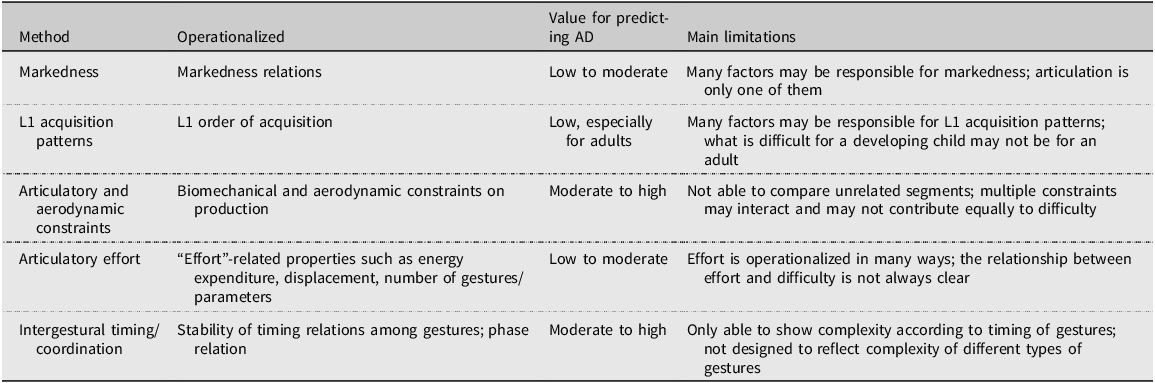
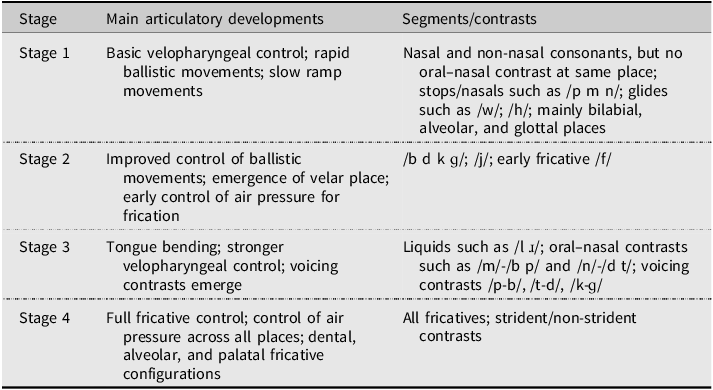
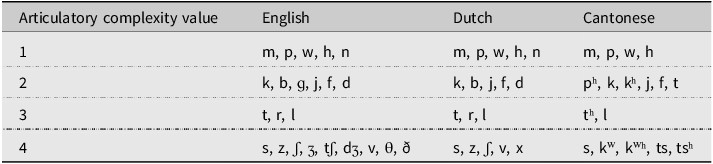
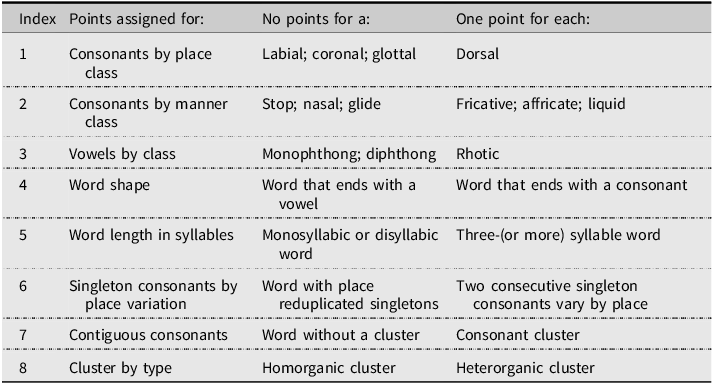
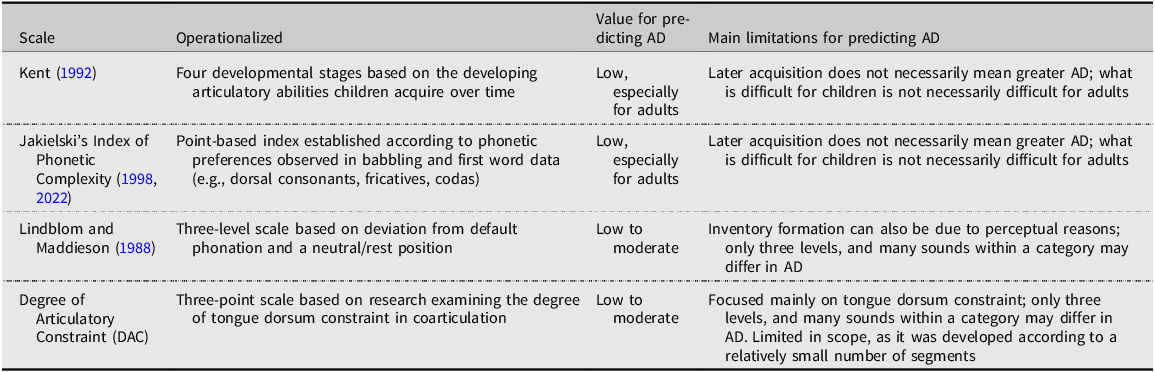

 Open access

