Introduction
Physiological dormancy (PD) is the most common kind of seed dormancy on Earth; it has been reported in gymnosperms (Coniferales, Gnetales) and in all major clades of angiosperms (Baskin and Baskin, Reference Baskin, Baskin, Smith, Dickie, Linington, Pritchard and Probert2004b). This class of dormancy is caused by a physiological inhibiting mechanism in the embryo that results in low growth potential, thereby preventing emergence of the radicle through covering layers (Nikolaeva, Reference Nikolaeva and Khan1977; Baskin and Baskin, Reference Baskin and Baskin2014). Depending on the species, PD can be broken by warm or cold stratification, and in some species it is broken during dry storage (i.e. afterripening) (Nikolaeva, Reference Nikolaeva and Khan1977; Holdsworth et al., Reference Holdsworth, Bentsink and Soppe2008; Baskin and Baskin, Reference Baskin and Baskin2014). Seeds in which PD is broken by high summer temperatures are capable of germinating in autumn, and those that require cold stratification for the breaking of dormancy become non-dormant during winter and germinate in spring (Baskin and Baskin, Reference Baskin, Baskin, Smith, Dickie, Linington, Pritchard and Probert2004b).
Three levels of PD are distinguished: non-deep, intermediate and deep (Nikolaeva, Reference Nikolaeva and Khan1977). Non-deep PD can be broken by relatively short periods (8–10 weeks) of warm or cold stratification (depending on the species), gibberellic acid (GA3) promotes germination and excised embryos grow normally. Intermediate PD is broken by long periods ( ≥ 12 weeks) of cold stratification, but a period of warm stratification (also, in some cases, afterripening) can decrease the length of the cold stratification period required to break dormancy. GA3 may or may not promote germination, and excised embryos grow normally. Deep PD in temperate regions is broken by long periods ( ≥ 12 weeks) of cold stratification, GA3 does not promote germination and excised embryos do not grow (Nikolaeva, Reference Nikolaeva and Khan1977). In tropical regions, long periods of warm stratification are required to break deep PD (Baskin et al., Reference Baskin, Baskin, Yoshinaga and Thompson2005). Non-deep is the most common level of PD, and it has been subdivided into five types (described below), depending on temperature requirements for germination as seeds come out of dormancy (Vegis, Reference Vegis1964; Baskin and Baskin, Reference Baskin and Baskin2004a, Reference Baskin, Baskin, Smith, Dickie, Linington, Pritchard and Probertb). PD is the only kind of dormancy known to occur in seeds of Asteraceae species (Georghiou et al., Reference Georghiou, Psaras and Mitrakos1983; Schütz et al., Reference Schütz, Milberg and Lamont2002; Karlsson et al., Reference Karlsson, Tamado and Milberg2008; Baskin and Baskin, Reference Baskin and Baskin2014). Freshly matured seeds of Asteraceae could be non-dormant and thus germinate to high percentages over a range of conditions; dormant and fail to germinate at any temperature in either light or darkness; or conditionally dormant and not capable of germinating over the full range of temperatures possible until all the PD is broken (Baskin and Baskin, Reference Baskin and Baskin2014).
Although Asteraceae species are an important component of the flora of the cold deserts of Central Asia (Pan et al., Reference Pan, Dang and Wu2001), few studies have investigated dormancy and germination of their seeds (Sun et al., Reference Sun, Lu, Tan, Baskin and Baskin2009). The annual/ephemeral Asteraceae species are of particular interest because different sizes of plants of the same species have been observed in the desert in spring in Xinjiang Uyghur Autonomous Region, China, (D.Y.T., personal observation). Large plants of an annual species at a population site in spring suggest that the seeds germinated in autumn, while small plants suggest that seeds germinated more recently in spring. These observations raise questions concerning the dormancy breaking and germination requirements of the seeds. Thus, we selected for study three annual Asteraceae species, Echinops gmelinii Turcz., Epilasia acrolasia (Bunge) C. B. Clarke and Koelpinia linearis Pall., that grow on desert sand dunes in Xinjiang.
Based on responses of seeds of winter annuals in moist temperate regions (Baskin and Baskin, Reference Baskin and Baskin2014), we hypothesized that seeds of annual Asteraceae species of the Asian cold deserts: (1) come out of dormancy in summer and germinate in autumn if sand moisture is not limiting; but (2) if seeds fail to germinate in autumn, they enter conditional dormancy in winter and can germinate at low temperatures in spring. Thus, we further hypothesized that seeds can undergo dormancy cycling, i.e. non-dormant part of the year and dormant (or conditionally dormant) part of the year.
To address these hypotheses, we asked the following questions. (1) Do seeds become non-dormant in summer? (2) Are the high temperatures of summer required to break dormancy? (3) After seeds become non-dormant, will low winter temperatures cause them to enter conditional dormancy, or will they remain non-dormant all winter? (4) Do seeds require light for germination? (5) Do seeds have an annual dormancy cycle? Answers to these questions would provide a better understanding of how the timing of germination is controlled in different cold-desert-adapted species.
Materials and methods
Dispersal units
The natural dispersal unit of K. linearis and E. acrolasia is an achene (hereafter seed) and that of E. gmelinii is a capitulum with a single achene (hereafter seed). Seeds of K. linearis are brownish, columnar-scorpioid and epappose (Fig. 1A); the pericarp is highly lignified and has abaxial, short, needle-like prickles (Shi and Norbert, Reference Shi, Norbert, Wu, Raven and Hong2011). Seeds of E. acrolasia are blackish, cylindrical and have a well-developed pappus (Fig. 1B), which is grey, slender and long plumose (Shi and Norbert, Reference Shi, Norbert, Wu, Raven and Hong2011). Each capitulum of E. gmelinii is composed of one dark yellow seed enclosed by outer, middle and inner phyllaries, which vary in shape and amount of pubescence (Fig. 1C) (Shi and Greuter, Reference Shi, Greuter, Wu, Raven and Hong2011).
(colour online) Dispersal units of the three study species. (A) Koelpinia linearis achene; (B) Epilasia acrolasia achene; (C) Echinops gmelinii capitulum.

Collection of seeds
Seeds of K. linearis, E. acrolasia and E. gmelinii were collected from plants growing on a sand dune in the Mosuowan Area of the Junggar Desert of Xinjiang Uyghur Autonomous Region, China (44°42′37.0″N, 86°02′02.8″E, 344 m above sea level) on 10 June, 10 June and 13 July 2012, respectively, and stored dry in paper bags in the laboratory (16–30°C, 10–40% relative humidity) until used.
The Mosuowan Area of the Junggar Basin has a temperate continental climate. Mean annual temperature is 7°C, mean low temperature of the coldest month (January) is − 23°C and mean high temperatures of the hottest month (July), 33°C. Annual precipitation (rain and snow) is 147 mm, 64% of which occurs in spring and summer, and the lowest (February) and highest (July) monthly amounts are 5 mm and 22 mm, respectively (data from Mosuowan Weather Station, Meteorological Bureau of Xinjiang Uyghur Autonomous Region, 1991–2010). Mean annual potential evaporation is 1942 mm (Yuan and Tang, Reference Yuan and Tang2010).
Effect of dry storage (afterripening) on dormancy break
To test for afterripening, seeds of K. linearis, E. acrolasia and E. gmelinii were dry stored in the laboratory for various periods of time and then tested for germination. The first germination tests were initiated on 30 June 2012 for K. linearis and E. acrolasia and on 21 July 2012 for E. gmelinii (at which time seeds were 20, 20 and 7 days old, respectively, but are referred to as 0 months old for presentation of data). Germination tests were conducted 1, 2, 3, 6, 9 and 12 months after the initial germination test. For each test, three replicates of 25 seeds of each species for each of the seven storage periods were incubated on two layers of Whatman No.1 filter paper moistened with distilled water in 9-cm-diameter plastic Petri dishes. Seeds were incubated at daily (12/12 h) temperature regimes of 5/2, 15/2, 25/15 and 30/15°C in light (12 h of ≈ 100 μmol m− 2s− 1, 400–700 nm, cool white fluorescent light each day) or in constant darkness (Petri dishes placed in lightproof black bags) for 28 d. Germination in light was examined daily for 28 d, and germinated seeds were removed at each counting. A seed was considered to be germinated when the radicle had emerged from the seed. Seeds incubated in darkness were checked only after 28 d; therefore, they were not exposed to any light during the incubation period.
After the germination trials were complete, seeds that had not germinated were tested for viability. They were cut open to expose the embryo and then placed in a 0.1% solution of 2,3,5-triphenyl-2H-tetrazolium chloride (TTC) for 24 h. Embryos that stained pink were counted as viable and those with no staining as non-viable. More than 98% of non-germinated dispersal units were viable, and germination percentages were based on number of viable units.
Effect of burial in experimental garden on dormancy break
The purpose of this experiment was to determine when dormancy is broken in seeds buried under natural temperature and sand moisture conditions. Approximately 800 freshly matured seeds each of K. linearis, E. acrolasia and E. gmelinii were placed in each of ten fine-mesh nylon bags on 9 July 2012, 9 July 2012 and 26 July 2012, respectively. Each bag was buried at a depth of 3 cm in plastic pots (21 cm deep × 18 cm in diameter, with drainage holes at the bottom) filled with sand from the natural habitat. The pots were buried level with the sand surface in the experimental garden on the campus of Xinjiang Agricultural University located at the southern edge of the Junggar Desert in Ürümqi, Xinjiang Uyghur Autonomous Region, China, and subjected to natural temperature and substrate moisture conditions. Sand temperature at a depth of 3 cm was recorded hourly throughout the burial period using Tiny Tag data loggers (Model MicroLite LITE5016, Fourier Technologies, Beijing, China).
The first germination tests were started on 30 June 2012 for K. linearis and E. acrolasia and on 21 July 2012 for E. gmelinii. Except for months when the sand was frozen and covered with snow (December 2012 to February 2013), one pot containing buried dispersal units was randomly selected and retrieved at monthly intervals, starting on 9 September 2012 and ending on 26 May 2013. After pots were retrieved, dispersal units were removed from the sand in green light, and three replicates of 25 seeds each for each species were incubated for 28 d in light and in continuous darkness at the four temperature regimes, as previously described. Following the germination tests, embryos were tested for viability, as described above.
Germination phenology
The purpose of this experiment was to compare the germination phenology of the three species under supplemented and non-supplemented (natural) sand moisture conditions in the experimental garden. Seeds of K. linearis, E. acrolasia and E. gmelinii were sown on 9 July 2012, 9 July 2012 and 26 July 2012, respectively, at a depth of 3 cm in plastic pots (described above) filled with sand from the natural habitat. Each treatment consisted of three replicates of 50 seeds, for a total of six pots for each species. In the watered treatment, the sand was watered to field capacity every 3 d throughout the experiment, except during the winter when it was frozen, while in the non-watered treatment the sand received water only via precipitation and snowmelt. At 7-d intervals from June 2012 to May 2013, seedlings emerging above the soil surface were counted and removed from the pots. Temperature and precipitation data were obtained from the Meteorological Bureau of Xinjiang Uyghur Autonomous Region.
Effect of pericarp and phyllaries on germination
The purpose of this experiment was to determine the role of the pericarp on germination of E. acrolasia and of phyllaries on germination of E. gmelinii. Since the pericarp of K. linearis is highly lignified, it was not possible to remove it from the seed. Thus, K. linearis was not included in this aspect of the study. Experiments were conducted in the light at 5/2, 20/10 and 30/15°C and were started when dispersal units of E. acrolasia and E. gmelinii were aged 20 and 7 d, respectively. Seeds stored dry in the laboratory for 1, 2, 3, 6, 9 and 12 months were also tested. Three replicates of 25 seeds were used for each treatment, and germination was checked daily for 28 d.
E. acrolasia
-
(1) Intact dispersal units (seeds, A) were placed in Petri dishes (A).
-
(2) Excised embryos (E) plus pericarp (Pe) from the 25 seeds were placed in Petri dishes to test whether soluble chemicals that might be leached from the pericarp would inhibit germination (E+Pe).
-
(3) Excised embryos were placed in Petri dishes to test whether the pericarp inhibited germination, either mechanically or chemically (E).
E. gmelinii
-
(1) Intact dispersal units (capitula, Ca) were placed in Petri dishes (Ca).
-
(2) Excised seeds (A) plus phyllaries (Py) were placed in Petri dishes to test whether soluble chemicals that might be leached from the phyllaries would inhibit germination (A+Py).
-
(3) Excised seeds without phyllaries were placed in Petri dishes to test whether the phyllaries inhibited germination, either mechanically or chemically (A).
Temperature requirements for dormancy break
The purpose of this experiment was to determine the effect of temperature and sand moisture on dormancy break in the three study species. For each species, 400 freshly matured dispersal units were placed in each of eight fine-mesh nylon bags in July 2012, and each bag was buried to a depth of 3 cm in native-habitat sand in pots. The sand in four pots was kept dry and that in the other four pots continuously moist (covered with aluminium foil). For each species, one dry pot and one wet pot were incubated at 5/2, 15/2, 20/10 and 30/15°C for 3 months. After 3 months, the number of seedlings was counted, and non-germinated seeds from each storage condition were incubated in light at each of the four temperatures. Three replicates of 25 seeds were used for each germination test, and emergence was checked daily for 28 d.
Statistical analysis
All data were analysed for normality and homogeneity of variance prior to analysis to fulfil requirements of one-way analysis of variance (ANOVA). If data were normal and homogeneous, they were subjected to further analysis. If data exhibited non-normal distribution or if variances were not homogeneous, they were log10 or square-root transformed before analysis to ensure homogeneity of variance. In cases where the ANOVA assumptions continued to be violated following data transformation, treatment differences were assessed by using the more conservative Kruskal–Wallis non-parametric test.
When variances of data were homogeneous, one-way ANOVA was used to test for differences in germination percentages. A three-way ANOVA was used to test the significance of main effects (light condition, temperature and storage time) and their interaction on germination in the ‘Effect of dry storage (afterripening) on germination’ experiment, and to test for significance of main effects (light condition, temperature and burial time) and their interaction on germination in the ‘Effect of burial in experimental garden on dormancy break’ experiment. Tukey's HSD test was performed for multiple comparisons to test for significant (P< 0.05) differences among treatments. Statistical tests were conducted at P= 0.05, and values are means ± standard error (SE) (Sokal and Rohlf, Reference Sokal and Rohlf1995). Data analyses were conducted using SPSS for Windows, Version 16.0 (SPSS Inc., Chicago, Illinois, USA).
Results
Effect of dry storage (afterripening) on dormancy break
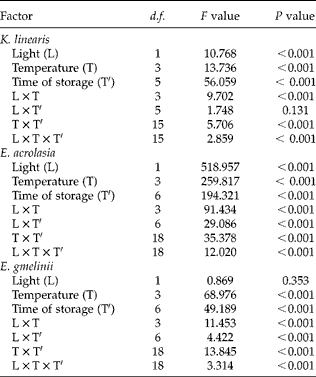
Three-way ANOVAs showed that germination of all three species was significantly affected by all factors, except the interaction between light condition and storage time (P= 0.131) for K. linearis and except light condition (P= 0.353) for E. gmelinii (Table 1).
Three-way ANOVAs of effects of light condition, temperature and storage time and their interactions on seed germination of Koelpinia linearis, Epilasia acrolasia and Echinops gmelinii stored dry under laboratory conditions

K. linearis
Although seeds germinated at all temperature regimes in the first germination test, germination percentages were higher at 20/10°C and 30/15°C in light than they were under the other conditions. After 6 months of dry storage (January 2013), germination percentages generally were higher than those of fresh seeds in both light and darkness at all temperature regimes, and the optimum germination temperature regime was 5/2°C in both light and darkness (Fig. 2A, B). However, germination decreased significantly at 5/2°C after 9 months of dry storage, and highest germination occurred at 15/2°C and 20/10°C in both light and darkness.
Effect of dry storage in the laboratory on germination (mean % ± SE) of seeds of Koelpinia linearis, Epilasia acrolasia and Echinops gmelinii incubated in light and in constant darkness at four temperature regimes.

E. acrolasia
Some seeds germinated at all temperatures in the first germination test, but germination percentages were higher at 15/2°C and 20/10°C in darkness than they were under the other conditions. Seeds afterripened gradually during storage, but germination percentage increased and then decreased during 6–9 months of storage in light at all temperature regimes (Fig. 2C). During 0–6 months of storage, germination at all temperature regimes in darkness increased, and the optimum germination condition for 1- to 6-month-old seeds was 5/2°C in darkness (Fig. 2D). After 9 months of storage, germination in light and darkness had decreased at 5/2°C (compared to 6-month-old seeds).
E. gmelinii
All 7-day-old seeds were dormant, and thus none germinated at any of the five temperature regimes in either light or constant darkness. After 3 months of dry storage, dispersal units germinated to low percentages at all temperature regimes in both light and darkness, and with an increase in storage time germination percentages increased at all temperatures, especially 20/10 and 30/15°C (Fig. 2E, F).
Effect of burial in experimental garden on dormancy break
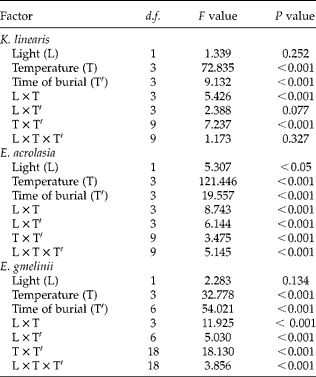
A three-way ANOVA showed that germination of all three species was significantly affected by all factors, except light condition (P= 0.252), interaction between light condition and burial time (P= 0.077) and interaction among the three factors (P= 0.327) for K. linearis and except light condition (P= 0.134) for E. gmelinii (Table 2).
Three-way ANOVAs of effects of light condition, temperature and burial time and their interactions on seed germination of Koelpinia linearis, Epilasia acrolasia and Echinops gmelinii buried in the experimental garden

K. linearis
During burial under natural temperature and sand moisture conditions, the ability of seeds to germinate in light and darkness across the range of temperatures increased, but generally 5/2°C was optimal (Fig. 3A, B). After 4 months of burial, seeds germinated to 77% and 72% in light and dark, respectively, at 5/2°C. In March 2013, all seeds in the bag had germinated.
Effect of burial in sand in the experimental garden on germination (mean % ± SE) of seeds of Koelpinia linearis, Epilasia acrolasia and Echinops gmelinii incubated in light and in constant darkness at four temperature regimes.

E. acrolasia
After 2 months of burial, seeds had gained the ability to germinate to ≥ 80% at 5/2°C in light and in darkness, and after 3 months to 77% and 72% at 5/2°C in light and in darkness, respectively, but to ≤ 35% under the other test conditions (Fig. 3C, D). When 9-month-old seeds were exhumed in March 2013, 97% of them had already germinated.
E. gmelinii
Freshly harvested dispersal units were dormant, but after 1 month of burial some of them germinated across the range of temperature regimes. After 2 months of burial (October 2012), seeds germinated to 57% in light and to 75% in darkness at 5/2°C. After 3 months of burial, about 40% of the seeds in the bag had germinated. Nine-month-old seeds (April 2013) germinated to 55% in light at 20/10°C and to 88% and 85% in darkness at 15/2 and 20/10°C, respectively (Fig. 3E, F). After 10 months of burial, germinability had increased in the light at 5/2°C and decreased in the light and darkness at 30/15°C.
Effect of pericarp and phyllaries on germination
E. acrolasia
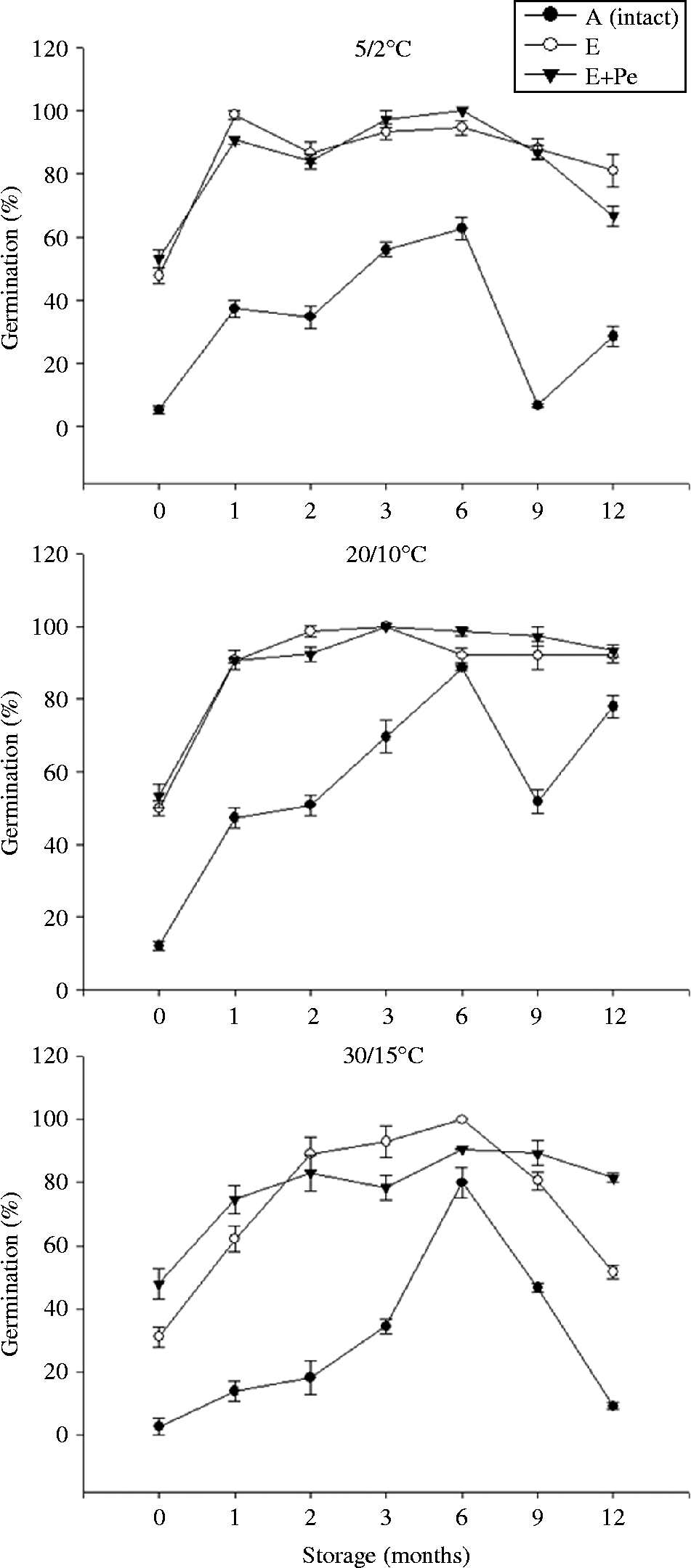
Removing the pericarp promoted germination of E. acrolasia at 5/2°C, but the isolated pericarp in Petri dishes did not inhibit germination (Fig. 4).
Effect of pericarp and of storage (afterripening) time on germination (mean % ± SE) of the seeds of Epilasia acrolasia incubated in light at three temperature regimes. A, achene (pericarp intact); E, embryo; E+Pe, embryo+pericarp.

E. gmelinii
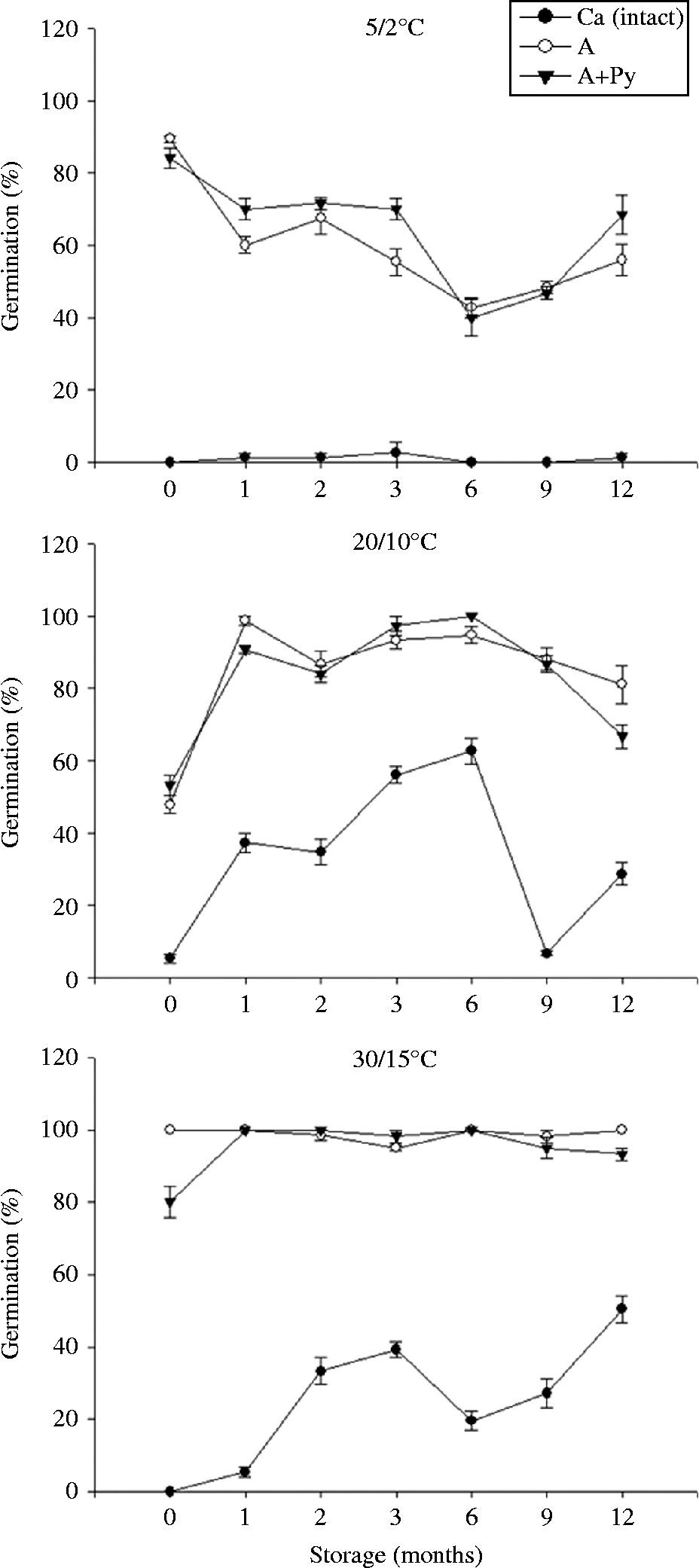
None of the intact 7-day-old dispersal units germinated at any temperature, and very few germinated at 5/2°C regardless of their age (Fig. 5). Depending on age, 0–57% of intact dispersal units germinated at 20/10°C and 30/15°C. Removing the phyllaries significantly increased germination; however, presence of isolated phyllaries in the Petri dishes did not inhibit germination.
Effect of phyllaries and dry storage (afterripening) time on germination (mean % ± SE) of the seeds of Echinops gmelinii incubated in light at three temperature regimes. Ca, capitulum (phyllaries intact); A, achene; A+Py, achene+phyllaries.

Temperature requirements for dormancy break
K. linearis
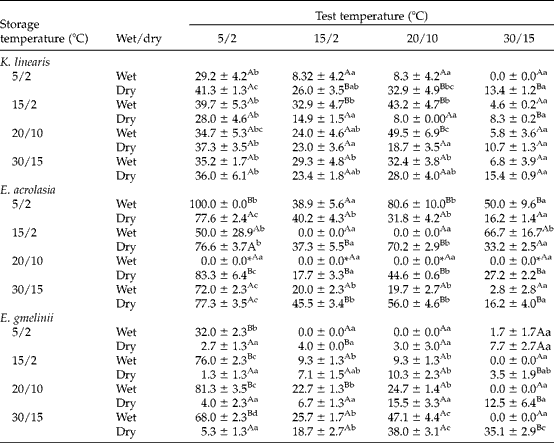
After 3 months (November 2012), about 75% of the seeds had germinated in the continuously moist sand at 5/2°C, and when tested at 5/2°C 29% of the non-germinated seeds germinated (Table 3). Some dormancy break also occurred in seeds stored dry at 5/2°C and in seeds stored wet or dry at 15/2, 20/10 and 30/15°C. The highest germination percentage for seeds stored wet or dry at the four temperatures was for those stored wet at 15/2 and wet at 20/10 and tested at 20/10°C; 99% of the seeds were viable.
Germination (mean %± SE) in the light at four temperature regimes of seeds of Koelpinia linearis, Epilasia acrolasia and Echinops gmelinii stored at 5/2, 15/2, 20/10 and 30/15°C in wet or dry sand for 3 months. Values followed by different uppercase letters in a column or different lowercase letters in a row are significantly different (Tukey's HSD, P=0.05)

* Only 2% of the seeds were viable, and all seeds failed to germinate.
E. acrolasia
After 3 months of storage in wet sand at 5/2, 15/2, 20/10 and 30/15°C, about 63%, 15%, 6% and 3% of the seeds, respectively, had germinated, and only about 10%, 6%, 2% and 80 % of the non-germinated seeds, respectively, were viable. When tested at 5/2°C, 100% of the seeds that had been stored in wet sand at 5/2°C germinated (Table 3). Except for no dormancy break in wet sand at 20/10°C, 67–100% of the seeds from all storage conditions became non-dormant. The optimum germination temperature was 5/2°C, except for seeds stored wet at 15/2°C, which germinated to the highest percentage at 30/15°C.
E. gmelinii
After 3 months of storage, about 5% of the seeds had germinated in the wet sand at 5/2°C (Table 3). The highest germination percentage was obtained for seeds stored wet at 20/10°C and incubated at 5/2°C. Only 4–16% of the seeds stored dry at 5/2, 15/2 and 20/10°C came out of dormancy. The seeds that did not germinate were viable. However, those stored dry at 30/15°C germinated to 38% and 35% at 20/10 and 30/15°C, respectively, but to only 5% and 19% at 5/2°C and 15/2°C, respectively; 97% of the seeds were viable.
Germination phenology
Seeds of K. linearis did not germinate in either watered or non-watered sand in autumn 2012, but they did so in both watering regimes in spring 2013. The total germination percentage on non-watered sand was lower than that on watered sand. Seeds of E. acrolasia germinated to a low percentage in both watered and non-watered sand in autumn 2012, but they germinated to significantly higher percentages in both watering regimes in spring 2013. By the end of spring, germination was significantly higher in non-watered than in watered sand. Germination of E. gmelinii was significantly higher in non-watered than in watered sand in autumn 2012, and remained so throughout spring 2013 (Fig. 6).
(A) Monthly total precipitation and mean minimum and maximum monthly temperatures at Meteorological Bureau of Xinjiang, Uyghur Autonomous Region from June 2012 to June 2013. (B–D) Germination (mean % ± SE) of seeds of Koelpinia linearis (B) Epilasia acrolasia (C) and Echinops gmelinii (D) on wet and dry sand in the experimental garden during autumn and spring of 2012–2013. Different lower-case letters indicate significant differences.

Discussion
In the first germination test, 20-day-old seeds of K. linearis and E. acrolasia germinated over the range of temperatures assessed with a maximum of 30% and 56% in light and darkness, respectively, at 20/10°C (Fig. 2). The temperature range for germination of seed populations of K. linearis and E. acrolasia did not change during dry storage at room temperatures or when buried in sand under natural temperature and sand moisture conditions during the summer (Fig. 3A–D). Freshly matured seeds of E. gmelinii were dormant and thus did not germinate at any condition. However, after 1 month of dry storage or burial in the experimental garden, seeds germinated to low percentages under all test conditions (Fig. 3E, F).
The only class of dormancy known to occur in seeds of Asteraceae is physiological dormancy (PD). Further, although there have been a few suggestions that seeds could have intermediate or deep PD, e.g. peripheral seeds in the heterocarpic species Garhadiolus papposus (Sun et al., Reference Sun, Lu, Tan, Baskin and Baskin2009; Baskin et al., Reference Baskin, Lu, Baskin, Tan and Wang2014), the kind of dormancy in diaspores of most Asteraceae species is non-deep PD (Baskin and Baskin, Reference Baskin and Baskin2014). The embryo in seeds with PD has a low growth potential, thus removal of covering structures from around the embryo increases germination percentage. Removal of the pericarp from the seeds of E. acrolasia increased germination percentages at all temperatures (Fig. 4), and removal of structures in the capitulum external to the seed significantly increased germination percentage of E. gmelinii. Further, seeds of all three species lost dormancy rapidly. Thus, we conclude that seeds of the three species have non-deep PD.
In other studies that have been done to determine the temperature requirements for dormancy break in seeds of annual species, seeds have been buried in pots of moist sand and placed over a range of temperatures for about 3 months. After the period of burial, seeds from each temperature are tested for germination over a range of temperatures. In winter annuals, the optimum temperatures for dormancy break are high (20/10, 25/15°C), and those for germination are low (e.g. 15/6°C) (Baskin and Baskin, Reference Baskin and Baskin1986). In summer annuals, the optimum temperatures for dormancy break are low (1, 5°C) and those for germination are high (25/15, 30/15°C) (Baskin and Baskin, Reference Baskin and Baskin1987).
A difference between the present and previous studies on temperature requirements for dormancy break is that seeds were kept dry and wet at each temperature; in previous studies seeds were kept wet only. The results were unexpected in that the responses are not the same as those from previous studies on either winter or summer annuals. Seeds of K. linearis become non-dormant at both low and high temperatures in wet and in dry sand, while those of E. acrolasia become non-dormant at high and low temperatures, with dry versus wet sand interacting with temperature in controlling dormancy break. Storage of E. gmelinii dispersal units in wet sand at low and high temperatures increased germination percentages at low temperatures, and storage in wet sand at high temperatures increased germination percentages at all temperatures. Little dormancy breaking occurred in dry sand, except at high temperatures, where seeds gained the ability to germinate at high temperatures. Interestingly, dormancy break occurred in seeds of Viguiera dentata, a perennial Asteraceae from an arid region with winter rain in Texas, USA, over a range of temperatures on moist sand (Baskin et al., Reference Baskin, Baskin and Van Auken1998).
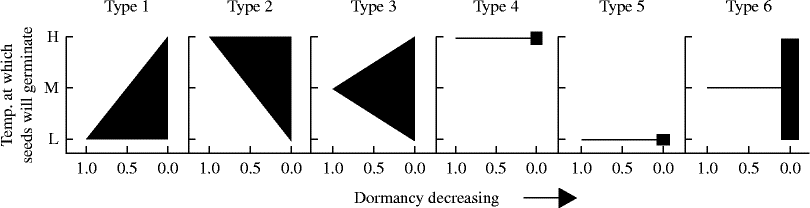
The temperature requirements for germination as seeds of K. linearis, E. acrolasia and E. gmelinii come out of dormancy do not correspond to any of the five types of non-deep PD described previously: type 1, increase in maximum temperature for germination; type 2, decrease in minimum temperature for germination; type 3, increase and decrease in maximum and minimum temperatures, respectively; type 4, germinate only at high temperatures; and type 5, germinate only at low temperatures (Baskin and Baskin, Reference Baskin and Baskin2004a, Reference Baskin and Baskin2014). Throughout the germination testing period, seeds of K. linearis and E. acrolasia germinated at 5/2, 15/2, 20/10 and 30/15°C. As dormancy break occurred, germination percentages increased at all the temperatures, but the range of temperatures for germination of the seed population did not change. Seeds of E. gmelinii were dormant, but after dormancy was broken their germination response was like that of K. linearis and E. acrolasia. That is, seeds germinated over a range of low to high temperatures, which did not increase or decrease with further afterripening.
Thus, based on our results, we propose that a sixth type of non-deep PD be recognized, in which seeds germinate over the full range of high to low temperatures possible for the species in the early stage of dormancy break (Fig. 7). As dormancy break in the seed population continues, the germination percentage increases at all temperatures. More research is needed, but it appears that Diptychocarpus strictus (Brassicaceae) and Eremopyrum distans (Poaceae), two other annals of the Central Asian cold deserts, also have type 6 non-deep PD. Fresh seeds of D. strictus were dormant, but after 1 month of dry storage (afterripening), they germinated at 5/2, 15/2, 20/10, 25/15 and 30/15°C. As the period of afterripening increased, germination percentages at all temperature regimes increased (Lu et al., Reference Lu, Tan, Baskin and Baskin2010). Freshly matured caryopses of E. distans germinated to 3–70%, depending on position in the spikelet, at 5/2, 15/2, 20/10, 25/15 and 30/15°C. As dormancy break occurred during dry storage, germination percentages for caryopses from each spikelet position increased at all temperatures (Wang et al., Reference Wang, Tan, Baskin and Baskin2010).
Six types of non-deep physiological dormancy in seeds. Types 1–5 are from Baskin and Baskin Reference Baskin and Baskin(2004a) and type 6 is a new type based on the results of the present study.

Although seeds of K. linearis, E. acrolasia and E. gmelinii have the ability to germinate over a range of temperatures throughout the breaking of dormancy in the seed population, timing of precipitation limits germination to the low-temperature seasons of autumn and spring. In the germination phenology study, seeds of E. acrolasia and E. gmelinii germinated in autumn in sand that was watered every 3 d, and in spring some seeds of all three species germinated. Further, many buried seeds of the three species germinated in the sand in autumn. Since 5/2°C is the optimum germination temperature, germination in autumn and/or spring is controlled by favourability of sand moisture. Lack of germination of K. linearis seeds on the sand surface in autumn may indicate that the sand was not moist enough to promote germination of this species. Seeds of K. linearis exhumed in October germinated to 33% and 60% at 5/2°C in light and darkness, respectively, suggesting that failure to germinate in the phenology study in autumn was not due to dormancy. Also, by March 2013 all the buried seeds of this species had germinated in the sand.
Although seeds of the three species could germinate over a range of temperatures in both light and darkness in autumn, the temperatures may be too low for germination by the time there is enough sand moisture for them to do so. Many of the buried seeds exhumed in October had germinated. Mean daily maximum and minimum sand temperatures in the garden for 1–14 October 2012 were 14.1 and 9.7°C, respectively. No doubt, burial in sand versus being on the sand surface improved the moisture conditions for germination. Thus, seeds cannot germinate in autumn until the sand is moist, at which time the temperatures are low. Consequently, although seeds have type 6 non-deep PD, the timing of favourable sand moisture causes them to have the germination phenology of species with type 5 non-deep PD, i.e. non-dormant seeds can germinate only at low temperatures. For example, fresh seeds of the winter annual Eriastrum diffusum in the Chihuahuan (hot) desert in the south-western USA are dormant. Dormancy is broken by exposure to high temperatures in summer, but non-dormant seeds can germinate only at low (15/6, 20/10°C) temperatures. Thus, seeds can germinate only if the soil is moist in winter (Baskin et al., Reference Baskin, Chesson and Baskin1993).
All seeds of K. linearis and E. acrolasia buried under natural temperature and sand moisture conditions in the experimental garden in summer 2012 had germinated by March 2013. Since seeds of these two species exhumed in November 2012 germinated to 76% and 80%, respectively, in darkness at 5/2°C, it is not surprising that they would germinate in the sand during late autumn and/or early spring. Thus, seeds of these two species cannot form a soil seed bank unless the sand is too dry to permit germination. On the other hand, although seeds of E. gmelinii exhumed in November 2012 germinated to 24% in darkness at 5/2°C, only about 40% of them germinated during burial. The reason why all the non-dormant dispersal units of E. gmelinii did not germinate during burial must be related to some factor(s) of the burial environment other than darkness. Inhibition of germination in the sand could be caused by decreased temperature fluctuations, changes in CO2/O2 ratio and production of volatile metabolites (Holm, Reference Holm1972; Baskin and Baskin, Reference Baskin and Baskin2014). The presence of non-germinated dispersal units of E. gmelinii in May and June of the year following dispersal suggests that this species can form a small, persistent soil seed bank, but more studies are needed to confirm this.
The three cold desert annual species of Asteraceae investigated in this study can germinate in autumn or spring, if sand moisture is available, with the resulting plants flowering and producing seeds in spring. Thus, functionally, plants from autumn-germinating seeds are winter annuals and those from spring-germinating seeds are spring ephemerals. Dormancy break occurs while seeds are subjected to natural temperature conditions in summer. Although non-dormant seeds can germinate at both low and high temperatures, germination is delayed until there has been some autumn precipitation, at which time temperatures in the habitat are low.
In the Central Asian cold deserts, there is enough rain in autumn of some years to promote germination, but in many years the sand is not moist enough for seeds to germinate until late winter when snow melt occurs. Dormancy break over a range of temperatures and the ability of seeds to germinate over a range of temperatures, especially low temperatures, ensures that some dispersal units of the three species are non-dormant regardless of when the sand becomes moist enough for germination. Thus, type 6 non-deep PD that is broken by either high or low temperatures allows for dormancy break at any time of the year and may help maintain seeds in the non-dormant state until there is enough moisture for them to germinate. However, if seeds are non-dormant and can germinate in the dark, all of them may germinate after the sand becomes moist; thus, a persistent seed bank would not be formed. The only way non-dormant seeds would remain non-germinated in moist sand is if some factor(s) of the burial environment in addition to darkness or of the dispersal units, such as the phyllaries of E. gmelinii, could prevent germination.
Acknowledgements
We thank Mahira Mollibaki for help with experiments and Xuan Li, Jannathan Mamut and Mihrigul Nurulla for collection of seeds.
Financial support
This study was supported in part by the National Natural Science Foundation of China (31160063, U1130301), the Major National Scientific Research Program of China (2014CB954202) and the International Science and Technology Cooperation Program of China (ISTPC2011DFB30070).
Conflicts of interest
None.