If HTA is not integrated into a country's legal framework, it cannot yield its full potential. For instance, if the process of a reimbursement decision is not in accordance with the theory of HTA—including interdisciplinarity, independency, scientific methods, or transparency—the legally prescribed process may lead to biased reimbursement decisions.
At the same time, HTA and the coverage decision-making process is interpenetrated by law. The assessment and appraisal of HTA must address several legal issues—to a larger degree than previously described (Reference Francke, Busse and Perleth1;Reference Francke and Hart2). It does not suffices to rush through a legal assessment by simply identifying the importance of informed consent. Informed consent is an important legal issue, but there are several other important legal issues influencing the daily use of health technologies.
HTA is defined as an interdisciplinary process and many international definitions consider the legal discipline as one part of it. If those definitions are taken seriously, our understanding of the legal analysis of HTA must improve (Reference Droste and Rixen3). This article provides a structured introduction to the legal issues of HTA. Because health law operates mainly on a domestic basis, we will look exclusively at Swiss law. However, the legal issues in Swiss law are relevant in other countries, even if the application of the specific national law (and its outcomes) may vary.
METHOD
The authors carried out a literature review in national and international databases to identify publications that focus on the legal analysis of HTA (i.e., PubMed, World Cat, Swisslex). Only four relevant publications could be found (Reference Francke, Busse and Perleth1–Reference Walin, Marchetti, Norderhaug and Royle4). Due the small number of publications in this field, the authors then looked at Swiss laws governing the issues relevant to HTA by using a qualitative approach. The findings of this analysis were structured into an outside and an inside perspective framework. The authors illustrate the importance of these legal issues with common practical examples drawn from the Swiss healthcare system.
TWO PERSPECTIVES
To structure the identification of the legal issues in HTA, we suggest dividing these issues into an outside and an inside perspective.
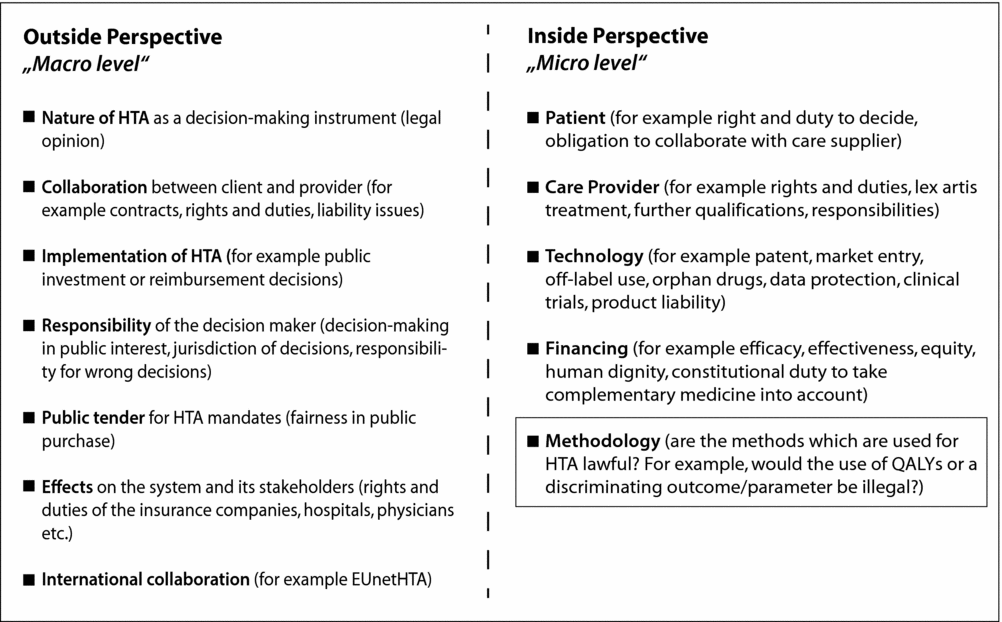
The outside perspective focuses on the macro level of HTA and includes legal questions concerning HTA as a whole. Examples for this perspective are the contractual relation between the decision-maker and those carrying out the HTA, as well as the legal process in which HTA is used for decision making.
The inside perspective, by contrast, focuses on the micro level of HTA. It includes legal issues within the elaboration process of an HTA report. For example, there are legal criteria for whether current medical and economical evidence fulfills the legal requirements to allow for the approval for reimbursement of certain technology. To identify the crucial legal issues, it is desirable to divide issues belonging to the inside perspective into five sub-categories (Figure 1).
Legal issues in HTA:Outside and Inside perspective.

Outside Perspective Issues
Nature and Collaboration
For lawyers it is essential to understand the legal characteristics of HTA and an understanding of HTA's legal nature provides a basis for identifying its risks and burdens. Assessing the characteristics of HTA seems to be similar to an existing legal instrument: the legal opinion. A legal opinion is written expertise about a certain topic. It provides specific, mostly science based information about an individual case or a narrowed research question (Reference Riemer Kafka5). The similarities between HTAs and legal opinions makes it possible to apply the existing legal framework on opinions to HTA reports.
First, an HTA report requires collaboration between a client and its provider, for example, between a health authority and the HTA producer. Details of such collaborations are often (and hopefully) settled in a written contract, the validity of which depends on its accordance with the law. For HTA reports, there are two types of contracts to consider: the contract for work and services and the simple agency contract (6).
The value of the contract for work and services is its measurable result and guaranteed outcome. The outcome (“the service”) is characterized by a structured, precise and predefined production process that is typical of systematic reviews. Consequently, the HTA producer becomes liable for the accuracy of the outcome of a systematic review.
Example: If there is a methodological error in the report that ultimately leads to a wrong decision, the HTA producer may become responsible for the damages he caused. The contract for work and services also obligates the customer to inspect the work for defects and inform the contracting party of any defects, otherwise the co-contractor cannot be held liable for any complaints in this regard.
Thus, within this basic contractual framework, the HTA producer would be liable for the result of the systematic review and his or her client is often obliged to inspect the report for methodological defects and biases (Reference Gauch7). Because the decision-maker is not usually well grounded in HTA methodology, it would be important to extend the contract to increase the protection of the customer by including an external review process or adding an explicit guarantee.
Instead of focusing on the outcome, the simple agency contract highlights the diligent and faithful performance of the business, which means that a specific result cannot be expected because of the nature of the work (Reference Fellmann, Poledna and Kuhn8). Taking this into account, an HTA report may be considered under the law of a simple agency contract if the result is unpredictable and may differ depending on the expert's interpretation such as the ethical or legal appraisal of clinical and economical evidence. In this case, an HTA producer (whether it is an individual or an organization) is liable for the diligent and faithful performance of the appraisal. Within this contract type, the client has no obligation to examine the HTA report for defects or biases and, in contrast to the contract for work and services, the customer can fully rely on the report and sue the provider for damages, as soon as an error in the report is noticed.
An analysis of these two contract types shows that HTA collaboration contains (a) different contract types, which create (b) different rights and duties for the collaborators. For the assessment-process, the contract for works and services is applicable. Because of the contractual framework, it may be helpful to increase the protection of the decision-maker by including an external review or a guarantee to the contract. For the appraisal process, the simple agency contract is applicable and it relieves the decision-maker of the duty to investigate the HTA report for defects and biases and obliges the HTA producer to conduct the HTA according to the professional standards (Figure 2).
Contract elements of HTA collaboration.

Because HTA reports can be described as legal opinions, the legal requirements of opinions are consequently applicable to HTA reports as well. For example, if a patient does not agree with a specific reimbursement decision (based on HTA), he has the right to file suit. If the patient is able to present convincing evidence to prove the faultiness of the HTA report, the judge may rule in favor of the plaintiff and the insurance company would be forced to reimburse the treatment. The verdict may also have consequences on the HTA producer, if the decision-maker decides to file a liability claim because of malpractice. Thus, there are not only scientific guidelines but also legal considerations that an HTA report must follow. As it happens, the scientific guidelines considerably overlap with the expectations of a court such as concerns about conflict of interest, scientific guidelines, etc. (Reference Bühler9–11). However, the HTA producer has to ensure that his or her work fulfills these minimal scientific requirements to limit liability.
Implementation
The question of successful implementation of an HTA report highly depends on its external legal framework—or in other words: if regulation is poor, the impact of HTA will be low as well.
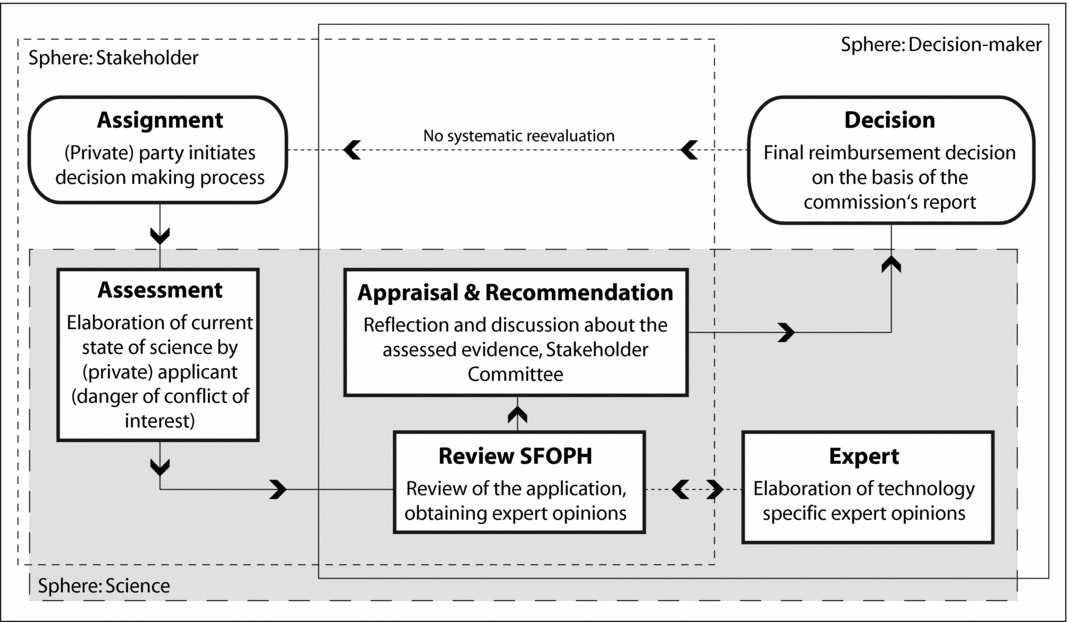
Switzerland currently pursues a pragmatic process of reimbursement decision making. To be reimbursed, a technology must fulfill three criteria; the technology must be effective, appropriate, and economical (12). If, for example, a technology producer believes that a technology fulfills those criteria, the producer can initiate an administrative process to ask for reimbursement. The applicant is responsible for producing the scientific evidence by filling out an official application form (13). The application will be reviewed by the Swiss Federal Office of Public Health and then forwarded to a stakeholders’ committee, which makes a recommendation to the decision-maker. If sufficient scientific evidence is provided, the technology may be covered by health insurance (12–14).
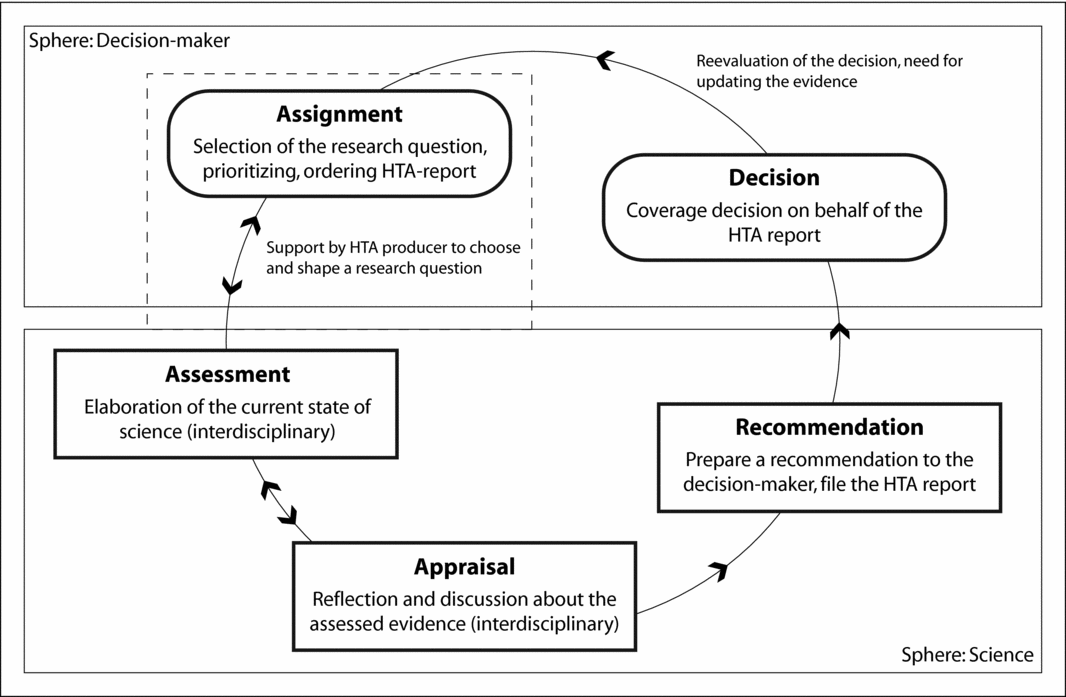
A comparison of the Swiss approach with the typical HTA process reveals the following differences (Figures 3 and 4):
Typical HTA Decision Making Process.

Swiss Reimbursement Decision Making Process (Medical Services).

The two figures show obvious differences between the typical and the Swiss reimbursement decision process. The advantage of the Swiss process may be its pragmatic, liberal and integrative approach, because everyone is allowed to initiate such a reimbursement decision process. The approach may also be cheaper for the state, because the time-consuming collection of scientific evidence must be prepared by the applicant. However, the weaknesses of the Swiss approach are its potential for severe conflict of interest, biased assessments, and stakeholder influenced appraisals.
The success of an HTA significantly depends on the applicable domestic law where it is prepared. Consequently, the legal framework must be organized in such a way that the results of unbiased HTA reports can impact the health system.
Responsibility of the Decision Maker
Even if the discretionary powers of the appraisal committee and the decision-makers sometimes seem to be limitless, the decision makers are certainly not allowed to make random decisions. A government, committee or private person, working in public service, is legally bound to work and decide in the society's best interest. For instance, the Swiss Constitution requires everyone who is participating in state activities to uphold the fundamental rights of the Constitution (15).
Taking these duties into account, the legal nature of HTA can strengthen the government's commitment to follow the evidence of an HTA report as well. Looking at the long-term practice of the Swiss Social Insurance Authorities (which works frequently with legal opinions), we observe that the authorities usually follow expert opinions, as long as they are reasonable and of good quality. Furthermore, the Swiss Federal Court usually requires in its traditional case law, that the courts follow an expert's opinion. If a court wishes to disregard an expert opinion, it must give plausible reasons and additional justification for the refusal (Reference Bühler9). There are good reasons to implement this process for reimbursement decision making: if an HTA report fulfills the scientific standards and contains obvious evidence, a decision-maker should generally be required to follow the HTA report.
Public Tender
If a public HTA institution wants to appoint a company to elaborate an HTA report, it is usually obliged to invite bidders to apply for a public order—legally known as public tender. The tender process is intended to make the public purchase more transparent, fair and cheaper. If the institution is private, this duty is not obligatory, as long as it is not indirectly funded by public money (Reference Stöckli16).
Example: The Swiss Medical Board (SMB) produces HTA reports in collaboration with private companies. Even though the organization is based on civil law (because it is an association), the SMB is obliged to undertake a tender, because of its public funding. Therefore, the SMB's decision to collaborate with an HTA producer must to be based on measurable criteria. Furthermore, unsuccessful applicants have the right to appeal against this decision.
Effects of the Decision on the Health System and Its Stakeholders
Once the reimbursement decision is made, the legal framework should require that all stakeholders respect the decision. In Switzerland, for example, the law prescribes which medical services must be covered by the insurance companies. An insurance company will be sanctioned, if it disregards a governmental reimbursement decision (12). Medical doctors are bound to the decision as well (Reference Fellmann, Poledna and Kuhn8;12).
Thus, the legal framework should ensure successful implementation of health technologies by making the reimbursement decision mandatory for all involved stakeholders.
International Collaboration
There are often similar HTA projects across domestic borders. If HTAs are generally binding, it could be the law as well, which increases international collaboration, by making it generally binding (Reference Slomanson17). International collaboration in HTA has great potential, but also without mandatory agreements international collaboration in HTA seems already on a promising track. Projects such as the HTAi Association and EUnetHTA are examples of international cooperation and exchange—without legal enforcement.
Inside Perspective Issues
Because the legal assessment of a technology can be enormously complex and extend into several legal sub-areas, it is helpful to divide the legal technology assessment into a few categories. Therefore, we choose a slightly different approach from EUnetHTA (Reference Walin, Marchetti, Norderhaug and Royle4) and suggest the following five categories: (a) Patient, (b) Care Provider, (c) Technology, (d) Financing, and (e) Methodology.
Patient
The category of the patient focuses on every legal issue that may affect the patient. Here we consider any possible situation that could cause discomfort or harm to the patient—before, during, and after the treatment.
The most important issue within this category is the patient's consent to the treatment. This right to give consent to a treatment is nonnegotiable (15;Reference Müller and Schefer18). To be able to give consent, the patient has to be informed about the entire treatment-path and its potential risks. If there are doubts about the patient's ability to consent, the care providers may have to involve the patient's relatives or the guardianship authority in the treatment decision to decide in the patient's best interest (Reference Fellmann, Poledna and Kuhn8).
Example: For a surgical brain tumor intervention, it may be helpful to consult the statistics and determine, if patients with brain tumor frequently show cognitive disabilities, which are difficult for the doctor to identify. It then might be helpful to recommend in the HTA report that the consent should be additionally confirmed by the relatives, a decision board and/or by a psychiatrist, to eliminate remaining uncertainties. Perhaps the HTA report could also refer to specific forms and checklists that could increase the validity of the informed consent.
The patient's category also includes the patient's duty to pay for the treatment (Reference Fellmann, Poledna and Kuhn8). Even if many medical treatments are reimbursed by health insurance, there may still be treatments that have to be paid for out-of-pocket. As a result, the patient is incentivized to consider cheaper alternatives or to find out which criteria have to be fulfilled to qualify for full reimbursement.
Example: A (patient-centered) HTA report could refer to promising alternative treatment methods and outline detailed criteria under which (legal) circumstances a reimbursement is possible.
Furthermore, the patient is obliged to participate in the treatment process. If the patient impedes the medical service, he or she will be made responsible for the consequences. It can be assumed that the more a treatment demands a patient's participation (for example through the collection of information, assessing pain, etc.), the more the treatment's success becomes the patient's responsibility.
Example 1: A patient is legally obliged to inform the doctor about his HIV infection.
Example 2: The HTA report could strengthen patient's responsibility by listing the patient's specific duties. This would result in reducing the physician's liability where appropriate and increasing the patient's commitment to the treatment.
Care Provider
The category of Care Provider focuses on legal issues where the technology is somehow related with care. The most important care-related laws are those that set out the duties created by patient-care provider relationship. Due to the number of possible legal issues within this category, only two issues will be discussed in depth.
The physician's main obligation is to provide the best possible treatment to the patient. If the doctor chooses an inappropriate or outdated treatment, he could become liable when the patient is harmed or does not recover (Reference Fellmann, Poledna and Kuhn8).
Example: A recent HTA report from Switzerland pointed out that in the case of Anterior Cruciate Ligament (ACL) injury there is no persuasive evidence to indicate reconstructive surgery as a first step. According to the report, the conservative treatment of physiotherapy without surgery should be applied, except for cases where the patient has significant pressure on his or her knee (for example sport athletes, construction workers, etc.). If an ACL patient is treated with immediate surgery and, during the surgery, experiences an ordinary complication, the surgeon may become liable, because he did not consider the HTA's recommendation ( 19 ).
Furthermore, the doctor has to inform his patient about the treatment. The duty to inform includes a detailed explanation of the diagnosis, an outline of alternative treatments, reasons why the proposed treatment is the most appropriate, and specific information about the financial aspects of the treatment. If the physician cannot prove that he has fully informed his patient (for example by documenting the conversation[s] with the patient), the physician might be charged with assault and/or be liable for any damages associated with the treatment (Reference Fellmann, Poledna and Kuhn8).
Example: Referring to the latest scientific knowledge, an HTA report usually points out why and under which conditions a certain health technology should be applied—or not. The information from an HTA report could be used by physicians to minimize the asymmetry of knowledge between them and their patients. The report could suggest an up-to-date checklist as well, which includes every crucial point of a technology and, thus, professionalizes the information flow between physicians and patients. The patient would be informed in more detail and the physician would reduce his or her liability.
Technology
The category of Technology focuses on any legal issue related to the technology itself. Every step in the life cycle of a technology needs to be legally assessed.
The most important technology-related legal issues are medical technologies (Reference Schmidt20;21), research with humans, data protection issues or patent law. Furthermore, there is product liability and, perhaps, issues related to the constitutional right of economic freedom. Again, only a few of those issues will be discussed more closely.
Data protection is a significant issue in medicine. Not only the physician, but also the developers of medical technologies are obliged to save and to protect data against unauthorized third parties. The Swiss data protection law considers patient related data as particularly vulnerable. For these reasons, data must be collected carefully and stored safely (22).
Example: Technology developers and users have to ensure that the screening machine protects collected data safely. An HTA report should indicate how a technology could conflict with the law of data protection and raise awareness for those issues. The challenges of personalized medicine will, in particular, increase expectations on this matter.
Patent law may also be an issue for conducting an HTA report. For various kinds of intellectual property there are not only national, but also international laws to consider. Protected patents are usually registered in national and international databases. The protection for these patents usually lasts for 20 years (Reference Pedrazzini and Hilti23).
Example: In the prioritization of a technology, the length of available patent protection ought to be considered. For instance, if the patent of a medical drug will expire soon, it would not necessarily make sense to conduct the HTA, because there is significant expected price competition. Alternatively, an HTA report may contain a reference that the patent of a technology will expire soon and, thus, invite other producers to enter/prepare for the competition.
Financing
The category of Financing considers all legal issues around the technology that could or should have an impact on the decision-maker.
The most important legal issues within the financial category are the criteria of health insurance law for a valid reimbursement decision. Furthermore, the decision has to be in accordance with the constitution and respect human rights such as equality, human dignity, personal freedom, etc. (15;Reference Müller and Schefer18). These issues are examined more closely below.
According to Swiss health insurance law, a positive reimbursement decision requires three criteria. A technology needs to be effective, appropriate, and economical. A technology is effective if it causes a measurable benefit to the patient. The technology is appropriate if it objectively is the best option in the individual case. Finally, the treatment is considered as economical as long as there is no cheaper treatment alternative (Reference Gächter and Rütsche24).
Example: An HTA report would need to consider those criteria carefully. They would also need to consider the latest case law and compare the assessed technology with other reimbursement decisions. These legal considerations are probably the most essential ones for the decision-maker, because its decision is strictly bound by these criteria.
Furthermore, the reimbursement decision has to be in accordance with the Swiss Constitution. Every technology has to be assessed to whether it has an impact on constitutional human rights, such as human dignity, personal freedom, or equality (15;Reference Müller and Schefer18).
Example 1: Recently, the Swiss Federal Court decided in the so-called Myozyme Case ( 25 ) that the economical criterion is disproportionate and violates the constitutional right of equality because the effectiveness of the treatment was too low and the treatment costs too high. Therefore, the court set a rough threshold: more than 100,000 Swiss Francs per gained life year would be considered disproportionate and thus unconstitutional.
Example 2: The obligatory health insurance reimburses laparoscopic obesity surgery for people with a BMI over 35 (under further conditions). This surgery usually causes a significant weight reduction. The consequences might be disfiguring skin folds, which can often cause psychological problems. For this reason, a reimbursement decision to deny plastic surgery (to remove the remaining skin) might be considered a violation of human dignity. Thus, legal consequences such as the violation of human dignity should be assessed in an HTA report as well.
Methodology
Finally, there is a slightly different category that is indirectly part of HTA as well: the category of methodology. Because most HTAs are run by a strict methodological handbook, it is helpful to assess the entire handbook to identify potential conflicts with the law.
Example: The use of QALYs is controversial, because they may systematically discriminate against people with difficulties and disabilities. Therefore, the effects of QALYs need to be assessed to determine under which circumstances the discrimination becomes legally relevant.
CONCLUSION
This short introduction into the legal issues of HTA underlines the presence of several legal issues relevant for HTA producers as well as the technology assessment itself. Looking at the potential risks for all HTA stakeholders, it seems vital to consider the legal issues in HTA before a legal dispute occurs. As illustrated, the harm and the consequences can be serious.
The suggested perspectival framework can be used in other jurisdictions, although the specific regulation may vary from country to country. The framework makes it easier to understand the various legal issues of HTA and provides a scientific basis for further research toward a sustainable legal technology assessment.
CONTACT INFORMATION
Daniel Widrig, MLaw (daniel@chta.ch), Candidate in Biomedical Ethics and Law at the University of Zurich, Freiestr. 15, CH-8032, Zurich, Switzerland
Brigitte Tag, Prof. Dr. iur. utr. RA, Professor for Criminal Law, Criminal Procedure and Medical Law at the University of Zurich, Zurich, Switzerland
CONFLICTS OF INTEREST
Daniel Widrig is funded by the SNSF and runs an independent information platform for HTA (www.cHta.info). Brigitte Tag is a member of the Expert's Council of the Swiss Medical Board.