Introduction
Living conditions are the circumstances that preserve life without necessarily engendering it; factors that shape the level and quality of life. The expression is generally used in relation to the circumstances of people's daily lives: jobs, family situation, housing, the local community, and the overall standard of life. This approach first refers to the material conditions of existence. However, we postulate that subjective conditions are inherent in the material or objective conditions of existence. In our view, the notion incorporates not only the objective elements that shape the level of life, but also the subjective or evaluative aspects of life.
The objective living conditions that are examined involve access to resources in the form of money, property, knowledge, mental and physical energy and social relations, since we know that this access enables individuals to exert some degree of control over their destiny. The subjective conditions that are studied here involve the individual's evaluation of his or her material living conditions. Ultimately, human beings face two fundamental existential problems: they must resolve, for themselves and for the people for whom they are responsible, the omnipresent question of the material conditions of their existence, in focusing, for example, on their food, shelter, health and so on; but they must also give some meaning to their material conditions, that is, they must judge these conditions in a way that inspires action and conduct aimed at, for example, accepting these conditions or aspiring to change them. From this viewpoint, it seems that objective and subjective living conditions develop reciprocally, and must be interpreted reciprocally, whether they be congruent or dissonant.
It is suggested that such a perspective is relevant to an attempt to resolve an enigma posed by the study of Inuit communities. In 1994, officials at Statistics Greenland conducted a major study of living conditions in employing the usual approach, which consisted in exclusively measuring objective conditions such as income, housing situation, etc. This survey took place when the government of Greenland decided to shut down some outlying villages that were almost exclusively oriented toward hunting and fishing activities, and therefore to stop providing some basic services such as supplying the general store or garbage collection. It confirmed that, in these villages, material conditions were well below the averages for the island as a whole. Paradoxically, it also showed that the residents did not want to move, and that they were instead determined to remain in their villages. The government of Greenland wished to understand the reasons behind this phenomenon, which was clearly not explained by the study of material conditions alone. This event led to the emergence of the Survey of living conditions in the Arctic (SLiCA) project, involving a small team of researchers from Greenland, United States and Canada. Since the beginning of the project, the Canadian northern regions on the one hand, and the situation in Greenland and Alaska on the other hand, have showed great similarities in terms of material living conditions. However, in contrast to Greenland and Alaska, a low but increasing out migration from the Canadian north to the southern part of the country occurred among the Inuit, so that in 2001, a total of nearly 14% of them were living primarily in urban or rural centres, while in 2006, they represented 22% of the total Inuit population (STC 2008).
The authors do not pretend to have secured any special findings explaining out migration itself. A research protocol concerning urban Inuit would have been very different from the concerns of this paper and would have diverted effort in other directions. So, questions like why and how did the apparent acceleration of Inuit outmigration occur will not be directly addressed in this paper. Our research relates primarily to questions concerning the majority that stays in the Arctic. What are the social forces that make them stay, in spite of harsh material living conditions? If we find why they stay, possibly it can be explained why some of them have left.
For the purpose of this paper, the authors have decided to focus exclusively on Inuit living in the Inuit Nunaat (Inuit homeland), which encompasses the four Inuit regions of Canada and where the the sedentarisation process was consolidated through the building of low cost housing and municipal, educational and health infrastructures in villages which are now permanent. This sedentarisation strengthened the prevalence of modernity and the increased implementation of its social institutions and modes of social relations, such as market logic, welfare state and cultural pluralism. Although they still exist and remain active, the earlier social institutions and social mechanisms (hunting, fishing and gathering activities, social hierarchisation, nomadism, mythological and shamanistic beliefs, etc.) that underlay the material survival and social cohesion of northerners were relatively marginalised.
Inuit objective living conditions are statistically below Canadian standards: household income, employment rate, housing conditions, education and public health levels are all below national averages (STC 2005a, 2005b, 2005c, 2005d; CMHC and ITK 2001). On the social level, some problems are apparently more frequent among the Inuit than elsewhere in Canada, such as school dropout (Schofield Reference Schofield1998), juvenile delinquency (Condon Reference Condon1987), child abuse and spousal abuse (Graburn Reference Graburn and Scheper-Hugues1987; Durst Reference Durst1991; Zellerer Reference Zellerer1989), drug abuse and criminality (Wood Reference Wood1997), and suicide (Kirmayer and others Reference Kirmayer, Hayton, Malus, Jimenez, Dufour, Quesney, Ternar, Yu and Ferrara1993; Dufour Reference Dufour1994). The same types of discrepancies are found in the areas of physical (MSSSN 2004) and mental health (Kral Reference Kral2003).
Nevertheless, contemporary Inuit communities seem to be engaged in a substantial development process. They are not only demonstrating their will to survive but are also in a process of demographic, economic, political and cultural expansion, as shown for example in the net population growth since sedentarisation, the investment in economic development and the continuing demands for self-government (Adams Reference Adams and Ingimundarson2002; Bone Reference Bone1992; Dickerson Reference Dickerson1992). After 50 years of rapid change, most of the Inuit of the Canadian Arctic still live on their ancestral lands and see themselves as a permanent distinct social group. So, how can we interpret the coincidence of certain unfavourable living conditions and a growing out migration, with the persistence and even the development of Inuit communities? What fundamental processes underlie this situation?
This study strives to reach the two following targets: the first is to profile certain objective and subjective living conditions among the Inuit of Nunavut; and the second is to analyse interrelations between these objective and subjective living conditions so as to improve our understanding of contemporary Inuit communities. Information about population, housing, language, education, economic activities, health, social problems and geographic mobility has been analysed. Our study first pinpoints the main characteristics of Nunavummiut and then highlights areas of consonance and dissonance. It ends with a discussion which attempts to bring out the coherence of the overall findings in suggesting a sociological interpretation of the configuration of Nunavummiut living conditions.
Methods
Descriptive statistics analysis is the method chosen to analyse the living conditions of the Inuit of Nunavut in 2001.
The Survey of living conditions in the Arctic
Several sources are used here, with the main one resulting from SLiCA. This is a large scale international statistical survey on living conditions, based on a probability sample and administered to the Inuit of Alaska, the Canadian North and Greenland, the Saami of Norway, Sweden and the Federation of Russia, and the Chukchi of the Russian far east (Andersen and Poppel Reference Andersen and Poppel2002).Footnote 1 SLiCA essentially completes the analysis of objective living conditions such as income, housing and hunting activities with an analysis of subjective living conditions such as people's perceptions about living conditions, social satisfaction, feeling of safety and psychological distress. In several ways, SLiCA is an innovative research approach. It is the first probability survey of this size, administered on this scale, that so finely measures the objective living conditions of the Inuit; that integrates into these measures customary activities such as hunting and fishing (these dimensions having until this point been studied separately from other social realities, or studied for more limited geographical areas, generally communities); and, finally, that includes the points of view of the populations themselves about their situation, that is, their subjective living conditions.
The data derived from the SLiCA survey cited here relate exclusively to the Canadian facet of the programme. In Canada, the survey was designed by a steering committee consisting of representatives of regional Inuit organisations (Inuvialuit Regional Corporation, Nunavut Tunngavik Incorporated, Makivik Corporation, Labrador Inuit Association), the national Inuit association (Inuit Tapiriit Kanatami) and Université Laval.Footnote 2 The questionnaire thus created was integrated into the 2001 survey of aboriginal peoples, administered by Statistics Canada.
Case study: individuals and households in Nunavut in 2001
This paper focuses on the case of Nunavut for two reasons. First, it is demographically the largest Canadian Inuit region. Nunavut alone contains about half of the Canadian Inuit population (STC 2003b: 8). Next, aside from the data associated with SLiCA, Nunavut represents a statistical geographic unit for which data are available from various sources and for a number of dimensions, especially from Statistics Canada, as Nunavut has since 1999 been one of the three official territories of Canada and consequently a statistical area classification component. Also, when Statistics Canada publishes data on aboriginal peoples as a whole, this essentially means the Inuit in the case of Nunavut, which is not the case in Labrador or among the Inuvialuit, where the statistics also include other aboriginal groups with sizeable populations. So, given the large proportion of Inuit and the readily available statistics, Nunavut proves to be especially well suited to an exploratory study of living conditions among Canadian Inuit, and one that could serve as a basis for other analyses seeking to examine certain dimensions or to profile other Inuit regions.
Adults aged 15 and older and households represent our units of analysis, in keeping with the data corpuses used. It is from this perspective that we hope better to understand Inuit living conditions, that is, what Nunavummiut individuals and households do and think about their living conditions.
Statistical data sources
Since the SLiCA survey was developed in Canada in connection with the aboriginal peoples survey 2001 (APS) and the 2001 census of Canada, some variables initially designed for SLiCA were measured during these surveys in order to avoid redundancies between the surveys and to lessen the respondent's burden. Most of the data analysed here are thus taken from these three surveys, all of which were administered in 2001.
SLiCA is a survey administered on the international circumpolar scale in order to collect, analyse and compare data on the living conditions of the Inuit, Inupiat and Saami. Its aim is to understand household and harvesting activities, personal well being, satisfaction regarding living conditions, and social participation. In Canada, it concerns the four Inuit regions of Labrador, Nunavik (Québec Arctic), Nunavut and the Inuvialuit region (the northwest portion of the Northwest Territories).
The APS covers other variables that are complementary to the analytical dimensions mentioned above: education, language, labour activities, income, health, communications technology, geographic mobility and housing (STC 2003a). Stemming from this survey is the data bank known as the 2001 census aboriginal population profiles (STC 2005b), from which were derived most of the figures analysed. The APS-SLiCA survey is post-censal in nature: it was administered to a probability sample formed from the census.
The 2001 census of Canada focuses on certain basic analytical dimensions: population, daily and household activities, geographic mobility, education, labour market, income, housing, etc. In principle, it contains information about all residents.Footnote 3 Since the present text concerns the Inuit, whereas the census data used here concern both Inuit and non-aboriginal populations (for objective living conditions only), these data should be interpreted carefully. The behaviours of these social groups may differ, and the appropriate cautions are noted where applicable. This does not however pose any major methodological problem, as the Inuit comprise 85% of the Nunavut census population. Resulting from the census is the data bank 2001 community profiles (STC 2005a), from which we derived the statistics presented here.
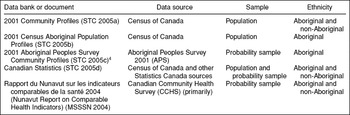
Other data banks were used to complete the analyses performed based on data connected with the SLiCA research programme. The statistics assembled here come from about 50 tables overall dispersed through the scientific literature. Table 1 shows the main statistical data sources used in this paper regarding the living conditions of the Canadian Inuit.
Main statistics on the living conditions of the Canadian Inuit.

Unless otherwise indicated, the statistics referred to in this study concern adults aged 15 and older, of Inuit identity and living in Nunavut in 2001. Otherwise, indications are given so as to define the data parameters (population, year, region, etc.).
Methodological and empirical contribution
In the field of Inuit research, the APS-SLiCA data are unique in several regards. As mentioned above, they combine the statistical study of the objective and subjective conditions of the Inuit, whereas these realities are generally studied separately. They also allow us to study the informal economy (hunting, fishing, etc.), which is not covered by the Statistics Canada system of national economic accounts. Several of the variables contained in APS-SLiCA had not previously been the focus of in depth study or of a quantitative approach. We also had access to a significant portion of the data through a personalised request made directly to Statistics Canada; these data have never been published elsewhere. Nor had a questionnaire type survey ever before been administered to the Inuit of Canada, and of the circumpolar region, with a probability sample of this size. The post-censal Canada wide survey covered a systematic random sample of 117,241 respondents identified as aboriginal people. The APS-SLiCA data bank is exclusively restricted to the major Inuit regions of Canada: that is, to a representative sample of 10,775 Inuit randomly drawn from among the 53 communities of Nunavut, Nunavik, Labrador and the Inuvialuit region, and averaging an 83% response rate. All of the quantitative estimates and analyses conducted at the individual or household level use a weighting factor that makes it possible to estimate sampling errors. This factor does not, however, allow us to obtain reliable estimates of sampling variance. In order to assess the quality of the data and to be able to use the data unrestrictedly, the coefficient of variation, which measures sampling errors, must be under 16.6, for a confidence interval of 95%; and this is the case for the data analysed in this text. APS-SLiCA thus allows for very fine statistical generalisations with an unprecedented external validity. Finally, although the dissemination of detailed statistics on basic dimensions such as population, education and the economy has long been a common practice for Canada as a whole, it is in many cases exceptional among the Inuit. The analyses that follow greatly take advantage of this major scientific innovation.
Results: objective and subjective living conditions
Population, housing and language
Population
In 2001, Nunavut had 22,560 inhabitants of Inuit identity, representing 85% of the region's total population (aboriginal and non-aboriginal)(STC 2005b). The aboriginal and non-aboriginal population of Nunavut had shown an 8.1% increase in relation to 1996 (STC 2005b), and such growth was more strongly attributable to the Inuit than to the non-aboriginal population. The phenomenon is also largely attributable to the significant increase of births in the population. According to a Statistics Canada population projection scenario extending to 2017, the Canadian Inuit as a whole will show the fastest growth rate among aboriginal peoples in Canada, that is, about 2.3%, in taking into account in particular a birth rate more than 1.5 times greater than the overall Canadian rate (STC 2005g: 9–10). Despite this, the overall growth of the Canadian Inuit population has slowed, and the population's fertility rate has fallen from 4 children per woman from 1986 to 1991 to just over 3 children from 1996 to 2001 (STC 2005e: 19).
This population growth prompted by high fertility has produced a very young population in Nunavut, where half of the Inuit population is under 19 years of age (STC 2005b). An aging trend is however projected for the Canadian Inuit population overall, the median age of which is expected to rise from 21 in 2001 to 24 in 2017 (STC 2005e: 9).
Nunavut's populationFootnote 5 is unequally distributed over a vast territory with a land area of more than 1,900,000 km2 and a population density of 0.01 persons per km2 (STC 2005b). These data mask the fact that the Inuit of Nunavut are grouped together into 27 agglomerations, 7 of which have a population of fewer than 500 inhabitants, while 10 have between 500 and 1,000 and another 10 have more than 1,000 inhabitants. This is the case for the capital, Iqaluit, with a population of over 5,000 inhabitants. The ten largest agglomerations alone contain almost 70% of the population. Overall, in terms of population distribution, we see a low regional density but considerable density at the local level, which proves to be even more evident at the household level.
Housing
In Nunavut, there are 5,665 dwellings inhabited by Inuit residents, with an average of 4 persons per dwelling (STC 2005b). Nearly three quarters of this population rent their housing, with private property ownership being the case for a minority of people (STC 2005b). Just over one half of the Inuit population aged 15 and older (54%) also live in overcrowded dwellings according to the Statistics Canada definition, that is, dwellings with more than one person per room. Most of these people live in housing where there are between 1 and 1.5 persons per room. In light of the high Inuit population growth, the problem of overcrowded housing is likely to persist if insufficient new rental units are built.
Despite this overcrowding, the available housing is equipped with basic amenities. Almost all Inuit (99%) have at least hot and cold running water, a flush toilet, and a septic tank or sewage system. However, only 87% have a home telephone (STC 2005c). Almost all have access to electricity.
In this context, housing appears to be one of the most problematic issues in the view of Nunavummiut. First, some of them say that, in general, the water is not safe for drinking (13%), or at least at some times of the year (21%) (STC 2005c). More than one fifth of adults (21.6%) feel that their housing needs major repairs (STC 2005b).Footnote 6 This results in one of the lowest proportions of people satisfied with this condition, compared with other conditions: only 45.8% of the Inuit of Nunavut are satisfied with the quality of the housing in their community, whereas 75.8% are satisfied with their rent or house payments (STC 2005c).
So it would appear that certain basic material conditions are ensured in Nunavut, from an objective point of view, or, at least, according to the measures of central tendency mentioned. More detailed analyses might however show that some subgroups are more or less disadvantaged. Beyond this minimum level of comfort, the overcrowded housing problem is an important issue, and we suggest that it may affect other living conditions (health, education, etc.).
Language
Inuktitut, the Aboriginal language of the Inuit, is showing signs of vitality: for a large proportion of Nunavummiut it is the language first learned and still understood (83.8%) (STC 2005b). But this vitality varies, depending on the context in which Inuktitut is used. Some 71% of individuals aged 15 and older use their main aboriginal language all the time, or most of the time, at home, whereas this percentage drops to 30% at school (STC 2005c). Most Nunavummiut also speak English. In fact, when we look at all the aboriginal and non-aboriginal residents of Nunavut, we find that 83% of these individuals speak English (STC 2005d). In this same population, English predominates at work in 72.3% of cases (STC 2005d): in public administration offices, for example. In Iqaluit, the territorial capital, bilingualism (English and Inuktitut) is prevalent among Inuit speakers under 50 years of age (Dorais and Sammons Reference Dorais and Sammons2002). This diglossia is apparently manifested in different ways in other communities in the region (especially in smaller communities), where Inuktitut seems to play a more important role when compared with the situation found in Iqaluit, where the frequency and intensity of contacts with non-aboriginal people apparently influence this situation. The Inuit are thus immersed in a linguistic environment in which their vernacular language is no longer the only means of communication, especially in institutional settings, and in the formal education system.
On the subjective level, most Nunavummiut feel that they have access to services in their main aboriginal language (between 70% and 92%, depending on the particular case: health, legal, social services, etc.) (STC 2005c). If Inuktitut is not always used in the Inuit's daily activities, as we described above, the Inuit show a strong emotional attachment to their language, since the vast majority (87%) of the Inuit of Nunavut say that it is ‘very important’ to keep, learn or re-learn an aboriginal language (STC 2005c). In Iqaluit, Inuktitut seems to be used particularly to address young children and elders, and to discuss subjects that are especially valued in Inuit traditions (Dorais and Sammons Reference Dorais and Sammons2002). So we find a discrepancy between the utilitarian and symbolic functions of the language, since the majority of Nunavummiut cherish their language more than they speak it.
Education
Almost all children aged 6 to 14 attend school (97%) (STC 2005c). Moreover, 18.6% of Nunavummiut aged 15 and older attend school full time (2.6% part time): this includes both men and women and especially individuals aged 15 to 24 (STC 2005b). But, in general, the Inuit of Canada are less well educated than is the average Canadian.
According to the analysis of the highest level of education reached for the Inuit population aged 25 and older, half of the individuals in this population (51.7%) do not have a high school graduation certificate, and 27.8% have a trades, college or university certificate or diploma (below bachelor level), whereas this proportion drops to 1.4% for those who have obtained a university degree at the bachelor or higher level (STC 2005b). When we look at all of the adult population, 11% of these individuals have no formal education (STC 2005c).
Some 73.3% of Nunavummiut claim to be satisfied with the quality of the education offered in schools. But there is still a high dropout rate. The reasons most often given for abandoning elementary and secondary studies are the following: pregnancy/taking care of children (13.5%), boredom (12.5%), wanted to work (9.6%) or had to work (9.3%), to help at home (9%), no school available/accessible (8.1%), wanted to go out on the land (4.8%), and problems at home (4.6%) (STC 2005c).Footnote 7 Most of the reasons that prompt individuals to leave school thus go beyond the characteristics of school itself and seem to be instead related to other living conditions.
Economic activities
Wage-earning activities
For most Nunavummiut adults, wage work is their principal activity or one of their occupations. Nearly one third (29.8%) of Inuit adults have a part-time job and nearly one quarter (22.5%) work full time throughout the year (STC 2005b). The labour force participation rateFootnote 8 in Nunavut is 61.8% (STC 2005b). For the Inuit, we have to take into account here the fact of the pressure brought to bear on the population of working age by the large proportion of children (under 15 years of age), as shown by the dependency ratio for all Canadian Inuit: there are 71 persons not of working age for every 100 individuals of working age (STC 2005e: 37).
The vast majority of the experienced labour forceFootnote 9 in Nunavut earns a living or recently earned a living in the tertiary sector. Some 84.9% of these individuals work in this sector. Healthcare and teaching, which are part of the tertiary sector, occupy 21.7% of the experienced Inuit labour force in the region, followed by wholesale and retail trade (14.6%). Activities in the remainder of the tertiary sector include finance and real estate, commercial and other services, especially in public administration. A number of large service sector industries are thus associated with the governmental and para-governmental sectors. For the rest, a smaller but nonetheless significant portion of the experienced labour force work or have worked in natural resource related industries (6.2%), and in manufacturing and construction (9%). Job opportunities moreover obtain only a low level of satisfaction (36.6%), but 80.5% of Nunavummiut were satisfied with their last job held (STC 2005c).
For Nunavummiut, the labour market is apparently characterised, in absolute terms, by an insufficient supply of jobs relative to the demand. The Inuit unemployment rateFootnote 10 (22.9%) in the territory is three times higher than for the Canadian population overall, and the employment rateFootnote 11 is considerably lower (46.7%). This inadequacy of the supply of jobs relative to labour force availability is seen despite a Nunavummiut labour force participation rate that is only a few percentage points below the Canadian rate (STC 2005a, 2005b). This means that the Inuit of Nunavut are almost as active as Canadians overall (in Statistics Canada's sense), but that their efforts are apparently less often rewarded with a job, which is partly explained by a situation of structural unemploymentFootnote 12 due to a mismatch between the available jobs and the qualifications of the labour force, or, more simply, by the lack of available jobs.
People's perception appears to correspond to this analysis: 28% of Nunavummiut say that they are unemployed because they cannot find a full-time job. Others however are not available for work because they are attending school (22%) or because they have family responsibilities (19%). Health problems, a lack of qualifications and the fact of being retired also explain this phenomenon, but to a lesser extent (STC 2005c). These factors show that the Inuit's likelihood of practising remunerated activities seems very closely related to the population structure and to the family situation of the individual. We will see later that this situation is apparently not explained only by economic considerations.
The labour market imbalances affect the subjective conditions of the Inuit. Unemployment is in fact the number one issue for Nunavummiut: 90.2% of the population consider it like a community wide problem. This issue ranks far ahead of other issues taken into account by the APS, including suicide, violence, and drug and alcohol abuse, which are pointed out as problems by about three quarters of the population.
Non-remunerated activities
The economic situation of the Inuit cannot be fully depicted without taking into account certain harvesting activities that provide a significant quantity of goods and services to Nunavummiut households: hunting, fishing, trapping and related activities.
These activities are at times remunerated, through the sale of hunting products, for example. But although they are generally not remunerated, such activities represent a substantial portion of the Inuit non-monetary economy, as the foods produced are usually consumed by hunters and their families or given to others; the mediation of the market is thus supplemented by that of social networks involving relatives, neighbours, etc.
More than half of Nunavummiut state that they have hunted (58%), fished (67%) or gathered wild plants (51%) during the last twelve months prior to the APS-2001 (STC 2005c). The Inuit overall hunt sporadically; a minority of individuals spends most of their time hunting and makes it their trade. This is the case especially because of wage-earning: in metaphorical terms, we can say that wage-earning is both the enemy and the ally of the hunter. The more or less fixed schedule of wage work does not allow individuals to hunt whenever they wish to. Weekends and holidays are for some people the only times that they can practise harvesting activities. On the other hand, wage work is a necessary source of income for the purchase of manufactured hunting equipment (firearms, motorized vehicles, etc.) (Duhaime and others Reference Duhaime, Chabot, Fréchette and Duhaime1998: 22–23).
Almost all Inuit in Nunavut say that they practise harvesting activities to feed themselves (STC 2005c). Non-monetary networks for the supply of country foods, although in quantitative terms less important than formal import networks (Duhaime and others Reference Duhaime, Morin, Myers, Caulfield, Fréchette, St-Pierre and Duhaime2002), provide a large portion of the meat eaten by Inuit populations living in the Arctic. The portion of proteins derived from the game and fish consumed is said to vary from 59% to 80% depending on the person's age and the region in which the individual is found in the Canadian north (Lawn and Lagner 1994a, 1994b, quoted by Duhaime and others Reference Duhaime, Chabot, Fréchette and Duhaime1998: 37). Imported meat is usually frozen, whereas local stocks offer a supply of fresh products. Overall, harvesting activities still have considerable economic importance, even though the production from these activities does not follow commercial circuits. A large proportion of Nunavummiut (91.9%) say that they are satisfied with the availability of foods derived from these activities.
Income
Inuit households in Nunavut have a median income of $38,348, which is almost 20% below that of Canadian households overall (STC 2005a, 2005b). This statistic should be interpreted keeping in mind the fact that the size of Inuit households is larger than that of Canadian households in general; so that even if the median income of Inuit households approximated to the median income of Canadian households, the Inuit have to support more people and that therefore, overall per capita income is lower for the Inuit.
Most Inuit in Nunavut, that is, more than 2 out of 3 (68%) and in comparable proportions for both men and women (2005b), earn employment income. As most of them have a job, it is not surprising to find that 75.8% of their total income comes from wage work (earnings or employment income). The case is generally very similar for Canadians overall (2005a, 2005b).
On the other hand, in terms of government transfer payments, Nunavut is very different from the rest of Canada: in 2000, as a percentage of income, transfer payments in Nunavut (20.5%) were worth nearly double those in the rest of the country (2005a, 2005b). In this regard, from 2000 to 2004, Nunavut had an average social assistance rateFootnote 13 of 27.1%. This rate corresponds to 2,860 households, or an average of 7,420 beneficiaries, including children here, of which, as we know, there are a great many in Nunavut. Although the various provincial or territorial social assistance programmes are not directly comparable among themselves, especially due to differences in the eligibility criteria and benefits paid, the fact remains that the proportion of Nunavummiut social assistance beneficiaries is four times higher than in the rest of the country (Morin Reference Morin2006: 91–79). What does this finding mean, since we have seen the concomitant importance of income from wage work? It apparently shows a socioeconomic gap between a large number of households with income from wage work that is very likely higher than the median income, and a large number of households that cannot obtain enough income from wage work to meet their needs, or where no member of the household has been able to find a job, so that they have to turn to public assistance programmes. To validate this hypothesis, one would need to do a more in depth analysis. Furthermore, the importance of transfer payments is intensified by the large number of young people in Nunavut, making the households in question eligible for child care benefits.
However, these data do not yet reflect income generated from the sale of products derived from harvesting activities. Thanks to SLiCA's methodological and empirical contribution, we can estimate the total amount of money earned by all members of a household from the sale of fish, meat, carvings, leather clothing, furs, crafts, etc. In Nunavut in 2000, just under 2 Inuit households out of 3 (65.6%) stated that they did not earn any income (or incur any loss) from these activities. Such activities provide between $1 and $2,499 to 17.4% of Nunavummiut. Others, less numerous, earn more: 4.7% earn between $2,500 and $9,999, while 4.6% of the population earn $10,000 or more from these activities.
In sum, the majority of Inuit in Nunavut work to earn the major portion of their income. Government transfer payments and income from harvesting activities represent supplemental income for most people and are not the only income sources used entirely to maintain their lifestyle. Let us now look more closely at how monetary and non-monetary activities influence the living standards of Nunavummiut.
Health and social problems
The Nunavummiut's state of health has improved since the middle of the 20th century, as is shown by, among other things, the increase in life expectancy and the decline in general, infant and maternal mortality particularly due to infectious and parasitic diseases. The betterment of material living conditions would seem to have a great deal to do with this: the dissemination of health services, an improved housing situation, etc. Nevertheless, the Inuit are facing physical and mental health challenges. And the incidence of some social problems has apparently increased since the middle of the 20th century, to the point that they have today become major issues (Bjerregaard and Young Reference Bjerregaard and Young1998).
HealthFootnote 14
The Inuit life span is on average about a decade shorter than that of Canadians overall. In Nunavut, the life expectancy at birth is 68.7 years,Footnote 15 all ethnicities combined, and, as in the rest of the country, women live longer than men (MSSSN 2004).
Despite a slight decrease during the 1990s, the infant mortality rateFootnote 16 in Nunavut (4.4%) is at least three times higher than that in Canada overall. Nunavut also recorded about 9% of low birth weightsFootnote 17 in 2004, that is, a little more than double the Canadian average (4%) (MSSSN 2004).
The Nunavummiut scores regarding life expectancy and infant mortality suggest that there are certain health problems, which is confirmed in greater detail by an analysis of other physical and mental health indicators.
Certain pathologies and poor health related lifestyles are more frequent in Nunavut than in the rest of Canada. This is the case for lung cancer (especially among women, for whom an overall rising trend is seen), colorectal cancer (particularly high in 2001), accidental injuries (especially for men), tuberculosis, and tobacco use. The opposite is found for mortality due to acute myocardial infarctus. Despite the uncertain reliability of the statistics, it appears that a slightly higher percentage of individuals have diabetes in Nunavut compared with the national level. But it is clear that there is no shortage of diabetes related risk factors in Nunavut: overweight and obesity (28% and 20% of individuals aged 18 and older), as well as physical inactivity and smoking (60% and 65% of individuals aged 12 and older),Footnote 18 are frequent in the territory.
Nearly a third of the Inuit of Nunavut suffer from one or several chronic illnesses diagnosed by a professional (diabetes, cancer, etc.) and a fifth of them have high blood pressure, heart disease or stroke-related disorders (2005c). Significant levels of respiratory problems (6.6%: asthma, chronic bronchitis, emphysema) and communicable diseases (4.8%: hepatitis, tuberculosis or HIV/AIDS) are also found (2005c).
In regard to mental health, 67.5% of aboriginal and non-aboriginal people in Nunavut say that they experience ‘light’ stress in their daily lives,Footnote 19 and slightly more so for men than for women. On the other hand, more women (21.2%) than men (15.6%) say that they experience ‘fairly intense’ stress (the highest level).Footnote 20 It is interesting that the incidence of this intense stress is a little lower in Nunavut than in Canada overall. A similar phenomenon is seen in the case of psychological distress,Footnote 21 as manifested by depression or anxiety (Desmarais and others Reference Desmarais, Beauregard, Guérette, Hrimech, Lebel, Martineau and Péloquin2000: 107). In Nunavut, 6.5% of Inuit adults present a high risk of psychological distress, which is several percentage points below the levels seen in western European countriesFootnote 22 (EORG 2003: 5). In examining the findings for all the Inuit of the Canadian Arctic, we see that approximately 60% of the persons presenting a high risk of psychological distress are women. Moreover, the incidence of this phenomenon apparently does not vary substantially from one age group to another (2005c). This psycho-individual type of malaise is sometimes linked to various social problems seen on the societal level.
Despite this, most aboriginal adults in Nunavut subjectively feel that their health is good (32.6%), very good or excellent (57.1%). And a large majority of Nunavummiut (70.4%) says that they are satisfied with the availability of health services (2005c).
Social problems
In general, the statistics indicate that the Inuit of Nunavut are proportionately more strongly affected by certain social problems such as suicide, alcohol abuse and criminality.
The suicide rate in Nunavut is 80.2 per 100,000 inhabitants, which is seven times higher than in the rest of Canada. The rate is considerably higher for men (131.9) than for women (24.6).Footnote 23 The potential years of life lost (PYLL) due to suicide have risen to more than 4,000 per 100,000 inhabitants under 75 years of age, which is one hundred times the level for Canada as a whole.Footnote 24
Also, more than two thirds of the population (70.3%) drink alcohol on average once a month or less. At first glance, the situation does not seem problematic, but this is invalidated by an analysis of so-called high alcohol consumption (more than five drinks per occasion), a level that is medically recognised to increase the risks of alcohol related problems. From this point of view, 50.8% of drinkers show a high consumption and 20.3% of these say that they adopt this risk behaviour more than 2 to 3 times a month (2005c). These results are higher than the equivalent findings for Canada overall.
The crime rate in Nunavut is 38,493.5 offences per 100,000 inhabitants (including aboriginal and non-aboriginal people, in 2004), a level that is 4.4 times higher than in the country as whole. Nearly all of these crimes (95.3%) are criminal code offences (except for traffic offences). In regard to the criminal offences, we find a significant proportion of crimes of violenceFootnote 25 (20.5%), especially assaults, followed by property related crimes (18.1%), especially breaking and entering.Footnote 26 Since the early 2000s, Nunavut has had between 2 and 4 murders annually (STC 2005d). Adults commit far more assaults, sexual assaults and drug related offences than do young people, as a proportion of the population; adults commit most of the murders, frauds and traffic offences (dangerous driving, impaired driving, and other offences). On the other hand, young people commit proportionately far more property related offences than do adults (sexual offences other than assault, breaking and entering, motor vehicle theft, possession of stolen goods). Proportionately speaking, violent crimes are considerably more frequent in Nunavut than in Canada overall (6.8 times more murders, 10.7 times more attempted murders and 12.8 times more sexual assaults), whereas more aggravated thefts are committed in Canada than in Nunavut (an incidence 8.5 times higher in Canada).Footnote 27
The prevalence of social problems is a concern for many Nunavummiut; drug abuse is identified as such by 77.8% of the adult population, suicide by 73.6%, alcohol abuse by 73%, family violence by 65.1%, and sexual assault by 58%. On the other hand, a fair number of respondents do not identify these problems as concerns. Most Nunavummiut also say that they feel safe in their community. Many people are satisfied with their personal safety from crime (91.5%). Many (87.5%) also feel very or reasonably safe from crime when they walk alone in their neighbourhood in the evening. And 86.6% of Nunavummiut adults walk alone in their neighbourhood or community in the evening, either daily or at least once a week. Many (81.8%) are not at all worried when they are alone at home in the evening.
Social networks, family ties and social support
If almost every Nunavummiut can count on one or more sources of information or emotional support, fewer than 6% of the adults cannot confide in someone when needs be, and just 4% of them cannot be advised by a pair when they have to make a crucial decision (2005c). ‘Social isolation’ is more important for financial matters: up to 17% of Nunavummiut have nobody from whom he or she might borrow 200$, if needs be.
We suggest that this information indicates more how financial resources are limited in Nunavut than a rebuff to requests for material assistance. As a matter of fact, material support in Nunavut is not limited to financial resources and services: 22% of adults use, during office hours or when they are studying, their network support as child care or baby-sitting, nearly all Nunavummiut (92.2%) of the territory have already received free traditional country food from either neighbours, or local hunter, etc. Very well documented among Canadian Inuit (for example Duhaime and others Reference Duhaime, Morin, Myers, Caulfield, Fréchette, St-Pierre and Duhaime2002; Kishigami Reference Kishigami1999, Reference Kishigami2002), this kind of sociality can take many forms of expression.
In sum, all of the Nunavummiut have access at least to a minimum of social support, of which, for most of them, particularly women, the quality has been assessed very high. Kinship still plays a greater role in the social support than the rest of social network (colleagues, neighbours, etc.). So, more than a half (53,9%) of Nunavummiut describe their ties with other members of their family as ‘very strong’, and for one fifth of them (20,7%) they are just ‘strong’ (2005c). To what extend do these social ties help them go beyond daily social problems, harmful living conditions and lack of resources they face? How much can they foster social cohesion among Inuit of Nunavut?
Geographical mobility
Young and growing, according to the last census, the Inuit population increased much more rapidly (26%) between 1996 and 2006 than the non-aboriginal population (8%) and Nunavut has the second fastest growing Inuit population (by 20%). It is important to notice that aboriginal people in Canada, especially Inuit, are increasingly urban. ‘In 2006, 54% lived in urban areas (including large cities or census metropolitan areas and smaller urban centers) up from 50% in 1996’ (STC 2008: 6). However the majority of Inuit (78%) still live in Inuit Nunaat, while a growing percentage (22% in 2006) live in other parts of Canada (southern urban centres: 17% and rural areas outside Inuit Nunaat: 5%). ‘In 2006, the urban centers outside Inuit Nunaat with the largest Inuit populations were Ottawa-Gatineau, 725; Yellowknife, 640; Edmonton, 590; Montréal, 570; and Winnipeg, 355’ (STC 2008: 23).
Most Nunavummiut adults (65%) have always lived in the same village. Almost all were living in Nunavut one year (96.9%) or five years (98.5%) prior to the census (2005b), although they may have moved within the region in the interval. This intraregional mobility appears substantial, since a considerable proportion of these inhabitants have proved to be relatively mobile, and to virtually the same extent for both men and women: nearly one quarter of Inuit adults had changed their place of residence at least once during the five years prior to the census (at least twice in 10% of cases) (2005c).
Why do they move? We find that the main purposes for most geographic mobility are jobs (21%), school (10%), or in some cases, temporary absences (8.1%), but mostly for family reasons (62.4%) (2005b) which is also why some people say they intend to move on later (19.1%) (2005c). Curiously, Nunavut residents adopt a sedentary attitude for the same types of reasons: 68.9% want to be near their family, 34.2% because it is their home town and 22% because of the presence of friends. Some people also do not want to move because of their job (20.4%). So the explanation for sedentarity or geographic mobility appears to primarily concern social networks and the sense of belonging to the territory, followed by educational, health and economic involvement.
All in all, two phenomena, which we view as fundamental, coexist. Although those who leave their region for rural or urban areas are increasingly numerous, most Nunavummiut live and wish to stay in their communities, which are at the same time paradoxically characterized by several living conditions substantially below statistical averages across Canada, and obvious indicators of positive dynamism (net demographic growth, political development, to name a few). Let us now discuss these coexisting phenomena based on the results presented above, and in the light of a sociological perspective.
Discussion
Our findings indicate that despite harsh material living conditions, and which are often seen as such by them, almost all Nunavummiut are satisfied with their lives in their community (92.1%) (2005c) and want to stay there, and do not present a high level of psychological distress compared with several other populations. How can we explain this? In order to shed some light on the coherency of these results, let us briefly summarise them.
From the Hawthorn-Tremblay report in the late 1960s to the Report of the Royal Commission on Aboriginal Peoples in 1995, the available statistics confirm that the material living conditions of aboriginal peoples, including the Inuit, are generally below Canadian averages. Our findings do not in general contradict such a picture. In Nunavut, the insufficient number of dwellings available results in their overcrowding and generates considerable dissatisfaction. The income of Nunavummiut is below the Canadian average, and northern residents must satisfy the consumption needs of a greater number of dependent persons, especially young people. Nor does the labour market meet the need for jobs, and the level of dissatisfaction with the number and type of jobs available is also evident. Significant health problems continue to exist, and social problems represent very widespread realities and concerns.
It is likely that these factors interact, so that the difficult conditions loom as obstacles to personal and collective growth and development. It has been abundantly shown elsewhere, for example, that there are strong correlations, if not causal relationships, between, on the one hand, determinants such as low income or overcrowded housing and, on the other hand, low education levels, the incidence of physical illnesses and psychopathologies, and so on.Footnote 28
However, some aspects of the data examined suggest that there are significant discrepancies between the dark picture usually painted of Inuit conditions and certain realities for Nunavummiut. Thus, although English is commonly used at work, most people feel that they can obtain services in their own language. A large majority of Nunavummiut say that they know Inuktitut and very often use it at home. Despite the low level of schooling and high dropout rates, most people say they are satisfied with the education services available to them. Many people not only practise harvesting activities, but also express their satisfaction with the availability of the food derived from these activities.
Let us look at these results in a different way: what might underlie this intersection of objective conditions, satisfaction and dissatisfaction? And what might this reveal about Nunavummiut living conditions that we do not already know?
The penetration of market determinants represented by the social institutions of modernity undoubtedly very strongly influence the collective behaviours of the Inuit of Nunavut and could in large part help in explaining aboriginal conditions. The setting up of permanent villages at the beginning of the 1960s and the establishment of regional authorities up to the creation of the territory of Nunavut in 1999 have played a part in the formation and stabilisation of a political system based on law, the separation of powers, including laicisation, and democracy. The penetration of market relations has increasingly fostered wage earning and consumption up to the present time, and both of them now constitute the main pillars of the appropriation of the material means of existence. However, such determinants, which are sometimes presented as a sort of historical fatality to which individuals apparently have no choice but to submit, do not explain everything; to say so would be to attribute to the Inuit the almost exclusive role of powerless victims of a history unfolding as it were without their involvement. We believe one cannot do that without explaining, in an intelligible way, the personal rationality and decisions that seem to be in part at the source of the current configuration of social relations. From the sociological perspective of actionalism, actors choose solutions because they know, or think they know, that is where their best interests lie. These choices are not random, but rationalFootnote 29: they are based on the possibilities offered to the person, including those that existing social institutions place before this person, but also including possibilities that stem from the actor's own will to act, from the actor's perceptions and values.
Let us emphasise immediately that the following section is speculative; it is an attempt to sketch out an interpretation of the general configuration of contemporary Nunavummiut living conditions that goes beyond a purely descriptive analysis. In so doing we are trying to bridge the gap between personal trouble and collective issues, between individual aspirations and social conditioning, between reasoned choice and various forms of social determinism in Nunavut. Although speculative, this section nonetheless has a heuristic value as it suggests statistical association and correlation tests in view of a more complete explanation, which could be performed using the same corpus studied here during a second wave of analysis; the same hypotheses could also be applied to the even broader corpus on all of Canada's Arctic regions.
The respondents’ behaviours and attitudes in regard to employment and education are indicative of what we are trying to show here. Are Nunavummiut dissatisfied with the number of available jobs simply because this leads to a high level of unemployment? Merely affirming this would not yet explain anything. We are supposing that this dissatisfaction in fact demonstrates a social valuing of wage work, now widespread across the Inuit region. Indeed, the actors seem very clearly to see wage work as the best way to earn monetary income, which has become indispensable in order to satisfy their consumption needs in a market driven world. Ultimately, this dissatisfaction would seem to show the penetration of a utilitarian economic logic not only into people's practices, but even into individual consciousnesses.
We can propose a similar type of explanation in the area of education. Despite the tangible difficulties facing Nunavummiut in the pursuit of their educational goals, shown by the low graduation rates and high dropout levels, most respondents say that they are satisfied with the quality of education in their community. Why? Maybe because they seem clearly to view schooling as a decisive tool for acquiring knowledge, skills and attitudes required to increase their autonomy: economic autonomy through the preparation for the labour market, however restricted it may be; and personal autonomy through the preparation that will enable them to influence their destiny. The behaviours (such as the collective conformity with the legal requirement to attend school by the younger generations and their persistence at school despite obstacles of all kinds) and the perceptions of Nunavummiut (such as the satisfaction shown in the surveys) in regard to the quality of education might be some expression of an associated valuing of the capacity of individuals or collectivities to realise their aspirations or, in other words, to achieve the goals to which they are attracted.
These traits in turn reveal the eminently modern character of contemporary Inuit society. Indeed, the valuing of self aspirations seems to testify even more strongly to the actors’ autonomy in their choices, made possible in a society where some of the rules and norms of the past have apparently been relaxed. Whereas in traditional types of societies, the main principle of social action is reproduction of the pre-established order (for example, the reproduction of roles and statuses so that the hunter's son invariably becomes a hunter), in contemporary Inuit society, individuals believe they can choose the role they wish to play and the status they wish to have, even if they have to deal with the constraints imposed on them by their social environment.
This explanation could also be helpful in regard to the dissatisfaction expressed about housing. Although most Nunavummiut say that they are dissatisfied with the housing situation, and although many point to specific problems such as the state of dwellings or drinking water, they also understand that permanent housing is an obvious improvement, from the viewpoint of both sanitary conditions and comfort, when compared with the igloos and animal skin tents in which earlier generations were born and lived their lives.Footnote 30 Here, the dissatisfaction might be understood as the expression of aspirations blocked as it were by the rigidity of the rules regulating this area. Indeed, Nunavummiut know very well that they could have a better situation, at least theoretically, such as a greater number of dwellings in better condition, and better quality water. However, in Nunavut, the actors’ relation to housing is in several ways fundamentally different when compared to their relation with the areas of employment and education. In the latter areas, the relations are shaped by the actors’ will to devote their vital resources, energy, skills, intelligence, and time to a goal that they have chosen and to which they can aspire, such as, for example, earning monetary income to meet the needs of their family or acquiring training that will give them greater autonomy: that is, to choose what they want to do with their lives. In short, in their relations to employment and education, the actors know or think they know that they are playing a decisive role, without which the relationship itself would not exist. With housing, the situation is very different. In this area, external determinations play a far more significant role than individual investment in the configuration of the social relationship. In Nunavut, individual home ownership is the exception; as a legacy of history, a large portion of the available housing consists of state subsidised low income housing, and tenants apparently experience this relationship more as a client relationship and even a consumption relationship. If they do not invest in housing as they would in work or school, it is because they grasp the narrow limitations of their individual role in this area. Even though the Nunavut government gained broad powers in this area of responsibility, the fact remains that key decisions about the quality and quantity of the housing made available to public assistance programme beneficiaries are less the result of the actors’ will than of parliamentary decisions, in Iqaluit, the Nunavut capital, or even in Ottawa, where, in the final analysis, the main budgetary decisions are made. In this situation, tenants, without any power in terms of the places in which they live, say that they are dissatisfied with them as they would about a consumer product that they had paid for and found when they used it that its features were not up to their expectations.
In other words, the judgements made by the actors would seem to be strongly influenced by their perception of their own power in regard to the various areas on which they are questioned. If this interpretation is correct, we must then suppose that Nunavummiut are now aware that each of them individually plays an important, and perhaps decisive, role in their state of health, which they assess positively, despite higher epidemiological statistics than the national averages.
If the explanation we are proposing has some merit, it will also shed light on the three apparent enigmas that remain in regard to the results presented. Why do Nunavummiut show a relatively low indicator of psychological distress, despite the higher incidence of social problems? Why do they feel safe in their communities, despite their perception regarding the number and severity of the social problems they apparently face to? And, finally, why don't all of them leave their region?
The higher incidence of social problems in areas inhabited by the Inuit has been documented many times and explained in many ways, particularly by their acculturation (with acculturation seen more as a form of alienation stemming from colonialism), and so on (Morin Reference Morin, Myers and Reschny2004). The authors believe that one should be cautious in making this type of analysis, since it seems in part at least based on a statistical fiction. There is undoubtedly a proportionately higher incidence of social problems in the north than in Canada as a whole. However, if one wanted to conduct more detailed comparisons, and more valid from the viewpoint of statistical rigour, in using not national averages but instead averages calculated on comparable segments of the population, one might reach different findings. For example, if the Inuit were compared with population segments sharing characteristics such as low income, underemployment or a low education level, one would probably find comparable incidence of problems associated with these determinants, including phenomena identified as social problems. From this perspective, it would then be much more difficult to identify these problems as being essentially ‘Inuit’, and to speak, for example, about ‘Inuit conjugal violence’ or ‘Inuit suicide’, and it would be more appropriate to analyse similar primary conditions associated with similar behaviours. Certain indications lead us to believe that it would be worth looking into this idea more closely. As seen with the Inuit, studies conducted in deprived areasFootnote 31 of Québec for instance show more social and health problems in these areas when compared with provincial averages: a shorter life expectancy, more frequent hospitalisations, increased incidences of unintentional trauma (especially road accidents and accidental falls) and intentional trauma (suicides and murders), more young people living in social assistance families, a higher adolescent fertility rate, and a higher proportion of young people whose situation has been submitted to regional youth protection organisations for more in-depth evaluation due to maltreatment (abuse and neglect) or behavioural problems (Pampalon and Raymond Reference Pampalon and Raymond2003). The statistical measures differ from those used for the Inuit, but the main findings are quite similar, hence the pertinence of a closer examination of the factors at the root of these similarities.
There are of course socio-historical conditions that are specific to Inuit regions, if not different from those found in other, comparable population segments, and these may help explaining the behaviours. But we believe that it would be wrong to try to explain the social problems experienced by Nunavummiut by pointing to historical phenomena alone, such as the dramatic issue of the residential schools, Anglicisation, or the inclusion of social institutions foreign to the ancestral Inuit culture.
We will not attempt to explain the incidence of these problems, or to verify whether the general sociological explanations for them might be relevant in the context. In fact, whatever the findings in that regard might prove to be, the most surprising results revealed by this study are the following. Although Nunavummiut do perceive the severity of the social problems they face, they show a lower risk of psychological distress than the national averages in western Europe; they do not feel a corresponding existential insecurity in their communities; and only a few of them present migratory behaviours that could be seen as those of avoidance or flight.
We believe that these paradoxes are merely apparent: that is, they appear if we neglect to analyse the role that individuals play in social action. There is no doubt that some individuals see the world around them with a degree of fatalism, which would for example support the real or perceived impossibility of their being able to move away, the desire to flee or even the plan to end their own life. But the results show that, collectively, individuals tend to have a different representation of their situation. This may be based on the actors’ awareness that they can do something about their destiny, as we maintained when we examined attitudes about employment, education and health. And, in Nunavut communities, we find many individual initiatives (such as support for others) and collective projects (such as the prevention and intervention programmes launched by non-governmental organisations) intended to fight against some of the known problems. There may be many people who are moving or thinking about moving to get a job or to be closer to their family. But the majority of them still do not leave the region itself: they persist in living on their land, including in villages only established a few decades ago.
They seem to act this way first because improving their living conditions in another place implies drawing on personal resources that they do not necessarily have, such as sufficient education to improve their job situation, or mastery of another language; on social support networks that do not necessarily exist in other villages or outside the region, such as family; and on collective resources that are not necessarily in greater supply elsewhere, such as housing. In this regard, family and neighbourhood networks seem to be especially important as residential stability factors, since they appear significantly to contribute to mutual support in particular: these networks seem to be abundantly used, for example, to discuss problems that arise, and to supplement people's diet with hunting and fishing products, thus alleviating the family's food budget while simultaneously sustaining people's sense of belonging. These networks cannot however be spontaneously reconstructed, as they are in part inherited, and then gradually built up through affinities. This applies within Nunavut, and all the more so when it is a question of migrating outside the region.
Nunavummiut also seem to act this way because, in individual consciousnesses as in the collective consciousness, they appear to have gone past the point in their history at which the world seemed completely beyond their control. Advances in formal, academic education and the generalisation of market relations foster the emergence of the individual, the birth of aspirations, and the capacity to control, however slightly, one's personal destiny, which then moves beyond the earlier logic of reproduction of tradition. The founding clans lose their once virtually exclusive role in defining individual destinies. The strength of tradition diminishes with the formation of other networks of social solidarity and the widespread penetration of other social institutions based on personal resources, interpersonal affinities, the state and the market. The establishment of a stable political system and the creation of a territorial government led by a majority of Inuit elected officials also symbolise this new capacity to influence the collective destiny. Even the growing incidence of out-migration among Inuit of Nunavut seems to be another expression of the new era of self fulfilment or wish fulfilment. Indeed, those who leave are mostly those who are willing to feel some needs of self fulfilment: women, young people with an intermediate level of schooling (between high school and master's degree), and unemployed persons.
Indeed, the decision of Nunavummiut to leave, to stay or to come back corresponds to their personal strategy for the fulfilment of a fundamental realisation: studying, working, family entry and settlement, health purpose, and so on. Individual and domestic aspiration is the key concept for understanding the vitality of Inuit communities and their migration pattern. If unfavourable living conditions at home place constraints upon their ability to accomplish their aspiration, and if they have social and economic resources needed, they leave their homeland. Otherwise, they prefer to stay. So, leaving or staying means choosing where is the best chance to carry out a promise or a duty, to fulfil a dream, a desire, or an aspiration, personally and domestically, than re-enacting the world of their ancestry.
In sum, if Nunavummiut, individually and collectively, continue to live in Nunavut or outside despite factors that could lead one to believe that they are afflicted or eroded by unfavourable conditions and social problems, it is not only because they are able to ensure their material existence there, but also because they are able to give a meaning to the reality around them and feel to get there (in the north or the urban or rural southern areas) and more control over their destiny.
Conclusion
The SLiCA survey was based on the hypothesis that material living conditions and social representations develop reciprocally, and need to be interpreted reciprocally, regardless of whether they appear congruent or dissonant. The survey ultimately postulated that individuals and collectivities confer a meaning on the conditions in which they live, which in turn stimulates their action and aspiration.
The results of this survey, complemented by results examined from other sources, do not invalidate previous findings concerning the generally more unfavourable conditions in Nunavut compared with the national averages. The objective of this analysis was not merely to confirm or to invalidate previously acquired knowledge. The authors wanted first to verify this knowledge with the help of new statistical methods that are far more reliable than those used previously. Then, if this knowledge was proved, we wanted to try to understand how it is, in this context that is generally described as distressed, that Inuit society not only survives but even aspires to develop and flourish, as evidenced by some collective behaviour, such as rapid population growth, marginal out migration and the investment in the development of political autonomy. The results in fact generally confirm that the objective conditions in which Nunavummiut live are less favourable than those in Canada overall. However, these findings allow us to go a little further in developing this social profile, by showing that the inhabitants of the north invest these conditions with meaning, through which they renew their cohesion and their desire to live together and, in case of out migration, to maintain strong social ties with original communities. If our analyses are correct, this meaning would lie in the capacity of the Inuit to imagine their role, to sustain aspirations regarding the world around them, or, in other words, to size up the present and make it their own.
Even though our proposed analyses attempt to provide an overview of the most important objective and subjective conditions documented in the SLiCA survey, these analyses are still limited. Firstly, they are solely based on measures of central tendency. Our analyses are offered here as hypotheses that could inspire new, more in-depth series of analyses and, in particular, statistical association and correlation tests. Secondly, our analyses only focus on data available for the territory of Nunavut, whereas the SLiCA survey was administered in all of Canada's Arctic regions, in following a strictly identical method, and in Northern Alaska, Greenland and Chukotka (Federation of Russia), as well as being conducted with the Saami of Northern Norway, Sweden and the Kola Peninsula (Federation of Russia). The provisional conclusions of our exploratory study are also offered as hypotheses that might inspire international comparative analyses.
Finally, these results enabled us to underscore a limitation inherent to analyses that use national averages to compare population segments with socioeconomic and cultural characteristics presenting differences that are sometimes negligible, and at other times considerable. Subsequent analyses will enable us to avoid this pitfall by comparing Inuit regions of the circumpolar world; but if comparisons need to be conducted within the countries concerned, they would have the advantage of targeting socioeconomic and cultural groups presenting more similarities with Inuit groups, in order to control for the distortions that tend to emerge in national statistics.
Acknowledgements
The authors would like to especially thank Birger Poppel of Ilisimatusarfik (University of Greenland), and the members of the SLiCA international steering committee who helped to develop the SLiCA international survey; Peter Usher, consultant, for his expert advice mainly in the designing of the Canadian survey; Edmund Searles of Bucknell University for his assistance during the launching of the project in Canada; the members of the Canadian steering committee representing Canadian Inuit organisations: Labrador Inuit Association, Makivik Corporation, Nunavut Tunngavik Inc., Inuvialuit Regional Corporation and Inuit Tapiriit Kanatami; Marie Patry and Statistics Canada, who, in agreeing to integrate the SLiCA questionnaire into their own surveys and to assume the associated costs, provided an unhoped for statistical coverage; the Social Sciences and Humanities Research Council of Canada, which has funded the work of the Canadian team since 1998; and Nick Bernard who was the research coordinator at the Canada Research Chair on Comparative Aboriginal Condition.