Introduction
Depressive symptoms are very common, especially among women in their childbearing years (Judd et al. Reference Judd, Rapaport, Paulus and Brown1994; McLennan et al. Reference McLennan, Kotelchuck and Cho2001; Goodman, Reference Goodman2007). Because women are usually the primary caregivers, children are substantially exposed to the mother's depressive symptoms during childhood. The effect of maternal depressive symptoms on child psychopathology has been the subject of a tremendous amount of research (Goodman & Tully, Reference Goodman, Tully, Keyes and Goodman2006). Better understanding is, however, complicated by the fact that maternal depressive symptoms are very heterogeneous as they can vary in severity and duration of symptoms.
At present, few studies have examined the effects of chronicity of maternal depressive symptoms on child problem behaviour. In general, these studies demonstrated that young children exposed to more severe and more chronic maternal depressive symptoms display more internalizing and externalizing behaviour problems (Early Child Care Research Network, 1999; Brennan et al. Reference Brennan, Hammen, Andersen, Bor, Najman and Williams2000; Kim-Cohen et al. Reference Kim-Cohen, Moffitt, Taylor, Pawlby and Caspi2005). More severe and chronic depressive symptoms may indicate a higher genetic risk, have adverse effects on mother–child interactions, and tend to co-occur with various socio-emotional risk factors (Cummings & Davies, Reference Cummings and Davies1994) such as a lower educational level, a lower household income, and a non-Western ethnicity (McLennan et al. Reference McLennan, Kotelchuck and Cho2001, Pascoe et al. Reference Pascoe, Stolfi and Ormond2006). Further, mothers with depressive symptoms, compared to non-depressed mothers, are more likely to experience marital or family distress which also places the child at risk for behavioural problems (Rehman et al. Reference Rehman, Gollan and Mortimer2008).
Although the longitudinal studies examining the effects of severity and chronicity of maternal depressive symptoms on child problem behaviour (Early Child Care Research Network, 1999; Brennan et al. Reference Brennan, Hammen, Andersen, Bor, Najman and Williams2000; Kim-Cohen et al. Reference Kim-Cohen, Moffitt, Taylor, Pawlby and Caspi2005) have contributed significantly to the understanding of the effect of maternal depressive symptoms on child problem behaviour, they are also subject to an important limitation. Severity and chronicity were modelled as predefined variables on the basis of subjective assignment rules such as cut-off scores to categorize individuals. As a consequence, it is difficult to disentangle the effects of severity and chronicity as these two dimensions are commonly confounded; more severe symptoms tend to last longer (Pettit et al. Reference Pettit, Lewinsohn, Roberts, Seeley and Monteith2009).
Statistical methods are now available that allow modelling of the course and severity of maternal depressive symptoms simultaneously by identifying trajectories of mothers reporting similar patterns of depressive symptoms (Muthen, Reference Muthen2002; Nagin, Reference Nagin2005). Currently, not many studies have addressed the heterogeneity of depressive symptoms by modelling trajectories (for a detailed overview see Nandi et al. Reference Nandi, Beard and Galea2009). We located only three studies that modelled trajectories of maternal depressive symptoms to examine their relationship with child problem behaviour (Campbell et al. Reference Campbell, Matestic, von Stauffenberg, Mohan and Kirchner2007, Reference Campbell, Morgan-Lopez, Cox and McLoyd2009; Gross et al. Reference Gross, Shaw, Burwell and Nagin2009), of which only one examined child behavioural outcome during early childhood (Campbell et al. Reference Campbell, Matestic, von Stauffenberg, Mohan and Kirchner2007). Exposure to maternal depressive symptoms during this developmental period may have particular adverse effects on child behaviour. Campbell et al. (Reference Campbell, Matestic, von Stauffenberg, Mohan and Kirchner2007) identified six distinct trajectories of maternal depressive symptoms from 1 month to 56 months postpartum and found that children of mothers in the higher symptom trajectories displayed the most severe problem behaviours.
Although these findings provided insight in the course of maternal depressive symptoms measured during infancy and childhood, it is not yet clear whether other trajectories are identified if maternal depressive symptoms are also assessed during pregnancy. This may lead to the identification of a trajectory showing new-onset postpartum depressive symptoms. It is important to take any depressive symptomatology during pregnancy into account because of the possible adverse effects on the developing foetus (Luoma et al. Reference Luoma, Tamminen, Kaukonen, Laippala, Puura, Salmelin and Almqvist2001; Deave et al. Reference Deave, Heron, Evans and Emond2008; Pawlby et al. Reference Pawlby, Hay, Sharp, Waters and O'Keane2009). Furthermore, it remains unclear whether the association between the trajectories and child problem behaviour can also be explained by concurrent maternal depressive symptoms, the symptom level at the endpoint of the trajectories. Previous research has shown that concurrent symptoms have a particularly adverse effect on child problem behaviour, possibly because they are the best indicator of ongoing depressive symptoms and interfere with mother–child interactions (Brennan et al. Reference Brennan, Hammen, Andersen, Bor, Najman and Williams2000; Trapolini et al. Reference Trapolini, McMahon and Ungerer2007; Bayer et al. Reference Bayer, Hiscock, Ukoumunne, Price and Wake2008). Along the same line, the added value of modelling trajectories of maternal depressive symptoms to predict child problem behaviour over more straightforward indicators of severity and chronicity of maternal depressive symptoms is unclear. Simple summary measures of severity and chronicity are generally reasonable. However, there is a risk of under- and over-fitting the data by creating predefined groups rather than indentifying real trajectories. Moreover, the uncertainty of an individual's category membership cannot be accounted for (Nagin, Reference Nagin2005). While these limitations have been demonstrated (see Nagin Reference Nagin2005), to our knowledge, it has not yet been assessed whether formal modelling of trajectories is of significant added value.
We addressed these issues in the current study, conducted within a large population-based cohort including 4167 mother–child dyads. The study had three main aims; first, to identify trajectories of maternal depressive symptoms from mid-pregnancy until 36 months postnatally, using a group-based modelling approach (Nagin, Reference Nagin2005). Second, to assess the associations with child problem behaviour as reported by each parent. Third, to examine the additive predictive value of trajectories over indicators of severity or chronicity such as concurrent depressive symptoms, mean scores or predefined categories that summarize maternal depressive symptoms.
Method
Setting
The study was conducted within the Generation R Study, a population-based prospective cohort from fetal life onwards in Rotterdam, the Netherlands; it is described in detail elsewhere (Jaddoe et al. Reference Jaddoe, van Duijn, van der Heijden, Mackenbach, Moll, Steegers, Tiemeier, Uitterlinden, Verhulst and Hofman2010). Mothers who were resident in the Rotterdam study area at their delivery date and had a delivery date from April 2002 until January 2006 were contacted. Midwives and obstetricians informed eligible mothers about the study at their first prenatal visit in routine care, and asked them to make an appointment at our research centre. The study staff contacted these mothers by phone for additional information, and in person at the first appointment at the research centre to obtain informed consent.
The study was conducted in accordance with the guideline proposed in the World Medical Association Declaration of Helsinki and was approved by the Medical Ethics Committee of the Erasmus Medical Centre, Rotterdam [MEC 198.782/2001/31 (prenatal) and MEC 217.595/2002/202 (postnatal)]. Written informed consent was obtained from all participants.
Study population
In total, 9778 (61%) mothers contributed data to the Generation R Study of which 8880 were enrolled during pregnancy [69% in early pregnancy (<18 weeks), 19% in mid-pregnancy (18–25 weeks), and 3% (>25 weeks) in late pregnancy]. These mothers gave birth to 9745 known liveborn children. Of these, 1163 mother–child dyads were excluded because of birth outside the study area, and another 1287 because of no consent for postnatal follow-up. Therefore, a total of 7295 mother–child dyads were considered eligible.
Mothers without any information on depressive symptoms, or with information on only one episode of depressive symptoms were excluded (n = 1605). Mother–child dyads without information on child behaviour (e.g. no report by mother or father, n = 1174) were also excluded. Of the remaining 4516 dyads, some mothers participated with more than one child in the cohort (e.g. older or younger siblings). To avoid paired data 349 siblings were randomly excluded, yielding a sample size of 4167 single mother–child dyads for the present study. Of these, the majority (n = 2252, 54%) had data on all four episodes of depressive symptoms, 33% had data on three episodes of depressive symptoms, and 13% had data on two episodes of depressive symptoms.
For a detailed overview of our study population, including the attrition at different assessments, see Supplementary Fig. S1.
Measures
Maternal depressive symptoms
Information on maternal depressive symptoms was obtained by mailed questionnaires at 20 weeks of pregnancy (range 18–25 weeks), 2 months postnatally, 6 months postnatally, and 36 months postnatally. Maternal depressive symptoms were assessed using the Brief Symptom Inventory (BSI), a short version of the Symptom Checklist 90 (SCL-90) (Derogatis, Reference Derogatis1993; de Beurs, Reference de Beurs2004). The BSI is a self-report instrument with good reliability and validity. For the current study, the 6-item depression scale was used, which consists of the following items: ‘feeling suicidal’, ‘feeling lonely’, ‘feeling down’, ‘having no interest in anything anymore’, ‘feelings of desperation about the future’, and ‘feeling worthless’. Each item was rated on a 5-point scale ranging from ‘0’ (not at all) to ‘4’ (extremely). The depressive symptoms score was rated according to the BSI manual by summing the item scores and dividing the result by the number of endorsed symptoms; this resulted in a range of scores from 0.0 to 4.0 (de Beurs, Reference de Beurs2004). Women with a score >0.80 typically meet criteria for clinically significant depression (de Beurs, Reference de Beurs2009). In the current study, internal consistencies (Cronbach's α) at the different time-points ranged from 0.82 to 0.87.
Child problem behaviour
When children were 3 years old, mothers and fathers each completed the Child Behavior Checklist (CBCL/1.5-5), a parents' questionnaire that contains 99 problem items rated on a 3-point scale: 0 (not true), 1 (somewhat or sometimes true) and 2 (very true or often true). The Internalizing scale is the sum score of items in four syndrome scales: Emotionally Reactive, Anxious/Depressed, Somatic Complaints, and Withdrawn. The Externalizing scale is the sum score of Attention Problems and Aggressive Behaviour. Higher scores represent greater severity. Good reliability and validity have been reported for the Child Behavior Checklist (Achenbach & Rescorla, Reference Achenbach and Rescorla2000). The internal consistencies for the Internalizing problem scores (maternal report, α = 0.82; paternal report, α = 0.81) and Externalizing problem scores (mother report, α = 0.89; paternal report, α = 0.89) were very good in the current study. Maternal reports correlated moderately with paternal reports (Internalizing problem score: r = 0.4, p < 0.001; Externalizing problem score: r = 0.5, p < 0.001).
Covariates
Information on maternal age, educational level, family income, ethnicity, parity, marital status, and history of a clinically significant depressed mood were obtained at enrolment using self-report questionnaires. Educational level (highest education finished) was dichotomized into ‘primary or secondary education’ and ‘higher education’. Monthly family income (based on the social security level for a two-person household) was categorized into ‘ < €1200’ (below social security level), ‘€1200–2000’ and ‘ > €2000’ (above modal income). Ethnicity of the mother (based on the country of birth of the mother's parents) was categorized into ‘Dutch’, ‘Other Western’ and ‘Non-Western’. Parity was dichotomized into ‘0’ and ‘ ⩾ 1’. Marital status was dichotomized into ‘married or living together’ and ‘living alone’. History of a depressed mood was defined as ‘present’ if the mother reported to have experienced a period of depressed mood for which she received treatment from a general practitioner, a psychologist or a psychiatrist. Family stress was assessed during pregnancy by the seventh subscale (General Functioning) of the Family Assessment Device (FAD) which is a validated overall self-report measure of health or psychopathology of the family (Byles et al. Reference Byles, Byrne, Boyle and Offord1988). A score >2.17 on the General Functioning subscale denotes unhealthy family functioning. We used that score as a cut-off for ‘family stress present’.
Statistical methods
To achieve the aims of the current study, data were analysed in three steps. In the first step, trajectories of mothers' depressive symptoms were modelled with a semi-parametric mixture model using the SAS procedure proc traj (Jones et al. Reference Jones, Nagin and Roeder2001; Nagin, Reference Nagin2005; Nagin & Tremblay, Reference Nagin and Tremblay2001). This allows comparison with a previously published study on maternal depressive symptoms that also used this procedure (Campbell et al. Reference Campbell, Matestic, von Stauffenberg, Mohan and Kirchner2007). Another approach is the growth mixture modelling approach (Muthen, Reference Muthen2002). Although both approaches share the common goal of identifying developmental trajectories, there is also an important technical assumption that distinguishes the two approaches: while growth mixture modelling allows for individual variation around the mean within trajectories relying on the normality assumption, group-based modelling assumes that there are groupings of distinct trajectories. Therefore, differences that may explain or predict individual-level heterogeneity can be expressed in terms of group differences. We choose the group-based modelling technique because we aimed to identify distinctive trajectories and relate those to a distal outcome and group-based modelling is ideally suited for this (see also Nagin, Reference Nagin2005).
Insofar a large proportion of the sample had a (near) 0 score on depressive symptoms, the developmental trajectories were modelled with the censored normal distribution. If data was missing, full information maximum-likelihood estimates were computed. As previous research had led us to expect to find 3–6 trajectory groups, models with 3–6 trajectories were estimated (Campbell et al. Reference Campbell, Matestic, von Stauffenberg, Mohan and Kirchner2007, Reference Campbell, Morgan-Lopez, Cox and McLoyd2009, Gross et al. Reference Gross, Shaw, Burwell and Nagin2009; Mora et al. Reference Mora, Bennett, Elo, Mathew, Coyne and Culhane2009; Nandi et al. Reference Nandi, Beard and Galea2009). Model selection was based on the Bayesian Information Criterion (BIC), the model with the largest BIC value (i.e. closest to 0) best fitting the data. Next, the model was refined by setting the orders of the trajectories (i.e. linear, quadratic, cubic). Multinomial logit models were estimated, relating maternal group membership to predictor variables including maternal age, educational level, family income, ethnicity, parity, marital status, history of depressed mood, and family stress. In this way, the parameters defining the trajectories and the probabilities of trajectory membership were estimated jointly (Nagin, Reference Nagin2005). To define a good model, the average posterior probabilities of trajectory membership should be at least equal to 0.7 for all groups (Nagin, Reference Nagin2005).
In the second step of data analysis, the associations between maternal trajectory membership and child internalizing and externalizing problems were assessed with linear regression analyses. Data reported by mothers and fathers on child problem behaviour were right-skewed. Square root transformations were applied to normalize the distribution. All models included the posterior probability of maternal trajectory membership as a covariate. Additionally, all models were adjusted for the predictor variables, excluding history of depressed mood, and for gender of the child.
In the third step, successive linear regression models were performed to examine the additive predictive value of trajectories of maternal depressive symptoms over concurrent depressive symptoms, and other indicators of severity and chronicity of maternal depressive symptoms. To this aim we defined severity of maternal depressive symptoms as the mean symptoms score across all four time-points and chronicity as the number of assessments during which the mother experienced severe depressive symptoms above a certain cut-off, in line with previous research (Early Child Care Research Network, 1999; Brennan et al. Reference Brennan, Hammen, Andersen, Bor, Najman and Williams2000). Severe depressive symptoms were defined as a symptom score >0.80 as measured by the BSI.
Percentage of missing data for predictor variables ranged from 0.9% to 15.3% (see second note in Table 1). Maternal reports of child behaviour were missing for 159 (3.5%) children. Paternal reports of child behaviour were missing for 24.2% of the children. To avoid the possible bias introduced by a complete case analysis, for missing data on categorical variables a ‘missing’ category was included. Missing data on continues variables (including if only one parental report of child behaviour was available) were imputed using expectation maximization (EM) in SPSS version 17.
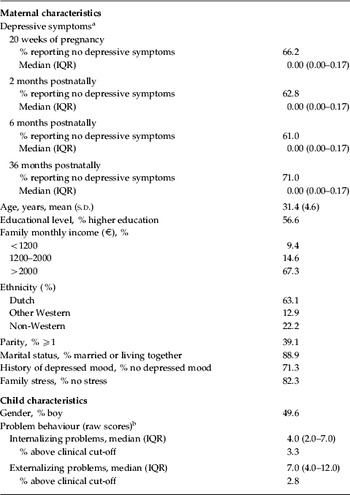
Sample descriptives (n = 4167)

IQR, Interquartile range.
Values were missing for educational level (0.9%), family income (8.7%), ethnicity (1.8%), parity (1.8%), marital status (3.0%), history of depressed mood (15.3%), and family stress (11.4%).
a Information on depressive symptoms were available for n = 3527 (85%) at 20 weeks of pregnancy, and n = 3436 (82%) at 2 months, n = 3187 (76%) at 6 months, and n = 4068 (98%) at 36 months postnatally.
b Children's problem behaviour as rated by the mother. Clinical range based on clinical cut-off of Dutch normative sample (Tick et al. Reference Tick, van der Ende, Koot and Verhulst2007).
Response analyses
The first group of mothers (n = 1605), who had participated in no or only one assessment of depressive symptoms, were lower educated (73.3% v. 46.1%, χ 2 = 285.90, p < 0.001), had lower income (<1200; 36.3% v. 13.5%, χ 2 = 322.98, p < 0.001), were more likely to be of non-Western ethnicity (57.0% v. 26.3%, χ 2 = 441.06, p < 0.001), and reported more family stress (15.9% v. 8.2%, χ 2 = 46.651, p < 0.001) than the mothers included in the study.
In the second group of mothers excluded from the study (n = 1174), no parental report of child behaviour was available. They were also lower educated (67.2% v. 40.9%, χ 2 = 239.42, p < 0.001), received lower income (<1200; 30.0% v. 19.7%, χ 2 = 315.23, p < 0.001), and were more likely to be of non-Western ethnicity (45.8% v. 21.5%, χ 2 = 275.99, p < 0.001) than mothers included in the analyses.
Results
Descriptive statistics of the participating mother–child dyads are presented in Table 1.
Trajectories of maternal depressive symptoms
Models with 3–6 trajectories were estimated. The BIC score kept increasing as more groups were added. Trajectories in the four-group model were conceptually interesting and average posterior probabilities, ranging from 0.70 to 0.92 (mean = 0.84), indicated a good to very good model fit. Because, in the five-group model, the smallest trajectory estimated in the four-group model (1.5%) was further divided into two even smaller groups (1.2% and 0.4%), we considered the four-group model as the most optimal model. If the BIC is not useful for model selection Nagin (Reference Nagin2005) recommends selecting a model with no more groups than is necessary to describe the distinct features of the data (see Supplementary Table S1 for description of the trajectories).
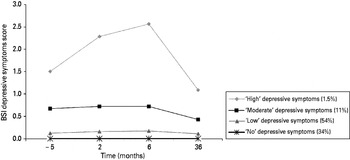
Fig. 1 illustrates the four trajectory groups of maternal depressive symptoms. The first trajectory (n = 1427, 34%) consisted of mothers who reported no or very few depressive symptoms throughout all four assessments [mean BSI score: 0.00 (95% CI 0.00–0.05)]. The second and largest trajectory (n = 2221, 54%) constituted of mothers who reported low levels of depressive symptoms. However, mothers in this trajectory named ‘low depressive symptoms’ did report significantly higher depressive symptoms at 2 and 6 months postnatally [mean BSI scores: 0.16 (95% CI 0.15–0.10), and 0.17 (95% CI 0.16–0.18), respectively] than in the prenatal and third-year assessment [mean BSI scores: 0.13 (95% CI 0.13–0.13) and 0.11 (95% CI 0.11–0.11), respectively]; as indicated by a significant quadratic term (p < 0.001). The third trajectory (n = 457, 11%) was named ‘moderate depressive symptoms’. Mothers assigned to this trajectory reported levels of depressive symptoms just below the score of 0.80 which signals clinically significant symptoms. In these mothers, depressive symptoms were higher at the first two postnatal assessments [mean BSI scores: 0.76 (95% CI 0.66–0.86) and 0.76 (95% CI 0.65–0.88), respectively] than at the prenatal assessment or the assessment 3 years after childbirth [mean BSI scores: 0.71 (95% CI 0.59–0.83) and 0.47 (95% CI 0.38–0.56), respectively]. Again, the quadratic term was significant (p < 0.001). The last trajectory compromised only 62 (1.5%) mothers. Mothers assigned to this trajectory reported consistently high levels of depressive symptoms that increased during the postnatal assessments at 2 and 6 months (quadratic term p < 0.001; mean BSI scores: 1.47 (95% CI 1.27–1.67), 2.31 (95% CI 2.16–2.46), 2.61 (95% CI 2.40–2.82), and 1.04 (95% CI 0.81–1.27)]. As the estimated mean depressive symptom scores were >0.80 at each assessment, the ‘high depressive symptoms’ trajectory included mothers fulfilling the criteria of a clinically significant depression.
Trajectories of maternal depressive symptoms from pregnancy to 3 years postpartum. BSI, Brief Symptom Inventory.

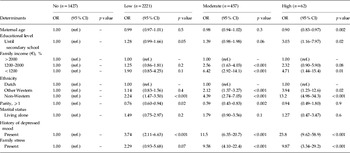
Table 2 presents the results of the multinomial logit models that were performed to examine the contribution of predictor variables. Compared to the ‘no depressive symptoms’ trajectory, the probability of being assigned to the ‘moderate’ or ‘high depressive symptoms’ trajectories increased if mothers were lower educated (moderate: OR 1.39, p = 0.06; high: OR 3.03, p = 0.02) and reported an income <€1200 per month (moderate: OR 6.42, p < 0.001; high: 4.71, p = 0.01). Moreover, mothers assigned to the higher depressive symptoms trajectories were significantly more often of non-Dutch ethnicity than mothers assigned to the ‘no depressive symptoms’ trajectory. Being ethnically non-Western increased the risk by approximately 13-fold of being assigned to the highest depressive symptoms trajectory (OR 13.2, p < 0.001). The probability of being assigned to the higher trajectories also significantly increased if mothers reported a history of depressed mood (moderate: OR 11.5, p < 0.001; high: OR 23.8, p < 0.001). Mothers assigned to the higher depressive symptoms trajectories also experienced significantly more family stress than mothers assigned to the ‘no depressive symptoms’ trajectory (moderate: OR 9.58, p < 0.001; high: OR 9.87, p < 0.001).
Multivariate multinomial logistic regression of predictor variables on trajectories of maternal depressive symptoms
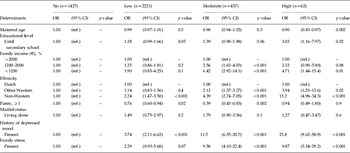
OR, Odds ratio;CI, confidence interval.
Values were missing for family income (n = 363, 8.7%), ethnicity (n = 75, 1.8%), parity (n = 74, 1.8%), marital status (n = 127, 3.0%), history of depressed mood (n = 636, 15.3%), and family stress (n = 475, 11.4%). Separate missing categories were run.
Child problem behaviour as a function of maternal depressive symptoms trajectory
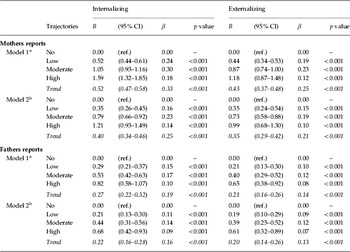
Child behavioural problems were examined as a function of trajectories of maternal depressive symptoms. Results are presented in Table 3. Overall, mothers assigned to any of the higher (i.e. low, moderate, high) trajectories of depressive symptoms rated their children as having significantly more internalizing problems than children of mothers assigned to the ‘no depressive symptoms’ trajectory, independent of sociodemographic variables and gender of the child (overall β = 0.25, p <0.001). Similarly, children of mothers assigned to the ‘low’ trajectories had significantly more externalizing problems than children of mothers assigned to the ‘no depressive symptoms’ trajectory (overall β = 0.21, p <0.001).
Regression analyses of maternal depressive symptoms trajectories on child problem behaviour as reported by each parent

CI, Confidence interval.
Italics indicate p value for trend across categories.
a Included covariates: posterior probability of maternal trajectory membership.
b Included covariates: posterior probability of maternal trajectory membership, maternal age, educational level, family income, ethnicity, parity, marital status, family stress, gender of the child.
Results with paternal ratings of child problem behaviour were very similar to the results with maternal ratings of child behaviour (see Table 3). Fathers rated children of mothers assigned to the higher trajectories as having significantly more internalizing (overall β = 0.16, p < 0.001) and externalizing (overall β = 0.13, p < 0.001) problems than children of mothers assigned to the lower trajectories.
The added value of trajectory modelling
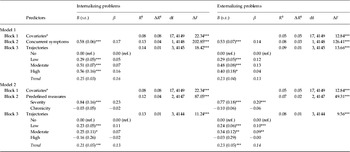
Successive linear regressions were performed to assess whether the course of the maternal depressive symptoms predicted child problem behaviour above the concurrent depressive symptom score at 36 months. The results are presented in Table 4, model 1. In the first step, predictor variables and gender of the child were entered as a block. In the second and third step concurrent depressive symptoms and the trajectories of maternal depressive symptoms were entered. The trajectories were entered as a categorical variable, with the ‘no depressive symptoms’ trajectory as the reference group. Although concurrent depressive symptoms significantly predicted child problem behaviour, the trajectories remained independent predictors of child internalizing and externalizing behaviour.
Successive linear regression models assessing the predictive value of trajectories on child problem behaviour as reported by the mother

Reported (standardized) regression coefficients are based on the full model.
Italics indicate p value for trend across categories.
The ΔR 2 depends on the order in which variables were entered into the model. For example, trajectories add an ΔR 2 of 0.01 if added to the predefined measures of depressive symptoms: This reflects the added explained variance due to modelling of trajectories of depressive symptoms. However, when trajectories are the only indicator of maternal depressive symptoms they would add an ΔR 2 of 0.04 to the model predicting internalizing problems, resulting in a total variance of 12% (data not shown).
a Included covariates: maternal age, educational level, family income, ethnicity, parity, marital status, family stress, gender of the child, and the posterior probability of maternal trajectory membership.
* p < 0.05, ** p < 0.01, *** p < 0.001.
Next, we assessed the added predictive value of trajectories of maternal depressive symptoms above a model including two predefined measures of severity and chronicity (Table 4, model 2). Variables representing severity and chronicity of maternal depressive symptoms were added to the basic model. In the third step, trajectories of maternal depressive symptoms (categorical variable) were added. Severity of maternal depressive symptoms, defined as the mean depressive symptoms score over all four assessments, independently predicted child internalizing (β = 0.23, p < 0.001) and externalizing (β = 0.20, p < 0.001) problems. The trajectories also predicted child internalizing problems independently of severity and chronicity of maternal depressive symptoms (internalizing: overall β = 0.21, p < 0.001; externalizing: overall β = 0.23, p < 0.001). Moreover, the trajectories added to the predictive capability of the model [internalizing: ΔR 2 = 0.01, df = 3, 4144, F(ΔR 2) = 11.24, p < 0.001, and externalizing: ΔR 2 = 0.01, df = 3, 4144, F(ΔR 2) = 9.56, p < 0.001].
All analyses were repeated with paternal reports of child problem behaviour as the outcome (see Supplementary Table S2). Results were very similar compared to the analyses using maternal reports.
To test consistency of the results, we also defined chronicity by a stricter cut-off and defined the top 15% of the depressive symptoms scores as positive instead of a score >0.80 on the BSI (cut-off scores now ranged between 0.34 and 0.51). The trajectories remained significant predictors of child internalizing and externalizing problems and had additional predictive capability (results not reported here).
Discussion
In a large population-based sample of mother–child dyads, we identified four trajectories of maternal depressive symptoms from mid-pregnancy through the first 3 years of a child's life: a ‘no’ trajectory (34%), a ‘low’ trajectory (54%), a ‘moderate’ trajectory (11%), and a ‘high’ trajectory (1.5%). Children of mothers assigned to the higher trajectories had significantly more problem behaviour than children of mothers assigned to the lower trajectories as reported by each parent. Moreover, trajectory modelling was of added value in predicting child problem behaviour over classical approaches that define severity using symptoms scores or cut-off scores to define chronicity. Further, paternal reports provided evidence that our findings were not due to a ‘depressed mother reporter bias’, i.e. sad mothers report more behavioural problems in their offspring than non-sad mothers.
Our results show that the vast majority (88%) of mothers report no or low depressive symptoms from the peripartum through the 5 years of their child's life. However, we also identified a group of 11% of mothers who consistently reported symptoms around the level of clinical symptoms. Further, a small group of mothers (1.5%) consistently reported symptoms well above the level of clinical symptoms. Overall, these results are in line with a previous study that modelled trajectories of maternal depressive symptoms (Campbell et al. Reference Campbell, Matestic, von Stauffenberg, Mohan and Kirchner2007) as assessed with the Centre for Epidemiologic Studies – Depression Scale (CES-D). In this study the vast majority of mothers also reported no symptoms or symptoms below the clinical cut-off on the CES-D. The remaining mothers reported symptoms around or above the clinical cut-off score on the CES-D, of which a small group of 2.5% of the mothers reported chronically high symptoms. Campbell and colleagues (Reference Campbell, Matestic, von Stauffenberg, Mohan and Kirchner2007) identified six trajectories. Possibly the three smaller trajectories of mothers with intermittent, moderate increasing, and high decreasing symptom levels, were merged into the ‘moderate’ trajectory identified in our study. However, studies must be compared cautiously, as the present sample is larger, of European descent and assessed with an instrument not including somatic symptoms or happiness as part of the depression scale.
A significant increase in symptom severity was noted at 2 and 6 months postnatally in all but the ‘no symptoms’ group. Indeed, up to 80% of all woman experience some kind of emotional problems after childbirth (Henshaw, Reference Henshaw2003). The increase in symptom severity was most pronounced for the ‘high’ trajectory. This may be explained by the fact that adverse socioeconomic characteristics predict postpartum depression (Buist et al. Reference Buist, Austin, Hayes, Speelman, Bilszta, Gemmill, Brooks, Ellwood and Milgrom2008) and mothers assigned to the ‘high’ trajectory had significantly more adverse socioeconomic and demographic characteristics than mothers assigned to other trajectories. Moreover, elevated depressive symptoms during pregnancy are an important predictor for postpartum depressive symptoms (Gotlib et al. Reference Goodman and Gotlib1991; Milgrom et al. Reference Buist, Austin, Hayes, Speelman, Bilszta, Gemmill, Brooks, Ellwood and Milgrom2008). This suggests that increased levels of depressive symptomatology are already present prior to birth of the child in some of the mothers experiencing postpartum depressive symptoms. Symptoms may already be present before pregnancy, which is in line with the finding that mothers assigned to the higher trajectories more often reported a history of depressed mood than mothers assigned to the lower trajectories. This may then explain why we did not identify a trajectory of new-onset postpartum depressive symptoms. Overall, the prevalence of postpartum depressive symptoms is estimated at approximately 7% for diagnosed caseness (Gavin et al. Reference Gavin, Gaynes, Lohr, Meltzer-Brody, Gartlehner and Swinson2005) and at 13% for self-reported symptoms of postpartum depression (O'Hara & Swain, Reference O'Hara and Swain1996), which resembles the percentage of mothers (12.5%) assigned to the ‘moderate’ and ‘high’ trajectories.
Children whose mothers were assigned to the higher depressive symptoms trajectories were more likely to have internalizing and externalizing problems than children whose mothers were assigned to the lower trajectories. Even children of mothers assigned to the ‘low’ trajectory already had significantly more problem behaviours. This suggests that chronic exposure to maternal depressive symptoms, even if symptom severity is low, has an adverse effect on child problem behaviour. Campbell and colleagues (Campbell et al. Reference Campbell, Matestic, von Stauffenberg, Mohan and Kirchner2007) reported similar effects, but no significant difference in child problem behaviour between children of mothers assigned to the two lowest trajectories. Using predefined variables representing severity and chronicity, Brennan et al. (Reference Brennan, Hammen, Andersen, Bor, Najman and Williams2000) reported that children were at increased risk for behavioural problems if their mother's depressive symptoms were more severe and more chronic.
More severe and more chronic maternal depressive symptoms often occur within a context of environmental risk, which may also place children at increased risk for problem behaviour (Elgar et al. Reference Elgar, McGrath, Waschbusch, Stewart and Curtis2004). Mothers assigned to the higher depressive symptoms trajectories were lower educated and had lower family income. Moreover, these mothers were more likely to be of non-Western ethnicity and experienced more family stress than mothers assigned to the lower trajectory groups. However, maternal trajectory membership remained a significant predictor of child internalizing and externalizing problems after adjusting for these socioeconomic and demographic variables. Although the present study was conducted in a longitudinal cohort, causality cannot be inferred. For example, the odds of experiencing family stress (marital discord) were much higher in mothers assigned to the ‘moderate’ and ‘high’ trajectories than in mothers in the lower trajectories. It is not clear what comes first: depression or family stress? Most likely, there are reciprocal influences between depressive symptoms and family stress without causal primacy of one of the two (Rehman et al. Reference Rehman, Gollan and Mortimer2008). Along the same lines, there are other possible influential factors that could have contributed to the association between trajectories of depressive symptoms and child problem behaviour. For example, more severe or more chronic maternal symptoms may reflect a higher genetic loading, manifesting itself as behavioural problems in the children who inherit maternal genes. Also, intra-uterine factors may transmit the risk from mothers to their children, as may parenting styles (Goodman & Gotlib, Reference Goodman and Gotlib1999).
We found that trajectories of maternal depressive symptoms predicted child problem behaviour independently of concurrent depressive symptoms. That finding implies that not only the level of concurrent symptoms (e.g. the end-point of the trajectories) is related to child problem behaviour, but also the course of the preceding symptoms. Most importantly, trajectories were of additional predictive value for child problem behaviour, over measures of severity, defined as the mean symptom score over all time-points, and chronicity of depressive symptoms, defined by cut-off scores. The additional explained variance of the model including the trajectories was small. However, this is only the explained variance added by modelling depressive symptoms differently with trajectories. Overall, trajectories of depressive symptoms accounted for 33% of the explained variance. Another advantage of trajectory modelling is that this approach gives insight into the distinct underlying patterns of depressive symptoms in a population (Nandi et al. Reference Nandi, Beard and Galea2009).
The trajectories of maternal depressive symptoms were modelled with a semi-parametric mixture model using the SAS procedure proc traj, i.e. group-based modelling (Nagin & Tremblay, Reference Nagin and Tremblay2001). When comparing this approach to growth mixture modelling, Campbell et al. (Reference Campbell, Morgan-Lopez, Cox and McLoyd2009) identified similar trajectories of maternal depressive symptoms with the growth mixture procedure as with the proc traj procedure (Campbell et al. Reference Campbell, Matestic, von Stauffenberg, Mohan and Kirchner2007). We identified three distinct trajectories showing an increase in symptom severity postnatally and a decrease towards 3 years postpartum (e.g. the ‘low’, ‘moderate’ and ‘severe’ trajectories). The increase and decrease were steepest for the ‘high’ trajectory, but similar for the ‘low’ and ‘moderate’ trajectories. Therefore, the latter two trajectories could have been merged into one trajectory using growth mixture modelling.
The current study has several strengths such as longitudinal and repeated assessments, a large community sample, and the use of both maternal and paternal ratings. Some limitations also need to be considered. First, it is not yet clear to what extent current results are generalizable to the broader population. Trajectories may differ as different or more assessment points are included and as different measures are used to define depression. Second, non-respondents in the current study were characterized by more adverse socioeconomic and demographic circumstances and this may preclude more differentiated high trajectories. Third, it remains unclear to what extent the associations are due to mother–child interactions or to genetic or intra-uterine influences.
Implications of current findings are twofold. First, future research would benefit from trajectory analyses. Not only would this provide further insight in maternal depressive symptoms, but it would also contribute to the understanding of the association with child development. Importantly, the risk of maternal depressive symptoms for child behavioural problems is not fully captured with a traditional approach. Second, current results seem to identify a clinically depressed group of mothers. More research is warranted to determine whether this group of mothers can be identified early based on certain characteristics. They would be a candidate group for early interventions to decrease or even prevent depressive symptoms and adverse child outcomes. Moreover, future research may benefit from designs that integrate information on depressive symptomatology and other possible causal factors in the association with child behavioural problems, such as family stress or genetic factors.
Supplementary material
For supplementary material accompanying this paper, visit http://dx.doi.org/10.1017/S0033291712000657.
Acknowledgements
The Generation R Study is conducted by the Erasmus Medical Centre in close collaboration with the Erasmus University Rotterdam, the Municipal Health Service Rotterdam area, Rotterdam, the Rotterdam Homecare Foundation, Rotterdam, and the Stichting Trombosedienst & Artsenlaboratorium Rijnmond (STAR), Rotterdam. The Generation R Study was made possible by financial support from the Erasmus Medical Centre, Rotterdam, Erasmus University Rotterdam and The Netherlands Organization for Health Research and Development (ZonMw) (grant no.10.000.1003). The present study was supported by an additional grant from the Sophia Foundation for Scientific Research (SSWO; grant 547, 2008) and a VIDI grant (017-106-370) to H.T.
Declaration of Interest
Dr F. C. Verhulst is a contributing author of the Achenbach System of Empirically Based Assessment, from which he receives remuneration.