

1 Introduction
How do pension funds deal with demographic and economic shocks? The importance of pension funds in many advanced countries is large (OECD, 2008), and funds are essential to the functioning of the country's financial system. The credit crisis has been a wake-up call for pension funds on the sustainability of pension contracts and has also moved the question of the governance of pension funds to centre stage. In spite of its dominant role in the financial systems and importance for the financial well-being of millions of pensioners worldwide, knowledge about how pension funds make decisions often only touches the surface, interpreting realized investment decisions of funds as the revealed preferences of rational and fully informed decision-makers (De Bondt and Thaler, Reference De Bondt, Thaler and Jarrow1995). This picture seems to be at odds with the day-to-day reality of stakeholders in the pension fund industry, who generally contract out asset management and pension administration, and for whom full information is more a dream than a reality. Risk, uncertainty and information asymmetries abound and the complexity of goals and objectives are hard to grasp, even for insiders, and links with the real and financial markets are difficult to assess. In this setting, pension fund trustees – members appointed by employers and employees who are entrusted with matching assets and liabilities – must cope with the realities of financial markets and demography and make decisions.
In this paper, we focus on the decisions of pension fund trustees in the Netherlands and examine how they deal with demographic and economic shocks. To discover how pension fund trustees make trade-offs between a number of pension policy instruments when these shocks occur, we have designed an experiment that uses the vignette method, also known in some disciplines as factorial surveys or conjoint analysis. In a vignette study, participants are presented with vignettes, short descriptions with specific information manipulated by the researcher (Van Beek et al. Reference Van Beek, van Praag and Koopmans1997; Ganong and Coleman, Reference Ganong and Coleman2006; Kapteyn et al. Reference Kapteyn, Smith and van Soest2007; Wallander, Reference Wallander2009). By the use of vignettes, we can mimic the dilemmas of the pension fund boardroom and reveal how choices are made by board members in good and bad times. The novel element in the setup is that decisions are not presented in a piecemeal or partial equilibrium fashion but are presented simultaneously and hence decision making may mimic closer the dilemmas of the pension fund board room where choices cover a wide range of policy instruments which affect both the short-run and long-run sustainability of pension fund contracts. Furthermore, examining the decisions of trustees helps to uncover how pension funds deal with ‘fat tail’ events: in the case of extreme wealth positions – very low reserves or very high reserves – it is a priori not clear how funds will redistribute the structural losses or surpluses.
Understanding decision making in the pension fund board room in the face of economic and demographic shocks would seem to benefit by paying attention to the vast expanding behavioural finance literature.Footnote 1 Contributions within this literature focus in general on the savings and investment strategies of individual workers (cf. Cronqvist and Thaler Reference Cronqvist and Thaler2004; Benartzi and Thaler, Reference Benartzi and Thaler2007). Studies rarely examine the decision-making process within pension funds directly. Studies on pension funds usually focus on governance issues such as the design of boards or the investment behaviour (Ammann and Zingg, Reference Ammann and Zingg2010), but the behavioural aspects of pension fund design, trustees’ decision-making abilities and characteristics are less well researched. Clark et al. (Reference Clark, Caerlewy-Smith and Marshall2006, Reference Clark, Caerlewy-Smith and Marshall2007) survey the decision-making ability of pension fund trustees in the UK, showing that British pension fund trustees lack common approaches relevant to investment decisions and are inconsistent in dealing with problems involving probability judgment. Clark et al. (Reference Clark, Caerlewy-Smith and Marshall2006) show that trustees are more cautious with other peoples’ money than they are with their own. The fact that trustees are not professionals has also led to concerns that trustees may lack the understanding to judge the advice they receive from finance experts. Clark et al. (Reference Clark, Caerlewy-Smith and Marshall2007), using UK pension fund governance and the U.S. mutual fund industries as examples, note a growing tension between representation and expertise in several fields. The evidence presented by them suggests that very few trustees have the competence and consistent judgment to challenge the experts who are responsible for executing complex financial decisions. These findings raise the question of how pension fund trustees do make decisions on the management of the pension fund. This study complements these cited works by looking directly at the policy choices of trustees under demographic and economic shocks; shocks which are summarized by elements that are considered important in the context of (Dutch) pension funds, such as changes in life expectancy, interest rates, inflation and the level of reserves. Data were collected in October and November 2008. At the start of the fall of 2008 pension funds could still think that they had sufficient reserves (an average coverage ratio of 121%) and even though the credit crisis became real and many expected that this could have adverse consequences for the assets of pension funds it was also a time when in October 2008 the Dutch pension regulator urged pension funds not to panic or to take corrective investment measures in haste (letter of Dutch Central Bank to all pension funds, dated 10 October 2008).
The remainder of this paper is structured as follows. In Section 2, we review the background of the Dutch pension system, and the role played by pension fund trustees. In Section 3, collection of the data is presented, and we explain at this point our estimation methodology. Section 4 presents the empirical results and Section 5 concludes.
2 Background on pension institutions
Here, we briefly review the background of the Dutch pension system and the governance questions that dominate the ongoing debate. According to Ambachtsheer (Reference Ambachtsheer2007) the Dutch pension system has a leading role in the world of pension finance. It shares some characteristics that are present in the UK pension system, but in particular the Swiss system (cf. Buetler et al. Reference Buetler, Huguenin and Teppa2005; Gerber and Weber, Reference Gerber and Weber2007). The Dutch system comprised 545 funds in 2008, managing €736 billion, covering 6 million active members and 2.5 million retirees (DNB, 2008). The pension system has three tiers: (1) a flat-rate public pension scheme, the so-called old-age pension law; (2) earnings-related occupational plans; and (3) private voluntary savings.
The second tier, occupational pension schemes, is the focus of our paper. In securing second-tier pension income, the Dutch pension funds are the dominant institution. Under certain conditions, Dutch companies may opt out of the mandatory pension plans if they offer their own scheme with equivalent benefits. Furthermore, there are around 700 single-employer plans. Another 46,000 mainly smaller employers offer schemes operated by insurance companies. The dominance may in part be explained by the high level of trust which workers and pensioners have in decisions taken by Dutch pension funds, certainly compared to private pensions offered by insurance companies (Van Dalen et al. Reference Van Dalen, Henkens and Hershey2010). Although Dutch employers are not required to offer pension schemes to their employees, collective wage agreements are a well-embedded tradition in the Dutch labour market. In 2007, occupational pension covered 91% of employees in at least some form. The overwhelming majority (96%) of all occupational pension contracts are the average wage Defined Benefit (DB) type. With DB plans, employees can count on a defined level of retirement income based on their salary and years of service, often up to a maximum of 70% of their average gross salary with 40 years of service. Further, due to lower marginal tax rates in retirement, after-tax replacement rates are usually substantially higher. For example, a pre-tax replacement rate of 70% is comparable to an after-tax replacement rate that exceeds 85% (Alessie and Kapteyn, Reference Alessie and Kapteyn2001). The employer pays nearly 80% of occupational pension premiums, and the employee pays the remainder. Post-retirement indexing of benefits is the rule, since virtually all DB pension contracts offer conditional indexation for cost-of-living increases. Although the absolute size of pension assets is larger in countries such as the US, UK and Japan, in terms of the relative size of the pension fund sector (as expressed as a percentage of GDP) the Dutch pension sector belongs to one of the largest in the world (OECD, 2008).
Not surprisingly, the quality of pension fund management is of great concern to the economies where retirement savings are highly concentrated in pension funds. The structure of the governing body is determined by the legal form of the pension fund. Generally, one can distinguish across countries two types of autonomous pension funds: the institutional type and the contractual type (Stewart and Yermo, Reference Stewart and Yermo2008). The institutional type, which can be found in e.g., Denmark, Italy, Japan and the Netherlands is an independent entity with legal personality and capacity and thereby also its own internal governing board. The contractual type is a segregated pool of assets without legal personality or capacity and is governed by a separate entity, like a bank, insurance company or a pension fund management company. These types of funds can be found in e.g. Spain, Mexico, Portugal and also in Italy. In countries with an Anglo-Saxon legal tradition, pension funds have characteristics of both types. Under the trust form, it is the trustees who legally own the pension fund assets and they must administer the trust assets in the sole interest of the plan participants.
In the present paper, we are dealing with board members of Dutch pension funds, hence of the institutional type. Basic decisions about level of pension premiums, indexing and the investment of pension premiums are delegated to pension funds. At the centre of the Dutch pension fund is the board of trustees, in principle, a bipartisan board of employer and employee representatives charged with managing the pension fund. Members are not elected; instead, a co-optation model is in place, under which employers’ organizations and labour unions appoint the trustees. This model is still in use today, although changing balances in boards are possible, especially with collective defined contribution schemes. Dutch pension funds are financial intermediaries positioned as a semi-public organization in the institutional pension framework; they are neither a private investor nor a government institution. The trustees have a fiduciary role to fulfil the obligations of a funded, DB pension plan, typically framed within a compulsory labour agreement. Therefore, the trustees as representatives of employers and employees have to balance the various interests of those two groups.
The Dutch regulators do not directly influence decision making, but set rules that indirectly restrict choices. For example, the Dutch pension law prescribes that pension funds whose ratio of assets to liabilities drops below 105% are required to restore their reserves within 3–5 years. The funds can accomplish this aim by decreasing benefits, raising premiums, or cutting administration costs. Or funds can reposition the investment portfolio to a 1 in 40 chance on a yearly basis to let the assets-to-liabilities ratio drop below the 105% level, thus limiting the riskiness of the investment decisions. In addition to the (in)direct influence of the pension regulator on decision making, we cannot rule out the presence of peer effects in decision making.
3 Data and method
For this study, data were collected by using a vignette design. A vignette study is a method intended for the investigation of human actions (Ganong and Coleman, Reference Ganong and Coleman2006; Wallander, Reference Wallander2009). The basic item of the survey is a vignette – a card with a short description of a situation or a person, generated by combining characteristics randomly manipulated by the researcher (Ganong and Coleman, Reference Ganong and Coleman2006). We create the vignettes by randomly combining characteristics. An important condition for using vignette-style surveys is that the number of characteristics used should be limited, because participants are typically unable to process large amounts of information. If the researchers introduce too many dimensions, it becomes difficult for the participants to clearly visualize the hypothetical person and situation (Rossi and Anderson, Reference Rossi, Anderson, Rossi and Nock1982). We presented each participant with ten vignettes representing a scenario with different demographic and economic characteristics and asked them to make hypothetical policy decisions for each scenario. By randomly varying the characteristics on the vignettes, one can determine the importance of a particular characteristic in the decision process.
3.1 Participants
We performed the survey among pension fund trustees in October and November 2008. Trustees in the Netherlands are required by regulation to take courses on pension fund investments and governance at regular intervals to improve their knowledge. Pension fund knowledge requirements have been stimulated by the Dutch Central Bank – the regulator of pension funds – who continues to use education as the means to improve the quality of governance of pension funds. Three classes of trustees participated in the vignette study and were asked to fill in the questionnaire in the classroom. None of the trustees declined the request to participate in vignette study, which resulted in a response rate of 100%. A total of 57 trustees (95% male; mean age 61 years) participated. With respect to gender this accords well with the statistics collected by the Dutch central bank. Unfortunately, there are no other broad-based statistics, but based on incidental reports on pension fund governance it seems that the other socio-economic characteristics (age, education and experience) are in line with what is generally observed for trustees in the pension fund sector, suggesting that the sample represents the group of trustees. Twenty respondents were members of the participant or accountability board of the pension fund, who are required to receive the same training. For practical purposes, we also denote this group as trustees. The average experience with pension fund management in the sample was 6 years and on average trustees spend 12 hours per month on entrusted pension fund issues.Footnote 2
3.2 Study design
The main aim of the vignette study is to see which factors play a role in the making of pension fund policy by the trustees. The presumption is that the major decisions, regarding all pension fund policy instruments considered in this paper are decided upon in principle by the board of trustees.Footnote 3 This is in line with actual practice in the Netherlands and accords well with the observation by Clark and Urwin (Reference Clark and Urwin2008), who argue that there is a hierarchy of decisions to be taken, distributed between pension fund trustees and their fund executives. The instructions that accompanied the vignettes were as follows:
‘Below you will find ten scenarios which a pension fund may encounter. Can you give us for each of the scenarios presented your choice of what you consider to be an adequate policy reaction?’
The pension fund policy mix consists of five instruments, on which the respondents had to form an opinionFootnote 4:
• Pension premium (a five-point scale ranging from ‘1’ considerably lower to ‘5’ considerably higher).
• Inflation indexing (a five-point scale ranging from ‘1’ no indexing to ‘5’ indexing considerably more than inflation rate).
• Structure of the investment portfolio (a five-point scale ranging from ‘1’ considerably less risky to ‘5’ considerably more risky).
• Entitlements of pensioners (a five-point scale ranging from ‘1’ considerably lower to ‘5’ considerably higher).
• Pension age (a five-point scale ranging from ‘1’ considerably lower to ‘5’ considerably higher).
The six independent variables used in the construction of the (random) vignettes are:
(1) life expectancy predictions (‘2 years lower than expected’ versus ‘2 years higher than expected’);
(2) the expected interest rate (‘1 percentage point increase’, ‘no change’ and ‘1 percentage point decrease’);
(3) expected inflation rate (‘1 percentage point increase’, ‘no change’ and ‘1 percentage point decrease’);
(4) the pension fund policies of the biggest three pension funds in the Netherlands (‘no policy change’ or ‘major steps to reform’), thus capturing the effect of leadership within the pension fund industry;
(5) the coverage ratio of the pension fund relative to other funds (‘worse than others’ or ‘better than others’), thus capturing the effect of social comparison (Camerer and Malmendier, Reference Camerer and Malmendier2007); and
(6) the coverage ratio of the pension fund (expressed as assets-to-liabilities ratio) in five categories: 90, 110, 130, 150 and 170).
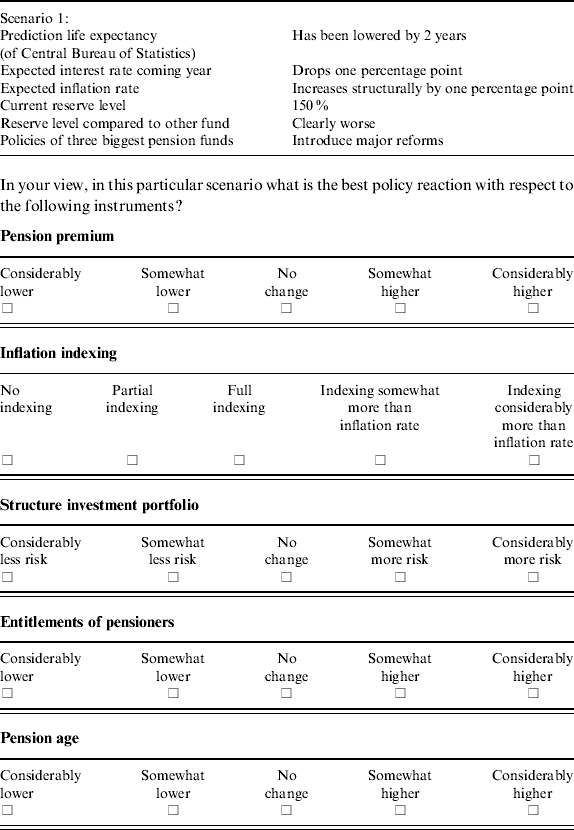
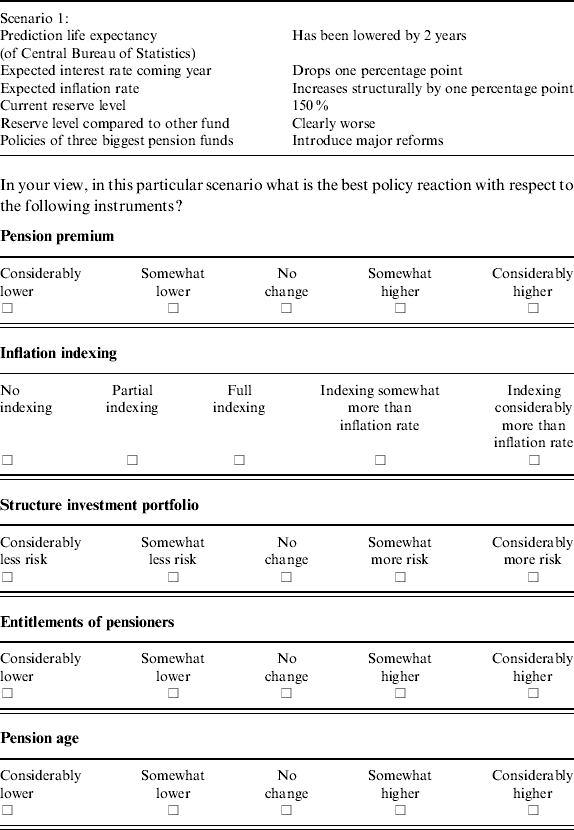
The number of unique combinations or vignettes (the vignette universe) is 360 (i.e. 2×3×3×2×2×5). Contrary to a factorial design in which all possible combinations are evaluated, in a vignette survey only a random selection from the vignette universe is judged by respondents (Wallander, Reference Wallander2009). This makes it possible to include a larger number of vignette dimensions and levels in the design, thereby enhancing the resemblance between the real and experimental worlds (Wallander, Reference Wallander2009). In our study, each participant received a random sample of ten vignettes. The ten vignettes are a randomly selected set out of the total of 360 vignettes. Every participant will therefore get a different set of scenarios to evaluate and formulate a policy response. Since the scenarios are randomly generated and selected, each respondent is equally likely to be confronted with a specific scenario. The scenarios are, of course, not equally likely to occur in a real-life setting, but one of the benefits of using vignettes is that one can explore extreme events with a low likelihood. An example of a vignette is presented in Box 1.
In a vignette design, the unit of analysis is the vignette (Ganong and Coleman, Reference Ganong and Coleman2006). The total number of observations in this study is 554. To estimate the driving forces behind pension fund choices of trustees, we use multinomial logit analysis.Footnote 5 We have reduced the five answer categories per policy instrument into three categories, combining codes ‘1’ and ‘2’ and codes ‘4’ and ‘5’. The status quo (code ‘3’) has been used as the reference category. In order to control for a design effect, we adjusted for clustering at the participant level. Without controlling for design effects, we would be likely to produce standard errors that are smaller than they should be.
Description of vignettes for pension trustees
We presented each participant with ten scenarios that a fictitious pension fund might encounter, and asked participants, ‘Can you give us for each of the scenarios presented your choice of what you consider to be an adequate policy reaction?
4 Results
4.1 Descriptive statistics
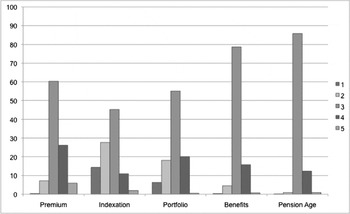
Figure 1 shows how often the participants have used the five pension policy instruments during the experiments. The middle option – take no specific action with respect to a policy instrument – is the option they choose most often. This choice suggests that trustees do not want to change the course in pension policy. In other words, the status quo bias may be a decisive element in pension fund decision making, a finding that is also evident in the individual investor's behavioural finance literature (Thaler, Reference Thaler2005).
Frequency distribution per pension policy instrumenta. Note: (a) For the variables ‘premium’, ‘benefits’ and ‘pension age’ the numbers denote: (1) considerably lower; (2) lower; (3) no change; (4) higher; (5) considerably higher. For the variable ‘indexation’, they denote: (1) no indexation; (2) partial indexation; (3) full indexation; (4) somewhat more than inflation; (5) considerably more indexation than inflation rate. For the variable ‘portfolio’ the numbers denote: (1) considerably less risk; (2) less risk; (3) no change; (4) somewhat more risk; (5) considerably more risk.

Most of the changes are made with respect to premiums, indexing and investments, which we expected for a setting in which pension plans are most often framed in terms of DBs. Premiums, indexing and investment are the short-term instruments that leave some room for manoeuvring within the rules of a DB pension contract.Footnote 6 Benefit entitlements and pension age are the instruments that are only changed as a last resort. It is only during the credit crisis for the first time in history trustees considered a reduction of pension entitlements. If pension entitlements are used as an instrument, increases in entitlements (16% of the cases) are more likely than decreases (5% of the cases).
4.2 Estimation results
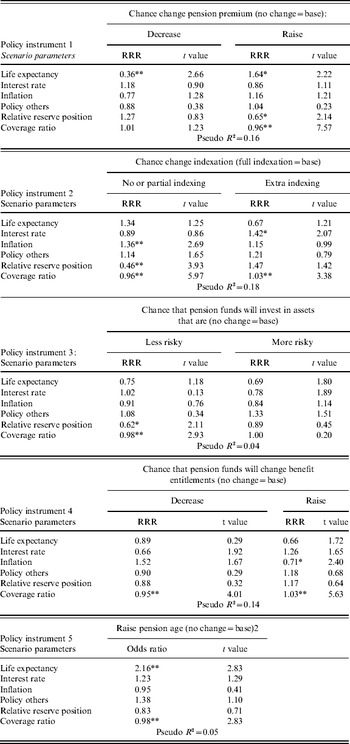
The central question is, of course, how trustees deal with shocks that are relevant for the finance of pension fund policies. The vignettes offer a range of shocks, some of which, e.g. life expectancy changes, can be described as structural, whereas other shocks, like changes in inflation or interest rates can be both structural and temporal. Table 1 presents the results of our analyses on decisions for the various policy instruments.
How do pension fund trustees decide on pension policy instruments in the face of demographic and economic changes? (N=554)Footnote 1

1 Method of analysis is multinomial logit analysis, standard errors are cluster adjusted at the level of respondents. Relative risk ratios (RRR) represent the change in the odds of being in the various choice categories rather than the base category associated with a one-unit change on the independent variable.
2 The option of a lowering of the pension age was offered, but due to the low frequency with which this option was chosen, only the binary choice between no change and an increase in pension age was examined. The sample N=548.
* Significance at 5%.
** Significance at 1%.
4.2.1 Pension premiums
The first policy instrument examined is the incidence of an increase or decrease in the pension premium level. The first column shows that the decrease in the pension premium is more likely if there is an unexpected drop in life expectancy. No other coefficients are statistically significant. The second column shows that an unexpected increase in life expectancy increases the probability of an increase in the pension premium. Hence, the effects of demographic shocks appear to be symmetrical: a demographic shock that reduces the liabilities of the pension fund leads to a reduction of the premium level, but a demographic shock that increases the liabilities also increases the likelihood that the premium will rise.
The most noteworthy results are the asymmetrical effects of changes in the asset/liability position. Although the coverage ratios in the vignettes may appear large, the credit crisis has proven that such shocks in the pension reserves are quite real. The asymmetrical reaction to such shocks can be seen most clearly by examining the effect of the coverage ratio on deciding to change to pension premium. A low coverage ratio increases the likelihood of an increase in the premium (see the effect in second column). If the reserve position increases, then it will lower the chance that pension premiums will be raised. A one-percentage point increase in the coverage ratio lowers the likelihood of increasing the pension premium by a factor of 0.96. However, trustees are very reluctant to lower pension premiums when the coverage ratio changes. In other words, premiums are ‘sticky’ and, for instance, a high coverage ratio does not induce pension fund trustees to opt for a reduction of the pension premium.
The reserve position also figures in the calculus of trustees when they compare this position to that of other pension funds. When pension trustees perceive that their position is better than other pension funds, then the likelihood of a pension premium increase is smaller. In other words, trustees make use of the heuristic to make decisions by comparison. We can find no discernable effect of this peer group with respect to the likelihood of a pension premium decrease.
4.2.2 Indexation of benefits
The second policy instrument that pension fund trustees use most often is the policy of indexation of benefits for inflation and wage changes. The results in Table 1 show that demographic shocks in the form of life expectancy changes do not lead trustees to use this policy instrument. Indexation seems to be more of an instrument that one can use to handle short-term economic changes. The estimation results show that the effects of the coverage ratio are more or less symmetric, but for the relative reserve position, the effect is large and asymmetric. For a pension fund trustee who perceives the reserve position to be in better shape than other pension funds, the chance that a pension fund reneges on its promise to index benefits for inflation is a factor of 0.46 smaller compared to the trustee who considers the reserve position to be worse than others. Further, an increase in the inflation rate also increases the probability that indexation will only be partial, or completely absent. The reverse position – a structural decrease in the inflation rate – does not encourage trustees to be more than generous and give beneficiaries some extra compensation. However, there is an effect from the interest rate: an increase in the interest rate for the coming year by one percentage point increases the probability of extra compensation by a factor of 1.42. Part of this effect may be the result of the logic of the Dutch DB pension schemes, in which an increase in the interest rate improves the reserve position. To give an impression of the size of the effect in the day-to-day life of a pension fund trustee, we note that a one percentage point increase in the interest rate (or, to be precise, the interbank swap interest rate) increases the reserve position of the average pension fund by 12 percentage points (Bonenkamp and Ter Rele, Reference Bonenkamp and Ter Rele2009). Considering the fact that a one percentage point increase in the coverage ratio raises the probability of extra compensation by a factor of 1.03, an improvement by 12 percentage points is almost right on target and translates into a factor of 1.42.
4.2.3 Risk management of investment
Indexation and pension premiums are policy instruments that are often used when the economic situation changes, but we also want to determine to what extent other instruments are used. Although financial asset management is usually outsourced to specialized investment firms or insurance companies, communicating the level of risk to those firms remains one of the principal responsibilities of the board of trustees. The third entry of Table 1 shows that in the investment portfolio of a pension fund, the correlation with relevant pension fund (scenario) variables is weak and only the coverage ratio, in absolute and relative terms, affects investment decisions in a one-sided manner. Whenever the wealth position of a fund deteriorates, trustees turn to cutting their exposure to risky assets. An increase in pension wealth does not persuade trustees to make the investment portfolio riskier.
4.2.4 Changing the pension contract
The question of changing the pension entitlements is a hotly debated topic in times of crisis, and the current credit crisis is no exception to this rule. Decreasing benefit entitlements goes to the heart of the matter of honouring obligations tied to a DB pension contract. Beneficiaries may see reneging on this promise in adverse times as a breach of contract, and pension funds are therefore generally very cautious about discussing this measure of last resort. It is in the extremely good and bad times that beneficiaries may realize that a DB contract does not differ much from a defined contribution contract. The fourth entry in Table 1 shows that in terms of the level of the coverage ratio, there is also slight asymmetry in the ways trustees deal with high and low coverage ratios. The sensitivity of a real benefit decrease in response to changes in the coverage ratio is a factor of 0.95 lower compared to the base category of trustees who prefer the status quo. Pension benefit increases in response to coverage ratio changes progresses at a slightly lower rate (1.03), but considering the enormous jumps in wealth positions during booms and busts, these small ratios translate into relatively large effects on the probability of changing benefits. In short, trustees are more reluctant to pension benefit cuts than they are to improving the pension contract and increasing pension benefits.
4.2.5 Pension age
There is one final other measure that is also considered in boardrooms and government offices: raising the pension age. Trustees review this option at some point, but they almost never consider the reverse position, lowering the pension age. At the bottom of Table 1 the binary choice between raising the pension age versus sticking to the current pension age is examined. Results show that there are essentially two elements triggering trustees to consider the option of raising the pension age: an increase in life expectancy and a fall in the coverage ratio of the pension fund. The size of these two effects differs considerably and may well reflect the extent to which trustees consider the change transitory or permanent. An increase in the reserve position decreases the likelihood of an increase in pension age only slightly (a factor of 0.98), whereas a (unexpected) change in the life expectancy increases the possibility of an increase in the pension age considerably: trustees faced with a 2-year increase in life expectancy are more than twice as likely to raise the pension age than those trustees who face a 2-year decrease in life expectancy.
4.3 Decision making in good and bad times
The previous estimation results give an impression of the quantitative effects. However, the baseline probabilities for each of the policy choices are absent, which makes it difficult to assess the likelihood that policy choices are actually implemented. To illustrate our results, we predicted the scores on the different dependent variables (policy options) based on the models in Table 1. Next, we present the scores as a function of the coverage ratios for two different extreme scenarios. The first denoted as the state ‘good times’ represents a scenario in which demographic and economic shocks improve the financial situation of the pension fund. In this scenario, we assume a lower than expected life expectancy, better (than other funds) reserve level, lower inflation, higher interest rate. In a second scenario, we assume the state ‘bad times’: the pension fund is confronted with higher than expected life expectancy, a worse (than other funds) reserve level, a higher inflation and a lower interest rate.
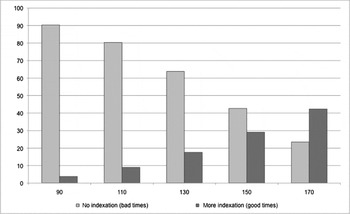
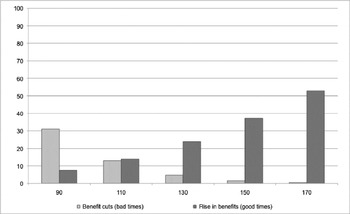
Figures 2–4 show the outcomes for the three most frequently used policy instruments for different levels of the coverage ratio. Of course, coverage ratios are not truly exogenous, but within the framework of this experiment, in which trustees are asked for a one-time decision, this ratio is, like the other scenario parameters, a fact of life. Again, we find the most striking outcomes in the policy instruments that trustees seem to use most often, premiums and indexing.
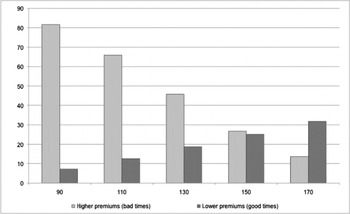
Pension premium choices in good and bad timesa. Note: (a) The figure shows per coverage ratio the probability that trustees raise premiums in bad times, compared to the probability that trustees lower premiums in good times. Good times are defined as: lower than expected life expectancy, better (than other funds) reserve level, lower inflation, higher interest rate. Bad times as: higher than expected life expectancy, worse (than other funds) reserve level, higher inflation, lower interest rate.

Indexing choices in good and bad timesa. Note: (a) The figure shows per coverage ratio the probability that trustees grant no indexation in bad times, compared to the probability that trustees grant extra indexation in good times.

Changing pension entitlements in good and bad timesa. Note: (a) The figure shows per coverage ratio the probability that trustees cut pension benefits in bad times, compared to the probability that trustees increase pension benefits in good times.

The first column of Figure 2 shows the likelihood that trustees opt for higher premiums in bad times for different coverage ratios. There is a high probability that premiums will be increased in extreme bad times: when the coverage ratio is below 130. In a sense, this is to be expected because when this ratio drops below the required 105% required by the pension regulator, trustees have to act, and the probability is 81% that a trustee will raise the pension premium. Raising the pension premium is no longer a dominant choice for coverage ratios of above 130%. This choice accords with the background questions that we posed to trustees whose stated optimal coverage ratio is on average 126% (see Table 1). Apparently they sense that under those circumstances a pension fund is well funded and one should refrain from changing the pension premium.
What is more surprising in Figure 2 is that under the other extreme situation – the good times scenario with a coverage ratio of 170% – lowering pension premiums is not the trustees’ dominant choice; the probability of lowering premiums is only just over 30%. We derive the same insights from Figure 3, where no indexation is the dominant choice in bad times, and during good times extra compensation is rarely the trustee's choice. However, we do note that even at the coverage ratio of 130%, which is more or less in line with the trustees’ idea of an optimal reserve position, the option of no indexation is still a dominant choice in bad times. In short, there is a strong asymmetry in the reactions of trustees to good and bad times and the breadth of losses that define when trustees are apt to take corrective measures. In the domain of ‘good times’ the status quo prevails and indirectly pension funds accumulate reserves which may be useful for extremely bad times. However, part of this surplus is dissipated during good times by viewing the decisions on pension entitlements. In Figure 4, the option of changing pension entitlements reveals the preference for the status quo of pension fund trustees, since even during extreme bad times the probability that pension benefits will be cut is approximately 30%. However, when the (very) good times arrive, increasing pension benefits is considered an option. When a pension fund has a coverage ratio of 170% the probability of raising benefits is 52%. When we compare the results in Figures 2–4 we establish that in extreme good times, trustees are more inclined to increase benefit levels than they are to lower the pension premiums. This implies that they tend to distribute the surpluses of a fund in favour of pensioners at the expense of the current group of workers. In other words, the pensioners alive during such a policy change incur a windfall gain.
5 Conclusions and discussion
Making pension fund policy choices in the face of demographic and economic uncertainty is a complex matter and demanding task of trustees. Trustees have to balance the interests of participants, sponsors and regulators, and these decisions usually take the shape of financial trade-offs. To add to the complexity, these trade-offs are both intragenerational and intergenerational (Barr and Diamond, Reference Barr and Diamond2006). In this paper, we offer a picture of the choices pension fund trustees make by way of an experiment carried out through a randomly generated set of scenarios (the so-called vignette method). They were asked to make decisions on a pension fund policy instrument: pension premiums, indexation, investment, entitlements and the pension age. By explicitly asking for a choice of these instruments, the experiment by means of vignettes generates insights that cannot be obtained from piecemeal experiments or experiments which only focus on one or two instruments.
This study has shown that trustees evaluate demographic and economic shocks differently. Changes in the life expectancy are perceived as permanent shocks and the reactions to this are in line with the permanent character: raising the pension premium and the pension age. As most of the changes with respect to life expectancy are of an increasing nature, the choices of trustees may be comforting as they seem to take structural measures for a DB contract when a structural change takes place.
However, economic shocks are evaluated differently and generate a number of asymmetrical responses. For instance, pension premiums are upwardly flexible but trustees are reluctant to decrease premiums. Asymmetries are also revealed by choices regarding the inflation indexation of benefits and changing real (defined) benefits. Finally, it appears that most policy decisions of trustees are strongly wealth dependent (as measured by the coverage ratio of the pension fund) in two distinct manners.
First of all, changes to the ratio between assets and liabilities make it necessary to take corrective measures if they diverge too strongly. This is one of the reasons why the coverage ratio plays such an important role in taking decisions. Another reason as to why this coverage ratio may be so important is the fact that this ratio is the most visible indicator which the pension regulator uses to assess the viability and sustainability of pension policies. For trustees, a substantial loss in reserves can imply a loss of freedom of choice for trustees. If the ratio of assets to liabilities drops below 105%, the regulator monitors pension funds’ activities more closely, requiring recovery plan by the trustees and regular financial updates from the fund. One of the reasons as to why this variable exerts such an influence on the choices trustees make may be the possibility that trustees are ‘conditioned’ to look first and foremost at the reserve position of a pension fund and then to other indicators.
Second, we find that wealth plays another role in the decision-making process: trustees of pension funds are affected by comparing the reserve position of their fund to the position of other funds. This is an indication that social comparison has a significant influence in trustees' choices of a pension fund policy. This result fits also well with other studies that point to similar mechanisms among investment managers. There is some evidence (cf. Olsen, Reference Olsen1997; Coval and Moskowitz, Reference Coval and Moskowitz1999; Shiller, Reference Shiller2002; Hong et al., Reference Hong, Kubik and Stein2005), which shows that investment managers are subject to biases and social influences (e.g., investing close to home, over-predicting desirable outcomes and under-predicting unwanted outcomes) which fall outside the standard model of investment.
In conclusion, this research is a first step in trying to uncover the decision-making process in the pension fund board room. Since the time of the survey, the circumstances in which pension funds operate have changed dramatically. During the fall of 2008, pension coverage ratio had dropped from 121% to an average coverage ratio of 98%. We believe that these hectic times strengthen the results as the sudden drop in the value of assets made some of the scenario's on which respondents had to act more realistic. Before the crisis a coverage ratio of 90% was unheard of, but as of today pension funds are fully aware that this percentage is quite realistic. Furthermore, the policy responses which we found from the vignette study capture the actual response of pension funds to the crisis in a nutshell: they immediately refrained from indexation, pension premiums were raised during 2009 and the discussion on changing the pension contract became real for many pension funds the first time since World War II, but in the end lowering pension benefits on a structural basis has so far remained an exception to the rule. In other words, pension funds will do their utmost to keep their promise of a DB pension.
Of course, the realism underlying the assumptions of the decision-making process or the range of parameters can always be questioned. Principal−agent relationships between the trustees and professional management of the fund are obvious candidates to be taken on board in future experiments. Nevertheless, the results of this study have given rise to comfort and wonder. Comfort because trustees seem to act in line with the common sense of pension economics, but also wonder as behavioural biases are not to be ruled out in the making of pension fund policy.