Introduction
Speciation in plants is the result of a complex series of evolutionary processes, with biotic and abiotic selection pressures acting upon taxa. The genus Leontopodium (Pers.) R.Br. (Asteraceae, Compositae), the edelweiss, is a genus in which species delimitation is in dispute, notably due to only limited knowledge of variation in their natural habitats. Similarly our knowledge is rather poor on the variability of taxonomically important characters, such as head construction, differential seed set, and morphological changes in achene and flower structure depending on the position in the flower head. According to the detailed monograph by Handel-Mazzetti (Reference Handel-Mazzetti1927), the genus contains 41 species. Since then, however, new species have been described and previously recognised species have been synonymised. Today, up to 58 species are recognised (Anderberg, Reference Anderberg1991; Bayer et al., Reference Bayer, Breitwieser, Ward, Puttock, Kadereit and Jeffrey2007; Russell et al., Reference Russell, Safer, Weiss-Schneeweiss, Temsch, Stuppner, Stuessy and Samuel2013). Dickoré, in a wider but as-yet-unpublished taxonomic work and as part of his contribution to this paper, suggests a total of about 35 species. We follow Handel-Mazzetti (Reference Handel-Mazzetti1927), along with Dickoré’s improvements, as was also followed by Blöch et al. (Reference Blöch, Dickoré, Samuel and Stuessy2010). Leontopodium is economically important for both pharmaceutical and horticultural purposes (Safer et al., Reference Safer, Tremetsberger, Guo, Kohl, Samuel, Stuessy and Stuppner2011b) and its distribution range from the Himalayan region to the Alps raises a number of questions concerning biogeographical patterns, distribution ranges, species delimitations, reproduction, etc. The highest number of Leontopodium species occurs in a relatively limited region, comprising the mountains of southwest China (Hengduan Shan) and the eastern Himalayas. Two species are found in Europe, with the most prominent representative of the genus being Leontopodium alpinum Cass.
A considerable amount of ecological (Erhardt, Reference Erhardt1993; Vigneron et al., Reference Vigneron, Rassart, Vértesy, Kertész, Sarrazin, Biró, Ertz and Lousse2005; Grabherr, Reference Grabherr2009), medical and pharmaceutical research (Dobner et al., Reference Dobner, Schwaiger, Jenewein and Stuppner2003; Schwaiger et al., Reference Schwaiger, Adams, Seger, Ellmerer, Bauer and Stuppner2004, Reference Schwaiger, Cervellati, Seger, Ellmerer, About and Renimel2005, Reference Schwaiger, Seger, Wiesbauer, Schneider, Ellmerer, Sturm and Stuppner2006; Li et al., Reference Li, Lin, Yang and Jia2006; Reisinger et al., Reference Reisinger, Schwaiger, Zeller, Messner, Stigler and Wiedemann2009; Safer et al., Reference Safer, Cicek, Pieri, Schwaiger, Schneider, Wissemann and Stuppner2011a) has focused on species of Leontopodium. Despite this high profile, however, molecular and phylogenetic studies on Leontopodium are scarce (Blöch, Reference Blöch2005; Blöch et al., Reference Blöch, Dickoré, Samuel and Stuessy2010; Safer et al., Reference Safer, Tremetsberger, Guo, Kohl, Samuel, Stuessy and Stuppner2011b). Although knowledge on chromosome numbers of Leontopodium species is fragmentary, several different numbers have been reported (see ICNA database; IPCN; Darlington & Janaki Ammal, 1945; Darlington & Wylie, Reference Darlington and Wylie1955; Meng et al., Reference Meng, Nie, Sun and Yang2012; Russell et al., Reference Russell, Safer, Weiss-Schneeweiss, Temsch, Stuppner, Stuessy and Samuel2013).
As chromosome numbers can be useful for interpreting systematic and phylogenetic relationships (e.g. Loureiro et al., Reference Loureiro, Kopecký, Castro, Santos and Silveira2007; Galbany-Casals & Romo, Reference Galbany-Casals and Romo2008), we have analysed 16 different species in Leontopodium and report the results here. However, it is not easy to extrapolate systematic or taxonomic conclusions from the results because it is not clear why, and if, intraspecific variability is so high in the genus. We therefore deliberately avoid a discussion on the biological implications of our study as the diversity of the existing studies does not yet allow for an ultimate and clear conclusion. The high diversity of chromosome base numbers, even within a species, leaves the impression that the base number itself is not a useful character for phylogenetic reconstructions as it might not carry any biologically relevant information. Here we simply point to some possible implications of the variability in the ploidy levels.
Materials and Methods
The study was carried out on 16 species of Leontopodium (Table 1), comprising 15 Asian and one European species. Seed from wild populations was collected and cultivated under identical conditions at the Botanical Garden of Justus-Liebig-Universität Giessen, which has the world’s most comprehensive collection of Leontopodium plants with more than 20 species. Figure 2 indicates the localities of the wild material. In most cases multiple accessions (in total 72) of each species were investigated; here we present the data from unambiguous counts on referenced material from the Botanical Garden, Giessen. We collected three individuals per accession in 2009. Voucher specimens are kept as living plant collections in the Botanical Garden, Giessen, as well as herbarium specimens that have been made from these same plants. The material, grown from seeds as indicated in Table 1, was examined and assigned to species by Bernhard Dickoré (Munich), Michael Jaeger and Sebastian Stille (both Giessen). Only material corresponding to the species descriptions was used for the analysis to avoid samples of unknown hybridogenic garden origin.
a, b, c, Outlines of chromosomes in consecutive focus layers in a root-tip cell of Leontopodium nivale; d, all 24 chromosomes marked in a, b, c shown in one picture of a cell of L. nivale; e, L. nivale growing in BG Giessen; f, 16 chromosomes marked in a cell of L. souliei; g, L. souliei growing in BG Giessen; h, 32 chromosomes marked in a cell of L. pusillum; i, L. pusillum growing in BG Giessen. Scale bar = 5 μm.

Geographical distribution of the investigated species and accessions. Leontopodium kurilense is missing as it is cultivated in Graz. Its natural range would normally be NE Japan.
Root tips of the collected plants were harvested for chromosome counts between 4:45 and 6:00 a.m. This was the period in which Leontopodium root tips showed mitotic activity, similar to observations for other plants (Cota & Philbrick, Reference Cota and Philbrick1994; Butorina & Do, Reference Butorina and Do2008).
Excised root tips were immediately treated with 0.05% aqueous colchicine for 6‒10 hours at room temperature. Root tissues were then fixed in 96% ethanol-glacial acetic acid (3:1, v/v) and stored at +4°C. Acetic acid (45%) was used to macerate the root tips at 70°C for 15 minutes. After repeated rinsings the root tips were stained with haematoxylin for 10 minutes at room temperature and rinsed again repeatedly. Immediately before microscopic preparation, samples were shaken at 110 rpm for 5‒12 hours to allow for an even distribution of the chromosomes within the cells. The root tips were then squashed on microscope slides, mounted in glycerol with 0.1% paraformaldehyde (PFA), and the preparation was sealed with dental wax.
Root-tip preparations were observed with a Leitz Laborlux S microscope at 1000×. Cells in which chromosomes were counted were documented with a digital camera (Lumix FS3, Panasonic). If necessary, several pictures of a single cell were taken to account for chromosomes in successive image planes (Power Shot S5IS, Canon) (Fig. 1). For documentation the outlines of the chromosomes were marked on the digital images with Corel Draw Version X3. The small size of the contracted chromosomes, due to the method of colchicine treatment, often hindered the exact counting of mitotic chromosomes, especially for cells with high chromosome numbers. Only unambiguous chromosome counts were used for data acquisition.
On average, 10‒20 root tips per accession were needed to find a sufficient number of good mitotic cells. Chromosome numbers were counted in four cells per accession on average, except for Leontopodium franchetii and L. sinense, where only single mitotic cells were available. All accepted individual counts were obtained independently and cross-confirmed by Stille and Ehlers.
Results
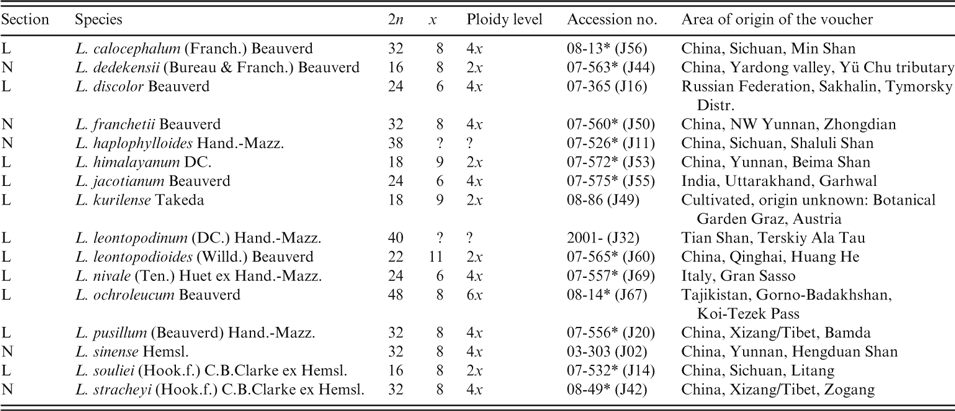
Examples of chromosome counts and investigated species of Leontopodium are shown in Fig. 1. Chromosomes of Leontopodium were found to be small, with an average length of 1 µm (Fig. 1). Table 1 presents chromosome numbers for all 16 investigated species along with accession number and provenance. Figure 2 illustrates the distribution area.
For most of the species examined the inferred basic chromosome number was x = 8. Diploid counts with 2n = 2x = 16 were found in two species, Leontopodium dedekensii and L. souliei. Polyploid counts were also recorded, with tetraploid (2n = 4x = 32) numbers in five species and a hexaploid number (2n = 6x = 48) in Leontopodium ochroleucum (Table 1).
Chromosome numbers (2n) of 16 Leontopodium species in sections Nobilia Hand.-Mazz. (N) and Leontopodium (L), with inferred basic chromosome number (x), ploidy level according to the inferred basic chromosome number, accession number in the Botanical Garden, Giessen, and the area of origin. Asterisks indicate collections from the wild rather than garden origin
Three other inferred basic chromosome numbers were obtained exclusively for species of Leontopodium sect. Leontopodium (Table 1). In Leontopodium discolor, L. jacotianum and the European species L. nivale chromosome counts of 2n = 4x = 24 were detected and interpreted as tetraploids with a basic chromosome number of x = 6. However, this could also be interpreted as a diploid level of 2n = 2x = 24 with a basic chromosome number of x = 12. For Leontopodium kurilense and L. himalayanum a diploid number of 2n = 2x = 18 was found, indicating a basic chromosome number of x = 9. For Leontopodium leontopodioides a basic chromosome number of x = 11 with a diploid number of 2n = 2x = 22 was most likely.
The total chromosome numbers counted for Leontopodium haplophylloides (L. sect. Nobilia) and L. leontopodinum (L. sect. Leontopodium) were 38 and 40, respectively, and do not match the basic chromosome numbers determined for the other species.
Overall, in the species examined, diploid and tetraploid chromosome numbers were most frequent. Where the basic chromosome number is x = 8 we suggest that polyploid series exist for species which are very closely related, for example at the diploid to tetraploid level for Leontopodium dedekensii and L. sinense (2n = 2x = 16 and 2n = 4x = 32, respectively) and at the diploid to the hexaploid level for L. souliei, L. calocephalum and L. ochroleucum (2n = 2x = 16, 2n = 4x = 32 and 2n = 6x = 48, respectively).
Discussion
Here we present chromosome numbers for 16 species of the genus Leontopodium, including the first published accounts for six of these species (L. calocephalum, L. franchetii, L. haplophylloides, L. leontopodioides, L. nivale and L. stracheyi). A basic chromosome number of x = 7, as suggested by several authors (Darlington & Wylie, Reference Darlington and Wylie1955; Arano, Reference Arano1956; Kadereit & Jeffrey, Reference Kadereit, Jeffrey and Kubitzki2007), or x = 12 or 13 (Russell et al., Reference Russell, Safer, Weiss-Schneeweiss, Temsch, Stuppner, Stuessy and Samuel2013) or x = 14 (Meng et al., Reference Meng, Nie, Sun and Yang2012) could not be corroborated for the genus Leontopodium. Instead, our study revealed the basic chromosome numbers x = 6, 8, 9 and 11. However, different basic chromosome numbers within a genus are not unusual, as shown for other Gnaphalieae genera, for example Anaphalis DC., Antennaria Gaertn., Gnaphalium L. and Helichrysum Mill. (for a comprehensive list see table 36.1 in Ward et al., Reference Ward, Bayer, Breitwieser, Smissen, Galbany-Casals, Unwin, Funk, Susanna, Stuessy and Bayer2009). For 10 of the 16 analysed species, which all belong to Leontopodium sect. Leontopodium and L. sect. Nobilia, previous chromosome counts were available, showing enormous variation (see Russell et al., Reference Russell, Safer, Weiss-Schneeweiss, Temsch, Stuppner, Stuessy and Samuel2013). It has so far not been possible to check voucher material (should it even exist) for the earlier chromosome studies to check for possible misidentifications. With this caveat, however, we compare our results to the literature data. Leontopodium dedekensii was found to have 2n = 16, whereas Russell et al. (Reference Russell, Safer, Weiss-Schneeweiss, Temsch, Stuppner, Stuessy and Samuel2013) reported 2n = 26. With 2n = 73 (Nishikawa, Reference Nishikawa1985) and 2n = 104 (Arano, Reference Arano1963), very high chromosome numbers have been reported for Leontopodium discolor (as L. hayachinense var. miyabeanum, a synonym of L. discolor according to Blöch (Reference Blöch2005), and as L. hayachinense, a synonym of L. discolor according to Dickoré, in prep.). Arano (Reference Arano1963), however, also counted 2n = 26 for Leontopodium discolor under another synonym, L. fauriei (according to Dickoré, in prep.), a basic chromosome number similar to the count of 2n = 24 recorded in our study. Russell et al. (Reference Russell, Safer, Weiss-Schneeweiss, Temsch, Stuppner, Stuessy and Samuel2013) reported 2n = 24 for Leontopodium himalayanum but we found 2n = 18. For Leontopodium jacotianum the chromosome number of 2n = 24 by Khatoon & Ali (Reference Khatoon and Ali1988) was confirmed. A comparison of the basic chromosome numbers of Leontopodium kurilense (2n = 18) and L. leontopodinum (2n = 40) with former counts suggests intraspecific variation. Counts for Leontopodium leontopodinum of 2n = 24 (ICNA Database), 2n = 49 (Sokolovskaja & Strelkova, Reference Sokolovskaja and Strelkova1938 – under the name L. campestre, a synonym of L. leontopodinum according to Dickoré, in prep.) and 2n = 52 (Vir Jee & Kachroo, 1985), and especially counts reported for L. kurilense with 2n = 26 (Sakai, Reference Sakai1934), 2n = 48 (Zhukova, Reference Zhukova1980) and 2n = 52 (ICNA Database), are much higher than the chromosome numbers presented here. The count for Leontopodium ochroleucum (2n = 48) is within the range of former counts (2n = c.50, Krogulevich, Reference Krogulevich1976; 2n = 49, Krogulevich, Reference Krogulevich, Malyshev and Peshlcova1978; 2n = 52, Krasnikova et al., Reference Krasnikova, Krogulevich and Rostovtseva1984, but see ICNA Database: 2n = 24). A large discrepancy was found for Leontopodium pusillum. Meng et al. (Reference Meng, Nie, Sun and Yang2012) counted 72 chromosomes whilst here we present the number of 2n = 32. The situation for Leontopodium sinense remains uncertain. Our counts revealed 2n = 32, Meng et al. (Reference Meng, Nie, Sun and Yang2012) reported 2n = 28, Russell et al. (Reference Russell, Safer, Weiss-Schneeweiss, Temsch, Stuppner, Stuessy and Samuel2013) 2n = 48. As for Leontopodium pusillum our results for L. souliei differ greatly from those of Meng et al. (Reference Meng, Nie, Sun and Yang2012). Whereas Meng et al. (Reference Meng, Nie, Sun and Yang2012) indicated 2n = 52, we counted 2n = 16.
For some of the species examined, a correlation between chromosome number and morphological attributes might be assumed, such as a difference in growth height being due to duplication of ploidy level (Briggs & Walters, Reference Briggs and Walters1997). In Leontopodium sect. Nobilia, L. sinense was characterised by having twice as many chromosomes as L. dedekensii (2n = 4x = 32 and 2n = 2x = 16, respectively) and is twice as tall; the species are very similar in other morphological characteristics. A similar situation occurs between species of Leontopodium sect. Leontopodium, with L. souliei (2n = 2x = 16) and the larger L. calocephalum (2n = 4x = 32).
Our data suggest that species in Leontopodium with the highest chromosome numbers and highest ploidy levels originate within the Himalaya distributional area (Fig. 2). Whereas Leontopodium haplophylloides (2n = 38) and the tetraploids L. franchetii, L. sinense and L. calocephalum (all 2n = 4x = 32) occur mainly towards the eastern end of the range of the genus, L. ochroleucum (2n = 48) and L. leontopodinum (2n = 40) are both limited to the western end. For the European species Leontopodium alpinum chromosome numbers of up to 2n = 48 and 52 have been reported (Siljak, Reference Siljak1977; Murin & Paclova, Reference Murin and Paclova1979), thus corroborating a high ploidy level west of the main distributional area of Leontopodium. This argues for the ability of species with higher ploidy levels to colonise new habitats more successfully and better adapt to areas with different environmental conditions, as has previously been suggested by, for example, Stebbins (Reference Stebbins1950) and Pellicer et al. (Reference Pellicer, Garcia, Garnatje, Dariimaa, Korobkov and Vallès2007). Polyploidy could thus be a crucial factor in adaptation to a changing environment and in determining future distributions. Intraspecific variation in chromosome numbers of Asteraceae as a general phenomenon was pointed out by Suda et al. (Reference Suda, Krahulcova, Travnicek, Rosenbaumova, Peckert and Krahulec2007) but seems to be particularly pronounced in Leontopodium. Forthcoming research will determine if this is due to natural intraspecific variability or whether it is a sign of taxonomic uncertainty.