For Barrington Moore (Reference Moore1966), all paths to modernity begin with the relationship between lord and peasant. This road may end in democracy, but it does not start under one. Indeed, according to Geddes (Reference Geddes1999), the historical opposition of large landowners to democracy is one of the few things we truly know about regime change. Likewise, although scholars continue to debate the relative importance of the bourgeoisie and working class for regime change, according to Mahoney (Reference Mahoney, Rueschmeyer and Mahoney2003, 148) “a weakened agrarian elite remains the most plausible explanation for why capitalist development is associated with the emergence and/or endurance of democracy.” With such statements in mind, it is unsurprising that rural inequality occupies a central role in contemporary theoretical and empirical studies of democratization.
Moore was hardly the first to note the association between landed elites and authoritarianism. Aristotle, Thomas Jefferson, and Tocqueville all highlighted a connection between an absence of landlordism and democracy. Likewise, although Marx (Reference Marx1982) and Engels (Reference Engels2000) both suggested that rural inequality could spark peasant mobilization, both ended up concluding that landed elites typically manage to stifle poor peoples’ demands for political change (Engels Reference Engels, Marx and Engels1977). Both Brentano (Reference Brentano1911) and Gerschenkron (Reference Gerschenkron1943) also highlighted how—in the famous case of Germany—landlords could successfully oppose democracy even as a country industrialized and grew wealthy.
Moore understood that not all landowners oppose democracy—only those who depend on a large supply of labor do. According to Rueschemeyer, Stephens, and Stephens (Reference Rueschmeyer, Stephens and Stephens1992, 8), labor-dependent landlords are “the most consistently antidemocratic force,” because they believe autocracy helps maintain and control a supply of cheap labor and prevents the taxation and redistribution they fear will be inevitable under democracy. Boix (Reference Boix2003), Acemoglu and Robinson (Reference Acemoglu and Robinson2006), Ziblatt (Reference Ziblatt2008), Ansell and Samuels (Reference Ansell and Samuels2014), Ardanaz and Mares (Reference Ardanaz and Mares2014), Mares (Reference Mares2015) and Thomson (Reference Thomson2015), among many others, all rely on this logic. In short, the affinity between labor-dependent landed elites and autocracy is not just conventional social science wisdom, it is an assumption—and for most of history, there was little reason to question it.
Nevertheless, several recent transitions appear puzzling for this logic. As Albertus (Reference Albertus2017) noted, landed elites in some countries that moved towards democracy in recent decades—such as Brazil, Colombia, and Pakistan—at least partly shifted sides. In some cases, landed elites simply stopped opposing a transition to democracy, while in others they even came to favor it. Are such examples exceptions to Moore’s thesis, or has something fundamentally changed about the relationship between landowning and opposition to democracy? What might cause us to rethink a centuries-old hypothesis that has taken on the status of a sociological law?
Scholars have overlooked a simple but important explanation for when, where, and why landed elites might lose their affinity for autocracy: agricultural mechanization, a causal factor with broad implications for understanding the political economy of regime change. In the latter half of the twentieth century, much of the world shifted from a natural resource-based to a technology-based system of agricultural production (Ruttan Reference Ruttan2002). Chemical, biological, and mechanical advances created the “Green Revolution,” which produced an astounding bounty, tripling global agricultural production even as world population more than doubled. New seed varieties, chemical fertilizers, and pesticides as well as advances in animal health-care techniques are “land-saving” advances—that is, they shift the explanation for increased output from expansion of the agricultural frontier to adoption of new technological inputs. More important for our story about regime change, however, are “labor-saving” innovations—improvements in mechanical technology that expand agricultural output by substituting tractors and related machines for human labor (Hayami, Ruttan et al. Reference Hayami and Ruttan1971).
Political economists have yet to consider the implications of mechanization—not for its impact on agricultural productivity, but for its impact on demand for agricultural labor. For our purposes the key implication of mechanization is that it transforms agricultural production from a system heavily dependent on human labor to one largely free of it, removing landowners’ need to repress workers and thereby eliminating their economic incentives to support autocracy. Given this, all else equal we should observe a connection between mechanization and democratization.
Industrialization pulls countless millions into cities, and in many countries fostered the rise of organized labor. Agricultural mechanization pushes countless millions out of the countryside, by eliminating their livelihoods. And just as factory-owners adapted politically to the rise of organized labor, landowners have also adapted to agricultural mechanization—most importantly, by abandoning their support for autocracy. We explore this argument cross-nationally, assessing its most important implications and maximizing the generalizability of our findings. We regress indices of democracy on a measure of agricultural mechanization, which acts as a proxy for change in landowners’ political preferences. We thus present preliminary and suggestive correlational evidence to demonstrate the plausibility of our argument rather than a precise test of causal mechanisms. This is the same approach as much other recent research on regime change that uses macro-level economic indicators as proxies for the preferences or relative strength of different political actors, such as Boix (Reference Boix2003), Ansell and Samuels (Reference Ansell and Samuels2014), or Albertus (Reference Albertus2017). Results from a series of models including country fixed effects support the idea that technological change in the agricultural sector is associated with changes in levels of democracy.Footnote 1 These results are robust across most model specifications, though in some cases they are weaker when including controls for time effects.
From Marx to Moore and beyond, scholars have rooted their theories in assumptions about relations between landowners and agricultural laborers. However, none have considered whether formerly labor-dependent landowners would continue to support dictatorship when agricultural production requires not just minimal labor repression, but virtually no labor at all.Footnote 2 We shift the focus of research on regime change away from industrialization and the erosion of landowners’ relative influence and towards the question of how agricultural mechanization alters the nature of labor-dependent landowners’ political preferences, regardless of their relative political weight. Three decades ago, Eric Hobsbawm (Reference Hobsbawm1992) suggested that the global decline of the peasantry was “the most spectacular, rapid, far-reaching, and profound social change in world history.” With over fifty years of technological change in the countryside since Lord and Peasant in the Making of the Modern World first appeared, it is time to amend Moore’s argument by considering how agricultural mechanization has re-made the modern world and altered landowners’ political preferences.
The next section provides information about the extent and impact of agricultural mechanization globally in recent decades. We then develop our argument explaining how mechanization can change landowners’ political preferences. We next present our data and set up and then test our core hypothesis. We conclude by considering the implications of our findings for the study of democracy and regime change.
Peasants to Tractors: The Transformation of Global Agricultural Production
Traditional agriculture persists in many areas around the world. Yet since the 1950s, rapid technological change has characterized global agriculture. Mechanization is a key element of the Green Revolution, which has generated near-miraculous increases in agricultural productivity. Mechanization also reduces demand for agricultural labor: In any country, as machinery substitutes for labor, the size of the agricultural population and dependence on labor-repressive production techniques declines. Importantly, this process can occur even as levels of landholding inequality—the key indicator of landed elites’ power in many important studies of democratization—remain unchanged. That is, mechanization is a dynamic source of change in landowners’ preferences that is unrelated to—and cannot be explained by—the relative distribution of land.
Mechanization: The Numbers
Since the early twentieth century, technological improvements have expanded the tasks of agricultural machinery from tilling soil and harvesting grain crops to seeding, weeding, and harvesting a range of formerly labor-intensive crops such as grapes, coffee, and fruit (Timmer Reference Timmer1988; Pingali Reference Pingali2007; Hayami, Ruttan et al. Reference Hayami and Ruttan1971; Ruttan Reference Ruttan2002). As the left panel in figure 1 reveals, the United States was the first country to mechanize. Mechanization began spreading elsewhere a few decades later (Binswanger Reference Binswanger1986). For example, the number of tractors in Japan increased from 500,000 to three million between 1960 and 1970, and likewise went from 800,000 to 1.5 million in Germany during the same decade. Some countries in East Asia and Southern Europe began mechanizing in the 1970s, but uptake has been uneven across regions since then. For example, while many countries in Latin America, the Middle East, and North Africa also began mechanizing around 1960, as did several communist economies, to this day mechanization has advanced relatively little in South and Southeast Asia and sub-Saharan Africa, where the number of tractors remains at only about one-third the level currently seen in Latin America.
Agricultural mechanization in eearly- and late-developing states, 1920–1980
Source: Binswanger Reference Binswanger1986, table 7

The Impact of Mechanization on Agricultural Employment
Since the onset of the Industrial Revolution, both owners and workers have intuitively understood the momentous implications of technological innovations on the demand for labor. Today a person who resists adopting some new technology is jokingly chastised as a Luddite—but the original Luddites risked their lives to destroy new threshing machines that they knew would eliminate their livelihoods. Just as in industry, human labor in agriculture cannot compete against machines. Yet unlike the gradual “pull” effect of industrialization on agricultural workers, agricultural mechanization typically drives down demand for labor in the countryside immediately, with devastating effect.
For example, in the U.S. South, 42% of cotton was mechanically harvested in 1960, but nearly all of it was before the decade was out (Alston and Ferrie Reference Alston and Ferrie1999, 121). Likewise, only twenty-five mechanical tomato harvesters were in use in California in 1961—but 1,000 were in use just six years later, harvesting approximately 80% of total tomato acreage (Schmitz and Seckler Reference Schmitz and Seckler1970, 570). Nearly everyone employed picking cotton or tomatoes was put out of a job in this short timespan. Similar stories can be found across the globe. In Malaysia, no rice was mechanically harvested in 1970, but over 80% was by 1980 (Scott Reference Scott1985, 75). Wherever mechanization advances, wages for unskilled agricultural work quickly plummet and jobs grow scarce.Footnote 3
Just two centuries ago the vast majority of humans lived and worked in the countryside. That world no longer exists. For example, in Germany the proportion of people working in agriculture plummeted from 62% in 1800 to 1.4% today. Even in later-developing Spain, where 65% of people worked in agriculture 200 years ago, only 4.2% now do (Allen Reference Allen2000; World Bank 2018). Poorer countries around the world are experiencing similar transitions today, just more rapidly. In Brazil almost 30% of people worked in agriculture in 1981, but only about 10% now do. The figures for Malaysia for the same period are 37% and 13% (World Bank 2018). The decline of the peasantry around the world and its association with urbanization has been noted since at least Marx’s time (Araghi Reference Araghi1995). Many factors drive this process, but figure 2 suggests that mechanization has rapidly accelerated the secular decline in the proportion of the world’s population working in agriculture, using both a broad indicator (change in the total proportion of a population working in agriculture) and a more specific and theoretically pertinent indicator, Albertus’ (Reference Albertus2017) measure of “Labor- Dependent” agriculture—people who work in agriculture but who own no land.
Changes in agricultural mechanization and rural populations, 1961–2011
Note: Ten-year changes within countries are plotted: 1961–1971, 1971–1981, 1981–1991, 1991–2001. Source: Albertus Reference Albertus2017; World Bank 2018

Agricultural Mechanization and Land Inequality
Although mechanization reduces demand for agricultural labor, it is not consistently associated with an increase in landholding inequality that is commonly associated with the power of landed elites. Labor-saving technology could generate significant economies of scale, making it possible for a single landowner to profitably farm much more land. Moreover, one might expect larger landowners to adopt and exploit expensive new technology first. Their greater resources might give them an advantage over neighbors with smaller farms and lead to consolidation of landholdings (Timmer Reference Timmer1988, 314; Binswanger Reference Binswanger1986, 36). However, globally, there is no relationship between mechanization and changes in landholding patterns. Figure 3 plots changes in the number of tractors per hectare of arable land against changes in two measures of landholding inequality: Gini coefficients and the proportion of farms in family ownership.
Changes in agricultural mechanization and landholding inequality, 1960–2010
Note: Ten-year changes in land Gini within countries are plotted, matching approximately 1950–1960, 1960–1970, 1970–1980, 1980–1980–1990, 1990–2000. Ten-year changes in family farms within countries are plotted: 1958–1968, 1968–1978, 1978–1988, 1998–2007. Source: Vanhanen Reference Vanhanen2003; Thomson Reference Thomson2016; World Bank 2018.

The correlation between changes in the number of tractors per hectare and changes in landholding inequality in a country is small and (counterintuitively) negative (r = -0.07). Likewise, the correlation between changes in the proportion of family farms and growth in tractor numbers is small and (again, counterintuitively) positive (r = 0.19). Conventional political accounts associate land inequality with landed elites’ opposition to democratization. If mechanization were associated with an increase in land inequality, it should also be correlated with opposition to regime change. However, unlike the devastating impact of mechanization on agricultural employment, mechanization has no clear impact on concentration of landholdings. It is also worth noting that measures of land inequality generally change very little over time within countries, particularly relative to the speed of mechanization. We mention this to highlight the fact that that the critical factor for understanding change in landowners’ political preferences is the change in the relative labor-dependence of agriculture given a particular degree of land distribution, not land inequality itself. Given this, levels of land inequality may be related to democracy but cannot explain changes in landowners’ political preferences over time within any country.
Scholars of regime change who take the importance of labor-dependent agriculture into account (e.g., Rueschmeyer, Stephens, and Stephens Reference Rueschmeyer, Stephens and Stephens1992; Ansell and Samuels Reference Ansell and Samuels2014; Albertus Reference Albertus2017; Mares Reference Mares2015; or Ziblatt Reference Ziblatt2017) agree that the degree of labor-dependence can vary across countries and even across space within countries. However, their theoretical arguments still assume that the nature of agricultural production itself is unchanging: that relative input costs and labor productivity are constant over time and there are no gains to technological innovation. This was a relatively plausible assumption for nearly all of human history—after all, only after the spread of mechanization in the second half of the twentieth century did we see the labor-dependence of agriculture decline rapidly and its productivity dramatically increase. Yet what happens to labor-dependent landlords’ political preferences when mechanization makes this assumption implausible? In what follows, we draw attention to the political consequences of within-country socioeconomic change rather than whether (ceteris paribus) country A is more likely to democratize than country B given different values at time t on different independent variables (such as land inequality) across those two countries.
Landowners and Tractors: Mechanization and Political Change
We argue that agricultural mechanization is a key component in the transition from natural resource-based to technology-based agricultural production because it is labor-saving, reducing landowners’ reliance on labor repression and demand for authoritarian government. To understand how agricultural mechanization can alter landowners’ preferences, we must first return to Moore’s argument about the affinity between labor-repressive agriculture and autocracy. Moore explored the different “paths to modernity” that preindustrial, traditional agrarian societies can take. The relationship between lord and peasant in traditional societies is one of mutual dependence: lords require peasants to work their land, while peasants depend on lords for security and welfare. This mutually beneficial relationship is nonetheless hierarchical: to maintain their status lords must control labor—they must prevent workers from slacking and keep them tied to the land to ensure an adequate supply of labor year in and year out. Landowners’ economic interests shape their political preference for “labor-repressive” agriculture, and therefore for autocratic rule.
Although he never explained how this might happen, Moore’s democratic path to modernity requires this relationship between lord and peasant to change—essentially, for the dependent peasantry to disappear, through what he called agricultural “commercialization.” By commercialization Moore did not mean that food would be grown for profit rather than for local consumption (Reference Moore1966, 419-22). Instead, he meant that food would be produced with minimal labor repression. Where commercialization fails to take root and repressive agricultural labor relations survive the onset of modernization, landed elites will continue to prefer autocracy, regardless of the growth of pro-democratic urban interests. Indeed, as long as agricultural production requires a large and constant supply of unskilled labor, landowners prefer a political system that depresses agricultural wages, allows them to use violence to maintain local law and order, keeps rural workers tied to the land, fails to enforce equality before the law, and offers workers no government services that might substitute for a local patron’s employment or “good will” in providing minimal forms of social welfare.Footnote 4
Examples illustrating the connection between labor-repressive agriculture and autocracy can be found throughout history and across global regions. In the post-Civil War US South, for example, landed elites ferociously opposed not only the spread of political rights and civil liberties to former slaves but also—to minimize labor’s exit options—any form of public spending on education, social security, and welfare (Alston and Ferrie Reference Alston and Ferrie1999; McAdam Reference McAdam2010; Mickey Reference Mickey2015). Similar relationships can be found in late nineteenth-century Germany (Anderson Reference Anderson2000; Mares, Reference Mares2015), early twentieth-century Brazil (Leal Reference Leal2012), or mid-twentieth-century Malaysia (Scott Reference Scott1985). Support for labor-repressive agriculture rested not on local culture but on economics: a need to maintain a supply of cheap labor. Societal norms or cultural beliefs (such as racism among U.S. southern planters) rationalize but cannot explain the emergence and persistence of oppression. Moreover, culture varies from place to place, meaning it cannot easily explain why we see similar relationships between landlords and peasants across time and space. At root, economics—not culture—explains the affinity between autocracy and labor-intensive agriculture.
Labor-repressive agriculture also does not necessarily disappear with industrialization, as the case of Germany illustrates. As long as a large supply of rural labor exists, wage pressure in agriculture due to the pull factor of industrialization can be contained, allowing labor-repressive politics to persist. As Germany industrialized, landowners in areas with surplus labor continued to support autocratic rule. In areas with labor shortages, industrialization strained the economic foundations of traditional agrarian society. In such regions landed elites supported electoral reform—a key step towards democratization—because the costs of agrarian clientelism and repression grew too high to keep workers tied to the land (Mares Reference Mares2015).
A similar logic played out in Brazil, where—just as in the U.S. south—landed elites responded to the abolition of slavery in 1888 by creating a system of agrarian clientelism that kept workers economically and politically dependent (Leal Reference Leal2012). As the country industrialized, many rural workers migrated to cities. This raised the cost to elites of maintaining agrarian patron-client networks. Workers were drawn to cities not just for better wages and working conditions but also because of the far greater availability of education, health care and other services. As Garcia and Palmeira explained, cities “signified a universe of rights,” while rural areas remained a world of “privation, arbitrary rule, subjection and captivity” (Reference Garcia and Palmeira2001, 61).
No matter the context, agricultural mechanization—not simply industrialization or urbanization—is what finally undercuts landed elites’ support for autocracy. Once technology can produce more output for the same or less cost than human labor, planters will invest in the more efficient mode of production. Mechanization’s economic effects are calamitous for rural workers and almost miraculous for landowners—and the scope and speed of change upsets every facet of rural social relations. As Hobsbawm implied, agricultural mechanization is a much faster way to engage in creative destruction in the countryside than urban industrialization.
Mechanization eliminates planters’ need to maintain a system of repressive labor relations for the simple reason that it completely eliminates their need to maintain a steady supply of cheap labor in the first place. With mechanization, the relative supply of labor no longer impacts the relative cost of repression, because the relative supply of labor becomes increasingly marginal to agricultural production itself. Labor scarcity can weaken landlords (Mares Reference Mares2015)—but only in a world where labor-saving technology does not exist or cannot be used, such as the case of pre-World War I Germany that Mares considered. Once mechanized, labor scarcity may not affect landlords’ profitability at all.
Consider the effects of mechanization on the costs of maintaining agrarian patron-client networks. Mechanization destroys the relationship of mutual dependence between landowners and workers. Because planters no longer need to keep labor tied to the land over time, they no longer care even minimally about workers’ long-term welfare. Weak demand for labor also takes away planters’ incentives to maintain an image as a patron who cares for and provides protection and services to their network of clients (Scott Reference Scott1985, 175). For example, in Malaysia mechanization meant landowners could offer their remaining workers less up-front pay, stop providing a midday meal, and end the practice of distributing gifts and sponsoring a communal feast at the end of the harvest to thank workers for their labor (ibid., 120). Mechanization also gave landowners incentives to force tenant farmers off the land, because it became more profitable to cultivate it for commercial production (ibid., 123).
Similar dynamics occurred in the U.S. south, where mechanization brought about the rapid demise of tenancy contracts. These were replaced by simpler wage contracts, as planters sought to push workers off of land that could be put into production. Sharecropping—an effective way to tie workers to the land after abolition (because the cropper receives a portion of the harvest rather than weekly wages—but only at the end of the season) also came to an end (Alston and Ferrie Reference Alston and Ferrie1999). Mechanization had similar effects on rural social relations in Brazil (Pereira Reference Pereira1997; Kerbauy Reference Kerbauy2000).
The need to coerce agricultural labor approaches zero as the demand for rural labor approaches zero—and the latter becomes likely the more that technology substitutes for labor in terms of relative contribution to agricultural output. Landholders’ normative views about political equality need not change at all with mechanization. What does change is their instrumental need for coercive control over their workers. Once technology eliminates this need, landlords’ political interests should also change—even if the relative distribution of land remains constant. As mechanization advances, so should democracy, primarily because landowners have less to fear from rural labor, which is left in a much weaker political position, and because they have less need for labor-repressive policies such as those that depress agricultural wages, keep workers tied to the land, and generally require significant use of coercion to maintain profitability.
We are not suggesting that mechanization gives formerly labor-repressive landowners incentives to actively promote democracy. As Mickey explained, mechanization of cotton production in the U.S. South mainly “attenuated the ferocity” of landowners’ opposition to expansion of democratic rights; it did not turn Jim Crow-era planters into civil rights activists (Reference Mickey2015, 10). Still, mechanization increases demand for skilled rather than unskilled labor, and as such it also gives landowners incentives to change the image of their polity as one safe for both capital and labor. Mechanization, by increasing the demand for skilled labor, should generate some degree of support among landowners for both democracy as well as investment in education, infrastructure, and other public goods, all as part of an effort to attract and retain a higher-quality labor force (Galor, Moav, and Vollrath Reference Galor, Moav and Vollrath2009; Mickey Reference Mickey2015).
Regardless, in politics a dog that no longer barks can be just as important as one that does. Consider a shift from a situation in which one actor (say the urban middle class) favors democratization while another (labor-repressive landlords, for example) opposes it to a situation in which one actor favors regime change while another takes no position. The likelihood of regime change is certainly greater in the latter situation. At a minimum, mechanization tends to remove a key actor from the coalition opposing democracy.
Agricultural mechanization should be added to the factors that potentially contribute to endogenous regime change. In such approaches democracy results from the political consequences of economic development under authoritarianism (Boix and Stokes Reference Boix and Stokes2003). To be sure, many potential sources of regime change are exogenous to the process of economic development. And even for theories of endogenous regime change, many different factors may be at work. Given this, the bar is set relatively high for finding a new signal through all the noise. Recent research has attempted to move beyond the purported impact of per capita GDP to discuss the impact of economic inequality. Yet, as noted, such efforts have leveraged factors (such as the distribution of land) that change little over time and do not incorporate the impact of dynamic change in the relations of production in the countryside. We focus on just one such dynamic aspect of economic development—one that may only occur decades after a country has experienced significant urbanization, industrialization, and per capita income growth—and one that, in point of fact, seems rather small when compared against overall GDP growth, for example. However, agricultural mechanization is likely to have relatively precise effects—on landowners’ political preferences—compared to other factors driving economic development, which may have more diffuse effects on the relative strength as well as the political preferences of other relevant actors.
Research Design and Data
Our argument suggests that all else equal, we should observe a positive association between mechanization and levels of democracy within countries. Given that our story is one of endogenous democratization, we estimate linear regression models of democracy including country fixed effects. This is theoretically important, even though it raises the bar for finding significant effects of any endogenous measure of democratization.Footnote 5 We include only a sparse set of control variables in our analysis, given the danger of including bad controls that are also potential outcomes of our main independent variable, agricultural mechanization.
We acknowledge that our analysis tests the plausibility of our theoretical argument rather than the precise causal mechanisms linking mechanization, landowners’ political preferences, and regime change. However, this sort of approach is common in cross-national research on democratization, in which scholars leverage variables such as a GDP growth, land, or income inequality as proxies for the political interests of different social groups. Our empirical analysis aims to suggest that a relationship does exist between a relatively small change to a nation’s economy (the adoption of tractors, in a sector that may even be declining in relative importance as industrialization advances) and relatively large-scale political change. It is our hope that our theoretical argument, coupled with these results, provide the basis for a broader macro- and micro-level research agenda on the political consequences of agricultural mechanization.
Dependent Variables: Levels of Democracy
The logic of “multiple potential causes” mentioned earlier suggests that we are more likely to pick up the effect of agricultural mechanization using continuous rather than dichotomous measures of democracy. Moreover, our argument focuses theoretically on elites’ relative demand for repression, something that dichotomous measures of regime type are less likely to pick up, given their emphasis on either government turnover or a participatory threshold.
Given this, our first dependent variable is Polity, a country’s yearly level of democracy, measured with the combined Polity 2 score, which focuses on the relative competitiveness of political participation, the openness and competitiveness of executive recruitment, and constraints on the chief executive (Marshall, Gurr, and Jaggers Reference Marshall, Gurr and Jaggers2017). Following Haber and Menaldo (Reference Haber and Menaldo2011) and Albertus (Reference Albertus2017), we use a standardized version of Polity which runs from 0 to 100. In addition, we use the V-DEM Electoral Democracy (also called Polyarchy) and Liberal Democracy scores (Coppedge et al. Reference Coppedge2018), both of which are continuous and scaled from 0–1. Polyarchy emphasizes electoral competition to a greater degree than Polity, as it includes assessments of freedom of expression and association, effective suffrage and clean elections, and a measure of whether elections determine the composition of a country’s executive. In turn, Liberal Democracy emphasizes protection of individual and minority rights by highlighting limits on state power: protections of civil liberties, strong rule of law, an independent judiciary, and effective checks and balances that limit the abuse of executive power. The Liberal Democracy measure includes the Polyarchy measure—and both V-DEM indicators are themselves similar to the Polity indicator. Given this, we have no theoretical expectation that mechanization should have distinct effects across measures of democracy.
Key Independent Variable: Agricultural Mechanization
We measure agricultural mechanization as the natural log of the number of tractors in use per hectare of arable land, per country-year. In all our analyses this variable is lagged by five years in order to address concerns of reverse causality between regime type and mechanization.
Tractors
In our data a “tractor” is defined as a wheeled or crawling machine used in agriculture. We have data on the uptake of tractors from 1930 to 2009. Data from 1960–2009 are annual, predominantly from the World Development Indicators (World Bank 2018), with 307 additional observations for the post-2000 period coming from the Food and Agricultural Organization (FAO) of the UN (Food and Agricultural Organization of the United Nations, 2018). Where these data overlap, they are almost always identical. In the few cases where the FAO data diverge significantly from those by the World Bank (by more than 20%), we drop the FAO observations for the entire time series for that country. Otherwise, we use the mean of the measure from both data sources.
For data prior to 1960, we collected historical information from hard copies of the FAO decennial global agricultural censuses (1955), which have been implemented since 1930. We collected data from the 1930 and 1950 censuses (no census was taken in 1940). We interpolated between censuses to generate yearly data, except in cases where there were gaps of more than ten years in coverage between the historical FAO and World Bank data, in which case we use only five years’ interpolated data.Footnote 6 Our mechanization dataset has a total of 8,677 country-year observations for 238 countries between 1930 and 2009.Footnote 7 Most of the observations, however, are for the 1960–2000 period.Footnote 8
Arable Land
We weight the number of tractors by each country’s endowment of arable land. These data come from the same sources as for tractors. Arable land is the proportion of total agricultural land under temporary crops, meadows, market or kitchen gardens, or left temporarily fallow. Most arable land is used for temporary crops, which are planted and harvested annually or two or three times per year.
Arable land is where capital can be most readily substituted for labor, and where the economic and political effects of this substitution are most likely to be quickly felt. On arable land, tasks that require a great deal of energy input (“power intense” operations) and little human judgment (low “control intensity” operations) (Pingali Reference Pingali2007, 2782) are more readily mechanized. Our measure excludes potentially arable land abandoned as a result of shifting cultivation patterns as well as land under permanent crops or permanent pasture. Land for permanent crops such as grapes, coffee, cocoa, or for grazing does not need to be tilled regularly, and tasks such as pruning and harvesting coffee or grapes have only been very recently mechanized. These factors reduce the returns to agricultural mechanization. Data on arable land are not as complete as for mechanization. We have a total of 6,826 country-year observations, again concentrated during the 1960–2000 period.
To construct our Tractors variable we take the natural log of the total number of tractors in each country-year divided by the number of hectares of arable land. We use the natural log of tractors because the data on tractors per hectare of arable land are heavily right-skewed, as shown in the upper-right panel of figure A1 in the online appendix. Tractors is positively correlated (r = 0.55) with Democracy (as shown in table A2 and in the lower-right panel of figure A1 in the online appendix). It is negatively correlated with Albertus’ measure of labor-dependent agriculture (r = -0.52) and positively correlated with Vanhanen’s measure of family farms (r = 0.40). However, as noted, it is only weakly correlated with the Gini coefficient of landholding concentration (r = 0.08).
Control Variables
To rule out the possibility—central to recent work in the field—that the relative power of landed elites is driving our results, we first include Albertus’ (Reference Albertus2017) yearly measure of Labor-Dependent Agriculture, the percentage of families in a country that work in agriculture but who lack ownership or ownership-like rights over any land. We also include Vanhanen’s (Reference Vanhanen2003) Family Farms measure, the proportion of farms that employ no more than four people and that are cultivated by the landowners themselves. We linearly interpolate Vanhanen’s decennial data, just as in Boix (Reference Boix2003) and Ansell and Samuels (Reference Ansell and Samuels2014).
Both of these measures capture different aspects of power relationships in the countryside and have different strengths and weaknesses. Albertus’ measure is weighted by the size of the rural population and thus it is actually a measure of the relative importance of labor-dependent agriculture in a national economy. It has broad coverage through time and is fairly precise, but covers far fewer countries than Vanhanen’s measure. Meanwhile, Vanhanen’s data are less precise, as they are derived from the FAO censuses for some countries but from the author’s estimates from other sources for other countries (Vanhanen Reference Vanhanen1997, 48-50)—but the dataset has broader coverage across time and space. It is also not weighted by agriculture’s importance in the national economy.
We also include two standard variables in the literature: the natural log of GDP per capita and the proportion of countries in the region that are democratic (Haber and Menaldo Reference Haber and Menaldo2011), as well as country fixed effects.Footnote 9 We standardize all variables to have a mean of zero and a standard deviation of one to facilitate interpretation of results, and we lag all explanatory variables by one year, except where otherwise noted. We present summary statistics of all variables used in our analysis in table A1 in the online appendix.
Results
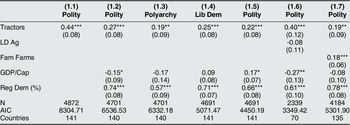
We estimate a series of fixed-effects linear panel regressions exploring the relationship between changes in the level of agricultural mechanization and changes in the level of democracy within countries, holding development, regional democracy, and landholding inequality or labor-dependent agriculture constant. Results appear in table 1 and are presented graphically in figure 4. We begin with Model 1.1, a simple bivariate regression of Polity on Tractors, including country fixed effects. The results are graphed in the upper-left panel of figure 4. Here, increases in mechanization are positively and significantly correlated with increases in democracy. Specifically, a one standard deviation increase in the number of tractors is associated with a 0.44 standard deviation increase in the Polity score from one year to the next—a substantively large effect corresponding to a 16-point increase on the 0–100 Polity measure.
Linear fixed-effects models of agricultural mechanization and democracy

Standard errors in parentheses
All models with country fixed effects, clustered standard errors
Model 5 with year fixed effects
* p < 0.10, ** p < 0.05, *** p < 0.01
Results of linear fixed-effects models, table 1

This result holds—although the magnitude of the effect decreases by about 40%—in Model 1.2, which controls for GDP per capita and the level of Regional Democracy. Most of the effect is absorbed by the latter variable, which is highly significant and remains so in all subsequent models in this table. Nonetheless, the correlation between tractors and democracy remains statistically significant and substantively large, as shown in the upper-right panel of figure 4. For example, the increase in the Polity score associated with a two standard deviation increase on Tractors is equivalent to fifteen points on the 0–100 Polity variable. This corresponds approximately to the change in that measure of democracy witnessed in Mexico from 1988 to 1996; in Russia under Yeltsin between 1991 and 1999; or in Cambodia from 1975 to 2009. Including the Tractors variable improves model fit over a regression that only includes GDP per capita and Regional Democracy, using an identical sample of country-years. The R-squared measure of variance explained within panels increases from 0.32 to 0.33 after the inclusion of Tractors and the overall R-squared increases from 0.48 to 0.50. The Akaike information criterion for the model including Tractors is lower, at 6537 versus 6655 for the more parsimonious model, also indicating superior model fit.
Thus far the results strongly suggest that agricultural mechanization is positively related to democracy. The use of alternative measures of democracy does not dramatically change this finding.Footnote 10 In Model 1.3 in table 1 we replace Polity with the V-DEM Polyarchy measure, alongside controls for GDP and Regional Democracy. As shown in the middle-left panel of figure 4, a one standard deviation increase in Tractors is associated with an increase in the Polyarchy measure of 0.19 of a standard deviation. This effect is significant at the p < 0.001 level, but around 30% smaller than in Model 1.2, which used the Polity score. In Model 1.4, which we graph in the middle-right panel of figure 4, the effect of Tractors on the V-Dem Liberal Democracy measure is similar in magnitude and statistical significance (p < 0.006) to its effect on the Polity measure in Model 1.2. A one standard deviation increase in Tractors is associated with an increase in Liberal Democracy of 0.25 of a standard deviation. Both of these models also improve model fit versus a constrained model including only controls for GDP and Regional Democracy.
Model 1.5 includes year fixed effects to control for unobserved factors that could influence the propensity of all countries to move towards or away from democracy through time. In this model, as one might expect, the effect of Tractors is attenuated compared to Model 1.2, which includes the same control variables but lacks year fixed effects. Here, a one standard deviation increase in Tractors is associated with a 0.22 standard deviation increase in Polity, significant at the p < 0.04 level but 27% smaller than in Model 1.2.
Models 2.3 and 2.4 in table A3 in the online appendix are identical to Model 1.5, but use the Polyarchy and Liberal Democracy measures as dependent variables. As with Polity as the DV, adding year fixed effects reduces the size and significance of the coefficients on Tractors to some degree, but in these models the statistical significance of the coefficients declines below p < 0.05.
Models 3.1-3.3 in table A4 in the online appendix are identical to Models 1.5, 2.3 and 2.4, but include a common cubic time trend instead of year dummies. The results are substantively identical to those including year fixed effects, but the size and statistical significance of the Tractors variable actually increases somewhat. In general, the relationship between Tractors and the Polyarchy and Liberal Democracy indicators is less statistically robust than with Polity when we include controls for time effects.
Model 1.6 in table 1 adds in Albertus’ measure of Labor-Dependent Agriculture. This reduces the sample size by almost half compared to Model 1.2 because of limited coverage of Albertus’ data.Footnote 11 As expected, this variable is negatively associated with democracy. However, its effect is small and its relationship with democracy statistically insignificant (p < 0.49). In contrast, the coefficient on Tractors in this model is over five times the size of that on Labor-Dependent Agriculture (and over 30% larger than in Model 1.2) and highly significant (p < 0.001). This result also holds in identical Models 2.5 and 2.6 in table A3, which take the Polyarchy and Liberal Democracy measures as dependent variables, respectively.Footnote 12
Model 1.7 further probes this relationship by replacing Albertus’ Labor-Dependent Agriculture with Vanhanen’s Family Farms measure. The sample size here is much larger than in Model 1.6 because Vanhanen’s measure has greater coverage. Yet even with this change in sample, Tractors remains positively associated with Polity, although the size of the effect and its significance are attenuated compared to previous models. Here, a one standard deviation increase in Tractors is associated with an increase of 0.19 of a standard deviation on the Polity measure. This relationship is significant at the p < 0.09 level. The Family Farms measure is more robustly associated with democracy than Labor-Dependent Agriculture. A one standard deviation increase in the proportion of Family Farms is associated with a 0.18 standard deviation increase in Polity, holding all else equal. This correlation is significant at the p < 0.002 level.Footnote 13
Discussion and Conclusion
“All that is solid melts into air,” Karl Marx wrote in the Communist Manifesto, suggesting that capitalist development would tear the world out of its feudal torpor and send it careening down the track of modernization—smashing habits, customs, and beliefs of all kinds. Building on Marx, Schumpeter later described capitalism as a system of “creative destruction,” because its technological innovations would both create tremendous wealth and sweep aside the social and economic bases of the old way of doing things. Considering these arguments, Moore (Reference Moore1966, 418) famously summarized his book’s central claim as “No bourgeoisie, no democracy.” Scholars since Moore have focused on the implication of this pithy phrase—that what matters most for the emergence of democracy is how capitalist development reshapes the relative strength of actors such as industrial and landed elites. A strengthened bourgeoisie might be necessary—but a weakened landed elite is also, as Boix (Reference Boix2003, 40) and many others have suggested, a “necessary precondition” for the emergence of democracy.
Of course, a key puzzle of modernization is that landed elites often retain outsize political influence, even after agriculture has been reduced to a minuscule proportion of total economic output (Varshney Reference Varshney1995; Albertus Reference Albertus2015; Thomson Reference Thomson2019). Building on earlier findings about how supporters of former dictatorships shape democratic transitions (Przeworski Reference Przeworski1991), Albertus and Menaldo (Reference Albertus and Menaldo2018) have recently highlighted the degree to which conservative and agrarian elites become accommodated to democracy, partly because they can capture the process of institutional design during regime transitions and gain far greater influence over process and policy under democracy than their relative numbers might suggest.
We offer a parsimonious explanation for why landed elites specifically may become accommodated to democracy. Moore’s argument implies that democracy may result from a shift in elites’ political preferences, regardless of the balance of forces. As noted, Moore intuited that landowners per se do not oppose democracy—only labor-dependent landlords do. We therefore ask, “What happens to our theories of regime change when rural labor becomes largely irrelevant to agriculture production?” After all, where there are no peasants there is no labor-repressive agriculture, even if land inequality remains extreme. Preference change among agrarian elites is rooted in structural economic change in the countryside, due to the uptake of agricultural technology. Mechanization reduces demand for unskilled agricultural labor, which reduces landed elites’ need to exercise autocratic power over rural workers. Research on regime change needs to incorporate the impact of this transformation in the relations of agricultural production, particularly considering the mountains of work on the political consequences of industrialization.
As with any argument, ours has limits. Future research should build upon our empirical results and explore the mechanisms linking agricultural mechanization, landowners’ preferences and democratization more precisely. Here are five suggestions. First, survey research could investigate whether agricultural producers who own machinery such as tractors hold more democratic values or have stronger preferences for democratic forms of government and the rule of law. Second, as Dasgupta (Reference Dasgupta2018) or Bhattacharya (Reference Bhattacharya2018) have done for other aspects of the Green Revolution, research could explore the impact of mechanization on rural mobilization and rebellion. Third, subnational comparisons could explore links between mechanization at the local level and the frequency of agricultural labor repression or rural conflict. Fourth, changes in agricultural mechanization in different subnational regions (perhaps due to different relative costs of labor and technology by crop) could be correlated with changing patterns in agricultural lobbying efforts or roll-call votes (as in Ziblatt Reference Ziblatt2008 and Thomson Reference Thomson2015 and Reference Thomson2019, for example) as mechanization reduces some planters’ need to focus on issues pertinent to control over labor while simultaneously increasing their demand for subsidized imports or domestic production of agricultural machines. Finally, one might consider the cross-national evolution of labor rights in the countryside, given mechanization. All in all, the impact of agricultural mechanization on politics could provide the basis for a fruitful research agenda.
In any case, we find evidence linking agricultural mechanization to democracy. This association is relatively robust, although in some models it is insignificant when we control for time using fixed effects or a common trend. The importance of agricultural mechanization is worth placing in context: as noted, compared with other variables typically employed in cross-national, macro-level studies of regime change, agricultural mechanization is a relatively “small” variable. It is but one element in agricultural production, and part of the productive process in a sector that is decreasing in absolute importance as development advances. Nevertheless, we find that in almost all of our empirical models greater use of tractors in agriculture is significantly associated with measures of democracy and improves our ability to explain regime change.
Theoretically, our argument suggests mechanization is a “dog that no longer barks.” In the preindustrial era landowners had strong affinities with autocracy. Yet today, many have little need for labor at all. Technology has transformed their economic incentives, and this plays out in their politics: with little need for cheap labor, landed elites have little need for a labor-repressive polity. What’s left is their desire for stable property rights and influence over policy, which they can assure more readily under democracy than dictatorship (Gehlbach and Keefer Reference Gehlbach and Keefer2011; Ansell and Samuels Reference Ansell and Samuels2014). In earlier eras landowners opposed democracy because they feared granting rural workers effective civil and political rights, and because they feared that expanded state capacity that often comes with democratization would embolden more workers to leave the farm for the city, where they could find better quality public services. With every new tractor acquired, such fears—palpable to landlords for centuries—melt into air.
Two centuries ago, technological advances enabled the industrial revolution, a structural transformation that reshaped social, political and economic relations. Yet in some countries the agricultural sector remained “backward”—highly labor-dependent—even as industrialization advanced. Structural change only came to the countryside in recent decades with the advent of mechanization—and in some countries, mechanization has yet to have much impact. Agricultural mechanization has made democracy safe for rural elites by eliminating the primary challenge they believe they confront under democracy: increased costs of repressing the economic demands and political rights of rural labor. In the end, Moore was right: the tension between powerful landed elites and democracy disappears if rural labor relations are sufficiently transformed.
Supplemental Materials
Refer to the online appendix for tables A1-A4 providing summary statistics and results of robustness tests, and figure A1 with graphical summaries of the agricultural mechanization data.
A list of permanent links to Supplemental Materials provided by the authors precedes the References section.
*Data replication sets are available in Harvard Dataverse at: https://doi.org/10.7910/DVN/AQJWCG
To view supplementary material for this article, please visit http://dx.doi.org/10.1017/S1537592720002303.