Cardiopulmonary exercise testing provides reproducible, and quantifiable data on cardiac and respiratory performance in patients with congenital heart disease (CHD). The measurement of exercise capacity using peak oxygen consumption has been considered as an important metric predicting cardiac-related events in a variety of cardiovascular conditions including heart failure Reference Burstein, Menachem and Opotowsky1 and pulmonary hypertension. Reference Wensel, Opitz and Anker2 However, the main issue of peak oxygen consumption measure is that it requires a maximal exercise for its interpretation. Age, sex, and body mass index are known factors determining peak oxygen consumption in a healthy population. Reference Ogawa, Spina and Martin3,Reference Woo, Derleth, Stratton and Levy4 Previous studies have shown that many adults with CHD terminated exercise before reaching their cardiovascular limit, which may be a serious shortcoming to the evaluation of the prognostic value of peak oxygen consumption. Reference Inuzuka, Diller and Borgia5,Reference Ramos-Barbon, Fitchett, Gibbons, Latter and Levy6 Fontan circulation is a unique palliation procedure for CHD with single-ventricle physiology, and a decrease in peak oxygen consumption has been demonstrated in most Fontan patients. Reference Driscoll7–Reference Udholm, Aldweib and Hjortdal10 However, a uniform relationship between peak oxygen consumption and mortality or transplantation could not be established in Fontan patients. Reference Udholm, Aldweib and Hjortdal10 This inconsistency may be due to differences in exercise efforts. Reference Fernandes, Alexander and Graham8,Reference Udholm, Aldweib and Hjortdal10,Reference Baba, Nagashima and Goto11 The peak respiratory exchange ratio, a ratio of carbon dioxide production and oxygen consumption measured via respiratory gas analysis, has been used as an objective criterion of effort during exercise testing. Reference Mezzani, Corra and Bosimini12 Based on the American College of Cardiology/American Heart Association guidelines, cut-off values of peak respiratory exchange ratio of ≥1.10 is generally accepted as maximal effort, whereas a peak respiratory exchange ratio of <1.10 is considered sub-maximal effort in adults. Reference Gibbons, Balady and Bricker13 The impact of peak respiratory exchange ratio on the prognostic power of peak oxygen consumption has been previously assessed in adults with acquired heart failure, Reference Baba, Nagashima and Goto11,Reference Chase, Kenjale and Cahalin14,Reference Kakutani, Fukushima and Yokota15 but the implication in patients with Fontan circulation remains uncertain.
The primary objective of this study was to compare the cardiopulmonary exercise testing parameters in Fontan patients with sub-maximal (peak respiratory exchange ratio of < 1.10) versus maximal effort (peak respiratory exchange ratio of ≥ 1.10). The secondary aim was to determine the correlation of cardiopulmonary exercise variables at different peak respiratory exchange ratios for increased risk of cardiac-related events in Fontan patients over short-term follow-up.
Methods
Ethical approval
The study protocol was approved by the Memorial Healthcare System’s Institutional Review Board. Given the anonymised nature of the data, the requirement for informed consent was waived in this study.
Study population and setting
This was a retrospective, single-centre study cohort design evaluating Fontan patients who performed exercise testing using a treadmill according to Bruce protocol between August, 2014 and April, 2018 at the Cardiovascular Institute, Memorial Healthcare System, Hollywood, Florida, United States of America. The commercial gas exchange measurement system (Ultima2, MedGraphics, St Paul, MN, United States of America) was used to calculate respiratory gas exchange: peak oxygen consumption, carbon dioxide output, minute ventilation, ventilatory threshold, and oxygen consumption at the ventilatory threshold on a breath-by-breath basis. The exercise was terminated when the rate of perceived exertion score of ≥7 on the modified Borg 10-point scale. Peak respiratory exchange ratio, peak heart rate, and blood pressure were taken at peak exercise. Cardiopulmonary exercise testing data were calculated as 30-second averages, which were updated every 10 seconds. Peak oxygen consumption was measured as the highest 30-second average during exercise. The ratio of minute ventilation and carbon dioxide output nadir was taken as the lowest 30-second average during exercise. The ventilatory threshold was measured using the V-slope method. Reference Fletcher, Balady and Amsterdam16 The oxygen uptake efficient slope, which is the rate of increase in oxygen consumption in response to the increase of minute ventilation during incremental exercise was recorded. Reference Hollenberg and Tager17 Patients were excluded if they had incomplete exercise data.
Data collection
Demographic and clinical characteristics were obtained via medical record extraction and consisted of age, gender, body mass index, and NYHA functional class. Patients were followed up for a median of 21 months for the incidence of cardiac-related events, including death; listed for or received heart transplant; supraventricular tachycardia requiring hospitalisation, cardioversion, and electrophysiological studies for atrial fibrillation, atrial flutter, intra-atrial reentrant tachycardia, junctional tachycardia, and atrial tachycardia; ventricular tachycardia or fibrillation; cardiac device implantation; thromboembolic events (a stroke or systemic embolic events); and interventional cardiac catheterisation.
Statistical analysis
Results are expressed as mean ± SD for continuous variables or as a number or percentage for categorical variables. Comparisons between subgroups were performed using unpaired t-test or the Chi-square test as appropriate. The relationship between peak respiratory exchange ratio and age, weight, body mass index, and cardiopulmonary exercise testing parameters were assessed using Pearson correlation coefficient tests. The previously reported mean values for peak oxygen consumption of 23 ml/kg/minute and the ratio of minute ventilation and carbon dioxide output slope of 34 in Fontan patients Reference Kempny, Dimopoulos and Eebing18 were used to create event-free survival curves using the Kaplan–Meier plots and were compared using log-rank tests. Cardiopulmonary exercise testing variables were first assessed using univariable Cox hazard analysis, and subsequent multivariable Cox was performed to detect independent predictors associated with cardiac-related events. Receiver-operating characteristic curves were constructed for cardiopulmonary exercise variables identified as independent predictors of cardiac-related events. For all analyses, a two-sided, p < 0.05 was considered statistically significant. Statistical analyses were performed using IBM SPSS version 26.0 (IBM, Armonk, NY, United States of America) and GraphPad Prism 7.0 (Graph Pad Software Inc., La Jolla, CA, United States of America).
Results
Patient demographic and clinical characteristics
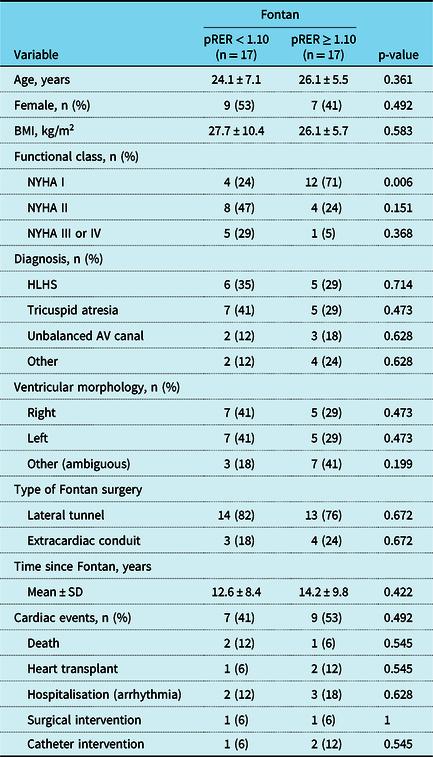
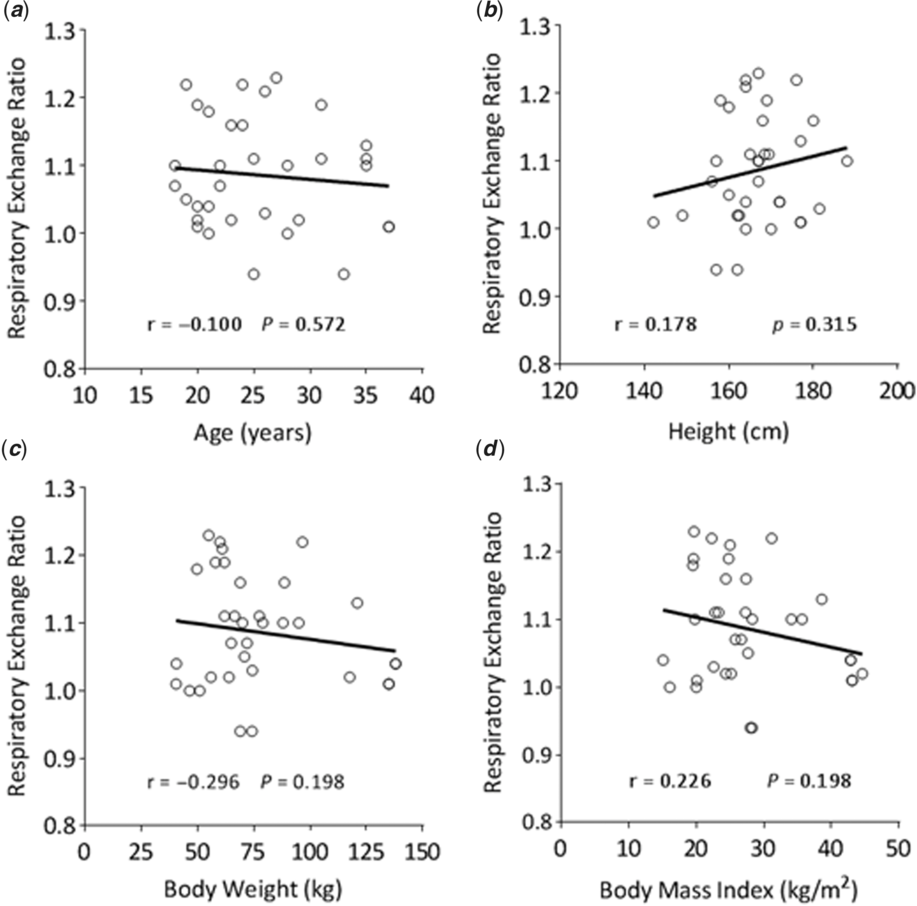
A total of 34 Fontan patients (mean age 44.96 ± 13.8 years) were identified that had complete cardiopulmonary exercise testing and follow-up data available. Of the 34 patients, 17 (50%) patients did not reach peak respiratory exchange ratio of ≥ 1.1 due to subjective symptoms of leg fatigue, dyspnoea, or Borg score of ≥7 on the 10-point scale. The demographic and clinical characteristics based on the peak respiratory exchange ratio were summarised in Table 1. Age, gender, and body mass index were comparable between the two groups. There were 12 (71%) NYHA Class I patients in the peak respiratory exchange ratio of ≥ 1.10 subgroup compared to 4 (12%) in the peak respiratory exchange ratio of < 1.10 group (p = 0.006). Tricuspid atresia was the most common diagnosis (35%). No significant differences were found in the distributions of ventricular morphology between the two groups. There was a total of 27 lateral tunnel Fontan and 7 extracardiac Fontan procedures in the entire cohort. The lateral tunnel Fontan procedure had been done in 14 patients with a peak respiratory exchange ratio of < 1.10 and 3 patients with a peak respiratory exchange ratio of ≥ 1.10, while the extracardiac Fontan had been done in 13 patients with a peak respiratory exchange ratio of < 1.10 and 4 patients with a peak respiratory exchange ratio of ≥ 1.10. The time since Fontan procedure for patients with peak respiratory exchange ratio of < 1.1 was 12.6 ± 8.4 years, whereas it was 14.2 ± 9.8 years in patients with peak respiratory exchange ratio of ≥ 1.1 (p = 0.422). A total of 16 (47%) cardiac-related events were observed over a median follow-up of 21 months, 7 (41%) in the peak respiratory exchange ratio of < 1.10 group and 9 (53%) in the peak respiratory exchange ratio of ≥ 1.10 group (odds ratio, 0.62; 95% CI: 0.18–2.58; p = 0.492). The details of cardiac events were summarised in Table 1 under each group. Patient age (r = −0.100, p = 0.572), height (r = 0.178, p = 0.315), body weight (r = −0.296, p = 0.198), or body mass index (r = −0.226, p = 0.198) were not significantly correlated with the respiratory exchange ratio (Fig 1(a–d)).
Baseline demographic and clinical data by pRER status

Scatter plots showing the correlation of peak respiratory exchange ratio with age and body size parameters in a population of 34 Fontan patients. (a) Correlation of peak respiratory exchange ratio versus age. (b) Correlation of peak respiratory exchange ratio versus height. (c) Correlation of peak respiratory exchange ratio versus body weight. (d) Correlation of peak respiratory exchange ratio versus body mass index.

Cardiopulmonary exercise variables according to the respiratory exchange ratio
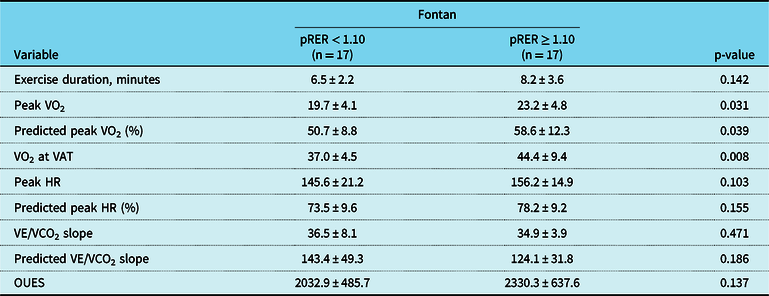
The cardiopulmonary exercise variables of Fontan patients based on their sub-maximal versus maximal effort were presented in Table 2. There was no significant difference in exercise duration between two groups, 6.5 ± 2.2 minutes versus 8.2 ± 3.6 minutes (p = 0.142). Peak oxygen consumption and percentage of predicted peak oxygen consumption values (based on age, sex, and body mass index) were significantly lower in patients with peak respiratory exchange ratio of < 1.10 compared to those with a peak respiratory exchange ratio of ≥ 1.10 (p = 0.031 and p = 0.039, respectively). The mean value of oxygen consumption at ventilatory threshold (% of peak oxygen consumption) was lower in patients with a peak respiratory exchange ratio of < 1.10 compared to those with a peak respiratory exchange ratio of ≥ 1.10 (37.0 ± 4.5% versus 44.4 ± 9.4%, p = 0.008). There were no differences in terms of peak heart rate, percent of predicted peak heart rate, the ratio of minute ventilation and carbon dioxide output slope and percent of predicted ratio of minute ventilation and carbon dioxide output slope, and oxygen uptake efficient slope between two subgroups (Table 2).
CPET findings by RER status

Data given as mean ± standard deviation (SD).
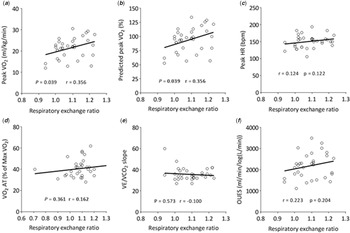
Figure 2(a–f) shows the relationship of peak respiratory exchange ratio with peak oxygen consumption, percent of predicted peak oxygen consumption, peak heart rate, the ratio of minute ventilation and carbon dioxide output slope, oxygen consumption at the ventilatory threshold, and oxygen uptake efficient slope. Both peak oxygen consumption and percent predicted oxygen consumption was positively correlated with peak respiratory exchange ratio values (r = 0.356, p = 0.039). There was no apparent correlation between peak respiratory exchange ratio and peak heart rate (r = 0.124, p = 0.122), ratio of minute ventilation and carbon dioxide output slope (r = −0.100, p = 0.573), and oxygen consumption at ventilatory threshold (r = 0.162, p = 0.361). There was a trend towards a positive correlation between peak respiratory exchange ratio and oxygen uptake efficient slope (r = 0.223, p = 0.204) in these patients, but not statistically significant.
Scatter plots showing the correlation between different parameters of exercise capacity and peak respiratory exchange ratio in a population of 34 Fontan patients. (a) Correlation of peak oxygen consumption versus peak respiratory exchange ratio, (b) Correlation of percent-predicted peak oxygen consumption versus peak respiratory exchange ratio. (c) Correlation of peak heart rate versus peak respiratory exchange ratio. (d) Correlation of oxygen consumption at the ventilator threshold versus peak respiratory exchange ratio. (e) Correlation of the ratio of minute ventilation and carbon dioxide output slope versus peak respiratory exchange ratio, (f) Correlation of oxygen uptake efficiency slope versus peak respiratory exchange ratio.

Impact of respiratory exchange ratio on the predictive power of cardiopulmonary exercise variables
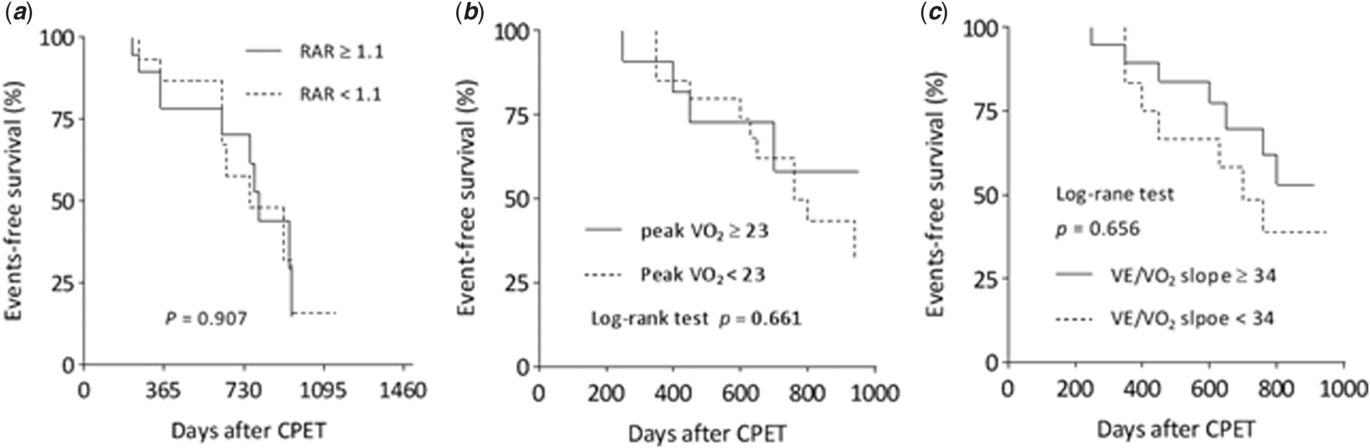
During a median follow-up period of 21 months (interquartile range, 13–28 months), cardiac events occurred in 16 patients (47%). On Kaplan–Meier analysis, there was no significant difference (p = 0.907) in the occurrence of the cardiac events between the patients with a peak respiratory exchange ratio of < 1.10 and the patients with a peak respiratory exchange ratio of ≥ 1.10 (Fig 3(a–c)), although the peak oxygen consumption presented a significant difference (p = 0.031) between the two groups (Table 2). The Kaplan–Meier survival curves grouped according to the mean value of the peak oxygen consumption of ≥ 23 or <23 ml/kg/minute (published normal value in literature) Reference Kempny, Dimopoulos and Eebing18 showed no significant difference (p = 0.661) in the occurrence of the cardiac-related events (Fig 3b). The analysis of the survival curve of these patients according to the mean value of the ratio of minute ventilation and carbon dioxide output slope of ≥ 34 or <34 (published normal value in literature) Reference Kempny, Dimopoulos and Eebing18 also failed to show any significant difference (p = 0.656) in the occurrence of the cardiac-related events (Fig 3c).
Kaplan–Meier plots showing the combined event-free survival in a population of 34 Fontan patients. Patients were classified into two groups according to peak respiratory exchange ratio (a), peak oxygen consumption (b), and the ratio of minute ventilation and carbon dioxide output slope (c), and log-rank probability values for comparisons between the two groups are shown.

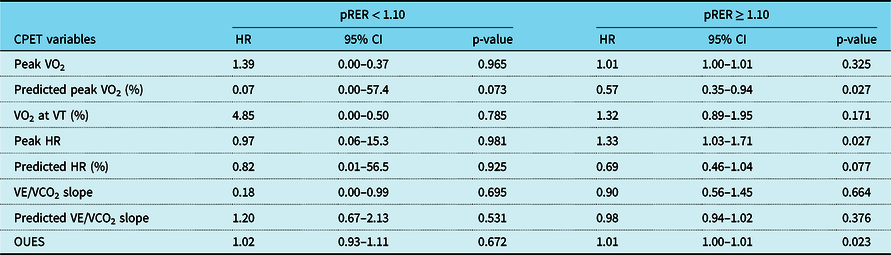
On multivariate Cox proportional hazard analysis, percent-predicted peak oxygen consumption, peak heart rate, and oxygen uptake efficient slope were found to be independent predictors of cardiac events only in the patients with a peak respiratory exchange ratio of ≥ 1.10 (Table 3). None of the cardiopulmonary exercise variables were independent predictors of cardiac-related events in patients with peak respiratory exchange ratio of < 1.1. A hazard ratio of 0.57 (95% CI 0.35–0.94) was observed for each unit (ml O2/kg/minute) increase in predicted peak oxygen consumption, a hazard ratio of 1.33 (95% CI 1.03–1.71) was observed for each unit decrease in peak heart rate, and a hazard ratio of 1.01 (95% CI 1.00–1.01) was observed for each unit increase in oxygen uptake efficient slope to predict cardiac events to predict cardiac-related events only in patients with peak respiratory exchange ratio of ≥ 1.1.
Multivariate Cox regression analysis to predict cardiac events in adults with Fontan circulation

Abbreviations: CI=confidence interval; HR = hazard ratio; HR = heart rate; VT = ventilatory threshold.
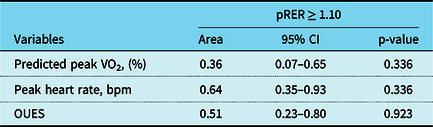
Receiver-operating characteristics curve analysis was performed to determine optimal cut-off values for percent-predicted peak oxygen consumption, peak heart rate, and oxygen uptake efficient slope predicting cardiac events in Fontan patients with a peak respiratory exchange ratio of ≥ 1.1 during cardiopulmonary exercise testing (Table 4). The area under the receiver-operating curve of 0.36 (95% CI 0.07–0.65, p = 0.336) was observed for predicted peak oxygen consumption, with an associated cut-off point of <57.5% (sensitivity 44%, specificity 50%). The area under the receiver-operating curve for peak heart rate was 0.64 (95% CI 0.35–0.93, p = 0.336), with an associated cut-off point of ≤151 (sensitivity 67%, specificity 50%). The area under the receiver-operating curve for oxygen uptake efficient slope was 0.51 (95% CI 0.23–0.80, p = 0.923), with an associated cut-off point of ≥2266 (sensitivity 67%, specificity 50%).
ROC curve analysis

Abbreviation: CI = confidence interval.
Discussion
The cardiopulmonary exercise variables are affected by the patients’ abilities to perform the exercise with maximum efforts. Previous studies have shown that one-third of the patients with heart failure were unable to reach the peak respiratory exchange ratio of ≥ 1.10 and that the test results are deemed insufficient for predicting prognosis. Reference Rostagno, Olivo and Comeglio19 In this study, we show that 50% of Fontan patients had a peak respiratory exchange ratio of < 1.10 even though they reached a Borg score of ≥7, and their exercise capacity is decreased consistently with published data. Reference Udholm, Aldweib and Hjortdal10 There was no difference in the type of ventricle, type of Fontan surgery, time since Fontan completion, exercise duration, and several cardiac-related events between two groups. As the demographic data (age, gender, body mass index, ventricular morphology, and diagnosis) are identical between the two groups, both peak oxygen consumption and percent-predicted peak oxygen consumption was positively correlated with peak respiratory exchange ratio values, indicating that peak respiratory exchange ratio is an important determinant of cardiopulmonary exercise variables in Fontan patients, similar to previous findings reported by Bongers et al. Reference Bongers, Hulzebos and Helbing20
The power of peak oxygen consumption as a predictor for cardiac-related events in Fontan patients was inconsistent amongst the previous studies. Reference Udholm, Aldweib and Hjortdal10,Reference Diller, Giardini and Dimopoulos21,Reference Ackermann, van Brussel and Hulzebos22 The reasons for such inconsistencies could be because of variable efforts (respiratory exchange ratio is not included in the most analysis) or due to different exercise protocols. In our study, multivariate Cox proportional hazard analysis identified that percent-predicted peak oxygen consumption, peak heart rate, and oxygen uptake efficient slope are related to the occurrence of cardiac-related events in patients with a peak respiratory exchange ratio of ≥ 1.10, but not in those with a peak respiratory exchange ratio of < 1.10. It is worthy of note that an extremely low peak oxygen consumption in Fontan patients is still likely to be an important predictor, as the risk for the combined endpoint of death and hospitalisation is more than two times higher for patients with peak oxygen consumption of < 18.9 ml/kg/minute compared with patients with peak oxygen consumption of > 18.9 ml/kg/minute. Reference Fernandes, Alexander and Graham8
Sub-maximal exercise variables useful to determine exercise capacity are the ratio of minute ventilation and carbon dioxide output slope, the oxygen consumption at the ventilatory threshold, and the oxygen uptake efficient slope. Reference Malhotra, Bakken, D’Elia and Lewis23 In our study, an elevated ratio of minute ventilation and carbon dioxide output slope (>34) is not associated with an increased risk of cardiac-related events. Prior studies have shown that the ratio of minute ventilation and carbon dioxide output slope is not an adequate predictor of outcomes in Fontan patients. Reference Fernandes, Alexander and Graham8,Reference Ohuchi, Negishi and Noritake9,Reference Ackermann, van Brussel and Hulzebos22,Reference Dimopoulos, Okonko and Diller24 This observation is most plausibly explained by the ratio of minute ventilation and carbon dioxide output slope elevation commonly encountered amongst Fontan patients that is mainly related to pulmonary blood distribution (and ventilation/perfusion mismatch) secondary to the absence of a sub-pulmonary ventricle and the consequent lack of normal pulmonary pulsatility.
The oxygen consumption at the ventilatory threshold is another useful sub-maximal exercise variable, but is only reported in a few studies as the ventilatory threshold is not always identifiable in all patients, and there is no clear evidence for its role as a potential predictor of cardiac-related events in Fontan patients. Reference Atz, Zak and Mahony25 In our study, oxygen consumption at the ventilatory threshold is slightly lower in the patients with a peak respiratory exchange ratio of < 1.10 compared to those with a peak respiratory exchange ratio of ≥ 1.10, but failed to demonstrate an important correlation with cardiac-related events. Similar to the oxygen consumption at the ventilatory threshold, the mean oxygen uptake efficiency slope value in Fontan patients with a peak respiratory exchange ratio of < 1.10 is slightly lower compared to those with a peak respiratory exchange ratio of ≥ 1.10, however, this trend has not reached statistical significance. There is only limited data available on the predictive value of the oxygen uptake efficient slope in Fontan patients. Giardini et al have reported that the oxygen uptake efficiency slope measured during the entire exercise was not linear in Fontan patients, as the oxygen uptake efficient slope measured during the first 50% of the exercise duration is usually lower compared to the second half of the exercise. Reference Giardini, Specchia and Gargiulo26
Patients with a Fontan circulation have lower peak heart rate during exercise due to chronotropic incompetence and correlated with poor long-term outcomes. Reference Ohuchi, Negishi and Noritake9,Reference Udholm, Aldweib and Hjortdal10,Reference Diller, Giardini and Dimopoulos21,Reference Classen, La Gerche and Van De Bruaene27,Reference Egbe, Driscoll and Khan28 Diller et al have reported that most cardiopulmonary exercise variables are related to increased risk of hospitalisation, only heart rate reserve was related to the risk of mortality during a short-term follow-up period in 321 Fontan patients. Reference Diller, Giardini and Dimopoulos21 In our study, patients with a peak respiratory exchange ratio of < 1.10 had a lower peak heart rate and percent-predicted peak heart rate compared to those with a peak respiratory exchange ratio of ≥ 1.10, although they do not reach statistical significance, perhaps due to small sample size. We have noted that a low peak heart rate is closely linked with the increased incidence of cardiac-related events only in patients with a peak respiratory exchange ratio of ≥ 1.10.
In adults with systolic heart failure, peak oxygen consumption, and the ratio of minute ventilation and carbon dioxide output slope provide a sensitive assessment of prognosis irrespective of the respiratory exchange ratio. Reference Chase, Kenjale and Cahalin14 Mancini et al Reference Mancini, Eisen, Kussmaul, Mull, Edmunds and Wilson29 observed a lower survival rate in patients with a low peak oxygen consumption who performed a “maximal” cardiopulmonary exercise test, but the peak respiratory exchange ratio was not reported. Mezzani et al, Reference Mezzani, Corra and Bosimini12 who employed a peak oxygen consumption cut-off of 10 ml/kg/minute, demonstrated that patients with a peak oxygen consumption of <10 ml/kg/minute and a peak respiratory exchange ratio of > 1.15 had a significantly worse survival than did patients with peak oxygen consumption of < 10 ml/kg/minute and a peak respiratory exchange ratio of < 1.15. Furthermore, the latter group’s survival rate was similar to that of patients with a peak oxygen consumption between 10 and 14 ml/kg/minute, which led to the conclusion that patients should be encouraged to exercise until the peak respiratory exchange ratio approaches 1.15. Reference Mezzani, Corra and Bosimini12 Fontan patients unlike adults with two-ventricle physiology had other factors that could affect respiratory exchange ratio and a percent-predicted peak oxygen consumption of 70% is considered as normal exercise capacity. Reference Kempny, Dimopoulos and Eebing18 Several factors may account for low peak respiratory exchange ratio in Fontan patients including age at Fontan operation, time since Fontan completion, deconditioning, absence of pulsatility in pulmonary circulation, progressively increased venous pressure, energy substrate in diet, chronic lung disease, chronic liver disease, depression, and anxiety. In Fontan patients, there is almost always associated with diastolic dysfunction and a state of chronic heart failure. These patients are near the plateau of the Frank–Starling curve, which leaves them unable to completely utilise the Frank–Starling mechanism and fully augment stroke volume during exercise, have limited stroke volume and which may contribute to increased dyspnoea beyond a patient’s tolerance and lead to test termination before the exercising muscles are sufficiently stressed, thus producing a low peak respiratory exchange ratio. Reference Clark, Poole-Wilson and Coats30 The presence of depression is associated with lower functional capacity and increased dyspnoea with exertion in patients with chronic heart failure. Reference Blumenthal, Babyak and O’Connor31 Though speculative, it is possible that Fontan patients with significant depressive symptoms may experience early dyspnoea, and higher subjective Borg score but limited respiratory exchange ratio.
The focus of single-ventricle palliation has moved from preventing mortality to improving quality of life. An increased risk of complications including death, transplantation, and functional deterioration occurs over time in patients with single-ventricle physiology who have undergone a Fontan procedure. Symptom-limited incremental exercise testing is a frequently used measure of cardiovascular health, as it allows insight into cardiac and pulmonary responses to exercise and is a robust tool for predicting worse cardiovascular outcomes in heart failure, including patients with Fontan circulation. However, it is important to pay attention to the protocol for exercise testing and how the test is terminated. Every effort should be made to achieve a maximal respiratory exchange ratio rather than relying on subjective parameters like the Borg score. We suggest considering using a Raise, Mobilise, Potentiate (RAMP) protocol rather than Bruce protocol, which could be a less stressor for Fontan patients during exercise testing and may achieve a higher respiratory exchange ratio as patients may tolerate the gradual increase in stress better before termination of exercise. However, we do not suggest exercise should be terminated based on the respiratory exchange ratio. The risk of over-exercise would pose serious risks to Fontan patients.
Limitations
Despite the importance of the findings presented here, there are a few limitations to our study. First, this is a single-centre retrospective observational study with the inherent limitations of a study of this design. The exercise testing was performed with a Bruce protocol with incremental exercise and the test was terminated based on symptoms perceived by patients with a Borg score of ≥ 7 on a modified Borg 10-point scale. Second, a small number of cases may have led to the insignificant differences in areas under the receiver-operating curve of the percent-predicted peak oxygen consumption, peak heart rate, and oxygen uptake efficient slope. It is, therefore, not ideal to draw any definitive conclusions on the power of the percent-predicted peak oxygen consumption, peak heart rate, and oxygen uptake efficient slope in predicting the outcome in patients with Fontan circulation. Additionally, several factors may affect the exercise performance, which includes autonomic dysregulation, presence of pacemakers, use of medication, comorbidities (such as obesity, anaemia, and diabetes mellitus), Fontan-associated liver disease, vascular dysfunction, muscle abnormalities, and most importantly, psychological well-being of the patient and motivation to exhibit maximum effort during cardiopulmonary exercise testing.
Conclusions
Fontan patients can be heterogeneous with many confounding factors for exercise intolerance. The cardiopulmonary exercise testing is most commonly performed as a symptom-limited test and is terminated based on the rating of perceived exertion such as the Borg score, but patients may not have achieved a maximal effort as evidenced by the respiratory exchange ratio of ≥1.1. The value of peak cardiopulmonary exercise variables become limited for the determination of prognosis and assessment of interventions in Fontan patients with sub-maximal effort. Our study underscores the importance to pay attention to the exercise protocol used and how the exercise test is terminated while interpreting data.
Acknowledgements
We are thankful to the ACHD team at Memorial Health Care System for the clinical data.
Financial support
This research received no grant from any funding agency, commercial, or not-for-profit sectors.
Conflicts of interest
None.
Ethical standards
The study protocol was approved by the Memorial Healthcare System’s Institutional Review Board (MHS.2018.036).