I. INTRODUCTION
Hydrogen is a promising form of sustainable energy for our future life. In terms of reaching economic hydrogen production, water electrolysis driven by solar energy has caught much attention in recent years. When a direct electrical current is supplied to electrodes immersed in an electrolyte solution, hydrogen is generated at the negative cathode and oxygen is formed at the positive anode.Reference Kato, Kubota, Kobayashi and Suzuoki1 The process is depicted in the following chemical reaction equation:
 $${\rm{Anode\!: }}\;2{\rm{H}}_2 {\rm{O}} \to {\rm{O}}_2 + 4{\rm{H}}^ + + 4{\rm{e}}^ - \quad,$$
 $${\rm{Cathode\!: }}\;4{\rm{H}}^ + + 4{\rm{e}}^ - \to 2{\rm{H}}_2\quad ,$$
 $$\,{\rm{Global \;reaction\!: \;}}2{\rm{H}}_2 {\rm{O}} \to 2{\rm{H}}_2 + {\rm{O}}_2 \quad.$$
Both acidicReference Miles and Thomason2, Reference Kreuter and Hofmann3 and alkaline electrolytesReference Zeng and Zhang4 can be used for the water electrolysis process. Unfortunately, water electrolysis has not yet achieved the efficiency and the cost levels required for any practical application. To reach a practical application, modification of the electrolyte and the electrode morphology are the most popular approaches. Recently, there have been numerous reports on how to improve the efficiency of hydrogen production by water splitting.Reference Seehra and Bollineni5–Reference Surendranath, Dinca and Nocera8 On the electrode side, the use of nonplatinum high efficiency electrode materials for water splitting will provide a promising future for the hydrogen economy. Our motivation for this work is to provide a platform, which outperforms the traditional industrial material graphite while still being compatible with the integration of other emerging technologies.Reference Lima, Lizcano-Valbuena, Teixeira-Neto, Nart, Gonzalez and Ticianelli9, Reference Antolini, Salgado, Giz and Gonzalez10 These also require robustness in structure and performance in different electrolytes and stability and reproducibility in the long term. In addition, it should be economically viable.
This paper presents a novel approach to maximize the current density of electrodes modified by carbon nanotubes for high efficiency hydrogen production. An ideal electrode for water electrolysis should have good permeability to water and gas. It should also offer good electrical properties with a long life. A porous graphite plate, when coated with titania, e.g., is known to provide a simple and economical electrode for water electrolysis.Reference Muller11 Multiwalled carbon nanotubes (MWNTs), consisting of multiple rolled layers of graphite, are metallic one-dimensional conductors.Reference Thess, Lee, Nikolaev, Dai, Petit, Robert, Xu, Lee, Kim, Rinzler, Colbert, Scuseria, Tomanek, Fischer and Smalley12–Reference Schonenberger, Bachtold, Strunk and Forro15 Due to their high electrical conductivity and mechanical strength, they have been investigated for electronic devices as electrical interconnects,Reference Xu, Wang, Miao, Chen and Tan16 field emission cathodes,Reference Choi, Chung, Kang, Kim, Jin, Han, Lee, Jung, Lee, Park and Kim17, Reference Wang, Corrigan, Dai, Chang and Krauss18 and in solar cellsReference Zhou, Colli, Ahnood, Yang, Rupesinghe, Butler, Haneef, Hirala, Nathan and Amratunga19; also, as MWNTs are quite chemically stable, they have been demonstrated as building blocks for biomedical sensors and fuel cells.Reference Kong, Franklin, Zhou, Chapline, Peng, Cho and Dai20, Reference Yoo, Nagashima, Yamazaki, Matsumoto and Nakamura21 In particular, for fuel cells, it has been proven that MWNTs can help reduce Pt loading by 60%Reference Yoo, Nagashima, Yamazaki, Matsumoto and Nakamura21; for solar cells, the performance was improved due to the enhanced surface area for light trapping without suffering electrical loss.Reference Zhou, Colli, Ahnood, Yang, Rupesinghe, Butler, Haneef, Hirala, Nathan and Amratunga19 These unique properties have thus led to our interest in the application of MWNTs for water splitting purposes.Reference Wang, Zhou, Li, Shu, Amaratunga and Milne22 Here, a systematic study on the electrodes for water electrolysis based on graphite electrodes with vertically aligned MWNTs attached is presented. The proposed graphite/MWNTs electrodes have been fabricated and tested in various conditions. Finally, performance and sustainability of the MWNTs electrodes have been demonstrated.
II. EXPERIMENTAL
The DC plasma ehanced chemical vapor deposition (PECVD) method has proven to be a high yield and controllable way of producing large area vertically aligned MWNTs.Reference Chhowalla, Teo, Ducati, Rupesinghe, Amaratunga, Ferrari, Roy, Robertson and Milne23–Reference Meyyappan, Delzeit, Cassell and Hash25 In this method, a feedstock of hydrocarbon is heated to a certain temperature with a transition metal catalyst to promote nanotube growth. A thin layer of nickel film (8 nm) was sputtered onto a graphite substrate. The graphite was then heated up to 750 °C to break up the nickel film into nickel particles. The metal particles are considered to be growth seeds, controlling the diameters of the tubes. The source of the carbon atoms is provided by the decomposition of acetylene under a high DC voltage low-pressure environment. Condensation of carbons on the metal particle produces the nanotube with the cylindrical surfaces parallel to the exterior planes of the particle. The growth pressure was 4 mbar, which led to a growth rate of 0.2 nm/min. A detailed description of MWNT growth by this technique can be found elsewhere.Reference Ren, Huang, Wang, Klemic and Reed26 MWNTs are grown in an Aixtron Blackmagic 6-inch PECVD system (AIXTRON Ltd., Swavesey, Cambridge, UK). Details of the growth technique, the multiwalled structure, and the hydrophobic properties of the MWNT films have been previously reported in Refs. Reference Chhowalla, Teo, Ducati, Rupesinghe, Amaratunga, Ferrari, Roy, Robertson and Milne23 and Reference Lau, Bico, Teo, Chhowalla, Amaratunga, Milne, McKinley and Gleason27.
The electrolysis of water was carried out using a three-electrode system, characterized by an Autolab PG30 potentiostat (Metrohm Autolab B.V., Utrecht, Netherlands). The prepared graphite or MWNTs samples are covered by Teflon adhesive tape, with a circular aperture of 2 mm in diameter to define the working electrode. The reference electrode used in the measurement was an Ag/AgCl in saturated KCl, with a relative potential of 0.197 V to normal hydrogen electrode (NHE). A piece of platinum wire was used as the counter electrode to conduct the current. Both acidic and neutral electrolytes were chosen to study the viability of MWNTs electrode in water electrolysis.
III. RESULTS AND DISCUSSION
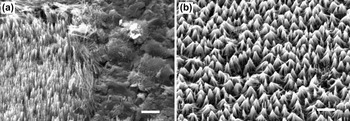
Scanning electron microscope (SEM) images of the vertically aligned MWNTs grown on graphite substrate are shown in Fig. 1. The images were taken with the sample tilted at 45° with respect to the incident electrons in SEM. The average height of these MWNTs was ∼2 μm, which was estimated using the scale bar and the tilted angle. From the SEM pictures, it can be seen that the space between adjacent MWNT is comparable to the diameter of the MWNTs, which is about 50 nm. The enlarged surface area due to the MWNTs is estimated to 100 times of that of plain graphite, assuming the MWNTs are 2 ?m in height, 50 nm in diameter and spaced by the same distance. Once samples are immersed into the electrolyte bath as either anode or cathode for the electrochemistry test, it is observed that as-grown separated MWNTs in the forest are forced to centralize on their tip end, which leads to the spaced vertically aligned MWNTs forest becoming MWNT clusters that are in the form of cones with outer walls consisting of MWNTs, as shown in Fig. 1. The distribution of the diameters of these newly formed cones varies from 200 nm to 1 μm. Because the original separation of the vertical MWNTs in forests is defined by the location of catalyst nanodots before the introduction of the hydrocarbon gas, this separation still maintained were immersed into the electrolyte. Therefore, the formation of the cone structures does not compress the surface too much.
Forty-five degree tilted view of the morphology of MWNTs grown directly on a graphite (a) before water electrolysis experiments (scale bar 2 μm) and (b) after water electrolysis experiments (scale bar 2 μm). The average height of these MWNTs in the figure is estimated to be ∼2 μm. In the right part of (a), the sample was scratched to remove some MWNTs grown on the graphite surface.

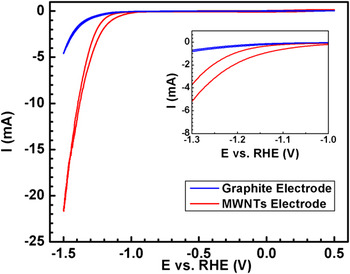
A strong acid electrolyte was chosen here to eliminate the influence of metal particles on MWNTs. The first experiment was conducted to compare the performance of a plain graphite electrode with that of electrode with a vertically aligned MWNTs forest added, by cycling the voltage in between −1.50 and 0.5 V (versus NHE). The cyclic voltammagram was plotted in Fig. 2, comparing the water electrolysis efficiency of graphite and MWNTs electrodes. The charge current under −1.5 V for the graphite electrode is 4 × 10⁻³ A, while that for the MWNTs-attached graphite electrode is 2.2 × 10⁻² A. This is ∼6 times higher than the current produced by the plain graphite electrode. According to the chemical reaction equation for water electrolysis in Sec. I, 4 mol of electrons will produce 2 mol of H2 gas and 1 mol of O2 gas. From the Faraday constant of 96,485 C/mol, 4 mol of electrons is 385,940 C of electricity 1 C = 1 A·s (this is 107.2 Ah to make 2 mol, 4.032 g of H2). The calculated amount of hydrogen generated by the MWNT electrode, from the transferred charge for 1 h (22 mAh), is 4.1 × 10⁻⁴ mol, which is ∼8.2 × 10⁻⁴ g in weight [in volume production ∼2.9 × 10³ L/(h m2)]. The faster and more intensive chemical reactivity brought by the MWNTs attached to the graphite electrode thus leads to an enhanced efficiency in the hydrogen production by water decomposition. The high efficiency can be attributed to the larger surface area and possibly by the enhanced catalytic capability when compared to graphite alone. It has been reported that MWNTs could lead to a double yield of hydrogen production in alkaline electrolytes (pH ∼ 14) at an anodic bias of 1.24 V (versus NHE) when comparing conventional graphite electrode.Reference Dubey, Sinha, Talapatra, Koratkar, Ajayan and Srivastava28 In this study, based on conversion from the current density in Fig. 2, the hydrogen production from MWNTs electrode at 1.24 V is ∼420 L/(h m2), while the production from graphite electrode is only ∼70 L/(h m2). These results further confirm that the MWNTs could also work in a strong acid condition and provide better hydrogen production enhancement.
Cyclic voltammagram in 3.7 M H2SO4 electrolyte, with plain graphite (blue line) and with MWNT forests on it (red line). The potential was measured against an Ag/AgCl reference and converted to NHE potentials by using E(NHE) = E(Ag/AgCl) + 0.197 V. Inset graph shows the I-V curve in the range of −1 to 1.3 V (versus RHE) for comparing results with Ref. Reference Wang, Zhou, Li, Shu, Amaratunga and Milne22 in the same range.

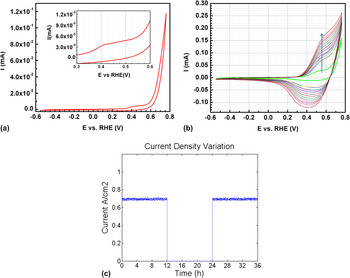
In a second experiment, the use of vertically aligned MWNTs electrode in water electrolysis was further examined in newly developed neutral electrolytes. Cobalt ions were discovered to display the capability to catalyze the splitting of water assisted by chemical oxidants in neutral phosphate solutions.Reference Zeng and Zhang4 Though the Co2+ still precipitates onto the electrode during the reaction, their catalytic activity remains effective on the electrode surface. To evaluate the applicability of the CNT-based electrodes in various environments, the same electrolyte as in Ref. Reference Zeng and Zhang4 [0.5 mM solution of Co(NO3)2 in 0.1 M potassium phosphate (pH 7.0)] was introduced for the water electrolysis. The results are presented in Fig. 3(a). An oxidation wave at 0.41 V was observed, followed by the onset of a strong catalytic wave at 0.55 V [shown in the inset of Fig. 3(a)]. The separation between the anodic wave and catalytic wave is consistent to the results shown in Ref. Reference Zeng and Zhang4, which is a characteristic of Co2+ salts in pH 7 phosphate electrolyte. Here, the current density shows an enhancement as well when using the CNT-based electrode. At 0.75 V, the current density is 3.82 mA/cm2, and after 11 h of Co+ deposition, it becomes 16 mA/cm2. In comparison, the indium tin oxide electrode used in the same electrolyte demonstrated a current density evolution from 0.25 to 1.25 mA/cm2at 1.29 V.Reference Zeng and Zhang4
(a) O2 evolution in KPi solution. Scan with rate at 10 mV/s. Inset shows the oxidized peaks during the O2 evolution. (b) Time evolution curves of the same reaction in (a), scanning at the rate of 100 mV/s and lasting for about 11 h (the arrow shows the time evolution direction). The charge transfer rate of the water oxidization is proliferated as time goes, which is a reflection of the long-term effectiveness of Co2+catalyst. (c) The stability and lifetime examination of the MWNTs electrode.

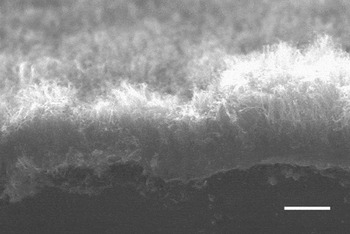
To further investigate the effects of high aspect ratio of MWNTs on the water electrolysis, vertically aligned MWNTs of much higher array density and length synthesized by thermal chemical vapor deposition (CVD) on a graphite substrate were synthesized and tested as electrode as well. In the thermal CVD growth technique, small iron catalyst is used for MWNTs growth.Reference Wang, Feng, Unalan, Zhong, Li, Yu, Akinwande and Milne29 A SEM image of one MWNTs sample from thermal CVD growth technique is shown in Fig. 4. These thermally grown MWNTs are at least tens of micrometers in length and are spaced by only a few nanometers.Reference Wang, Feng, Unalan, Zhong, Li, Yu, Akinwande and Milne29 Characteristics like these offer very attractive film properties including the huge surface area to body volume enhancement. However, unlike the MWNTs grown by PECVD, when these samples were immersed into the electrolyte and current was passed for water electrolysis, the whole MWNTs layer peeled off from the plain graphite. The unexpected surface tension as well as the stress from the large amount of hydrogen or oxygen bubbling are probably the reasons that thermal CVD-grown MWNTs are not appropriate for electrolysis application. The exact reason causing the MWNTs peeling off needs to be further studied.
MWNTs grown via thermal CVD (scale bar 5 μm).

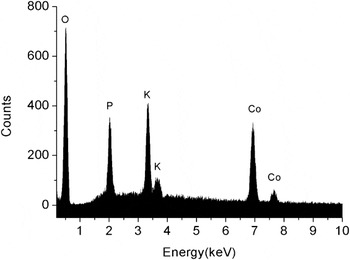
The failure of thermally grown MWNTs to function as electrodes in solvents for water electrolysis raised the issue of the sustainability of the electrodes produced utilizing PECVD-grown MWNTs. Hence, the long-term sustainability has been assessed. At first, samples were swept with 1.5 V to generate hydrogen and oxygen for 12 h under the same conditions as in Fig. 3(b). Subsequently, these samples were kept in electrolyte for 12 h without applied voltage. After that, the first step was repeated on each sample for another 12 h. The above operational cycle was repeated for a week. It turned out that all samples retain their initial working performance with a minimal difference in the I-V curve [shown in Fig. 3(c)]. Energy dispersive x-ray spectroscopy (EDX) is also used here (Fig. 5) to examine the composition of the precipitated elements on the electrode after 11 h of water electrolysis. Traces of K, P, and Co are found under the EDX analysis, which is consistent with results in Ref. Reference Zeng and Zhang4. Although the CNT forest is covered by a layer of Co, the large surface area provided by CNT forests still takes effect by magnifying the charge transfer rate.
The EDX spectra of the Co-coated MWNTs electrode after 11 h water electrolysis in KPi solution.

Moreover, samples which were kept in the electrolyte without applied voltage and any disturbance for 1 wk showed little alteration. It is unclear at this stage why the PECVD grown MWNTs remained on the graphite substrate while the thermal CVD grown MWNTs didnot survive during the water electrolysis. The reason could possibly be related to the diameter of the MWNTs. The PECVD-grown MWNTs are usually bigger in diameter (∼100 nm), while the diameters of the thermal CVD-grown MWNTs could be as small as 2–5 nm. The adhesion of MWNTs to graphite substrate could be very week due to much less bonding carbon atoms at the carbon nanotube/graphite interface.
IV. SUMMARY
In this paper, a carbon nanotube-based electrode platform is introduced and characterized. This MWNTs-based electrode provides a ∼6 times enhancement of water splitting current density and efficiency compared to graphite electrodes in strong acidic electrolyte. This is thought to be due to the larger surface area and higher catalytic activity. In addition, our PECVD-grown vertically aligned carbon nanotube on graphite reveals good stability and long-term sustainability without any complicated and expensive pretreatment. Furthermore, the electrolyte of the neutral KPi solution with Cobalt ions has been used to demonstrate the long-term compatibility of this electrode to various environments including coating with metals as catalysts. By combining other catalysts or electrolyte, the vertically aligned CNT-based electrode is a promising platform for the large-scale economic hydrogen production by water electrolysis. Future work includes a comprehensive investigation on control of fabrication conditions for the electrodes as well as the integration of the different catalytic systems.