The immediate stimulus for this state of the field article is the keynote with which Murray Rubinstein opened the Sixth Annual Conference of the European Association of Taiwan Studies.Footnote 1 “Is Taiwan studies dead?” portrayed a field increasingly marginalized by the growing attraction of China and a concomitant brain drain of Taiwan specialists, with the viability of studying “Taiwan in and of itself” further eroded by the inexorable encroachment of hegemonic disciplines. Drawing on the opinion of several Taiwan specialists, Rubinstein concluded that “we cannot but be aware that there are troublesome signs of our sub-field's viability, if not its impending demise.”Footnote 2 For the assembled audience of Taiwan scholars, these sentiments were “sobering and disturbing” indeed. Judging by some of the responses that I collected for this article, concerns about the status, sustainability and future of the field are not uncommon among Taiwan specialists. These concerns highlight the need for more work on the state of the Taiwan studies field, an endeavour that has not previously received much attention.Footnote 3 The objective of this article is to contribute some empirical observations and to stimulate further reflections on the field and the direction it is headed.
Some Preliminaries
In this article I treat Taiwan studies as a field of research within area studies and focus on research output.Footnote 4 Other factors affect the viability of a research field – such as the sustainability of supporting institutions, provision of training for the next generation of scholars and so on – but research output is the major product and currency of academia. For space reasons, this article focuses solely on English-language research. Narrowing down further, it focuses on research published in peer reviewed journals. While monographs, edited volumes and book chapters represent a significant component of published work on Taiwan, using journal articles as a means to survey the field is useful for several reasons. First, journal publications constitute a larger and arguably more representative sample of research output. Books are published in comparatively small numbers and demand resources that – with the exception of converted doctoral theses – slant the sample towards more established scholars. Second, journal publications are more amenable to measurement. For this reason, citation data and journal rankings increasingly serve as measures of individual and institutional performance.Footnote 5 For instance in Taiwan, the “SSCI/TSSCI craze” is a key element in career progression and determining the allocation of public research funding.Footnote 6 Third, journals often have a broader reach than the more narrowly targeted readership of monographs. Research communities can coalesce around particular journals, which can serve as a meeting ground and communal space for scholars in the field.Footnote 7 To be clear, I do not claim that Taiwan studies can be reduced to articles published in peer reviewed journals. My argument is merely that journal articles are a useful indicator of research output in the field. The following sections use empirical data to address a series of concerns about the field.
Is Taiwan Studies Marginalized within China Studies?
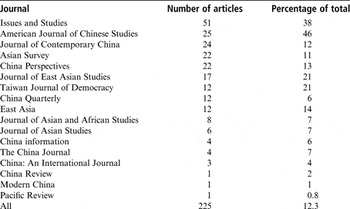
In her state of the field article on political research on Taiwan, Shelley Rigger reasonably argues that “Taiwan studies occupies a marginal position in the China studies field.”Footnote 8 To exemplify the point, she observes that, for both students and faculty, Taiwan is invariably an adjunct to China studies programmes and departments. What about in terms of research output? One expectation is that if Taiwan studies is marginalized it should be manifest in a low level of publications in China studies and East Asia journals. To explore this issue I recorded the number of articles (excluding notes and reviews) published on Taiwan in ten mainstream China studies and seven East Asian studies journals between January 2004 and December 2008 (Table 1). Overall, 225 articles focusing on Taiwan were published in the five-year period. This constitutes an average of 12.3 per cent of the total number of articles published in these journals. There is substantial variation in the number of articles on Taiwan across journals and in absolute terms: Issues and Studies, for example, published double that of the next placed journal.Footnote 9 These data do not indicate whether that is due to some journals being more or less amenable to publishing work on Taiwan, or reflective of authorial decisions on where to submit manuscripts.Footnote 10
Articles on Taiwan in 17 Area Studies Journals, January 2004–December 2008

Source:
Author.
Does research on Taiwan appear to be marginalized? If we look at the proportion of all articles published in the last five years, it is evident that in some outlets research on Taiwan occupies a prominent place. This is particularly so in the case of the American Journal of Chinese Studies (46 per cent) and Issues and Studies (38 per cent). In the two leading China journals based on impact factor – The China Journal and The China Quarterly – 6.5 per cent of all articles published were on Taiwan.Footnote 11 In the case of the former, I will show that this probably reflects author decisions on where to submit manuscripts. In the case of The China Quarterly, which, as discussed below, is the most desirable publication venue for Taiwan scholars, it is likely to be a reflection of the strong competition from both China specialists and other Taiwan scholars.
Overall, around 10 per cent of all articles in China journals in the last five years were about Taiwan. If China Review and Modern China, which seldom publish Taiwan research, are excluded, this rises to 12 per cent. With a similar proportion of articles on Taiwan published in East Asian area studies journals and given the relative size of the Taiwan and China research communities, I suggest that these figures do not reflect a marginal position. Moreover, concerns that research focusing on Taiwan is being sacrificed for comparative research appear exaggerated.Footnote 12 Of the 225 articles, only 59 (24 per cent) compared Taiwan to China or other cases.Footnote 13
Is there a Plurality of Research Areas Represented in Taiwan Studies?
Rick Edmonds observed several years ago that political science research has long “dominate[d] in China studies.”Footnote 14 It is easy to understand why this may also be the case in Taiwan studies. Cross-Strait relations, national identity issues, democratization and democratic consolidation are major areas of interest that are within the purview of political science and international relations (IR), while economic development and economic links between the two sides fall into political economy (PE). However, research on Taiwan is certainly not limited to political science and its sub-disciplines. For instance, searching the ISI Web of Science database demonstrates a huge number of publications on Taiwan in other disciplines. Indeed, in the past 20 years political science and IR ranks 11th among different disciplines for volume of research on Taiwan, with the most populous discipline being management. Research on Taiwan is being carried out by specialists in economics, sociology, history, women's studies, urban studies, environmental studies, development studies, anthropology and law. To what extent are these research areas represented in the 17 journals in my sample?
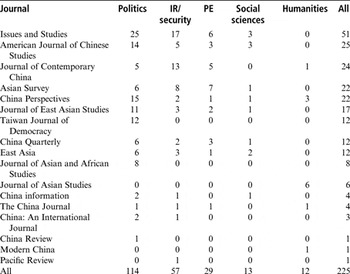
To explore this question I coded the content of all 225 articles on Taiwan published over the five-year period. Aggregate findings for five main categories are reported in Table 2. The results are clear: research on Taiwan published in these journals is dominated by political science and its sub-disciplines (PE and IR). More than half (51 per cent) of the articles focused on subjects within political science, with national identity, public opinion, elections and institutions (including political parties) among the most salient. Just over one-quarter of the articles focused on aspects of international relations or security. Not surprisingly, relations with China and the security implications of those relations were the most prominent. Non-political social science research topics and humanities (such as culture, religion and history) combined for just 25 articles, around ten per cent. These categories combined had fewer articles than those focusing on political economy.
Number of Articles by Subject Area, 17 Area Studies Journals, 2004–2008

Source: Author.
Political science research topics also constituted the majority of articles in most outlets. Among the few exceptions, Journal of Contemporary China had a stronger focus on IR and security studies. Humanities research was represented in just a handful of outlets. However, this appears to be an indication of the marginalization of non-political subjects in these journals rather than a lack of scholarly interest. Consider for instance that the majority of panels at two major international gatherings of Taiwan specialists, EATS and NATSA, are in the arts and humanities.Footnote 15 Consider also that ten disciplines (including those in the humanities and social sciences) produced more research articles on Taiwan in the last 20 years than political science and IR.Footnote 16 These data suggest that it is non-political science research on Taiwan, rather than research on Taiwan per se, that is marginalized in the major China and East Asian studies journals analysed here. This observation is consonant with the view that broader interest in Taiwan is driven by its politics, status and relations with China.
Is Research on Taiwan Becoming More Discipline-oriented?
Nearly two decades ago Lucien Pye observed that “the sovereignty of the disciplines has been authoritatively reasserted [over area studies]. It is not enough to hold the respect of other area specialists. Tenure depends upon the judgement of those who guard the standards of each discipline.”Footnote 17 The changing balance between area studies and disciplinary research has been noted somewhat ambivalently in the case of Taiwan studies. For instance, Cheng and Marble lament the marginalization of area studies in the United States and observe that, in consequence, “the younger generation of scholars is now locked in to what are clearly disciplinary career paths.”Footnote 18 However, the authors subsequently claim that a Taiwan studies “increasingly embedded in social sciences” is an indication of the “growth and maturing” of the field.Footnote 19 The latter argument is reasonable: theory-driven disciplinary research on Taiwan, or employing Taiwan as a comparative case study, contributes to knowledge about the island and opens up a new sphere for Taiwan scholars to share their work. Furthermore, Taiwan is an interesting case study with the potential to contribute to the theoretical and empirical corpora of the social sciences and humanities.Footnote 20 It may be increasingly difficult to study “Taiwan in and of itself” as Rubinstein observes, but that does not mean that Taiwan studies must suffer because of it. Thus instead of asking whether disciplines are “encroaching” on Taiwan studies, it is more useful to ask whether Taiwan studies is integrating into disciplines. To explore this question I use two sources of data. I first report Taiwan scholars' attitudes to publishing their work,Footnote 21 before providing a case study of Taiwan research published in political science and IR journals.
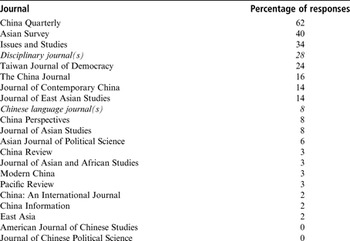
I asked Taiwan scholars “to which three journals would you first consider submitting a very strong manuscript on Taiwan?” This question has been used in other contexts as an indicator of the relative regard that respondents hold publication outlets, although I do not explicitly use it for this purpose.Footnote 22 The results are given in Table 3. Nearly two-thirds of respondents reported that they would first submit a strong manuscript on Taiwan to The China Quarterly (63 per cent), followed at some distance by Asian Survey (40 per cent) and Issues and Studies (34 per cent). These three choices were also the journals that most survey respondents regularly read. There is an effect of institutional location on responses, so that scholars based in the United States were more likely to choose Asian Survey and Journal of Contemporary China, journals with institutional homes in the US.
Target Journals for Strong Submissions
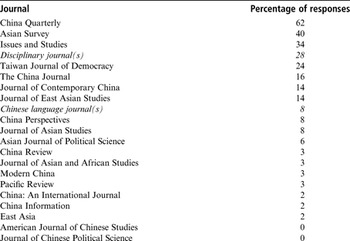
Source: Author. N = 64. Multiple choices allowed, thus total percentage exceeds 100.
It is notable that some of the journals with relatively large numbers of articles published on Taiwan appeared low on the list of targeted outlets. This is particularly extreme in the case of the American Journal of Chinese Studies, where 46 per cent of all articles between 2004 and 2008 were on Taiwan, but where not one respondent said they would submit a strong manuscript. Some 28 per cent of respondents said they would submit a strong manuscript to a disciplinary journal, the fourth most popular response. This was almost entirely driven by scholars based in Taiwan. While cautious about over-interpretation in a sample of 65 respondents, Taiwan-based scholars (particularly those with political science backgrounds) appear keener to target disciplinary outlets with their best work than colleagues in the United States, Europe or elsewhere.
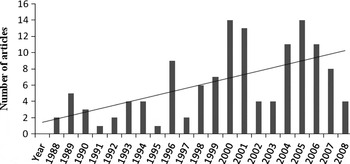
A further manifestation of integration with the disciplines is the quantity (and quality) of research published in disciplinary journals. To measure this in the case of political research on Taiwan, I searched the top 50 journals in political science and top 30 journals in IR.Footnote 23 Specialist methodological, theory and journals with an area focus (such as Political Analysis or European Union Politics) were excluded, giving a sample size of 52 journals. I then recorded the number of articles on Taiwan over a 20-year period. The results are shown in Figure 1.Footnote 24
Taiwan Articles in 52 Political Science/IR Journals, 1988–2008

In the 20-year period 129 articles on Taiwan appeared in the top 52 political science and IR journals. Three outlets, Studies in Comparative International Development (15), Washington Quarterly (13) and Foreign Affairs (12), accounted for almost one-third of the total. Articles on Taiwan also featured relatively often in Electoral Studies (9), Journal of Democracy (8) and Survival (7). The profile of these journals clearly demonstrates broader interests in Taiwan: security studies (particularly relating to US foreign policy), development and democratization. Eighteen journals in the sample did not publish any articles on Taiwan. The trend indicates an upward trajectory, but there are substantial fluctuations over time. This no doubt reflects events on the island, notably presidential elections and the broader attention that Taiwan commands at these times, particularly in terms of policy-oriented journals such as Foreign Affairs and Washington Quarterly. Footnote 25
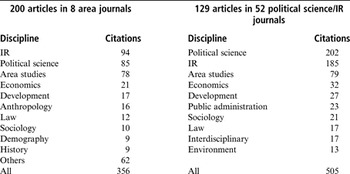
A final indication of the degree of interaction with disciplines is provided by analysing citation data. Table 4 shows the number of articles citing Taiwan research published in eight area studies journals and 52 political science and IR journals over a 20-year period, broken down by discipline.Footnote 26 Unsurprisingly, articles published in disciplinary journals were more heavily cited (by a factor of 2:1). Equally unsurprising, but important nevertheless, is the finding that research on Taiwan published in political science and IR journals reached a much greater number of political scientists: 387 articles (77 per cent) that cited Taiwan research published in political science/IR journals were other articles in political science and IR. Research published in area studies journals (the majority, but not exclusively, on political and IR topics) reached fewer political scientists in absolute (179) and proportional terms (40 per cent). The effect of publication outlet (that is, area studies or disciplinary) on reaching area specialists was minimal. Publishing in political science and IR journals thus does not appear to reduce links to area specialists while opening up greater access to the discipline.
Citing Articles by Subject Area, 1988–2008

Source: ISI Web of Science.
Globalization and Collaboration in Taiwan Studies
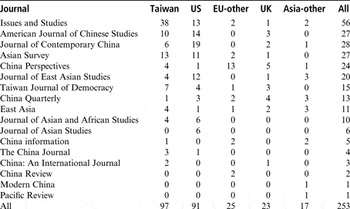
David Shambaugh recently lamented the slow progress in both the globalization of China studies and the lack of collaboration between scholars.Footnote 27 Although in China studies the national composition of the field is increasingly diverse and scholarly exchanges have burgeoned, Shambaugh argues that healthy growth requires greater diversity and more substantive scholarly collaboration. To address these questions of globalization and collaboration in the case of Taiwan studies, I recoded the 225 articles in 17 area journals for the institutional location of authors and the type of authorship, that is, single, co or multiple authors. Table 5 shows the institutional location of 253 authors, including co and multi-authored pieces. Of these, 97 authors (38 per cent) were located in Taiwan compared with 91 in the US (36 per cent), marking these two locations as the major centres of Taiwan research, far ahead of the UK (9 per cent). Scholars based in continental Europe and Asian locations other than Taiwan (including Australia and New Zealand) constituted a combined 17 per cent of all authors. Overall, institutions in 15 different national locations were recorded.Footnote 28
Authorship by Institutional Location, 17 area journals, 2004–2008

Source: Author.
Collaborative research is often personally and professionally rewarding, in some cases allowing multiple authors to address research questions requiring expertise and resources that would not be feasible individually. However, focusing specifically on political research, Rigger noted the lack of collaboration within the Taiwan studies research community. In particular, she highlighted the non-optimal division of labour between Western and Taiwanese scholars.Footnote 29 Of the 225 articles I recorded, 199 (88 per cent) were single authored and 26 (12 per cent) featured co or multiple authors. The level of international collaboration (based on institutional location) was extremely low, with the majority of collaborators based in the same national location. Moreover, the number of collaborations between those based in Taiwan and those based elsewhere accounted for just eight articles (3.6 per cent). While collaboration is not synonymous with co-authoring journal articles (other indicators include edited volumes, journal special editions and research grants) it seems that, eight years on from Rigger's article, there may still be room for greater exploitation of potential synergies.Footnote 30
Fractionalization of Taiwan Studies
As I interpret them, the data presented in this article suggest that Taiwan studies is fractionalized rather than marginalized. The quantity of research is not visibly declining and the venues for publishing research on Taiwan are “sprawling and diverse.”Footnote 31 Yet, while it is encouraging that Taiwan scholars enjoy ample outlets to disseminate their work, the field lacks a flagship journal dedicated solely to research on Taiwan around which the Taiwan studies research community could perhaps coalesce. The experience of the China studies field shows how a major journal can have an important influence on unifying and growing the research community.Footnote 32 Practically, such a journal is useful in keeping scholars in touch with research in the field, and developments on the ground and in the profession.Footnote 33 In the case of Taiwan studies, where there are concerns about sustainability and questions about the field's identity, the psychological effect of a flagship journal could be even greater.
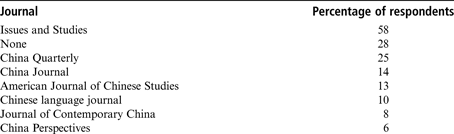
In order to gauge the opinion of Taiwan scholars on this issue, I asked two questions. First, I asked survey respondents to indicate “which journal(s) represents a meeting point and communal space for Taiwan studies in the way that, e.g., The China Quarterly or The China Journal do for China studies?” The results are given in Table 6. The most popular choice, by a considerable margin, was Issues and Studies. More than half of respondents (57 per cent) said the journal fulfils this role, with support particularly strong among those based in Taiwan. This choice appears reasonable: the journal publishes the most articles on Taiwan, is one of the most regularly read and is a popular choice for strong submissions. The second most common response was “no journal fulfils this role” (27 per cent) marginally ahead of The China Quarterly (25 per cent).
Which Journal is a Focal Point for Taiwan Studies?
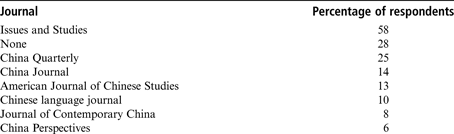
Source: Author. N = 64. Multiple choices allowed.
I followed up by asking survey respondents if they believed that a dedicated English-language “Taiwan studies journal” would benefit the Taiwan studies research community and the field.Footnote 34 A substantial majority of respondents (72 per cent) said they thought it would, or definitely would, be beneficial, while 22 per cent were undecided and 4 per cent did not think it would have a beneficial effect. Solicited comments ranged from “yet another journal would fragment the field still further,” to “[such a journal] would help to crystallize the study of Taiwan, bringing together work in a more productive, focused dialogue.” Many respondents who were supportive of the idea still voiced concerns that the field is too small and narrow to support a dedicated journal, or said that the way for Taiwan studies to flourish is instead to seek greater visibility via penetration of disciplinary literature. Others supported the idea as a way of promoting non-political science research.Footnote 35 The level of abstract support – albeit combined with reservations about a range of practical issues – suggests that such a venture is worthy of further discussion.
Conclusion
The objective of this article is to stimulate further reflections and analyses of the state of Taiwan studies. On the basis of the data presented in the article, Taiwan studies is neither in decline nor marginalized – with the important qualification that I reached this conclusion based solely on analysing English-language journal publications. There are ample outlets for disseminating research on Taiwan and in some journals, albeit ones with lower impact, work on Taiwan occupies a prominent place. In terms of gaining representation in disciplinary journals, Taiwan scholars appear to be highly successful. Although two major centres account for the majority of research on Taiwan (Taiwan and the US), the Taiwan studies community is spread over a diverse range of nations. Research on Taiwan in the journals I analysed is dominated by political science and cognate research areas with other disciplines under-represented. The level of collaboration between Taiwan scholars, using co-authorship as a proxy, is low, particularly between colleagues based in Taiwan and those in other locations. There is a core group of journals that are the most read and most desirable to publish in. There is general sympathy for the idea of a hypothetical “Taiwan Journal,” but also questions about its feasibility, and a majority of survey respondents feel that Issues and Studies fills the role of a de facto “Taiwan Journal.”
In terms of further research on the field, there are many avenues to pursue, in terms of the research questions we ask and the methods and data we use to address them. This article focuses on one facet of the field; further work is required on other aspects. It does not analyse monographs, edited volumes, academic conferences or research funding. It does not look at trends within the profession, training for future generations of Taiwan specialists or the institutions that support Taiwan studies. Neither does it address more fundamental epistemological questions about what constitutes the field and the discursive and political implications of “doing Taiwan studies.” Survey responses along the lines of “Taiwan studies is marginalized in the academy, just as Taiwan is in the world,” suggest that developments in the field cannot be divorced from developments in the world at large. Yet, rather than lamenting the vigorous growth of China and China studies we need to consider how Taiwan studies can adapt to these conditions and thrive.