The notion of “topography” works in two or three dimensions. It can refer to the arrangement of physical features on the landscape, or to its representation on the surface of a map. Ed Ruscha's photobooks preserve this play between two and three dimensions, drawing attention to both the graphic qualities of the photograph as a flat entity and the photobook as a three-dimensional object. William Jenkins's use of the term to title George Eastman House's 1975 exhibition New Topographics: Photographs of a Man-Altered Landscape was intended, he argues in the catalogue essay, to suggest a disengaged attitude to content directly inspired by Ruscha's work.Footnote 1 With its connection to mapping and surveying, a topographical attitude is one of measurement, or of notation, rather than of narrative or appraisal. He sees in Ruscha's books “qualities of rigorous purity, deadpan humor and a casual disregard for the importance of the images,” photographs “stripped of any artistic frills and reduced to an essentially topographic state, conveying substantial amounts of visual information but eschewing entirely the aspects of beauty, emotion and opinion.”Footnote 2 The connection Jenkins made between this work and photobooks by Ruscha such as Twentysix Gasoline Stations (1962), Some Los Angeles Apartments (1965), Every Building on the Sunset Strip (1966), ThirtyFour Parking Lots in Los Angeles (1967), Nine Swimming Pools (1968) and Some Los Angeles Apartments (1965) was about photographic style; both Ruscha's work and the work of the photographers in this exhibition mobilized a type of look where “the appearance of neutrality was strictly maintained.”Footnote 3 This play with the look of neutrality (along with the deadpan humour that comes along with weakening affect and multiplying images) was indeed part of Ruscha's influence on photographers such as Lewis Baltz and Stephen Shore, as well as on Jenkins.Footnote 4 The idea of “neutrality,” however, only begins to indicate the complex ways in which Ruscha's photobooks work as publications, as photographs, and as objects to think with. In the pages that follow I will argue for a common thread that goes beyond neutrality, demonstrating how all three of these elements in Ruscha's photobooks – a resistance to obvious affect, flat-plane abstraction, and a consistent engagement with photographic and readerly points of view – come together to form an extended conceptual and visual meditation on “distance.”
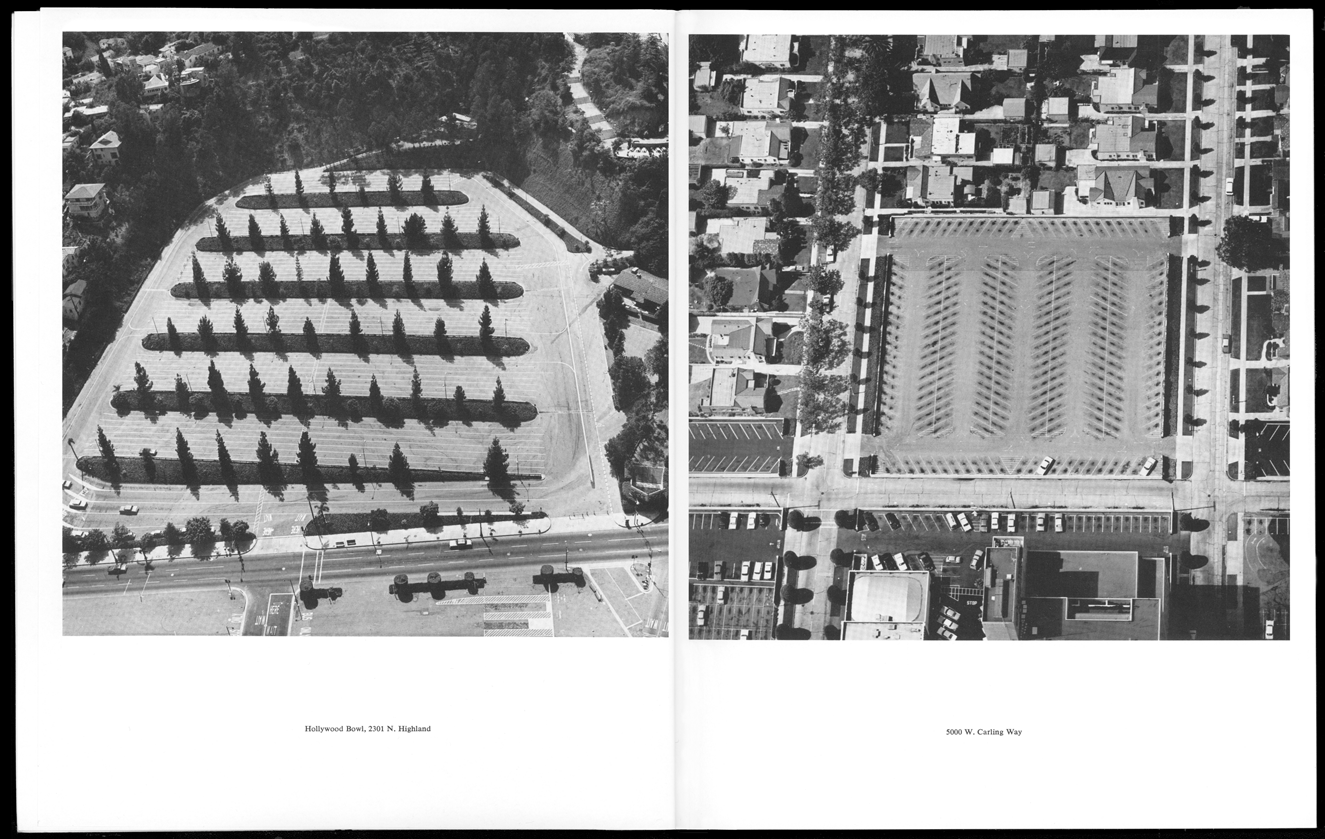
Susanna Newbury draws a line between Ruscha's vision of LA and the changes to architectural thinking of the 1960s and early 1970s manifest in works on the new West by Denise Scott Brown, Robert Venturi, Stephen Izenour and Reyner Banham. She points out that more or less all of the buildings in Thirtyfour Parking Lots were part of a postwar industrial boom in the Laurel Canyon and Wilshire Boulevard area.Footnote 5 Ruscha photographs malls, theme parks and corporations like Lockheed and Rocketdyne as well as the Eileen Feather Figure Salon, and the Hollywood Bowl (Figure 1).
Ed Ruscha, Hollywood Bowl, 2301 N. Highland and 5000 W. Carling Way, from Thirtyfour Parking Lots in Los Angeles (1967). © Ed Ruscha. Courtesy the artist and Gagosian.

Newbury demonstrates that these large lots are those of the new giants that are wiping out any kind of small industry in the area, and that Twentysix Gasoline Stations similarly shows Mobil, Texaco, et al. edging out the mom-and-pop stations. Historically, this is true; however, because these photographs are anti-didactic and anti-judgmental, there is no easy way to settle whether Ruscha's record of the infrastructure is meant as a critique or as a more neutral catalogue of the postwar West Coast building boom. Any emotional and intellectual resonance in Ruscha's own photographs is a good deal more ambivalent than a straightforward critique would be.Footnote 6 Ruscha's emptying out of parking lots and real-estate lots gives us a world that is much more orderly than, for example, Nicholas Nixon's shots of parking lots where the cars are present, and we can see human disorder and bad parking in evidence over the whole surface. (By contrast, Lewis Baltz's photographic presentation of California in the New Topographics exhibition, and in The New Industrial Parks near Irvine, California (1974) is even more abstracted than Ruscha's.) Eleanor Antin compares Ruscha's parking lots to Alain Resnais's “neoclassical fantasy,” Last Year at Marienbad, where, she says, Resnais also emptied out and reworked the environment. She calls Thirtyfour Parking Lots “an elegant series of eighteenth-century concrete and asphalt gardens,” remarking,
The empty parking lots unfold before and behind their buildings with geometric precision … Positioning the camera eye up there in the sky displaces the event. Ruscha knows very well that down here on earth those asphalt parking lots are never empty.Footnote 7
Indeed, although Ruscha's photography consistently engages with what it means to be in, move through, and look out at America, his photobooks almost refuse notions of inhabitation. Andy Warhol is said to have noted, looking at Twentysix Gasoline Stations, “Oh, I love it because there are no people in there,” and Ruscha speaks of seeing a quietude in the empty swimming pools and blank pages of Nine Swimming Pools.Footnote 8 Humans are here in their infrastructural traces, but Some Los Angeles Apartments only carries the most basic signs of individual people and the bays of Thirtyfour Parking Lots contain few parked cars. The erasure of the individual as photographic content is manifest in the scale of these photobooks too – the books themselves are small, and the cityscapes even smaller – as well as in the absence of any human proxies or subjects in the photographs.
This sense of a formalized, emptied environment has its analogue in the way Ruscha's photobooks play down various elements of artistic intentionality. In these books, the author/artist is constructed as distanced too. In order to create these sequences of images, Ruscha followed what Margaret Iversen argues is the equivalent of an “event score,” presenting photographs as a performative fulfillment of a premise rather than as the capture of a privileged instant. Because Ruscha decided on the titles first and then obtained the photographs, they can, she argues, “readily be understood as a contracted form of an instruction: ‘record 26 gasoline stations along Route 66’.”Footnote 9 Given that Ruscha shot many of the photographs in Real Estate Opportunities, Nine Swimming Pools, and Some Los Angeles Apartments himself, the delegation of work in Thirtyfour Parking Lots is not perhaps as important in this regard as his more consistent evocation of military, real-estate and home photographers. There is an assertion of stylelessness in the lack of cropping of these photographs which moves any centre of interest away from the golden section, and from other strong positions on the pictorial planes. The unassuming size of the books contributes to this sense of unassertiveness. The avoidance of lyricism in the photographs’ narrow tonal range and the lack of darkroom manipulation parallel the avoidance of pathos in the lack of visual traces or presences of individual people. Bluntly informative captions emphasize the deliberately mundane nature of Ruscha's subjects.
This step away from the photograph as record of an assertive, decisive agency, and from its status as a spontaneous capture of the unique instant, is very much part of an anti-subjective impulse that runs through late 1960s and early 1970s art.Footnote 10 Jenkins quotes Lewis Baltz's statement that “the ideal photographic document would appear to be without author or art,” but this is also the era of Roland Barthes's “Death of the Author,” of the anonymized arts of Daniel Buren and BMPT, of the Art and Language group, and of Fluxus.Footnote 11 As Britt Salvesen points out in her essay on the New Topographic photographers, an aesthetic of objectivity encompasses many of the artistic and intellectual currents running through photographic based-work of this period:
ultimately, objectivity proved so useful as a stylistic linchpin because it could be correlated with a variety of authorial stances: non-engagement (Walker Evans), egalitarianism (cultural landscape studies), eclecticism (Learning from Las Vegas), irony (Ed Ruscha), anti-romanticism (Robert Smithson), activism (environmentalism), and anonymity (nineteenth-century survey photography and other utilitarian documents).Footnote 12
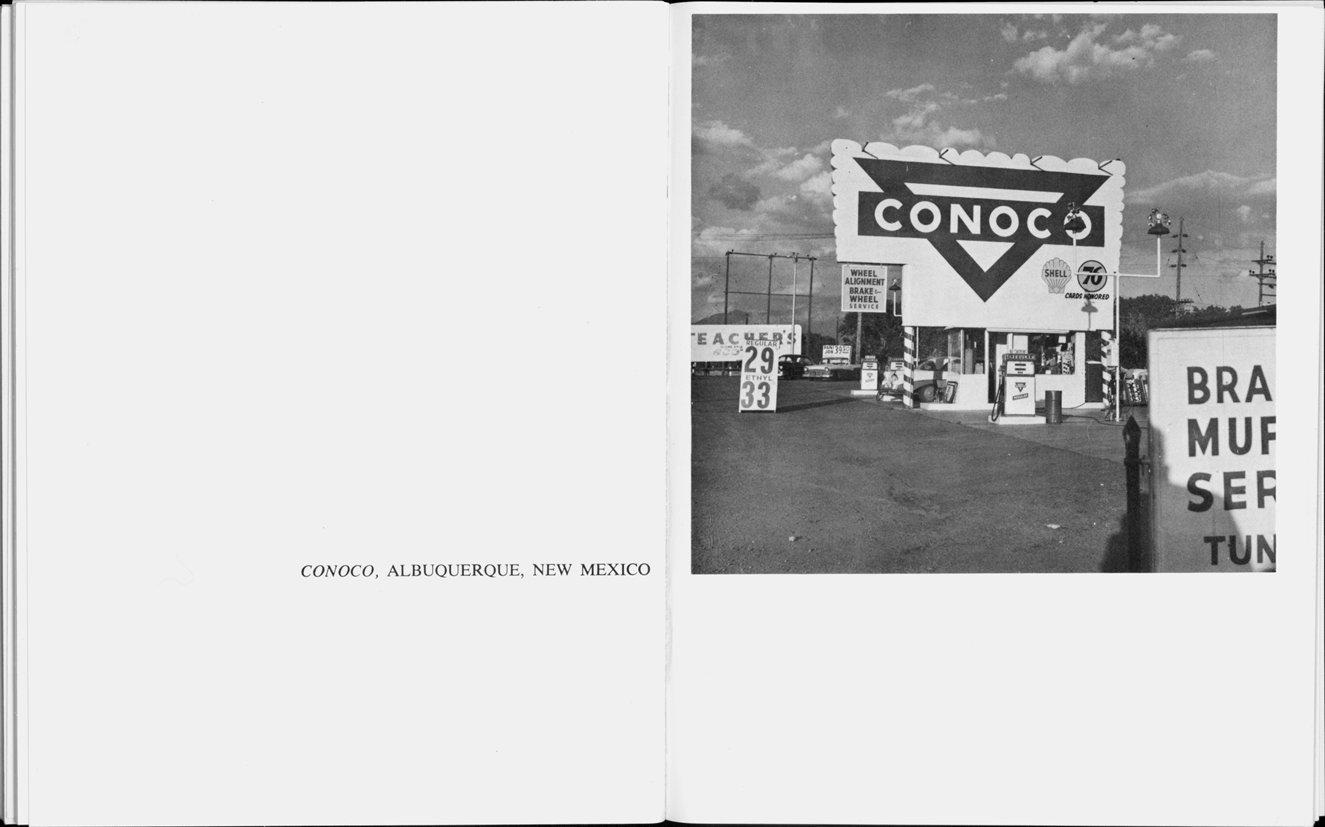
Conceptualism, too, sought a version of the artist who, as Sol LeWitt put it in the explanatory notes for Serial Project #1, “functions merely as a clerk cataloging the results of his premise.”Footnote 13 There is a reaction against abstract expressionism in Ruscha's methods; he trained at Chouinard (now Cal Arts) at the height of abstract expressionism's popularity, and he talks of it being “an enormous freedom to be premeditated” about his works, to imagine then work through the stages to execute something.Footnote 14 However, neither this premeditation, nor his love of Marcel Duchamp's work (discussed below), leads him into the dematerialization of pure conceptualism. Ruscha maintains that conceptualism always denied its use of the visual (“they all have visual statements”), and that, against this, he remains a resolutely visual artist.Footnote 15 Like Warhol, Roy Lichtenstein and James Rosenquist, Ruscha worked commercially before and alongside his early work, and the conditions for authorship for blue-collar workers may have also informed the interrogation of the notion of the role of the expressive artist in this period. For Thirtyfour Parking Lots this authorial distance extends to a measure of “deskilling” too: the photographs were taken by Art Alanis, a commercial photographer. The traffic between graphic arts and fine arts in this period is explored by Thomas E. Crow in The Long March of Pop, and it is significant to note that Ruscha's training at Chouinard Institute was also in graphic design and print layout. Ruscha's play with typography and with signs and hoarding in photographs such as Conoco, Alburquerque, New Mexico (1962) works to disengage text-based images from the utilitarian considerations of graphic design. (Figure 2.)
Ed Ruscha, Conoco, Albuquerque, New Mexico, from Twentysix Gasoline Stations (1962). © Ed Ruscha. Courtesy the artist and Gagosian.

Despite the movement away from expression and intentionality in these photobooks, Ruscha is very much present in the mythos of these works as their creator. He appears in photographs touching and holding the books, and advertisements for Ruscha's work in the Ferus gallery construct Ruscha's persona as young, hip, witty and virile.Footnote 16 This marking of the work as Ruscha's is thus in a productive tension with other measures that seek to elide the figure or message of the photographer–artist. Ruscha states that he had a notion to photograph things “dead head straight on without much emotion,’ because “lack of emotion is almost like … a little like no style, in a way,” he explains,Footnote 17 but clearly consistent refusal of the main markers of pictorialist landscape can indeed become a distinct style.Footnote 18 Indeed, Ruscha's style is recognizable enough to have precipitated a number of parodies and homages.Footnote 19 (In describing the aesthetic of distance in the New Topographic photographers, Salvesen points us towards Susan Sontag's “On Style,” a piece that is contemporaneous with Ruscha's work, which asserts that it is precisely these varying distances from subject matter which are what we might call “style” in a wider sense.Footnote 20) Ruscha's version of photography as “a little like no style” thus works, paradoxically, to reaffirm his style.Footnote 21 Both physical and emotional distance are at stake in these photographs, then. The sense of physical distance that is captured in the point of view of, for example, Twentysix Gasoline Stations, with their consistently low-level, shot-from-the-hip-across-the road perspective, asks us to use the photographer as proxy to place ourselves physically in the act of viewing, whilst the construction of an implied dispassionate artist – particularly in evidence here in the blurred photograph labelled as “Whiting Bros., Near Ludlow, California” – asks us, too, to remove ourselves affectively.
A much-quoted remark of Ruscha's from 1965 finds him sidelining the aesthetic qualities of the medium: “photography is dead as a fine art; its only place is in the commercial world, for technical or information purposes,” he states.Footnote 22 Although Ruscha's opinion seems to change over the years (in 1999 the parking-lot photographs were printed as new fifteen-inch square silver gelatin prints), this emphasis on technical data is useful as a sense of the tenor of the photobooks, if not of their institutional context. Indeed, one of the venues for the publication of Ruscha's work was Dan Graham's edition of the multimedia magazine in a box Aspen, which concentrated on “Art and Information,” and placed Ruscha's Thirtyfour Parking Lots in the same box as photographic and text-based elements of environmental work by Smithson and Oppenheim; as experimental music scores by Steve Reich and Philip Glass which derived from processual operations; and as conceptual work by Yvonne Rainer, Richard Serra, Terry Atkinson and Michael Baldwin, and Eleanor and David Antin.Footnote 23 Both environmental work, such as Smithson's and Oppenheim's, and conceptual work such as Graham's and LeWitt's, was dependent on photographic and textual representation for its circulation and explanation. Both material and dematerialized art, then, came together in this period in their dependence on “information” to circulate, and, as Charles Gagnon states in “Handling Conceptual Art,” “in many cases materials and techniques were chosen because they were deemed to be neutral, unexpressive” or “did not belong to the usual techniques of art making.”Footnote 24 Working as “Eddie Russia” – the layout artist for Artforum from 1965 to 1969 – Ruscha would have known contemporary made-for-magazine pieces, as well as the secondary documentary presentations of large sculptural works, well.Footnote 25 In this milieu, “information” is the answer to the question of how to record an art experience that both is overwhelmingly physical, and has a logical, in some cases overtly mathematical or scientific, intellectual form. This notion of “information” is another modality of what I am calling “distance.” It creates a forum for modes of apprehending the arts ostensibly outside emotional empathy, or aesthetic appreciation.
Information for Ruscha has a more humorous tone than it has for Graham, or for Smithson; for Ruscha information seems to have an alluring absurdity. (So, for example, the photograph of a Conoco gasoline station reproduced above is cropped to produce text – “bra” and “muf” – that leads the viewer to speculate both on a female sexual symbolism in the triangle shape above them, and on the improbability of these references.) Noticing something that might remain unnoticed is a mischievous gesture that comically overinflates the insignificant. In an interview with A. D. Coleman in 1972, Ruscha invents a being called the “Information Man” whose grasp on dry data is total:
The Information Man is someone who comes up to you and begins telling you stories and related facts about a particular subject in your life. He came up to me and said, “Of all the books of yours that are out in the public, only 171 are placed face up with nothing covering them; 2026 are in vertical positions in libraries, and 2715 are under books in stacks. The most weight on a single book is sixty-eight pounds, and that is in the city of Cologne, Germany, in a bookstore. Fifty-eight have been lost; fourteen have been totally destroyed by water or fire” … Now wouldn't it be nice to know these things?Footnote 26
The Information Man notices, but does not obviously judge, leaving the situation and choice of focus to carry bathos. In many of the more empty photographs, noticing can be taken as a form of affirmation, if not direct judgment, but it is a form of attention that is witty in its shift of focus onto the overlooked, and ambivalent in that it offers no purport for this shift of attention. The sense of the artist as a centre for meaning is still present, but the kinds of meaning he summons are more or less topographical – they are about place, position, mass, material condition. They are also broadly inconsequential; it would be nice to know these things, but niceness is the opposite of necessity or utility. Eleanor Antin's deadpan commentary is a good match for Ruscha's in this regard. Antin makes clear how the serialism in and of his books produces a sense of meaningfulness whilst, through a series of exaggerated and inconsequential explications, she parodies the excesses and inaccuracies that seem to ensue if one follows up this sense of meaningfulness with an earnest search for the information in these photographs. “Anyone who takes twenty-six photographs of the same subject and packages it as a complete work might be expected to have a point of view about the material,” she suggests, but “we already possess more information about gas stations than Ruscha gives us.”Footnote 27 (Robert Adams's comment that “anybody who simplifies the confusion of life into a composition is making personal judgements from the start” is also germane.Footnote 28) Taken in this way Ruscha's works are a satire of the notion of obviousness itself; the snapshot aesthetic is a marker of a self-evidence that is not all it seems to be. This play between salient and non-salient detail might also be seen in the ambiguity created by the printing of the photobooks in halftones. As halftones the images lose much of the fineness of grain which would lead the viewer into inspecting specific elements of the view, but nevertheless they do still capture incidental details, albeit ones which cannot be rationalized into any narrative or “message.”
One obvious precedent for this proto-conceptual play with information and significance in Ruscha's photography is in Marcel Duchamp's work. One marker of Duchamp's influence in the mid-1960s might be found Arturo Schwarz's creation of eight authorized sets of replicas of the readymades between 1964 and 1965 (the same time as Ruscha would have been working on Some Los Angeles Apartments); here Duchamp worked with Schwarz to produce his own work in serial.Footnote 29 Ruscha's version of the readymade presents what might be seen as deliberately tedious material that is framed as unwilled, if not actually “found.” Indeed, Ruscha comments, “I feel that the spirit of his [Duchamp's] work is stronger in my books than in anything else,” and calls his photobooks “an extension of a readymade in photographic form.”Footnote 30 Ruscha speaks of what it means to respond to Duchamp's work as a kind of “mystery”: “the ultimate mystery of his work is its value. It's hard to be taught how to look at Duchamp's work; it has to be felt somehow.”Footnote 31 He speaks specifically of Duchamp's Coffee Grinder as “like a mystery that did not need explaining to me … it has a dedication to certain classic truths about the making of a picture and the illustrating of an object and then it also has this inane-ness to it.”Footnote 32 This offhand talk of mystery is the marker of a resistance to interpretation but might also constitute a name for the affective charge an everyday object has when it is reseen as an art object. In other words, the kind of mystery in Duchamp's inanity might be seen as a source of the irony, or bathos, in Ruscha's photobooks, too. This sense that an object is both what it is – inane, perhaps – and something else too produces a doubleness that might be taken as the equivalent of the doubleness of literary irony, where the narration and the narrated present discordant messages. In this, it is part of a cluster of feelings about the photobooks that mark moments of internal tension: “paradox and absurdity have just always been really delicious to me. The intangible gets to me, the subjective gets to me, the emotional and intuitive gets to me,” Ruscha has stated.Footnote 33
The photograph as information, or as a product of LeWitt's conceptual idea as “machine that makes the art,” does not, therefore, mean that it is affectively blank. “It is the objective of the artist who is concerned with conceptual art to make his work mentally interesting to the spectator, and therefore usually he would want it to be emotionally dry,” LeWitt states, but even dryness, I would argue, is an affect.Footnote 34 Ruscha's presentation of mystery is a quiet one, and the sense of something extra, a resonance that happens in the photobooks’ distanced form and subject, might be taken as the kind of “weak affect” that Sianne Ngai writes of in her essay on the “Merely Interesting.” Here, using Ruscha's photobooks as one of her examples, Ngai looks to describe the subtle blend of triviality with a snagging of our attention that is marked by calling something “merely interesting” – as characterized by a “wavering between the boring and interesting” – a “feeling so low in intensity that it can even be hard to say whether it counts as satisfaction or dissatisfaction, feels good or bad to feel.”Footnote 35 Ngai describes Ruscha's photobooks as “clearly engineered to keep affect on a low burner, generating, at most, tiny flares of interest like the ‘small fires’ appearing at regular intervals in Various Small Fires and Milk.”Footnote 36
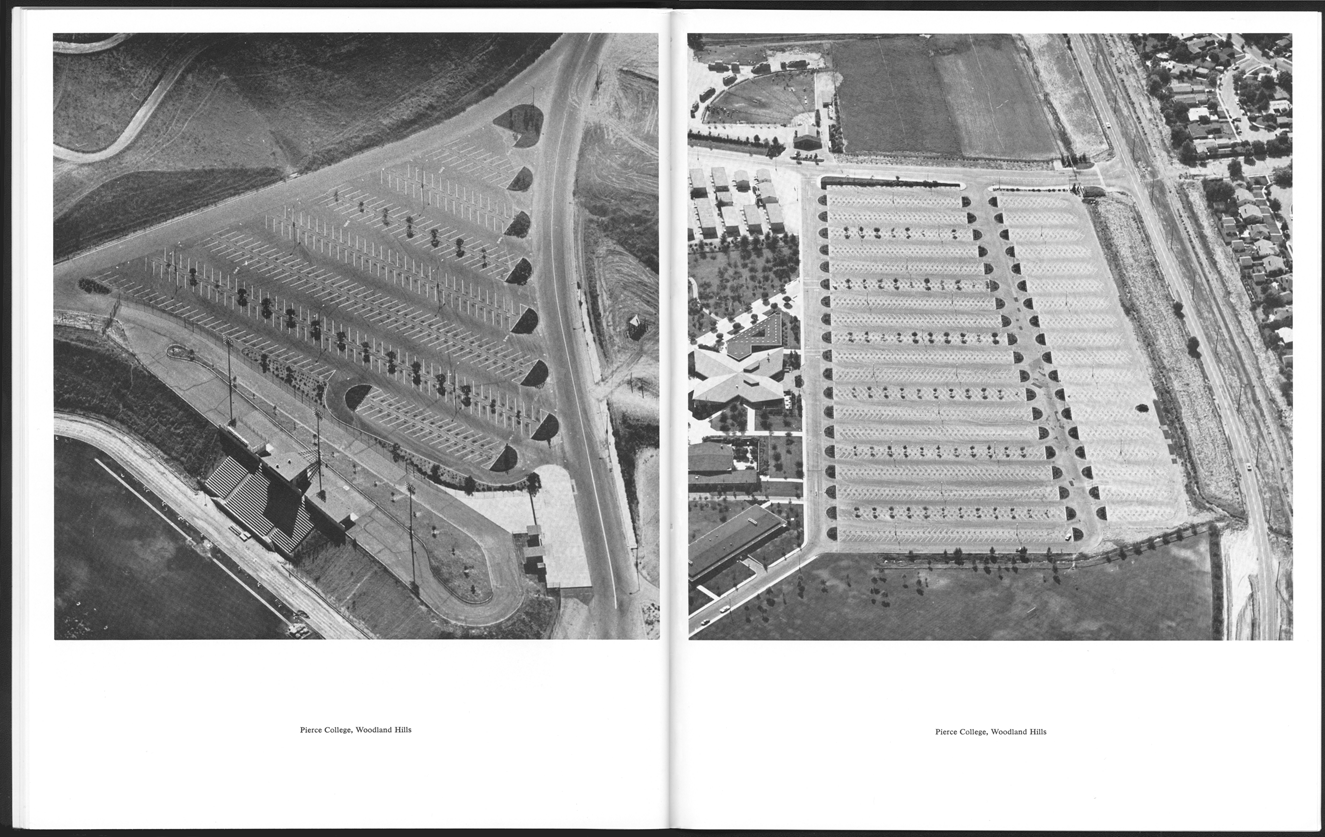
The sheer emptiness of Ruscha's photographs is brought to the forefront of our consciousness as viewers because of the work's presentation in serial. One deserted photograph is incidental; thirty-four or twenty-six empty landscapes constitute an aesthetic. The replication of any image alters its affect considerably. Repeated, an image seems muted as it is emptied out of its individuality, but this muting is replaced by a different form of weight and emotional resonance which is more to do with a feeling of teeming, or, in the case of many of Warhol's multiples, of inundation. Ruscha's compositional reliance on geometric shapes and oblique planes is emphasized as they are repeated, and aspects of the landscape such as trees or oil spills become motifs. As the photographer Frank Gohlke points out, the serial format nudges us to look for difference and sameness, working both to throw us back on the smallest details of the images and to seek the broadest possible correspondences: “The series is what gives the individual photograph its interest, although parking lots, for example, are interesting in themselves because there is variation. Tiny details within them become very interesting” (Figure 3).Footnote 37
Pierce College, Woodland Hills, from Thirtyfour Parking Lots in Los Angeles. © Ed Ruscha. Courtesy the artist and Gagosian.

This presentation is heightened by binding the photographs into a book where parallels and disjunctions are created by virtue of the photographs’ position on the rectos and versos. The apartments move up and down in scale and in and out of the guttering; the cropping of the parking lots varies according to the shape of the lot, whilst the swimming pools and vacant lots remain constant. The gas stations, parking lots and swimming pools are punctuated by irregularly spaced blank or caption pages inserted, in part, to keep the spine of the book a satisfying thickness. Turning the page gives us a similar image in a similar position even more obviously than moving through the walls of a gallery would, and Ruscha's blank pages act self-reflexively, to keep us attentive to what we see and expect to see.
Salvesen convincingly argues that Ruscha's books aren't “as uniform as that artist would have us believe – instead the uniformity is largely an effect of seriality, which thus emerges as Ruscha's true innovation.”Footnote 38 Ruscha's seriality is slightly different to the mathematical formalism in mid-1960s conceptual pieces, or even the more obviously visual uniformity in Bernd and Hilla Becher's typological work.Footnote 39 Instead there is a humour in the bringing together of things that are not usually counted, whose position in the background of our lives does not normally merit the privilege of cataloguing – vacant lots, car parks, empty streets, even vacant pages. Ruscha's photobooks attempt to mark sites without their becoming highly “marked” in terms of our attention. These books might be thought of as working to bring the perceptual background into the foreground but without the implication of an artist's expression, and with only minimal affect. The serialism of the works is part of the control of affect; looked at in isolation these photographs become absorbing. The eye finds texture, shadow and reflection, we start reading signs and labels, and we start reading the lines and marks of the parking lots’ concrete. Read in serial, though, our attention is moved from the markers of place, matter and process towards the repeated constructions of these images. The planes, perspective lines and elevations of the apartment blocks, patios, gasoline stations and car parks begin to function as the basic elements of composition.Footnote 40
Instead, his use of lines, planes and surfaces turns a topographic survey of the land into a question of what topos might mean for a photograph. The horizontality of the landscape seems to be producing elements of Ruscha's wider style, including his preference for a landscape canvas format, for the wide-screen panorama, for the horizontality of reading words and phrases in English as well as for the backgrounds of those later works. “Fundamentally, I'm an abstract artist. I respond to primal, basic aspects of art. The horizontal line. The vertical line. The works here are a series of manipulations using vertical and horizontals. I want to see things stretched,” Ruscha states.Footnote 41 In these more visually textured photographic works the detailed sense of place in the landscape features of Los Angles and southern California – features which are absent or elided in Ruscha's painting – are in tension with the presentation of that land as geometrical, abstracted form. This strategy carries over to the photographs too in the case of the apartment blocks, where, as Ken Allan points out, we are led to seek out the names and to contrast the romanticism of the Lee Tiki, Fountain Blu, Il Pompeii, and Capri with the brutality of the concrete structures. The way that the photographs emphasize this severity through accentuating the compositional lines of the buildings contributes to the effect captured by speaking of Ruscha's “irony”: the patterning of tension between repetitive abstraction and idiosyncratic sense of place gives these pictures an additional sense of doubleness.
This end product is not, however, primarily a Warholesque parody of consumerism and mechanical reproduction; these photographs are too affectively distanced for that kind of commentary. Instead, this end product brings Ruscha into three dimensions, giving him a medium through which to take part in the kinds of contemporary investigation into objecthood we more usually associate with minimalist art. The phenomenological turn marked by minimalist sculpture was part of an impulse to challenge the idea of the expressive artist asserting his (usually his) unique vision through pliant material by bringing the agency of matter and of the environment of viewing back into consideration. The replacement of a romantic expression with a process or a system united minimalist artists and conceptual ones, and, in its anti-subjectivity, brings affective and physical distance together as prime concerns of the period.Footnote 42 This extends to the patina of the books, too. There are a number of comments Ruscha has made that suggest that part of what he was aiming for in many of his works was a kind of look – a variety of surface and objecthood – that would be informed perhaps both by his place in the Los Angeles art world of the “finish fetishists” and by his training as a graphic designer. Ruscha speaks of the Los Angeles sense of “manufactured” finish being less of an influence on his painting (he remained an easel painter) than on his books:Footnote 43 “What I really want is a professional polish, a clear-cut machine finish. This book is printed by the best printer west of New York. Look how well made and crisp it is … It is almost worth the money to have the thrill of 400 exactly identical books stacked in front of you”; “I want the end product; that's what I'm really interested in”; “the book is the look, not the photograph.”Footnote 44
As Allan argues, throughout his career Ruscha has been engaged by the notion of “flatness” both as a magazine layout artist, and in his later trompe l'oeil techniques.Footnote 45 This investigation into the planar segues into one of volume, and then into recession. Indeed, as Allan points out, the first painting that Ruscha sold, Box Smashed Flat (Vicksburg) (1960–61), was a nominally two-dimensional representation of something that used to be three. In keeping with this attention to the objecthood of these overlooked items, Ruscha's “flat” works – canvasses, drawings and books – are actually treated as three-dimensional, so the books are almost all the same size, bulked out with blank pages to make the spines the correct kind of thickness. Canvases such as Smash (1963) are treated as objects as well as planes when Ruscha places their titles along the canvas edge, and then draws them, rotating them through three dimensions (Smash Triptych, 1964). “I consider my books to be strictly visual materials. I even perceived them as bits of sculpture, in a way,” Ruscha states. “They were three-dimensional, they were thick,” “my paintings were book covers in a way,” he continues.Footnote 46
So, as the paintings become books, the books become sculptural objects: drawings of these books include “Hands Flipping Pages” (1963, Twentysix Gasoline Stations), “Hand Showing Book Spine” (1963, Twentysix Gasoline Stations) and Hand Showing Book Cover (1963, Twentysix Gasoline Stations).Footnote 47 “Photo, Riot, 400 Books” (1963) also steps the viewer through these spatial permutations, ending with a drawing of a stack of books projecting through three dimensions as if it were the Twentieth Century Fox logo, complete with searchlights. The sheer materiality of the books is emphasized in photographs such as those in Jerry McMillan's 1970 series which include Ed Ruscha with six of his books balanced on his head, Ed Ruscha covered with twelve of his books, and Ed Ruscha unfolding Every Building on the Sunset Strip.Footnote 48 Here the kinds of concern with positionality that I am calling “distance” also function to highlight proximity. Remediation plays down their representative function, and gives the photobooks to us as body-sized objects, associating them with Ruscha's body in particular.Footnote 49 This interest in what happens when three dimensions are printed and laid out in two, and then returned again to three, is also evident in the layout of the books. Allan demonstrates the way images are juxtaposed in Some Los Angeles Apartments to use the gutters of the book to force an exaggerated perspective into some of the pictures so that they appear to rise from the book's spine, and pays close attention to Ruscha's drawing of 1965, “Barrington Avenue,” which has an apartment block turning into a blank curved page – a drawing of a photograph turning into a drawing again.Footnote 50 In effect, here the book itself, and the page too, become topographies. This extends to Thirtyfour Parking Lots too; there is a visual pun between the high-angle perspective of the reader with the book open in her or his hands and the overhead perspective of the aerial shot.Footnote 51
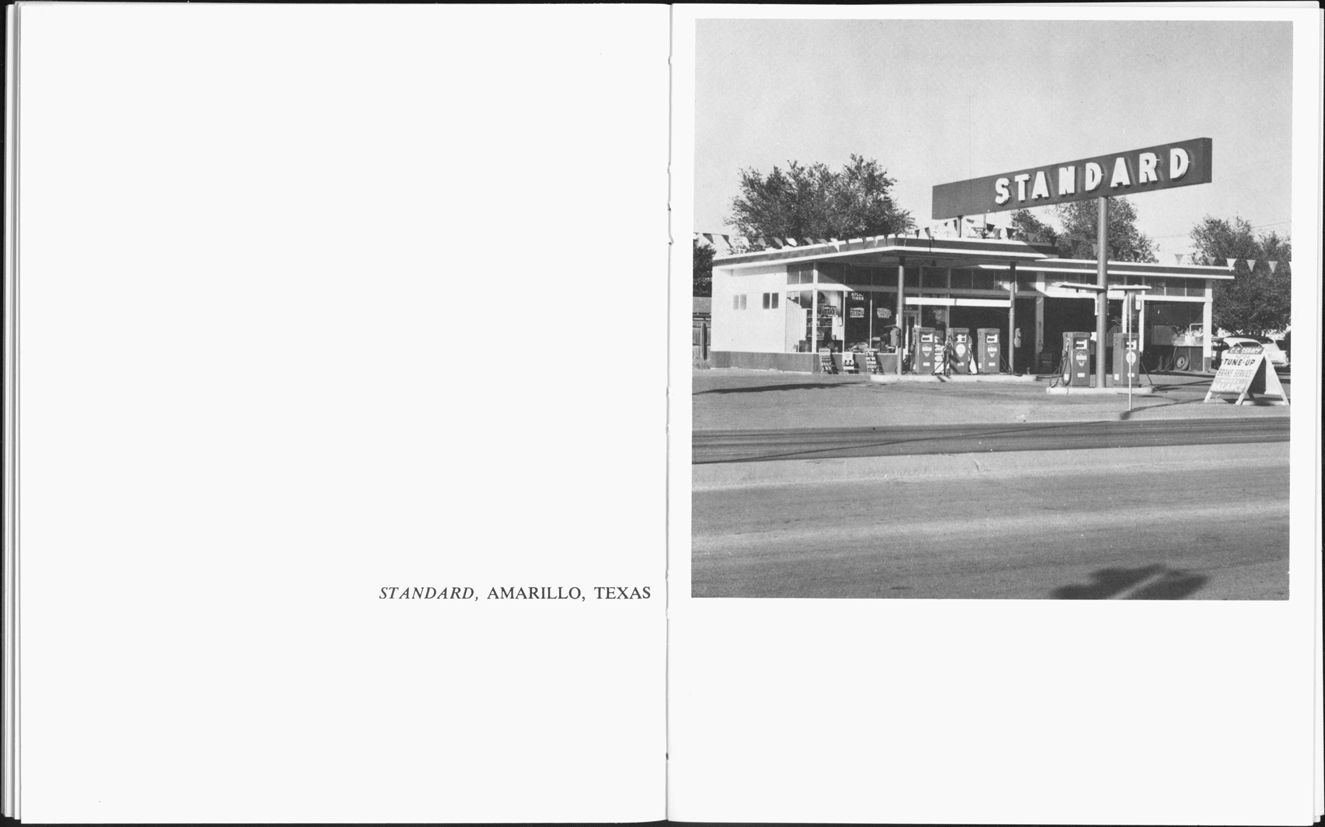
Ruscha's emphasis on the compositional blocks of the apartments, swimming pools, gas stations and lots are thus produced by the photographic flattening of the depth of the landscape onto a planar surface.Footnote 52 This becomes a compositional device, a way to divide up the pictorial field. “A photograph showed me how a subject would look flat. So I didn't have to make all those adjustments from nature. Other artists translate the three dimension of the real world into a two-dimensional image. The photograph did that for me,” he explains.Footnote 53 Rowell's purpose in “Ed Ruscha: Photographer” is to demonstrate how Ruscha's painting style drew from his photographic one, teaching him how to compose on the flat, but also inspiring “horizontal or diagonal baselines, crazy tilted perspectives, incongruous cropping and high or low vantage points,” which, she demonstrates, are visual parallels for aerial views and tabletop photography.Footnote 54 She writes of how, for the painting of Standard Station, Amarillo, Texas (1963), Ruscha worked from tracings of the photograph (Figure 4), using a projector to enlarge photographs of the Los Angles apartments onto glass plates before reworking and exaggerating their perspective.Footnote 55 Ruscha talks about seeing a landscape made of boxes, and these found boxes, occurring within the urban landscape, become the subject through which Ruscha presents the effects of distance in the form of different physical points of view.Footnote 56
Standard, Amarillo, Texas, from Twentysix Gasoline Stations (1962) © Ed Ruscha. Courtesy the artist and Gagosian.

One of the most obvious results of this flattening is to emphasize the recessive diagonals of perspectival depth and the flat planes of the lots, pools and buildings that run along those lines. These oblique perspectives, particularly when they are shot over a distance and from the hip, as the gas stations appear to be, mean that much the photographic frame is filled by ground or by sky. Ruscha works with a copy of Millet's Ophelia in his studio, a painting which positions the viewer above Ophelia, where, he says, “you're looking down on this woman in a sort of aerial oblique manner,” giving us the woman in the plane of the water as a primary element of the composition.Footnote 57 As Salvesen's visual comparison makes clear, one of the differences between Ruscha's photographs in Real Estate Opportunities and actual real-estate photography is that Ruscha's photographs are taken on the oblique whilst the sales photographs stay on the flat, and that realtor's photographs crop out much of the ground or sky to throw focus onto the architecture.Footnote 58 There is also a difference in detail; Ruscha's photographs are printed much more finely.
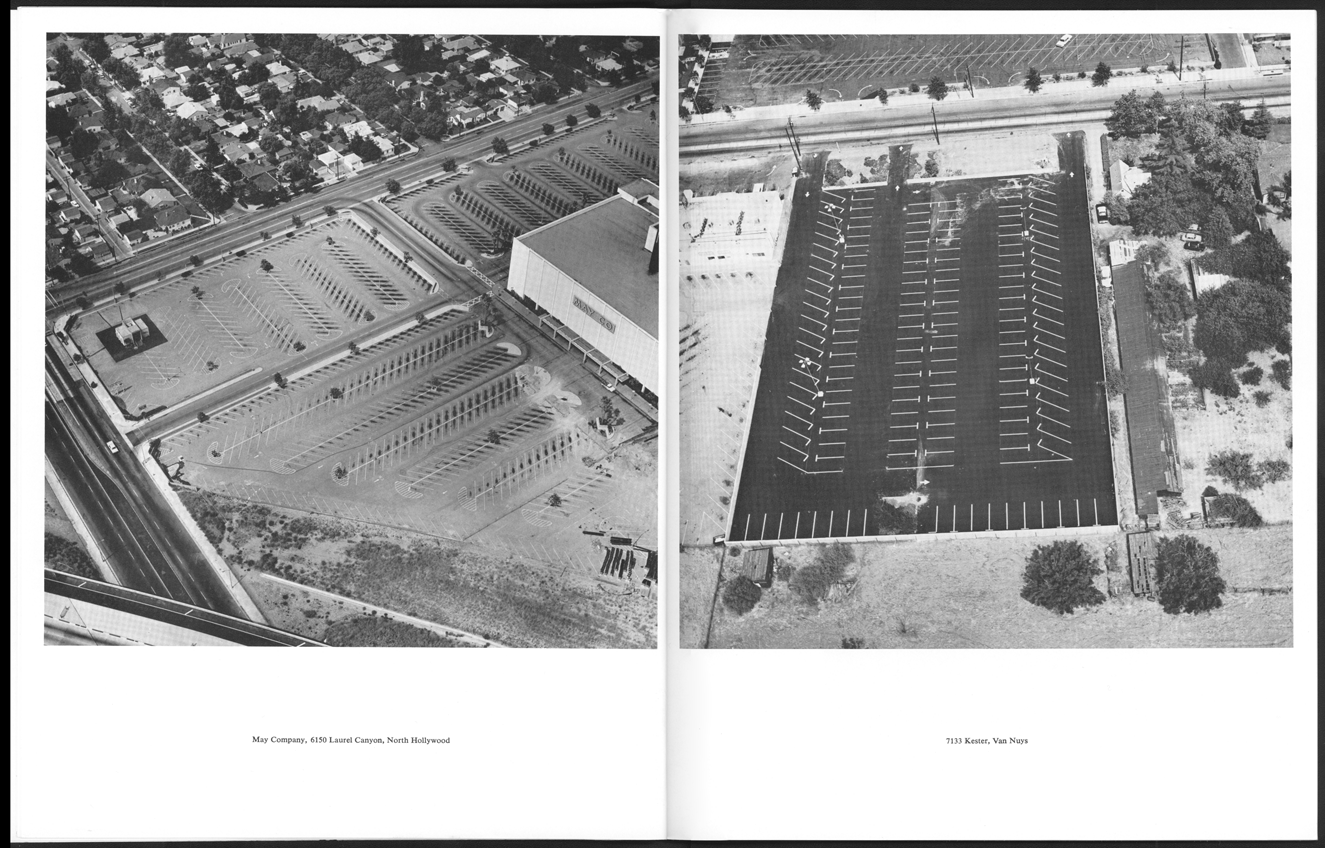
What should, in a more utilitarian setting, be the ground of a “figure-and-ground” relationship is much more fully activated here, so that the normal hierarchies of pictorial backgrounds and foregrounds do not hold. Real Estate Opportunities plays with this switch of emphasis: the first look at any of its photographs is generally at the sweep of the view, then at the solid boxes of the buildings or of the cars, sometimes at the road between us and the lots, then a recontextualization prompted by the real-estate signage reminds us of the title, which moves our eye back to any expanses of grasses, asphalt or concrete in the foreground or negative space. This act of forcing us visually back into the secondary compositional elements makes the book quite difficult to look at for sustained periods of time, and, as with the roadside vistas of the gasoline stations and apartment blocks, the distance of the camera from its subject is emphasized by the uncropped expanses of asphalt in the bottom third or half of many of these pictures. The parking lots, too, thematize visual distance, but this time vertically. It does not take much more than a drive up to Mulholland, or to the Hollywood sign (which Ruscha also painted) to start seeing LA from above. “I guess I've always been intrigued by oblique perspectives, like aerial views. There's something about a tabletop … taking a viewer up in the air, so you can look down from an angle,” he says, and these pictures, like the paintings of Los Angeles County Museum on Fire (1968), make a subject out of those angles themselves. Even the photographs of the parking lots, which at first glance seem to be taken straight on, are in fact slightly oblique perspectives, a view that, like military photography, gives the viewer something between a flat and a solid mass, more useful for surveying buildings than the flat vertical shots which are used to produce maps (Figure 5).Footnote 59
May Company, 6150 Laurel Canyon, North Hollywood, and 7133 Kester, Van Nuys, from Thirtyfour Parking Lots in Los Angeles. © Ed Ruscha. Courtesy the artist and Gagosian.

These large tracts of ground receding away from the camera, as well as the architectural obliques, come to dominate our vision of the photographs in part because the forced perspective of the diagonals exerts a pull on the eye which is unmitigated by more obviously foregrounded elements. (This is why, in some ways, Nine Swimming Pools seems the least severe of the books – the diving boards lead the eye more naturally along the perspective lines, and the expanses of water give us the play of light, waves and reflection as subject.) In The Poetics of Perspective, James Elkins suggests that perspective lines can be felt as a form of entrapment; they “tug at the eye,” “direct the gaze along orthogonals,” producing a kind of “confining,” “repetitive motion.”Footnote 60 This dramatic “pull” of the eye is exploited by Ruscha throughout his work, in these photobooks, but also in the movie-based paintings too – for the Twentieth Century Fox logo in Large Trademark with Eight Spotlights (1962) and for his paintings of the Hollywood sign. Los Angeles as the land of the film industry is in Ruscha's work not just in its glossy texture, but also in these klieg light diagonals. Indeed, Ruscha speaks of combining the ideas of the Twentieth Century Fox logo with the movement of the movies as he was composing Standard Station:
The photograph was the model for other depictions, with its baseline perspective and its diagonal screaming overhead. It followed an idea I had about cinematic reality … It's not simply a story about a type of architecture that I might be interested in. It also echoes a memory I had of watching movies when I was young. It seemed like all movies would have a train in them. Invariably, they had the camera down on the tracks and shot this train so it appeared as though it was coming from nowhere, from a little point in the distance, to suddenly zooming in and filling your total range of vision. In a sense, that's what the Standard gas station is doing. It's super drama.Footnote 61
The obliques and diagonals divide the picture plane to produce the impression of movement over distance, which for Ruscha seems to mean that the lines of the cityscape become the “drama” of the work. The flattening of landscape onto the photographic surface is here performed with a celluloid surface, performing a similar feat of remediation to the drawings of the photobooks – in the Standard gas station canvases, paintings, produced from a tracing of a photograph, take their exaggerated lines from the flattened landscape of a filmed train.
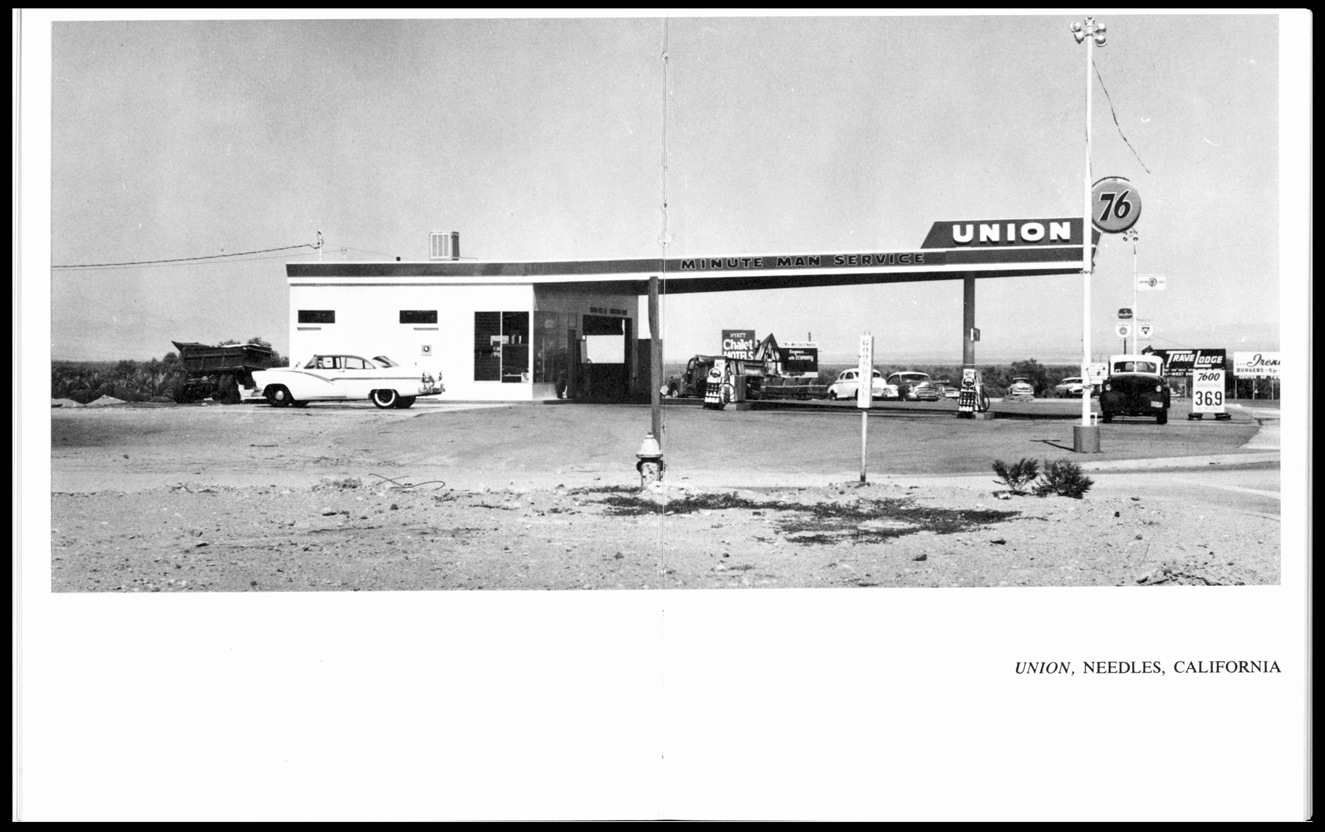
This movement is most obviously present in Ruscha's dependence on the car for these photobooks. Ruscha's work gets identified with Los Angeles by his contemporary, British engineer-turned-architectural historian Reyner Banham, because of its reliance on and consistent return to what Venturi, Izenour and Scott Brown call the “autoscape,” but also because, perhaps, of its more general overall impression of movement over distance: “the language of design, architecture, and urbanism in Los Angeles is the language of movement,” Banham argues.Footnote 62 This extends to our viewing of Ruscha's work too. As Reynolds points out, emphasizing horizontality, surface and flatness Ruscha's work encourages us to scan the landscape of the picture, rather than to settle on a focal point.Footnote 63 Photographs such as Union, Needles, California (Figure 6) are works about the autoscape which also keep the eye moving.
Union, Needles, California, from Twentysix Gasoline Stations. © Ed Ruscha. Courtesy the artist and Gagosian.

Ruscha was approached by architects interested in his photographs of parking lots for their variety of markings and sense of the architecture of place, but he professed to be more interested in the oil stains; that is, the sense of trace left by movement over distance.Footnote 64 From a systems point of view, however, both oil stains and fire lanes are traces. Architecture, Scott Brown, Izenour and Venturi argue, is “frozen process,” and this too applies to the gaps and highways between architecture that Ruscha makes his own. In keeping with the 1960s and 1970s movement away from isolated objects and towards a set of philosophies of systems,Footnote 65 Ruscha speaks of these photobooks as constituting a formal system:
once I established a format – the first one was agony – it was fluid because I had a format and I could almost fit these ideas. Each one could be plugged into the system I had. It's like a system of expression, if you want to look at it that way.Footnote 66
This aesthetic system for the photobooks intersects with a phenomenological body–book–pictorial–space system, but also with the Los Angeles infrastructure that is their content. Royal Road Test is almost all road surface, and the photographs in Twentysix Gasoline Stations (such as Union, above) are as much a study of different conditions of asphalt as they are of the stations above them. In the Parking Lot photographs we get many lines, and bays, and fire lanes and tracks and roads: this is a ground that is dominated by the car, but also by the systems that direct those cars in flows. The flow is arrested in these empty lots, but it's still here in trace as arrows and skid marks.Footnote 67 As Newbury argues, these photographs give us the spaces between the new industries of southern California, showing us an infrastructure in the remaking.Footnote 68
The textures of the photographs, too, give us geography as much as they give us abstraction; set against the boxes and planes there are the textures of concrete, cracked scrub, grassland, wet tiling, rippled water, dusty highways, sun-bleached ground, and each one of those surfaces asserts their presence as a trace of human decisions or natural processes. The backyards in Nine Swimming Pools show assertive interventions into the environment; the startling blues and crisp shapes of the pools work in counterpoint with the debris of everyday life scattered on the poolsides. The concrete highways and parking lots are the traces of civil engineering designed to put humans in cars into processes, the vacant lots evidence of more natural processes literally regaining their ground. Indeed, the new discipline of “landscape urbanism” continues this perspective to design horizontally; that is, across the horizon in landscapes rather than buildings, to attempt to mitigate this sense of cities as sprawling clusters of isolated objects with distances between.
If landscape is about vistas, or about depth, or about travels towards the horizon, then Ruscha's landscapes function differently. Where there is travel it is past something and over something. In Ruscha's parking lots the eye has no focal point to guide and rest it, and, in many respects, we are given a set of photographs that, because of the arrows and lines painted on the ground, are indeed close to the notion of topography in their notation of maps, details, diagrams and functions. Having a perspective creates a landscape and a three-dimensional sense of the object in its environment, but oblique perspective brings it towards abstraction, and towards topography as the marks of those forces that structure and re-create that landscape. The inclusion of the viewer's body as part of the system of the work is manifest in these photobooks in the way that they are given to us as solid objects to be handled as well as read, as well as in their games with scale and movement. Through the emptied-out views, the photobooks insist on their geography and phenomenological geometry, and the body of the viewer is guided through these abstracted vistas as part of the underlying system that was southern California's postwar infrastructure. Ruscha's thematization of affective distance may attempt to remove the romantic notion of the artist as going through and giving us exemplary experience, but it still positions us very clearly in terms of physical point of view. It is physical distance which produces the distinctively expanded foregrounds, the extreme high or low horizons, the pronounced diagonals, and the aerial perspectives that punctate these books.